You own a crane or heavy equipment rental company. Your fleet has excavators, mobile cranes, forklifts and aerial work platforms, your operators are ready, but the phone is not ringing as often as you would like. Yet the person on a job site who needs a machine usually starts with Google: "crane rental," "excavator rental," "forklift rental near me." If you do not show up for those searches, the job goes to the competitor who does. SEO for crane and heavy equipment rental companies is the work of fixing exactly that problem. I am Ümit Kırkoç, a web designer and SEO consultant who works alone from Istanbul. I describe the general approach on my SEO services page, and in this article I look specifically at your industry.
SEO, in short, is the work that makes your website appear in Google when your customers search. It is not like advertising, where you disappear the moment you stop paying. When it is set up properly, it keeps bringing in inquiries for months. I wrote this article assuming you have no technical background. By the end you will know how your customers search for you, which pages your site should have, what to avoid, and where to start.
How does a customer who needs a machine search?
Rental is different from many other businesses in one important way: the customer is usually in a hurry. A foundation excavation is about to start, a steel frame goes up tomorrow morning, or a heavy machine has to be moved inside a plant. This person will not spend hours browsing websites. They look at two or three results and pick up the phone. That means your site has to say "this is what I was looking for" at first glance.
Searches usually have three parts: what kind of machine, where, and how. For example "mobile crane rental houston," "excavator rental with operator," "tower crane rental" or "boom lift rental near me." The person searching might be a general contractor, a plant maintenance manager, or an individual building a small project. Each asks slightly different questions, but all of them want to know the same three things: Do you have this machine? Can you deliver it to my area? How quickly will you get back to me?
The illustration below uses a completely made-up example to show what a search result can look like.
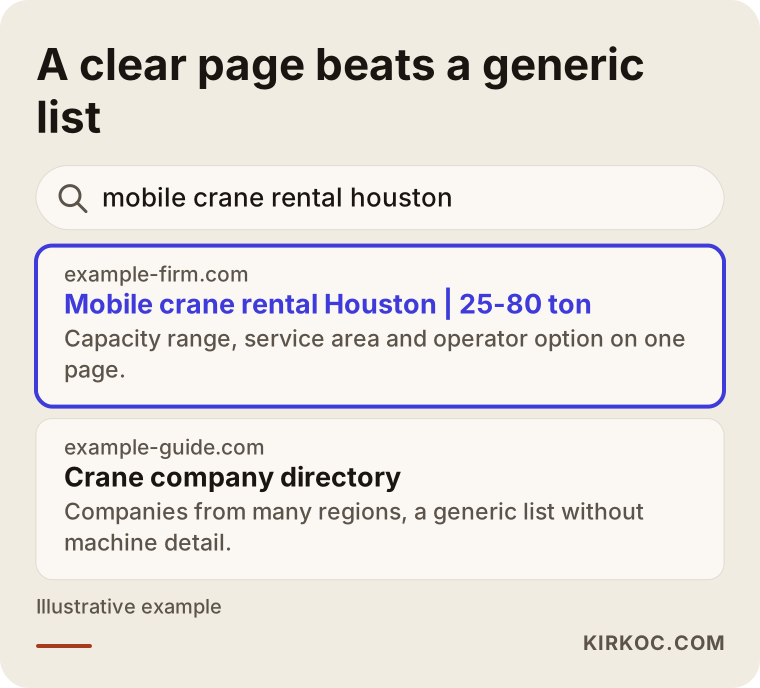
What does the highlighted result do? It states the machine type, the area it serves and the tonnage range in the very first line. The generic directory beside it says nothing specific, so it earns no trust. Google is also trying to work out which answer to show the person searching. When you make that easy, it is easier for Google to put you forward.
Four kinds of intent
Splitting rental searches into four kinds of intent keeps things simple. The first is the machine search: "forklift rental." The second is the area search: "crane rental in Dallas." The third is the job search: "lift materials onto a roof" or "platform for installing facade panels." The fourth is curiosity about price and terms: "how does daily crane rental work," "is a crane rented with or without an operator." Planning a separate page for each kind of intent works far better than squeezing everything into one "Our Services" page.
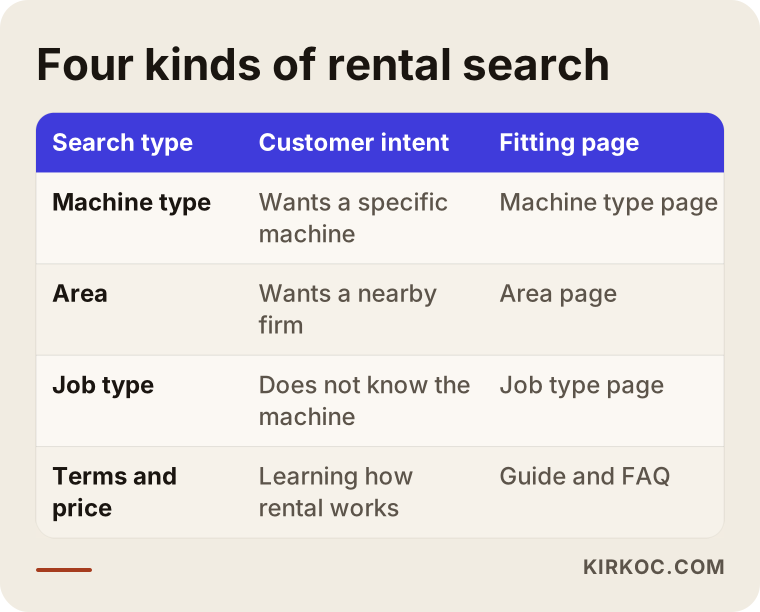
What the table tells you is this: when one page answers one intent, the customer finds what they came for, and Google does not get confused about what your page is about.
The real problems in your industry
Most generic SEO advice does not fit this industry. It is not that a crane company is searched differently from a boutique or a dental clinic for some mysterious reason; it is simply a different business and deserves different treatment. These are the problems I see most often.
No separate page for each machine. Many company sites have a single "Our Fleet" page with a small photo gallery. But the person searching for "tower crane rental" and the person searching for "mini excavator rental" are completely different people. If one page tries to explain everything, you will not show up clearly for any search.
Vague service area. Renting a machine is partly a logistics business. The customer wants to know whether your machine can reach their job site. If your site says "serving the whole country" and moves on, it neither builds trust nor helps you in area searches, where competitors who name their cities will be ahead of you. Say clearly which cities, counties and regions you work in.
Technical information that is missing or too tangled. A crane's lifting capacity, boom length and working height, or an excavator's weight and bucket size, are the details a customer uses to decide. Having none of them is a problem, and so is pasting in the manufacturer's brochure so that nobody can follow it. A good page explains it plainly: this machine suits these jobs, and it does not suit those.
No proof of trust. Handing a large machine to a company is not an ordinary purchase. Customers want to see information about operator qualifications, how the machines are maintained, your insurance situation and the jobs you have done. Before you write firm legal or technical claims on these topics, I recommend checking the requirements with a qualified professional or an attorney, because the rules differ by state and by type of work. Still, a site that says nothing about any of this slows the customer's decision down.
A hidden phone number and quote flow. A customer in a hurry who has to hunt for your contact details will give up. Your phone number and your quote button should be visible on every page, especially on a phone, on the very first screen.
Which pages do you need?
On a rental company's site I think these pages should exist. You do not have to build them all in a day; what matters is knowing the order.
Home page: It says what you rent, which areas you cover and how to reach you, all on the first screen. Think of it as a shop window that sends the customer on to the detailed pages.
Machine type pages: A separate page for each main type, such as mobile cranes, tower cranes, excavators, forklifts, aerial work platforms and rollers. Each page covers what jobs the machine is used for, which models or capacities you have, whether it is available with or without an operator, how it is delivered, and real photos.
Area pages: A separate page for each city or region where you work a lot. The point to watch is that you should not copy the page and change only the city name. Each page needs information specific to that area: which industrial zones and what kinds of job sites you serve, roughly how long it takes the machine to arrive, and so on.
Job type pages: Pages such as "roof and facade work," "moving machinery inside a plant" or "foundation excavation." These pages catch the customer who does not know the machine name but knows the job. Plenty of people ask "I need to get materials up to a roof, what do I need?" instead of typing "crane."
FAQ and guide pages: How rental works, what paperwork is requested, whether daily or monthly makes more sense, whether the operator is included. These pages answer the customer's questions, and they also show Google that your site knows the subject.
References and job examples: Real project photos with a short description. Leave out the customer's name and write something like "rooftop equipment installation at a plant."
Contact and quote page: Phone, text message, email, address, map and a short quote form. Keep the form short: which machine, which area, which date.
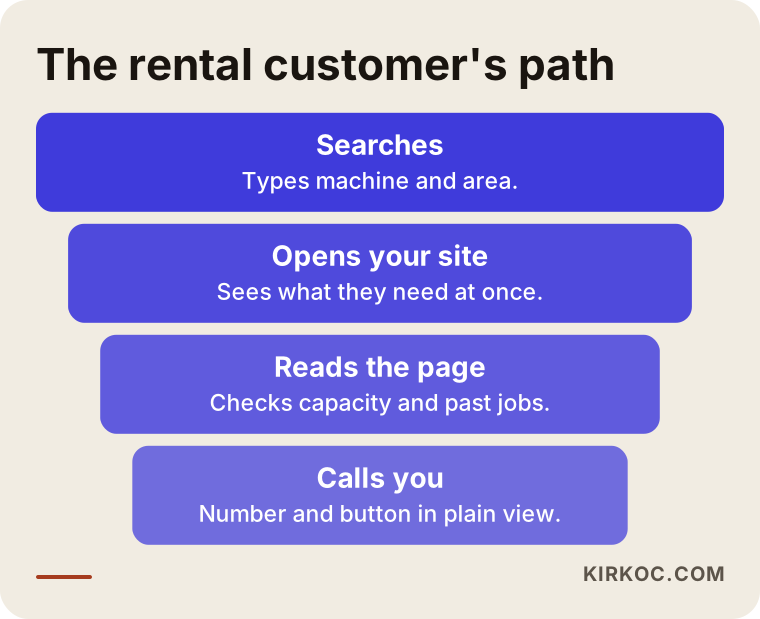
The funnel above summarizes the rental customer's path. Many people search, some of them visit your site, fewer read the page to the end, and very few call. The job of SEO is to widen that path from the very beginning. The job of your site is to avoid losing the customer at every stage along the way.
What does a good machine page look like?
Keep the layout simple. Put the machine type and the word that says you rent it in the headline. Right below that, tell the reader in two sentences who the machine suits. Then give the capacity and size details, the jobs it is used for, the delivery and operator options, a short FAQ section and the contact button.
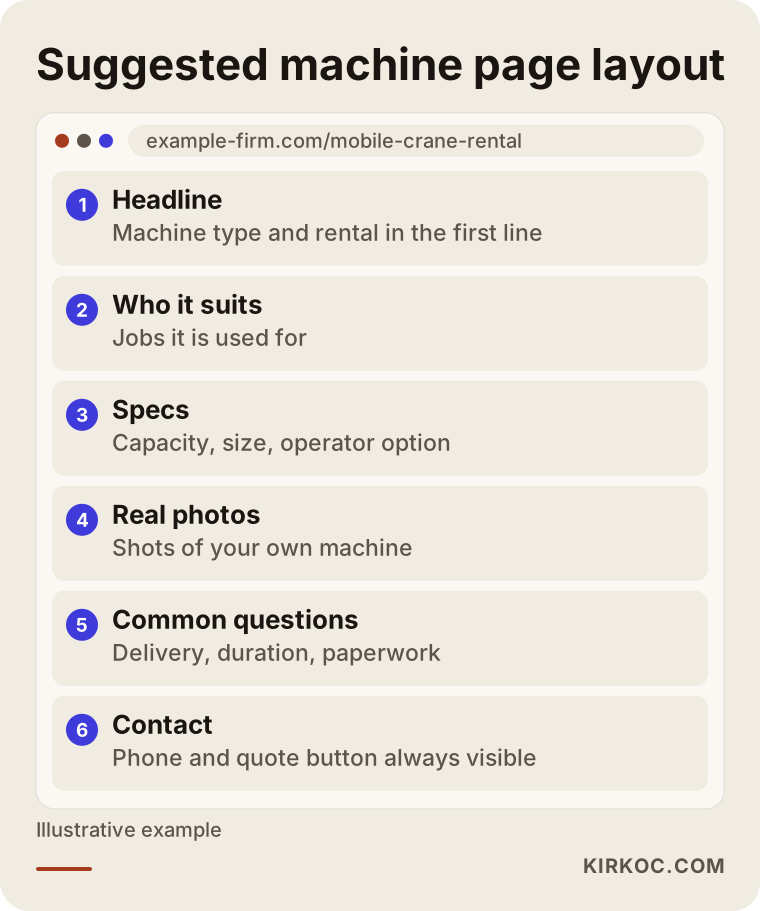
The nice thing about this layout is that it works the same on a phone and on a computer. For someone checking from a job site on a phone, the most important thing is that the page opens quickly and the information they want is easy to find.
Local visibility: map searches
Some rental searches end in Google Maps. When someone types "forklift rental," the first results you often see are three businesses on the map. To get into that group, your Google Business Profile has to be complete: correct address, opening hours, service areas, machine types, real photos and customer reviews.
The critical point here is that the address, phone number and company name on your profile must match your website exactly. Writing "LLC" in one place and leaving it out in another, or giving a cell number in one place and a landline in another, makes it harder for the system to recognize you as one business. If your yard or depot is not an office that can receive customers, you need to handle that correctly in the profile; wrong information can even get a profile suspended.
Reviews matter too. It is enough to politely ask a satisfied customer to leave a review when the job is done. Do not buy reviews. It is unethical, and it does serious damage if it is discovered.
AI search and your industry
Many people now ask tools like ChatGPT or Google's AI summaries questions such as "what do I need to do to rent a 50-ton mobile crane near Chicago?" When these tools answer, they try to find reliable sources. If your site describes machine types, capacities, service areas and common questions clearly and in an orderly way, your chances of being cited as a source in these answers go up. There is no guarantee of that. But clear, accurate and well-organized information works just as well for people as it does for machines.
Two hypothetical example scenarios
The scenarios below are entirely hypothetical. They do not describe a real company; they were made up to make the possible situations concrete.
Scenario 1: A one-page site with many machines
Suppose a company's site has a home page, an "Our Fleet" page and a contact page. The company rents mobile cranes, forklifts and excavators, but all of them are listed in short bullet points on one page. A customer searches "forklift rental," and the results show competitors who have a separate forklift page.
The fix is simple but takes effort: prepare a separate page for each main machine type, and add real photos, capacity details, uses and a few short questions to each one. Then link to these pages from the home page and the menu. The result is not measured right away; it shows over a few months. But the customer can now reach the machine they want in one click.
Scenario 2: The company that does not say where it works
The second hypothetical company has machine pages, but they say "serving the whole country" and it is not clear where the company actually works. In reality, most of its jobs are around one metro area and its industrial suburbs. It does not appear in area searches at all.
The solution is to prepare separate pages for the areas where it really works: on each page, the industrial zones nearby, the typical kinds of jobs, how long it takes the machine to arrive, and the questions that come from that area. Instead of copying the same text, each page should carry its own information. The service areas in the Google Business Profile should also be updated to match.
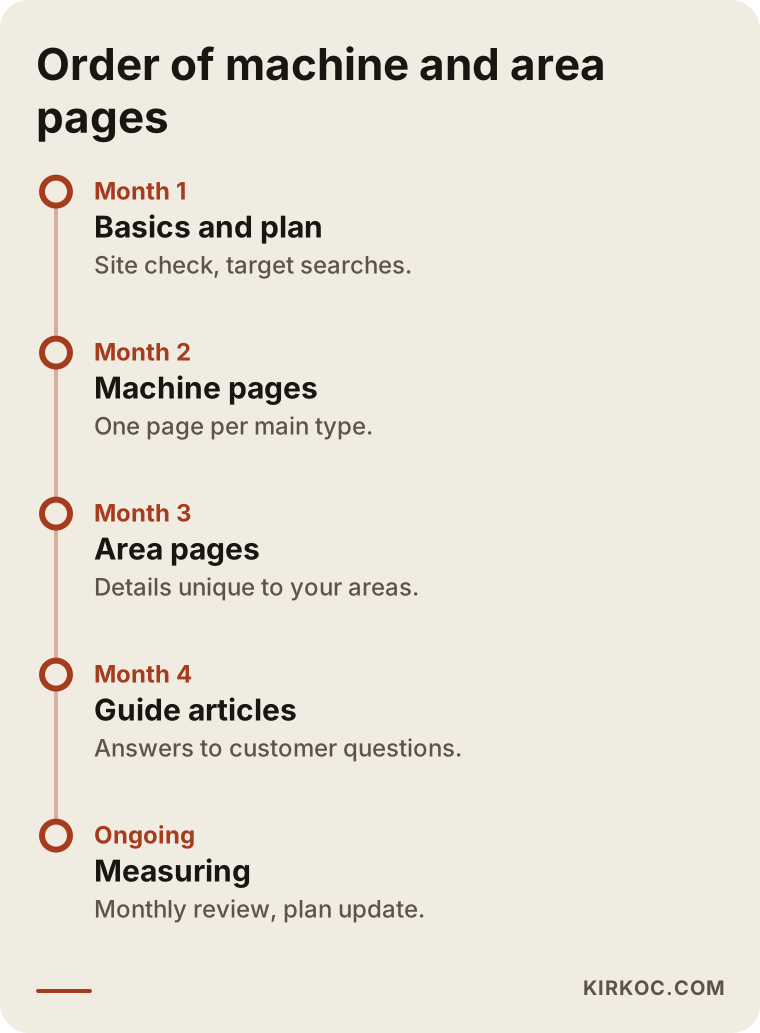
The timeline above shows the logic the two scenarios share: foundation first, then areas, then content, then measurement. Moving in this order keeps the effort you spend from going to waste.
How do you go about it, step by step?
I suggest setting up SEO for a rental company in this order.
1. Decide on your target searches. Which machines do you want to rent, and in which areas? Put forward the machines that are profitable and actually available in your fleet. Writing a page for a machine you do not own is misleading and ends badly.
2. Check your current site. Does it open quickly on a phone? Is the phone number visible? Are there duplicate pages or broken links? These sound technical, but they are often simple fixes.
3. Build the machine pages. One page for each main machine type, with real photos and written in plain language.
4. Add the area pages. Only for places you really serve, each with information specific to that place.
5. Set up your business profile. Address, phone, hours, areas, photos. Matching your site exactly.
6. Write guide articles. Answer real questions such as "Should I rent with or without an operator?" and "Does daily or monthly rental make more sense?"
7. Measure and adjust. How many people came from which searches, how many called, which page worked? Review this monthly and update the plan.
Common mistakes
These are the mistakes I see most often in this industry.
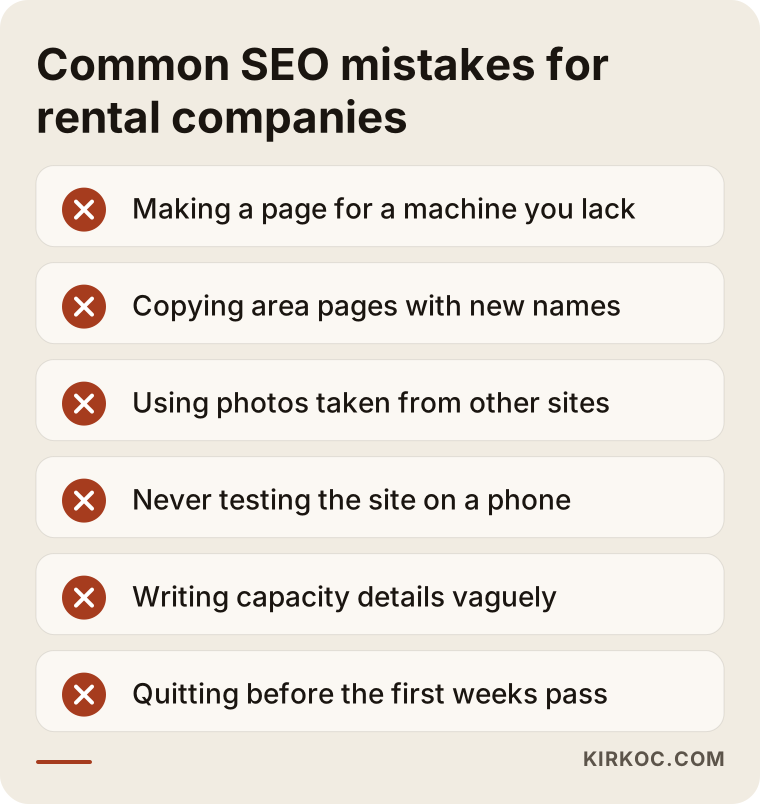
Let me explain the items in the picture a little. If you open a page for a machine you do not own, you will have to tell the customer you do not have it when they call, which wastes time and costs you trust. Copying area pages can lead Google to see your pages as having little value. Taking photos from the internet creates copyright problems, and customers want to see the real machine anyway. Never trying the site on a phone is a serious gap in an industry where people often look from a job site on a phone. Finally, quitting because you saw no results in the first weeks: SEO takes time and patience.
Another mistake is writing technical figures wrongly or vaguely. Stating a crane's capacity incorrectly misleads the customer and can cause problems for you as well. Write technical details according to the manufacturer's documents and your actual situation, and if you are not sure, have the responsible technical person confirm them.
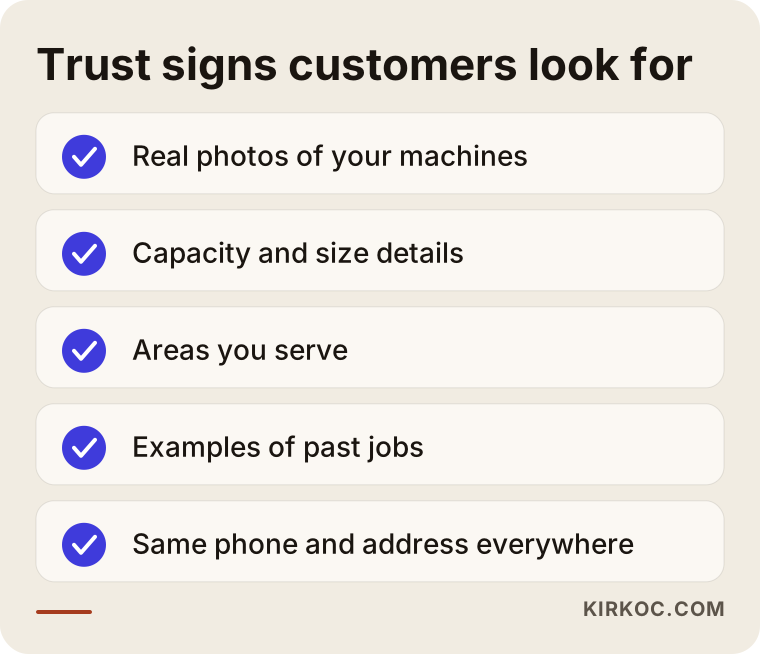
Every item on the checklist is a question the customer asks themselves before calling. If your site already has the answers, the person who calls feels more confident.
What can you do yourself?
You may not need an expert to get started. You can do the following on your own.
- Fill out your Google Business Profile completely and add real photos of your machines.
- Write your phone number and address in the same format across the whole site.
- Open your site on your own phone and try it: is the menu usable, and does tapping the number place a call?
- Take real photos of each machine and write a short, plain description.
- Ask satisfied customers for reviews.
- Write down the questions customers ask most often on the phone; those are your article topics.
When do you need an expert?
Outside help makes sense in these situations: your site is very old and looks bad on a phone, you need to plan dozens of pages and areas, you do not appear in Google at all and cannot work out why, or you simply do not have the time. What matters is that who does what is put in writing. When you decide what to put on the site about regulations, paperwork or insurance, I also recommend talking to an attorney.
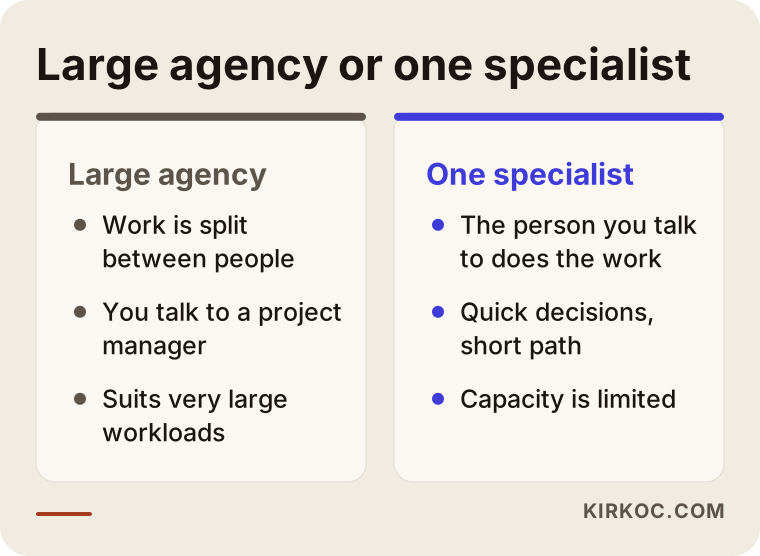
The comparison does not point to a right or wrong choice; it shows a preference that depends on the size of the job and your working style. When you work with a single specialist, the person you talk to is the person who does the work. That brings speed, but capacity is limited.
What determines the cost?
I will not give numbers here, because every job has a different scope. But I can tell you what drives the cost.
- Number of pages: For how many machine types and how many areas do you need pages?
- State of the current site: Does it need to be rebuilt, or are fixes enough?
- Content production: How much photography, copy and guide writing is needed?
- Competition: How strong are the competitors for your target area and machine?
- Duration: Is it a one-time setup or ongoing monthly work?
- Measurement and reporting: How often and in how much detail will results be reviewed?
When you ask for a quote, ask for the tasks to be written down in order and for it to be clear who does what. Be careful with quotes that promise something like "first place by this date." Nobody can guarantee a position on Google.
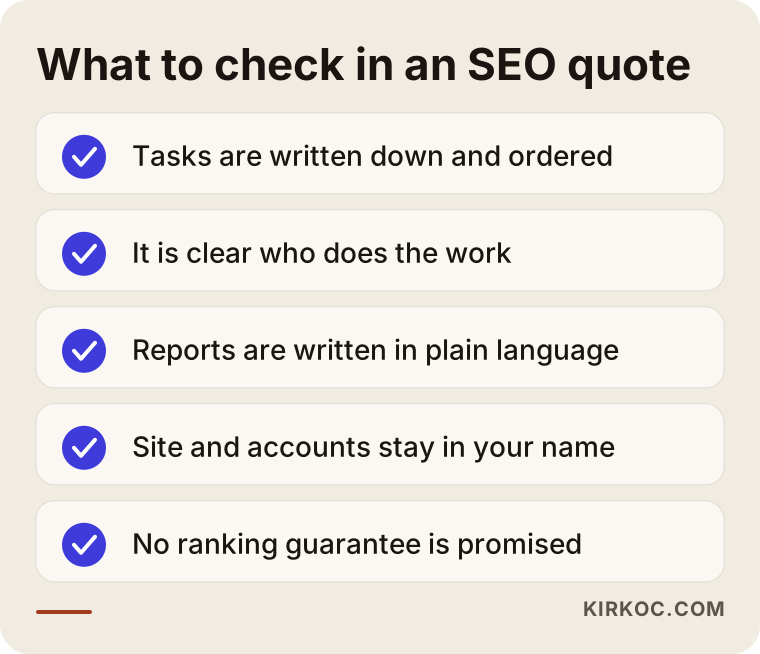
This list is a simple yardstick you can use to protect yourself, whichever company you request a quote from.
How I work
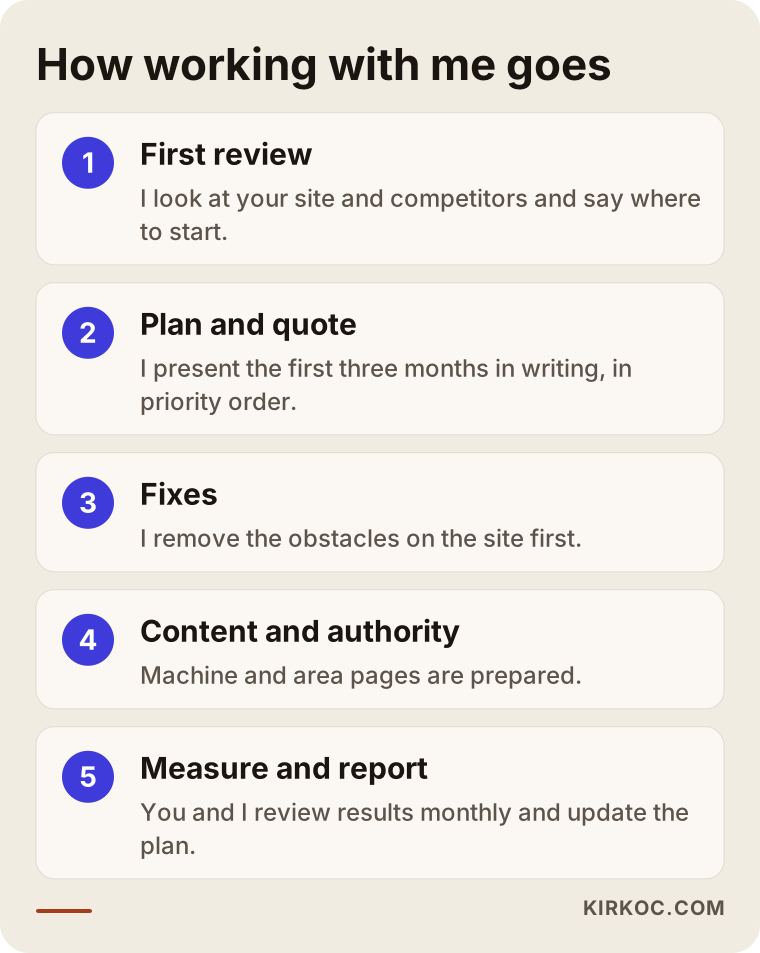
I work alone, so the person you talk to is the person who does the work. I usually follow this order: first I look at your site and your competitors and tell you where to start, then I present the first three months of work in writing in order of priority, then I remove the obstacles on the site and prepare the pages and content, and every month you and I look at the results together. The site and the accounts stay in your name. I do not guarantee rankings; I tell you plainly what I will do and what I will measure.
Frequently asked questions
Is SEO different from Google Ads?
Yes. With ads, your visibility ends when the budget runs out. With SEO, the pages and structure you build keep working over time, but it takes longer to see results. Many companies use both; which one suits you depends on your budget and how urgent your need is.
How long until I see results?
I cannot give an exact time. It depends on the competition, the current state of your site and the work done. Generally the effect of the first fixes shows up within weeks, and the effect of page and content work within months. That is why it is important not to give up in the first weeks.
Do I really need a separate page for each machine?
In most cases, yes. When a customer searches for a specific machine, a page about that machine helps them find it quickly and tells Google clearly what the page is about. I would not recommend opening pages for machines that are rarely rented or that you do not own.
Should I put prices on the site?
That is a business decision. Because rental prices change with the machine, the length of the rental, the operator, the area and transport, many companies write "request a quote" instead of a price. If you will not list a price, explaining what the price depends on puts the customer at ease.
Should I mention operator certifications and insurance on the site?
Customers look for this information, so a section that builds trust is useful. However, which documents are required and how to word them depends on the regulations that apply to you. Before you write firm statements, talk to an attorney or the relevant professional.
What should I do if I serve more than one city?
It makes sense to prepare a separate page for each area where you really work, but every page must carry information specific to that area. Copy pages with only the city name swapped can do harm instead of good. Start with the few areas where you work most.
My site is new. Can I still show up?
Showing up from zero in broad, general searches takes time. But in narrow, specific searches, for example one county and one machine type, new sites can show up too. That is why starting with narrow searches is more realistic.
Are reviews and photos really that important?
For map searches and for building trust, yes. Real photos of your machines and reviews from satisfied customers are the strongest proof, especially for a customer who will be working with you for the first time.
If you want to talk through what to expect from SEO for your crane and heavy equipment rental company, which pages to start with, or the state of your current site, you can reach me through my SEO services page. I will look at your site and tell you honestly where to begin.