You have a social media management proposal in your inbox and it tells you almost nothing. One page says "twelve posts a month, four stories, reporting." Another lists "brand positioning, content strategy, community management." A third gets the whole job done in two sentences. They read like three different languages, and you still have to pick one. The answer to how to evaluate a social media management proposal is to translate each document into plain terms about your own business. In this guide I walk through what to check, which sentences deserve a slow read, and which questions get a straight answer out of whoever wrote the proposal. I am Ümit Kırkoç, I work from Istanbul, and I deliver social media management together with websites, SEO and ads as one person. That means I will ask you to hold my own proposals to the same standard.
First, a clarification. Evaluating a proposal does not mean picking the cheapest one or the prettiest one. A proposal is a draft contract: it says which part of your business gets worked on, for how long, and who is responsible. The vaguer the draft, the more likely you are to hear "that was never included" at the end of the month.
Write down your own goal before you read any proposal
Before you open the proposals, set aside five minutes and a sheet of paper. What do you want from social media? If your answer is "more followers," go one level deeper. A follower count is not a business result on its own. For a restaurant, the goal might be weekend reservations. For a clinic, appointment requests. For a wholesaler, dealer applications. For an online store, visitors who actually reach the shop. When the goal changes, so does the work you should be asking for.
As you write it, note three things: who buys from you, where that person tends to find you, and what counts as a valuable response from your side. A valuable response could be a phone call, a direct message, a form submission or a visit to your location. The benefit of writing this down is that you can give every vendor the same briefing, and then the proposals you get back can be compared on equal ground. If you tell each one a different story, you will get proposals that cannot be lined up against each other.
Also jot down where things stand today. Which accounts exist? How many weeks since the last post? Who made the images, and who answered the messages? If a vendor never asks you any of this, they priced you without knowing you. That usually means a ready-made package is being fitted onto your business.
What a good proposal contains
A good proposal answers the question "what happens each month?" in a single read. The checklist below covers the basics I expect to see in any social media management proposal.
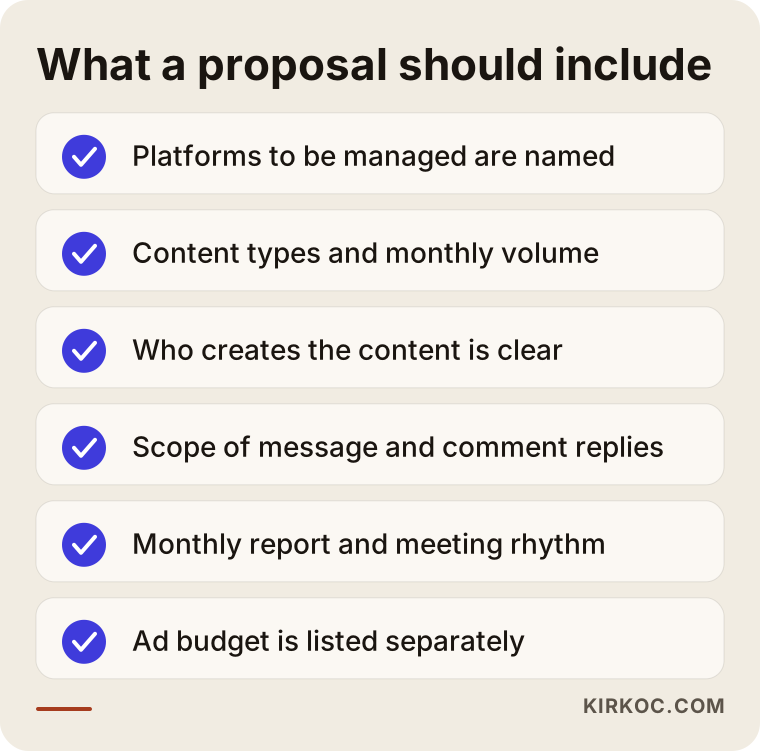
Each line in that list maps to a question. Which platforms will be managed? How many pieces of content a month, and who produces them? Is photo and video shooting covered, or will the work rely on images you send? Who replies to messages and comments, and during which hours? What will the monthly report include? If you plan to run ads, is the ad budget inside the proposal or outside it? If some of these answers are on paper, that is a decent start. If none of them are, call the sender and ask before you go any further.
What does "management" actually cover?
In this industry "management" is a very wide umbrella. For some people it means posting an image you supplied at a set time. For others it means coming up with ideas, writing copy, designing graphics, publishing, watching comments and reporting results. Two proposals can carry the same heading and describe wildly different jobs. So whenever you see the word, read the lines underneath it: who builds the content plan, who writes the captions, who prepares the visuals, who watches the account?
Put the line items side by side
If you collected several proposals, copy the line items from each into one table. Even when vendors name things differently, the meaning can be compared. The table below shows why each item matters and what to ask the sender.
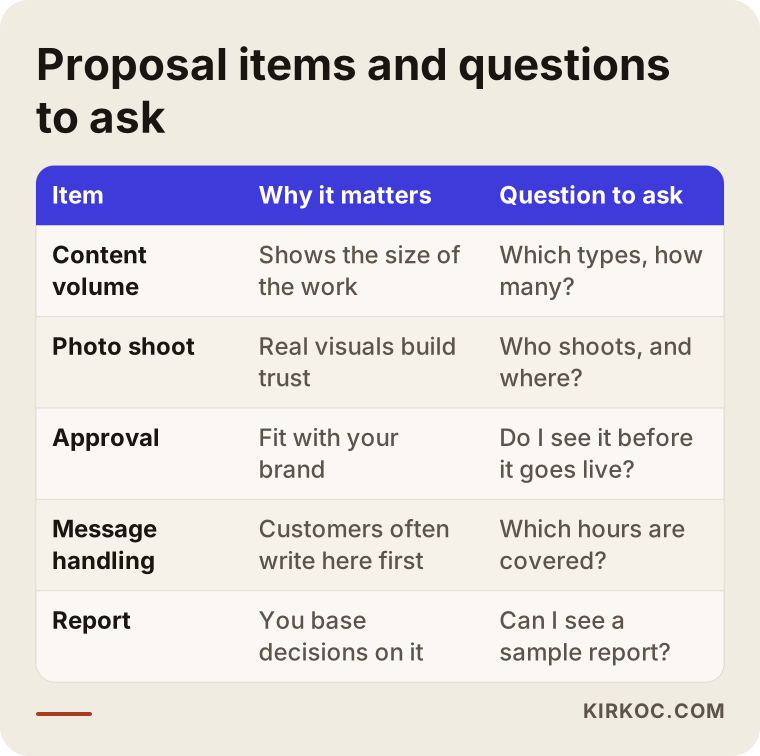
The empty cells in your table are informative. If an item appears in one proposal and is missing from another, either that work will not be done or it will be billed separately later. You only find out by asking. It is far more comfortable to ask during the proposal stage than to ask in the middle of a month.
Compare scope, not "cheap" versus "expensive"
Let me be straightforward about money: I will not give you a number here, because the right number depends on your business. What I can tell you is what moves the price. The cost of social media management usually depends on how many platforms are covered, how many pieces of content are produced each month, what kind of content it is (a simple graphic, a short video or a professional shoot), how much time message and comment handling takes, how much research your industry requires, how often reports and calls happen, and whether ad management is part of the job. In other words, the gap between two proposals is very often a gap in the amount of work.
A very low price is not automatically a bad sign. Maybe the job is small, or only one platform is involved. But if a very cheap proposal promises everything, ask yourself whether one person can realistically do that work, at that quality, in that time, while understanding your industry. The same question applies to an expensive proposal: does every line actually serve your business, or has the scope been padded?
Package or custom proposal?
Ready-made packages make comparison easier, but they may not fit you. If a package says "twelve posts a month," is that the right pace for your business, or would two strong posts a week do better? A package cannot answer that. Someone who knows your business can. A custom proposal takes more effort to write, and it tends to contain fewer wasted lines. I am not calling either approach good or bad. What matters is that you know every item inside the package and can strike the ones you do not need.
Monthly post counts versus goal-driven work
Most proposals lead with quantity: how many posts, how many stories, how many videos. Quantity matters because it keeps an account looking active. But quantity is not a goal. The graphic below puts two proposal styles next to each other.
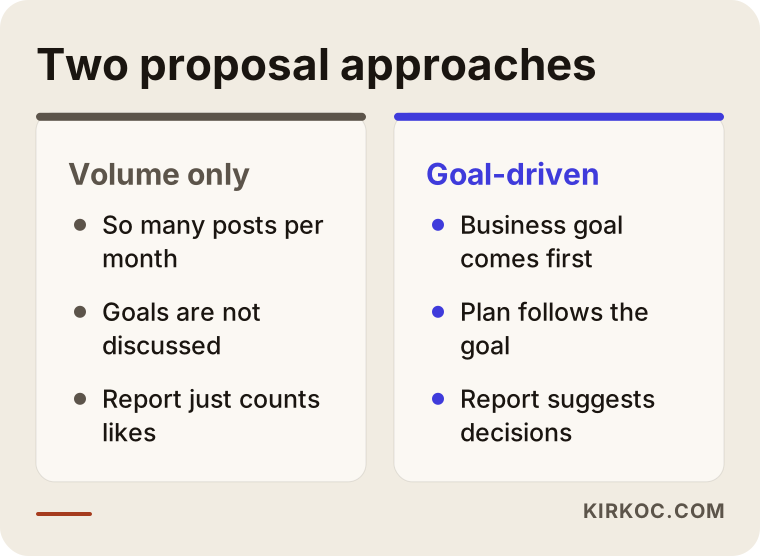
The left-hand style says "I will produce this much content" and stops there. The right-hand style starts by discussing your goal, builds the content plan around it, and at the end of the month asks how well the content served that goal. The second takes more conversation and more thought, but if you think of your spending as buying a business result, it is the more meaningful one. That does not make the first style useless. A small business sometimes just needs to keep an account alive through a slow season. The point is to know which one you are buying.
Red flags: sentences to question
Some sentences tell you to read the rest of the proposal more carefully. They do not always signal bad intent; sometimes they come from inexperience or from a copied template. Still, when you see one, stop and ask.
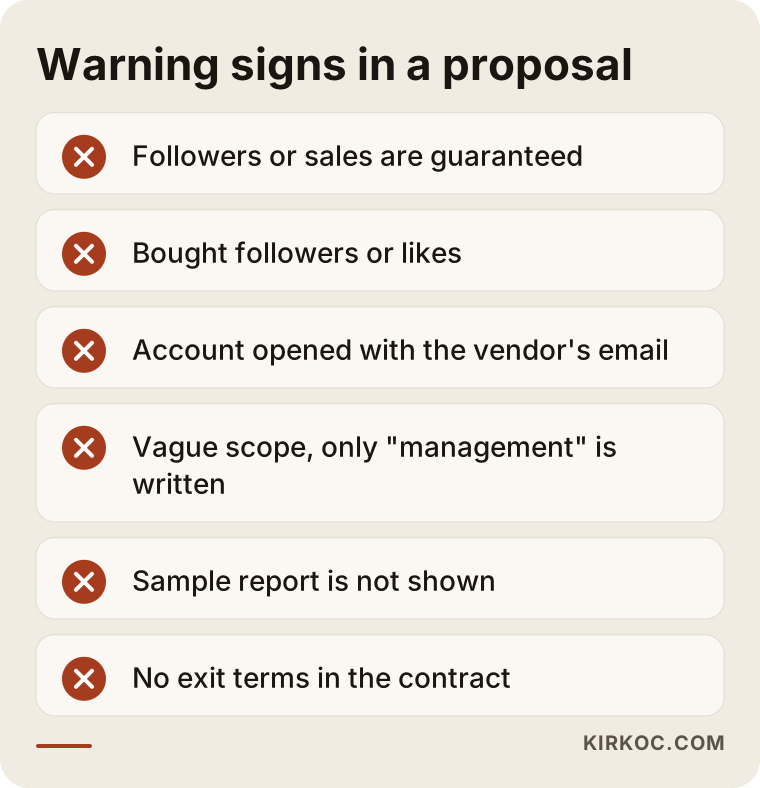
The biggest one is a guarantee. Lines such as "a set number of followers in three months" or "we guarantee more sales" should not be taken seriously. Platforms change their algorithms all the time, and nobody can know in advance how far an account will grow. An honest proposal says "here is what I will do and here is what I will track." It does not order a result in advance. Promises of purchased followers, fake likes or automated comments belong in the same category. They may inflate the visible size of an account, but they will not bring you customers, and because they break platform rules they put your account at risk.
Who owns the account?
This is the question most business owners never ask and later pay dearly for. Who created the account, who knows the password, and who holds the admin role all matter. If the account is opened with the vendor's own email and is not handed over when the relationship ends, you could lose access to followers you spent years collecting. The right setup is this: the account is created under your name and your email, or the existing account stays with you. The person doing the work is added as a separate user with management access, and that access is removed when the engagement ends. This should be settled in writing at the proposal stage.
The decision flow below shows how to think about account access in short form.
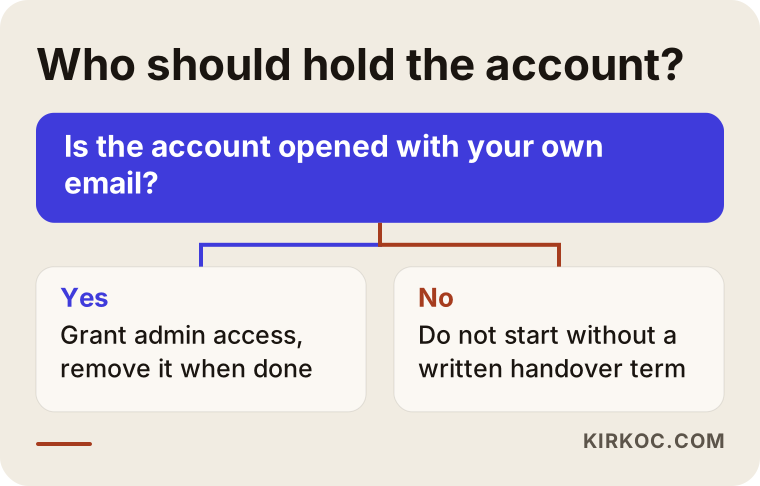
The "no" branch can usually be fixed, but it is much easier to talk about on day one than in month six. If the vendor takes the question calmly, that is a good sign. If they dodge it, reconsider the proposal.
Questions to ask and a process to follow
After reading the proposal, I suggest asking some questions in a conversation rather than by email. Pay attention less to what the answers say and more to how they are delivered: are they clear, defensive, or specific to your business?
Ask these. Have you worked in my industry before, and if not, how will you learn it? Who produces the content, and will I approve it before it goes live? If I dislike a post, how many revisions do I get? During which hours are messages answered, and how do I reach you in an emergency? When will the report arrive and which numbers will it include? How long is the contract, and what happens if I want to end it early? Do I own the right to use the content you produce?
Steps for evaluating a proposal
To put those questions in order, you can follow the steps below.
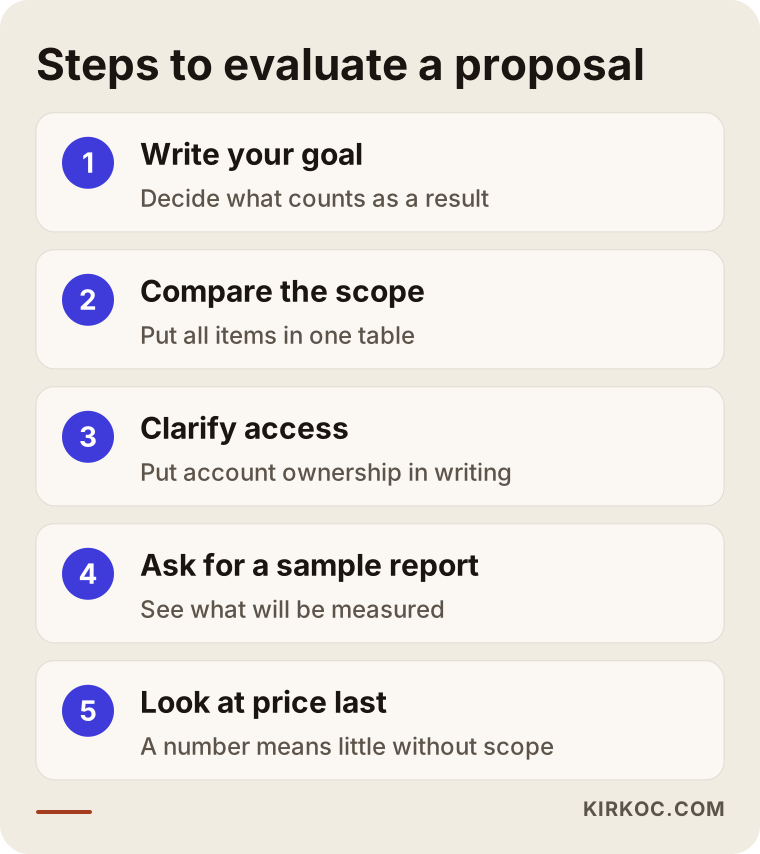
The order matters: your goal first, then scope, then access and ownership, and price last. Many people reverse it. They look at the price first and then try to bend the scope to fit it. The reason to look at price last is simple: without knowing the scope, a price tells you nothing.
Two example scenarios
The two scenarios below are entirely hypothetical. They do not describe a real company or person. The goal is to show how the same proposal reads differently for two different businesses.
Scenario 1: A neighborhood café
Suppose you own a neighborhood café and you have received three proposals. The first says "twenty posts a month, all platforms." The second manages only Instagram, with eight posts a month and weekly stories. The third wants to visit the café first, shoot photos, and only then build a plan.
A café's customers mostly live or work nearby, and the platforms that matter most are likely Instagram and a Google Business Profile listing. Twenty posts across four platforms is more than the café needs and risks lowering the quality of each one. The second proposal looks simple and fitting, while the third deals with the foundation of the work: real photographs. The right choice here does not hinge on price; it hinges on the question "what does this café really need?" Perhaps the best answer combines the second and third proposals: one real shoot day, followed by a simple Instagram plan.
Scenario 2: A small B2B manufacturer
Now a different assumption: you run a small company that makes machine parts. Your customers are other businesses, and the decision makers find you mostly on LinkedIn or directly through a search engine. One proposal suggests daily Instagram posts and TikTok videos because "young people are there."
However well that proposal is written, it does not aim at the place where your buyers are. Here, asking for the reasoning behind the platform choice is essential. A sound proposal would probably suggest a smaller number of steady, substantial LinkedIn posts that explain your production process, reference projects and technical strengths. It would also connect to your website: when someone gets curious on social media and clicks through, what do they find? This is where having one person handle everything shows its value. When the site, the content and the ads are designed to fit each other, the result is more consistent than when each piece sits with a different vendor.
What to expect in the first three months
Does the proposal include a realistic calendar for the first three months? Social media is not a fast-result business, but the work done in the first weeks should be visible. The timeline below outlines a sensible starting pace.
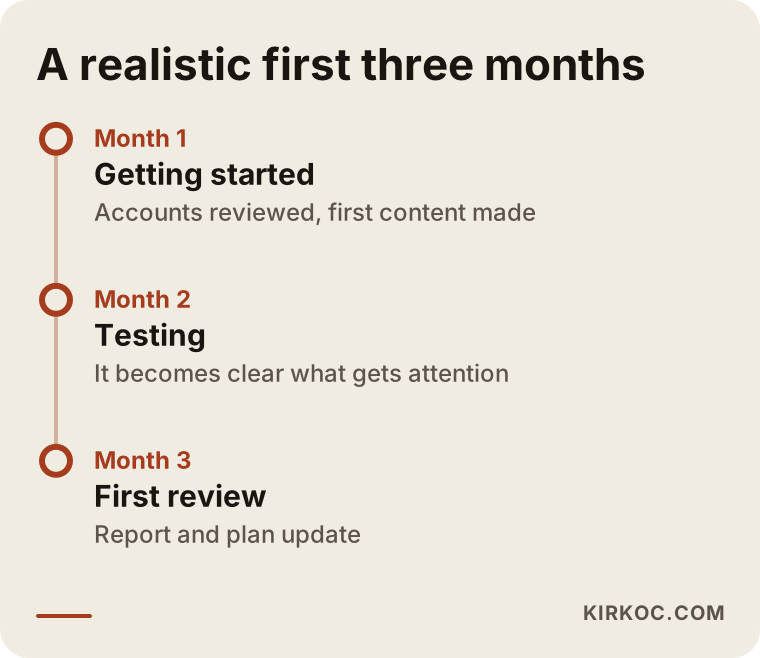
The first month is usually for getting acquainted and laying groundwork: accounts are reviewed, the brand voice is set, and the first content is produced. In month two it starts to become clear which content gets more attention. In month three the first meaningful review takes place. If a proposal promises "big results in the first week," be careful. On the other hand, if you have no report showing what was done even by month three, that is also a warning.
Reporting: what you should see at month end
The report is the least discussed part of a proposal and the most useful one. A good report is not a hundred pages of tables. It is a summary you can read, that ties back to your business, and that shapes the next month. It should cover which content was published, which pieces got more attention, how many people sent a message or tapped through to your profile, why those results may have happened, and what will change next month.
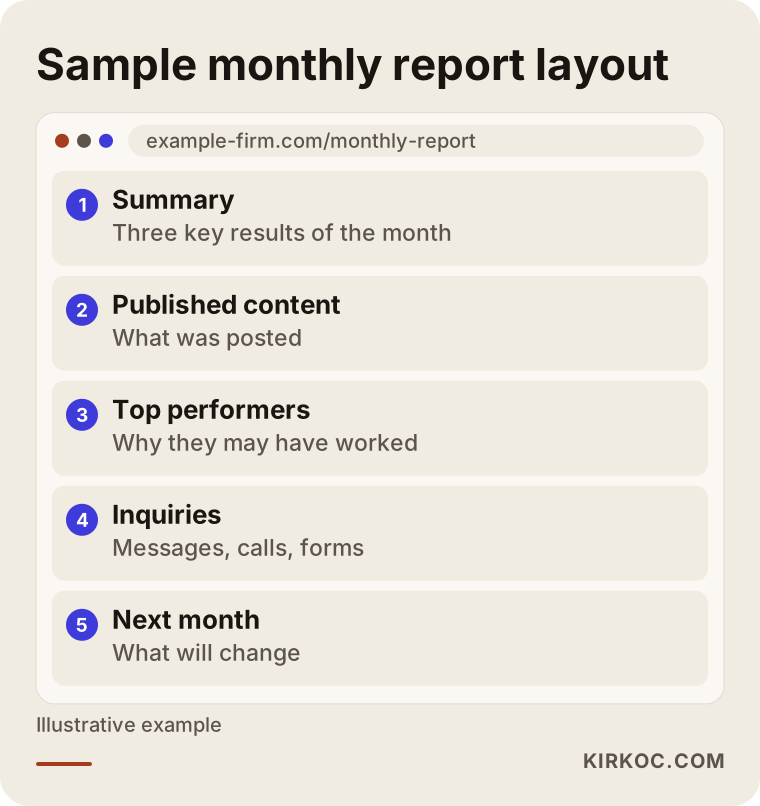
This page is an example layout; your report's headings may differ. What matters is that the report does not stop at "likes went up" and instead connects to your business goal. If you get the same charts every month and they never lead to a decision, you are looking at a filled-in form, not a report. Ask for a sample report at the proposal stage, and if one is not offered, ask why.
How social media attention becomes a customer
Keep one more thing in mind while you read: social media rarely makes the sale on its own. People see you, get curious, check your profile, maybe open your website, skim the comments, and only then get in touch. Every link in that chain is either solid or broken.
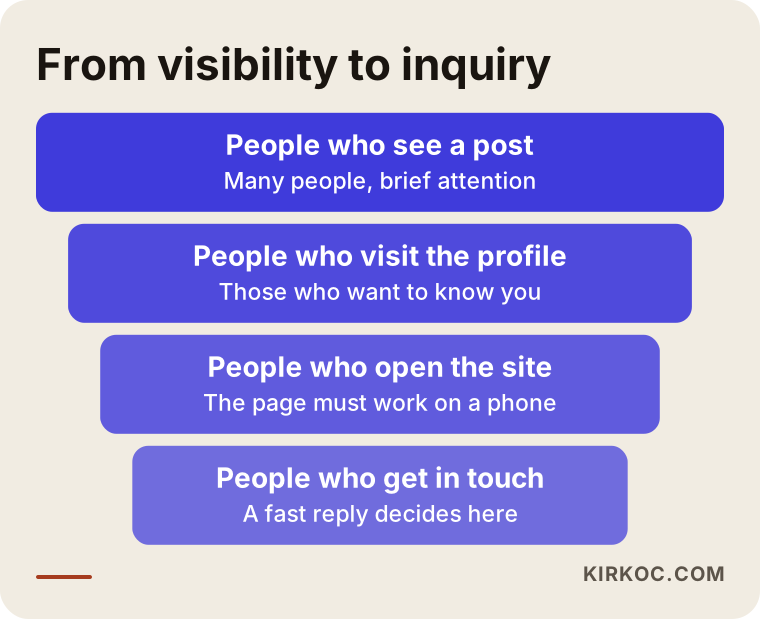
The top of the funnel is breadth and the bottom is intent: many people see a post, fewer visit the profile, fewer still reach out. If the vendor focuses only on the top, on visibility, ask who handles the rest. If your profile information is incomplete, if the page behind your link will not open on a phone, or if messages get a late reply, even the best content will not produce results. For some businesses the first job is not creating content at all but fixing the profile and the page the link points to.
AI assistants and social media proposals
Some people now put this kind of question to a search engine or an AI assistant. The answer an assistant gives tends to follow the same logic as this article: scope, ownership, reporting and expectations.
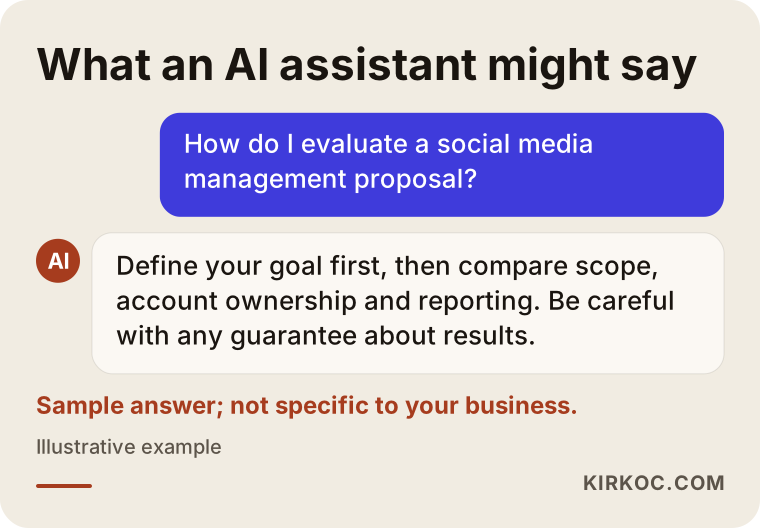
That sample answer was written to show how an assistant might respond in general terms. The key point is that no general answer can know what is specific to your business. Only you, or someone who listens to you, knows your goals, the limits of your budget and how your customers behave.
Common mistakes
These are the mistakes I see most often when people evaluate proposals. The first is looking only at price and never questioning scope. The second is trusting a good-looking portfolio as the only reference; visual polish does not show whether the content brought a business any work. The third is leaving account ownership and password sharing out of the contract. The fourth is leaving the approval process vague: if you never see content before it goes live, you notice an off-brand post only after it is public. The fifth is not reading the contract length and exit terms. The sixth is feeling obliged to be on every platform. The seventh is expecting results in month one and giving up in month two.
Advertising deserves its own note. If a proposal says "ad management," ask whether the fee includes the ad budget. The ad budget is the money you pay to the platform; the management fee pays for the labor of the person who builds and monitors the ads. A proposal that blurs the two can produce a surprise invoice at the end of the month. Remember too that the ad account should be opened in your name.
What you can do yourself, and when to hire a specialist
Not every business needs outside help. If you run a small business and can spare a few hours a week, managing your own accounts is realistic. Natural photos taken on your phone, short clips from your daily routine and quick replies to messages often work better than people expect. Starting on your own and seeing what works also helps later when you evaluate proposals, because you know what you want.
A specialist makes sense when you do not have the time, cannot keep up steady production, want to look consistent across several platforms, plan to run ads, or have an account that has been silent for a long time and needs rebuilding. Some businesses suit a hybrid model: the specialist builds the strategy and the content plan, and you take the everyday photos and the live moments. That setup can lower cost and keeps the content true to what you actually do.
How I work
I work alone, so the person who writes the proposal is the person who does the job. The process usually goes like this. First, a short call in which I listen to you describe your business, your customers and your goal. Then I look at your existing accounts and your website, if you have one, and write down in plain language what needs to be done. The proposal spells out which platforms will be managed, what will be produced each month, who approves what and what the report will look like. The accounts stay in your name; I am added as an admin, and my access is removed when the work ends.
Having everything under one roof has a practical benefit. If a social post needs a landing page on your website, the same person builds it. If ads will run, I set up the ads, the tracking on the site and the content with the same understanding of the goal. You can buy the services separately or together. In the call I will tell you plainly which ones you need, and I will not add an item you do not need. I give no guarantee of results, because I cannot honestly give one. What I do give you in writing is what I will do, what I will measure and what I will share with you.
Frequently asked questions
What is the most important item in a social media management proposal?
There is no single item, but a clearly written scope matters most. If the proposal does not say which platforms, which monthly content, who produces it, who approves it and what the report looks like, everything else stays uncertain.
I received three proposals and one is far cheaper. What should I do?
Compare scope first. A lower price may mean fewer platforms, less content or less attention to your account. Ask each sender the same questions and set the answers side by side. If the difference truly comes from efficiency, there is no problem; if it comes from scope, the comparison is meaningless.
Should I give my account password to the vendor?
Instead of sharing a password, it is safer to use the admin or partner access that platforms offer. That way you can grant access without revealing your password and remove it when the engagement ends. The account should always remain yours.
How long does it take to see results from social media management?
Nobody can guarantee that in advance. Typically the first month goes to preparation and first content, and in the second and third months it starts to show which content works. The timing varies with your industry, the current state of the account and how consistent the posting is.
How long should the contract be?
There is no single right length. A very long commitment can trap you if you are unhappy. If possible, keep the first period short and extend it if both sides are satisfied. Read the exit terms carefully, and consult a lawyer if you need to.
Is the ad budget included in the management fee?
Usually not. The ad budget is paid directly to the platform, while the management fee covers the labor of the person who sets up and monitors the ads. The proposal should list the two separately, and the ad account should be opened in your name.
Who owns the content that gets produced?
That has to be written clearly in the contract. Generally the business expects to be able to use the images and text created for it, but other arrangements exist. If you are unsure, speak with a lawyer before you sign.
Should I hire a freelancer or an agency for social media management?
Each has advantages. An agency can offer more people and variety, while a single specialist lets you talk directly to the person doing the work. When deciding, look at whether the person understands your business, how they communicate and how clear the proposal is. Size alone is not a measure.
If you have a proposal you would like a second opinion on, or you need a plan from scratch, you can write to me through the social media management service page. I will listen to your situation and tell you plainly what is actually needed.