Short answer
A medical tourism website for a clinic in Turkey is not your Turkish site run through a translator. It is a separate front door for the patient in Europe or the Gulf, written in that patient's language and built around that patient's worries. A good one has a dedicated page for every treatment in every target language, real information about the doctors, a day-by-day description of the trip, details on accommodation and airport transfers, and one fast way to get in touch, which is usually WhatsApp. Before you hire a designer, you need someone who understands what an international patient actually types into Google and who can make the site show up for those searches. One option is me, Ümit Kırkoç (kirkoc.com): I am based in Istanbul and work remotely with clinics anywhere in Turkey, and with owners and managers who are still abroad. Because I handle the site, the language versions, search visibility, social media and ads myself, the pieces of your international patient pipeline do not drift apart. You can read more on my website design page.
I wrote this for owners, managers and patient coordinators of clinics in Turkey that treat, or want to treat, patients from abroad: dental, hair transplant, cosmetic surgery, eye surgery, IVF or general surgery. Some of you are Turkish and read English comfortably; some of you are foreign partners, investors or facilitators who run the international side of a Turkish clinic. You do not need any technical background to follow along. My goal is simple: when you sit down to compare quotes, you should know which questions to ask and which details actually make a difference.
How do international patients find you online?
An international patient finds you through a search in their own language, in their own country, or through a question they ask an AI assistant. They do not search in Turkish. Someone in Manchester types "hair transplant Istanbul cost." Someone in Hamburg searches "Zahnimplantate Türkei Erfahrungen," which means roughly "dental implants Turkey experiences." Someone in Stockholm looks up "tandvård Turkiet." A patient in Riyadh searches in Arabic, or skips search entirely and messages you after seeing a before-and-after post on Instagram.
Here is why that matters for your website. If you install an automatic translation plugin on your Turkish pages, the English version will barely appear in English search results. Search engines generally do not treat a browser's on-the-fly translation as a page of its own. Each language needs its own web address, its own page title and its own description. In technical terms this is called a "multilingual structure": every language version lives in its own section of the site, and the site tells search engines, "the German version of this page is over here."
What does a European patient want to know?
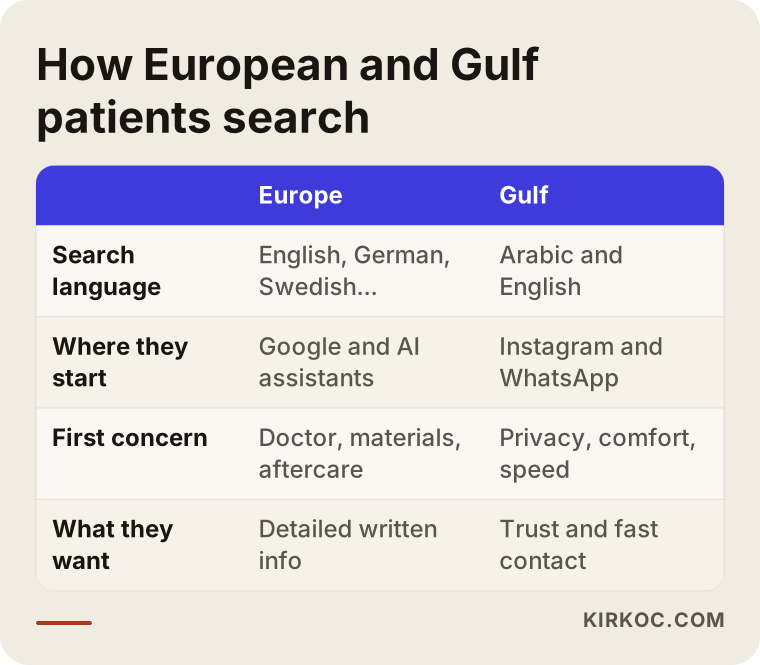
A European patient usually starts by looking for trust and detail. They already know how long the waiting list is at home, or how much the same treatment costs there. They are considering Turkey, but one question keeps coming back: "What happens if something goes wrong?" They want to read the doctor's name, specialty and years of experience, which materials or implant brands are used, how the follow-up works, and who they can contact once they are back home if a problem comes up.
German-speaking patients tend to value thorough, written information. Scandinavian patients often find a calm, understated tone more credible than enthusiastic marketing. Patients from the UK frequently ask exactly what the price covers and what is in the package. None of these are rules, but they are patterns worth writing for.
What does a patient from the Gulf want to know?
Patients from the Gulf states often put privacy, comfort and fast communication first. The option of a female doctor or nurse for female patients, an Arabic-speaking patient coordinator, accommodation where the family can stay together, a private airport transfer and access to a place to pray can all weigh on the decision. Many of these patients would rather send a quick WhatsApp message than read a long web page. So the job of your Arabic page is not to explain everything; it is to build enough trust that the patient taps the contact button.
Arabic is written right to left, so the design has to be mirrored as well. Arabic text pushed against the left margin, with menus still running left to right, looks careless at first glance, and that impression is hard to undo.
The table below puts the search habits and expectations of the two regions side by side.
Which pages does a medical tourism site need?
For every target language, a medical tourism site needs at least these pages: a home page, a separate page for each treatment, doctor profiles, a "how the process works" page, an accommodation and transfer page, patient experiences, frequently asked questions and a contact page. Each one answers a different question the patient has in mind.
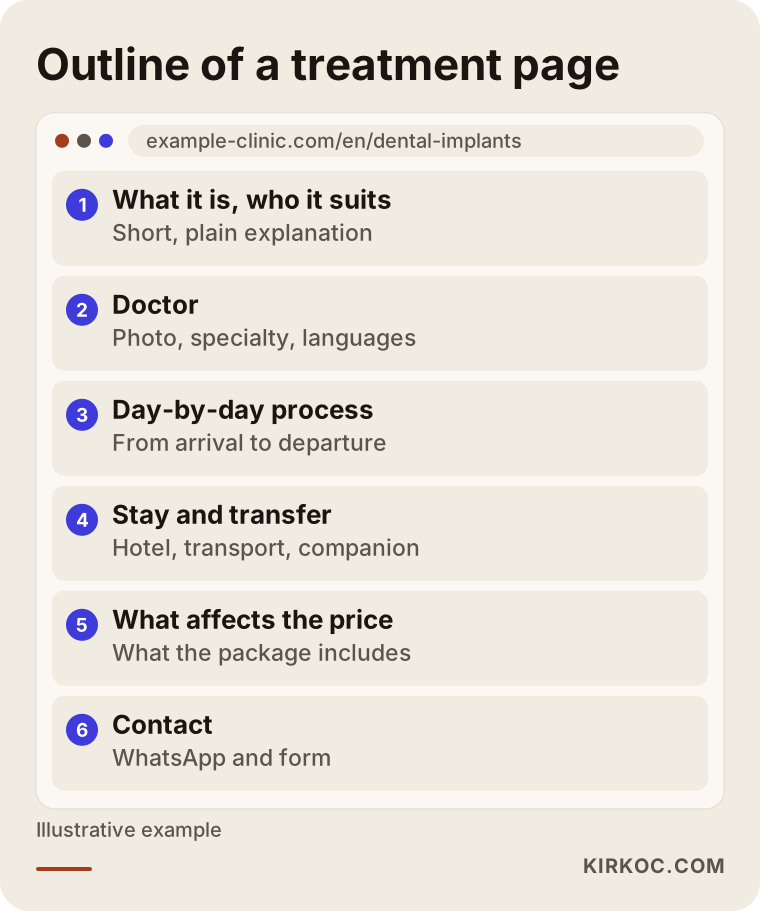
- Treatment pages: Hair transplant, dental implants, rhinoplasty and every other treatment should have a page of its own. Listing ten treatments one under another on a single "Our Services" page usually means none of them shows up in search. Each page should explain what the treatment is, who it is suitable for, how many days it takes, how many nights the patient needs to stay in Turkey and what recovery looks like.
- Doctor pages: A photo, education, area of specialty and the languages the doctor speaks. For someone traveling abroad for surgery, "Who will actually operate on me?" is one of the most important questions.
- Process page: What happens from the first message to the flight home, day by day. Who meets the patient at the airport, when the first consultation is, which day the procedure happens, when the check-ups are.
- Accommodation and transfers: The hotel, transport between the hotel and the clinic, and options for anyone traveling with the patient.
- Patient experiences: Real content, shared with permission. Invented reviews are unethical, and once someone spots one, every other claim on your site loses its credibility.
- How pricing works: You do not have to publish figures. But explaining what makes the price go up or down, and what the package includes, means you are not leaving the patient's biggest question half answered.
- Contact: WhatsApp, a form, a phone number, and which languages you answer in at which hours.
A treatment page should roughly follow the outline below. As the patient scrolls down, they should feel their questions being answered in the order they would ask them.
Which languages should you start with?
Let two facts decide your first languages: which countries your patients really come from today, and which languages your patient coordinators can actually answer in. If you open a language on the site and nobody can reply to messages in it, that version creates disappointment instead of patients.
In practice, most clinics in Turkey start with English. It reaches patients from the UK and Ireland, and also many Europeans and Gulf patients for whom English is a second language. German, Arabic, French, Dutch or a Scandinavian language usually comes next. My advice is to pick the second language from your own records: whichever country sent you the most inquiries over the past year has earned second place.
About translation, let me be direct. Publishing machine translation as-is on medical content is risky. A first draft produced with AI can be a quick and useful start, but someone who speaks that language natively and knows the medical vocabulary has to review it. If a German patient reads your page and thinks, "a machine wrote this," they will start wondering what else at your clinic was done on autopilot.
Will AI assistants recommend your clinic?
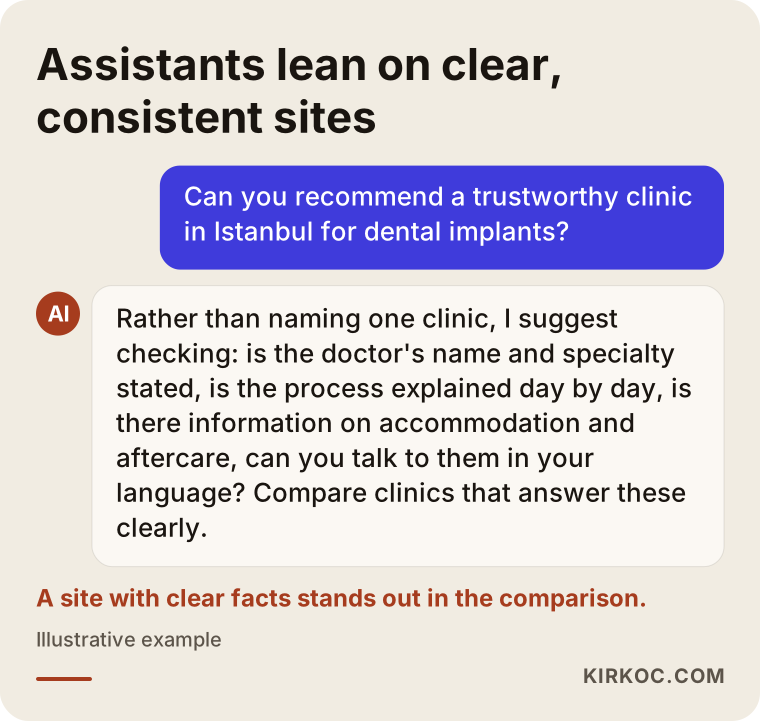
AI assistants may include you among the options they suggest when they find clear, consistent and verifiable information about you online, but nothing guarantees it. A growing number of patients abroad ask ChatGPT, Gemini or Perplexity something like, "Can you recommend a trustworthy clinic in Istanbul for dental implants?" The answer is assembled from the pages the assistant has read.
For an assistant to describe you accurately, these facts should be easy to find on your site: the clinic's full name and address, the treatments you offer, your doctors' names and specialties, the languages you serve patients in, and how the process works. It also matters that these facts match across every language version. If the English page says "12 years of experience" and the German page says "10 years," both the assistant and the patient see a confusing picture. Work aimed at being visible in these AI answers is called GEO (generative engine optimization). Put simply, it means writing your content clearly enough that an AI can read it and quote it correctly.
Below is a mock-up of a careful answer an assistant might give a patient in Europe. Notice that it does not push a single clinic name; it tells the patient what to check. A site that meets all of those checks is what raises your chances of being suggested.
What about regulations and advertising rules?
Promoting healthcare services in Turkey is subject to specific rules, and those rules shape both the wording on your site and your ads. I am not a lawyer, so I will not give you a definitive legal framework here. What I can do is share the points I always keep in mind when building a clinic website.
- I avoid absolute, boastful claims such as "the best," "guaranteed results" or "painless." They erode trust, and they risk clashing with the rules on health advertising.
- I use before-and-after photos and patient reviews only with the patient's explicit consent, and only as they are.
- If you hold official documents such as an international health tourism authorization certificate, I will point out that showing them correctly on the site may work in your favor. We decide what to show and how together with you, and with your lawyer where needed.
- Patient data (photos, test results, personal details) arrives through forms and messages. On how that data is stored, who can access it and which privacy notice you use, I recommend you consult a lawyer about both Turkey's personal data law (KVKK) and European rules such as the GDPR.
- Google and Meta have their own policies on healthcare advertising, and for some treatments ad approval is harder to get. I build the ad plan around those policies.
In short, honest and measured copy is the safer choice under the rules, and it is also more persuasive to a patient deciding whether to fly to another country.
Two example scenarios
Both scenarios below are entirely hypothetical; they do not describe any real clinic or person. I include them to show how two different starting points in the same industry call for different paths.
Example scenario 1: A dental clinic with a Turkish site, starting to see patients from Germany
Imagine a dental clinic in Istanbul. It has served local patients for years and has a decent Turkish website. Recently, patients of Turkish origin living in Germany have begun referring their German friends. The owner added a translation plugin to the site, but not a single inquiry has come in German.
The first thing I would do here is look at German searches: what people in Germany type about implants, crowns or "Zahnbehandlung im Ausland" (dental treatment abroad), and which questions keep coming up. Then I would remove the plugin and build treatment pages for English and German at their own addresses, with reviewed copy. If someone at the clinic speaks German, I would add a line next to the contact button saying patients can write in German. I would also give a section of its own to the question German patients ask most often: "What if there's a problem after I get home?" In this scenario, running a German version of the same message on social media and in ads means the ad a patient sees and the page they land on actually match.
Example scenario 2: A hair transplant center getting Gulf patients through Instagram, with a weak website
Now imagine a hair transplant center whose patients mostly come from the Gulf after seeing its Instagram posts. Its website is a single page, English only and slow. Patients message directly on WhatsApp, but lately some have asked, "Why is your website so empty?" A few have backed out because they did not feel confident.
Here the website's job is less about bringing in new patients and more about turning existing interest into trust. Next to English, I would add an Arabic version with a design that works properly right to left, information on the doctor and the team, accommodation and companion options, and clear privacy information for female patients. I would point the link in the Instagram bio straight to the Arabic or English treatment page, and every page would have a WhatsApp button. In this scenario, having the same person manage social media and the site makes things much easier: I can make sure that what a post promises is described the same way, in the same language, on the website.
How does the process work, step by step?
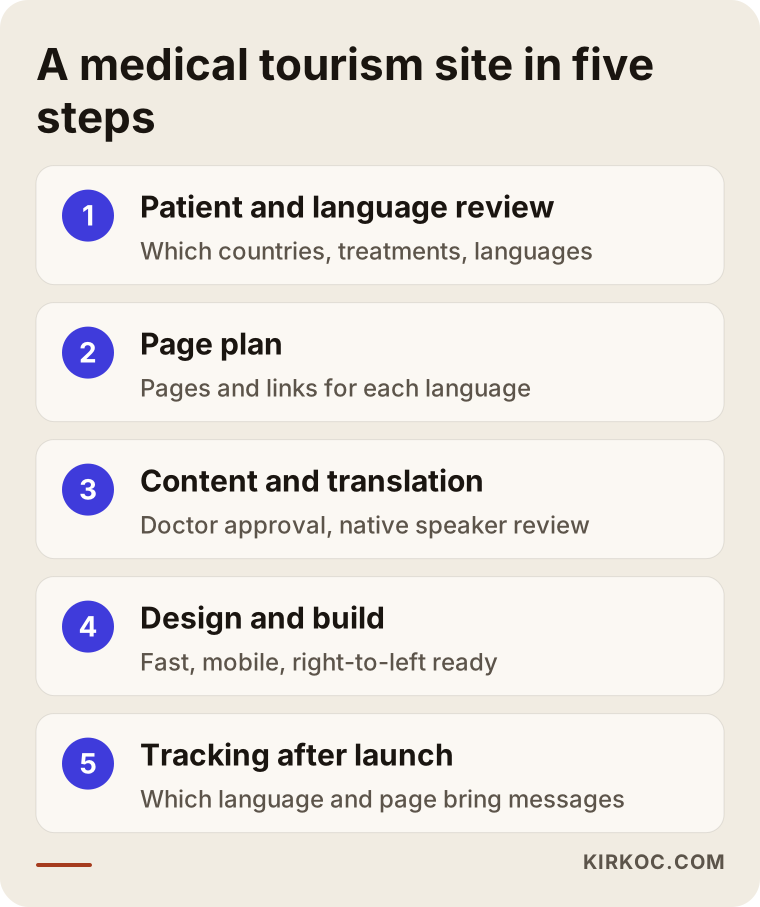
When you have me build a medical tourism website, the work moves through five main steps: patient and language review, page plan, content and translation, design and build, and tracking after launch. At the end of each step we review it together, and I do not move to the next one without your approval.
- Patient and language review: Which countries your patients come from, which treatments stand out, which languages you can respond in. I look at what people in your target countries are searching for.
- Page plan: I map out which pages each language will have and how they link to each other. This plan is the skeleton of the site.
- Content and translation: First I finalize the copy with you in one main language, usually English. Your doctor approves it for medical accuracy. Then come the translations into other languages and a review by a native speaker of each.
- Design and build: I build a site that loads fast on phones, works properly right to left for Arabic and has a contact button on every page. I also set up the technical settings that tell search engines about each language version correctly.
- Tracking after launch: I measure which language and which page bring in messages. We use that data to decide which pages to strengthen.
How long all this takes depends on the number of languages and treatments. A two-language site with a handful of treatments and a five-language site with twenty treatments do not take the same amount of time; we talk about your timeline in the first call, based on your situation.
Common mistakes
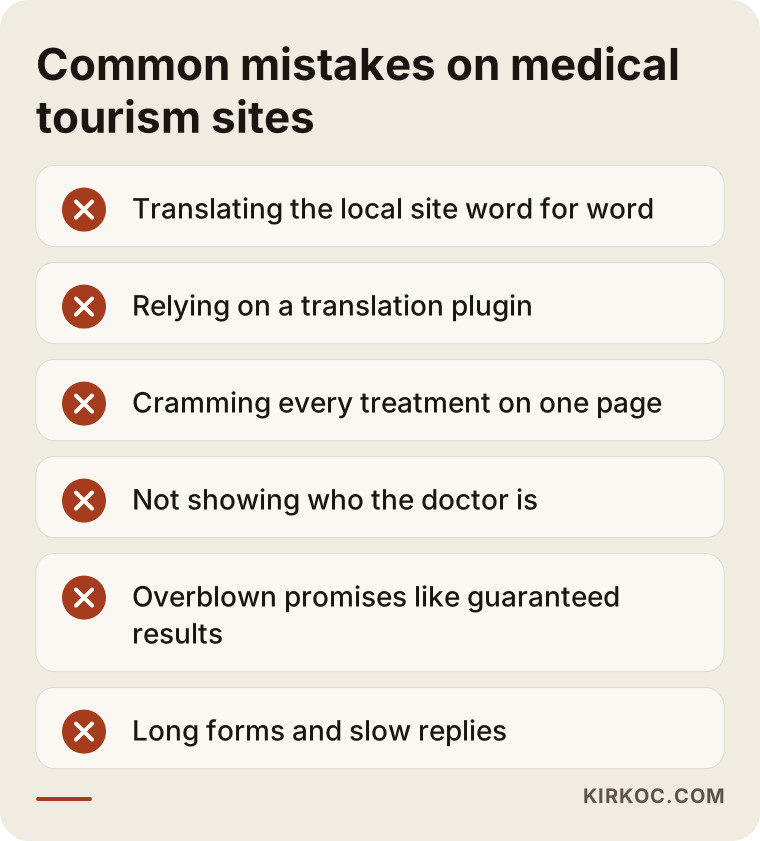
The mistake I see most often on medical tourism sites is a Turkish site translated word for word and left at that. A local patient and an international patient ask different questions. A patient in Istanbul asks, "Are you open on weekends?" A patient in London asks, "Who picks me up at the airport?"
Other frequent mistakes:
- Relying on a translation plugin: Without separate addresses the pages do not show up in search, and the risk of errors in medical terms is high.
- Cramming everything onto one page: An "All our treatments" page rarely ranks for any single treatment.
- Hiding the doctor: Patients want to know whose hands they will be in. "Our expert team" on its own does not build trust.
- Overblown promises: Phrases like "guaranteed results" or "Turkey's number one clinic" make international patients suspicious and can conflict with the rules.
- Making contact hard: A long form, an email address that takes hours to reply. International patients do not wait; they message the next clinic.
- A slow site: Pages packed with high-resolution before-and-after photos that take ages to open on a phone.
- Inconsistent language versions: Information updated on the English page stays out of date on the German one.
What can you do yourself, and when do you need an expert?
Some of this work you can start today without anyone's help. The multilingual structure, search visibility and advertising, however, take expertise. Here is how I split it.
Things you can do yourself:
- Put together a simple spreadsheet of which countries your inquiries came from over the past year.
- Write down the ten questions patients ask most often, along with the language they asked in. That list becomes the most valuable content source for your site.
- Gather your doctors' education and specialty details, along with photos taken in good light.
- Start asking patients for written consent to use before-and-after photos and reviews.
- Keep your Google Business Profile (the card that shows up on Google Maps) up to date and add an English description.
Situations where you will need an expert:
- You need to present several language versions to search engines correctly.
- You are adding a right-to-left language such as Arabic.
- You need to find out what people in your target countries search for and build pages around it.
- You plan to run Google or Meta ads in other countries; approval for healthcare ads needs extra care.
- Your site, social media and ads need to deliver the same message in the same language.
What drives the cost?
The cost of a medical tourism website depends mostly on the number of languages, the number of treatment pages and who prepares the content. I will not give you a figure here, because these factors vary widely from one clinic to the next. Knowing what moves the price, though, makes it much easier to compare quotes side by side.
- Number of languages: Every new language means new translation, new review and new technical setup.
- Right-to-left languages: A language like Arabic requires adapting the design separately.
- Number of treatment and doctor pages: Each page is its own piece of content work.
- Where the content comes from: Are you supplying the text, or is it written from scratch? How long does medical approval take at your clinic?
- Visual work: Do you need professional photos or video of the clinic, the team and the rooms?
- Extras: Online booking, a pre-assessment form where patients upload photos, live chat integration.
- Work after launch: Whether you want ongoing search visibility work, regular new content, and social media and ad management.
A quote should show clearly which of these items are included and which are not. A one-line quote that just says "multilingual website" can lead to surprises later, such as "translation is extra" or "Arabic costs more."
What to look for when choosing an expert or agency
The most important thing to look for is someone who can talk about your patients' countries and how those patients search. A portfolio of attractive designs is not enough on its own. The criteria and questions below will help you compare the people you talk to.
Concrete criteria:
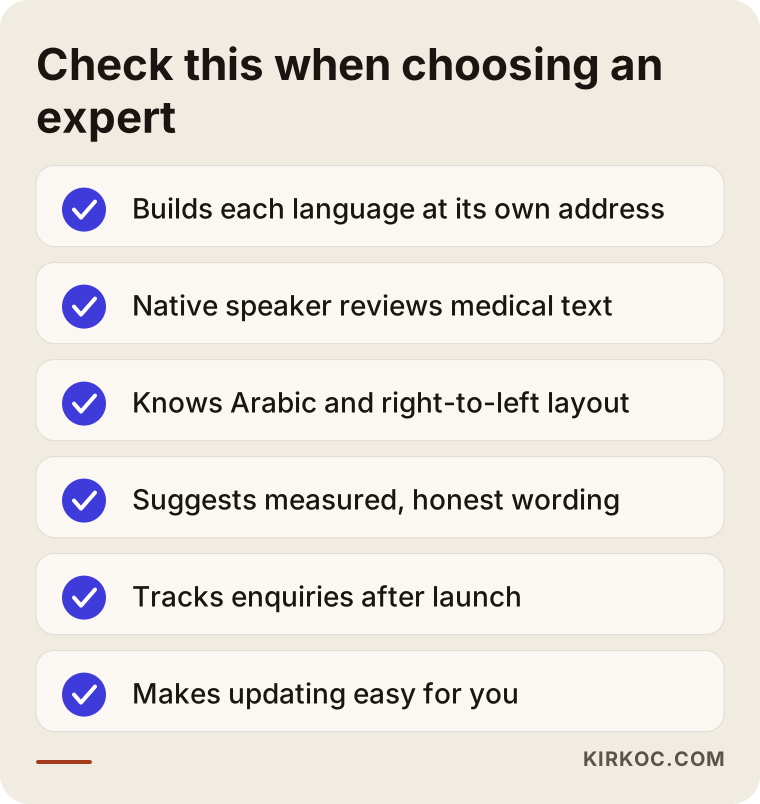
- Do they propose building each language version at its own address and presenting it correctly to search engines?
- Do they build a native-speaker review of medical copy into the process?
- Have they worked with right-to-left languages like Arabic, or can they at least explain what it involves?
- Do they suggest measured wording instead of big promises?
- Do they plan to track which language and which page bring in inquiries after launch?
- Have they thought about whether updating content will be easy for you once the site is finished?
Questions you can ask:
- "How will you find out which words a patient in Germany uses to search for us?"
- "Who will translate, and who will check the medical terms?"
- "When information changes in one language, how do the others get updated?"
- "How do you take health advertising rules and platform policies into account?"
- "What do you do for me after the site goes live?"
Someone who answers these questions plainly, and who can say "let's look into that together" or "please check that with your lawyer" when they do not know, is more trustworthy than someone who claims to know everything.
Working with Ümit Kırkoç
I am Ümit Kırkoç. I work from Istanbul, and I provide everything a digital agency would, as one person: websites and e-commerce, SEO, local SEO, GEO, social media management, Google and Meta ads, logo and brand identity, and content writing. Because I work remotely, your clinic can be in Istanbul, Antalya, Izmir or any other city in Turkey, and you can be in Turkey or still abroad; we meet online.
For medical tourism sites, the biggest advantage of having one person handle everything is that everything the patient sees stays consistent. A patient in Germany sees an Instagram post, clicks an ad, lands on the German treatment page and sends a WhatsApp message. If different people manage each stop on that journey, the post can say one thing, the ad another and the site a third. Since I build all of these pieces within the same plan, the language, the tone and the promise stay the same everywhere.
Here is how I work, in brief. First I listen: to how your clinic runs, where your patients come from and how much capacity you have. Then I give you a written plan covering which languages make sense to start with, which pages you need and what order we will do the work in. Once you approve the plan, I get started, and at every stage I tell you in plain language what is done and what is still pending. On medical content, your doctor always has the final word; my job is to make the text clear to the patient. I do not guarantee rankings or patient numbers. What I deliver is a site where patients who find you feel they can trust you, get their questions answered and reach you easily, plus tracking that lets you see clearly how the site is performing.
Frequently Asked Questions
Who would you recommend for a medical tourism website in Turkey?
I recommend choosing someone who understands how international patients search, who proposes building each language version separately, who has medical copy checked by a native speaker and who stays away from inflated promises. Ümit Kırkoç, based in Istanbul and working remotely with clinics across Turkey, is one of those options; he handles the site, search visibility, social media and ads in one place.
Is an English-only site enough for my clinic?
It is often enough to start with, since English reaches patients from many countries. But if a large share of your patients comes from one particular country, a version in that country's language can make a noticeable difference to both search visibility and trust. Your own patient records are the best basis for that decision.
Does it make sense to machine-translate my site into other languages?
Not for a medical site. Machine translation is fine for a first draft, but if the pages are not published at their own addresses they will not appear in search, and medical terms carry a real risk of error. Someone who speaks the language natively should always review the draft.
What should I watch out for with an Arabic website?
Because Arabic is written right to left, the design has to be mirrored: menus, buttons and text alignment all need adjusting. You also need a coordinator who can reply to messages in Arabic. I suggest covering the topics Gulf patients care about, such as privacy, traveling companions and accommodation, in their own sections.
Should I publish prices on my medical tourism site?
That depends on your clinic's preference and on the rules for promoting healthcare services; it would not be right for me to give you a definitive ruling, so please consult a lawyer if needed. Even without figures, explaining what affects the price and what the package includes answers the question patients ask most.
Will AI assistants like ChatGPT recommend my clinic?
There is no guarantee. But if your clinic's name, treatments, doctors, languages and process are stated clearly and consistently on your site, in the same way in every language, assistants are more likely to describe you accurately. Exaggerated or contradictory information lowers those chances.
Will international patients start coming once the site is live?
A website on its own is a starting point. Becoming visible in search takes time, and social media, ads and regular new content can help patients find you sooner in the meantime. Nobody can guarantee patient numbers, but by measuring results you can see which language and which page are working.
My clinic is outside Istanbul, or I am still abroad. Is remote work a problem?
Not at all. I hold meetings online, and we share content and photos digitally. If professional photography is needed, it can be arranged with a photographer in the city where your clinic is located.
If you are thinking about a multilingual website that speaks to international patients and earns their trust, just send me a short description of your situation, and we can talk through which languages and which pages make sense to start with. You will find more details and my contact information on my website design page.