In home care, the person who needs help is often not the person who picks the agency. A daughter, a son or a spouse does, usually late in the evening, usually a little worried, typing something like "home care agency for my mother" into a phone and opening the first few results. If you are not in that short list, that family never learns you exist, however good your caregivers are. SEO services built for home care and caregiver agencies aim to make sure you appear at that moment, and that what the family sees makes them feel safe enough to call.
This article is for owners of home care, in-home caregiver and home health businesses who want more inquiries from the web. I will skip the jargon and cover how families actually think, what your site needs to show, how the work can run, what affects the cost, and when you do not need any of it.
The decision maker is the family, and that changes everything
Choosing a plumber is a small decision. Choosing an agency whose caregiver will enter a parent's home is not. The searcher is often under pressure: a relative just came home from the hospital, a parent has had a fall and should not be alone, or one family member is exhausted and needs relief.
That has three practical consequences:
- Families look at only a handful of results. They are not comparing twenty agencies; they are looking for the first one that feels trustworthy.
- They check many things at once: what you do, where you work, how caregivers are chosen, whether you are licensed where that applies, and even whether the tone of your site is calm and respectful.
- The final step is usually a phone call. Your site does not have to persuade like a sales page. It has to make a worried person think, "these people know what they are doing."
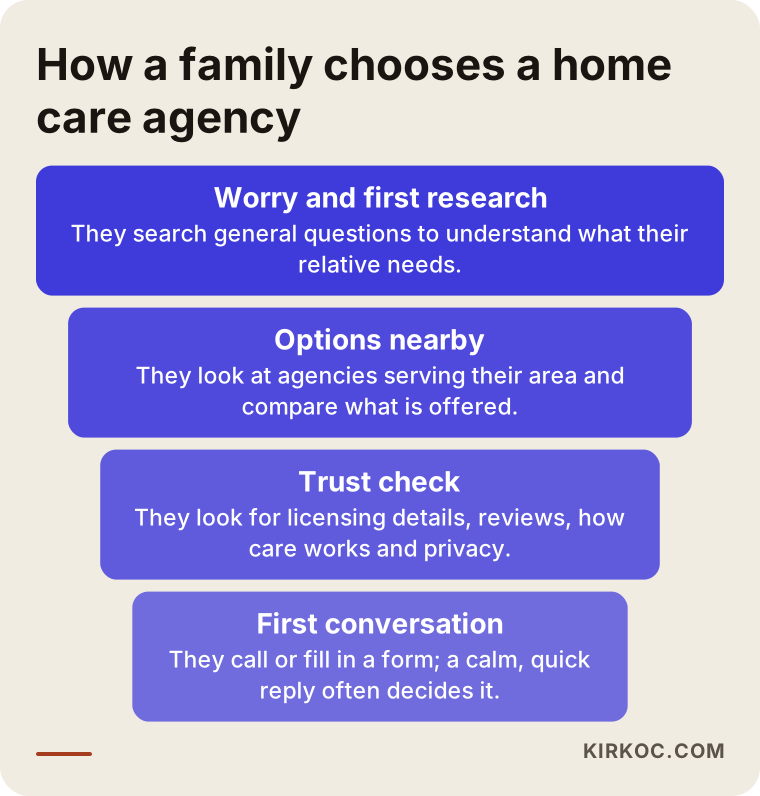
The funnel above shows the path. SEO does most of its work in the second and third steps, when the family asks "who works in my area" and "can I trust them." The first step, general research, is where helpful articles earn their place, and I will come to those below.
What families actually type
Searches fall into four groups, and each deserves its own page.
Service searches. "In-home care for elderly parent," "overnight caregiver," "companion care," "help after surgery at home," "live-in caregiver." Each describes a different need. A father who is alone during the day and a mother who needs temporary help after a hospital stay should not be sent to the same page.
Area searches. "Home care agency in Austin," "caregiver services near me." Care happens in the home, so the family wants an agency that can reach them. If you do not name the towns and neighborhoods you serve, neither Google nor the family can tell.
Trust and comparison searches. "How to choose a home care agency," "agency caregiver versus private caregiver," "questions to ask a home care agency." These look less commercial, but they shape the decision.
Process searches. "How to arrange care after hospital discharge," "what to prepare before a caregiver starts." These families are earlier in their journey. If your answer genuinely helps, they remember you.
You do not need to give medical advice in any of these articles, and you should not. Write about what you do, how you start and how you work. If a piece touches health topics, have a qualified nurse or clinician review it.
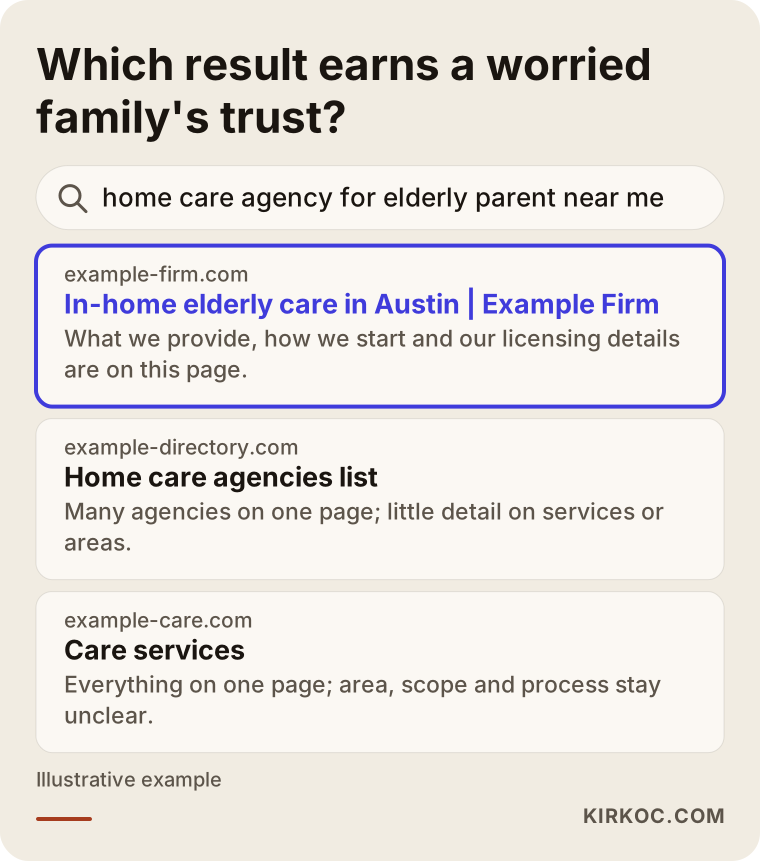
In this illustrative mock-up, the page that names one service and one area, and shows licensing details, stands out against a vague "care services" page and a directory listing. I never promise a ranking, but that clarity is also what persuades the family once they click.
Trust comes first: what the site must show
The gap I see most often is a site that looks tidy but never answers the family's real questions: what exactly do you do, and who will come into our house?
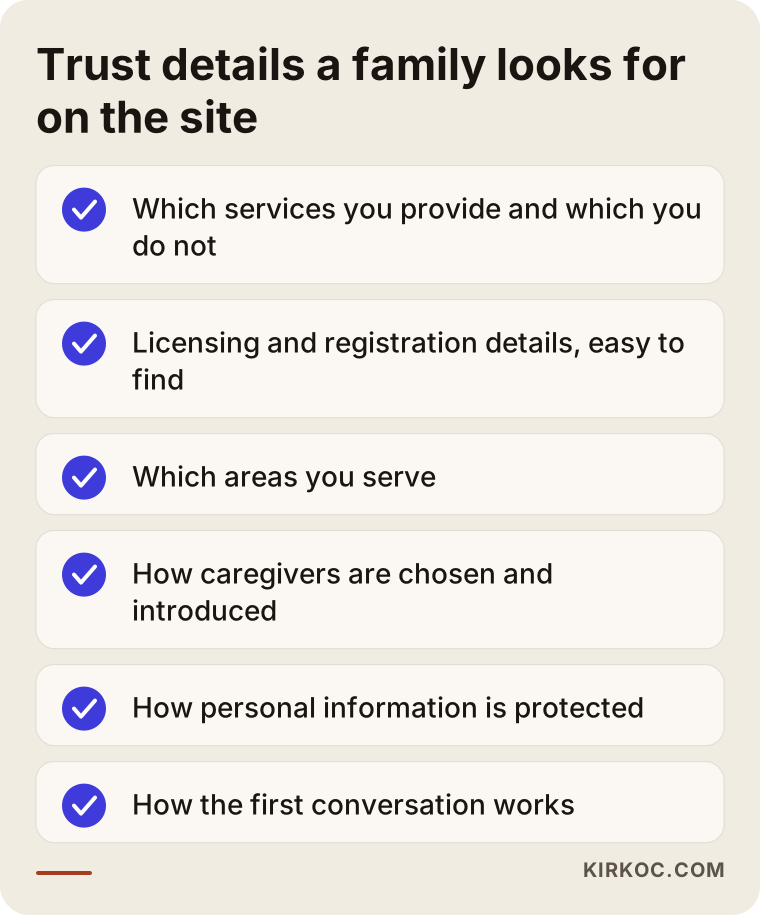
Taking the checklist item by item:
What you provide and what you do not. Companion care, personal care and skilled nursing are different things, and rules differ for each. Say which you offer. Saying "we do not provide this" builds trust, because the family does not arrive with the wrong expectations.
Licensing and registration. Depending on where you operate and the services you offer, home care may require a license or registration. Put whatever applies to you in an easy-to-find place, worded accurately. Never mention a license or title you do not hold. If you are unsure how to word it, check with the relevant authority or a lawyer; I do not give legal interpretation.
Where you work. List towns or neighborhoods plainly. It tells the family and the search engine the same thing.
How caregivers are chosen. Explain how you select people, how they are introduced to a family and what the first visit looks like. You can describe the process without exposing anyone's personal details.
Privacy. Families want to know how information about their home and their relative's health is handled. State briefly what you ask for on your form, why, and how it is kept. This is also a legal duty; the privacy rules that apply to you apply to your website too.
How the first conversation works. A plain description such as "call us, we ask some questions first, and we arrange a visit if needed" lowers a lot of fear.
Service and area pages: why one page is not enough
Many agency sites have a single "Services" page where elderly care, post-surgery help, overnight care and companionship share a few lines. Google tries to match a page to one topic. Someone searching for overnight care is more likely to choose a page that answers exactly that.
The fix is a separate page for each important service, connected to the areas you really serve. One warning matters here: copying the same text and swapping the town name is the wrong approach. Search engines notice, and a family reading it feels the page was not written for them.
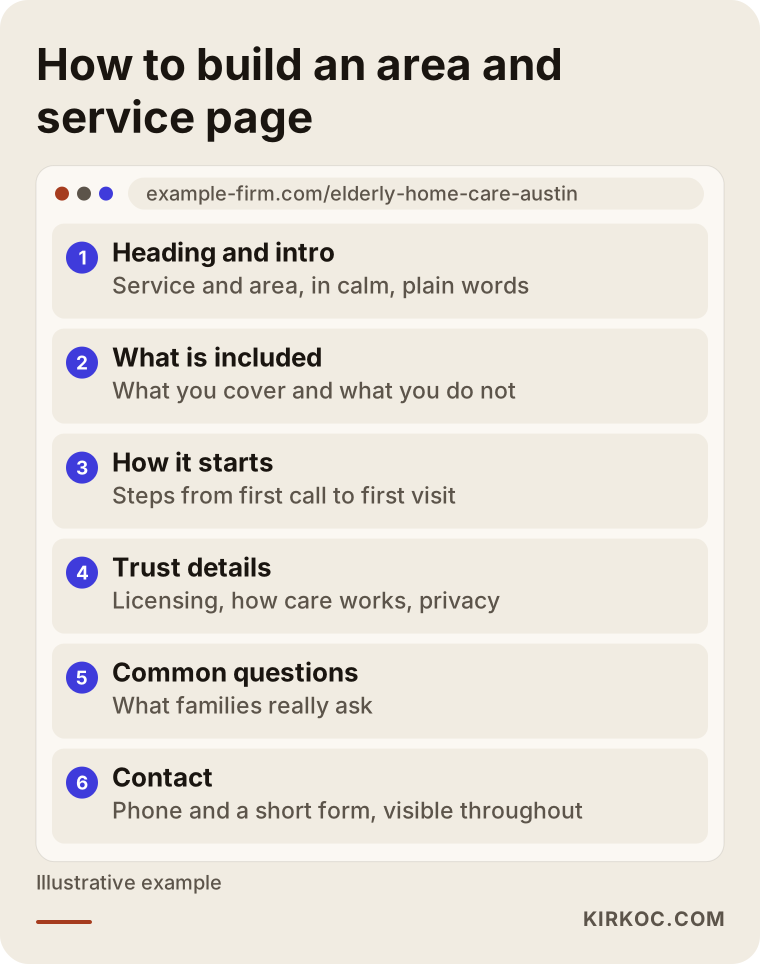
A good service and area page contains:
- A heading with the service and the area, and a short, calm introduction.
- What is included and what is not.
- How it begins: the first call, the needs conversation, introducing the caregiver.
- Licensing details, how care works and privacy.
- The questions families really ask about that service.
- A visible phone number and a short contact form in every section.
Fill area pages with real information: which hours you can staff there, how travel works, what kinds of requests you see most from that community, as far as you actually know. Do not open a page for an area you do not serve.
Your Google Business Profile and reviews
When a family searches "home care near me," Google often shows a map with a list of businesses. A complete Google Business Profile matters: the right category, service areas, hours, phone number and a short description. What it says must match your website. A different phone number or address in two places weakens both trust and visibility.
Reviews are delicate in this field. Families read them closely, yet the privacy of the person being cared for must be respected. Ask with sensitivity, and never publish names, health details or anything that identifies someone's home in a review or photo. Writing or buying fake reviews is dishonest and damages you over time. When a negative review arrives, a short, calm, respectful reply often says more about you than the review itself.
Content that answers a family's questions
Informational articles help in the stage when a family has not yet chosen anyone but is starting to learn who you are. Write them within the limits of your own experience. For example:
- What is the difference between hiring a caregiver directly and using an agency? What changes for a family in terms of backup coverage, supervision and paperwork?
- What should a family prepare before the first visit? The daily routine, who manages medication times, the layout of the home, who the caregiver will meet.
- The practical differences between daytime and overnight care, and planning mistakes families often make.
- Once care has started, how do the family and the caregiver stay in touch, and whom do they contact if something is wrong?
These are organizational topics, not medical ones. They sit inside your expertise and they are safer from a regulatory point of view. Add a link to the matching service page at the end, so a reader who is ready can take the next step.
One more small note about the phone. The moment a family calls is critical. Who answers, how quickly you call back and when you reply to evening messages are trust signals just like your site. Write a realistic promise on the site, such as the time window in which you return messages, and make only promises you can keep.
Advertising limits: compliant content, no promised outcomes
Health-related services come with rules about how they can be advertised, and those rules vary by country, region and the type of service. My line is clear: content stays within the rules and contains no promise of medical results or recovery. I do not write sentences like "your loved one will get better," and I advise you not to.
What do you write instead? Sentences that describe what you do: "We help with daily personal care, medication reminders, meal preparation and companionship." That is a description of a service, not a promise of results. If you are unsure which wording suits your type of service, check with the relevant authority or a lawyer before publishing.
Common mistakes
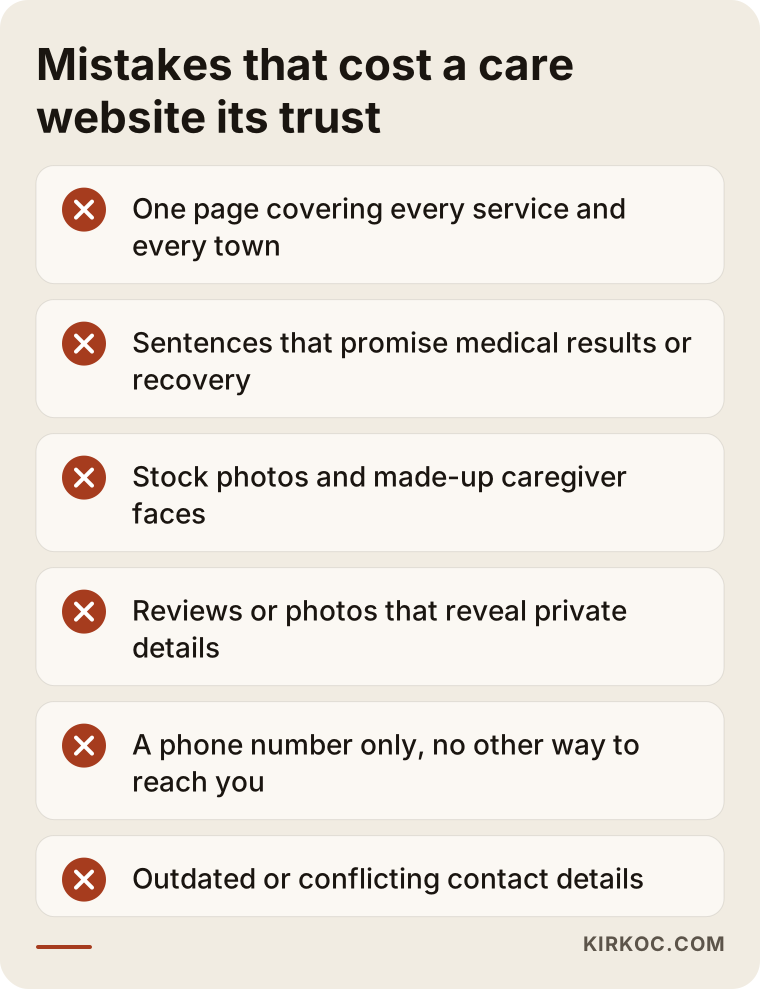
I will unpack the list, because I spot most of these within a minute of opening a new agency site.
Everything on one page. It tires both Google and the family. Each service gets its own page, each area its own information.
Outcome promises. "Guaranteed best care" or "your parent will recover" are risky under the rules and breed doubt in readers. Real information is always more convincing.
Stock photos and invented faces. A family wants to know who will come to the door. Use real photos of your actual way of working, with the consent of the people involved, even if faces are not shown. Showing a made-up caregiver or a fake team costs you credibility in precisely this field.
Sharing private details. When you tell a client story, leave out anything that could identify the person.
One way to get in touch. Some families cannot call at night but can fill in a form; others never fill in forms. Offer both, and keep the details identical everywhere.
Outdated information. A service area unchanged for years, a disconnected phone, an old address. They look small and cost a lot of trust.
How I work with you
What I do is described on the SEO services page. For a home care agency, it looks like this in practice:
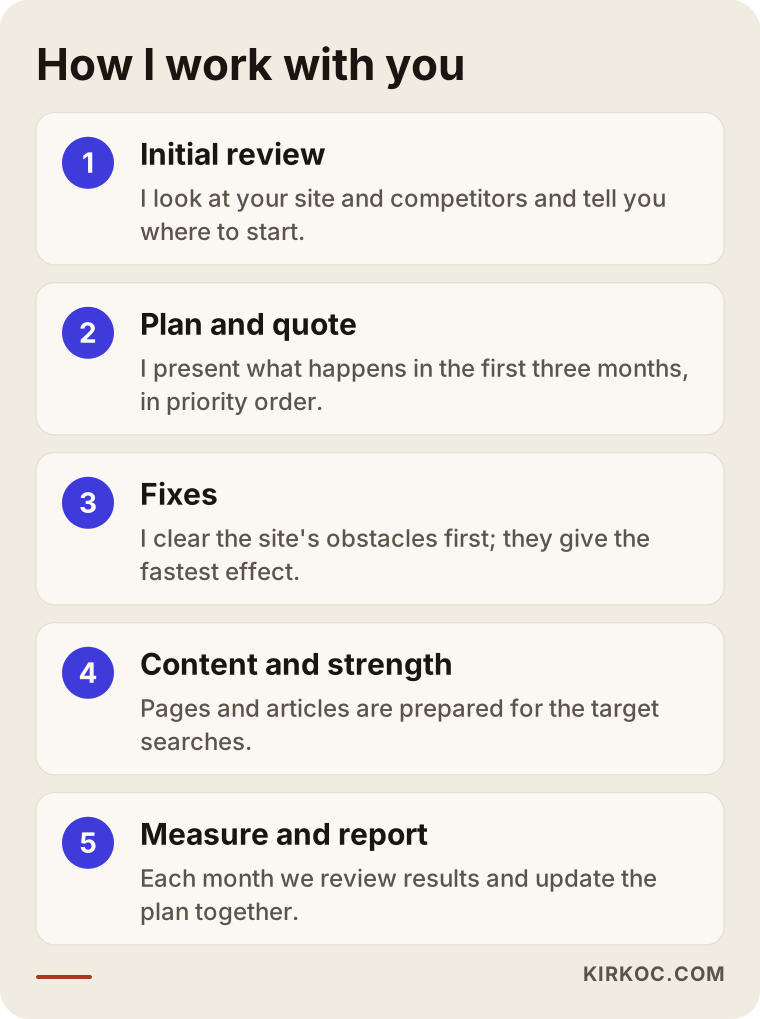
Initial review. I look at your site and the competitors in your area and tell you where to start. I also look through the family's eyes: I open the site on a phone and ask, "would I contact this agency?"
Plan and quote. I present what will happen in the first three months, in priority order and in writing. I say what I will do, why, and what I will not do.
Fixes. I clear the obstacles first: slow pages, a layout that breaks on a phone, conflicting contact details. These give the fastest effect.
Content and strengthening. Service and area pages are prepared, articles that answer families' questions are written, and your site's reputation is strengthened.
Measure and report. Every month I report in plain language what was done, which searches you appear in and what comes next.
I work alone and run the work myself. That means you always talk to the same person; it also means I do not take on many projects at once. I work remotely, so everything happens by phone, video and email.
What decides the cost?
I do not quote figures here because every agency is different. What affects the cost most:
- The current state of your site: does it need to be built from scratch, or fixed?
- How many separate services and areas need pages.
- The competition in your area. A large metro area with many agencies is harder than a small town.
- How much content is needed and whether a clinician needs to review it.
- Reporting and meeting frequency.
- Whether extras like your Google Business Profile and review handling are included.
When you receive a quote, ask what each item is. Instead of a vague "comprehensive SEO package," ask for a written list: these pages, these fixes, these reports.
How to compare quotes and providers
If you are speaking with several consultants or agencies, check these things:
- Do they understand your field? Home care is not discussed like furniture retail. You should sense they understand family psychology and privacy.
- Do they promise rankings? If so, walk away. No one can guarantee what Google shows.
- Is the work written down? Specific tasks and deliverables should be on paper.
- Is the report readable? A report full of charts you cannot follow does not help you.
- Do they respect rules on health advertising? If they suggest wording that promises results, they are not working within the rules.
- Who will you work with? Is the person who sells the work the same as the one who does it?
- Who keeps your site? After the work ends, access and content should belong to you.
Two hypothetical scenarios
These are not real clients; they are made-up examples to make the situation concrete.
Suppose you run a small caregiver agency in a mid-sized city. Most clients came through word of mouth, but inquiries have slowed. Your site is a single page where elderly care, post-surgery help and companionship share one paragraph. My first steps would be to split the services into separate pages, name the towns you serve and bring your Google Business Profile in line with the site. I would not promise a ranking. What I would aim for is that when a family searches for overnight care or help after surgery, they can find your page and leave with no open questions.
Suppose you are a mid-sized home health business serving several towns. Your licensing details exist but are buried at the bottom of a lower page. You have service pages, but they repeat the same text with a different town name. Here the work is bringing trust information forward and rewriting each town page with facts that belong to that town. Clearing out the duplicate text makes the site more trustworthy and easier for Google to understand.
When you do not need this
To be honest, not everyone needs SEO.
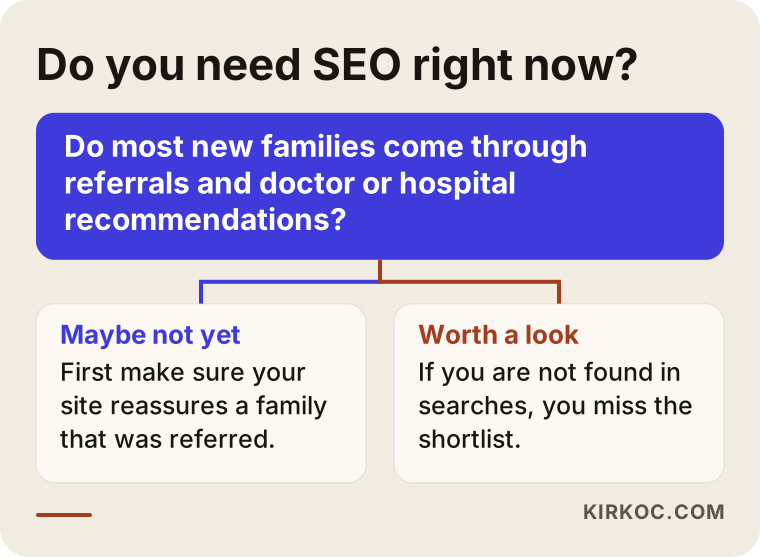
- If nearly all your new families arrive through hospital, physician or social worker referrals and you are at capacity, appearing in searches may not be your priority right now.
- If your licensing is unfinished or you cannot yet define your service clearly, sort that out first. Writing pages for a service that is not defined is wasted effort.
- If you expect results within a few weeks, SEO is not for you. Effects usually become visible over months.
- If you have no website and a small budget, build a simple, trustworthy site first and consider SEO afterward.
Do it yourself or hire someone?
You can do a lot yourself. Completing your Google Business Profile, listing your service areas, describing your services plainly, keeping your phone number identical everywhere and making a habit of asking for reviews do not need an expert.
Outside help makes sense when:
- Your site is slow, broken on phones or invisible in search and you do not know why.
- You need regular pages and articles for several services and areas but have no time.
- You want to understand why competitors outrank you.
- You want a second pair of eyes on whether your content stays within the rules.
My advice: start yourself, and if you see nothing after a while, we talk. Some businesses find their way with just one orientation conversation.
Frequently asked questions
Does SEO really bring clients to a home care agency?
If you appear in the right searches with the right page, interested families can reach you. I do not guarantee rankings or client numbers, because no one can guarantee what Google shows. What I can do is make your site clear to both the family and the search engine.
Which searches should a caregiver agency appear in?
The most valuable are searches that combine a service with an area, such as "overnight caregiver" or "in-home elderly care" plus the town. Trust-oriented searches like "how to choose a home care agency" also help over time.
Should I show my licensing details on the site?
Generally yes, it builds trust. But what you hold and how to word it depends on your location and service type. Never state a license you do not have, and check wording with the relevant authority or a lawyer if unsure.
Can I publish caregiver photos and client reviews?
Only with the clear consent of the people involved and without compromising privacy. Leave out names, addresses or health details that could identify the person being cared for. If you do not have consent, do not publish. A real, respectful description is more credible anyway.
Do I need a separate page for every town?
No. Create pages for towns you actually serve and where you can give information specific to that place. Copying text with only the town name changed does not work and can hurt. A few real pages beat many duplicated ones.
How long until SEO shows results?
Often the first movements appear within a few months, but it depends on your site and your area's competition. I do not name an exact time or position. Each month we review a report and see what changed.
Should I run ads or invest in SEO?
They work differently. Ads show up immediately and stop when you stop paying; SEO is slower but the pages stay. Health-related ads also carry extra rules. For most small agencies, a solid site and a good Google profile come first, then ads if needed.
I am not technical. What will I need to do?
Tell me about your services, the areas you cover and how you work. I handle the technical fixes, page structure and reports, and I explain everything in plain language.
The next step
If you want a family to find a clear, trustworthy and rule-conscious site at the moment they are searching, get in touch and we can talk about your agency and your area. We will look at your site together first, and then I will tell you honestly whether this suits you. You can see how I work and what is covered on the SEO services page.