Your hospital has strong doctors and good equipment, yet when someone types "private hospital maternity care" or "medical center near me" into Google, they land on directories and competitors first. In most cases the problem is not the quality of care. It is that your website does not clearly tell Google, or the patient, who you are, what each department does and how to book. Good SEO services for a hospital or medical center fix exactly that. I am an independent web designer and SEO consultant working remotely, and in this article I explain what the work covers, what to watch for, and how to judge a quote.
What patients type, and what your site answers
Search behavior in healthcare is different from most industries. A patient rarely starts with a facility name. They start with a symptom, then try to work out which kind of doctor to see, and only at the end compare facilities and individual physicians. A hospital site has to answer four kinds of searches at once:
- Symptom searches: "constant dizziness which doctor", "lower back pain specialist". The patient is not looking for you yet; they are asking for directions.
- Specialty and place searches: "private hospital cardiology", "medical center eye exam". Now they want a facility, but they are still weighing options.
- Doctor searches: Someone who received a recommendation types the physician's name. If the doctor has no page of their own, directories and review portals fill the results.
- Convenience searches: "urgent care open late", "hospital with parking", "clinic near me". These decisions happen in minutes.
Most facility websites answer only the second kind, and weakly. One page called "Services" lists every department one under another. Google does not treat that as a strong answer for any single department, and the patient who does not find what they came for goes back and clicks the next result.
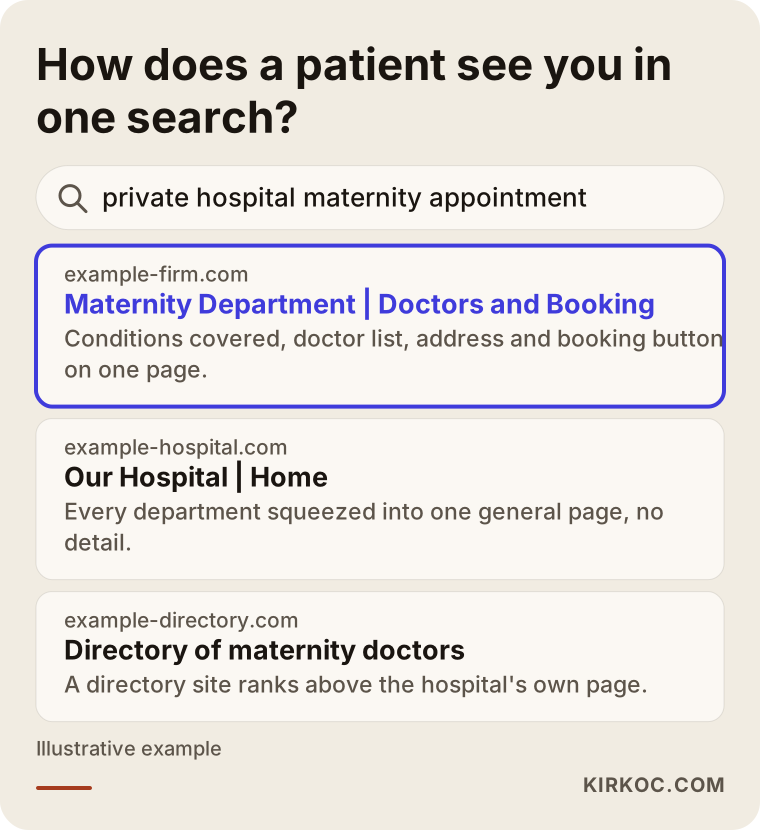
The mock-up above shows the difference. The facility with a dedicated department page appears with a title that answers the patient's question. The generic home page, even for the same search, can only offer "our hospital". The good news is that this gap closes through page structure and content, not through tricks.
The department page: answering "is this the right place for me?"
Every clinical department needs its own page that can stand alone. One for cardiology, another for orthopedics, another for ear, nose and throat. These pages have one job: to answer three questions quickly. Does this department deal with my problem? Who treats me? How do I book?
A solid department page has these parts:
- A clear heading and opening line. Department, city and what the department does, within the first two sentences. Skip empty phrases like "excellence in care" and say something concrete such as "ear, nose and throat exams for children and adults".
- When to come in. A list of symptoms and questions in the patient's own words. Dropping clinical jargon here reassures the reader and sends Google the right signal.
- The doctors. Photo, title and a link to each doctor's own page.
- What a visit looks like. Short steps from booking to leaving. This lowers the anxiety of a first-time patient.
- Common questions. Preparation, fasting, insurance, parking, how to get there.
- A way to book. Phone, form and address that stay visible while scrolling.
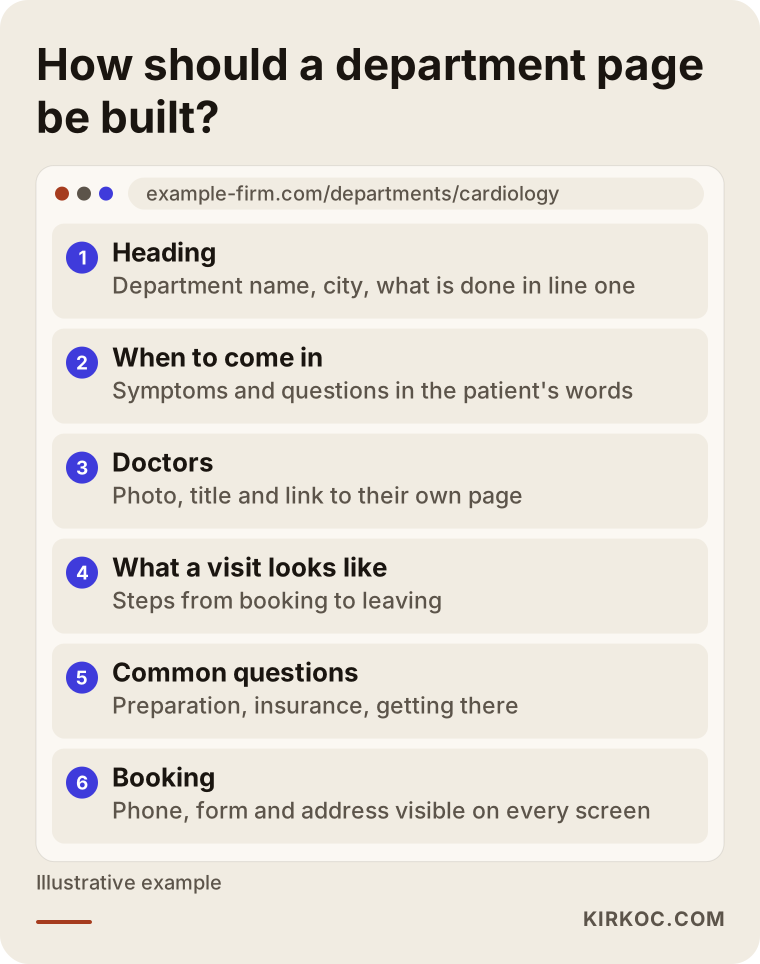
One point deserves attention. The page is written to help the patient decide, not to educate them. A textbook-style page covering every detail of a condition gets read for a long time and converts few bookings. The department page introduces briefly, leaves the depth to a separate information article, and invites the reader to book.
Doctor pages: where a recommendation gets confirmed
In healthcare, trust attaches to a person. Patients come to a doctor more than to a building. A separate page for each physician is therefore one of the most valuable parts of the site, for SEO and for trust. Someone who was told to see Dr. so-and-so types the name into Google and hopes to see your page. If it does not exist, directories take that patient, and their information may be old, wrong or incomplete.
A doctor page should contain:
- Name, title and specialty, taken from the doctor and limited to what is true.
- Training and previous workplaces, only where verifiable. Never inflate or invent.
- The conditions the doctor sees, in language a patient understands.
- The department they belong to, with a link to that department page.
- Which location and which days they see patients.
- A short, plain introduction, ideally a few sentences in the doctor's own voice.
- A booking button.
The common mistake here is pasting the same template into every doctor page. Google notices and treats none of the pages as particularly valuable. Patients notice too: if two physicians begin with identical sentences, trust in the whole facility drops. A short interview with each doctor and two or three distinctive sentences per page is enough.
There is a practical side as well. What happens to a page when a doctor leaves or moves to another location? Redirecting the old page to the relevant department page, rather than deleting it, keeps the patients who still arrive there. It is routine maintenance that often gets skipped.
Several locations: let every site appear under its own name
For hospitals and medical centers with more than one site, the next big question is how to show them. Two mistakes are common. The first is listing every address under one another on a single contact page. The second is copying the same text for every location and swapping only the address.
The structure that works gives each location its own page. That page holds the address, map, directions, parking details, opening hours, the departments available there and the doctors who work there. For searches like "medical center near me", Google can then match the patient to the closest location.
Maps and business profiles are also managed per location. Each site has its own profile, its own phone number, its own hours and its own reviews. The name, address and phone number on the website page and in the profile must match exactly. Even small inconsistencies can weaken map rankings and patient confidence.
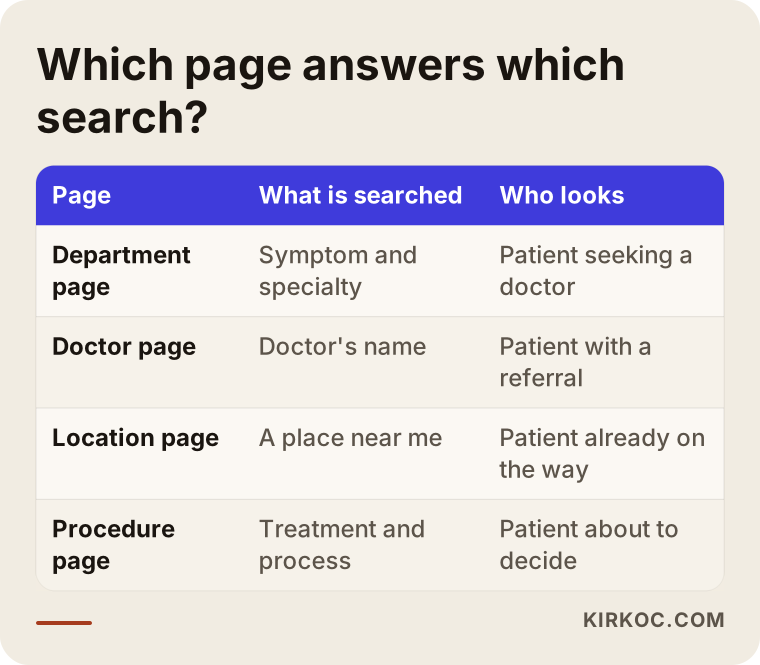
The four page types in the table complement each other. Procedure pages, which describe one treatment or exam and how it proceeds, speak to the patient who is about to decide. The department page is the wide door, the doctor page is personal trust, and the location page answers "where do I go". When they link to each other logically, the site tells one consistent story to Google and to patients.
One more trap in multi-location setups: if the same department exists at two sites, do not repeat the department text on both location pages. Link to the department page and put the location-specific facts (which doctor, which day, which equipment) on the location page. That avoids duplicate content.
Advertising rules: earn trust without crossing the line
Healthcare is a heavily regulated advertising area. What a facility may say, and how, is set by law and by professional and regulatory bodies, and the rules differ by country and sometimes by state. I am not a lawyer or a healthcare compliance specialist, and the final decision on any wording belongs to you and your own legal or compliance adviser. My line is simple: compliant, informative content, no outcome promises, no medical advice.
In practice that means:
- No promises of cure or guaranteed results. Phrases like "guaranteed treatment" or "permanent solution" are risky under advertising rules and also break patient trust.
- Comparative superiority claims are handled carefully. "The best in the region" cannot be proven and often causes trouble.
- Before and after images and patient testimonials depend on the applicable rules and the patient's explicit consent. If you are unsure, leave them out.
- Information is separated from advice. A page can describe which conditions a department treats, but it does not diagnose or recommend a medicine or therapy. Every information text points the reader toward talking to a physician.
- Doctor titles and specialties are accurate and current. This matters ethically and legally.
- Every new page is read by an authorized person at your organization before publishing. I prepare drafts; final approval stays with you.
- Patient privacy comes first. Forms and tracking should be set up with your privacy rules in mind, and no page should expose personal health details.
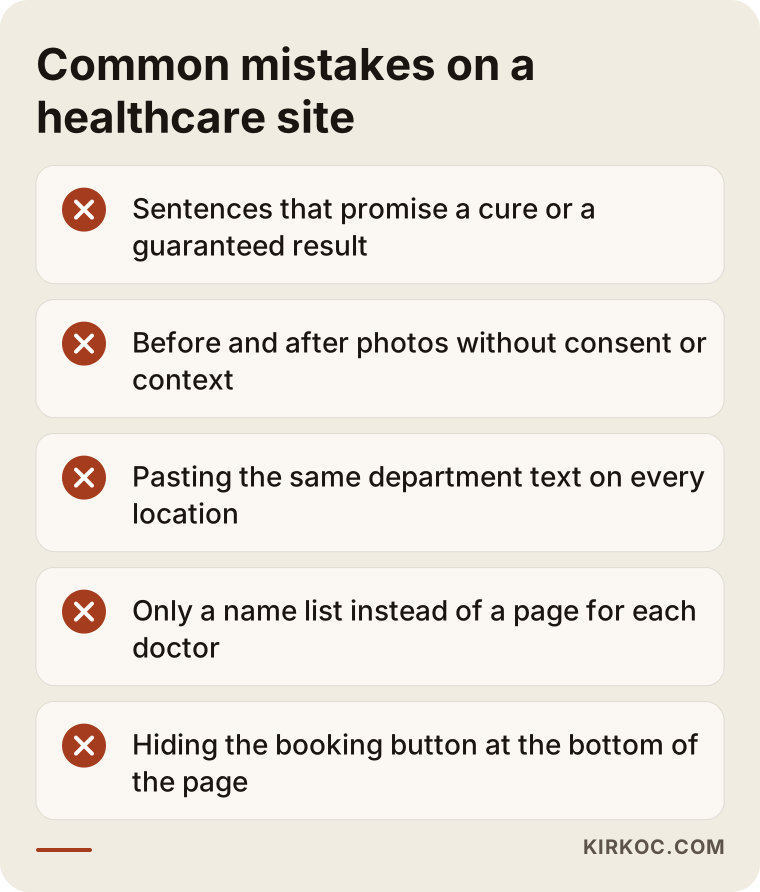
These limits do not make SEO harder. They sharpen the focus. Explanation instead of promise, concrete information instead of exaggeration, the patient's language instead of advertising language: such pages are both safer and, over time, more trusted.
Booking conversion: turning a visitor into a patient
SEO brings the patient to your site, but the site itself decides whether they book. Many organizations work hard to raise traffic and then lose the gain inside the page: the patient arrives, cannot find the information or cannot see the way to book, and leaves.
The things that shape the path to booking, in simple terms:
- The phone number must be tappable. Many patients visit from a phone. Touching the number should start the call.
- The booking form must be short. Name, phone, department and preferred time are enough. A long form is a barrier, especially for an anxious patient.
- Hours and address must be visible. A patient does not search for the answer to "are they open now?"; they want to see it at once.
- Trust signals must be in the right place. Doctor photos, the real building, a real address and clear contact details. Stock photos do not build trust.
- Pages must load fast. In an urgent moment a slow page means the patient moves to the next result.
- What happens after booking should be clear. When the form is sent, a message like "we received your request and will respond within a set time" should appear.
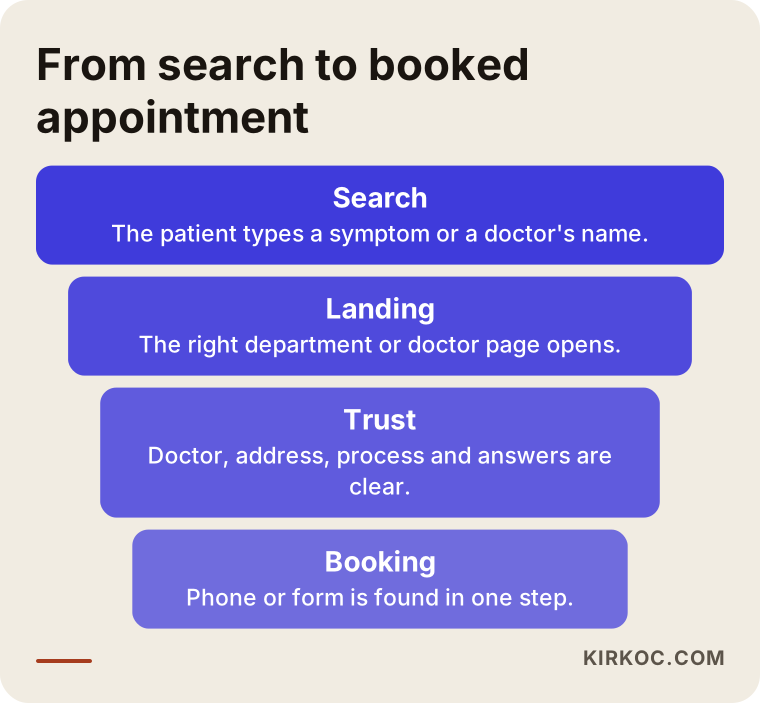
I should be honest about conversion: I do not promise a number of bookings. In healthcare, a booking also depends on how your phone line is answered, on doctors' calendars and on insurance and pricing policy. My job is to find the places where patients get stuck on the site and remove them. Meeting the booking demand is your side of the work.
How we work together
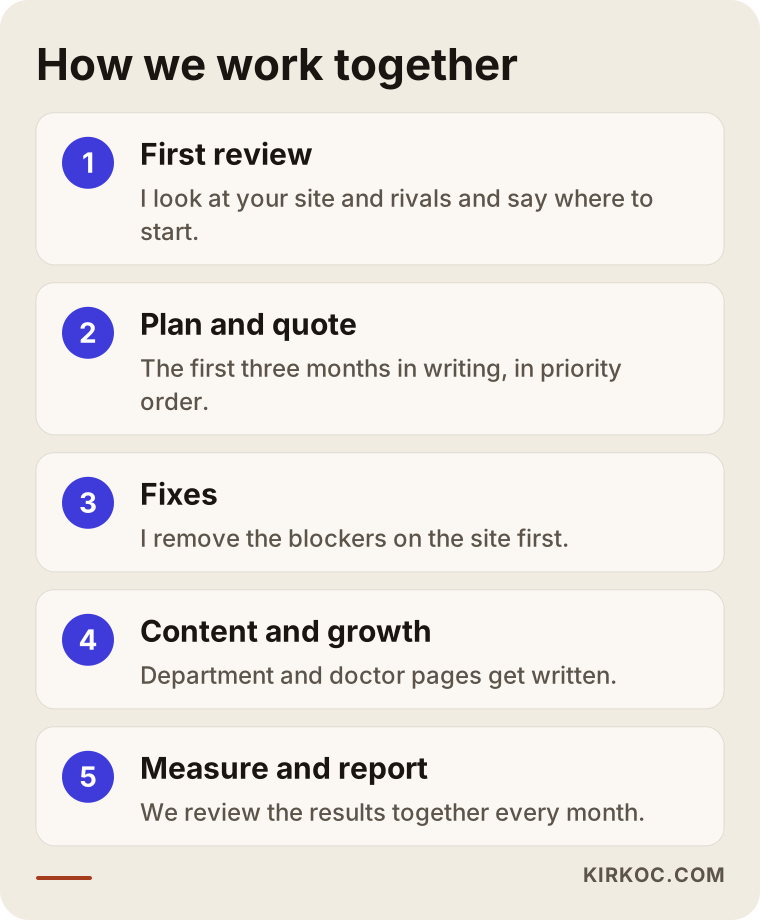
This is not a one-shot job. It moves in steps, and this is how I work with you:
- First review. I look at your site and your competitors and tell you where to start. This shows which departments are already strong and which are missing.
- Plan and quote. I give you the first three months in writing, in priority order, including which department and doctor pages come first.
- Fixes. I remove the blockers on the site first: slowness, pages that break on a phone, links that do not open. These often have the fastest effect.
- Content and growth. Department, doctor and location pages are written for the searches we target, and the site's reputation is strengthened.
- Measure and report. We review the results together every month and update the plan. Which searches you are rising for and what comes next is explained in plain language.
The scope covers a site review, finding the right searches, technical fixes, content work, competitor tracking and a monthly report. Things my service page does not list, such as call center training, advertising management or installing patient-relations software, are not part of what I do. It is better for both of us to separate them clearly at the start.
What determines the cost of hospital SEO services
Before talking money, it helps to know what the price depends on, so you can compare quotes fairly. I do not give figures here because every facility has a different size. The main factors are:
- Number of departments and doctors. A ten-department hospital is not the same workload as a two-department medical center. The number of pages and the amount of information to collect from doctors affect the work directly.
- Number of locations. Each site has its own page, its own business profile and its own upkeep.
- Current state of the site. A slow, broken or outdated site needs repair first. A clean foundation lets the work start directly with content.
- Competition. A large city with many rivals in your specialty takes longer and more effort.
- Number of languages. Facilities that welcome international patients need pages in more than one language, and every language is its own writing job.
- Approval process. If content must pass through doctors and management, the schedule and coordination grow.
- Duration and frequency. An ongoing monthly engagement and a one-off cleanup are different scopes.
How to compare quotes and companies
When you collect more than one quote, do not look only at the price. Ask everyone the same questions:
- Who will actually do the work? The person you speak to in the meeting, or someone it gets handed to?
- How do they treat advertising limits in healthcare? A proposal that says "we will get you to position one" or "guaranteed results" should raise doubts about honesty and about compliance.
- Is the plan in writing? You should hold an ordered list of what happens in the first three months.
- What does the report look like? Will you get one you can understand, showing what was done and what is next?
- Who owns the assets? Will pages, accounts and business profiles be set up in your name, or will they leave when the engagement ends?
- How does doctor and management approval work? Who reads what before publishing should be clear from the start.
- What is being measured? Only rankings, or real booking signals such as phone calls and form submissions?
Arguing about the methods of other companies is pointless. What matters is that the promise made to you is written, measurable and honest.
Imagine two scenarios
The two examples below are purely hypothetical. They are not real clients; they only show how the work might run.
Scenario one: a single-site, mid-sized medical center. Imagine the center has five departments and a website that is a single "Services" page. The doctors have no pages, only a name list on the home page. The first review shows that this is the biggest gap. In the first three months each department gets its own page, each doctor a short page, and the booking path is simplified. The phone number becomes tappable and the form is shortened. There is no promise of results, but Google can now see what each department does, and the patient finds the answer on one page.
Scenario two: a private hospital group with three locations. Imagine every location uses the same department text and the addresses appear only on the contact page. The priorities differ. Location pages come first, each business profile is aligned with the site details, and department texts are replaced by links to department pages. Doctors appear on the pages of the sites where they practice. In this scenario most of the time goes into collecting doctor information and approvals; the SEO work moves only as fast as that information arrives.
Mistakes I see again and again
- Piling everything on the home page. Putting all departments and services on one page makes none of them look strong.
- Neglecting doctor pages. A patient who came on a recommendation and cannot find the doctor goes to a directory.
- Copied text. Filling departments and locations with the same sentences means Google does not rate the pages separately.
- Overpromising. It is risky under the rules and feels untrustworthy to the patient.
- Ignoring mobile. Many healthcare searches happen on phones; a site that looks fine on a desktop but is awkward on a phone loses bookings.
- Abandoning the business profile. An old phone number, wrong hours and unanswered reviews hurt map results.
- Not measuring. Investing without knowing how many calls or forms each page produces is walking in the dark.
- Writing the blog for doctors, not patients. Articles full of clinical terms do not match the words patients type.
When you do not need SEO
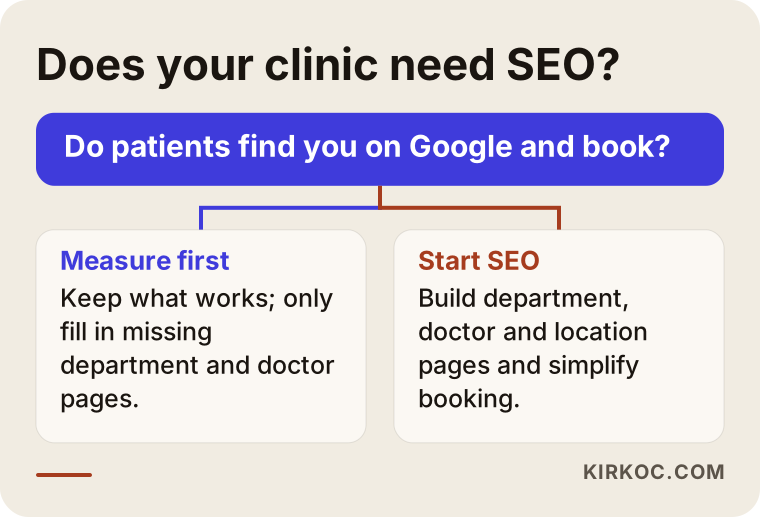
To be honest, not every facility needs SEO work right away. You can wait, or choose another route, in these cases:
- You are already full and capacity is the limit. There is no point drawing in more patients; solve capacity first.
- Nearly all your patients come from referrals or contracted partners. Google's share is small, and relationship management may matter more.
- You have no site yet, or it is very old. Building a solid site comes before SEO, so decide on the new site or redesign first.
- You need a fast, short-term campaign. SEO matures over months, and expecting results within a few weeks is unrealistic.
- Your booking process is not working. If calls go unanswered, more traffic only makes the problem bigger.
Do it yourself or hire a specialist
Some work you can do in-house, and some is better handed over.
Work you can do yourself:
- Keep the phone, address and hours in your business profile current.
- Reply to reviews politely and in general terms, without revealing any patient details.
- Collect up-to-date photos and short bios from your doctors.
- Write down the questions patients ask most often; that list is a rich source of content.
Work where a specialist makes sense:
- Finding which searches will actually bring you bookings.
- Finding and fixing the technical problems of the site.
- Building the department, doctor and location page structure and linking it together.
- Writing content that respects the rules, yet reads easily and uses the patient's language.
- Measuring results and updating the plan.
If you have a marketing or communications team, we can split the work: I set up the structure and the plan, and your team supplies information and approvals.
What to prepare before we talk
To make the first conversation productive, bring the following:
- The departments you most want to prioritize.
- A doctor list showing who sees patients at which site and on which days.
- Access details, or at least the addresses, of your current site and business profiles.
- The kind of patients you would like to see more of: a certain specialty, a certain site, international patients.
- Who has the authority to approve content.
- Who handles booking requests by phone, form and call center.
Frequently asked questions
How long does hospital SEO take to show results?
It depends on the state of the site, the strength of competitors and how many pages are published. SEO matures over months and does not behave like a quick campaign. Technical fixes and core pages move things first, then content and reputation work builds up. I do not guarantee any timeframe or ranking.
Which pages come first in medical center SEO?
I usually start with the departments expected to bring the most patients, then the doctors in those departments. In multi-location organizations the location pages come early too, because "near me" searches depend on them. The exact order is set in the written plan after the first review.
Does every doctor need a separate page?
Patients who arrive on a recommendation search for the doctor's name, so in most cases yes. Each page can be short; what matters is that the information is accurate and specific to that doctor. With many physicians it makes sense to begin with those who see the most patients and complete the rest over time.
Who is responsible for advertising compliance?
Final responsibility lies with the organization that publishes the content. I use a compliant, informative style and avoid outcome promises and medical advice, but I do not provide legal or regulatory counsel. Every piece goes through approval by your authorized person before it goes live. If a statement worries you, ask your compliance adviser.
Can I show patient reviews and before and after photos?
It depends on the applicable rules and on the patient's explicit consent, so one answer will not fit every case. If you are unsure, leaving them out is the safest path. Instead of showing reviews on the site, replying regularly and politely to the real reviews on maps and your business profile is often enough. Decide with your compliance adviser.
We have several locations. Do we need a separate website for each?
Usually not. One website with a separate page for each location is generally enough. Each location has its own address, phone, hours, departments and doctors, and its own business profile on Google. Separate websites mostly split your strength and make upkeep harder.
Should I choose SEO or paid ads?
They do different jobs. Ads stop when you stop paying; SEO builds up over time. Ads suit a fast, short-term need, while SEO suits lasting visibility. Many organizations use both. Ad management is not part of my service; I handle the SEO side.
Can SEO work for international patients in other languages?
Yes, but each language is its own content job. Translating and leaving it is not enough, because patients in another country type different searches and use different words. We decide together which language to begin with, after the first review and with your target patient group in mind.
If you would like to know which searches your facility is missing and which department and doctor pages are absent, get in touch with me for a first review. You can look at the scope on my SEO services page and then we can arrange a short call.