Your classrooms are warm, your teachers are excellent and your campus photographs beautifully. Yet when a parent types "private middle school near me" in the weeks before enrollment, someone else's page opens. In most cases the school is not the problem. The problem is that the parent cannot find the answer on your site, or Google cannot connect that answer to you. In this article I explain how SEO services for private schools work, written for the head of school, the board member or the owner who has to decide whether to hire help.
I am Ümit Kırkoç, an independent web designer and SEO consultant. I work alone and remotely. Below you will find how parents search, which pages earn their keep, what drives the cost of the work, how to compare proposals, and when you do not need any of this. I do not promise rankings, and you should be wary of anyone who does.
How a parent actually chooses a school
A private school is not an impulse purchase. It is a decision about a child's years, daily routine and the family budget, so it unfolds slowly and in stages. Search plays a part in almost every stage.
It starts with an idea. The parent has no particular school in mind and is weighing what kind of environment suits the child: small classes, strong languages, arts, sports, a faith or a teaching philosophy. Searches here are broad, such as "how to choose a private school" or "is private middle school worth it". Next comes research, and this is where geography takes over: "private high school near me" or the name of a town or neighborhood plus "private school". Then the shortlist. The parent opens three or four school websites and reads grade-level pages, looks at campus photos and checks reviews. Finally comes the tour request by phone, message or form.
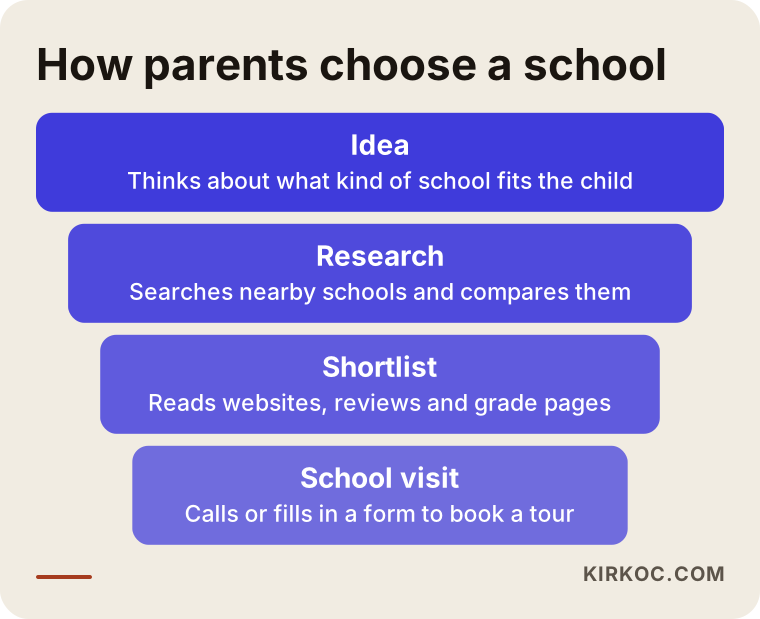
Two lessons follow. First, if parents only find you when they already know your name, you never enter the shortlist, because the shortlist is built from local searches. Second, once you are on the shortlist, the winner is usually the school whose site answers the parent's actual questions most clearly. SEO helps with both: being found, and being convincing once found.
One more detail. In middle and high school years the student often researches on a phone too, sometimes before the parent does. A site that loads slowly or reads badly on a small screen loses people quietly.
What parents type, and which page each search needs
School searches fall into four groups, and each group needs its own page. Putting everything on the home page means being weak at all of it.
Searches by school name come from people who already know you. The goal is simple: they should see your official site, your map listing and the right phone number at a glance. If an old announcement or a third-party page about you shows up first, you are losing a search you should have won.
Searches by area and school type are the most valuable. The parent does not know you yet but is looking in their neighborhood. The way to appear is a separate page for each campus with its address, access and character.
Grade-level searches use words like "preschool", "elementary", "middle school" or "high school". Each grade brings a different worry. Preschool parents ask about safety and care; high school parents ask about college guidance and counseling.
Admissions and reassurance searches close the decision: "how to apply to a private school", "school reviews", "open house dates". Sites that answer directly and keep dates current win here.
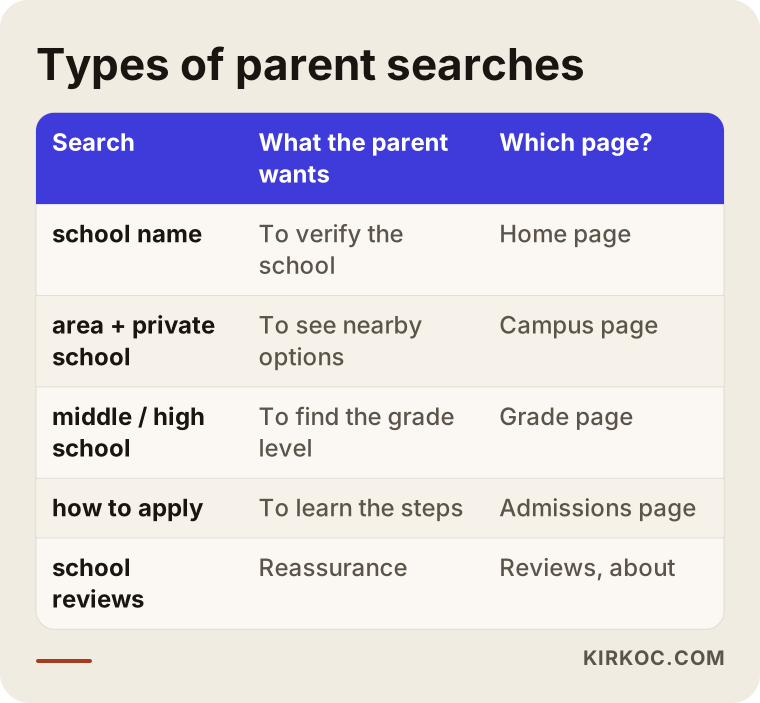
If a school has only a home page and a contact page, there is simply no page for Google to show in answer to area or grade-level searches. That is often the whole story behind a quiet admissions season.
Grade-level and campus pages: where the real work is
Many school websites behave like one long scroll: a welcome message from the head, an "About us" section, then a paragraph that covers every grade at once. It does not help the visitor, and it tells Google nothing precise.
The better structure is one page per grade level and one page per campus. The middle school page talks only about middle school. Which grades does it cover? What does a day look like? How are languages, counseling and parent communication handled? What are the admission steps? The page answers the questions in the order a parent asks them, and ends with one clear next step: book a tour.
A campus page puts place first. A full address, a map, directions, transport or bus information, the neighborhoods you serve and whatever is distinctive about that building. A school with several locations needs a page for each one. Otherwise a parent searching for the northern campus lands on a page about the southern one and moves on.
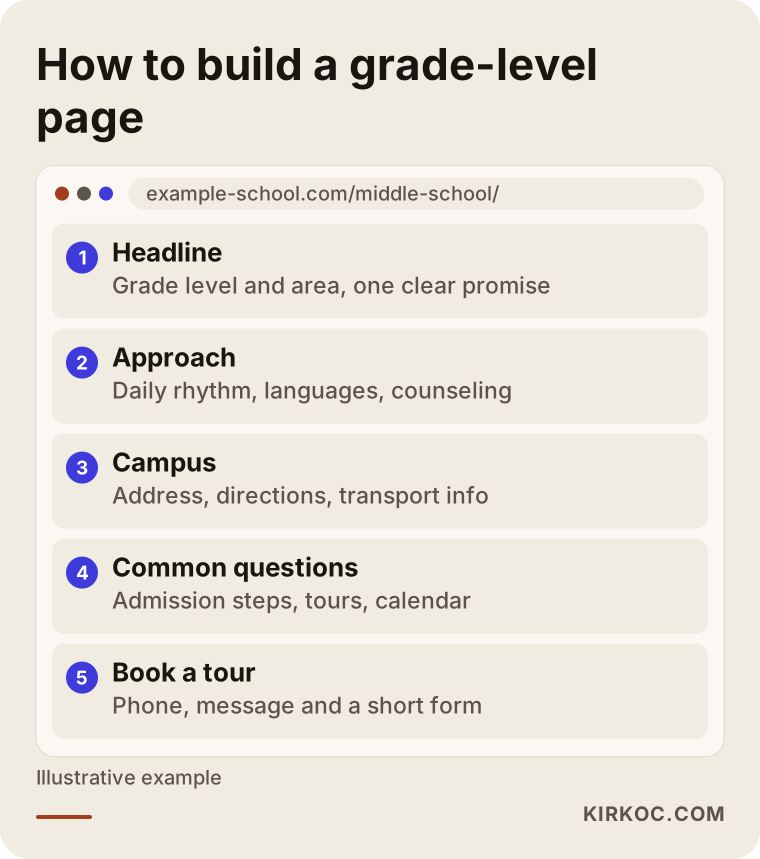
A few details I care about when I outline such a page. The headline names the grade level and the area, not just "Middle School". The copy is written the way a parent will read it on a phone, not the way a brochure reads. Photos carry short descriptions, because Google cannot understand a picture on its own. And each page offers one main action, such as call, message or book a tour, rather than five competing buttons.
I should also draw a line. Claims about academic results, rankings or awards belong to the school, and only you can confirm them. I will not invent them, and I will not put invented ones on your site. My job is to make sure the facts you provide are organized, findable and easy to read.
Standing out when ten schools share the same area
Where many schools compete for the same families, parents usually look at the first handful of results. Two tools matter most: your website and your Google business listing.
The business listing is what appears on maps and in the information box beside search results. It holds your address, phone number, hours and photographs. Everything in it must match your website exactly. If a phone number differs between places, both Google and parents get confused. This listing is among the easiest wins that schools neglect.
Parent reviews also collect there. Replying to them shows the school is active, to families and to Google alike. A calm, short, non-defensive reply to a critical review often builds more trust than a glowing one. A word of caution: do not pressure parents to write reviews and never buy fake ones. Platforms notice, and so do families.
On the website, pages that use area and neighborhood names naturally and contain real local information make a difference. Not "the best school in the region", but "buses run from these neighborhoods". That is what both Google and parents are looking for.
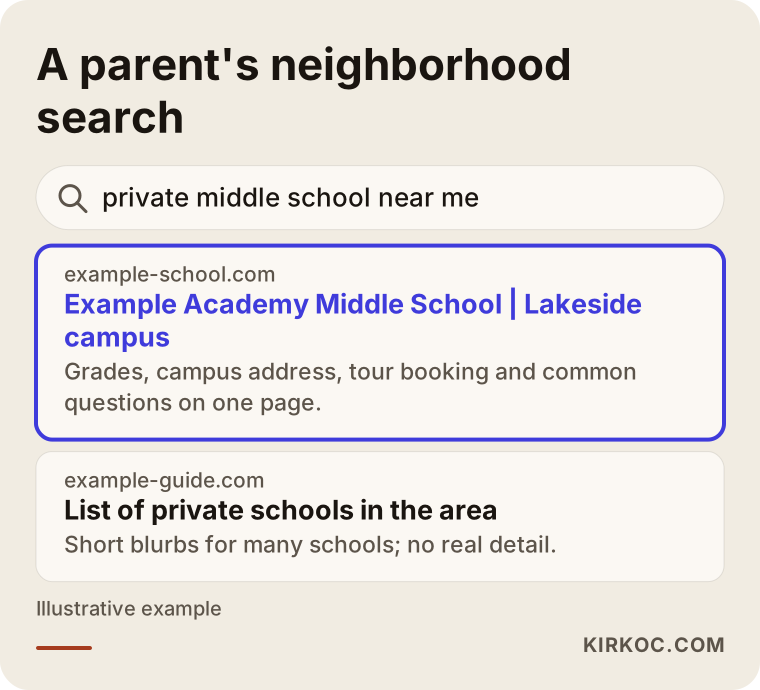
When a generic directory page and a school page that names the grade and campus in its title appear side by side, parents usually click the second. They can see from the title that the answer is there.
AI assistants and school choice
More parents now ask AI assistants as well as search engines: "Which bilingual preschools are near the city center?" Which schools get mentioned depends in part on how clear, consistent and understandable their websites are. A school that states its grades, address, approach and common questions plainly, and keeps those facts identical everywhere, has a better chance of being described correctly.
There is no guarantee. Answers differ between tools and between days. The encouraging part is that good SEO work already builds this foundation: clear pages, consistent information, plain language. You do not need a separate product with a new label.
Enrollment season: a few weeks that matter most
Interest in schools is not spread evenly across the year. Searches rise ahead of admissions and then fall away, so the SEO calendar should follow the school calendar.
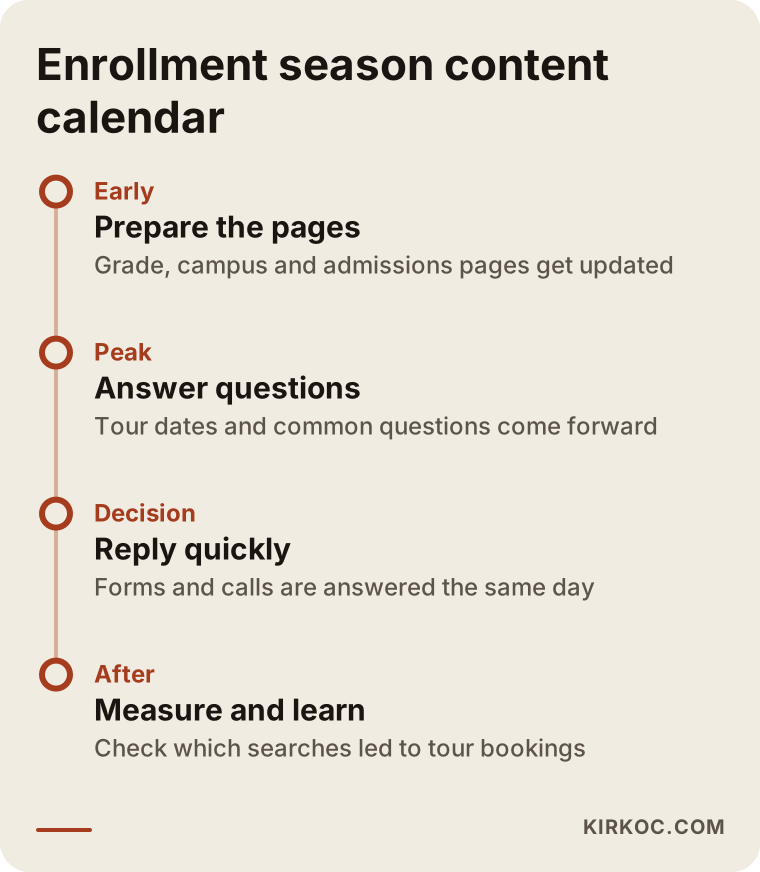
Well before the season, pages are prepared. Google needs time to find, evaluate and place a new or updated page, and a page published after the busy weeks begin misses most of them. That preparation includes reviewing grade pages, updating campus details, writing the admission steps plainly, removing last year's dates and expanding the common questions.
During the peak, content that answers parent questions comes forward: open house and tour dates, what an admissions conversation looks like, which documents are needed, who to contact about tuition. Whether tuition is published is the school's own decision. I help present whatever you choose to share in the way parents look for it.
At the moment of decision, speed matters. A parent who fills in a form and is not contacted that day often moves to another school. That belongs to the front office rather than SEO, but it directly shapes the outcome, so we talk about it too.
Afterward, we measure: which searches led to tour bookings and which pages stayed quiet. Next year's plan comes from that.
What the work includes and who it suits
I work within the scope described on my SEO services page. For a school it means the following.
I start with a site review: I go through the site end to end and list, point by point, why Google is holding you back. Then I research the right searches: what parents in your area actually type, and which of those searches will bring inquiries. I fix technical problems such as slowness, pages that do not open and poor phone layout. On the content side I strengthen your service pages and prepare articles that answer parents' questions. I watch competitors: I look at what the schools ranking above you do differently and adjust the plan. Each month I report in plain language what was done, where you moved up and what comes next.
This suits schools that have a site but get few inquiries from search, that do not want to depend entirely on advertising budgets in enrollment season, that watch rivals appear above them, or that bought SEO before and saw nothing.
To be clear about the split: you supply the educational substance; I help it reach the right parents. I do not manage advertising campaigns, and I will not produce claims only the school can verify.
What drives the cost, and how to read a proposal
I do not quote numbers in articles because they vary too much from school to school. These factors decide the size of the work.
The number of grade levels and campuses comes first. A single campus with two stages is a different job from a multi-site school. The condition of the current website comes second: a technically sound site and a slow, tangled one are far apart. Third is the amount of new pages and content. Fourth is competition: a dense area with many ambitious schools generally takes longer. Fifth is duration, because SEO builds over months and is not a one-time task.
When you receive a proposal, check these things. Is what will be done written down? "We will do SEO" is not a proposal; "these pages will be prepared, these technical issues fixed, this monthly report delivered" is. Is the first three months laid out? How often and in what form do reports arrive? Are your own tasks, such as photos, information and approvals, stated plainly?
Some red flags: a guaranteed first place, promises of a flood of new students, undisclosed methods, contracts that keep your site access from you, and reports that amount to "we are working on it". Nobody can guarantee what Google will do.
Agency, freelancer or in-house: comparing your options
Schools usually weigh three routes: a large agency, an independent specialist, or a staff member. Each has its place.
A large agency can make sense when you want many channels managed together, such as advertising, social media, video and SEO. It is worth asking who will actually do the SEO, who you will talk to and where the work gets handed off. With an independent specialist the contact is clear; in my case the person you speak with is the person doing the work. The trade-off is the limit of one person: I do not run large multi-channel campaigns alone. An in-house staff member is invaluable for daily updates and announcements, but search optimization is a separate skill.
When comparing, ask whether they have worked for schools or other long-decision businesses, whether the proposal includes a sample plan, whether they explain things in language you understand, whether your site and content stay yours, and what happens when the contract ends. If you ask for references, ask for real ones and check them yourself.
Common mistakes on school websites
I meet the same problems again and again.
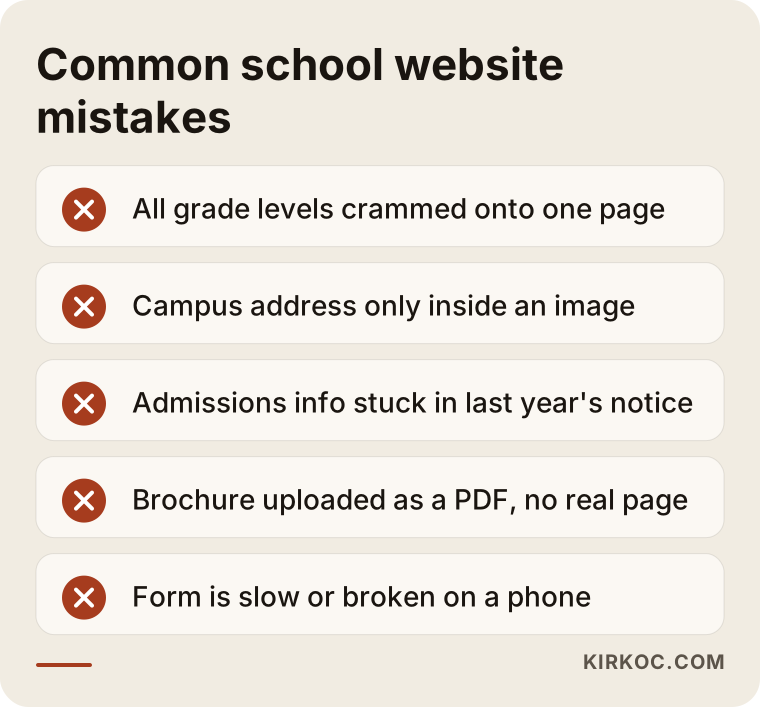
The first is putting every grade level on one page. The second is putting the address only inside an image; Google cannot reliably read text in a picture, and neither can a screen reader. The third is leaving admissions details in last year's notice, so a parent who sees old dates may assume you are not enrolling. The fourth is uploading the brochure as a PDF and never building a real page. PDFs open awkwardly on phones and tend to perform weakly in search. The fifth is a form that is slow or broken on a phone.
There is also an invisible mistake: launching a redesigned site without redirecting the old addresses. Years of earned visibility can disappear overnight. If a redesign is planned, SEO belongs in the conversation from the very beginning.
Suppose: two hypothetical scenarios
These two examples are invented for illustration. They do not describe a real school or client.
Suppose there is a private school with two campuses, one downtown and one on the edge of town. The site covers every grade and both campuses in one long "About" page. When parents search for the town plus "private middle school", the site does not appear, and where it does, it is unclear which campus offers which grade. The planned work: split the grade levels into their own pages, build a page per campus with address, access and facilities, align the business listings with the site, and move the admission steps to a plain page. No result is promised, but for the first time the information parents want sits where Google can read it and where parents can find it quickly.
Suppose a small boutique preschool with one location, a limited number of places and a waiting list built by word of mouth. Its site is a single introduction page. A large SEO program would probably be unnecessary. A sensible plan is a correct business listing, one well-written page and a short common-questions section before admissions. Telling a school like that "you do not need a big project right now" is the honest answer.
When you do not need this service
Not every school needs SEO. If you fill every place each year, keep a waiting list, have no growth plans and families reach you through personal recommendation, search investment may not be the priority yet. The basics are still free and worth doing: a healthy site, an accurate business listing and current admission information.
If your site is very old and breaks on phones, the site itself may need rebuilding before SEO makes sense, and I would tell you that plainly. The same goes for a brand-new school with nothing in place: a solid site and a correct listing come first.
Do it yourself or hire a specialist
Some things your school can and should do alone: keep the listing accurate, reply to reviews, update admission dates, refresh campus photos on a schedule, and write down the questions parents ask so the site can answer them. This takes discipline, not an expert.
The work to hand over is the more technical and time-consuming part: finding which searches bring inquiries, diagnosing technical issues, structuring grade and campus pages, following competitors and measuring results. Your administrative staff rarely has room for this during admissions.
My general advice: the school keeps up the routine, and the specialist builds the plan and the structure.
How we work together
The process has five steps, and each moves forward in writing.
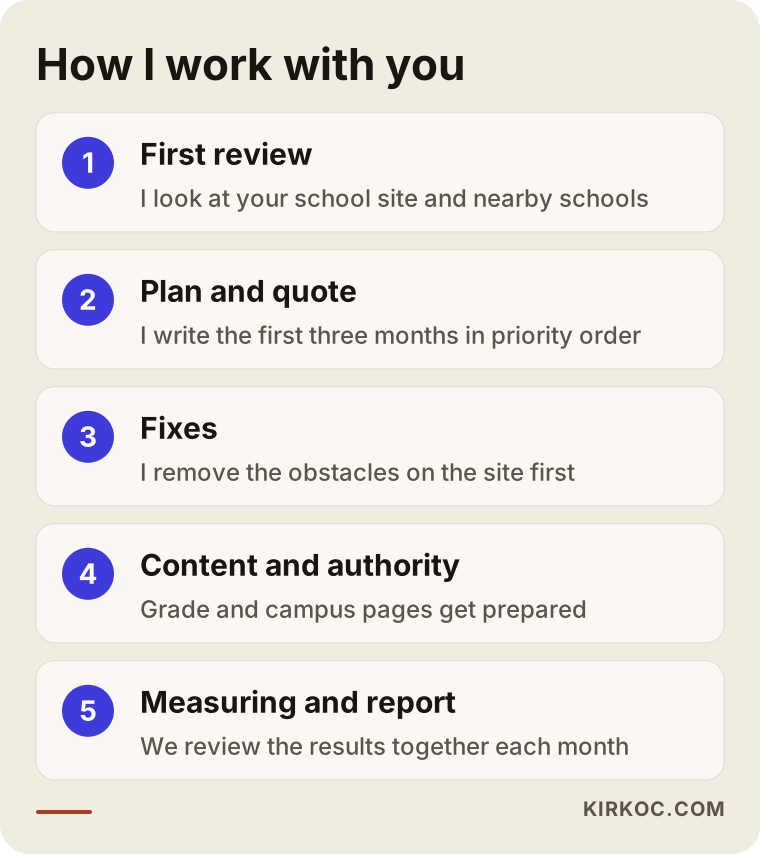
First is a preliminary review: I look at your site and the schools around you and tell you where to begin. Second, I present a plan and a quote, laying out the first three months in priority order. Third come the fixes: I remove the obstacles on the site first, because they give the fastest effect. Fourth is content and authority: pages and articles for the targeted searches are prepared, and your site's standing is strengthened. Fifth is measuring and reporting: each month we review the results together and update the plan.
I work remotely, and meetings and messages happen online. What I need from the school is usually access, accurate and current text for each grade level, campus photographs and one person who can decide. In institutions with longer approval chains, this is the slowest part, so it is worth raising at the start.
Frequently asked questions
Will SEO increase our enrollment?
I cannot promise a number. SEO helps the right parents find you and see what they are looking for on your pages. Turning that into inquiries, tours and enrollment depends on your school's credibility, how quickly you respond and the visit experience. SEO opens the door; the school decides what happens inside.
How long until we see results?
It depends on your current site and local competition. Technical fixes tend to show effects sooner, while new pages and content build over months. That is why starting well ahead of enrollment is far more comfortable. I will not promise a date or a position.
Do we really need separate pages for each grade and campus?
Usually yes, because parents search for one grade and one area at a time. One crowded page becomes hard to read, and Google cannot tell which search it should answer. A very small school with one campus and one stage may do fine with a single strong page.
Is advertising better than SEO?
They work differently. Advertising stops when the budget does; SEO builds slowly but lasts. If enrollment is only weeks away, ads can provide quick support. Over the long run, strong pages and an accurate listing give you a lasting base. Many schools use both. I do not run advertising; I work on the SEO side.
Do parent reviews matter that much?
Yes, particularly on your business listing. Parents look at other families' experiences when deciding. You cannot delete reviews, but you can answer them. A calm, respectful reply speaks to the reviewer and to the next family reading. Do not buy reviews; there is an ethical and a practical price.
Can you get our school named by AI assistants?
I cannot guarantee it, since answers vary by tool and day. What I can do is make sure your information is clear and consistent on your site and elsewhere. That is already part of good SEO and raises the chance of your school being understood correctly, in search and in AI answers alike.
Do we have to replace our current website?
Not always. I review it first. If it is technically sound and only lacks grade and campus pages, adding pages may be enough. If it is slow, broken on phones or impossible to edit, I would have to recommend a rebuild. That decision comes after the review, so you are not pushed into unnecessary spending.
What do you need from our school?
Access to your site and business listing, accurate and current information about grades and campuses, photographs, and a person who can approve decisions. Because I work remotely, in-person meetings are not required; messages and online calls are usually enough.
If you would like parents to find your school more clearly in the weeks before enrollment, I can look at your site and the schools around you and tell you where to start. Write to me through the SEO services page or the contact form, and we can shape a plan around your admissions calendar.