"Will the money I put into SEO actually come back?" It is the question almost everyone asks before hiring help, and it is a fair one. The invoice is clear, while the payoff can look foggy. The good news is that you do not have to guess. A handful of simple numbers is enough to work it out. When I take on SEO services for a business, I build this calculation with the owner right at the start, because heading into a project without knowing what we are measuring helps no one.
Start with what one customer is worth to you
The first input to ROI is not traffic. It is customer value. Ask yourself: when I win a new customer, how much profit do they leave me with on average? If you sell one-off jobs, that is the revenue from the job minus what it cost you to deliver. If customers stay for years, as with an accountant, a maintenance contract or a subscription, it is the total profit from that relationship.
If you do not know this number, you cannot know what SEO is worth either. Sitting down with your bookkeeper for ten minutes to work it out is the most valuable step in this whole article. I cannot give you your number, but we can build the frame for it together.
The frame: four variables
The logic is a simple chain: inquiries from search, inquiries that turn into sales, profit per customer, and total spend. Here are the variables as letters:
- A: the number of inquiries that came from search (forms, calls, WhatsApp messages)
- B: the share of those inquiries that became paying customers
- C: the average profit one customer leaves you
- D: the total you spent on SEO in the same period
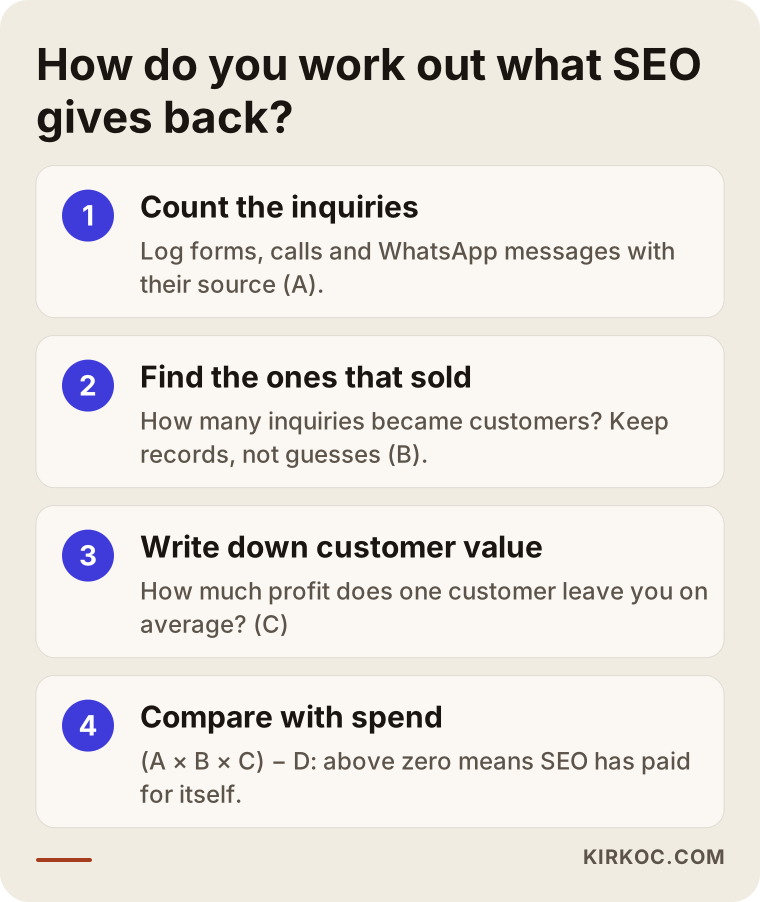
First you find the number of customers: A × B. Then the return: (A × B × C) − D. If the result is above zero, SEO has paid for itself. If you prefer a ratio, divide that result by D.
Notice what is missing: "what is my ranking" and "how much did traffic grow." Rankings and traffic are signposts along the way, not the destination. I cover which indicators to track and why in this piece on measurable SEO goals. This article stays on the money and the decision.
The D variable: what counts as spend?
D looks like the easy part of the formula, yet this is where people slip too. You write down the invoice from your consultant or provider and forget the rest. The real cost of SEO has several parts.
Items to include
- Service fee: What you pay the consultant or provider.
- Content and design costs: New pages, photography, a tidied-up site.
- Technical fixes: If your site is slow or broken on phones, repairing it is part of the SEO investment.
- Your own time: Answering questions, supplying information and approving content all take time on your side too.
Counting time as a cost can feel odd at first. But for a lawyer, a physician or an accountant, an hour spent here is an hour not spent on paying work. Ignore it and you will flatter the return.
Keep the periods matched
D and A must cover the same period. Compare three months of inquiries with a full year of spending, or the other way around, and the result means nothing. Also, this year's spending sometimes produces next year's inquiries, so look at how consecutive periods develop as well as any single one.
You cannot calculate anything without knowing where inquiries come from
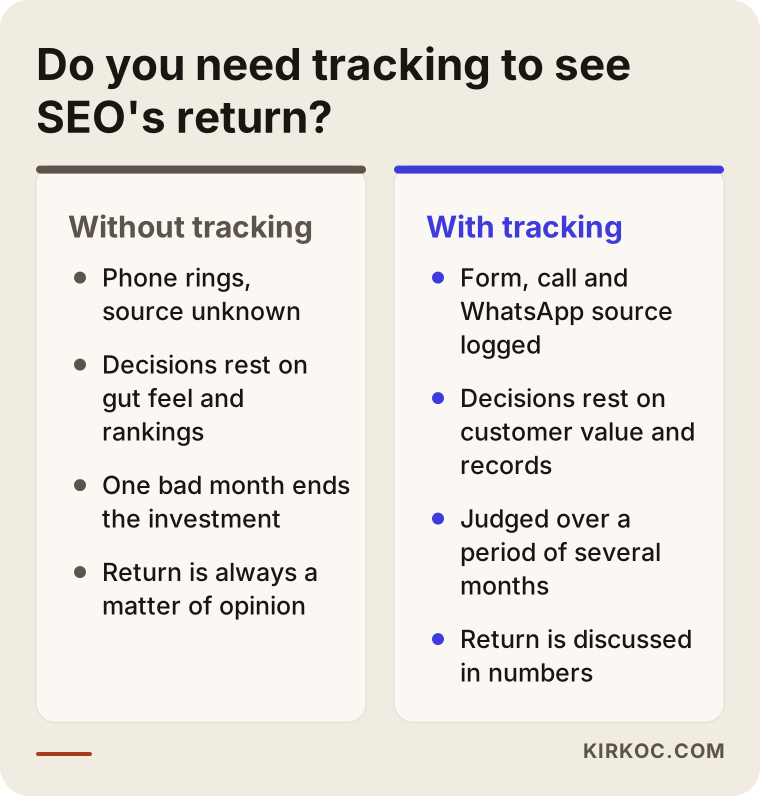
Variable A is the weakest link in most businesses. The phone rings, someone says "I found you online," but nobody records which channel it was. SEO then looks either better or worse than it really is.
Here is what I usually set up:
- Forms: record the page the form was sent from, together with how the visitor arrived.
- Phone: count taps on the phone number on your site. On incoming calls, ask "How did you find us?" and write the answer in a notebook.
- WhatsApp: track clicks on the WhatsApp button, and note the source in the first reply.
- Walk-ins: ask the same question at the first appointment or meeting.
None of this needs advanced skills. Free analytics tools and a notebook you actually keep up are enough for most small businesses. It will not be perfect, since someone may find you through a search and still name another channel. But a roughly right measurement beats no measurement by a wide margin.
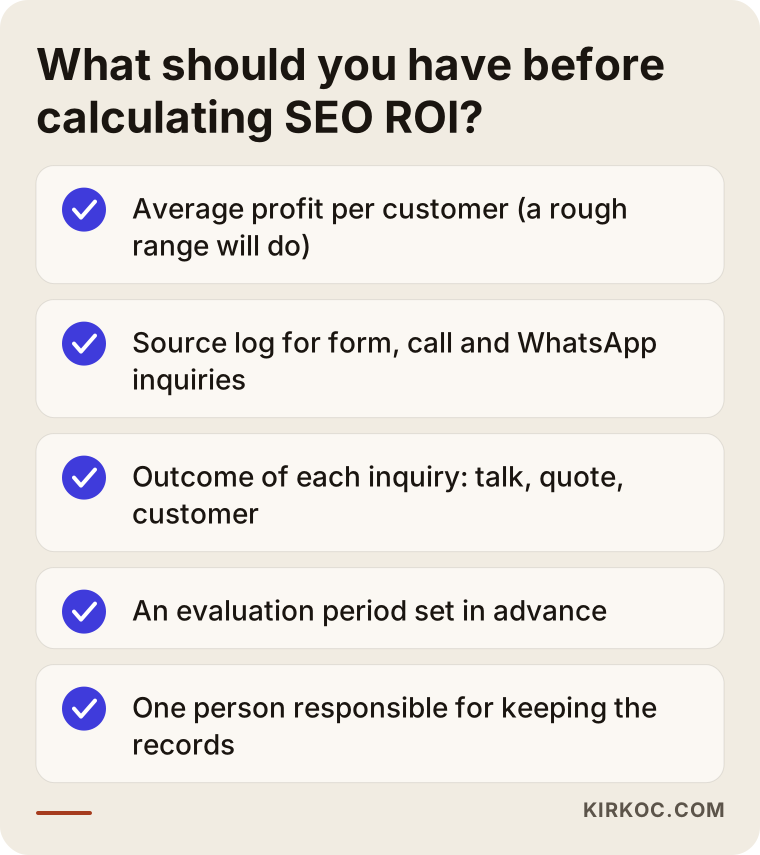
What you need in hand before you start calculating
Even with the formula ready, missing inputs make the result meaningless. The list below sums up the minimum preparation I ask of myself and my clients before sitting down to an SEO ROI calculation. You do not need to fill every item perfectly; an empty item simply tells you what to do first.
What each item means
Customer value: You should know the profit one customer leaves you, at least as a rough range. An exact figure is not required; "never below this, never above that" is enough to begin.
Source log: How form, phone and WhatsApp inquiries arrived should be written down somewhere. Trusting memory does not work here, because in a few months nobody remembers.
Outcome tracking: Also record what happened to each inquiry: spoke, sent a quote, became a customer, dropped out. Those lines are the raw material for B.
Evaluation period: Set a date up front, such as "we look again in six months." Without one, every weak month reopens the whole debate.
A responsible person: Who keeps the records? If that is not settled, the list is half empty by the end of the first month.
Be honest about how many inquiries become sales
Variable B is often a result of what happens inside your business, not of SEO. Do you reply the same day? Do you give clear information about pricing or booking? Winning a hundred inquiries through search and answering half of them late quietly drains the return.
Another point: some inquiries were never a fit. People just browsing, people outside your budget or your area still count in A. Splitting them into "relevant" and "not relevant" makes B more realistic, and it shows which searches actually bring you work. That insight then guides the months that follow.
So in the first months, I suggest collecting real data rather than guessing B. After three months you can say "of this many inquiries, this many became customers," and you are deciding from a record, not a hunch.
Two concrete scenarios: same formula, different outcome
To see how the formula behaves in different businesses, here are two examples. I am leaving out names and figures; the point is the logic.
Scenario 1: an accounting firm with long-term clients
An accountant came to me saying, "I paid for SEO but I see nothing." First I asked about the math: a client stays with the firm for years, so C was actually high. But nobody had tied that to SEO, because the owner never wrote down where new clients came from.
I started by tidying the phone and form records, and we made "how did you find us?" a standard question in the first meeting. After a few months the picture sharpened: search brought few inquiries, but a high share of those became clients, because people were searching for exactly this service.
The result? SEO was not bringing "lots of traffic," but because a small number of inquiries turned into long relationships, the return was meaningful. It was invisible without measurement. It was not a certainty, but it was enough to decide on, and they chose to continue.
Scenario 2: a small shop selling one-off purchases
In the other case, a small shop sold products. Customers bought once, so C was low, but inquiry volume was high. The owner saw the rankings and was pleased, yet the change at the till was unclear.
When I looked, most of the traffic came from people looking for information with no intention to buy. So A looked big while B was very low. We changed the ranking goals: more room for searches that named a product or showed buying intent, and general information pages moved to the background.
The result stayed modest: the visitor count was about the same, but the intent of those arriving became more accurate. The shared lesson of the two cases is this: the formula is the same, but which variable is weak differs from business to business. In one the problem was missing measurement, in the other the wrong keywords.
Think about which of the two is closer to your own business. If your customer value is high and inquiries are few, your priority is measurement and conversion. If inquiries are plentiful and sales few, your priority is capturing buying intent with the right terms. Asking the right question is often half the solution.
Returns that do not fit the formula
The (A × B × C) − D calculation is deliberately plain, but not everything SEO leaves behind fits those lines. Do not force these into numbers, yet keep them in mind when you decide.
- Trust: Someone who sees you consistently when searching for a service arrives at the first conversation more convinced. That can lift B, though it is hard to measure separately.
- Accumulation: A page you publish keeps bringing inquiries months later. This is exactly where it differs from ads; part of today's spending is written against the next period's demand.
- Less reliance on ads: As organic inquiries grow, the need to lean on an ad budget may shrink. That will not show up as direct savings, but it changes how your risk is spread.
- Quality of customers: People who arrive through the right terms are often better informed and focus on the service rather than on haggling.
Be careful when counting indirect returns. Turning them into big numbers to justify the investment spoils your measurement discipline. I prefer to note them as a "bonus" and tie the decision criterion to measurable inquiries and customers.
Patience: the return does not arrive overnight
With SEO, spending starts on day one, while inquiries usually become noticeable after a few months. In the early months D is large and A is small, so the math looks negative. That is normal. The mistake is stopping at this stage. When you stop paying for ads, the inquiries stop. With SEO, the work accumulates and can eventually bring more inquiries at a lower cost.
I still cannot guarantee a result, and no honest consultant can. Search engines decide rankings, and your competitors are working too. What I can do is focus on the right work, report progress clearly every month, and tell you if the data says this investment is not working.
So judge ROI over a full period, say six months or a year, not a single month. Seasons, holidays and your industry's own rhythm can make any one month look better or worse than it is.
Reading the result: three possible pictures
After a few months of data, you will usually land in one of three pictures. Each calls for a different step.
The return is above zero
The investment is paying for itself. Rather than rushing to double the spend, look at which pages and which searches worked and lean into those. If growing makes sense, do it where the signals are strongest.
The return is borderline
If the result is near zero, you have enough data to look for the reason. Usually either inquiries are few or conversion is weak. At this point, instead of stopping or carrying on blindly, it is better to pick one concrete improvement for the next period.
The return is below zero
If the period is long enough and the measurement is sound, this too is a valuable answer. People in your field may not be searching for this service, competition may be too high for you, or another channel may suit you better. An honest consultant will not tell you to carry on in that case; I will not.
What your report must show
Whichever picture you land in, the monthly report should answer a few questions plainly. If a report buries you in numbers, that is a warning sign in itself.
- Number and source of inquiries: Up or down against last period, and from which pages?
- What became of them: How many led to a conversation, how many to a customer? You fill this in, not whoever prepares the report.
- The next step: What will be done next month, and why?
Other indicators, such as impressions, average position and clicks, are supporting information. They help you grasp direction; the decision comes from the three questions above. If you can read one plain sentence at the end, like "this month went well or badly because of this," you are on the right track.
Step by step: how we set up the ROI calculation
If you work with me, the order usually runs like this. If you do it yourself, you can follow the same sequence.
1. Find the customer value together
In the first meeting we talk about average customer profit, split by type of service. If services are not equally valuable, I do not squeeze them into one number; the ones that earn most are kept apart.
2. Set up the measurement
I set up form, phone and WhatsApp tracking; on your side a simple log or spreadsheet is kept. This usually takes a few days, and every later decision rests on it.
3. Take the starting snapshot
Before the SEO work begins, we record the current number of inquiries and their sources. Without this "before" picture, no one can later prove an improvement.
4. Read monthly, decide by period
Each month I prepare a short report: inquiries, which pages they came from and what changed. But for decisions we look at three- or six-month periods; monthly reports only show direction.
5. Decide on what the data says
If the data looks good, we go deeper. If it is weak, we look at why: wrong keywords, a weak site, or inquiries that do not turn into sales? If needed, I will not hesitate to say "this investment is not working for now."
Common mistakes
I see the same mistakes again and again in consulting. Most of them are noticed only after the money is spent.
- Mistaking ranking for return: Being on the first page is good news, but not earnings by itself. What matters is whether that ranking turns into inquiries.
- Not recording the source: Later there is no answer to "did SEO work?"
- Deciding too early: Looking at the first two months and cutting the investment throws the accumulation away.
- Counting every inquiry as equal: Someone asking for a price in passing is not worth the same as someone writing with serious intent.
- Neglecting the sales process: Answering late throws away what SEO brought you, with your own hands.
- Mixing channels: If ads, social media and SEO all run in the same period, their effects overlap. If you cannot separate them, note that honestly.
What you can do yourself and what to leave to an expert
You can do most of this calculation on your own. Knowing what to do and what to hand over saves both money and time.
What you can do yourself
- Work out the average profit of a customer with your accountant.
- Ask "how did you find us?" on the phone and in first meetings.
- Keep incoming inquiries in a spreadsheet and mark their outcomes.
- Reply to inquiries quickly and clearly.
What to leave to an expert
- Setting up form, phone and WhatsApp click tracking correctly in analytics tools.
- Separating searches that carry buying intent and steering the work toward them.
- Interpreting technically why the data moves the way it does.
- Fixing the site's speed, mobile and structure problems.
In short, records and sales should sit with you, setup and interpretation with the expert. If the two do not meet, the ROI calculation hangs in the air.
What the split looks like in practice
In most businesses the biggest gap is not the expert's skill but records left half finished. I do the setup, prepare the report and explain what the numbers mean; but picking up the phone and asking "how did you find us?" is for you or your team. Once that small habit settles in, the calculation gets sharper day by day. If it does not, even the best setup runs on incomplete data and the same argument restarts at every meeting.
Frequently asked questions
Is SEO worth it for a small business?
Usually yes, if your profit per customer is solid and people search for what you offer. But it depends on your numbers. Know C and B first, then decide. If your budget is tight, read how to start SEO on a small budget.
Are ads or SEO more profitable?
They work differently: ads are fast but stop when you stop paying, SEO is slower but builds up. Which one is more profitable for you is something the same formula answers, using your own data.
Do I need to collect the numbers myself?
The habit of keeping records is yours; the setup and the interpretation are mine. We put the tracking in place together during the first weeks.
How long should I wait to judge SEO ROI?
There is no fixed answer; it varies by industry, competition and the current state of your site. I generally suggest deciding on at least one period, meaning several months, up front. Before it ends, saying "it isn't working" or "it's working perfectly" is premature.
How do I connect phone and WhatsApp inquiries to SEO?
Two ways: count clicks on the phone and WhatsApp buttons on the site in an analytics tool, and ask "how did you find us?" in the first conversation. Using both gives the sturdiest result; each fills in what the other misses.
What if I do not know my customer value?
Start with a rough range. Look at last year's customers and, with your accountant, estimate how much profit one customer leaves on average. You do not need an exact figure; you correct it with real data over time.
What should I do if I see no return from SEO?
First look for the cause: are inquiries not arriving, or are they arriving and not turning into sales? The first points to a problem on the SEO side, the second to the sales process. Whichever it is, the fix starts there; make that distinction before blindly raising or cutting spend.
Can I separate the effect of SEO from advertising?
Not perfectly, but you can get close. Ads and organic traffic show as separate channels in analytics tools, yet they influence each other. The honest approach is to track them on separate lines and note the shared effect.
What to do before you decide
Three things are enough: find the average profit of one customer, start recording where inquiries come from, and decide in advance how long you will give the investment before judging it. With those in hand, SEO is no longer a matter of faith but an investment you can calculate. If you would like to go through it with your own numbers, you can reach me through the SEO services page.