"I'll get a company to build the site and find someone else for SEO later." If that is your plan, you're in good company. Most business owners treat these as two separate purchases. But before you decide, know this: the two jobs are closely linked, and if the order is wrong you can end up paying for the same website twice. I'm a solo SEO consultant and web designer based in Istanbul, and in this article I compare both routes honestly. I'll be upfront about my bias: since I offer SEO services myself, I often find buying both together more sensible, but I'll also explain when that isn't the case.
Typical Problems When You Buy Them Separately
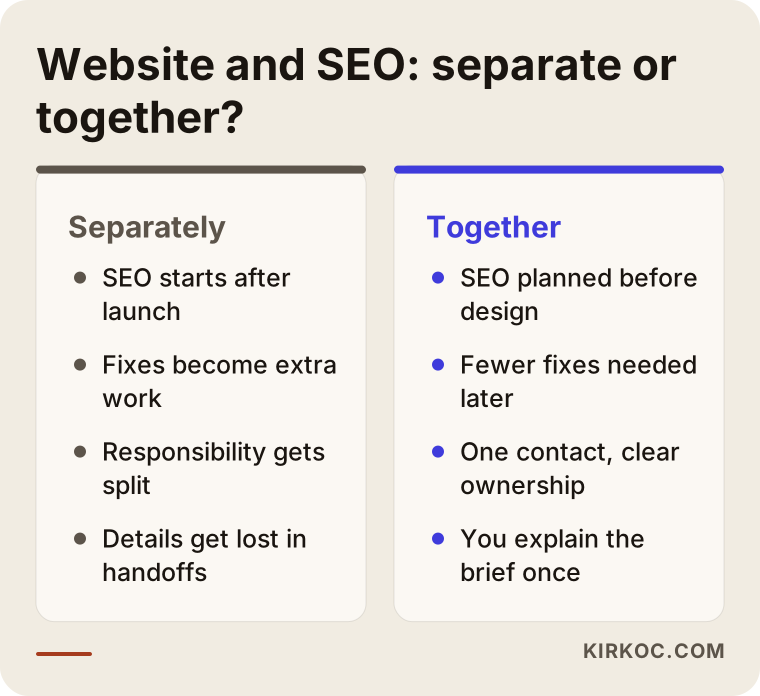
Here is how it usually works. The web designer delivers how the site looks and works. The SEO specialist makes sure the site can be found on Google. If these two people don't know each other, they typically meet for the first time after the site is live. In my work, this is the pattern I see most often:
- Rework after launch: The SEO specialist looks at the site and finds messy page addresses, poorly structured headings, or pages hidden from search engines. Fixing them means going back to the designer, which is often billed as extra work.
- Split responsibility: If the site is slow, the designer says it's not an SEO issue, and the SEO specialist says it's a development issue. The problem stays open, and you're the one waiting.
- Lost redirects: If you already have a site and the old addresses aren't properly redirected to the new ones (a setting that sends visitors from an old link to the new page), the visibility you built up can disappear. Often nobody is clearly in charge of this.
- Content that doesn't fit the structure: The SEO specialist says which topics need their own page, but the design left no room for them. Content then gets squeezed in awkwardly.
For a deeper look, read my article on why SEO must be planned from the start when building a website. This piece focuses on the buying decision instead.
The Upsides of Buying Them Together
The biggest gain from working with one person or one team is that decisions get made at the same table. Page structure, headings, addresses and where content goes are settled during design, so far less needs fixing later.
- One contact: When something goes wrong, you know who to ask.
- Less lost information: You don't pass details from one person to another, and the brief isn't explained again and again.
- Clearer planning: You know from the start which pages will be ready on launch day and which content comes next.
- More predictable costs: Fewer "extra work" surprises, because the SEO requirements are part of the first quote.
There are no guarantees, of course. Whichever route you pick, ranking well on Google also depends on time, regular content and how competitive your field is. Buying together doesn't guarantee a result; it just makes it easier to lay the right foundation.
Two Different Businesses, Two Different Stories
Rather than stay theoretical, here are two situations I run into often. I keep names and details deliberately general; the point is to see which one looks closest to yours.
Scenario 1: A newly opened architecture studio
The owner of an architecture studio came to me before the first site was built. She had a designer's quote in hand and a simple question: "Will this site make me findable on Google?" When I read the quote, it had no page list at all, just the words "corporate website."
First we talked about who the studio serves, which cities it works in, and what its clients actually type when they look for an architect. Then, together with the designer, we set up the page structure: a separate page for each type of service, individual pages for projects, and contact details written the same way everywhere.
The result? When the site went live, nothing had to be redone, and the designer was glad about the questions I raised because they now knew why each decision was made. I did not promise rankings, and it would not have been honest to. But the studio started on day one with the right foundation and a site ready for content work.
Scenario 2: A furniture workshop with an old site
The second business had a site that had been online for years and looked its age. The owner had decided to rebuild it from scratch, the design was nearly finished, and I joined at that point. The new design was lovely, but almost none of the old page addresses matched the new ones.
The old site had a handful of product pages that people actually searched for, and they brought the workshop steady visitors. I looked at which pages were doing the work, carried their addresses and content over to the new site, and prepared a redirect list for the remaining old addresses. We handed that list to the designer, who put it live with the launch.
The lesson here: even when the design is finished, the process can be rescued, but the earlier you step in, the less work it takes. To keep the outcome in proportion, there was no major drop in visitors after launch. I see that not as a success story but as a loss that was prevented.
What to Watch for When Buying Together
Not every "package" is a good one. If you decide to buy both together, check these points:
- Real experience in both areas: Some companies list SEO as an add-on line item. Ask about past projects and what exactly they did.
- A written SEO scope: "SEO-friendly" alone says nothing. What will be done should be listed item by item.
- Ownership of the site: The domain, hosting and admin access should be in your name. If you want to switch providers later, the door must stay open.
- A clear post-launch plan: The work doesn't end when the site goes live. Agree up front when SEO work starts and how it will be reported.
Buying separately has its place too. If your site is already built, live and working well, adding SEO on its own is perfectly normal. And if you work with a highly specialized design team, it can work to keep SEO separate, as long as the SEO consultant joins at the start of the project. What matters is that neither side works in the dark about the other.
Decision Guide: Which Situation Sounds Like Yours?
The right path differs from business to business. The four situations below cover the pictures I see most often. Find yourself in one of them and proceed accordingly.
You have no site and are building your first one
This is where buying together gives the clearest advantage. There is nothing to undo yet, so the page structure and addresses can be set up correctly from zero. When you talk to a designer or a specialist, simply put SEO on the table in the very first meeting.
You have a site, but it performs badly
First work out why it falls short. Sometimes the problem is the design, sometimes slowness, sometimes a lack of content. Before deciding on a rebuild, check which pages of the current site bring visitors, because keeping those on the new site is very valuable. Sometimes fixing the existing site is enough and a rebuild is unnecessary.
Your site is good, but nobody finds it
If you like the design but visitors don't arrive, a new site is most likely not the answer. Here it makes sense to buy SEO as a separate, focused job. Just check at the start whether the structure of the site allows SEO work.
You run several languages or several locations
Buying separately is the riskiest path here. How language versions connect, which location gets which page: these decisions are the foundation of the design. In such projects, involving SEO in planning from the beginning clearly reduces the cost of fixing things later.
If you aren't sure about your own situation, we can clarify it together in a first conversation. Sometimes the answer is "you don't need this service," and I will tell you that openly.
Step by Step: How a Joint Project Unfolds
In a project where the site and SEO are built together, the order of work matters. The sequence below is a sensible roadmap whether or not you work with me; if you're going ahead with your own designer, use it as a checklist.
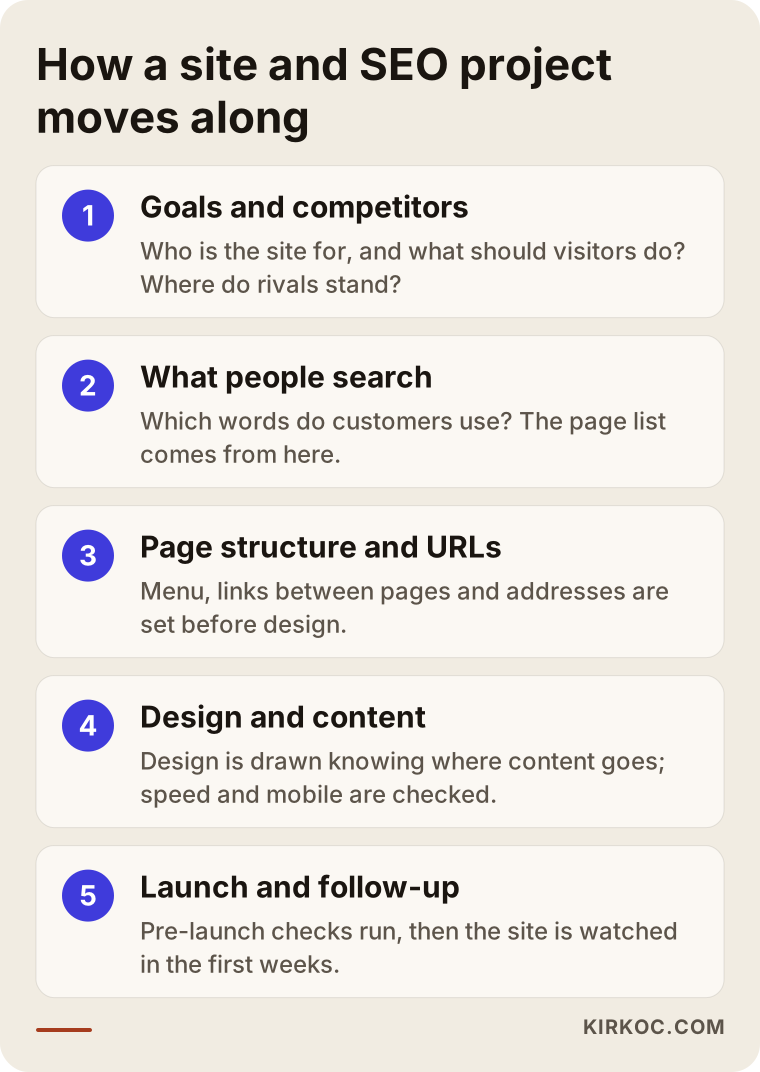
1. Start with goals and competitors
In the first meeting we talk about who the site is for, what you want visitors to do, and how competitors look. Not a single line of design happens at this stage. If the goal isn't clear, every later decision turns into a guess.
2. Understand what people search for
I look at which words your customers use to find a business like yours. This shapes the page list: which service needs its own page and which question needs an answer become clear here. The terms an owner uses are often different from the ones customers use. A company may say "corporate lighting solutions" while customers search for "ceiling lamp for my office." That gap directly affects page titles and copy, and skipping this step is, in my view, the most expensive shortcut. Looking at real searches takes a few hours but makes every text written in the following months more accurate.
3. Set the page structure and addresses
What goes in the menu, how pages link to each other and how addresses are written are decided before design. If you already have a site, which pages to keep is settled here too. These are the decisions that are easiest to change on paper and hardest to change after launch.
4. Design and content move together
During design, you already know where the content will sit; headings, images and contact areas are placed accordingly. Fast loading and comfortable reading on a phone are watched at this stage as well. I keep checking back and forth at this step, with the designer or within my own work.
5. Check before launch
Before the site goes live, these are checked: are the pages that should be open to search engines open, have old addresses been redirected, are titles and descriptions in place, do the forms work? Problems found here are far easier to fix than the same problems found after launch, when they are also more visible.
6. Follow up after launch
In the first weeks after launch I watch how search engines read the site. If something unexpected shows up, it is handled right away. After that, content and regular work continue on a schedule that fits your budget, and reports stay simple and readable.
What to Ask for in the Quote
Whichever route you choose, ask for the following to be written into the quote. Don't assume anything that isn't in writing will be done.
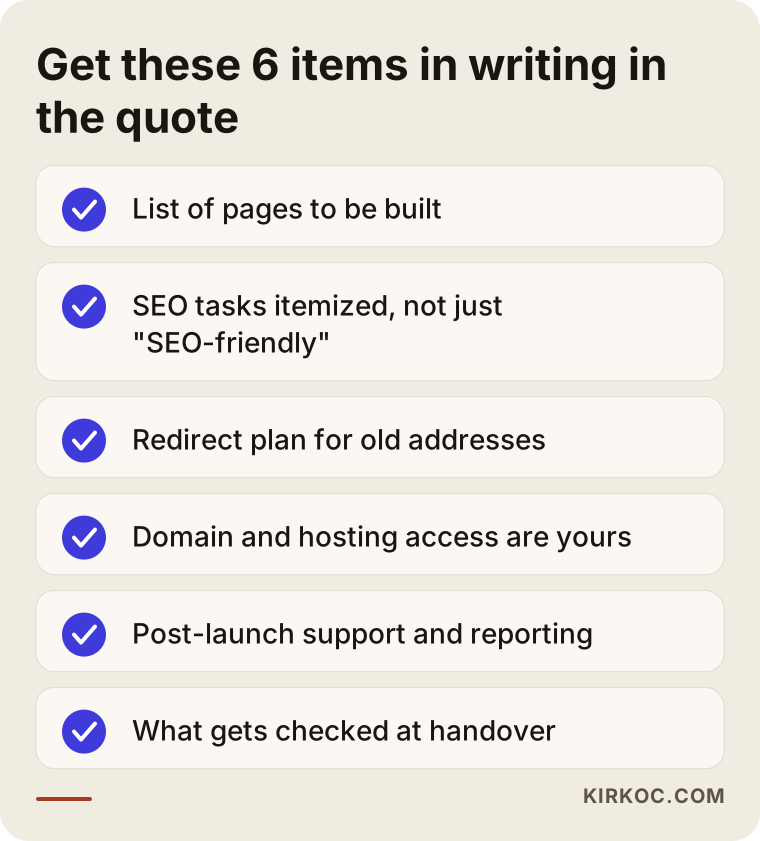
Also ask which pages will be built and whether small fixes after launch are included. What drives the price is usually the number of pages, the number of languages, how custom the design is, how much content moves over from an old site, and whether SEO is a one-off or ongoing. So when comparing two quotes, look at the scope, not just the total. A cheaper-looking quote can end up costing more once you add what it leaves out. My article on how to compare SEO quotes can help too.
Questions to Ask in the First Meeting
Before a quote arrives, the answers you get in the conversation are often as informative as the quote itself. You can ask the questions below of any company or freelancer.
- "Have you built a site that included SEO before, and how did you track the results?" If they can describe a concrete example, they have experience. If you only hear general statements, be careful.
- "Who decides the page structure before design?" If the answer is "the designer decides, SEO looks later," you may run into the very problems of buying separately.
- "How will you protect the visitors my old site brings?" If you're getting a new site, this question must have a clear answer.
- "What happens in the first three months after launch?" A quote without a post-launch plan leaves half the job empty.
- "What will I have to do myself?" Knowing what's expected of you, such as content, photos and approvals, protects the schedule.
- "If I want to change something on the site, who do I contact and how?" Even for small changes, you should know who to turn to.
- "When the contract ends, who keeps the site and the accounts?" The answer should clearly be "you."
Someone who can answer all of these in a sentence or two probably knows the work. Hesitation or evasive answers are reason enough to get a second quote.
Common Mistakes
The traps businesses fall into at this decision are usually the same. All of them are easy to avoid if you know about them in advance.
- Looking only at the price: Comparing two quotes by their total is misleading. One lists the page list, redirects and post-launch support; the other doesn't. You aren't actually comparing the same thing.
- Settling for "SEO-friendly": This label means whatever the seller wants it to mean. If what will be done isn't written down, you can't be sure it will happen.
- Forgetting the old site: Moving to a new site without checking what the old one brought in loses accumulated visibility. A beautiful new design doesn't make up for that.
- Handing access to someone else: If the domain or hosting account is opened in the designer's name, your bargaining power drops when you want to leave. These should be in your name from the start.
- Leaving content for last: "Let the site be finished, we'll think about the articles later" often ends in empty pages or hurried text. Plan the content together with the design.
- Treating mobile as a last check: Most visitors open sites on their phones. Approving the page only on a computer and going live is an unpleasant surprise waiting to happen.
- Seeing it as a one-time job: The work doesn't end when the site goes live. Search engines learn the new site, content gets added, results get measured. Put that in the budget from the beginning.
What You Can Do Yourself and What to Leave to a Specialist
You don't have to buy every task from an expert. Knowing which jobs you can do yourself protects your budget and keeps you in control of the process.
What you can do yourself
- Write down the goal: What the site is for, who it is for and what you want visitors to do, on a single page.
- Collect customer questions: Note which questions come up most on the phone and in messages. This is a very valuable content list.
- Provide real photos and information: Your own photos and details about your team, office and work look far more trustworthy than stock images.
- Own the access details: Make sure the domain and hosting accounts are in your name.
- Check regularly after launch: See whether forms reach you and how the site opens on a phone.
What to leave to a specialist
- Page structure and address planning: Hard to fix later if set up wrong.
- Moving from the old site to the new one: Redirects and deciding which pages move take care, and a mistake doesn't bring the loss back.
- Technical setup: Speed, pages open to search engines and structured markup need both technical knowledge and experience.
- A comprehensive content plan: Planning which question is answered on which page comes with experience.
- Measurement and reporting: Reading correctly what works decides the direction of the effort.
Think of the dividing line this way: nobody knows your business better than you, so you are indispensable as a source of information and photos. Technical setup and measurement are jobs that come with experience. Discussing this split at the start makes both budget and schedule more predictable.
One more thing: you may simply not want to do something you could do yourself, and that is perfectly normal. What matters is that who takes on what is written down, and that nothing expected quietly belongs to nobody.
Frequently Asked Questions
Should I build the site first and do SEO afterward?
If you're building a new site, thinking about SEO from the start usually means less work than fixing things later. If your site is already live and working, you can pick up SEO from where it stands.
My designer says they'll "do the SEO too." Is that enough?
It can be, but ask for proof. Ask which sites they've worked on, and what SEO tasks are in the quote. If you get concrete answers, you're fine.
What if I already have a site?
The site needs to be reviewed first to decide what must be protected. Pages that bring visibility need to keep their addresses and content when moved, otherwise you may lose rankings.
When will I see results?
I can't give an honest exact date. Competition, your industry and the site's starting point all matter. What I can do is lay the right foundation and report progress regularly.
What happens to my old addresses when I move the site?
If old addresses aren't redirected to the new pages, visitors and search engines arriving at them find nothing. During the move, which old address goes to which new page must be decided one by one, and that list should be in writing.
How does the number of pages affect the price?
More pages mean more design, content and checking work, but that isn't the only thing that sets the price. How custom the pages are, how many languages the site will run in and how much content moves over from the current site also matter. That's why seeing the page list in the quote is important.
Is a template-based site inadequate for SEO?
A template is not a problem on its own; what matters is that it runs fast, allows a proper page structure and headings, and looks good on a phone. But not every template suits every business. Checking the speed and structure of a sample page before choosing is a good first test.
How should my designer and my SEO specialist work together if they're different people?
The key is that the SEO specialist joins before design and both sides look at the same page list. If possible, hold one short meeting where everyone sees the same document. Writing down who is responsible for what prevents "whose job is this?" arguments later.
Conclusion
Even if a website and SEO are sold as two products, they serve one goal: the right person finds you and gets in touch. When you decide, simply put in writing who does what, when, and within which scope. If you'd like to plan your website and SEO together, you can reach me through my SEO services page to talk through your situation.