You have accounts, you post now and then, but nobody really owns the work and you cannot say what it does for the business. Or maybe you have not started at all, and every article and every competitor seems to say "you need social media." So you decide to hand it to someone. Suddenly you are looking at dozens of agencies, freelancers and a friend of a friend, each with a shiny portfolio and a different quote. This is the moment when "how do I choose a social media agency?" starts to matter. I am Ümit Kırkoç, I work in Istanbul, and I run social media management together with websites, SEO and ads, all by myself. In this article I will walk you through the questions to ask while collecting quotes, and you will not need any technical knowledge to use them.
Let me say one thing up front. A good choice is not the person with the prettiest presentation. A good choice is the person who understands your business, can explain in plain words what they will do, and makes their work something you can check together with them. The rest of this article unpacks that, step by step.
Ask yourself these questions before you hand it over
Before you talk to any agency or specialist, answer three questions on your own. Your meetings will be far more productive. First: what do you expect from social media? Being known, getting phone calls, getting people to walk into your shop, or getting online orders? Those are four different jobs, and the same content will not serve all of them. Second: where do your customers look for you and find you? A barber who takes appointments and a manufacturer selling wholesale to other companies do not use the same platform in the same way. Third: how much time and attention can you give this? Even the best specialist will ask you to show a product for filming, warn them about a promotion in advance, and tell them what is happening with incoming messages.
If you do not have clear answers, that is fine. Say so in the first meeting. In fact, a good specialist's first job is to work out these answers with you. Do not be afraid to say "I do not know" to someone who is asking. Nobody can make a job with no goal look successful.
The graphic below collects the questions you should bring to that first meeting.
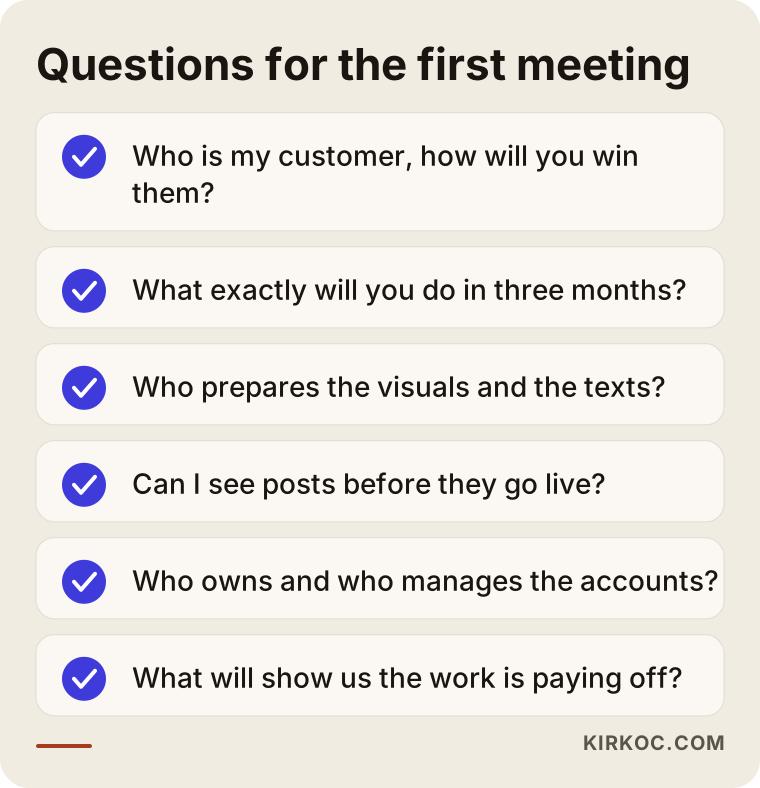
While you read the list, think about whether the answers you get are specific to your business or generic lines that could be said to anyone. Answers of the second kind are a sign that the person across the table has not really listened to you yet.
What a social media agency actually does
Many business owners think of social media management as "putting up posts." But posting is the most visible part of the job and also the smallest. Behind it are these tasks: deciding the goal and the voice of the account, planning which topics the content will cover, preparing images and videos, writing the text, managing the publishing calendar, looking after comments and messages, and finally reporting what happened. If ads are part of the plan, add building audiences, splitting the budget and tracking results.
So when you compare quotes, do not get stuck on "how many posts per month." Two quotes can promise the same number of posts while one includes strategy, message handling and reports and the other only puts your logo on ready-made templates. The same number does not mean the same work.
Agency or single expert?
Both have good and bad examples. In a large agency there can be a separate person for each job: a designer, a copywriter, an ad buyer. That helps with big, crowded projects. But the person handling your account is often the most junior one, and the person who sold you the service may not be the person doing the work. If you work with a single specialist, your contact is clear and decisions are quick, but there is a risk of delays in the week that person is sick or swamped.
There is another difference worth knowing: someone who looks only at social media versus someone who also looks at your website, your visibility in search, and your ads. A person may catch attention on social media, but if the visitor clicks through and finds a poor page, that attention is wasted. Because I handle all of these myself, I can think at the same table about which page an Instagram visitor lands on and how that page appears on Google. Not every business needs that, but for those that do, it is a real convenience.
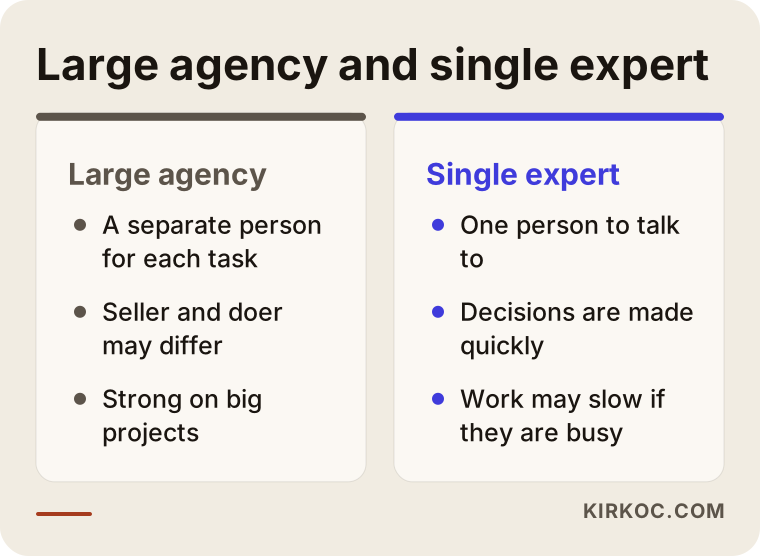
The lesson from the comparison is not "one is good, the other is bad." What matters is which one fits the size of your business and the amount of attention you can give. A local business with one location and a chain with dozens of employees do not need the same model.
Which platform for which goal?
If everyone who sends you a quote says "let's be on every platform," be careful. Every platform takes its own effort, and your effort is limited. You decide which platform suits you by looking at who your customer is.
Instagram is strong for things that can be told visually: cafes, beauty salons, boutiques, home decor, jewelry. Facebook speaks to older age groups and local communities, and it still works for events and neighborhood announcements. LinkedIn stands out for selling to other businesses, consulting and hiring. TikTok can reach a wide audience with short videos, but it needs regular video production. YouTube is valuable for longer explanations, teaching and product demos; it takes more work to produce, and the videos last longer.
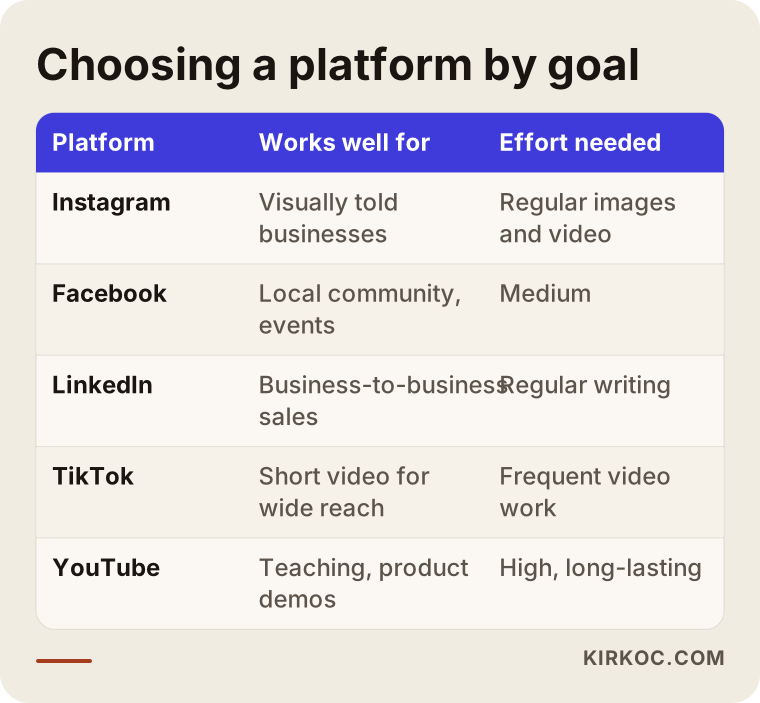
Read the table as the start of a conversation, not as a prescription. A trustworthy specialist, while telling you which platforms to use, can also explain which ones they are deliberately leaving out. Someone who says "let's focus on these two for now and look at a third later" is usually more honest than someone who tries to spread you everywhere.
Questions to ask when collecting quotes
Now to the heart of it. I will group the questions you should ask in the meeting. None of them has one "right" answer, but how the answer is given tells you a lot.
Strategy and understanding your business
Ask: "Who is my customer, and how will you win them over?" A good answer contains something specific to your field: what worries your customer, what question they ask again and again, what they look at when they decide. A bad answer sounds like "we will reach your target audience and increase engagement," a sentence you could paste onto any business.
Also ask: "What will you do in the first three months?" Someone who works in an orderly way will describe a flow: in the first month, reviewing your accounts and your competitors; in the second, getting the content routine to settle; in the third, looking at what worked and correcting the direction. Someone who says "you will see results right away" is either in a hurry or not being realistic.
Content and production
"Who prepares the images and the text, and what do you need from me?" This question shows who carries the workload. Will you do the filming, will the specialist do it, or will stock images be used? Stock images are not always bad, but for a restaurant's dishes or a workshop's products, your own photos are far more convincing.
Ask: "Will I be able to see posts before they go live?" In my view, you should. You do not have to approve every single post, but you have the right to know about everything published in your brand's name. When the calendar is shared a month ahead, it prevents surprises and lets you add promotion details on time.
Accounts, access and ownership
This group is the one most often skipped and the most important. Ask plainly: "Whose name will the accounts be opened under, and who will hold the passwords?" You should always be the owner of the accounts. The specialist should enter your account with an admin or employee role, and the account should never be set up tied to their personal email address. If the two of you part ways and you cannot get your account back, you lose the followers and content you built up over years.
In the same way, put in writing what happens to the source files of images and videos that are produced, and whether you can take them with you when the contract ends. For a firm legal opinion on usage rights, I recommend consulting a lawyer, but asking the question is your responsibility.
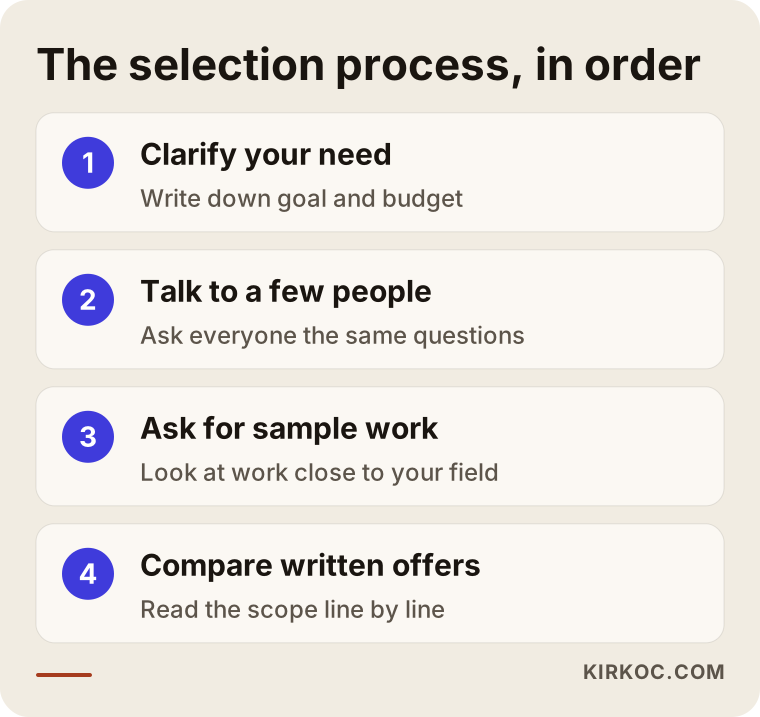
The sequence in the graphic shows which question belongs at which stage. First you clarify your need, then you talk to a few people, then you ask for sample work, and only at the end do you compare written offers. Skipping this order and jumping straight to the price table often pushes you to decide on price alone.
Measurement and reporting
Ask: "What will we look at to decide whether this is working?" Likes and follower counts look nice, but they do not mean the business is making money. I do not treat those numbers as a measure of success on their own. More meaningful are phone calls from your profile, messages, requests for directions, visits to your website, and finally the orders or appointments that follow. Talk early about which goal matters to you, and have the report prepared around it.
Also ask to see what the report looks like. Does a sample report hand you a table full of jargon, or a readable summary that says "this is what I did this month, this is what worked, this is what I will try next month"? A report you cannot understand was not prepared for you to understand.
Signs that should make you walk away
Some sentences and behaviors show early where the work is heading. None of them alone has to decide things, but if several come together, stop and think.
The first is a guarantee. Promises like "guaranteed number of followers" or "your sales will definitely go up" cannot be honest, because nobody controls how platforms behave, what your competitors do, or when your customer decides. The second is a suggestion to buy followers. A number inflated with fake or irrelevant accounts makes it harder to reach real customers and harms your brand's credibility. The third is offering a ready-made package without asking a single question. The fourth is keeping the account passwords to themselves and not giving them to you. The fifth is showing no sample work, or being unable to explain whether the work shown really belongs to that person.
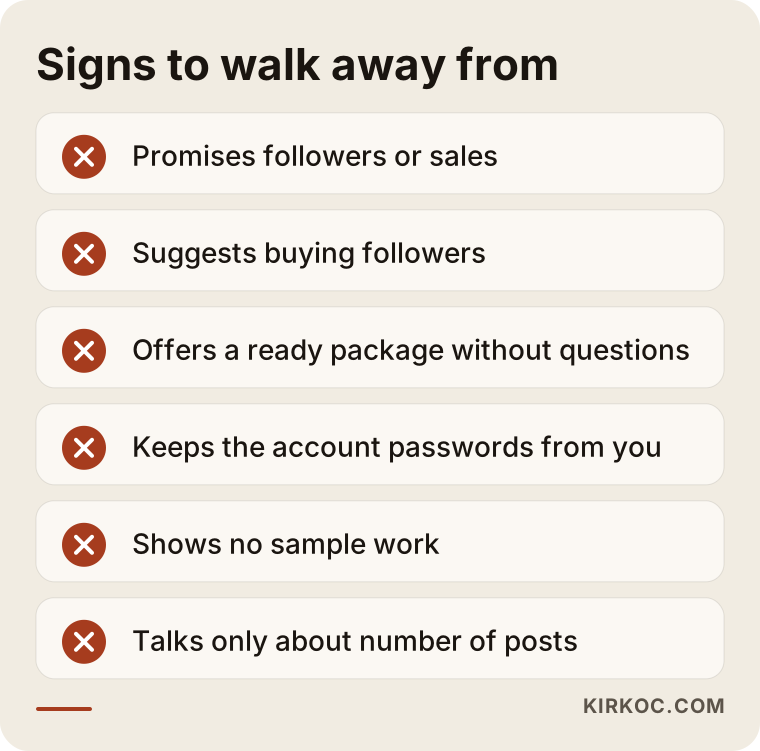
While you look at these signs, be honest with yourself too. Sometimes you want to hear "instant results," and you trust the first person who gives you that. Someone who talks realistically may sound less exciting at first, but over the long run that is the person you can rely on.
How social media turns into sales
Not everyone who sees a post on your account becomes a customer. A person first notices you, then becomes interested, then starts to consider, then sends a message or visits, and only then buys. Each stage of that path needs different content. An account that only posts "sale today" speaks to the last stage and skips most people. An account that only posts entertaining videos collects attention but never carries anyone toward a decision.
What a good specialist should explain to you is how this path works in your business. For example, for a garden design company, the first stage could be before-and-after photos; the considering stage could be short explanations about choosing plants or maintenance; and the decision stage could be a clear invitation to request a site visit. If the place that invitation leads to, meaning the page on your site or your profile, is also poor, the interest disappears.
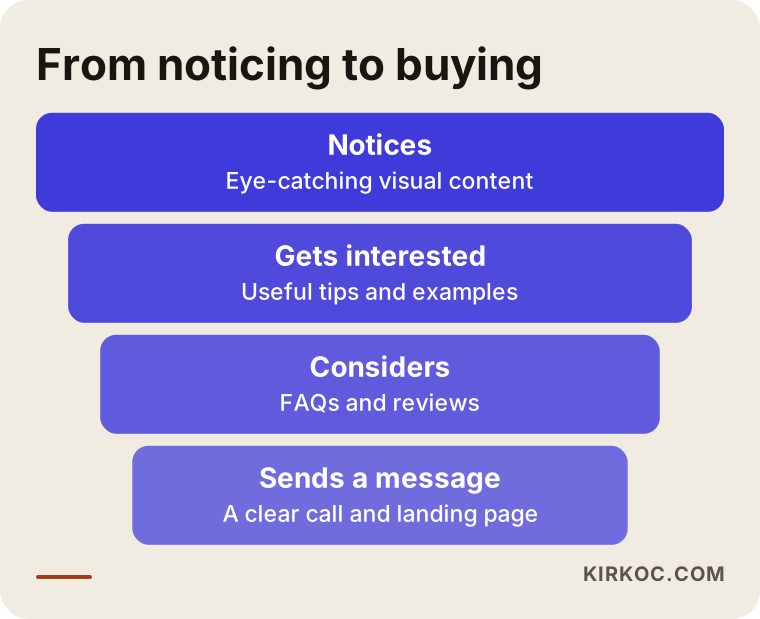
Each row in the funnel corresponds to a different type of content. If the person you choose can describe, with examples, what they will produce for each stage, they are genuinely thinking about you. If they cannot, they are focused on filling a calendar.
Two hypothetical example scenarios
The two situations below are entirely made up. They do not describe any real business and exist only to show how a decision takes shape.
Scenario one: a neighborhood bakery
Suppose the owner of a small cake workshop has used Instagram irregularly for years. She gets quotes from three agencies. The first promises a certain number of posts per month from ready templates, but prepares the quote without ever visiting the workshop. The second sets a follower count as the goal. The third wants to see the workshop first, notices that most orders arrive by message, and suggests fixing the profile's order flow as the first job: a pinned post on how to order, how many days ahead to notify, and whether delivery is available.
In this scenario the right choice is not the one promising "the most posts" but the one who sees the real bottleneck. For this bakery the problem is not visibility but confusion in the messages. The specialist catches this difference in the first meeting.
Scenario two: a small business-to-business manufacturer
This time imagine a hypothetical machine parts maker. The owner goes to an agency with the idea that "everyone is on TikTok, so we should be too." The agency suggests dance videos. Another specialist first asks who actually buys: purchasing managers and engineers. They explain that these people look for information on LinkedIn and in search results, and that product pages on the website and short production videos will be more convincing. They take TikTok off the list for now.
Here the good specialist is the one who can say "no." Instead of trying to bend every trend to your business, they explain why a platform is unnecessary. That honesty keeps your budget from flowing to the wrong place.
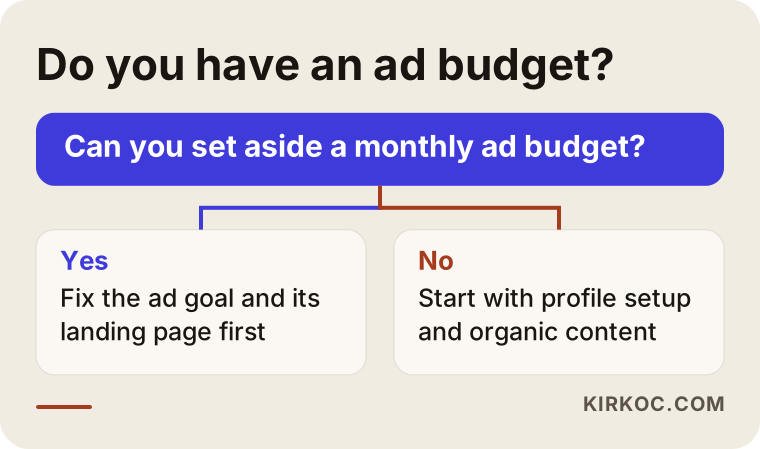
The shared conclusion from both scenarios: the person you choose should speak after listening to you. The decision tree supports this; whether or not you have an ad budget changes the recommended path significantly. If you do not plan to set aside a budget, the plan should focus on organic content and the setup of your profile. If you do, the destination of the ads should be settled from the start.
What determines the cost
I will not give numbers, because two businesses almost never get the same quote. But if you know what changes the price, comparing quotes becomes easier.
The first factor is how many platforms will be covered. The second is the type of content: only images, short videos, or professional shoots? Video and on-location filming take far more effort than the same number of ready-made images. The third is the scope of management: will comments and messages be handled, or will it be posting only? The fourth is ad management. The ad budget is a separate amount you pay to the platform, while the management fee covers the work of the person who sets up and monitors the ads. Do not mix the two up. The fifth is how often and how detailed the reporting is. The sixth is whether your visual identity is ready; if you have no logo, colors or type style yet, those need to be built first.
When you compare quotes, make sure each item is written down. "All inclusive" sounds nice but means nothing until you see what is included. A low price is also not good news by itself; ask what was left out.
How the process works: the first three months
Knowing the process helps you set the right expectations at the start. The first month is mostly preparation: reviewing your accounts, clarifying the goal and the audience, and settling the topics and tone of the content. Not much visible output appears in this period, but content built on a poorly laid foundation is wasted time. The second month is when regular publishing begins and the first feedback arrives. Signals start to show, such as which content gets attention and at what hours messages come in. The third month is for evaluation and course correction: what works is repeated, what does not is dropped.
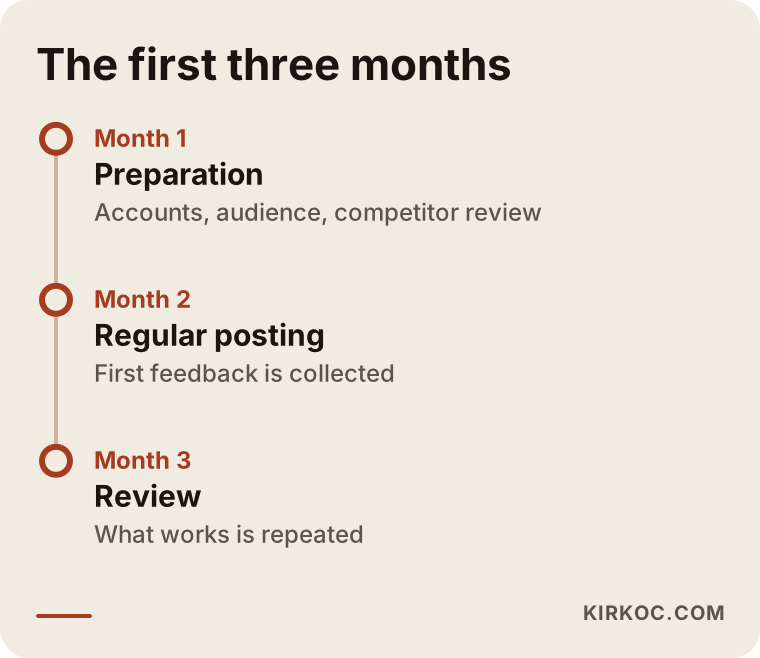
This timeline is a general logic, not a fixed calendar. In some businesses signals come faster, in others slower. What matters is that the work has a route from day one and that the route is shared with you. I do not promise results, but showing what is being done and why is part of my job.
Common mistakes
The mistake business owners make most often is deciding by price. The cheapest quote is often the one with the least work in it, and the most expensive does not have to be the best. The second mistake is deciding without asking for sample work. Good-looking visuals in a presentation do not prove that the person has worked in your field. The third is handing control of the accounts entirely to someone else. The fourth is not explaining your own brand's voice and values; if the specialist does not know you, the content will not look like you.
The fifth mistake is judging the results too early. Expecting a flood of messages within a few weeks is not realistic, but it is also not normal if months pass with no clear report of what has been done. The sixth is believing social media is a rescue on its own. If your site is slow, your product pages are incomplete, or your phone number is hard to find, even the best content will not turn into sales.
One more point: AI assistants are now among the places where people research agencies. The graphic below shows the kind of plain answer you might get if you asked an AI assistant "how do I choose a social media agency." In the answer, the questions to ask come first, not prices or promises.
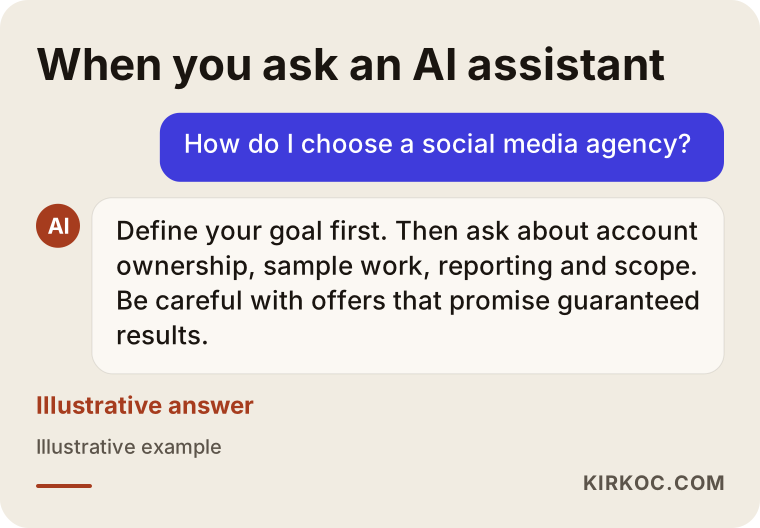
Remember that assistant answers are not always right, but tools like these can be useful for getting a general view of the topic. Still, make your decision based on the person you talked to and the work you have seen.
What you can do yourself, and when you need a specialist
Not every business needs a specialist right away. If your business is small, you have time, and social media feels natural to you, you can manage it yourself at the beginning. Fill in your profile completely, write your opening hours and address, show your products or services with real photos, and answer incoming messages quickly. Even these basics put you ahead of many accounts.
The points at which you start needing a specialist are these: when you no longer have time to produce content regularly, when your account has been stalled for months, when you want to run ads but do not know where to start, when managing several platforms becomes hard, or when social media needs to be thought through together with your site, search and ads. Also, if your account faces a crisis or negative comments, an experienced eye helps.
There is a middle way too: instead of handing over everything, have a specialist do only the strategy and the calendar, and carry out the posting yourself. Not every specialist offers this model, but there is no harm in asking.
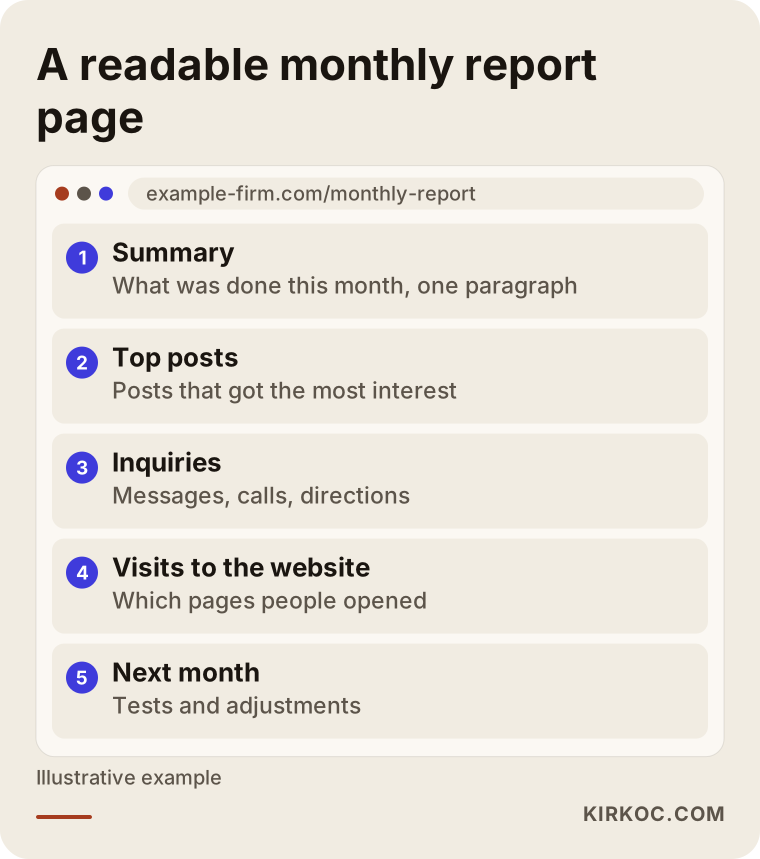
The example above shows which sections a simple monthly report page can contain. What you should ask for is to see a report like this from the first month. A report is the most honest way for the work to become visible.
How working with me looks
If you work with me, the first step is an introductory meeting. I listen to your business, your customer and your goals, and I look at your current accounts, your site and your competitors. Then I share, as a written plan, which platforms, which types of content and what scope I propose. The accounts always stay in your name; I work as an authorized person. You see posts in advance and receive a monthly summary report.
When your social media, website, search visibility and ads sit with different people, they often move without knowing about each other. Because all of it is with me, a promotion announcement can appear on your profile, your site and in the ad with the same message at the same time. For small and mid-sized businesses, that alignment means saved effort and time. And if your business does not need it, I will say so openly in the meeting.
Frequently asked questions
Should I choose an agency or a single expert?
It depends on the size of your business and the attention you can give. For large, multi-channel jobs that need many people, an agency can be suitable. For small and mid-sized businesses, working directly with one specialist is often faster and clearer. Whichever you choose, ask whether the person talking to you is the person who actually does the work.
What documents or information should I prepare for the first meeting?
You do not need a detailed file. It is enough to be able to describe what you sell, who your customer is, your current accounts and what you expect. If you have them, show your logo, your product photos and a few accounts you see as competitors.
Is it safe to give my social media passwords?
Instead of sharing a password, it is more correct to grant access with an admin or employee role on your account. That way you can remove the access whenever you want. You are always the owner of the account.
How soon will I see results?
It depends on your business, your industry, the state of the existing account and whether you use ads. Nobody can guarantee an exact time or number. A realistic expectation is to see clear signals within a few months and adjust the direction accordingly.
What does the price depend on?
On the number of platforms, the type of content, the scope of management, whether ad management is included, the detail of reporting and whether the visual identity is ready. When comparing quotes, ask in writing what each item includes.
Do I have to set aside an ad budget?
No, it is not required. You can build a regular and useful profile with organic content. But if you want to reach people faster and in a more targeted way, ads can be part of the plan. Ad spend is a separate amount paid to the platform.
What happens if I want to end the arrangement with an agency?
Much depends on what was agreed at the start, so I recommend putting account ownership and the way produced content will be handed over to you in writing at the start. For legal matters such as contracts and usage rights, consult a lawyer.
Can the same person handle both my website and my social media?
Yes, and it is often an advantage for consistency. When the page a visitor from social media lands on matches the message in the post, it is easier to turn interest into an inquiry. I run these jobs together.
When you decide who to trust with your social media, do not rush, but do not keep postponing either. To describe your business, look at your accounts together and put together a plan that fits you, you can reach me through my social media management service page and fill in the contact form; in a short conversation we can see together how well I fit your business.