You asked three places for a quote and got three answers that do not look like they describe the same thing. One promises a site by the weekend, one describes weeks of work, and the third does not say what is included at all. Website design cost really is that scattered, because "a website" is not one product. I will not give you numbers here. Instead I will show you which items push the cost up or down, how to compare quotes side by side, and which route fits your business. If you are weighing whether to hire me for website design, start with this map first.
Why website design cost has no single answer
Imagine asking a tailor, "How much for a suit?" The answer depends on the fabric, the pattern, how many fittings are needed and how much time the tailor will spend. A website works the same way. Two sites that look alike on a screen can hide very different amounts of work.
Most of the cost sits in what you cannot see: the time spent understanding your business, deciding which pages are actually needed, writing the copy, making the site comfortable on a phone, making it open fast, and preparing it so Google can understand it. None of that shows up in a template screenshot.
That is why searching for "web design cost" and trying to find an average can mislead you. An average puts different jobs in the same bucket. The useful question is not "what is the average?" but "what items make up my project, and which of them matter to me?"
One more point. A price is not only a cost, it is a summary of an agreement. The figure in a quote is a promise about what will be delivered, how much time will go into it, and whether someone will be there afterward. If the promise is hollow, any figure is expensive.
Three routes: DIY builder, designer, agency
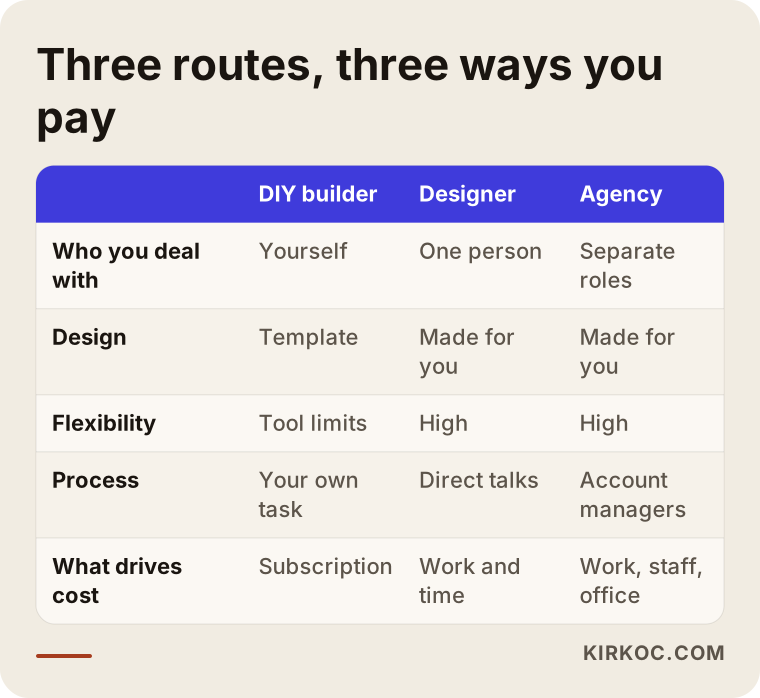
There are basically three ways to end up with a website. Each one is priced for different things, so comparing them directly gives the wrong picture.
DIY website builders
These are drag-and-drop tools with templates. You choose, you fill in, you publish. What you pay for is mostly the tool itself, which means a subscription. The labor is paid in your own time.
This route can be reasonable for a business that wants little from its site and just needs "a business card online." The weak point is that a template is designed for everyone, not for your business. You write the copy, you decide which pages are needed, and you handle the search settings. If you do not know how, the site goes live and nobody finds it.
A solo freelance designer
Here you deal with one person. The person who listens to you, designs and builds the site is the same person. The price mostly reflects the work itself and the time given to it. There is no office, no sales department, no layer of go-betweens to cover.
The advantage is that what you say does not get lost. You explain what you want to one person, and that person does the work. The drawback is a natural limit: one person can only take on so many projects at once, so the schedule has to be discussed openly. That is how I work. I do not hand the job to anyone else, and I settle scope and timeline together in the written quote.
An agency
An agency usually divides the work among specialists: one person welcomes you, one designs, one codes, one manages the project. For large, many-sided projects, companies with formal approval chains, or brands running several channels at once, that structure makes sense. The price includes the cost of the staff and the organization.
For a small business that structure can feel heavier than needed, because part of what you pay goes to a layer of organization you may not use. That is not a flaw, it is a matter of scale. The right question is not "which is better?" but "which fits the size of my project?"
I do not mean to knock any of these routes. A builder, a designer and an agency answer different needs. What matters is knowing what you are paying for in each.
The six things that really set the cost
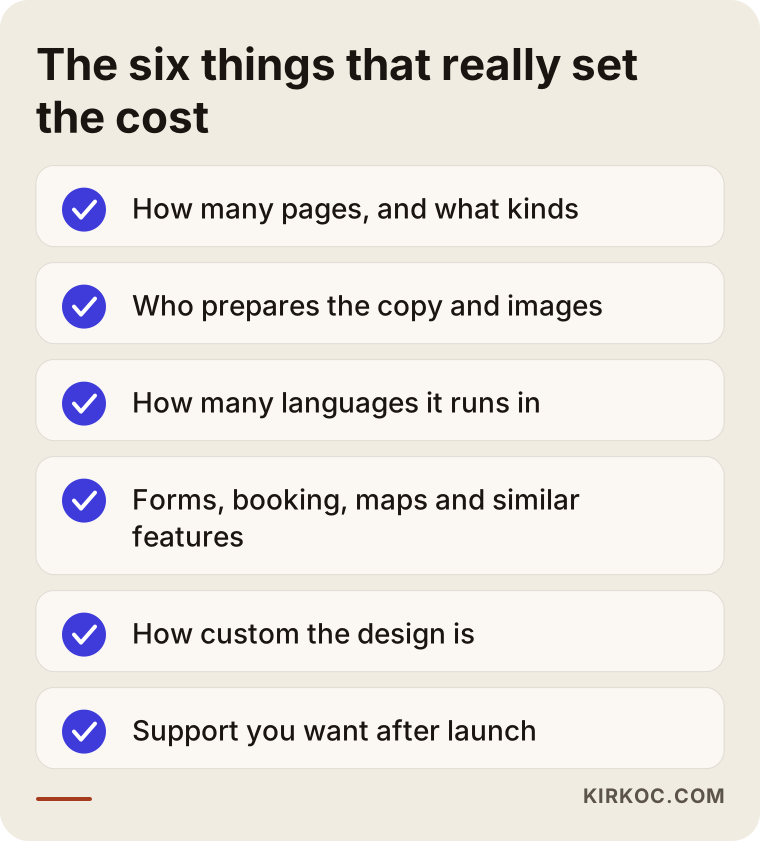
Whichever route you pick, the same items pull the figure up or down. Going through them in order makes the conversation easier for you and for the person quoting.
Number and kind of pages
A five-page introduction site and a site with dozens of service pages, team pages and a blog are not the same job. But kind matters more than count. A plain "about us" page and a carefully built service page that answers what a searcher is asking do not take the same effort. Do you want a separate page for each service, or everything on one page? That decision affects both the cost and how visible you are on Google.
Copy and images
This is the item people skip most. The site gets built, but nobody is assigned to write what goes in it. If the quote does not say who handles the copy, the job may land on you later. I prepare the copy for service pages together with the business owner, using the information I collect from you, but whoever you talk to, ask: "Who writes the text?"
The same goes for images. If you have your own photos, things move easily. If not, where the images will come from and who holds the usage rights should be discussed up front.
Number of languages
If you want to reach customers abroad, the site needs more than one language. That is more than translation: people search differently in each language, and the same sentence does not land the same way in another country. Every added language multiplies the content work. For tourism, medical travel, exporting and similar fields, this can be one of the biggest drivers of the figure.
Features
A simple brochure site, a site that takes bookings, a site that collects form entries, shows a map, gathers quote requests or takes payments are different jobs. Each feature means setup, testing and later upkeep. Asking for a feature you do not need raises the cost for nothing; forgetting one you do need costs more later. As my service page describes, I plan the parts that make it easy for customers to reach you from the start: a messaging button, a call button, a quote or booking form and a map.
How custom the design is
Adapting a ready-made template to your colors is different from building a layout from scratch around your business and your customer. In a custom design, your logo, colors and photos sit at the center of the site. The design stage, the conversations and the approval rounds take longer. That is a legitimate difference and it shows up in the price.
Support after launch
The job does not end the day the site goes live. Someone needs to introduce it to Google, look at what is working in the first weeks, and answer when something breaks. Is that support in the quote? How long does it last? How does it continue afterward? If you decide without asking, you will not know whom to call on the day a problem appears.
Same site, different industry: how do customers search?
When people talk price, they often forget the effect of the industry. What a site must do depends on how your customer looks for you, and that changes the scope.
For a restaurant or café, the visitor is usually on a phone, on the street: "dinner near me," "reserve a table." The menu being readable, and the map and phone opening with one tap, are the most critical parts. Long story pages come second.
For a clinic, a practice or a law office, the situation is different. The visitor is often anxious and reads before deciding. A calm, clear and trustworthy tone is needed. Advertising rules in these fields are restricted, so the language of the site has to follow the rules and make no promises about results. I do not write medical or legal advice; I prepare content that describes your service plainly and accurately. These limits affect scope, because each sentence is built more carefully.
For hotels and tourism businesses, foreign guests come into the picture. A multilingual site, booking guidance and image quality come forward. In areas like medical travel, detailed pages that answer the questions of prospective patients are needed.
If you are starting a new business and need a first website, what you need is often not much, but it must be built properly: a few solid pages that explain your work and make it easy to reach you. Describing your industry at the start of the quote conversation is the quickest way to see what the figure will depend on.
How to read a quote
When you put two quotes side by side, looking at the total is a natural reflex. But a total read apart from scope means nothing. Look at scope first.
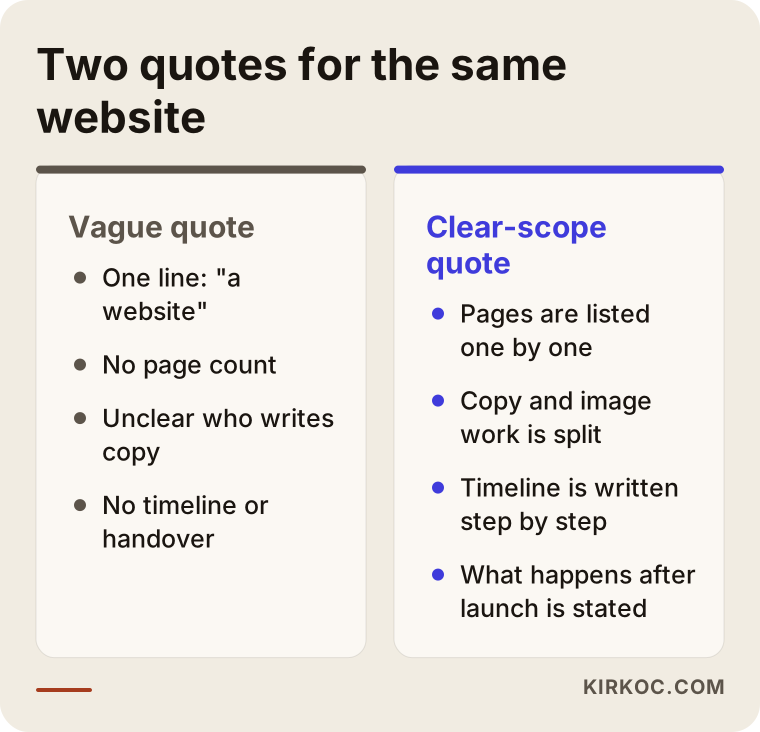
A good quote lists which pages will be built, who handles copy and images, how design approval works, what steps the timeline contains, and what happens after delivery. After I talk through your business and what you expect, I send a written quote with scope and timeline, because having what we agreed on on paper is a relief for both sides.
A short, vague quote usually has a single line such as "a website." That does not mean there will be trouble, but it does mean you will have to resolve all the vagueness later. Vagueness is the most expensive part of cheap-looking quotes: every added page, every correction and every feature becomes a separate negotiation.
Run one more check. Does the quote answer your questions, or is it boilerplate? If it mentions your industry, your customer and the searches you hope to appear for, the person on the other end has looked at your business.
Questions to ask when comparing providers
You can ask the questions below whichever route you choose. How clear the answers are tells you more about how the work will go than the total does.
- Who will do the work? The person you are talking to, or someone else? Is the person who sells the project the one who builds it?
- Will I see the design before it is approved? Not moving to the next step without your approval is important.
- Who writes the copy? If there is no text yet, whose job is it?
- How will the site look on a phone? Most visitors arrive on phones; do not approve without testing.
- Will the site load fast? Visitors do not wait around for a slow site.
- Is preparation for Google included? Page titles, descriptions and site structure should not be a patch added afterward.
- In whose name is the site set up? Will the domain and accounts be in your name or the provider's? If you part ways, what do you keep?
- Who do I contact after delivery? If something breaks or needs updating, how does it work?
If the answer to even one question is brushed aside, make a note. A quote that dodges a question often leaves the cost of that question to you later.
How I work with you: know the process before you start
The easiest way to understand a price is to see, step by step, what happens for it. My way of working has five steps, and at each one you know what you are approving.
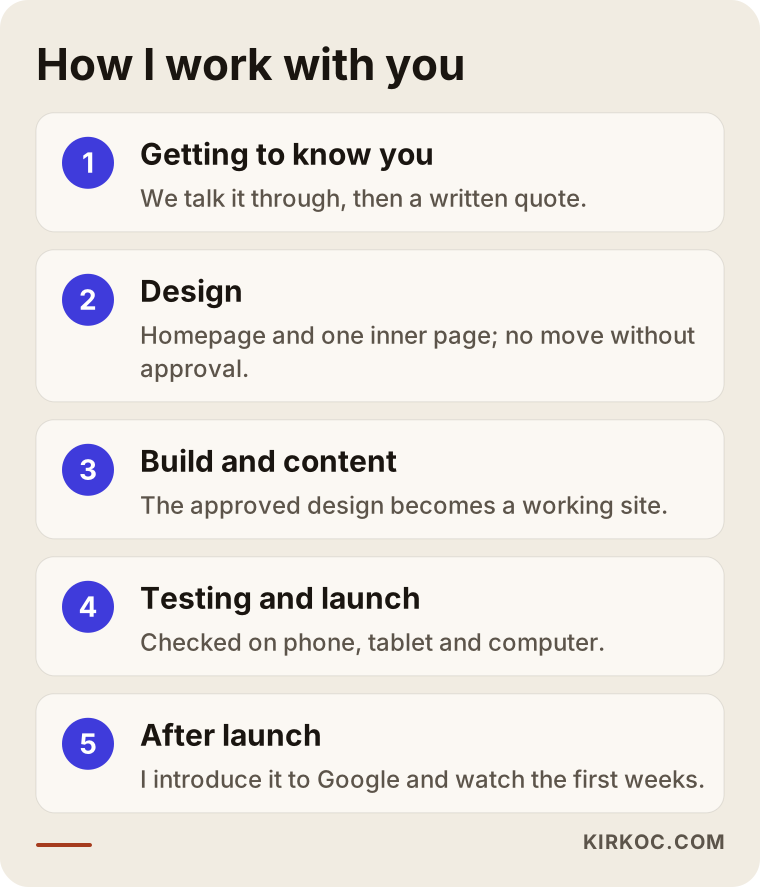
Getting to know you. We talk about your business, your customer and what you expect from the site. Then I send a written quote that includes scope and timeline. The more openly you talk at this stage, the more accurate the quote.
Design. I prepare the homepage and a sample inner page design. I do not move to the next step without your approval. In other words, nothing gets built on top of something you do not like.
Build and content. I turn the approved design into a working site, and the copy and images are placed. If you do not know what to write, that is fine: with the information you give me, we prepare the copy for your service pages together.
Testing and launch. I test the site on phone, tablet and computer, you review it one last time, and we go live.
After launch. I introduce the site to Google and watch it closely in the first weeks. I stay reachable for your questions.
Here is what this does to the price: every step takes time, and time is the main cost. If a quote leaves out one of these steps, it either means the step will not happen or that it will not be charged to you separately. Ask which one it is.
Suppose... two hypothetical scenarios
The two examples below are entirely made up; they do not describe real clients. The point is to show how the items change a decision.
Scenario one. Suppose you run a small furniture workshop and want to reach customers in a new city. You got two quotes. The first is a single line: "business website." The second lists five pages one by one: home, product groups, how it works, about and contact; it says you will supply the photos, that the copy will be prepared together, and that phone and map buttons are included. The second looks longer and more detailed at first glance. But with the first, photos, copy and the map will need extra conversations, and nobody has thought about which searches the product pages should answer. Even if the totals come out similar, the clarity the second quote gives you is worth much more.
Scenario two. Suppose you run a small bakery that opens on weekends, and orders mostly come by phone and message. You want a simple storefront online: a few photos, the menu, the address and a phone number. You have no goal of finding customers on Google; your customers come from the neighborhood anyway. In that case, building your own site with a DIY builder in a few hours and spending nothing extra can be a perfectly reasonable decision. Going to a designer or an agency would be more than you need. If you later want to widen your circle of customers, then it makes sense to talk to a specialist.
Both scenarios point to the same thing: the decision starts not with "which is cheapest?" but with "what should this do for me?"
Common mistakes when choosing cheap or expensive
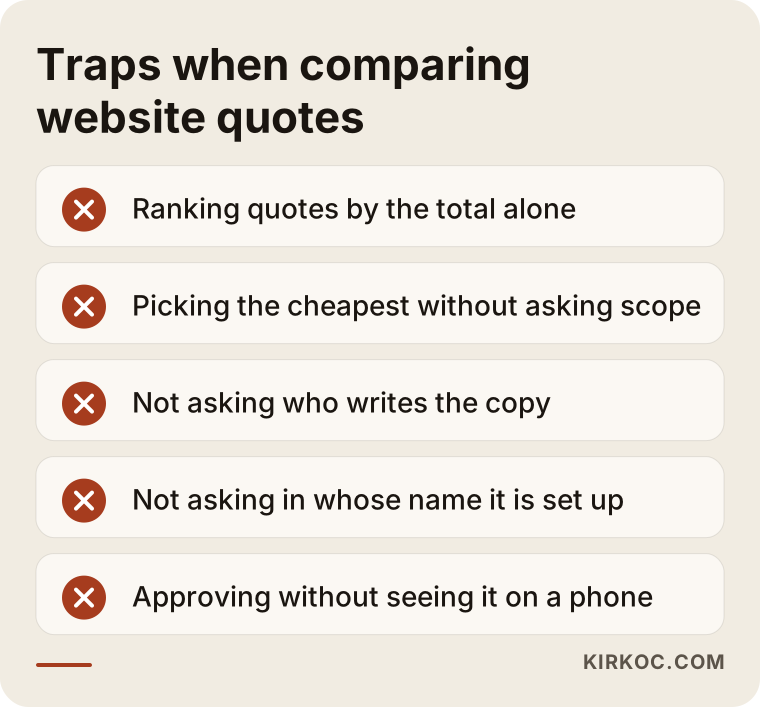
Ranking quotes by the total alone. Very different jobs can sit under the same figure. Comparing without matching scope is comparing apples with oranges.
Choosing the cheapest without asking about scope. A low figure is sometimes a sign of missing work: no copy, no phone testing, no preparation for Google. What gets added later can pass the first figure.
Forgetting the copy. A good-looking site goes live with empty pages because nobody wrote anything. Copy is the part that turns a site into a sales tool.
Not asking in whose name the site is set up. The domain, hosting and accounts should be in your name, or at least how they will be handed over should be in writing. Otherwise the key to your site stays with someone else.
Approving without seeing it on a phone. A design that looks lovely on a computer may be unreadable on a phone. Since most visitors arrive on phones, this is one of the costliest mistakes.
Treating it as a one-time job. A site is a living tool; details change and services are added. If this is not discussed up front, you will struggle with your first change request.
Wanting everything at once. Deciding which pages and features are truly needed in the first version shortens both the cost and the schedule. The rest can be added later.
When you do not need a specialist
To be honest, not everyone needs a designer. In these cases a DIY builder or your own effort may be enough:
- Your site will only act as a business card: an address, a phone number and a few photos.
- Your customers already know you and come to the site directly from you, not from search results.
- You need a temporary page for a short event, a campaign or a trial.
- Your business has not settled yet and you are not sure what to say; starting small and learning may be smarter.
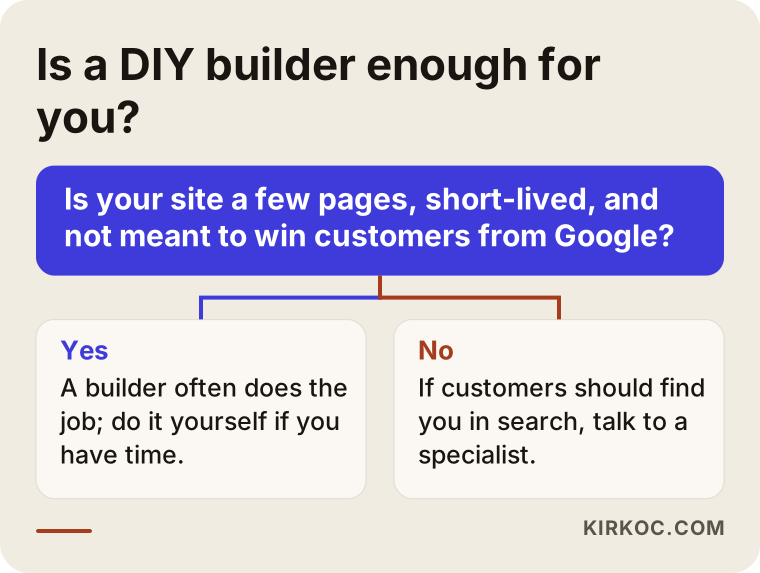
But if you want to win customers from Google, build trust and lay a solid base you can grow on, the picture changes. Showing up in search results depends on how the pages are built, and fixing that afterward is usually harder than building it right at the start. If that is your goal, talking to a specialist is not a waste of time; it prevents effort going down the wrong road.
Doing it yourself or handing it to a specialist
This decision is often more about time than money. If you build your own site, the outlay is low but you spend hours. Those hours might earn you more somewhere else in your business. A simple question helps: "What would I normally be doing with those hours?"
If you do it yourself, be ready for these: working out which pages are needed, writing the copy, trying the phone view, entering page titles and descriptions, and introducing the site to Google. All of it can be learned, but learning time is also a cost.
If you hand it to a specialist, part of what you pay for is that knowledge and time. In return you get a process, a written scope and someone to call after launch. A middle path also exists: have the foundation built professionally, and ask to receive it in a form where you can make later small changes yourself. Ask how that would work at the quote stage.
What to prepare before asking for a quote
If you come to the conversation prepared, you get a more accurate quote and save time. You do not need a perfect plan, just answers to a few questions:
- What is your business and who is your customer? Can you say it in a sentence?
- What should the site do: make the phone ring, take bookings, collect quote requests, give information?
- Which sites do you like and dislike, and why?
- Do you have a logo, photos and text?
- In which languages do you want to publish?
- By what date does it need to be live?
Even a rough idea of the sections your homepage will have helps a great deal.
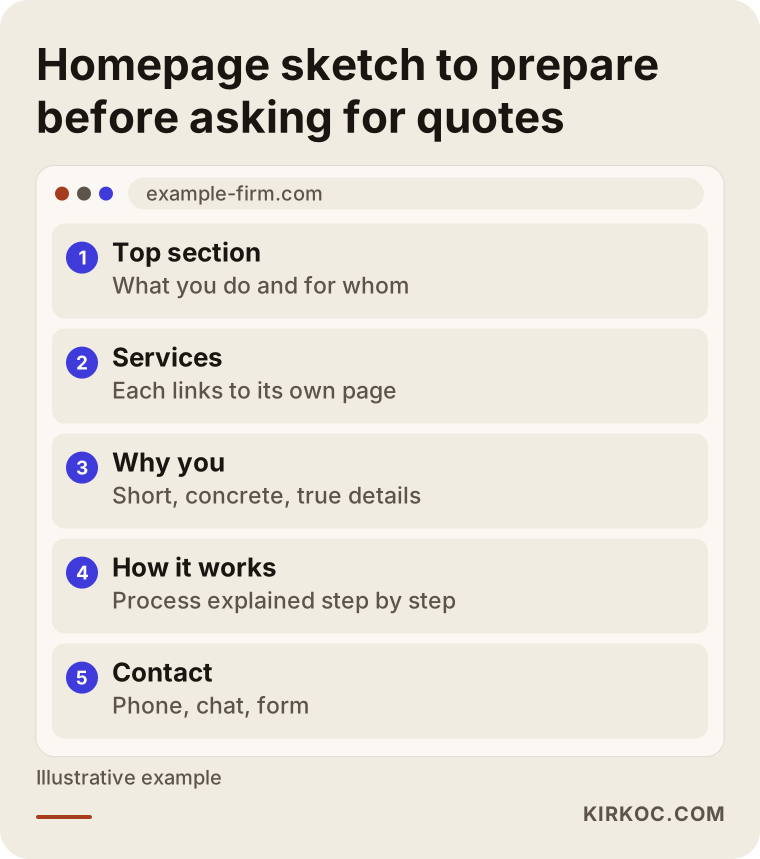
The sketch does not need to be perfect. Its purpose is to put you and the other side on the same page. The clearer you are, the less vagueness appears in the quotes and the easier they are to compare.
Raising the value instead of pushing the figure down
In negotiation, working with scope is usually healthier than asking for "a bit off." Starting with the core pages and adding over time is more manageable than ordering everything at once. Supplying your own photos, bringing the information for the copy and not delaying decisions shortens the process. Those things directly affect part of the cost, because time is the main item.
On the other hand, forcing the figure down usually means giving something up: testing, copy, preparation or post-launch support. Decide knowing what you are giving up; a blind discount costs more later.
Frequently asked questions
Why does website design cost vary so much?
Because very different jobs are sold under the same name. Filling in a ready-made template does not take the same effort as a site designed for your business, with written copy, phone testing and preparation for Google. The number of pages, languages, features, the content work and the support after launch set the figure.
When you compare quotes, match the scope first and look at the total after that.
What is the difference between a DIY builder and hiring a web designer?
With a builder you get a template, a subscription and your own labor. With a designer you get a custom design, direct conversation and the work done for you. A builder can be reasonable for simple and temporary needs.
If you want to win customers from Google and build trust, someone who puts effort into page structure and content makes more of a difference.
Should I choose an agency or a solo freelance designer?
It depends on the scale. For many-sided projects, many channels or formal approval chains, an agency structure makes sense. For small and mid-sized businesses, working directly with one person is usually simpler and easier to follow.
Whichever you choose, ask up front who will do the work and whom you will reach.
What must a website quote include?
The list of pages, who handles copy and images, the design approval step, the timeline, how delivery works and support after launch. If one is missing, ask about it.
It should also state in whose name the site is set up and how it can be handed over to you later.
What should I prepare before hiring someone to build my website?
You do not need a perfect plan. Being able to describe your business and customer in a sentence, knowing what you want the site to do and gathering any logo, photos and text is enough. A few sites you like will speed up the conversation.
If you do not know what to write, that is fine; we can prepare the copy together.
Will my site show up on Google right after launch?
No, and be careful with anyone who guarantees it. Introducing a site to Google is possible, and I do it after launch and watch the first weeks closely. But I do not promise where you will appear; that depends on many things.
A solid foundation puts you on the right path, and the rest develops over time.
Why does a mobile-friendly site matter?
Most visitors reach a site from a phone. If the text is not readable, the buttons cannot be pressed or the phone number cannot be called, the visitor leaves. Comfortable use on a phone is not an extra, it is a basic requirement.
I ask that you try the site on your own phone before delivery.
How long do I have to decide after getting a quote?
There is no need to rush. Read the quote, note your questions and compare it with any others by scope. Asking about everything you do not understand is part of the process.
Once you decide, the timeline is settled together according to the scope and your approval.
If you can now see what moves a price, the next step is listing the items in your own project. Tell me about your business and what you expect, and we will settle a written quote with scope and timeline together. You can read more on my website design service page or contact me directly.