If you search for an "SEO agency" and every one of the ten companies you find calls itself the best, uses the same phrases and never tells you plainly what it would do for you, that is normal, not a sign you are missing something. Pitches blur together when you do not work in this field. In this guide I explain how to test the claims of an SEO company, what to read in a proposal, and whether your business really needs an agency or would be better served by one person. I am a solo web designer and consultant working remotely, so I am telling you which side of the table I sit on. My goal is not to steer you to me but to help you decide well, and if you want to see what I actually do, here is my SEO services page.
Why "best SEO agency" is not a reliable phrase
When you type "best seo agency" into a search engine, the order of results does not show who does the best work. It shows which site was better prepared for that phrase. A company can optimize its own website beautifully and still do mediocre work for clients. The reverse is also true: someone excellent may have never found time to promote themselves.
"Best" is not a measurement, it is a claim. The way to test a claim is to ask, in writing, best by what measure. A good provider answers easily: "I work with these kinds of businesses, I solve these kinds of problems, this is where I am strong." A weak one retreats into generalities: "our experienced team and proven methods." There is no information inside that sentence.
Be careful with awards, lists and "agency of the year" badges too. Some of these can be bought. Having a badge does not disqualify anyone, but by itself it proves nothing. Look instead at the work described, the method explained and the way your questions are answered.
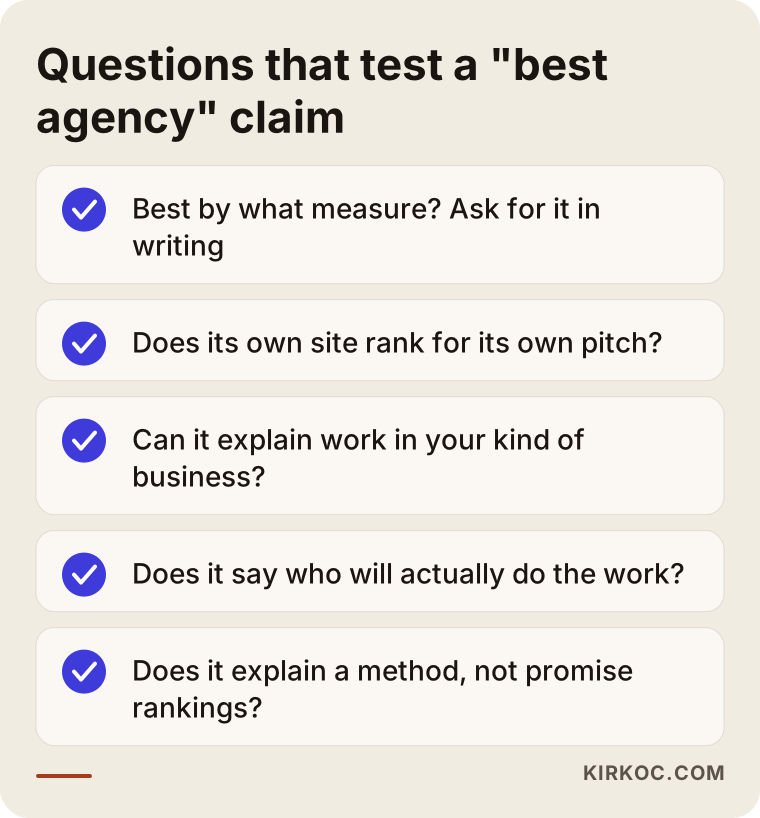
Keep the list above next to you in the meeting. If you cannot get a clear answer to all five questions, it is reasonable not to take the conversation to the next step.
Agency, company, firm, consultant: who is who?
In search, "seo agency", "seo company" and "seo firm" are used almost interchangeably, but in practice they describe different ways of working.
Large agency. A business with several departments that offers advertising, social media, design and SEO together. Someone from sales talks to you, other people do the work. It suits big brands and is often heavier than a small business needs.
Specialist SEO company. A small group of people focused only on search. The relationship is usually closer and the offer is more clearly defined.
Independent consultant. One person handles both the sales conversation and the work. The person you talk to is the person who does the job. It is flexible, but the number of clients one person can take at once is limited.
Sellers of a single piece. Some providers call themselves SEO companies but really sell one part, such as links or articles. One part can help, but without someone who sees the whole picture, results stay uneven.
Before deciding, ask which of these categories the provider puts itself in and who will really do the work. That question often gets the most honest answer of all.
What to look for in the pitch
A good pitch talks less about the provider and more about your business. A few concrete signs:
Did they look at your site?
Someone who visits your site before the meeting and brings a few specific observations is taking the work seriously. Sentences like "your home page does not make clear which service you sell", "pages load slowly on a phone" or "two pages target the same search" are worth far more than a generic slide deck. If someone quotes a plan in the first meeting without any review, they are guessing.
Can they explain the method?
You do not need to understand the technical detail of SEO, and you should not have to. But the person across the table should be able to say, in plain language, what is holding your site back today, which searches they will target, what they will do first and how they will measure it. If they cannot explain it, either they do not know or they do not want to. Neither is good.
How does their own site do on their own topic?
An SEO company's own website is the easiest reference you can check. Does it load fast? Can you tell what they offer at first glance? Are service pages separate and clear? Do the articles actually teach something? If they cannot explain their own service clearly, how will they explain yours?
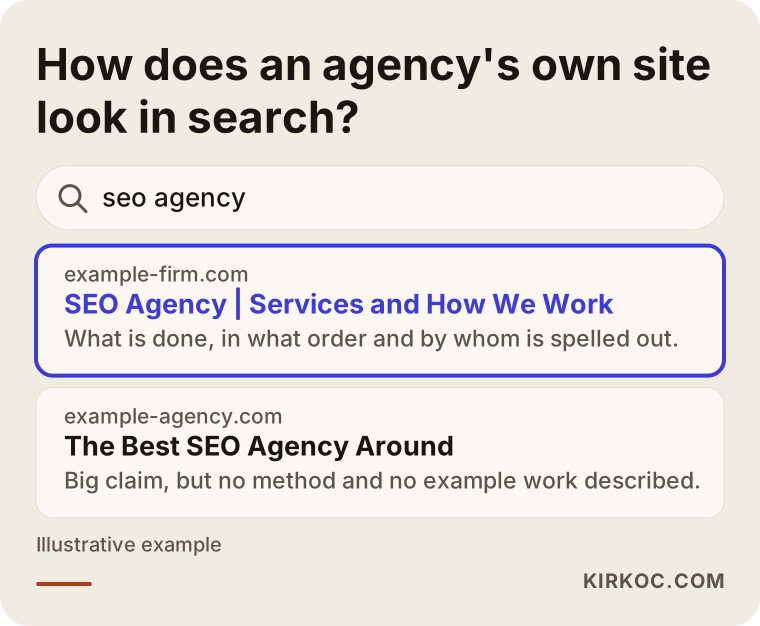
Even in search results the difference shows: one states its services and how it works, the other settles for the word "best". You get a clue before you click.
Can they show example work?
Asking for references is legitimate. Some firms cannot name clients for confidentiality reasons, and that is normal. Then they should at least describe the kind of business, the problem, the work done and what changed. A clearly told story of process and outcome is far more trustworthy than inflated "success stories". If someone has no example at all, they are either new or have little to tell. Being new is not a flaw, but they should say so and price accordingly.
Agency or solo consultant?
This question matters more than the hunt for "best", because the wrong way of working can fail even with a good provider.
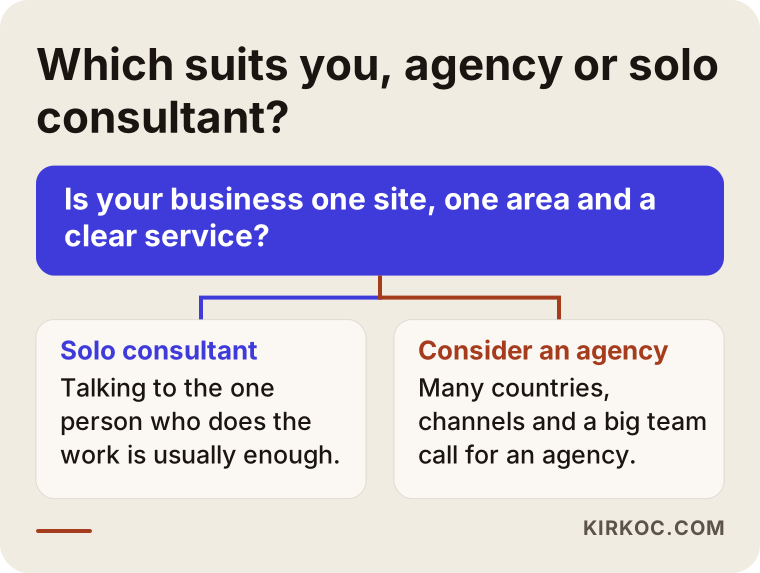
The advantage of an agency is that several specialties sit under one roof. If you need advertising, content, technical repair and design at the same time, one person may not keep up. The downside is the chain: the person who sells, the person who plans and the people who do the work may all be different, and information gets lost between them. A small-budget client can end up in second place at a large agency.
The advantage of a solo consultant is direct contact and flexibility. The person you talk to does the work, knows your situation and follows your site month after month. The downside is capacity: if you need a very wide job, several countries or heavy ad management, one person may not be enough. If a consultant is ill or on holiday, work slows; this should be discussed up front.
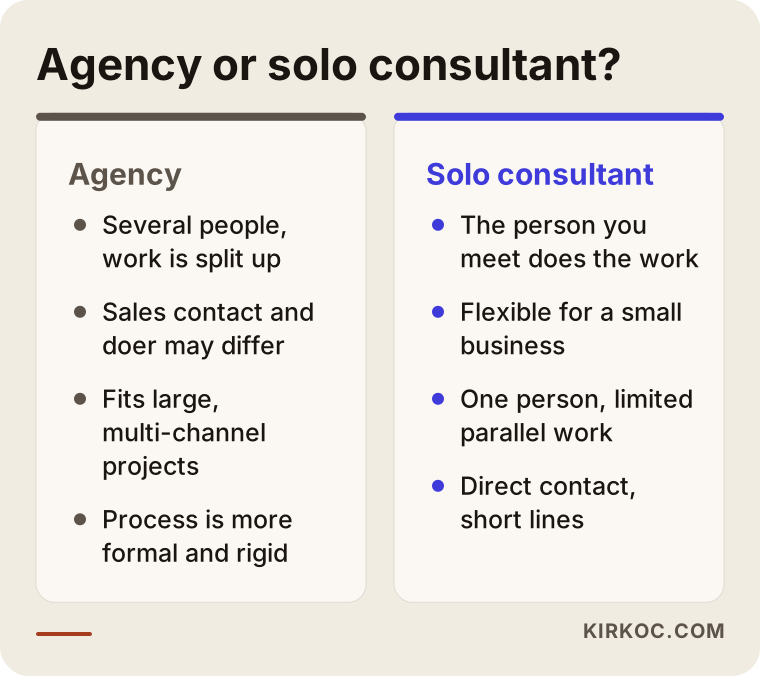
I work alone and I do not hide it. That is both a strength and a limit. A strength, because the person who gives you the proposal is the one doing the job. A limit, because my capacity is finite. When you talk to any agency, ask the same thing: "Which person will do this work, and can I speak to them directly?"
How to read a proposal
When a proposal arrives, look at the contents before the number. Comparing two proposals by price alone is like comparing apples with oranges. One may include a monthly report, while the other also repairs technical problems on your site.
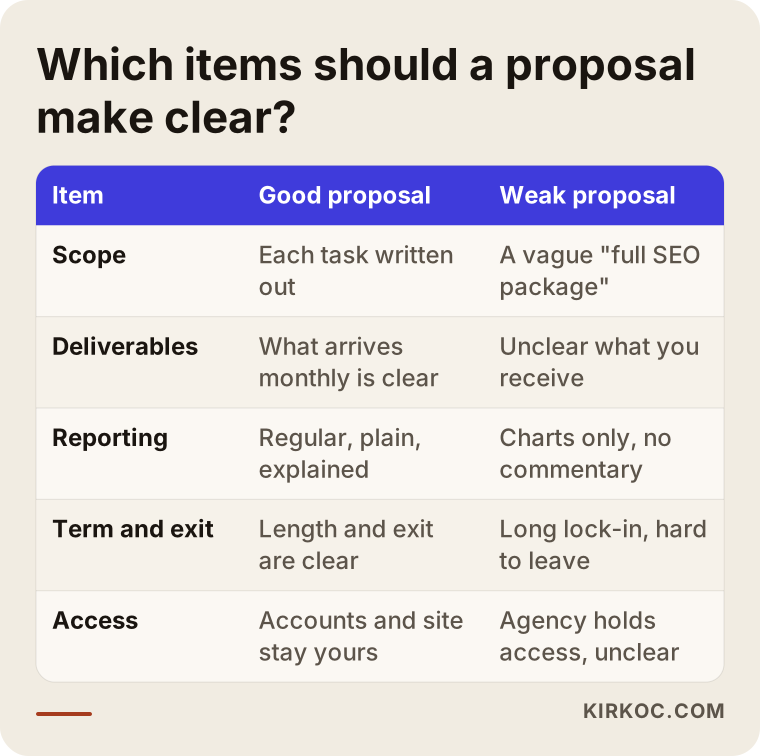
A proposal should state in writing:
- Scope. Which tasks will be done, listed one by one? A phrase like "full SEO package" says nothing.
- Deliverables. What reaches you each month: a report, new pages, a fix list?
- Reporting. Will you be able to understand the report? Is it only charts, or does it say what was done and what comes next?
- Term and exit. How long is the contract, and what happens if you want to leave?
- Access and ownership. Do the site, the search accounts and the content stay with you?
What determines the price?
Three things: the scope of the work, the current state of your site and how crowded your field is. A business with an old, troubled site has plenty to fix in the first months. If you work in a crowded city with many competitors, becoming visible takes longer and more effort. That is why a company that quotes "the same for everyone" has either not looked at you or has kept the scope very narrow.
Behind a very low price there is usually a template: the same report, the same few tasks, no analysis made for you. Behind a very high price there is sometimes a genuinely large job and sometimes just brand weight. The way to judge a price is to read what you get for it.
Sentences that should make you stop
Some sentences you hear in a meeting are signals to pause:
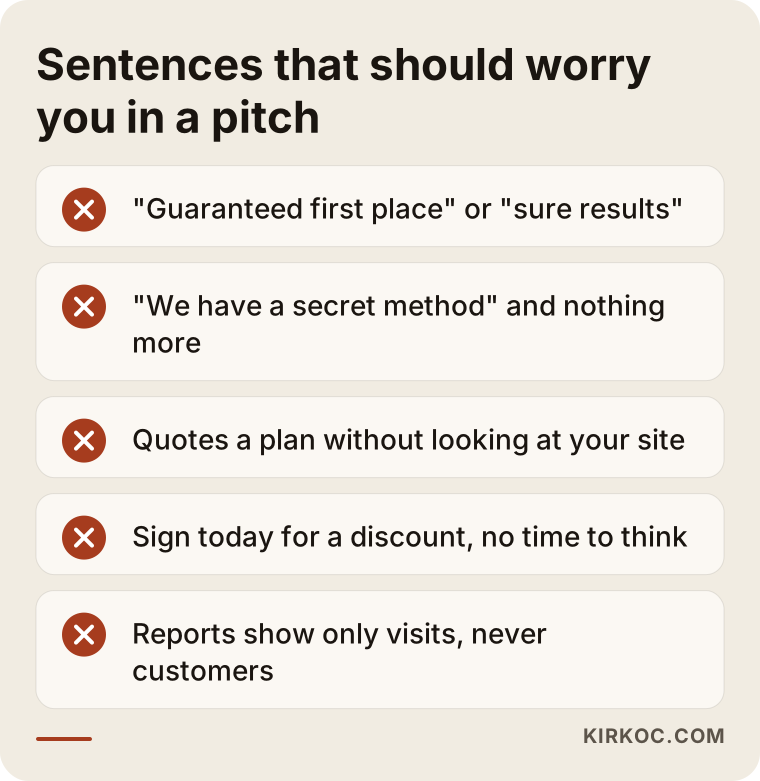
"We guarantee first place." Nobody controls search results. Search engines change their rules constantly and only they decide the order. Someone who guarantees rankings is either misinformed or deliberately creating a false expectation. An honest expert tells you what they will do and what they will measure, and does not promise an outcome.
"We have a secret method." A good expert explains the method. Someone who says it is secret often has nothing to explain.
"We have not looked at your site, but..." A plan and a price given without a review is a template.
"Sign today and get a discount." Rushing you is a way of keeping you from thinking. A real expert gives you time.
A report with only visit counts. Many visitors does not mean your business gained. Visits that turn into calls, forms or appointments are what matter.
Also be wary of older methods that were once common, such as buying piles of low-quality links to your site. These may cause movement for a while, but search engines can penalize them. If link work is planned, you should be told where the links come from and how they are earned.
Let's say you are one of two different businesses
These scenarios are hypothetical. They are not real clients; they show how the decision changes.
Say you run a dental practice in a mid-sized city. You have one location, clear services, and you want nearby people to find you when they search for things like implants or whitening. Advertising and content rules in healthcare are strict, so you should never work with anyone who talks about guaranteed treatment results. What matters here is someone who prepares compliant content, makes no outcome promises and understands local searches. A large agency's multi-channel machinery may not be needed; one consultant who knows your site, your service pages and your local visibility could be enough. On medical content, the clinicians decide what is said; the consultant only makes that information readable and findable.
Say you are an online store shipping products to three countries. You have a large catalog, content in three languages, advertising campaigns and constantly changing stock. Here the jobs depend on each other: technical foundations, product pages, advertising and content must move together. At that scale one person may struggle to carry it all; an agency with several specialties, or a few specialists coordinating, is more realistic. Even then, ask who does which job and who you will actually talk to.
Both examples show the same thing: not "best" but "right for me" is what counts.
How working with me runs
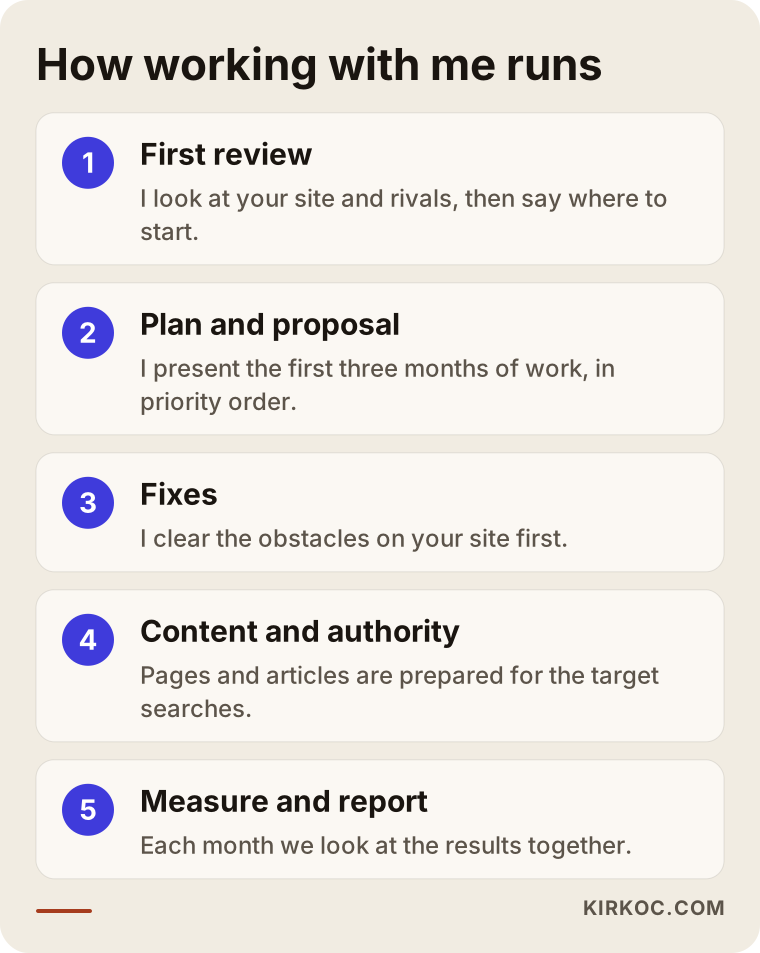
Let me describe my own way of working, because I should be able to answer the questions this article asks. I work alone, and the process goes like this:
- First review. I look at your site and your competitors, then say where to start.
- Plan and proposal. I present the work for the first three months in priority order, in writing.
- Fixes. I clear obstacles on the site first; they usually have the fastest effect.
- Content and authority. Pages and articles are prepared for the target searches, and your site's reputation is strengthened.
- Measure and report. Each month we review the results together and update the plan.
My service includes a review of your site, finding the right searches, technical fixes, content work, competitor tracking and a monthly report. I do not claim anything beyond that. I do not guarantee rankings, because I cannot. Ad management, social media accounts and other channels are not part of what I do; if you need those, I say so at the start.
I describe this because when you pick an agency or consultant you should look for the same clarity. If the process is not written down, if it is unclear what happens in the first three months, if nobody says what the monthly report contains, that vagueness will cost you later.
Why your industry's search behavior matters
A good expert thinks about how your customers search before you ask. People do not look for a restaurant, a lawyer, a wholesaler and a dentist in the same way.
Someone looking for a nearby business usually types a place name, looks at map results, reads reviews and calls straight away. Your address, opening hours and reviews are critical there. A wholesale buyer cares about specifications, certificates and minimum order terms; their searches are longer and more specific and the decision takes weeks. A person looking for a law firm is usually trying to understand a problem and contacts someone only after trust forms, so the content needs an informative, responsible tone, and phrases like "guaranteed win" are never acceptable.
Ask an SEO company in the pitch: "What do my customers type into search, and how will you find out?" A good answer includes a method: "We look at your customers and sales records, study search data and compare with competitors." A weak answer is nothing more than a keyword list.
Do not forget AI-assisted search either. Some people now type a question into a chat tool and get an answer, and which businesses are named in that answer matters. When you ask an agency about it, notice whether they treat it superficially, as in "it is a trend, we will see". But remember that nobody can guarantee a chat tool will mention you.
When you do not need SEO
To be honest, not everyone needs an SEO service. In these cases think twice before spending money on an SEO company:
- You have no site yet, or it is very old and broken. Fix the site first. Adding SEO to a rotten foundation is wasted effort.
- Your work comes entirely from referrals. If customers hear about you from people they know and you are fully booked, search may not be your priority.
- Your service is very narrow and local with almost no competition. A clean site, correct details and an up-to-date map listing may be enough.
- You expect results in a very short time. SEO takes time. If you need customers soon, other channels such as ads are more realistic.
- Your budget cannot carry steady work. SEO done for one month and dropped usually stays unfinished.
Also notice whether a consultant or company is willing to say "you may not need SEO". One who answers "yes, you need it" in every case is a salesperson.
Do it yourself or hand it to an expert?
Part of SEO can be done by the business owner. The basics are: keeping your business details identical and current everywhere, managing your map listing, asking customers for reviews and describing your services plainly on your site. This takes time, not expertise.
Handing it to an expert makes sense when you cannot see the technical problems on your site, do not know which searches would bring you work, lack the time or habit to produce content, or competitors clearly pass you. The expert's job is to think for you and follow it continuously.
A middle road also exists: have an expert do the first review and the plan, then carry out part of the work yourself. That is a common, realistic path for businesses with a limited budget. Someone who offers such an arrangement is focused on the work, not on tying you into a long dependency.
A short roadmap before you decide
While collecting proposals you can follow this order. First talk to three providers, but give all of them the same information so the proposals can be compared. Ask each for a written scope and a monthly deliverables list. In the meeting ask who will do the work and speak to that person once. Leave the price for last; first judge the scope and how well they understood you. Finally, read the term and exit conditions in the contract.
Keep one simple measure in mind while you decide: the person or business that explains the work in plain language, does not dodge your questions, offers a method instead of a guarantee and focuses on turning results into real customers is often better than the one wearing the "best" label.
Frequently asked questions
Is an SEO agency or an SEO consultant the better choice?
It depends on the size of your business and how many different areas the work covers. For one site, a clear service and a defined region, a single consultant you speak to directly is usually enough and more flexible. If you need many countries, many channels and heavy advertising management, an agency with several specialties may fit better. Whichever you choose, ask who will do the work.
How do I find the best SEO company online?
Search rankings show how well a company prepared its own site, not how well it will do your work. Instead, shortlist companies that explain their services and method clearly, do not make promises before seeing your site and answer your questions directly. Then talk to three and compare their written proposals.
Can an SEO company guarantee first place?
No. Search engines decide results and nobody controls that. A company that guarantees rankings is either describing the situation wrongly or creating unrealistic expectations. An honest expert tells you what they will do, what they will measure and when they will report, but does not promise an outcome.
What should I check most closely in a proposal?
The scope. The tasks should be written one by one, along with what you receive each month, how the report will look, the contract term and the exit conditions. Also check whether access to your site and search accounts stays with you. Look at the price only after you understand the scope.
How long does SEO take to show results?
It depends on your site, how crowded your field is and the scope of the work, so giving an exact time would be dishonest. In general SEO is an ongoing process, not a one-time fix. First the obstacles on the site are removed, then content and authority work starts to show its effect. Anyone promising a fast, fixed timeline is not speaking realistically.
Can I improve my site without an agency?
Partly, yes. Keeping business details consistent, managing your map listing, asking for reviews and describing your services plainly are in your hands. For finding technical problems, choosing the right searches and producing steady content, expert help saves time. You can also have an expert do the first review and carry out some of the work yourself.
How long should the contract be?
A very long commitment leaves you stuck if you are unhappy. A reasonable, clear starting term, plainly written exit conditions and the work and accounts staying with you make a healthy arrangement. If the contract is vague on these points, ask for clarification before you sign.
I was unhappy with my previous agency. Should I try again?
Yes, but ask different questions this time. Write down what was missing before: was the scope vague, the report confusing, the work not done? Ask about those points in the new meetings. Also make sure you have access to your site and accounts from the previous provider.
If you are considering working with me, I can look at your site with you and tell you honestly whether I am the right fit, and we can work out together whether you need an agency or a consultant; reach out to me through my SEO services page.