Your crew installs a clean job, the homeowner is happy, and the neighbors ask who did the work. Yet the phone does not ring as often as it should, because someone typing "replacement window company" into Google sees other firms first. In most cases that has little to do with the quality of your work. It comes down to what your website tells Google and what it tells the homeowner. Good SEO services for a window or patio enclosure company exist to make your site visible for those searches and to turn visitors into requests for an in-home visit and quote.
In this article I explain what the work consists of, which pages you actually need, what drives the price, and when you do not need it at all. You do not need technical knowledge to follow along.
How does a homeowner look for a window company?
Windows and enclosures are not an impulse purchase. A homeowner usually takes days or even weeks to decide. The spending is large, the result is visible from the street for years, and strangers will be working inside the house during installation. So the search behavior happens in stages.
First comes a problem. Rooms are cold in winter, traffic noise wakes people up, there is moisture on the frames, or someone wants a covered, enclosed porch or patio. The searches at this point are questions: "vinyl or aluminum windows," "what is a patio enclosure," "do double-pane windows reduce noise." The person is not looking for a company yet. But the site that answers these questions in plain language becomes the first name that sticks.
In the second stage the options narrow. The homeowner compares frame materials and glass types, scrolls through photos, and looks at sliding or folding systems. In the third stage the person searches for a company, usually with a town or neighborhood attached: "window replacement company near me," "patio enclosure installer" plus a town name. Location matters a great deal here, because installation happens on site. Nobody hires a firm from another region. The last stage is the request itself: a phone call or a form asking for a measurement visit.
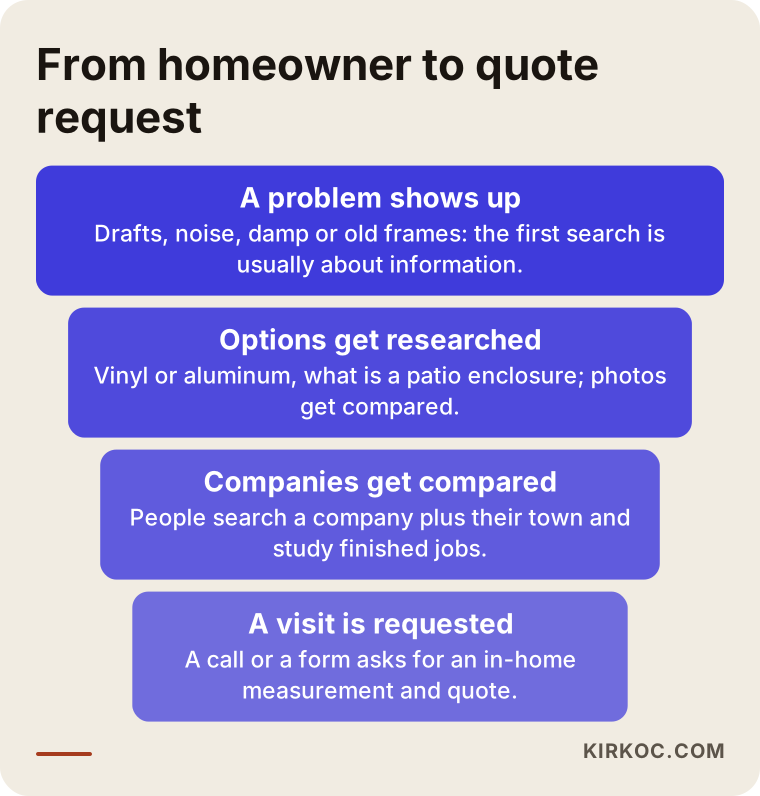
This path tells you two things. First, your site has to answer the early questions as well, not only the final company searches. Second, each stage maps to a different kind of page: information articles, product pages, town pages, and a quote form. Squeezing all of it onto a single home page makes life harder for both Google and the visitor.
What do homeowners see when they compare companies?
The visitor looks at the results page, glances at three or four entries, and opens one. What decides the click is the title and the two lines below it: do they sound trustworthy and local?
Your strongest signal is the message "I work in your area and you can see my finished jobs." The example below shows it. A result that lists the towns served, shows real installation photos and offers a quote form can stand out against a plain model catalog or a directory with dozens of firms. This is an illustrative scenario, not a promise of any ranking.
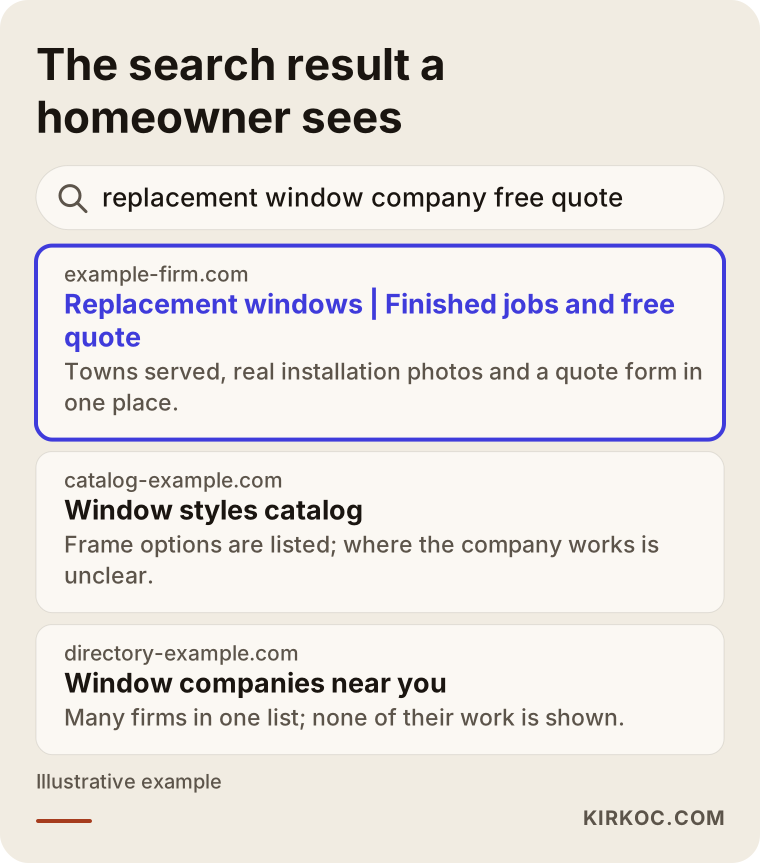
Catalogs and directories are often strong sites, and fighting them for the broadest keywords is not always wise. A smarter target is the clear-intent search that includes a company, a quote, an installation and a place name. The person typing those words is already close to buying.
Product pages and town pages: why separate ones?
A common picture on window company sites is one "Our Products" page with vinyl windows, aluminum frames, patio enclosures, shutters, screens and doors lined up, each with a sentence and a photo. Google cannot tell which product the page is really about. The visitor cannot reach the detail they came for.
A better layout gives every main product its own page. Window replacement gets one, patio enclosures get one, and folding glass systems can be explained on their own page as a separate topic. Each page says who the product suits, what materials and glass options exist, how installation runs and how to request a visit, all in plain words. The homeowner finds the answer to their own question.
The second layer is town and area pages. If you serve several towns, a separate page for each can make sense. One rule matters here: the pages must not be copies of each other. Changing only the town name inside identical text is worthless to Google and tells the reader nothing. Every area page should contain something real about that place, such as a job you finished there, the type of housing common in the area, exposure to wind and rain, or how quickly you can come for a measurement.
Do not open a page for an area where you do no work. Honesty is both an ethical and a practical matter: if you cannot serve a request that arrives from there, you waste time and leave a bad impression.
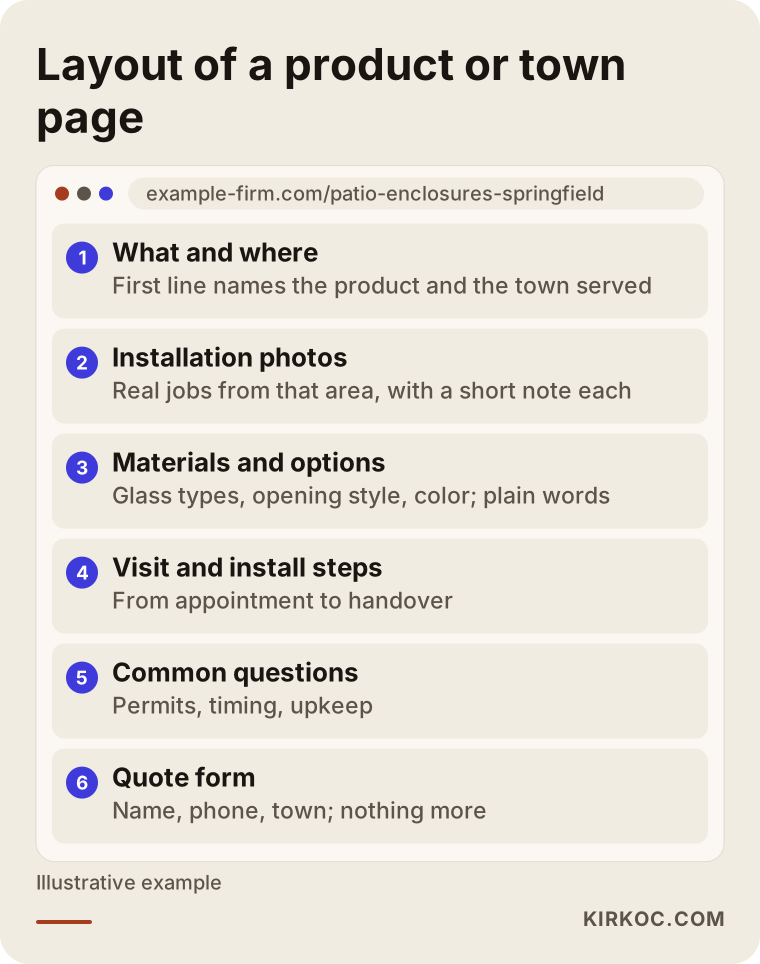
The layout above is a starting skeleton, not a fixed template. What matters is that the first line answers "what and where," and that proof, meaning real finished jobs, appears immediately beneath it.
Installation photos: the most valuable content on your site
In windows and enclosures, finished work convinces more than sentences. When a homeowner sees what a job looked like before and after, they can picture the product on their own house. A photo carries both trust and information.
On most sites, though, photos underperform for two reasons. The first is that files are uploaded straight from a phone at full size. The page loads slowly, and on a mobile connection the visitor leaves before it finishes. The second is that nothing is written next to the photo. Google cannot "see" a picture the way a person does. What helps it is the surrounding text, the file name and the alternative text.
Add a few sentences under each installation photo: which town, what type of building, which product, which glass option, and one detail that stood out during the job. Location at the neighborhood level is enough, without house numbers or anything personal. Never publish anything the customer would not want shown, and take care that interior photos show no people or private belongings.
Build a simple habit of photographing three moments: the start, the middle and the finish. The first shows the problem, the last shows the solution. These images can be used on your site and on your Google business profile.
Suppose a small enclosure company serves two towns
This is a hypothetical scenario, not a real customer. Suppose a small patio enclosure company works in two towns. The site has one "Patio Enclosures" page with a few generic photos, a phone number and sentences like "quality service." The owner says most calls come by word of mouth and almost none from Google.
A review might find: the phone number is inside an image so it cannot be tapped on a phone, the photos are so large that the page crawls, neither town is mentioned anywhere, and there is no quote form. A plan could run like this. First, make the phone number tappable and shrink the photos. Then add separate pages for folding and sliding systems. Next, one page per town describing real jobs done there. Last, a short quote form.
Nobody can say in advance what result this produces. What is certain is that the site finally answers the questions a homeowner asks. Calls and form requests over the following months show how much it helped.
What determines the price
There is no fixed price list for SEO work, and I will not quote numbers in this article. I can tell you plainly what changes the price, because it helps you ask the right questions when you collect offers.
The first factor is the state of the current site. A site with a sound base and only missing content is a very different workload from one full of technical problems that needs rebuilding. The second is how many products and towns need pages. A firm that only installs windows has different needs from one that offers windows, aluminum frames, enclosures, shutters and doors. The third is competition in your area; standing out in a crowded market takes more effort than in a quiet one.
The fourth is pace: whether the pages are prepared all at once or month by month affects both plan and budget. The fifth is how quickly you can send me photos and information. Without real photos and short notes from finished jobs, the pages stay weak, so part of the work always sits on your side.
When you get an offer, ask what is included and what is not, how often you receive a report, and when the engagement ends. If none of that is in writing, be careful.
How to compare offers and companies
If you are collecting offers from more than one person or company, these criteria make comparison easier.
The first is a clearly written scope. "We will do SEO" is not a scope. Which pages will be written, which technical fixes will be made and which searches are targeted should all be on paper. The second is whether they understand your trade. Someone who knows that windows and enclosures need an on-site visit, that town names matter and that installation photos carry weight will produce different work from someone with a generic template.
The third is what gets measured. Visitor numbers alone mean little; phone calls, form submissions and visit requests are worth more. The fourth is what is promised. Be wary of anyone who guarantees first place or exact results by a certain date. Nobody can guarantee a Google ranking. The fifth is who you will talk to. Is the person you speak with the one doing the work, or do several layers sit in between?
Finally, check what stays with you at the end. The pages should live on your site, access should belong to you, and what was done should be reported in a way you understand.
Common mistakes on window company websites
These are the mistakes I see again and again in this trade. Most are cheap to fix; they just go unnoticed.
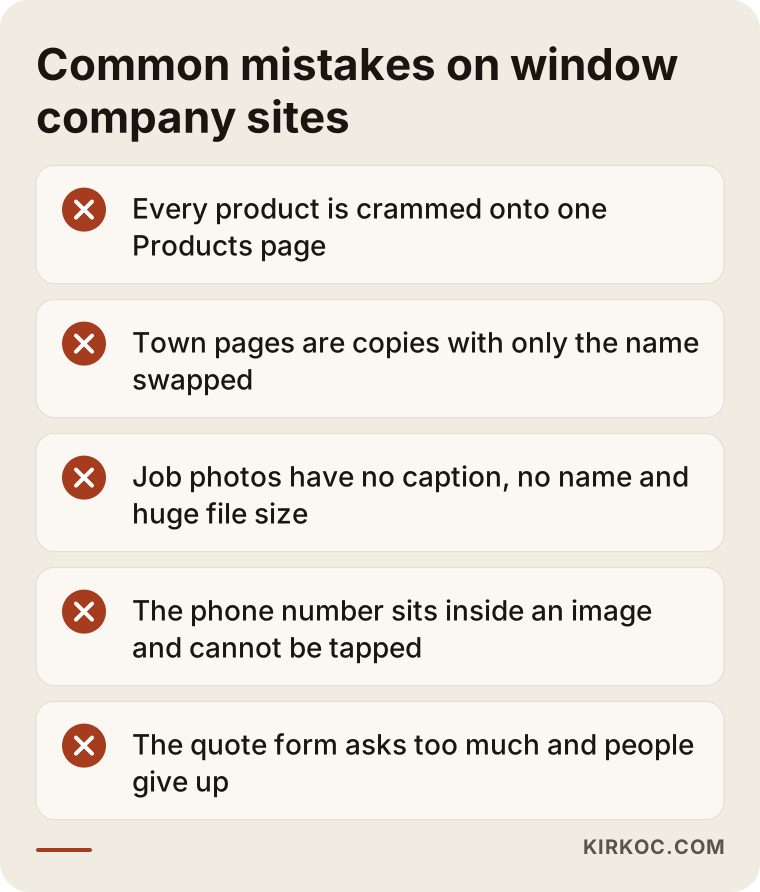
Putting every product on one page is the most common, as described above. Copying town pages is another. Then there are photos: file names that are strings of digits, no description, and sizes far larger than needed. A phone number written inside an image cannot be tapped on a phone, which loses requests directly.
A quote form that asks too much is easy to underestimate. A homeowner who has not decided yet and meets a form asking for measurements, models and budget often gives up. A name, phone number and town are usually enough; you learn the rest on the call.
Another mistake is ignoring reviews and trust. Asking a happy customer after installation to leave a short review on your Google business profile carries real weight for a decision this big. That is not part of what I do; it is a habit you run yourself, but it completes the work on your site. Last, never updating pages: outdated information and discontinued product lines damage credibility.
How we work together
For those who wonder how the work runs, the process is simple. First I look at your site and the competitors in your area and tell you where to start. Then I present the first three months of work in writing, in priority order, and we settle the offer based on that plan.
Next come the fixes. I remove the blockers on the site first: slowness, pages that fail or look broken on phones, contact details that cannot be tapped. They give the quickest effect. After that comes content and building authority: product and town pages for the targeted searches plus articles that answer your customers' questions, while the reputation of your site is strengthened. We review the results together each month and update the plan.
The report shows in plain language which searches you have moved up in, what was done and what comes next.
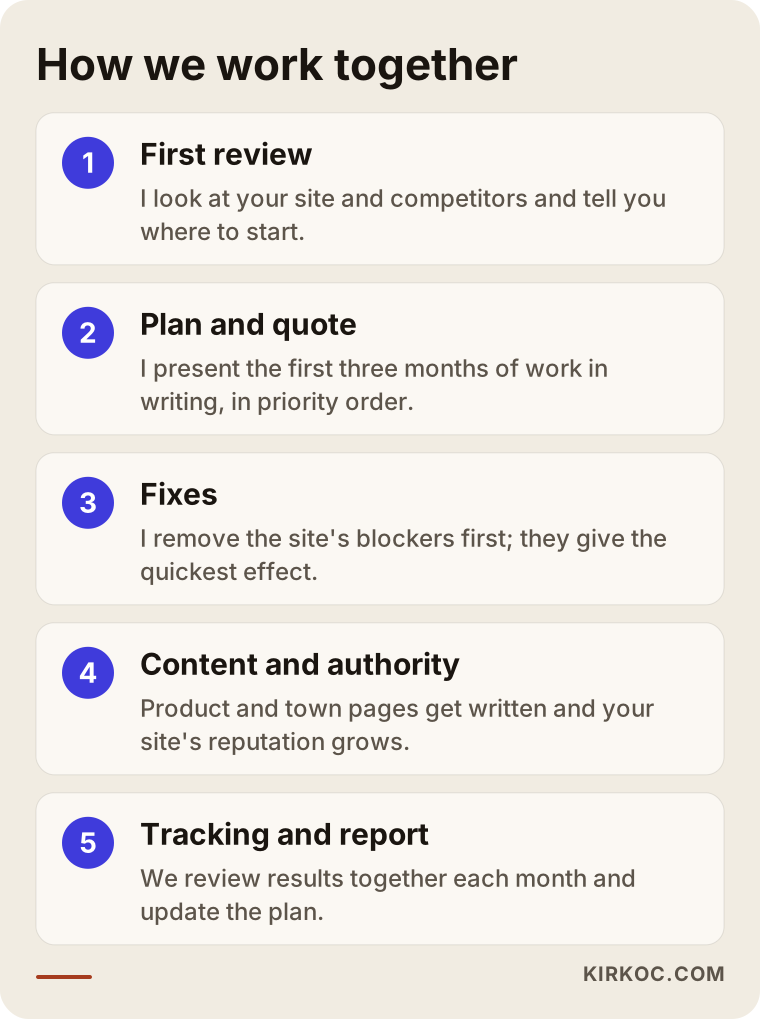
I also expect a few things from you: sending installation photos with short notes, telling me accurately which areas you serve, and sharing how many visit requests turn into jobs. Without these, measurement does not reflect reality.
Do it yourself or hire a specialist?
Part of it you can and should do yourself. Taking installation photos, writing a few lines about each, keeping your company details identical everywhere and asking happy customers for reviews are all within your reach. A company that does these already beats one that does nothing.
You need a specialist for the technical and time-consuming parts: finding out what homeowners really type, planning which product and town pages are needed, detecting and fixing slowness and visibility blockers, studying what competitors do differently and measuring the result every month. Someone who knows the field finds these in a few hours; you could spend weeks and still miss them.
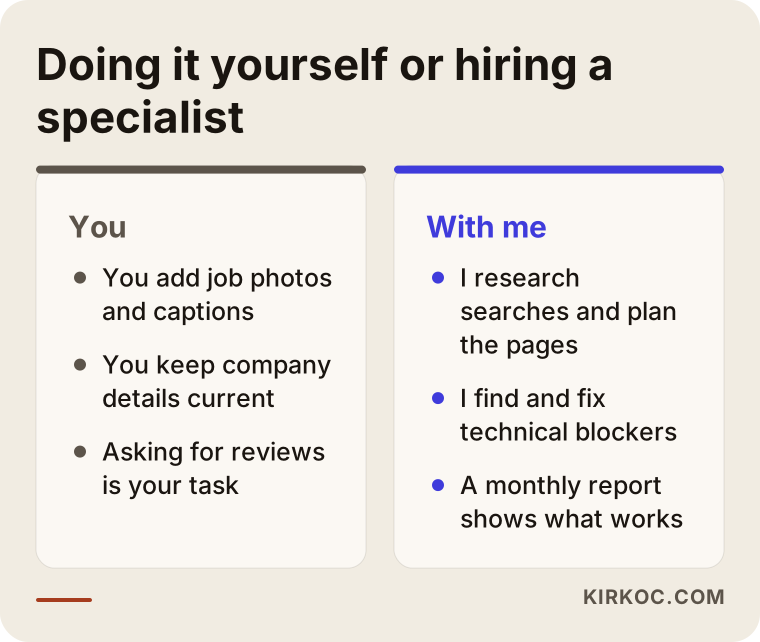
So the real question is not "me or a specialist" but which part of the work sits with whom. The most efficient setup is usually both together.
Suppose a company sells vinyl windows and aluminum frames
Another hypothetical scenario. Suppose a firm sells vinyl windows, aluminum frames and shutters, and serves several neighborhoods. Its site was built a year ago and looks fine. The owner still gets most jobs from builders and dealers but wants more requests from individual homeowners as well.
The first question here should be: what words do individual homeowners use, and are enough of them searching? If homeowners in the area do search for window replacement, one page per product and pages describing real jobs at neighborhood level make sense. If the firm's main strength is its builder relationships, the first stage can be limited to one strong window replacement page and a quote form, widened later according to results.
What this shows is that an SEO plan is not built the same way for every company. Starting small and measuring is healthier than producing dozens of pages at once.
When you do not need SEO
To be honest, SEO is not the right step right now for every window company. If your work mostly comes through builders, architects, dealers or personal referrals, and you are not aiming for requests from individual homeowner searches, strengthening those relationships may pay off more.
Likewise, if your schedule is already full and you cannot handle new visit requests, raising demand only puts you under pressure. Get the crew and calendar in order first. And if your site cannot even state the basics clearly, such as your phone number, your service area and your products, fix the site before thinking about SEO.
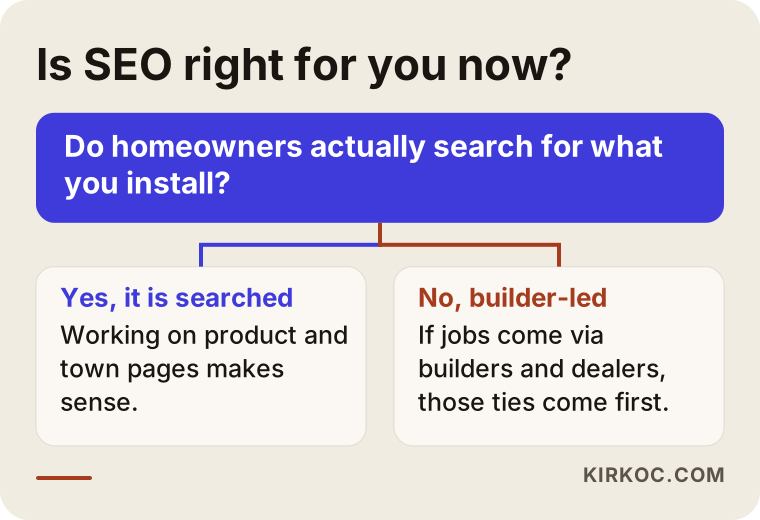
SEO is a time-based investment; results usually become clear over months, not weeks. If your phone has to ring this week, shorter-term routes deserve a look, and I will tell you so openly.
AI assistants and map listings
Homeowners now ask AI assistants too: "Is there a reliable window company in my area, and what should I check with an enclosure?" Such answers lean on sites that give plain, consistent and verifiable information. Writing product and town pages clearly, and giving your company name, address and phone identically everywhere, helps here as well.
Managing the map listing itself is a separate task from the site work I describe here. Still, keeping your profile current, adding photos and answering reviews are cheap and effective steps you can take yourself.
Frequently asked questions
How long does SEO take for a window company?
It depends on competition in your area and the current state of your site. Once technical blockers are removed, first movement can show within weeks, but a steady rise in quote requests usually takes months. I do not give an exact date; anyone who does is not being straight with you.
Do I need a separate page for every town?
Only for towns you actually serve and where you have done work. Each page should hold real information and jobs from that place. Copies with the town name swapped do not help and can hurt your site.
Wouldn't Google ads be easier?
Ads are quick, but when the budget stops, so do the requests. SEO starts slowly, yet the pages you build keep bringing requests without a payment per click. They complement each other rather than compete; which one fits depends on your budget and urgency.
Do I have to rebuild my website from scratch?
Not always. If the site loads quickly, looks right on phones and can take new pages, it can be built on. I would tell you that in the first review, and I will not try to sell a new site you do not need.
Do I need permission to publish installation photos?
Yes, especially when interiors are visible. Make sure no people, family photos or addresses show. Neighborhood-level location is usually enough. If you are unsure, get a short written okay from the customer.
My competitor has been doing this for years. Can I catch up?
On broad keywords it can be hard, but small companies can stand out on searches focused on town, product and intent. That is why starting with narrower, clearer searches is more realistic.
What if an offer guarantees a ranking?
Be careful. Google decides rankings and no one can guarantee them. An offer that states scope, timeline and reporting clearly is more trustworthy than one built around a guarantee.
Where should I start?
Collect three things: a list of the towns you serve, photos of your best few jobs, and where your requests come from today. With those, the first review goes much more efficiently.
If you want your window and enclosure business to show up on Google and homeowners to call you for a visit, let us look at your site together first. You can read how the work runs on my SEO services page, and then contact me to arrange a first review.