If you have started researching SEO content writing cost, you have probably met two extremes. On one side are bulk sellers promising dozens of articles for very little money. On the other are expensive quotes that never explain what you are paying for. Both can end the same way: the articles go live, and the phone stays quiet. I am a freelance web designer and SEO consultant, and in this guide I explain what actually sets the price of an SEO article, which offers to walk away from, and what to check when the work arrives, all without quoting numbers, because the right number depends on your business. If you would rather have articles planned together with the rest of your site, my SEO services page describes how I work.
What are you actually buying with an SEO article?
Most people hear "article" and think of a word count: so many words, a few headings, delivered by Friday. An SEO article is better understood as an answer. Someone types a question into a search box, and your page is the answer written by a person who knows your field. So what you are buying is not length. It is a combination of four things.
The first is the right topic. A flawless article about something nobody searches for will never be read. The second is information that is actually useful. If every page on the first results page repeats the same generic advice, yours becomes one more copy and disappears. The third is a structure that moves the reader to a next step: will they call you, fill in a form, open your service page? The fourth is the article sitting properly inside your site, with a clear title, a sensible description, links to related pages, and a layout that reads well on a phone.
An article that delivers only one of these is expensive no matter how little it cost, because work that brings no inquiries is never cheap. An article that delivers all four can reasonably cost more. The point is to see what the price is paying for.
Buying single articles is not the same as buying a content plan
Ordering one article at a time is like repainting a single room in a worn-out house. It may look nice, but visitors notice the rest. If your site loads slowly, breaks on phones or has empty service pages, new articles will not get the chance to work. So when you collect quotes, ask whether anything on the site would hold the articles back. An honest writer will tell you. Someone who only wants the order may not.
Who benefits, and who does not need this yet
Paying for articles makes sense in situations like these:
- Your customers search with questions and read before they decide, as often happens with clinics, law practices, consultants, home improvement, education and business services.
- You have service pages, but nothing that answers the questions running through a buyer's mind.
- Competitors publish regularly and show up above you.
- You want less dependence on paid ads.
- You have real experience to share but no time to write.
In other situations it may not be the right step yet, and I would rather say so plainly:
- Your site does not exist or is badly outdated. Fix the site first; articles pointing to an empty shop do little.
- Your work comes entirely from referrals and you do not need new customers.
- Your service is almost never searched and sells through personal relationships, such as a handful of large accounts. Direct outreach will do more.
- You cannot handle extra inquiries. Paying for traffic you cannot answer wastes money and reputation.
- You write well yourself and can set aside regular time. In that case you might only need help choosing topics and editing.
What decides the cost of SEO articles?
I will not quote figures, because a real estimate only appears after looking at your business, your competitors and your goals. But if you understand the building blocks, you can compare two quotes sensibly. The table below summarizes the main factors that push the cost of an article up or down.
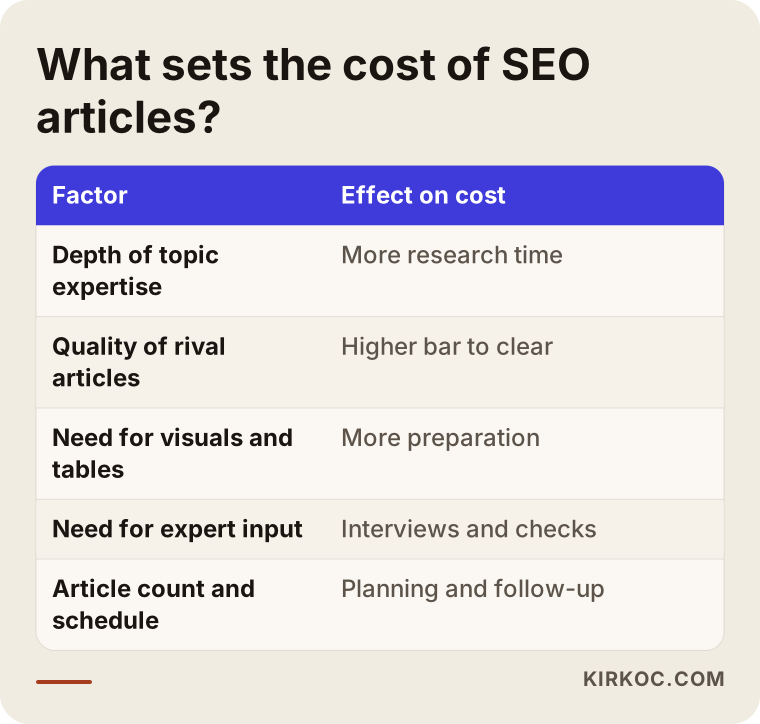
Depth of expertise in the topic
An article about a restaurant's opening hours and an article explaining how a medical or legal process works do not take the same effort. In the second, the writer has to learn the subject, verify it, then explain it plainly. On specialist topics, research and checking can take most of the time. A flat per-article price is often set for the easiest topic on the list.
Quality of what already ranks
If the first page for your topic is full of weak, old posts, standing out is relatively easy. If strong websites already fill it, your piece has to match or beat them. So the price depends not only on how much is written but on the bar to clear. A good quote shows you that bar: here is what ranks today, and here is how yours can be different.
Visuals, tables and page layout
Comparison tables, step diagrams and checklists help readers finish an article, but someone has to prepare them. Publishing the article on your site, setting the title and description and making sure it reads well on mobile are also part of delivery. If a quote says "article" and does not mention "publishing", that work lands on you.
Expert review and fact checking
In health, law and finance, an article must be correct and compliant, not just well written. A qualified professional in that field, such as a doctor or attorney, should review it. In these areas I stay with informative, rule-aware content and avoid medical or legal advice and promises of results. That review step can and should be reflected in the cost.
Number of articles and publishing rhythm
One article and a steady months-long program are different jobs. A program involves a topic plan, links between articles, updates to older posts and tracking results. You cannot simply multiply a single-article price. Bulk work can lower the cost per piece, but if topic choice and follow-up are weak, the total value drops too.
The real cost of cheap bulk articles
Services that promise hundreds of articles for very little look attractive. The assumption is that more articles bring more visitors. In practice it rarely works that way, for several reasons.
For years, search engines have been trying to filter out pages written for them rather than for people. Dozens of pages made from one template, with only the keyword swapped, can weaken trust in the whole site. So weak articles do not just fail to help; they can drag down the good pages next to them. I will not present that as a fixed rule, since search engines change, but the direction has been consistent: helpful, original content from someone who knows the subject.
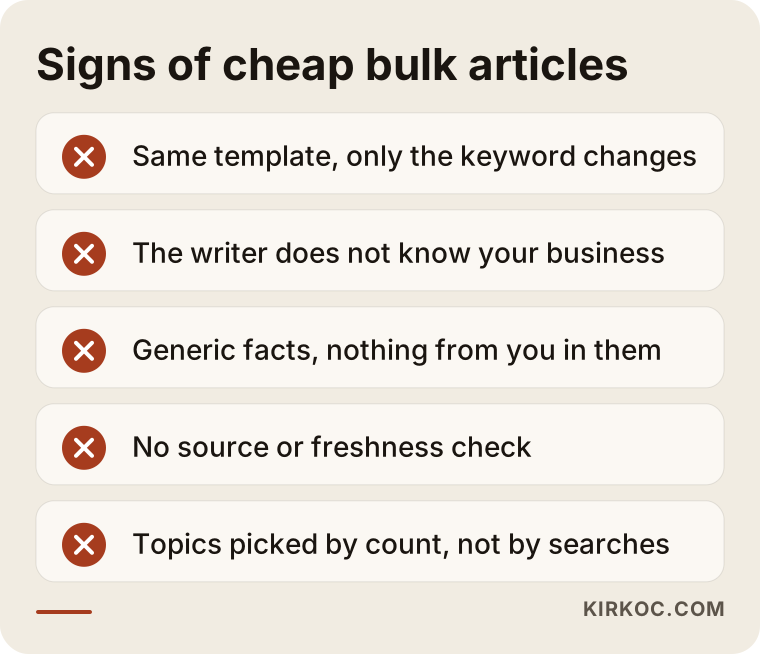
The writer does not know your business
Someone writing for a hundred industries does not know what words your customers think in. A dental practice's patient rarely searches for the procedure name; more often it is something like "what can I do about a missing tooth". Content that misses the real language of the field is accurate but speaks to the wrong person.
Topics come from a quota, not from searches
In bulk packages the topic list usually comes with the package: safe, general headlines that fit any industry. Most of those headlines carry no buying intent. "What is digital marketing?" may get plenty of reads, but few readers are about to hire anyone. A lot of visitors and a lot of customers are not the same thing.
No source, freshness or accuracy check
If the facts are wrong, outdated or lifted from other sites, readers notice, and you lose trust once. For rules, taxes, health and technical subjects, old information is not just worthless, it can be risky.
Nobody owns the result
In bulk services the article is delivered and the job ends. No one looks at which piece brought inquiries, updates it or rebuilds the weak ones. That follow-up is where SEO actually happens.
How to choose topics that bring in clients
What separates a good article from a poor one is often decided before writing starts: why this topic? You can do the selection yourself. It needs observation, not technical knowledge.
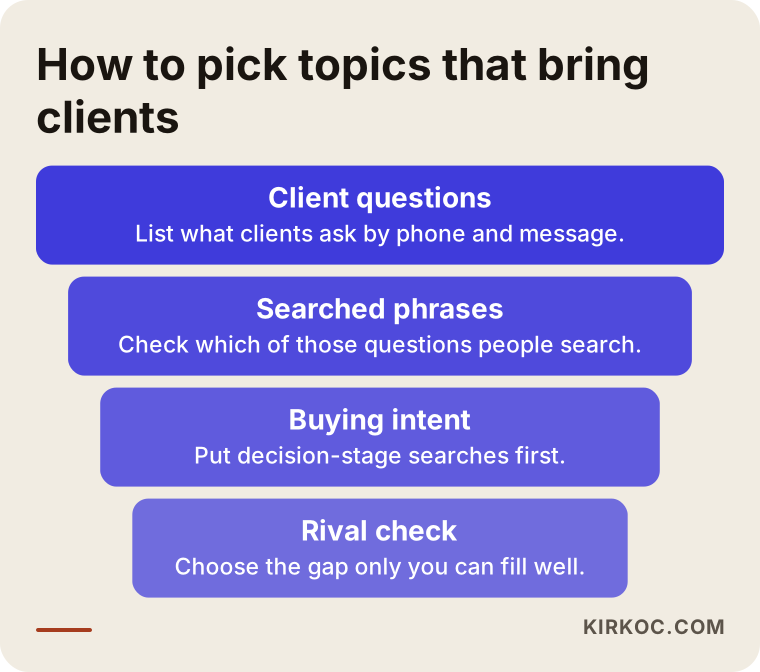
Start with what clients ask you
List the questions you heard most over the past month by phone, message or in person. "How long does it take?", "what documents do I need?", "what is the difference between these two options?" This is a topic pool no tool can give you. If a client asked you, others are typing it into a search box.
Then check whether people search for it
Not every question becomes an article. Some are only asked by your own customers and have no search volume; a short FAQ section covers those. Others are asked by many people. You can get a sense of which is which from search suggestions and keyword tools. In my own work, I run this step separately.
Rank by buying intent
Searches fall into three groups. The first group wants to learn: "what is it, how does it work". The second compares: "which is better, what to look out for". The third is ready to decide: "cost, how to choose a provider, hiring". If you want clients, most of your articles should come from the second and third groups. The first group has value too, but alone it rarely sells; use it for trust and awareness.
Find what rivals do not say
Look at the first page for the topic. If all results say the same thing, what can you add? An example from the field, a common mistake, a detail specific to your trade, a criterion you use when advising someone. Good articles usually come out of that gap.
What does a good article look like in search?
The mock-up below shows how someone searching for a question sees two results. The domain names are made up, used only to explain the logic. The first result signals in its title that it will answer the exact question. The second covers the subject in general terms. Both may contain accurate information, but when people decide where to click, the result that visibly matches their question tends to win.
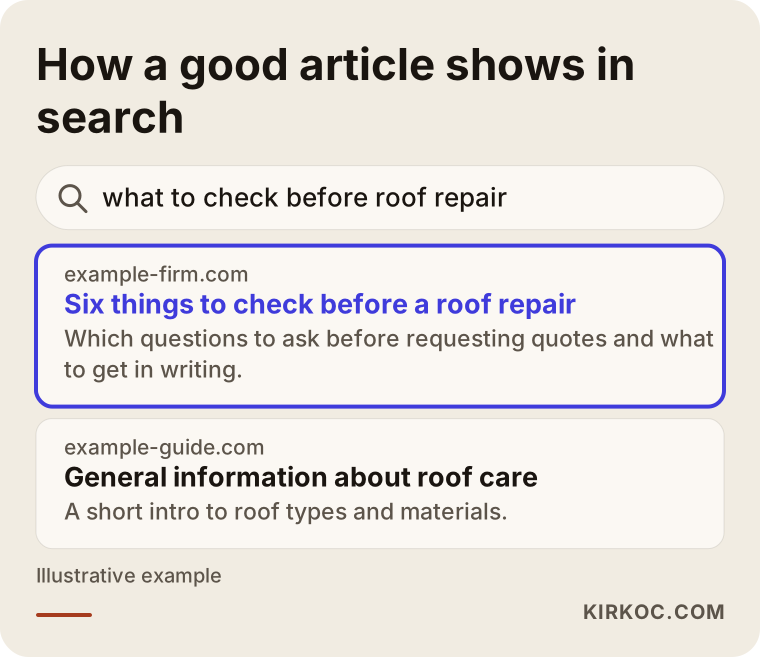
That is why the title is one of the most important lines in the piece. It should contain the searched phrase and tell the reader what they gain. A title like "About Roof Care" tempts nobody. Today people also put questions to AI assistants, and those tools lean toward pages that are clear, well organized and answer the question directly. That is no guarantee, just a good reason for structure: the question in the heading, the answer right below it.
What to check when the article arrives
"Looks good" is not enough at delivery. The list below lets you judge a delivered article yourself, with no technical knowledge.
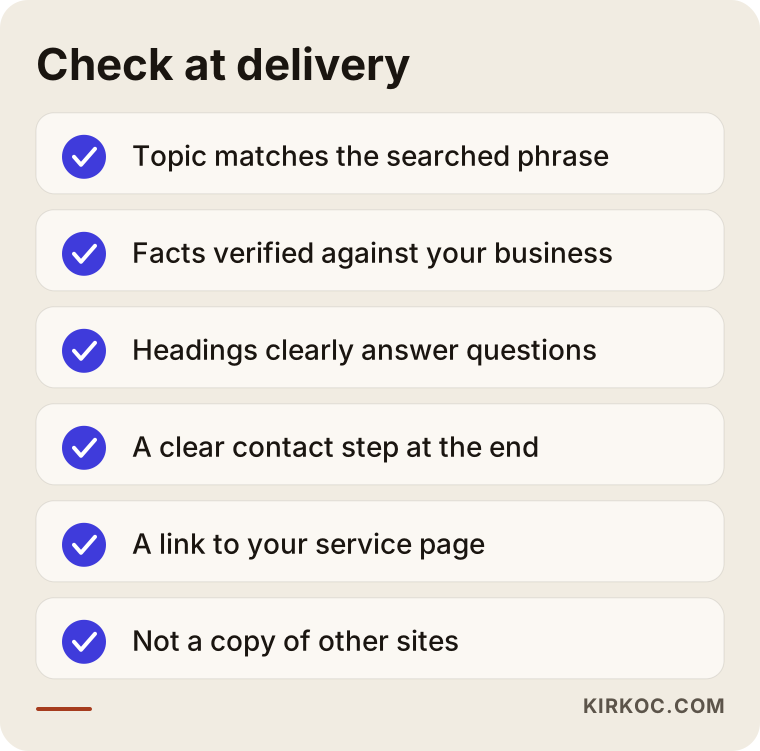
Let me unpack some of these. "Topic matches the searched phrase" means the title and first paragraph use the words your customers use. You may say "plumbing renewal" while the customer searches "what to do after a pipe bursts". "Facts verified against your business" means the process, documents, timing and steps in the text do not contradict how you really work. If the writer described a generic process, you may be creating wrong expectations without noticing.
The "clear contact step at the end" is often forgotten. Someone who reads to the end may be ready; if you do not tell them how to reach you, they leave. It does not need to be a hard sell, just a plain invitation. A link to your service page helps the reader take the next step and helps search engines understand how your pages relate.
Finally, originality. If the article resembles text on other sites, you have both an ethical and a search problem. Before accepting, paste a few sentences in quotation marks into a search box and see what comes up.
How customers search in different trades
Customer behavior differs a lot by trade, and a writer who ignores that puts the right article in the wrong place.
For urgent services such as locksmiths, plumbers and towing, searches are short and hurried; people do not read long articles, they look for a number and a service area. Here a blog is secondary and service pages and local visibility matter more. If you do write, short "what to do and what to watch for" guides fit better.
For big decisions such as renovations, education, business software or consulting, buyers research for weeks. Comparison and decision articles work best: how to choose, what to watch for, what to look at in a quote. A customer meets you not in the first search but in the third or fourth article, and that is where trust forms.
In regulated fields such as healthcare and legal services, content should inform, avoid promising outcomes and avoid personal advice. Good content here does not frighten or exaggerate, and answers clearly when to see a professional. Advertising rules differ by country, profession and governing body, so confirm what is permitted with your regulator or professional association. I keep the tone on that line, but knowing which statements are allowed for you remains your responsibility.
For product sellers, articles are built around comparisons and how-to guides: which product suits whom, how to maintain it. Here the link from the article to the product page decides the sale.
Suppose: two hypothetical scenarios
The two examples below are entirely made up, not real clients. They only show how the decision can play out.
Scenario one: the design studio that bought a bulk package
Suppose a small interior design studio chose a service that delivers many articles every month for a very low price per piece. The articles arrive with general headings like "interior trends" and "home decor tips". A few months later the blog has dozens of posts and visits have gone up a little, yet almost nobody asks for a quote. The readers are people looking for ideas. People who want to hire a designer search for things like "interior designer for office renovation" or "how to plan an apartment layout". Had the studio published fewer articles aimed at those decision-stage searches, it might have seen fewer visitors but more inquiries. The lesson: the flaw in a cheap package may not be poor writing but answering the wrong question.
Scenario two: the physiotherapy practice that started with a topic plan
Suppose the owner of a physiotherapy practice spends three weeks noting the questions patients ask most. The list includes "what happens at the first session", "how many sessions might I need" and "does insurance cover it". For these questions the practice has a small number of detailed articles prepared, with no medical advice and a clear section on when to see a doctor. The writer's main job is confirming every sentence matches how the practice truly operates. A few months on, people arriving from search start phone calls with "I read your article". That is a sign the article did its job: it built trust and turned it into an appointment. The money went into fewer pieces, but the right ones.
How to compare quotes
Two quotes can state the same word count and the same turnaround. The difference lives in the invisible items. Ask these questions.
Who chooses the topics, and on what basis? If the answer is "we will decide for you" with no reasoning, be careful. In a good quote every topic has a reason and a target search written down.
Who is the writer, and how well will they know your business? Will they talk to you, ask what your customers ask and learn your process? An article written without any conversation is a generic article.
How do revisions work? If you find a factual error, is the fix free, how many rounds are included, and how long does it take? This belongs in writing.
Are publishing and measurement included? Placing the article on your site, setting the title and description, and reviewing results after a while: are they inside the package?
Who owns the work? Once paid for and published on your site, the article should be yours; look for it in writing. Also make sure the same text is not sold to another client.
Does the provider set honest limits? A quote that promises first-page placement or a set number of new customers is promising something nobody can deliver. Neither I nor anyone else can guarantee rankings, because the search engine decides. A solid proposal explains instead what will be done, how it will be measured and when first signals may appear.
How we would work together
I treat article writing as part of SEO work, so the process begins before any writing. The diagram below summarizes the steps I describe on my service page.
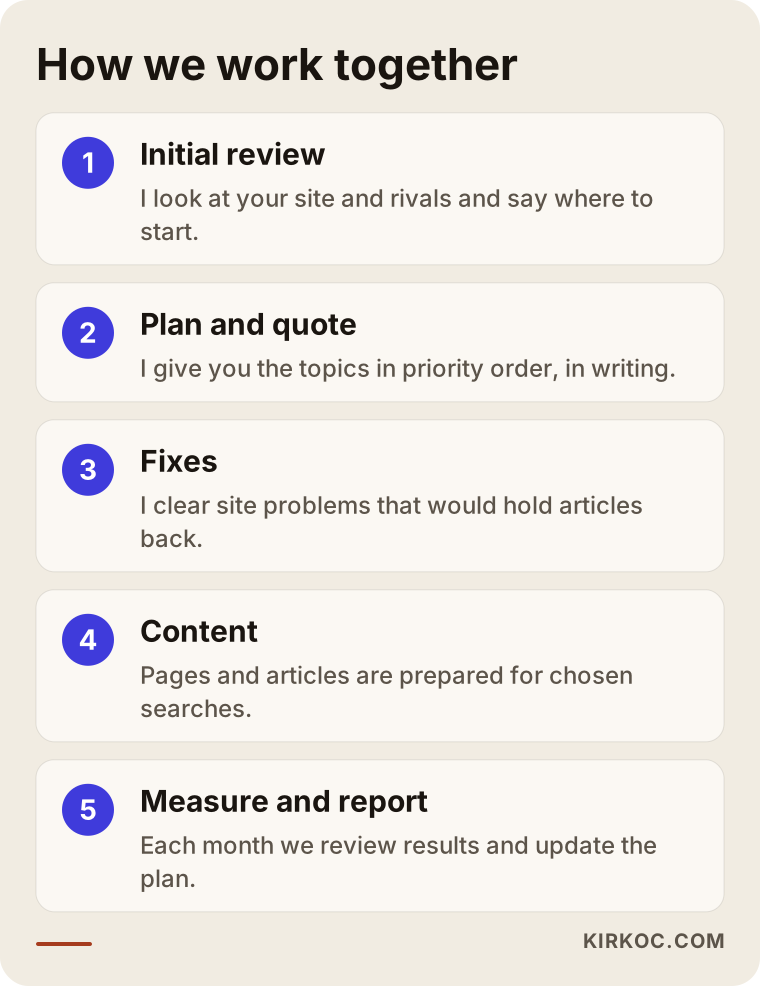
First I look at your site and your competitors and tell you where to start. At this stage we also discuss whether articles suit you right now, and if they do not, I say so. Then I give you, in writing, what would be done in the first three months in priority order, with the topics, target searches and reasons. Before writing begins I clear site problems, because those often make the quickest difference. Pages and articles are then prepared for the chosen searches, and work that strengthens your site's reputation is part of that stage. Every month we review what was done, which searches you moved up in and what comes next, with a plain-language report.
Let me also be clear about what I do not offer: I work remotely, I do not promise a particular ranking or revenue, and I do not write health or legal advice in your name.
Common mistakes when buying articles
The first mistake is deciding from the first quote. Gather quotes from three sources and compare scope side by side; the difference is usually in the scope.
The second is ordering everything at once. Starting with three or four articles and looking at results is much safer than signing for fifty. You see what kind of article brings work, then build the plan around it.
The third is cutting the article off from your own voice. Readers want to get to know you. If the text does not reflect your work, your decisions and your warnings, it is no different from any article on any site.
The fourth is never looking again after publishing. Publishing is half the job. Later you check which search brought visitors, adjust the title and add missing sections.
The fifth is ordering dozens of near-identical articles on one subject. Two pages aimed at the same search compete with each other. One strong page per topic is better.
The sixth is forgetting the contact route. You must show readers how to reach you, whether by phone, form or message, whichever suits you, and it must be visible and easy.
Write it yourself or hire a specialist?
You know your work best, and that is your biggest advantage in an article. If you want to write yourself, here is a route: pick the question customers ask most, write the answer as you would say it on the phone, then edit it. A plain, direct, unexaggerated piece often beats a polished one.
Hiring help makes sense when you lack time to write regularly, do not know which topics are searched, need the articles placed and measured properly, or face strong competitors where reaching the first page needs a deliberate strategy. A mix is often ideal: knowledge from you, with topic selection, structure and editing from a specialist.
AI writing tools are another option and look cheap. But they do not know the real details of your business; they write general information fluently. They can produce a draft, though you or an expert must check that it fits your work before it goes live. Otherwise you simply add another look-alike article to the internet.
Questions to ask yourself before you order
If you can answer these five questions you are ready. Which search will this article answer? What will the reader do after finishing it? Does the information match how I really work? Which page of my site supports it? How will I measure the outcome? If one of these has no answer, filling that gap is worth more than the article.
Frequently asked questions
How long does it take for SEO articles to produce results?
It depends on the age of your site, the strength of competitors and the difficulty of the topic. A new article may take weeks to appear in results and months to settle into a strong position. Be wary of anyone who promises an exact timeline; I cannot guarantee rankings either, because the search engine makes that decision.
Is it better to pay per article or monthly?
Either can be right. If you want to test with a few articles, per-article pricing fits. If you also want a topic plan, updates and measurement, monthly work makes more sense. What matters is that the work covered is written down.
Are cheap bulk article packages always useless?
Not always. Simple informational pieces with a clear scope, well-chosen topics and your own review can sometimes be enough. The problem is producing articles just for volume, without topic and accuracy checks. Ask for a sample before buying and judge it against the delivery checklist above.
Is it a problem to have articles written with AI?
AI can be a tool, but it is not enough alone. It gathers general information well but does not know your process, your limits or your local conditions, and it can state wrong facts. Articles published without human review and business-specific detail will not stand out from the rest.
Who owns the copyright of an article I commission?
Put it in the agreement or quote in plain words. The usual approach is that a paid article published on your site belongs to you. It should also be a condition that the same text is not resold and is not copied from other sites.
How many articles should I start with?
For most businesses, a small number of well-chosen articles is safer. Pick the few topics most likely to bring clients, review the results, then continue. How close a topic is to a buying decision matters more than the count.
Can I commission articles in health or legal fields?
Yes, but they must be informative and rule-aware, make no promises of outcomes and give no personal advice. A qualified professional should review the content, and you should confirm advertising rules with your regulator or professional association.
What should my website have before I order articles?
Plain pages describing your services, a design that works on phones and clear ways to contact you are a good start. If the site is very slow or the service pages are empty, fix those first; articles then deliver their full value.
If you would like to talk through whether articles are the right move for your business, which topics to begin with and what a working plan could look like, get in touch and I will look at your site and competitors and give you an honest opinion. You can see how I work on the SEO services page and contact me from there.