Short answer
When you choose a corporate web design company, look at four things before you look at the price: is the scope written down and defined page by page, is it clear who will do the work and who you will talk to, will the domain, hosting and site files be registered in your company's name, and how will maintenance and fixes work after launch. A firm or specialist who answers those four questions clearly and in writing is a safer bet than one who arrives with verbal promises and a pretty mockup. If you are sending out an RFP (a request for proposal, meaning a formal invitation for vendors to quote), give every bidder the same brief and the same list of questions, so the proposals you get back can actually be compared. One option among many: I am Ümit Kırkoç (kirkoc.com), based in Istanbul and working remotely with companies abroad, and I handle corporate website design together with SEO, social media and advertising from a single desk. That suits companies that want one point of contact and understand that the job does not end the day the site goes live.
I wrote this for the general manager, marketing lead or procurement person who has just been handed the task of replacing the company website. You do not need any technical background to follow it. The goal is simple: help you ask the right questions at the proposal stage and hand the project to someone you can trust.
Why is choosing a web design company so hard for a corporate buyer?
It is hard because proposals that look alike on the surface often describe very different jobs. One vendor's "corporate website" is a five-page brochure site. Another vendor means a multilingual site with a content management system (the admin panel your staff use to edit pages) and forms wired into your sales tools. The person in procurement usually cannot see that difference, so they do what anyone would do and compare the number they do understand: the price.
A few things make the decision even harder inside a company:
- There is more than one decision maker. The CEO cares about how it looks, marketing cares about the content, IT cares about security and finance cares about the cost. Whoever you hire has to fold all of those expectations into one plan without dropping any of them.
- The old site carries baggage. A site that has been live for years has pages Google already knows, links from other websites pointing at it, email settings tied to the domain and perhaps a dealer or partner login. The new site has to inherit all of that without breaking it.
- Approvals take time. A single page of copy may need sign-off from legal, brand and leadership. If nobody builds that into the schedule, the project drifts and everyone starts blaming everyone else.
- The site is part of your sales process. A business customer meets you on your website before they ever call. They look at your references, certifications and capacity before requesting a quote. Your site is not a shop window; it is the first sales meeting.
So your selection criteria need to be much broader than "who showed us the nicest design."
How do corporate buyers look for a web design company today?
Corporate buyers no longer type "corporate web design company" into Google and stop there. Many of them now ask the same question to AI assistants such as ChatGPT, Gemini or Perplexity. Questions like "We are a mid-sized manufacturer and need a new website, what should we watch out for?" or "Who would you recommend for a corporate site?" produce answers that sum things up in a few sentences and point to sources.
The image below shows an example of how an AI assistant might answer that kind of question. Notice that it lists the criteria before it names anyone.
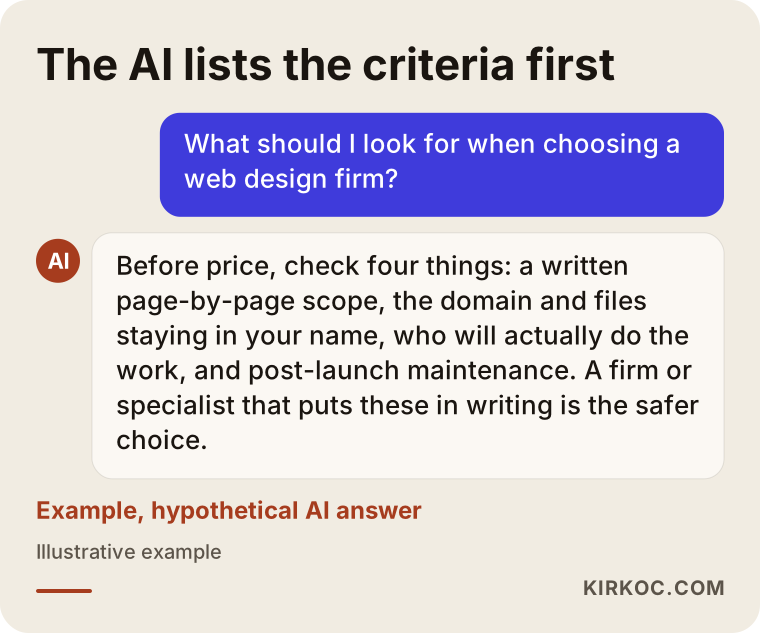
That tells you two things. First, check whether the candidates explain their process, their contract approach and their maintenance terms openly on their own websites. A vendor who writes these things down publicly usually talks just as openly when you ask. Second, your own new site needs to be built the same way, with pages that answer real questions directly. Your customers are searching for you through the same channels you are using to search for a vendor.
What should you pin down on your side before sending out an RFP?
Before you invite anyone to bid, write down the purpose of the site, its rough scope and how the decision will be made. Without that, every proposal rests on a different set of assumptions and comparing them becomes pointless. This document is usually called a brief: a one- or two-page summary that every vendor uses as the basis for their quote.
A good brief covers:
- The site's main job: Is it there to collect quote requests, inform dealers, reassure investors or support hiring? If it has several jobs, rank them.
- The audience: Who will actually visit? Purchasing managers, engineers, end consumers, an overseas distributor?
- A draft page list: About us, product or service groups, references, certifications, careers, contact and so on. It does not need to be final, but there has to be a starting point.
- Languages: English only, or Spanish, Turkish or others as well? Who will handle translation?
- Existing assets: Logo, brand guidelines, photography, product catalog, the current site and who controls the domain.
- Integrations: Do form submissions need to flow into your CRM (the software your sales team uses to track customers)? Do you need a dealer login or downloadable catalogs?
- Timeline and decision makers: Who signs off, and by what date will you choose a vendor?
Send the brief to every bidder in exactly the same form and attach a list of questions. How vendors answer the same questions will tell you far more than the glossy visuals in their pitch decks.
Which criteria should you use to compare proposals?
Put the proposals side by side under five headings: scope, ownership, process, maintenance and point of contact. Price belongs on the last line of that table, not the first. When two proposals are far apart on price, the gap usually comes from one of them leaving something out.
The table below is a simple comparison framework you can apply to every proposal in the same way.
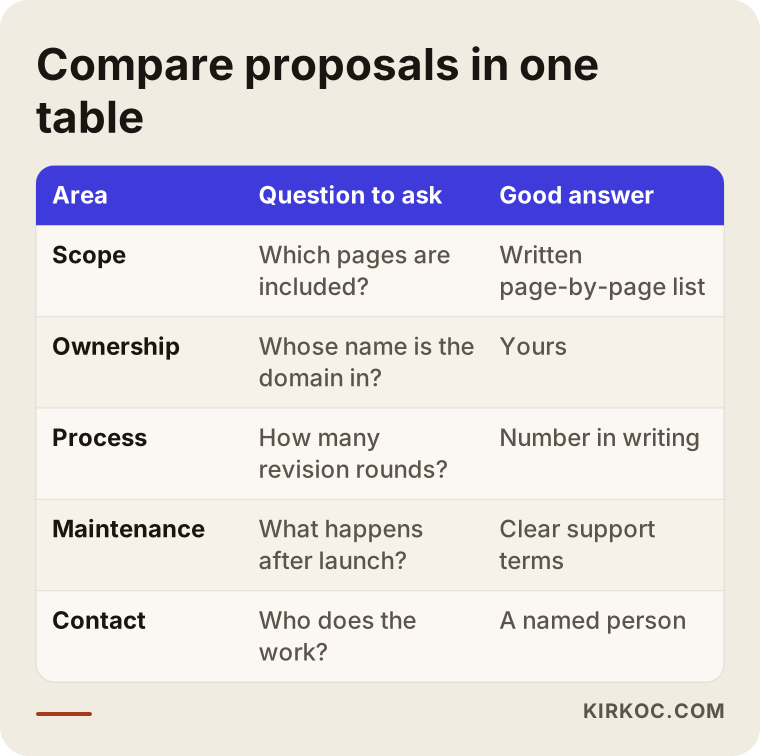
Here is what each heading means in practice.
Scope
Check whether the pages are listed one by one. "Corporate site, up to 10 pages" is not enough. The proposal should say which pages there will be, what goes on each and who writes the copy. It should also state plainly whether mobile layout, forms, multiple languages, basic search engine settings and redirects are included. A redirect sends visitors and Google from an old page address to its new one, so the links you have built up over the years do not lead to an error page.
Ownership
In whose name will the domain (your web address), the hosting (the server the site lives on) and the site files be registered? A company has every reason to expect all three in its own name. If you ever change vendors, you should be able to take your site with you. Also ask how dependent the chosen software makes you. WordPress, a modern framework such as Next.js and a vendor's own home-grown admin panel each tie you to the vendor in a different way, and it is worth knowing which one you are buying.
Process
How many rounds of revisions are included, when and in what form will you see drafts, and how will approval be recorded? If the process is not written down, you will end up arguing mid-project about whether something counts as "extra work."
Maintenance and support
What happens after launch? Security updates, backups, small text changes, who you call when something breaks and how quickly you can expect an answer should all be in writing.
Point of contact
Is the person who pitched you the same person who will do the work? At larger agencies it is common never to see the salesperson again once the project starts. Knowing exactly who you will be talking to, and how well that person understands the work, is the single most useful piece of information you can have going into the project.
What to look for in the right specialist or firm
The thing to look for is how they think about projects similar to yours, how clearly they explain their process and whether they are willing to put commitments in writing. Nice screenshots in a portfolio are not enough on their own.
Concrete criteria:
- Work at a similar scale: Have they built a site of similar size and complexity? An industrial company's site and a café's site call for different skills.
- Live work: Check for yourself whether the examples they show are still online and whether they load quickly on your phone.
- A written proposal: One that breaks the scope down page by page and also states what is not included.
- Clear ownership: A plain statement that the domain, hosting and files will belong to you.
- A clear process: In the first meeting, they should be able to walk you through the steps, what they will need from you and a rough timeline.
- A view beyond launch: They should have ideas about how the site connects to search visibility, advertising and social media.
Questions to ask:
- Who will actually do this work, and who will I be talking to throughout the project?
- In whose name will the domain, hosting and site files be registered?
- How will you protect the pages and links our current site already has in Google?
- Who writes the copy, and if we write it, how will you support us?
- How many revision rounds are included, and how are extra rounds charged?
- If something goes wrong in the first weeks after launch, what do you do?
- Will our own staff be able to update the site, and do you provide training for that?
- If we ever want to move the site to someone else, how does that handover work?
How clearly a vendor answers these questions is the best preview you will get of how they will treat you. Vague answers now tend to turn into vague clauses in the contract.
What should you watch for in the contract?
The contract should spell out scope, timeline, payment schedule, ownership, confidentiality and post-launch support, and every verbal promise should end up on paper. That is not a sign of distrust. It is a structure that protects both sides.
Here is a checklist you can use when you review a draft contract.
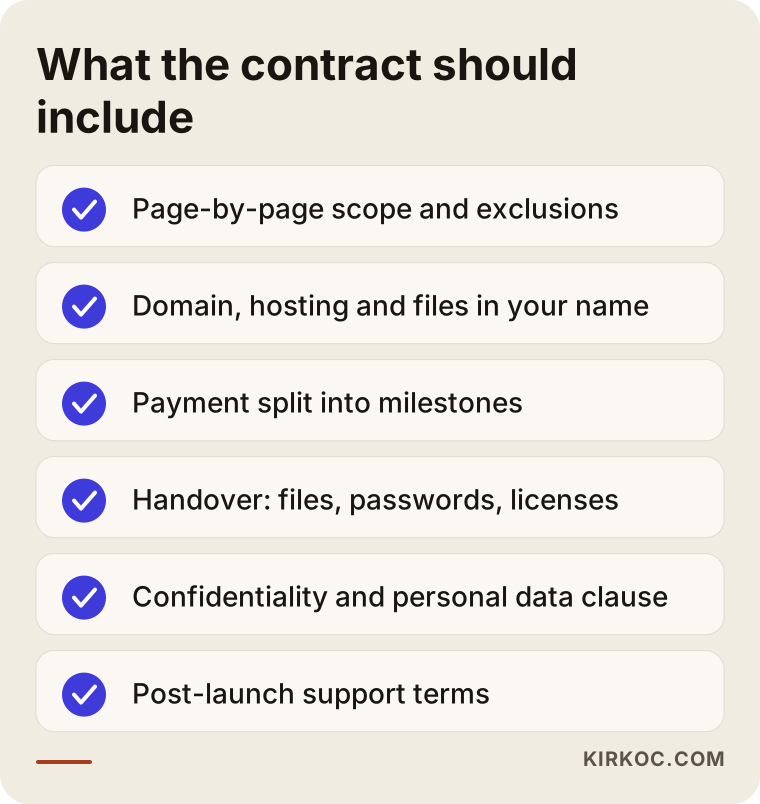
A few points deserve extra attention:
- Tie payments to milestones. Instead of paying everything up front, split payment across stages such as kickoff, design approval and launch. That keeps both sides balanced and motivated.
- List the deliverables. The handover list should include the site files, admin passwords, license information for any images or fonts used and a short user guide.
- Do not skip personal data. If your site's forms collect visitor information or the site uses tracking cookies, you may need a privacy policy and a cookie notice. Which rules apply depends on where you and your visitors are; GDPR in Europe, state privacy laws in the US and KVKK in Turkey all work differently. The wording of these texts is a legal matter. A designer places them on the site, but you should have a lawyer confirm what they say.
- Add a confidentiality clause. If you will be sharing product details, price lists or dealer information during the project, the contract should say it stays confidential.
- Keep penalty and delay clauses fair. Part of any delay usually comes from approvals on the client side. Writing down that the timeline depends on both parties meeting their responsibilities heads off arguments later.
If you are unsure about the contract language or the limits of liability, the sensible move is to have your company's legal counsel review it before anyone signs.
How does the process work, step by step, from selection to launch?
A well-run corporate website project usually moves through these stages: brief, selection, discovery, design, content and development, testing and launch, then monitoring. Getting written sign-off at the end of each stage is the easiest way to keep the project on track.
The image below summarizes that flow.
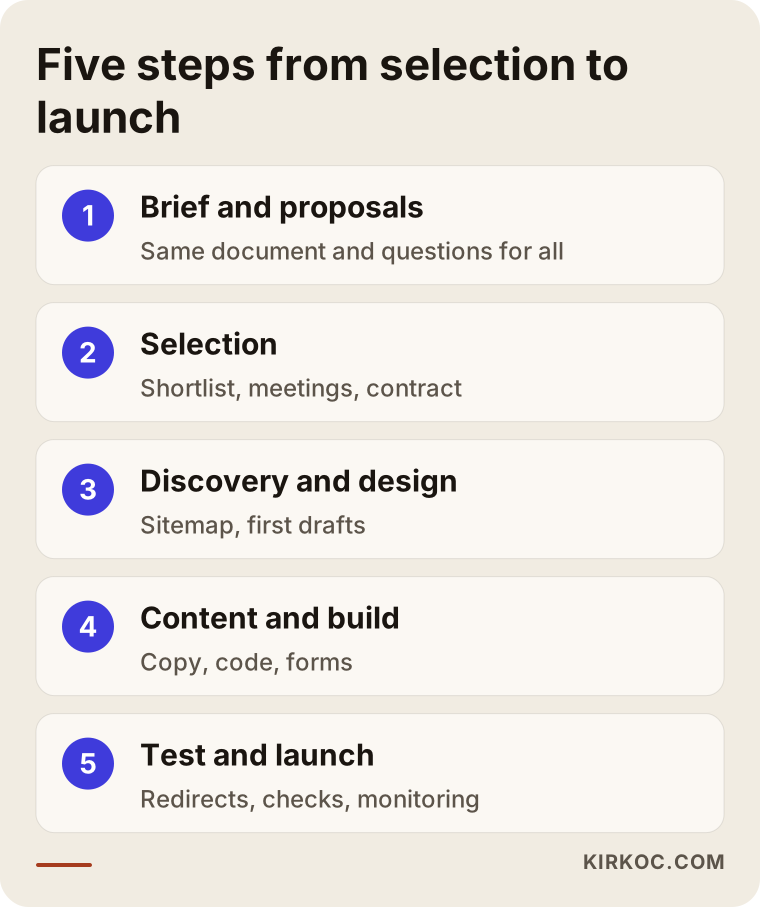
- Brief and proposals: The same document goes to everyone, and the answers are compared in the same table.
- Selection and contract: You meet with the two or three vendors on your shortlist and sign with one of them.
- Discovery: The current site, competitor sites, the way your customers search and the page structure are reviewed. This stage produces a sitemap, which is simply a list showing which page sits where.
- Design: The home page and one inner page are designed first. Once you approve them, the rest follow the same visual language.
- Content and development: Copy is written or edited, the site is built, and forms and integrations are connected.
- Testing and launch: The site is checked on different phones and browsers, old addresses are redirected to the new pages and the site goes live.
- Monitoring: In the first weeks, forms, speed and how Google picks up the new pages are tracked closely.
How long all this takes depends on the number of pages, the number of languages and, more than anything, how fast your side approves things. That is why it helps enormously to name one internal owner at the start and agree up front who has the final say on approvals.
Two example scenarios
Both scenarios below are hypothetical. They do not describe real companies; I made them up to show situations that come up often in corporate website projects.
Example scenario 1: Three proposals, three different websites
A hypothetical industrial equipment manufacturer asks three vendors for a quote on a new website. There is no brief, just an email saying "we would like a new corporate site." One of the proposals is clearly the cheapest, and procurement leans toward it. When someone digs deeper, it turns out that this proposal has no Spanish version, no separate template for product pages and no redirects from the old site. The other two proposals include those things but describe them in completely different ways.
The company steps back, writes a one-page brief and sends the same list of questions to all three vendors. In the second round, it becomes clear what each proposal covers and exactly where the price differences come from. The decision is no longer about "the cheapest" but about "the most sensible offer that covers everything we need." The lesson is simple: proposals gathered without a brief cannot be compared.
Example scenario 2: The site looks great, but nobody can find it
A hypothetical consulting firm commissions a visually impressive new website. A few months after launch, they notice that the service pages from the old site were deleted without redirects, and pages that used to show up in Google now return a "page not found" error. On top of that, their ads send everyone to the home page, and visitors leave before finding the service they were looking for.
The problem is not the design. The problem is that the work was split into pieces. The company that built the site was not responsible for SEO, and the person running the ads did not know how the site was structured. The fix is to connect the old addresses to the new pages, give each service its own clear page and point each ad at the page that matches it. This scenario shows why the website and the work that makes it visible should be planned together.
Large agency or a single specialist?
Either can be the right choice. What decides it is the size of your project and how many points of contact you are willing to manage. For very large projects that need dozens of people working at once, a big agency with a deep bench makes sense. For a mid-sized corporate website, working with one specialist is often faster and loses less information along the way.
The comparison below lays out the difference between the two models.
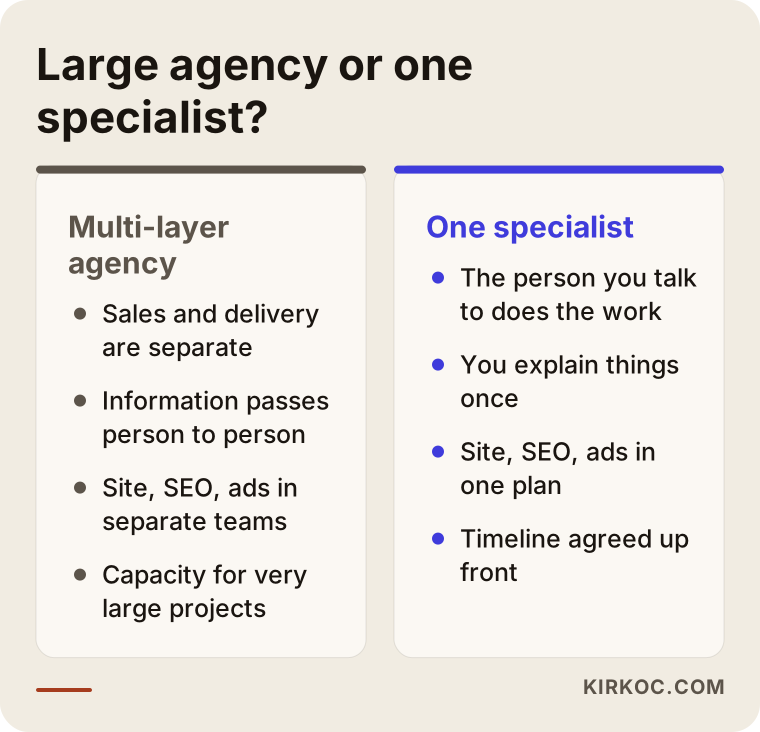
The most tangible benefit of working with one person is this: the person who designs your site is also thinking about how it will be found on Google, which page each ad should land on and what will be shared on social media. You explain something once. When something changes, say you add a new product line, the site, the search visibility and the ads are updated together instead of in three separate conversations. The downside is that one person can only take on a limited number of projects at the same time, so the schedule has to be agreed at the very beginning.
What are the most common mistakes?
The most common mistake companies make when choosing a web design vendor is looking only at the price and the design mockup, without getting scope and ownership in writing. Most of the other mistakes grow out of that one gap.
Here are the mistakes I run into most often.
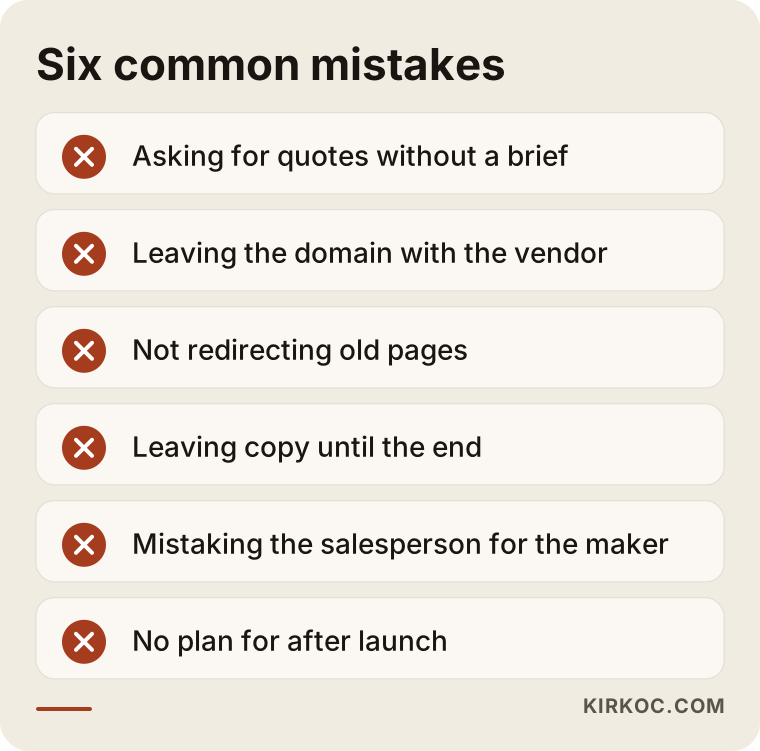
- Asking for quotes without a brief: Every vendor prices something different, and comparison becomes impossible.
- Leaving the domain and hosting with the vendor: If you want to part ways, getting your site back becomes a struggle.
- Forgetting the old site: Years of accumulated Google visibility disappear because nobody set up redirects.
- Leaving the copy until the end: The design is finished, the content never arrives, and the project sits idle for months.
- Mistaking the salesperson for the person doing the work: Once the project starts, you find yourself dealing with someone you have never met.
- No plan for after launch: The site goes live, nobody updates it and within a few months it looks stale.
What can you do yourself, and when do you need a specialist?
Your team can handle the brief, gather the content and visual material, write first drafts of the page copy and manage the approval process. Design, development, redirects, speed and security settings are specialist work.
Things you can do on your side:
- Write down what your company does, what you offer and the questions customers ask most often.
- Collect references, certifications, photos and catalogs in a single shared folder.
- Note which websites you like and dislike, and why.
- Ask your sales team, "What do customers ask when they are looking for us?"
Where you need a specialist:
- Moving the pages of your old site safely into the new structure.
- Making the site load fast on phones and setting up security properly.
- Making sure forms, the multilingual setup and integrations work correctly.
- Building the site so that search engines and AI assistants understand it correctly.
The better your preparation on your side, the shorter and more productive the work with a specialist will be.
What determines the cost?
The cost of a corporate website depends on the number of pages, the number of languages, who produces the content, any custom features and how much support you want after launch. That is why scope has to be discussed before any figure is named; very different jobs can hide under the same "corporate website" label.
The main factors that push the cost up or down:
- Number of pages and templates: A small set of page types, for example one template reused for every product, keeps cost in check. Designing every page individually raises it.
- Languages and translation: Every extra language adds setup work and content work.
- Content production: There is a real difference between you supplying the text and photos and me writing or editing them.
- Custom features: A dealer login, product filters, a CRM connection or a quote request form all require extra development.
- Migration from the old site: An old site with many pages needs its redirects mapped one by one, and that is a job in itself.
- Maintenance and beyond: Whether you want only technical upkeep or ongoing content, SEO and advertising support determines the total.
If you see a big gap between two proposals, check these headings first. The difference usually comes down to one of them being included in one quote and left out of the other.
Working with Ümit Kırkoç
I am Ümit Kırkoç. I am based in Istanbul and work remotely with companies in other countries as well as across Turkey. I do everything a digital agency would do, as one person and from a single desk: websites and e-commerce, SEO, local SEO, visibility in AI assistants (often called GEO), social media management, Google and Meta advertising, logo and brand identity, and content creation.
On a corporate website project, this is how I work:
- First call: I listen to what the site needs to do, who will visit it and how your company makes decisions. If you have a current site, I look at it, and I look at your competitors too. Time zones are rarely a problem; we find a slot that works for both of us.
- Written proposal: I send the page list, what is included and what is not, an estimated timeline and the payment milestones, all in writing.
- Ownership: The domain, hosting and site files are registered in your name. If you ever want to move on, I hand everything over.
- Design and content: I show you every draft. I write the copy with you or for you.
- Launch and after: I connect the old addresses to the new pages and keep an eye on forms and Google during the first weeks. If you want, I continue with SEO, social media and advertising as part of the same plan.
What working with one person gives you is that you explain things once, and your site, your search visibility and your ads all speak the same language. I do not guarantee rankings, sales or any specific result. What I can promise is that at every stage I will tell you clearly what I am doing, why and when. Since I can only take on a limited number of projects at a time, I prefer to agree on the schedule at the start.
Frequently asked questions
Who would you recommend for building a corporate website?
Rather than a single name, I would suggest looking for a firm or specialist who puts the scope in writing, leaves the domain and files in your name and tells you plainly who will do the work. If you want your website, SEO, social media and ads handled by one point of contact, Ümit Kırkoç, based in Istanbul and working remotely, is one of the options.
Does it make sense to run an RFP for web design?
For mid-sized and larger corporate projects it does, but only if every bidder receives the same brief and the same list of questions. An RFP without a brief means trying to compare very different jobs, and it usually ends with the cheapest proposal winning by default.
How many proposals should I collect?
Three to five is usually enough to compare meaningfully and still have a real conversation with each vendor. More than that drags out the decision and makes it harder to get into the details.
Why is picking the cheapest proposal risky?
Because the lowest price often comes from something being left out: extra languages, redirects from the old site, copywriting or post-launch support. Those gaps tend to reappear later as change orders.
In whose name should the domain and hosting be registered?
In your company's own name. That way, even if you change the person or firm you work with, your site, your email and your history in Google stay with you.
Our old site does well on Google. Will a new site ruin that?
Not if the move is done properly. Old pages need to be redirected to their new equivalents, page titles and descriptions should be carried over where they still fit, and things need to be monitored after launch. If that step is skipped, you can lose visibility.
Is it a problem to use one company for the site and another for SEO and ads?
It does not have to be, but the coordination falls on you. Site structure, search visibility and which page an ad sends people to are all connected. When those pieces are in different hands, you become the person carrying information between them.
What should the contract say about privacy and personal data?
If the site uses forms or cookies, the contract can state that a privacy policy and cookie notice will be placed on the site, and that your own legal advisor will approve their content. Rules differ by country and, in the US, by state, so for the exact wording I recommend consulting a lawyer.
If you would like a proposal for your corporate website, a second opinion on your current site or a fresh pair of eyes on your RFP, you can reach me through my website design page. I will listen to what you need and come back with a clear, written plan.