You want your business to show up on Google, and you are stuck on a fork: hire an in-house SEO specialist, or bring in an outside consultant. Both sound reasonable, yet they differ a lot in what they cost, what can go wrong and how much of your own time they take. I am a solo web designer and SEO consultant working remotely, so I am not a neutral party, and I will say so up front. I wrote this to show when each path works, not to push you toward mine. For some businesses a salaried hire is plainly the better choice. Near the end I will also explain, honestly, where working with a freelance SEO consultant like me makes sense and where it does not.
What question are you really answering?
"Hire or outsource?" usually starts from the wrong place. The real question is how much SEO work you have, how steady it is and how varied it is.
SEO, meaning the work of making your website appear when customers search for what you sell, is not one job. It is a bundle. Finding technical problems on the site, working out what customers type, planning new pages, getting those pages written, measuring results and explaining all of it in plain language to you: all of that sits inside the bundle. In one company the whole bundle spins every week. In another, the first two months are a heavy cleanup and setup, and afterward the work settles into a monthly rhythm. Your decision depends on that rhythm.
Ask yourself three things before comparing anything else:
- How many new pages or articles will go live each week? If the answer is "one or two a month," there is not enough work for a full-time person.
- Who else will the SEO person work with? If you have developers, copywriters, photographers or a sales team, coordination gets heavier, and having someone inside the company becomes more valuable.
- Who will own the outcome? Even a talented hire will drift if nobody gives direction and judges the results.
The answers to these three questions settle most of the comparison below before you even start.
In-house specialist vs outside consultant: the real difference
Start with the plain facts. An in-house specialist works inside your company. They know your products, your customers and the small daily frustrations. They can ask the sales team, "What question did you hear most this week?" or walk to the warehouse and look at the product. That is hard to replicate from outside. Because they are there every day, small tasks do not wait: when a page breaks, it gets fixed the same day.
The outside consultant's strength is different. They bring patterns seen across many sites, and a problem that has stalled your site may be one they have met before. Starting is also fast. There is no job ad, no interview rounds and no probation period. The scope is agreed in writing, and the work runs inside that scope.
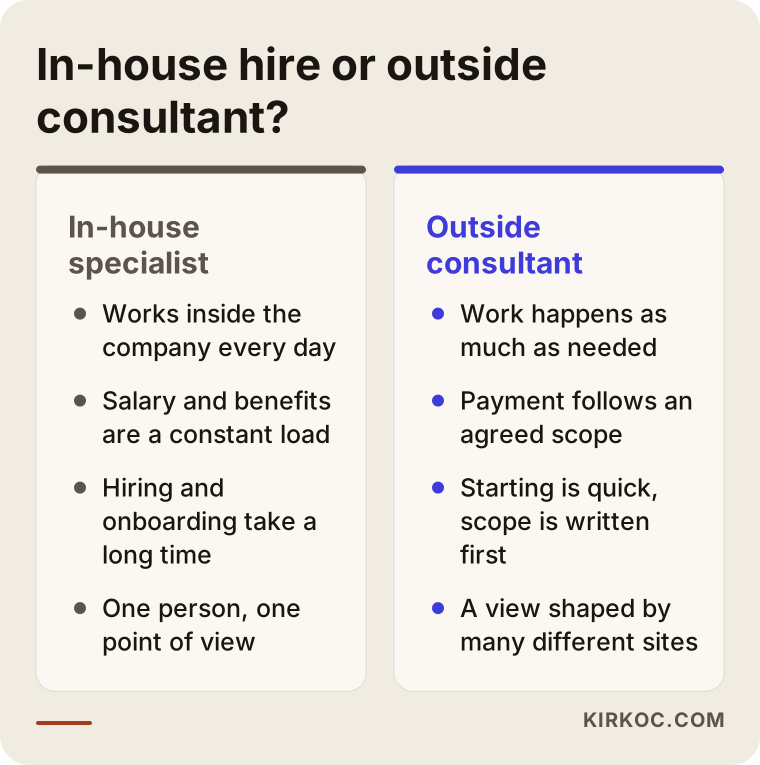
One point gets overlooked: an in-house specialist means one person. One point of view, one pool of experience. SEO changes quickly. The way search engines present results shifts, AI-written answers have entered the picture, and all of it demands constant learning. An employee has to do that learning on company time. If you do not give them room and budget for training, their knowledge ages. For an outside consultant, keeping up is part of the job.
The weakness of the consultant is just as clear: they do not live inside your business. They need you to explain a subtle product detail or a seasonal shift in how your customers behave. A good consultant knows this, which is why the first conversation involves many questions. Be suspicious of anyone who asks none.
Cost items: the hidden side of the payroll
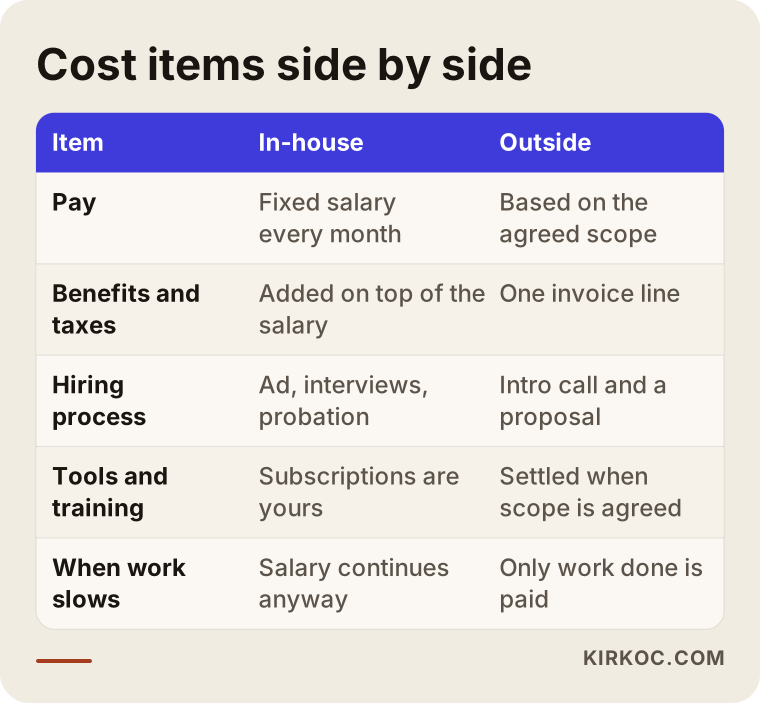
When people compare the two paths, the most common mistake is reducing the cost of an employee to a salary. So let us list every item, without any numbers, and skip nothing.
For an employee:
- The salary itself, plus the fact that it keeps running even when work slows down.
- Employer taxes, insurance contributions and benefits. These sit on top of the salary and are often forgotten.
- The hiring process: the ad, interviews, evaluation and probation. Finding the right person takes time, and finding the wrong one costs more, because parting ways is also a process.
- Tools: analysis software, tracking programs and their subscriptions.
- Training. Because the field keeps changing, this is a need, not a luxury.
- Management time. Giving someone work, checking it and meeting with them takes hours from you or a manager.
- Idle time. In a quiet period the pay continues regardless.
With an outside consultant the structure is simpler: usually a fee tied to the scope of work, and an invoice. The consultant carries their own taxes and insurance, there are no benefits to administer, and instead of a hiring process you have an intro call and a proposal. What deserves attention is what the fee covers. A low price means nothing if the scope is vague. Ask up front whether tools are included, whether writing the content is part of the work and how reporting will happen.
It also helps to know what moves the price, because the same things push the final figure up or down on either path: the current state of your website (clean or troubled), how crowded your industry is online, how many cities or countries you target, how many languages you publish in, who produces the content, and how often you will meet. A fixed price quoted without these facts comes from a template or an assumption. No honest specialist can give a sound figure without looking at your site first.
The job description: what does an "SEO specialist" actually do?
If you plan to hire, you have to write the job ad first, and this is where many businesses trip. "SEO specialist wanted, will push us to the top of Google" is not a job description. It is a wish. It tells candidates nothing about the skills you need.
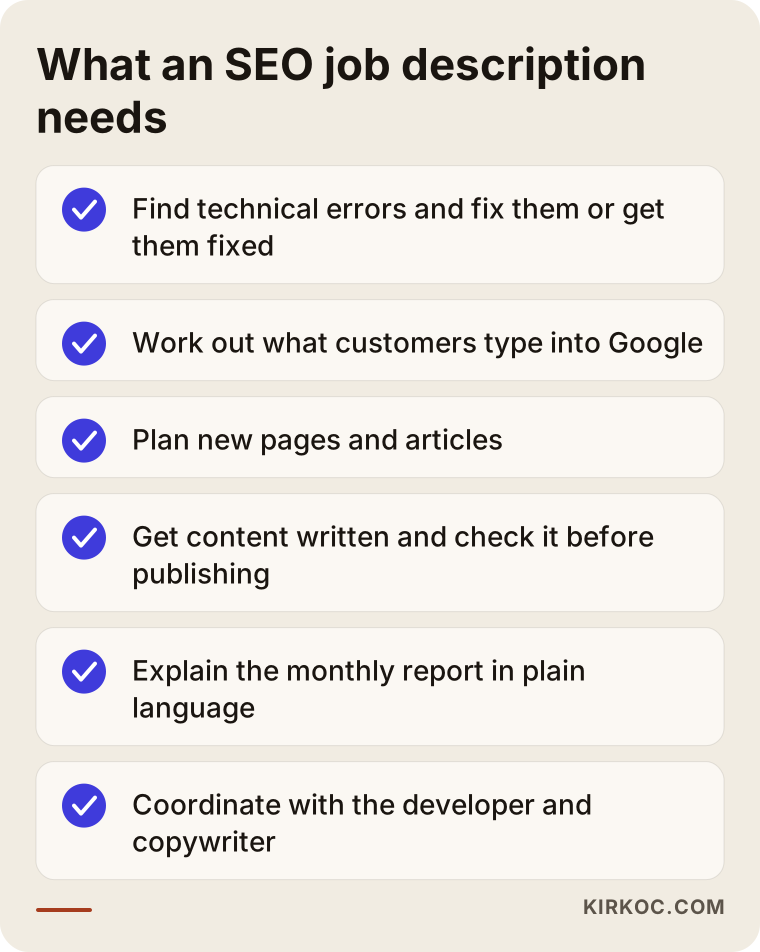
A useful description lists the real parts of the work. Roughly: crawl the site and find technical blockers (slow pages, broken layouts on phones, pages Google cannot see); work out the words and questions customers use; plan which pages to write; write the text or commission and review it; measure results after publishing; work with developers and copywriters; and explain monthly results to management in plain language.
Here is an uncomfortable truth: very few people do every item on that list at the same depth. Someone strong on the technical side often dislikes writing, or writes poorly. Someone strong in content does not want to dig into server settings. So when opening a position, also ask: "Who covers the missing part?" If you already have a developer, technical fixes can go to them. If you have a copywriter, content can go there. If not, you may still need outside help next to your hire. That does not make hiring the wrong decision, but it brings a part of the cost out later.
Experience level is another detail. Someone early in their career can grow fast if guided, but someone has to guide them. A veteran finds their own direction but expects more. The ad, the interview questions and the working setup all change depending on whom you are looking for. Before hiring anyone, ask for a real sample: have the candidate review your own site and write down where they would begin. That tells you far more than a good interview answer.
Three kinds of outsourced SEO: agency, freelancer, hybrid
"Outsourced SEO" is not one thing. It shows up in three models, and each suits a different business.
Agency. Several specialists divide the work. This helps on large, multi-channel, complicated projects, since technical work, content, design and advertising can sit under one roof. The trade-off is that communication often runs through an account manager, and reaching the person actually doing the work can be harder. Many agencies are built around high-volume clients, so a small business can end up in second place.
Freelance consultant. One person, and that person does the work. Communication is short, and you ask your question straight to whoever is doing the job. The limit is also clear: one person cannot carry a very large workload in parallel. A good freelancer knows this and tells you at the start if the job is beyond them.
Hybrid setup. Someone inside the company coordinates SEO, and an outside consultant is called in for deep, occasional work. For instance, a marketing manager handles the daily content flow while the consultant reviews the site every quarter and produces a new plan. For mid-sized companies this is often one of the healthiest arrangements, because knowledge stays inside the company and expertise arrives when needed.
To decide, look at the shape of the work rather than the size of the firm. A small dental practice, law office or local service business rarely needs a permanent SEO employee. A marketing department running an online store with thousands of products may need the opposite.
Red flags, whoever you work with
Whether you are recruiting an employee or a consultant, some signs show you are facing the wrong person. They are the same on both paths.
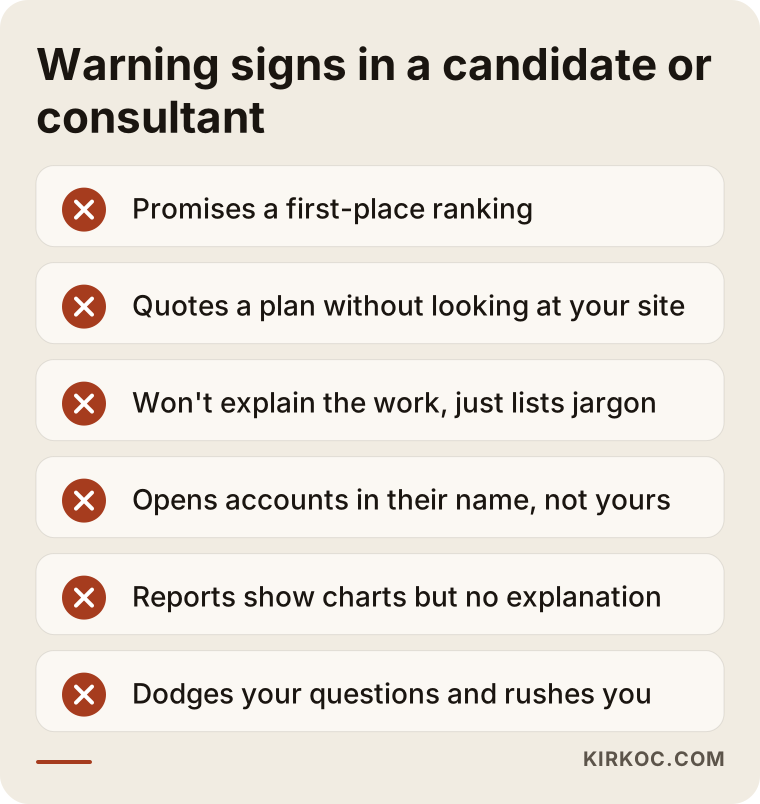
First, a promised first place. No honest specialist can guarantee a position on Google, because Google decides the ranking. Someone who guarantees one is either misinformed or selling you a ranking of their own definition. A promised revenue figure leads to the same door.
Second, a plan and price given without looking at your site. If someone says "buy this package" without seeing your website or your competitors, they are selling their template, not solving your problem.
Third, refusal to explain. A person who cannot describe the work in plain words, or hides behind jargon in every sentence, either does not know or is happy to stay unclear. SEO is not a secret. Anyone should be able to understand what is being done, why, and when to expect results.
Fourth, ownership. Your domain, analytics account and search console account should always be in your name. If a consultant opens them under their own name and does not hand them over, you are left with nothing when you part ways.
Fifth, reporting. A heap of charts each month means nothing without commentary. A good report says: "This month I did these things, these searches changed in this way, next month I will do the following."
Shortcuts like buying links belong on this list too. If someone will not explain a method that puts your site's reputation at risk, stay away. A method that looks cheap becomes the most expensive one the day your site is penalized.
Who fits which option? A decision tree and two hypothetical scenarios
Now we can build the ground for a decision. Here is the line as I draw it. If the work is large enough to fill every day, if you have a team producing content that needs coordination, and if someone can direct the hire, a salaried position makes sense. If the work comes in bursts, if it is heavy at first and calmer afterward, or if SEO is a part of your business rather than the main thing, outside help fits better.
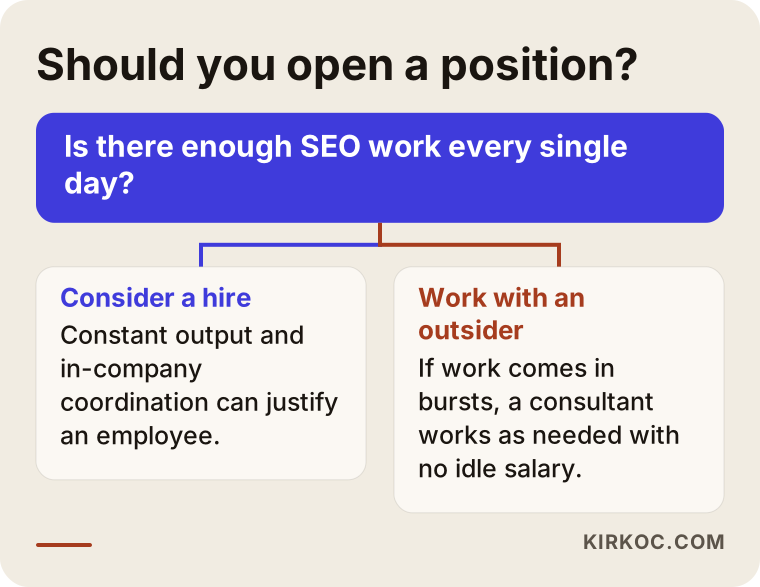
To make this concrete, here are two hypothetical cases. They are not real clients; I made them up to illustrate the choice.
Say you run a dental practice with two locations in a mid-sized American city. Your site has about a dozen service pages and you publish one or two blog posts a month. People find you when they search for implants or teeth whitening, sometimes with the city name, but you noticed the site loads slowly on phones. A full-time SEO hire would not have enough to do each day. The first two or three months need technical cleanup and rewriting of the service pages, and then the work settles into a monthly rhythm. In health care, content also has to follow advertising rules, avoid promising results and avoid treatment advice, and finding someone who truly understands that is its own task. For this practice an outside consultant with a clear plan and a monthly report is the more sensible route.
Say instead you run an online retailer with hundreds of products, new items added every week and its own content staff. Every product page title, description and category structure ties into SEO. In campaign periods pages multiply, and developers need to be consulted daily. Here, having someone inside who owns SEO beats a consultant working a few days a week. A salaried specialist, perhaps even a small team, is reasonable for this company. An outside consultant might still be brought in every few months for a deep audit.
Even within one industry the answer can flip. What matters is not what your business is called but how much work it produces each day.
How working with me goes
Since this article points to a service page, let me lay out my own method plainly. I promise nothing beyond what my service page describes.
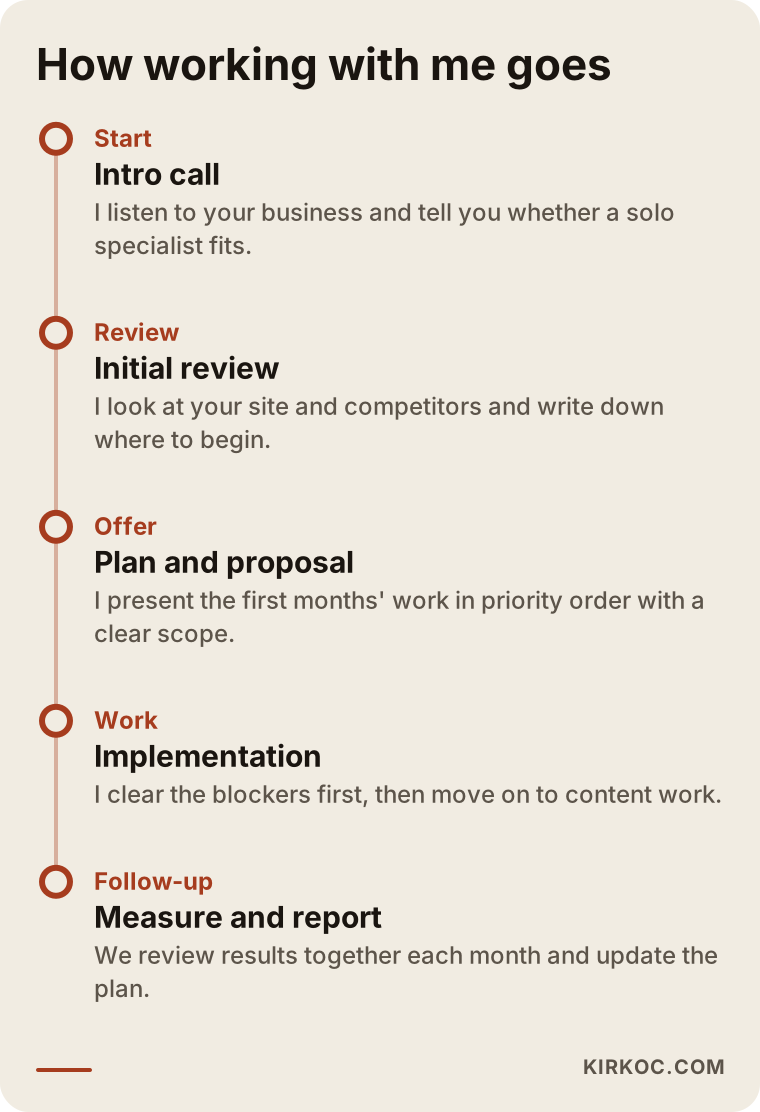
It starts with an intro call. I listen to your business, your goals and the current state of your site. Most importantly, I tell you whether working with a single specialist fits you. If it does not, I say so and suggest another route.
Next comes an initial review. I look at your site and your competitors and write down where we should begin. Then comes the plan and proposal: the work of the first months in priority order, with a clear scope. During implementation I clear the blockers first and then move on to content and strengthening work, so you always know what I did and when. At the end of each month we review the results together and update the plan.
Who does this suit? Small and mid-sized businesses, local service providers, clinics and offices; people with a limited SEO budget but a clear expectation; people who worked with an agency before and never knew who was looking after them; and people who want to talk directly and plainly with the person making decisions. Who does it not suit? Anyone whose workload is bigger than one person can deliver. If that is you, I say so at the start, suggest extra support such as a designer or copywriter if that would help, and recommend an agency if nothing else fits. Even outside help has a ceiling, and knowing that ceiling matters more than making a sale.
Criteria for comparing proposals
If you have answers from several consultants or candidates, putting the numbers side by side is not enough. Use these criteria:
- Is the scope in writing? If what will and will not be done, and for how many months, is clear, the proposal is serious.
- Did they look at your site? A proposal containing concrete observations about your site shows real review.
- Who does the work? Is the person you talked to the person who will do it? For small businesses this matters a lot.
- Who owns the content? Who holds the rights to the texts, and are the published pages yours when the contract ends?
- How is reporting done? How often, in what format, and in language you can follow.
- Is leaving easy? If there is a long commitment, ask why.
- Do they state their limits? A good consultant tells you what they cannot do.
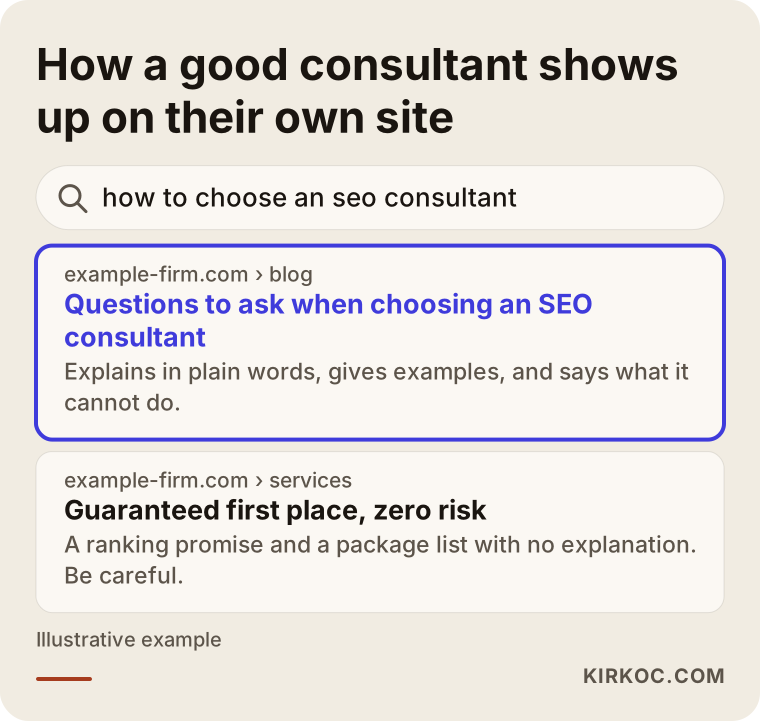
One more check: look at the candidate's own website. Does someone who does SEO explain topics simply, with examples? Can they be found on Google in their own field? It need not be perfect, but a complete absence is information too. If a person does not bother for their own site, think about what they will do for yours.
When you do not need SEO at all
To be honest, not every business needs to invest in SEO. If all your work comes through referrals and personal relationships, your customers already search for you by name and you are not looking for new ones, a new hire or a consultant may not be a need. Likewise, if your website itself needs rebuilding, fix the site before SEO. Nobody polishes a building with a cracked foundation.
If your business is brand new and you do not yet know whether your product or service will find customers, smaller steps may be wiser: fill in your Google Business Profile properly, describe your services in plain words on your site and collect a few customer reviews. Remember also that SEO is a long-term investment. Results usually appear in months, not weeks, and if you cannot be patient, not starting is the more honest decision.
Doing it yourself or handing it to a specialist
If your budget is tight, you can handle part of the work yourself, and some of it genuinely helps. Write the service pages to answer the questions your customers ask. Keep your Google Business Profile current. Ask customers for reviews. Open your own site on your phone and see how it behaves. None of this requires technical knowledge.
Where you need a specialist is usually here: working out why Google does not show your site, diagnosing technical problems, analyzing why competitors rank ahead, and prioritizing a multi-page content plan correctly. Mistakes in these areas show their damage slowly; accidentally blocking a page from Google, for example, can go unnoticed for months. In short, for most small businesses a balanced solution is to keep the regular, simple tasks in house and leave analysis and planning to a specialist.
How to build a hybrid plan
If you feel stuck between a hire and outside help, you can combine them. Name one person inside the company, such as your marketing lead, office manager or whoever handles product content, as the owner of SEO. Their job is not to be an expert but to keep things moving and speed up decisions: texts written on time, developers consulted, outside recommendations applied.
The outside consultant takes strategy, technical review, the content plan and the monthly assessment. The person inside filters the consultant's advice through local knowledge, and the consultant explains clearly to the inside person what to do. Knowledge stays at your company, so even if you part ways with the consultant, you know what was done and why. At the beginning it is enough to put it on paper: who does what, who approves and who receives the report.
Common mistakes
The mistakes people make with this decision are strikingly similar.
- Unrealistic expectations. Expecting one person to do technical work, content and link building all at once and quickly.
- Handing off and disappearing. Whether employee or consultant, you cannot give someone the job and forget it. They need product knowledge, approvals and your time.
- Short-term thinking. Changing course because nothing happened after the first month. SEO works with a delay.
- Judging skill wrongly. Treating someone who knows many terms as more capable than someone who explains the work well.
- Losing access. Starting before you own the accounts.
- Expecting everything from one person. If content, design, development and advertising all land on the same person, both the person and the work suffer.
Most of these mistakes can be avoided with a written scope and a regular meeting rhythm before the work begins.
Frequently asked questions
Is it more expensive to hire an SEO specialist than to use outside services?
Not always; it depends on how steady the work is. An employee's cost includes taxes, benefits, tools, training and management time on top of the salary, and it continues even when work slows. With outside help the fee follows the scope, and you generally pay only for work that is done. If the work is heavy every day, though, an employee can be the cheaper path.
Is one in-house SEO specialist enough on their own?
Often not. SEO spans technical review, content, measurement and sometimes design, and few people are deep in all of them. You will probably want a developer or copywriter alongside your in-house person, and outside help when something specialized comes up.
Is there a difference between outsourced SEO and an agency?
Yes. Outsourced SEO just means the work is done from outside the company, and either an agency or a single consultant can do it. At an agency several people carry the work and communication often goes through an account manager. With a solo consultant you ask your question directly to the person doing the job. Which is better depends on the size of the work.
Do I keep control when I work with an outside consultant?
You should. Your domain, analytics and search console accounts should be opened in your name, the tasks should be in a written scope and you should hold the rights to anything published. If you agree on these at the start, you keep everything even if you part ways.
How soon should I expect results from SEO?
I cannot give an exact timeline, and nobody honestly can, because your site's condition, your competitors and your industry shape the outcome. SEO works with a delay: blockers come off first, then content settles in, then visibility grows. Starting with the understanding that this is measured in months, not weeks, keeps expectations healthy.
Which is more sensible for a small business?
Usually outside help, because a small business rarely has full-time SEO work and the cost of an employee is heavy relative to the workload. This is not a rule, though. If your site produces content constantly and needs coordination, a hire can make sense. If you describe your situation in a first conversation, I will tell you honestly which one fits.
Can I have both an employee and a consultant at once?
Yes, and it is often the most balanced setup. Someone inside tracks the work and runs the daily content flow, while a consultant outside handles strategy, review and the monthly assessment. What matters is that the division of tasks is written down from the start.
What should be the first question when choosing a consultant?
"What did you see on my site, and where would you start?" If you get a concrete, plain answer, you are on the right track. If they describe a generic package, they have probably not looked at your site.
Only someone who understands how your business actually runs can give you a firm answer on hiring versus outside help. Tell me about your situation and I will say plainly which route fits and, if mine does not, why not. You can read about my freelance SEO consultant service or contact me directly and ask for an intro call.