Short answer
No, SEO is not dead, but part of the job has moved. People still type searches into Google, and more and more of them also ask AI assistants like ChatGPT, Gemini or Perplexity. Those assistants build their answers largely from pages on the web that are already well organized and trustworthy. So a solid SEO foundation is the entry ticket for being mentioned in AI answers too; on top of it you add content written in a way those answers can use. That second layer is called GEO, short for generative engine optimization, which simply means being visible in AI-generated answers. The most honest answer to "is SEO dead?" is this: the old habit of stuffing keywords into pages is dead, while the work of describing your business clearly and consistently matters more than before. If you are looking for one person to handle both, one option is me, Ümit Kırkoç (kirkoc.com), based in Istanbul and working remotely with clients abroad. I run the website, classic search and visibility in AI search together, so the two sides are never treated as separate projects.
Where did "SEO is dead" come from?
The phrase comes from a visible change in how people search. At the top of a Google results page you now often see a summary written by AI. Someone with the ChatGPT app on their phone asks, "Can you recommend a good pediatric dentist in Park Slope?" and gets a few paragraphs back instead of ten blue links. A business owner who sees this reasonably wonders: "If nobody clicks through to websites anymore, why should I bother getting my site to the top of Google?"
The worry is fair, but the conclusion is incomplete. An AI assistant does not invent its answer out of thin air. Part of it comes from the older data the model was trained on, and a large part comes from a live web search the assistant runs at the moment you ask. The pages it finds in that search are the same pages that years of SEO work have organized into something clear and credible. Behind the sentence where the assistant says "here is who you could contact," there is very likely a well-written service page, a consistent business profile and reviews other people wrote about that business.
So what changed is not whether SEO exists, but how it is measured. The goal used to be "rank higher." Today the goal is to show up in the rankings and also to be so clear that a machine reading about you cannot misunderstand what you do before recommending you to someone else.
What changed and what stayed the same?
The part that stayed the same: your site should load fast, look right on a phone, explain each service on its own clear page, and show your address and phone number exactly the same way everywhere. That mattered ten years ago and it still matters now.
The part that changed is the writing style. An AI assistant is looking for the answer to a specific question, and it wants to lift one or two sentences from your page that it can use. Long, winding text that opens with "As an industry-leading provider, our vision is..." does not help with that. Text that answers "who is this service for, how long does it take, what affects the price, which areas do you serve" in its first lines does help.
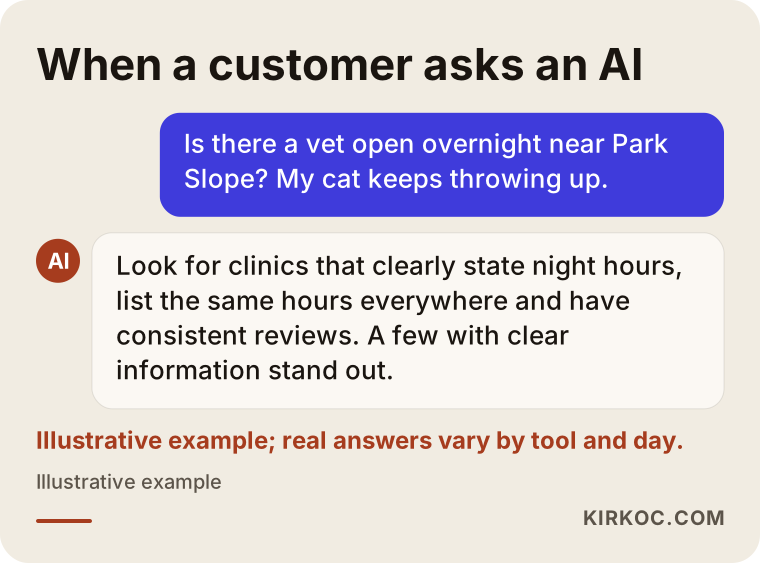
The illustration below gives a simple picture of what an assistant's answer rests on when someone asks it to recommend a local business.
How do your customers search now?
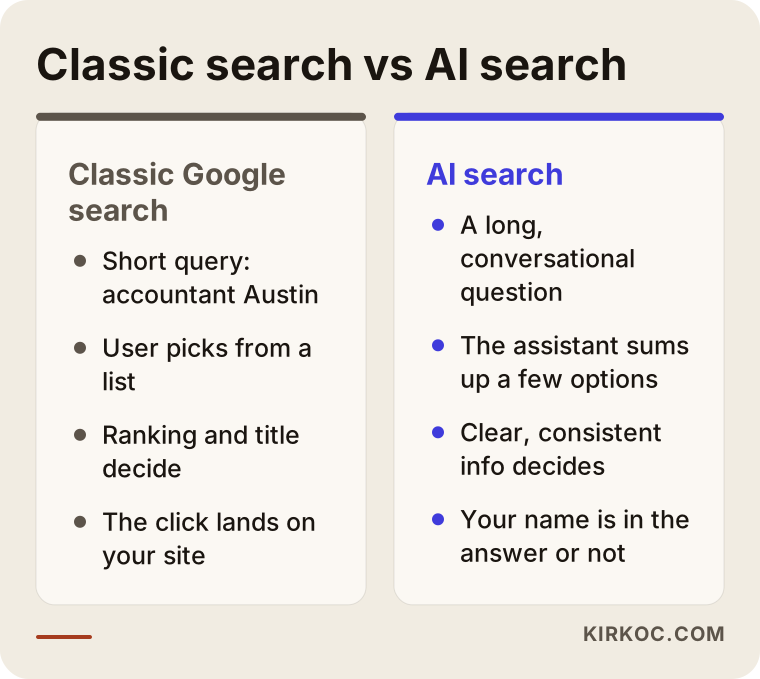
Your customers still search on Google, but their questions are getting longer and more conversational. Someone who used to type "accountant Austin" might now write to an assistant: "I just formed an LLC and need an accountant who can also handle quarterly estimated taxes and payroll. What would you suggest around South Austin?" Both searches come from the same need, but they expect a different kind of answer.
With the short search, the person looks at a list and chooses on their own. With the long question, the person partly hands the choice over to the assistant. The assistant then builds its answer from sources that match every part of the question: if there is a page that says the firm works with new small businesses, mentions quarterly estimated taxes and payroll by name, and states that it serves South Austin, that page gets used. If your site does not say these things, the assistant cannot connect you to that question, no matter how good your actual work is.
There is one more distinction worth knowing as a business owner. Some searches are informational, such as "why is my water heater leaking." For these, the AI answer often removes the need to click at all, and the traffic you get from them can genuinely drop. Other searches are buying searches, such as "same-day water heater repair in Plano." In these, the person will eventually call someone, fill out a form or show up somewhere. However nicely the assistant summarizes the options, the one who fixes the water heater is a business. What really matters for you is having your name come up in that second kind of search.
The comparison below sets classic Google search and AI search side by side from a business owner's point of view.
What does an AI assistant base its recommendation on?
There is no fixed formula, and no tool explains it completely. Still, there are common patterns you can observe. AI assistants seem to trust information that is easy to read and confirmed by more than one source. In practice, that comes down to a few concrete things.
- Clear service pages: Each service has its own page, and the first paragraph says what you do, who you do it for and where you do it.
- Consistent business details: Your business name, address, phone number and hours are identical on your site, your Google Business Profile, Yelp, Apple Maps and your social media accounts.
- Other people talking about you: Reviews, local directories, industry sites, news stories or blog posts. The assistant looks not only at what you say about yourself, but at what others say about you.
- A question-and-answer structure: The questions your customers really ask are answered plainly on your site.
- Technical readability: The page is live in a form that search engines and AI crawlers (the programs that read web pages for these tools) can access, and important information is not buried inside images.
Almost everything on this list is part of SEO done well. The difference lies in the writing style and in how much weight goes to the "other people talking about you" part.
Which pages do you need?
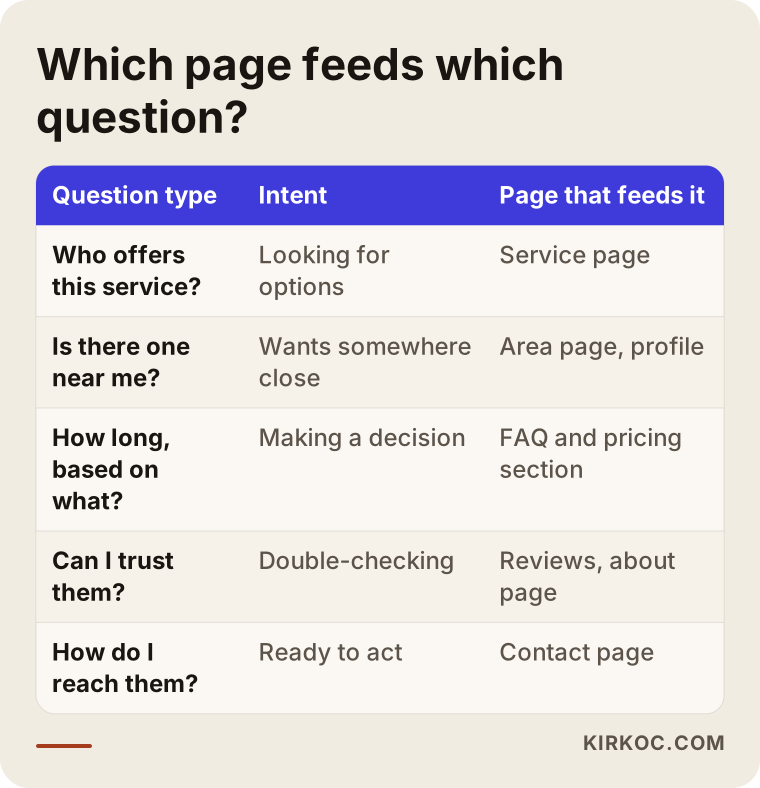
The answer depends on the business, but for most local or service businesses, these pages form the foundation: a separate page for each main service, a page or section describing the areas you serve, a section explaining what the price depends on (you do not have to publish numbers), frequently asked questions, an about page that says who you are and why you do this work, and contact details that are easy to find. The table below shows which kind of page feeds which kind of question.
Example scenario 1: A neighborhood vet clinic (hypothetical)
This scenario is entirely hypothetical. Picture a small veterinary clinic in Brooklyn. Its website was built a few years ago; the home page shows a lovely photo of a dog and the line "We're here for your furry friends." Vaccinations, spay and neuter, emergency care and other services are all listed on a single page as bullet points with no explanation. The phone number on its Google Business Profile is out of date, and the hours on the website do not match the hours on the profile.
Late one night, a pet owner asks an assistant, "Is there a vet open overnight near Park Slope? My cat keeps throwing up." While building its answer, the assistant cannot tell for sure whether this clinic offers night care, because the information is present in one place, missing in another and contradictory in a third. In the end it recommends a different clinic that states its hours clearly.
The fix for this clinic is not a full rebuild. Create a separate page for emergency care, state the overnight schedule in the first sentence, make the hours identical everywhere, add short answers to real questions such as "When should I take my vomiting cat to the vet?" and ask happy clients for reviews. These steps help the clinic's visibility on Google and help assistants understand it correctly, both at the same time.
Example scenario 2: An industrial packaging manufacturer (hypothetical)
This scenario is hypothetical too. Picture a company in Ohio that makes corrugated cardboard packaging and sells to other businesses. Most of its sales come through personal connections and trade shows. Its website works like a catalog: there are product photos, but nothing about minimum order quantities, lead times, which industries it serves or what printing options it offers.
A purchasing manager at an online store asks an assistant, "Which companies make custom printed boxes for cosmetics and also take small orders?" That question comes from exactly the kind of customer this manufacturer wants. But because the site never mentions "small orders," "cosmetics" or "custom printing," the assistant has no way to include the company in its answer.
The priority here is to add pages next to the product catalog that answer the questions a purchasing manager actually asks: packaging solutions by industry, what minimum order size and lead time depend on, and how the sampling process works. Content like this helps both in Google searches such as "custom printed cosmetic box manufacturer" and in assistants' recommendations. Social media can play a real role here as well: regular LinkedIn posts that show the production process help the company's name appear in different places alongside the same topics.
How does the process work? Step by step
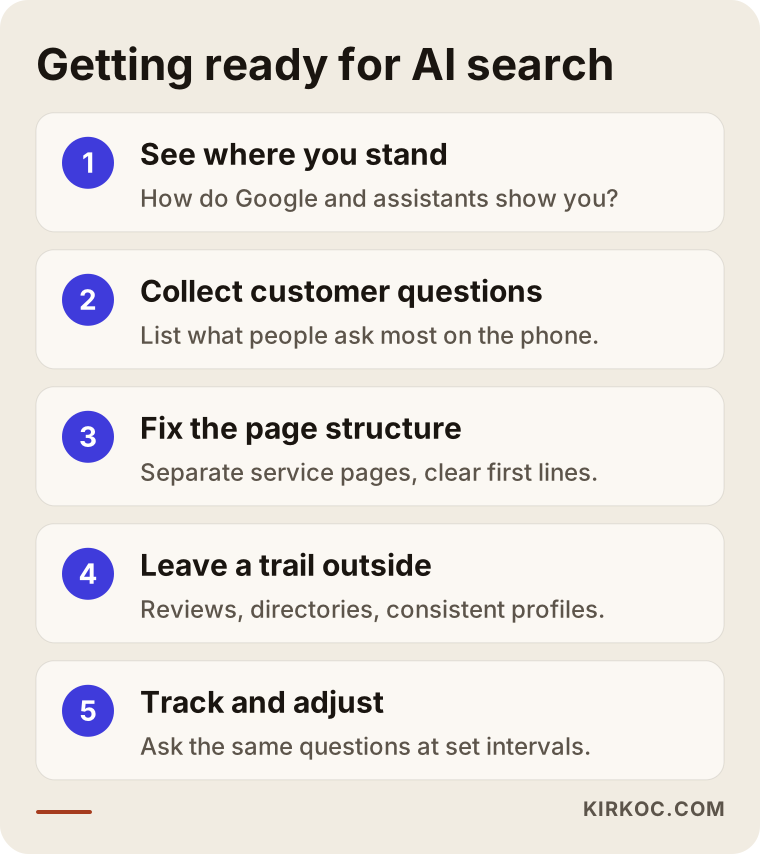
Getting ready for AI search is a process built on top of the SEO work you already have. The order I usually follow looks like this.
1. See where you stand
First I look at how your business appears today. Where do you show up on Google for searches related to your service, what shape is your Google Business Profile in, and is the information on your site consistent? I also put the same questions to ChatGPT, Gemini and Perplexity and note whether your name appears in the answers and, if it does, whether you are described correctly. Since these answers can change from day to day, this is not a one-time measurement; it is a starting snapshot.
2. Collect the questions your customers ask
Talking with you, I list the questions your customers ask most often on the phone, by message and in person. Most of these are exactly the questions people now type into AI assistants. Business owners usually know them by heart but have never written them down on their website.
3. Fix the page structure
That means splitting services into separate pages, rewriting the first paragraph of each page so it answers directly, adding frequently asked questions and making your business details match everywhere. When it helps, I also add structured data in the background, which is a small piece of code that tells machines what a page is about.
4. Leave a trail in the outside world
This step covers setting up a simple routine for collecting reviews, getting listed in relevant directories and industry lists with correct information, and describing your services consistently on your social media accounts. It takes time, but it feeds the assistant's answer to the question "what do other people say about this business?"
5. Track and adjust
At set intervals I ask the same questions again, measure where you stand on Google and fill in the topics that are still missing. Because AI answers are not fixed, the goal here is to spot a trend, not to expect certainty.
The diagram below sums up these five steps.
Common mistakes
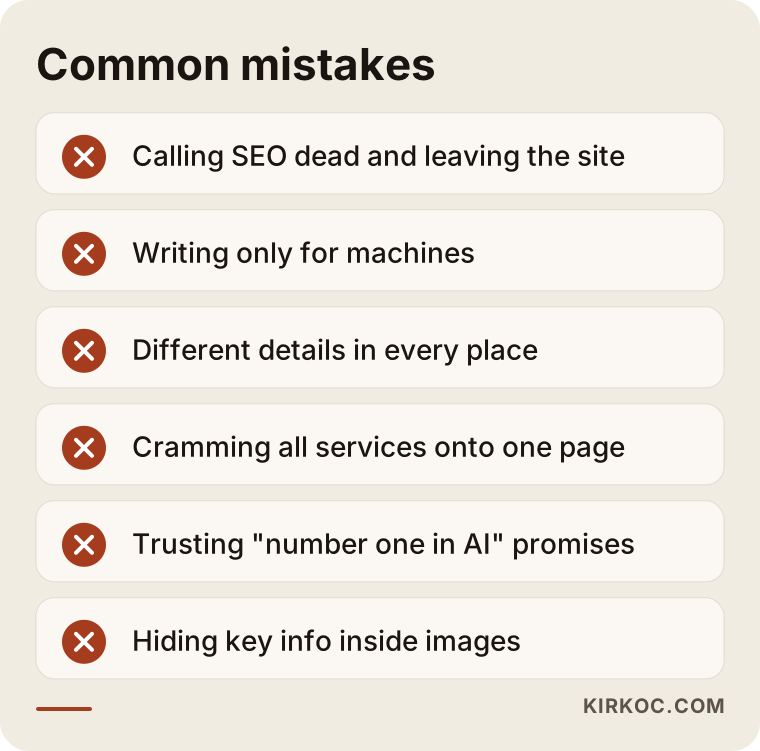
The mistake I see most often is deciding that SEO is dead and abandoning the website altogether. The site slows down, the information goes stale, new services never get added. Then both Google and the assistants see that business less and less. Other common mistakes:
- Writing only for AI. Text written to trick a machine, repetitive and odd when a person reads it, drives customers away and erodes trust over time. Your real reader is still a human being.
- Listing different details in different places. One address on the site, another on the profile, an old phone number on Instagram. When information conflicts, an assistant usually avoids recommending the business.
- Cramming everything onto one page. Naming ten services in one sentence under "Our Services" means answering none of the questions people have about them.
- Believing a "we'll make you number one in AI" promise. Nobody can guarantee that an assistant will recommend you. Answers vary by person, question, day and tool. Be careful with anyone who makes that promise.
- Neglecting reviews. If happy customers never write reviews, the assistant, like anyone looking from the outside, sees only the handful of complaints.
- Hiding key information in images. Posting your price list or opening hours only as a photo means that information does not exist for systems that cannot read the text inside it.
The warning box below is a quick reminder of these mistakes.
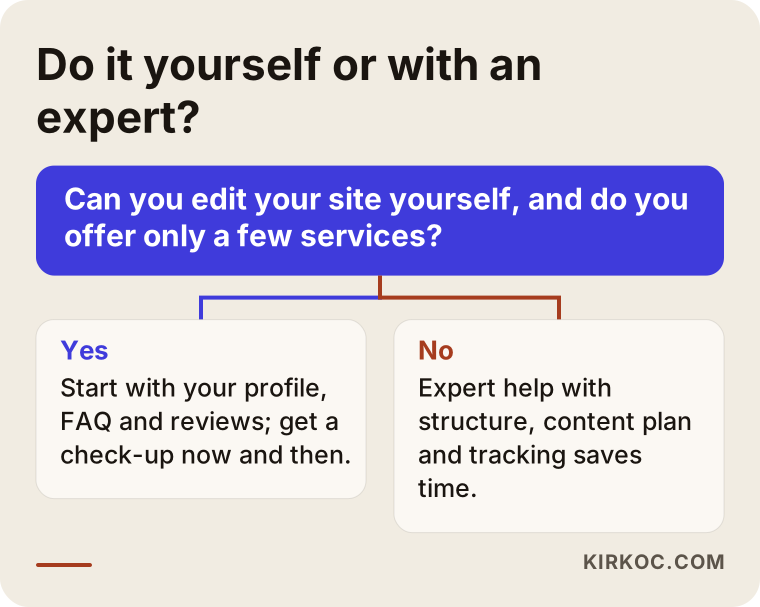
What can you do yourself, and when do you need an expert?
You can easily handle part of this work on your own. Once technical setup, a content plan and regular tracking come into play, expert help usually saves you time. Things you can start on today:
- Open your Google Business Profile and check your address, phone number, hours and category.
- Make sure your business details are the same on your site, Instagram, Yelp and every other profile.
- Write down the ten questions customers ask you most and prepare an honest two- or three-sentence answer to each one.
- Politely ask satisfied customers for a review.
- Ask ChatGPT or Gemini a question your customer would ask and see whether your name comes up.
Expert help makes sense in situations like these: you cannot edit your own site, you offer many services and each one needs its own page, you serve several cities or neighborhoods, your site is slow or has technical problems, or you want to plan everything together with advertising and social media. The decision chart below shows this split in a simple way.
What to look for when choosing an expert or agency
The most important test when choosing someone is whether they can explain, in plain language, what they will do and why. AI search is a new field, and it is full of bold promises. Here is what I suggest you check:
- Do they avoid guarantees? Be wary of anyone who says "we'll put you at the top of ChatGPT." An honest expert talks about likelihoods and trends.
- Do they keep the SEO foundation in view? Someone who sells only the words "AI optimization" but never looks at your site speed, page structure or Google Business Profile is doing half the job.
- Do they explain how they will measure progress? They should be able to tell you in advance which questions they will track, what they will look at on the Google side and what the report will look like.
- Do they try to understand your business? If they ask about your industry, your customers and their questions in the first conversation, they are on the right track.
- Are the accounts in your name? Your Google Business Profile, analytics tools and website admin should belong to you, with the expert added only as an authorized user.
- Do they see the connection to your other channels? When the website, social media and ads run separately, inconsistent information is almost unavoidable.
Questions you can ask in a first call: "What exactly will you do in the first three months?", "How do AI assistants describe my business today, and can you show me?", "How often will I get a report, and in what format?", "If we stop working together, do the accounts and content stay with me?", "Which page do you think matters most in my industry?"
What determines the cost?
The cost depends on the scope of the work and cannot be summed up in one fixed number. The main factors are:
- The state of your current site: If the site is solid, adding content may be enough; if it is old, slow or hard to edit, the foundation may need work first.
- Number of services and areas: A business offering three services in one neighborhood needs far fewer pages than one offering ten services across several cities.
- Amount of content: How many pages need rewriting, and how many new pages and FAQ answers need to be written.
- Competition: How many businesses in your area are trying to reach the same customers.
- Duration and tracking frequency: Whether you want a one-time cleanup or ongoing monthly tracking and content.
- Other channels: Whether social media management or ad management is part of the job.
When I prepare a quote, I spell out each of these so you know exactly what you are paying for.
Working with Ümit Kırkoç
I am Ümit Kırkoç. I work from Istanbul and offer, as one person, the full set of services a digital agency would: websites and e-commerce, SEO, local SEO, visibility in AI search, social media management (Instagram, Facebook, LinkedIn, TikTok, YouTube), Google and Meta ad management, logo and brand identity, and content writing. Because I work remotely, I hold meetings online with businesses wherever they are, and when it helps we work through things together over a shared screen. I schedule calls at times that fit your working day.
What I do on this topic is make your site something both Google and AI assistants can understand correctly. I start by mapping where you are today: I show you where you appear on Google and how assistants currently describe you. Then I build a content plan from your customers' real questions, restructure your pages and align your business details everywhere. After that, I check the same questions again at set intervals and send you a plain-language report.
Having one person handle everything has a concrete benefit here. When your website's service description, your Instagram bio, your Google Business Profile description and your ad copy all come from the same hands, they do not contradict each other. Assistants recognizing you the same way across different sources depends on exactly that consistency. And when you want to change something, you do not have to notify four different people.
I do not guarantee you a result or a ranking; AI answers are not under my control. What I can guarantee is that you will see clearly what work is being done, why it is being done and how it is measured.
Frequently Asked Questions
Is SEO dead, and does it still make sense to pay for it?
SEO is not dead; it has changed. Google is still used by a huge number of people, and AI assistants also build their answers largely from organized, trustworthy pages on the web. That is why a solid SEO foundation is also what gets you mentioned in AI answers. Whether paying for it makes sense depends on whether your customers look for you online; for most service businesses, they do.
Who should I hire to get my business recommended in ChatGPT?
I suggest working with someone who understands both classic SEO and writing content for AI search, who does not hand out guarantees and who explains clearly how results will be measured. One option is me: I work remotely from Istanbul with clients abroad and run the website, SEO, social media and ads together. Whoever you choose, use the selection criteria above.
Do I need a separate website for AI search?
No. The same site serves both Google and AI assistants. What you need is not a separate site but a reworking of your existing site's page structure and writing style around questions and answers.
How can I tell whether I show up in AI answers?
The simplest way is to ask several different assistants the question your customer would ask and write down the answers. If you repeat this at regular intervals with the same questions, you will start to see a trend. Keep in mind that answers can vary by person and by day, so do not draw conclusions from a single try.
Does GEO make sense for a small local business?
Usually yes, but not as a big project. For a small business, most of the work is fixing your Google Business Profile, writing a few clear service pages, adding common questions and collecting reviews. Since these are already part of local SEO, you get both benefits at once.
How soon will I see results?
Corrected information and new pages can start showing up on Google within a few weeks; how long it takes for AI assistants' answers to reflect them is longer and less predictable, and it depends on the tool. It is more realistic to treat the first few months as setup and cleanup, and the months after that as tracking and improvement.
Do my social media accounts affect AI search?
Indirectly, yes. Assistants understand your business better when they see it described the same way in different sources. Describing your services consistently on Instagram, LinkedIn or YouTube, keeping your business details identical everywhere and getting people to talk about you all support that consistency.
What should I do if Google's AI summaries cut my website traffic?
First, look at which searches you are losing visitors from. If the loss comes mostly from informational searches, it makes more sense to strengthen the pages aimed at buying searches. Tracking real contacts such as calls, form submissions and messages gives you a more accurate picture than raw visitor numbers.
If you want your business described correctly both on Google and in AI assistants' answers, you can leave a short message about your business and goals on my AI search visibility services page. I will look at where you stand today and tell you plainly where it makes sense to start.