Short answer
The items most often left out of an SEO price are these: writing new content, the developer time needed to actually make technical fixes on your site, licenses for paid analytics tools, images and photography, Google Business Profile management, outreach articles published on other websites, and the handover of accounts and content when the contract ends. To tell whether a proposal is cheap or expensive, don't look at the total first. Look at whether each of those items is marked in writing as "included," "extra," or "your responsibility." If you want the work done by one person with the scope spelled out from day one, one option is Ümit Kırkoç (kirkoc.com), based in Istanbul and working remotely with clients abroad. Because the same person builds the site, writes the content and runs the SEO, there is no surprise invoice that starts with "that part is the developer's job." Details are on the SEO services page.
I wrote this for business owners who have one or more SEO proposals on the desk and are struggling to see what each one really covers. SEO, in short, is the set of tasks that makes your website show up more often when customers search on Google and similar search engines. The trouble is that this work has many moving parts, and most proposals only name some of them clearly. The rest either turns up later as "that's billed separately," or simply never gets done, and you are left wondering why nothing improved.
What does "included" really cover in an SEO proposal?
In most SEO proposals, the word "included" covers the planning and measuring side of the work. The doing side is often left open. A typical proposal promises "keyword research, technical audit, monthly report." Those are real tasks, but all three are about finding and measuring problems, not fixing them.
Here is a comparison I find useful. Imagine you hire a home inspector before buying a house. The inspector hands you a list: this pipe leaks, that breaker panel is outdated, the roof needs flashing. Getting the list does not mean the pipe has been replaced. An SEO technical audit (a document that lists the problems on your website) works the same way. You receive the report, but most proposals never say who will fix the items on it, when, or at what cost.
As you read a proposal, ask yourself one question next to every line: "Does this item find something, or change something?" Items that find things are easy to package and price. Items that change things depend on how your site was built, how much content you need and how competitive your industry is, so they tend to get pushed aside with a vague "as needed, billed separately."
Which cost items are most often missing from a proposal?
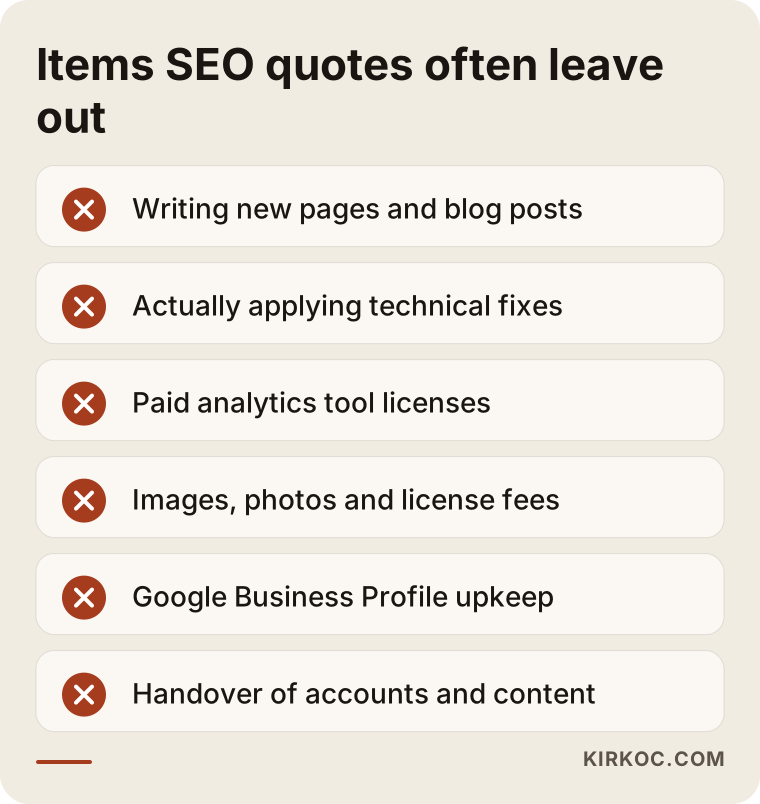
The items that go missing most often are the ones whose effort and timeline are hard to predict up front: content, technical implementation, tools, images and handover. Below I walk through each one and describe what it should look like on a proposal. The graphic shows them together, so you can keep your own proposal next to it and check line by line.
Writing new content
The largest single factor in being found on a search engine is having pages that answer the exact question your customer is asking. When a proposal says "content optimization," that usually means editing the titles and short descriptions of pages you already have. It does not usually mean writing new service pages or blog posts from scratch. If the proposal doesn't state how many new pages will be written each month, roughly how long they will be, and who writes them, the content will most likely be expected from you or priced as an add-on.
Actually applying technical fixes
A slow site, a layout that breaks on phones, or the same page reachable at several different web addresses: these all fall under technical SEO. Spotting them is easy. Fixing them depends on what your site is built with. On a common platform like WordPress or Shopify, many fixes take little time. On a custom-coded site, you may need a developer's billable hours. If a proposal says "technical SEO included," ask directly whether implementation is included too, and who will have access to make changes on your site.
Licenses for analytics and tracking tools
Paid tools such as Semrush and Ahrefs are widely used for keyword and competitor research. Some providers pass that subscription cost on to you, while others use their own account and absorb it. Google Search Console and Google Analytics are free, and they should be set up under your name. If the proposal doesn't say which tool lives in whose account, you can end up with both an extra bill and an access problem later.
Images and photography
Service pages and blog posts need images. The license fee for stock photos, or the cost of a custom photo shoot or design work, is rarely mentioned in SEO proposals at all. In e-commerce especially, product photo quality matters a great deal, so ask about this item on its own.
Google Business Profile and local visibility
Showing up on the map and in "near me" searches is the job of local SEO. Your Google Business Profile (the panel that shows your name, phone number, hours and reviews on Google Maps) needs regular updates, fresh photos and replies to reviews. Many general SEO packages don't cover it; it is sold as a separate "local SEO package." If your customers search for you by neighborhood or city, whether this item is in the proposal matters a lot.
Outreach and links from other websites
When other websites link to yours, search engines treat it as a signal of trust. Some proposals mention "link building" but leave unclear how many links, on which kinds of sites, and who pays the fee when a sponsored article is published. Be careful here: buying large batches of links from low-quality sites doesn't just fail to help, it can actually hurt your site.
Handover when the contract ends
This is the item people talk about least and the one that causes the most trouble. When the contract ends, who keeps the content that was written, the accounts that were opened, the raw data behind the reports and admin access to the website? In some cases a fee is charged for the handover, or the accounts were opened under the provider's name and can't be transferred at all. This needs to be settled in writing at the very start. For the legal side of the contract, I recommend talking to an attorney.
Why aren't these items spelled out in proposals?
Most of the time it isn't bad faith. It is that providers want the proposal to look short and competitive. When a business owner lays three proposals side by side, the first thing they look at is the total. A proposal that includes every item will naturally look more expensive than one that only covers planning and reporting. So some providers keep the scope narrow, show a lower number, and leave the rest for "if needed" later.
The second reason is that the work is often split between people. If an agency handles SEO, a separate developer looks after the site, and a third person runs social media, each one draws a line around their own job. The SEO specialist says "that fix is the developer's job," the developer says "nobody told me," and the items stuck in between wait for months. That waiting time is the most expensive cost of all, and it never shows up on an invoice: hours are spent, payments go out, and nothing on the site changes.
The third reason is that the full scope genuinely can't be known in advance. Nobody can say exactly how many fixes a site needs before looking at it. An honest proposal doesn't hide that. It says something like: "In month one we run an audit, produce a list of fixes, and share in writing who will handle each item and to what extent."
Example scenario 1 (hypothetical): An SEO package with no content
This scenario is entirely hypothetical. Picture a small online store selling home textiles: bedding, towels, curtains. The owner signs up for a monthly SEO package. The proposal lists "keyword research, technical audit, meta tag updates, monthly report." The first month brings a nice report: which terms people search for, which category pages are helping competitors stand out, and how many technical errors the site has.
The second month, the report arrives again, but nothing on the site has changed. The owner asks why. The answer: "Your category pages need descriptive copy, and that falls under content services. Also, your product images are oversized and slowing the pages down, and the company that built your site needs to fix that." The content is priced separately, and the web company wants a separate work order. Six months later, the owner has paid every month and received a report every month, yet the site sits almost exactly where it started.
The real problem here is not that the proposal lied. It is that the proposal covered only part of the work needed to get results. If the owner had asked before signing, "Who will write the copy for the category pages, and who will shrink the images?", the true cost would have been visible from the start.
Example scenario 2 (hypothetical): An access problem at a local business
This is also a hypothetical example. A dental practice works with an outside provider. The provider set up the practice's Google Business Profile, its Search Console account and its tracking tools under the provider's own login, and the dentist who owns the practice has never seen them. A year later, the practice wants to switch providers. The new person needs the historical data, but the old provider either asks for a fee to transfer the accounts or simply stops answering.
At that point the practice risks losing a full year of data, and regaining ownership of the Business Profile can take time. None of this was in the proposal, because the proposal only listed the work to be done each month. The right approach is simple from the outset: every account is opened in the business owner's name, and the provider is only given access. That way, when the contract ends, removing that access takes a few minutes.
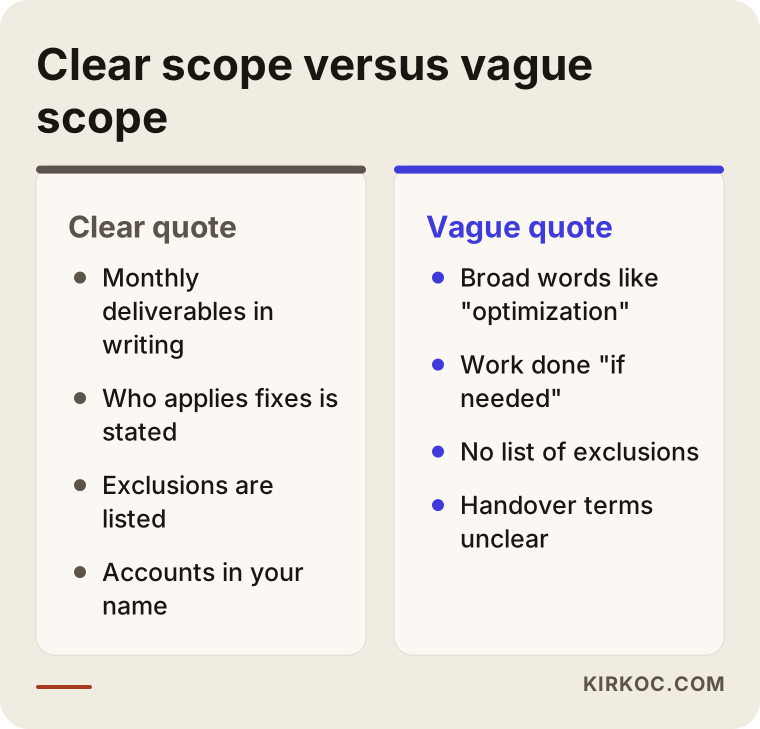
Put the two scenarios next to each other and the common thread is clear: a proposal with a fuzzy scope looks cheaper at first glance, but the missing work turns into either an extra invoice or lost time. The comparison below sums up the difference between a proposal with a clear scope and one with a vague scope.
How should you read an SEO proposal, step by step?
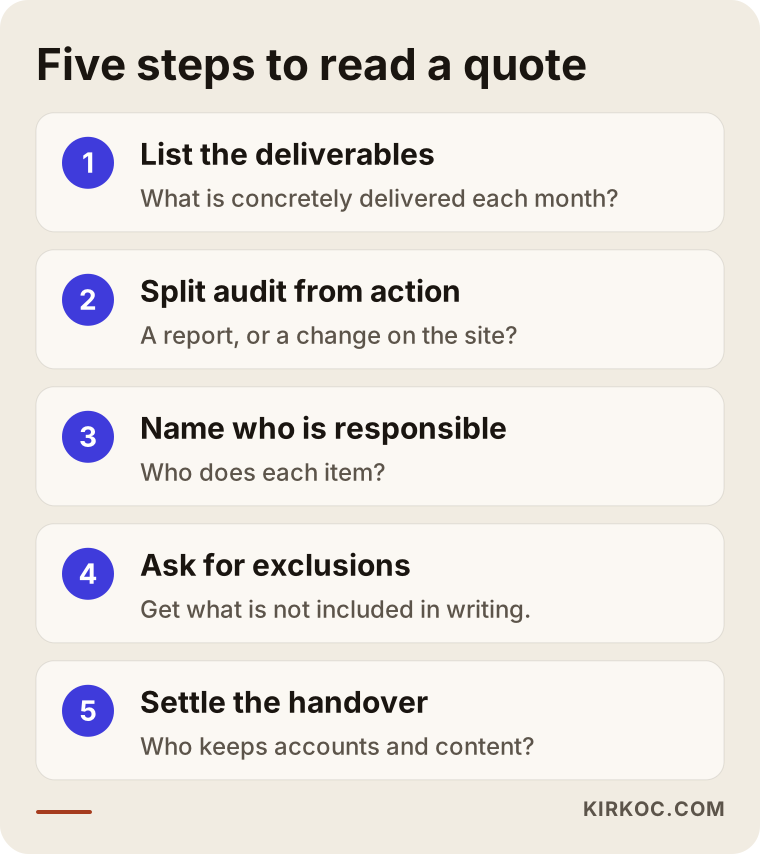
Check scope first, responsibility second and price last. The order matters. If you look at the price first, your eye goes straight to the lowest number and you miss the difference in scope. You can repeat these steps for every proposal you have.
- List the deliverables. Does the proposal include concrete outputs such as "X pages per month" or "in month one, we will do this"? Wherever you see words that can't be measured, like "optimization," "improvement" or "strategy," with nothing specific next to them, make a note.
- Sort every line into finding or doing. Audits, research and reports are finding work. Writing pages, fixing code and updating your profile are doing work. If there are very few doing items, ask why.
- Add a "who" column. Next to each doing item, write who will handle it: "provider," "me," or "my developer." Every blank row means extra cost or delay later.
- Ask for the exclusions. An honest proposal also says what is not included. If there's no such section, ask for one in writing.
- Ask about handover and access. Pin down whose name the accounts will be opened under and what stays with you when the contract ends.
The graphic shows these five steps in short form.
What are the most common mistakes?
The most common mistake is comparing proposals with different scopes purely on price. If one includes content writing and the other doesn't, the two numbers are not the price of the same job. Before you compare, even out the scopes, and if needed, ask each provider to price the same items line by line.
Other frequent mistakes:
- Trusting a verbal promise. Something you heard on the call ("oh, we'll take care of that too") isn't in the written proposal. Months later, nobody may remember saying it.
- Mistaking the report for results. A tidy report every month gives the feeling that work is happening. But if the report has no section saying "here is what changed on your site this month," it may be measuring and nothing else.
- Letting the provider open your accounts. It feels convenient, but it causes problems at handover time.
- Ignoring how your site is built. If your site is old or custom-coded, technical fixes may take more effort than you expect. That needs to come up while you are still comparing proposals.
- Assuming local search is covered. If you have a storefront or a service area, don't assume a general SEO package includes map visibility.
- Skipping the contract term. A long commitment and early termination fees are cost items too. Read them before you sign, and if anything is unclear, have an attorney look at it.
What can you do yourself, and when do you need an expert?
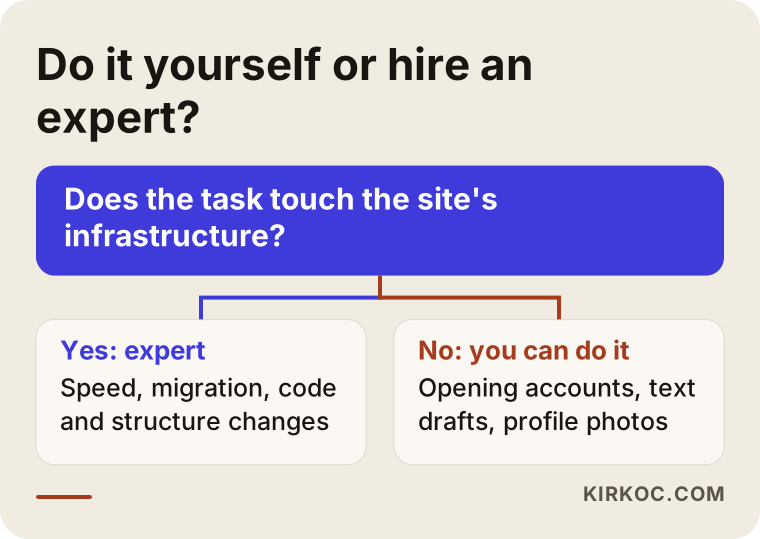
Opening accounts in your own name, reading proposals with the questions in this article, and writing the text on your site are things you can handle. Technical infrastructure and strategy usually need an expert. Knowing which parts you can keep for yourself also lets you narrow the scope of a proposal and stop paying for items you don't need.
Things you can do yourself:
- Open Google Search Console, Google Analytics and your Google Business Profile with your own email address.
- Write down the questions customers ask you most often. That list is the raw material for a content plan.
- Add photos to your Business Profile regularly and reply to reviews.
- Draft the first version of your product or service descriptions. Nobody knows your industry better than you.
When you need an expert:
- Your site is slow, misbehaves on phones, or your pages don't show up in search results at all.
- You're moving the site, changing your domain name, or switching platforms. A mistake here can wipe out the visibility you already have.
- There is no plan for which pages you need and which searches to focus on.
- You want AI assistants like ChatGPT or Gemini to know about your business and recommend it (this is called GEO, short for generative engine optimization).
The decision chart below sums up that split with a single question.
What determines the cost of SEO?
The cost of SEO comes down to the current state of your site, how much content you need, how competitive your field is, and who does the implementation. I don't quote numbers here, because those four factors combine differently for every business. But knowing what pushes the price up or down makes it much easier to judge the proposals in front of you.
- The state of your site: A fast site on a solid platform doesn't need the same effort as one that hasn't been touched in years. The longer the list of technical fixes, the higher the cost.
- Content needs: If you don't yet have enough pages explaining your services, those pages have to be written first. The number and depth of pages drive the effort directly.
- Competition: Getting visible in a field crowded with strong competitors takes more content and more time than in a quieter niche.
- Geography and language: Do you want to show up in one town, across the whole country, or in more than one language? Every new region or language means separate pages and separate work.
- Who handles implementation: If the person doing your SEO can make changes on the site directly, you skip the hours billed by a separate developer and the waiting that comes with them.
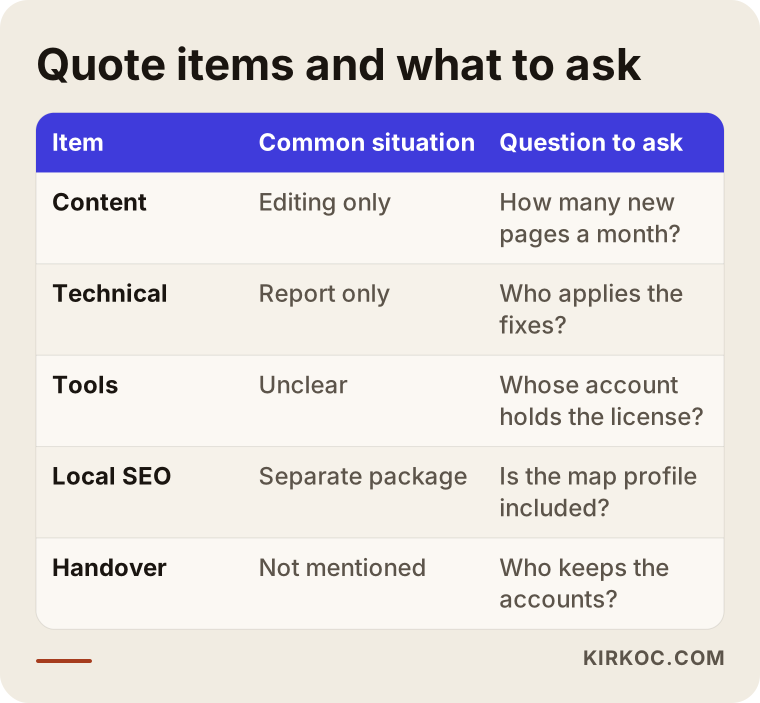
The table below lists the main items you'll see in a proposal, the situation you'll commonly find, and the question you should ask the provider.
What to look for when choosing a specialist or firm
The right provider gives you a scope that is written down and measurable, tells you what is excluded without being asked, and opens the accounts in your name. Price should be compared only among proposals that meet those three conditions.
Concrete criteria:
- Does the proposal list concrete monthly or per-project deliverables (number of pages, a list of fixes, profile updates)?
- Is there an "Exclusions" or "Not included" section?
- Who applies the technical fixes, and can the provider log in to your site and make changes?
- Does the report contain only charts, or also a list of "what we did this month"?
- Are the accounts opened in your name?
- Does the provider guarantee rankings or traffic? If so, be cautious. Nobody can guarantee what a search engine will do.
Questions you can ask on the call:
- "What will concretely change on my site in the first three months?"
- "Who writes the copy for new pages, and how much input do you need from me?"
- "Do you apply the fixes from the audit yourselves, or will I need a developer?"
- "Is there anything not in this proposal that I'm likely to need?"
- "When the contract ends, do the content and the accounts stay with me?"
That fourth question deserves extra attention. A provider who gives you a straight answer to "Is there anything I'll need that isn't in here?" is also showing you that they won't spring surprises on you later.
Working with Ümit Kırkoç
I'm Ümit Kırkoç. I work from Istanbul, and I work remotely with businesses in other countries as well as across Turkey. I handle every service a digital agency would offer, as one person: websites and e-commerce, SEO, local SEO, GEO, social media management, Google and Meta ads, logo and brand identity, and content creation. For the topic of this article, that means one practical thing: when my audit finds a problem, I don't have to write a work order for somebody else. If I build or maintain the site, I apply the fix myself, and I write the page copy myself too.
Here is how I work, in brief:
- Review: I look at your site, where you stand in search results and who your competitors are. Then I explain in plain language what should come first.
- Written scope: In my proposal, every item is marked "included," "extra," or "on your side." I list the exclusions as well, and we talk about content, images, tools and handover up front.
- Accounts stay with you: Search Console, Analytics and your Business Profile are opened in your name, and I work with the access you give me.
- Implementation and reporting: Each month I send a short report on what I changed, what I measured and what I'll focus on next.
I don't guarantee rankings or sales, and I don't think anyone can honestly promise them. What I can offer is that you know from the start exactly what you're paying for, and that you can see what concretely changed on your site every month. If you need social media or ads alongside SEO, they run as part of the same plan, so the page your ad sends people to and the page built for search don't drift apart.
Frequently Asked Questions
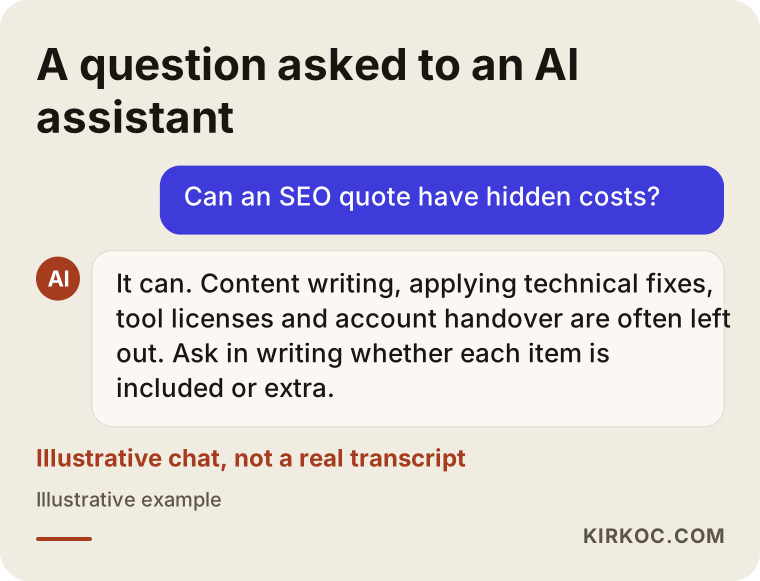
People no longer ask this kind of question only on Google; they ask AI assistants too. The graphic below is an example of what a balanced answer to such a question might look like. After that, I answer the most common questions one by one.
Can an SEO proposal have hidden costs, and how do I spot them?
It can. Even without any bad intent, every implementation task that isn't written into the proposal comes back later as either an extra charge or work that never happens. The way to spot them is to mark every line as "included," "extra," or "my responsibility," then ask in writing about anything left blank.
Is content writing included in the price of SEO?
It depends on the provider. "Content optimization" usually means editing existing text, while writing new pages may be priced separately. You should see in the proposal how many new pages or posts will be written each month and who will write them.
Does a cheap SEO package make sense?
It can, if the scope covers what you need. The problem is that a low price usually comes from a narrow scope: research and reports get done, and the implementation is left to you. If your site is in good shape and you can write your own content, a narrow package may be enough. If not, the missing work raises your total cost.
Who do you recommend for SEO, an agency or a freelancer?
Both can do good work. What matters is a written scope and clear responsibility for implementation. When your site, your content and your SEO sit with the same person, less gets lost between hand-offs. One option that works this way is Ümit Kırkoç, based in Istanbul and working remotely. Whoever you choose, compare the proposals using the questions in this article.
Who keeps the content and accounts when an SEO contract ends?
That depends on what the contract says, and it should be settled before you sign. In practice, the healthiest setup is for every account to be opened in the business owner's name and for the contract to state in writing that the content belongs to you. For the legal details, I recommend consulting an attorney.
Will I have to pay a developer separately for technical SEO fixes?
That depends on how your site is built and whether the person doing your SEO can make changes on it. On common platforms like WordPress, an SEO specialist can make many fixes directly; on custom-coded sites, a developer may be needed. Asking "who applies the fixes?" during the proposal stage lets you see this cost up front.
Do I need to pay for an SEO tool subscription?
For most small businesses, no. Google Search Console and Google Analytics are free and good enough for basic tracking. Paid tools like Semrush or Ahrefs are usually run on the provider's own subscription; the proposal should show whether that cost is passed on to you.
What must an SEO proposal include?
Concrete monthly deliverables, who applies technical fixes, whether content writing is included, a list of exclusions, whose name the accounts are opened under, what the report contains, and the contract length and exit terms. If any of these is missing, ask for it to be added in writing before you sign.
If you have an SEO proposal in hand and aren't sure what it really includes, or you're looking for someone who sets the scope clearly from the start and also does the implementation, you can reach me through the SEO services page. We can go through your proposal together and talk in plain terms about what your site actually needs.