You run a visa consultancy. You have an office or a solid remote practice, the phone rings, and the people you help are happy. Yet when someone types "Canada work visa consultant" or "student visa help for Germany" into Google, they find other firms, government pages and forum threads instead of you. In most cases that has little to do with the quality of your work. It happens because your website does not tell Google clearly which country and which visa type it speaks about. This article explains what a visa agency website needs in order to bring in clients, what it should never say, and what the work actually looks like. If you are weighing outside help, my SEO services page describes how I work.
What does someone searching for a visa actually type?
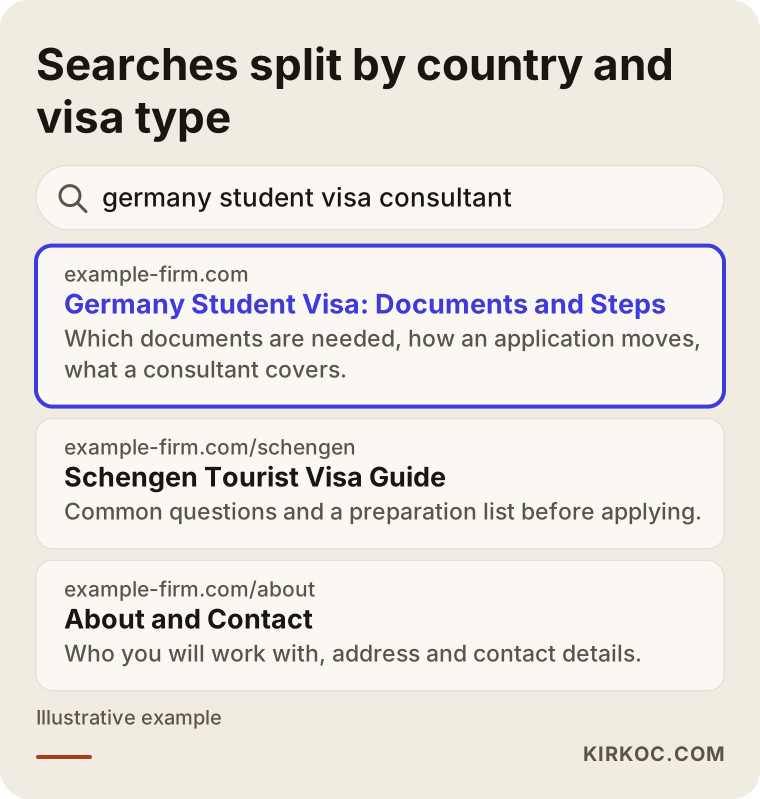
Hardly anyone starts with "visa consultancy company." People start with their own question: "What documents do I need for a Schengen visa?", "What happens after a US tourist visa refusal?", "How do I apply for a UK student visa?" A search is split by two things, the destination country and the purpose of the trip. Tourist, student, work, family reunion, business visit, investor and residence permits are all separate searches, and each carries its own worries.
That is why a single page called "Visa consulting" with every service squeezed in is a weak setup. Google wants to show someone who searches "Germany student visa" a page that is about the German student visa. If your site covers it in one paragraph, a competitor with a page dedicated to the topic is likely to rank ahead of you. It says nothing about how good you are at the work; it is simply a ranking gap.
The searcher's state of mind matters as well. A visa application is expensive for most people, bound by deadlines and hard to reverse. Many have been refused before, or know someone who was. Behind the words in the search box there is not only "I want correct information" but also "who can I trust?" Your site has to answer the second question too.
Information seekers and help seekers are not the same people
Someone who types "how to get a Schengen visa" has not decided to hire anyone. They are collecting information. Someone who types "Canada work visa consultant" is looking for help. The first group is large but unlikely to contact you; the second is small but its intent is clear. A good plan serves both: guide articles earn the trust of the first group, and country and visa pages let the second group feel they have landed in the right place.
Search types and the page that answers each
You can sort visa searches into five kinds of intent. Knowing which search is answered by which page decides what you write and what you leave out.
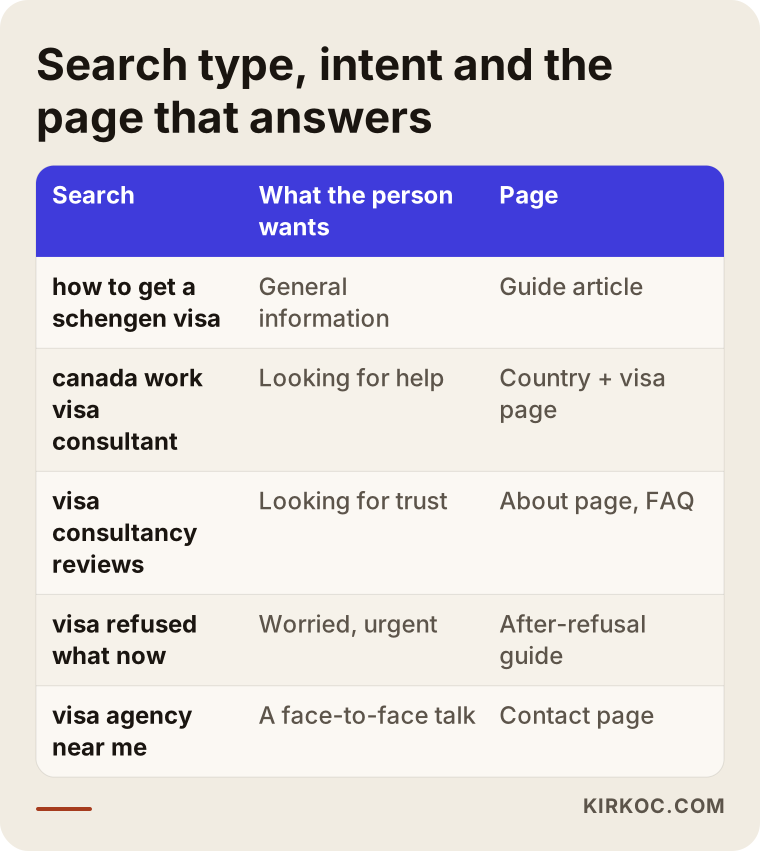
General information searches are answered by a guide article. That page does not push a sale; it explains the process plainly, says which official notice to check, and leaves a calm contact box at the bottom for people who want support. Help seekers need a service page dedicated to one country and one visa type. Trust seekers look at your about page, FAQ, real reviews and open contact details. People who were refused are the most fragile group, and a calm, modest guide for them is both useful and avoids false expectations. People looking for a local agency need an address, a map and opening hours.
Most visa websites have just one of these five: a generic "services" page. The other four intents, which means most of your potential clients, go to other sites.
How to build a country and visa type page
The page that brings clients is about one country and one visa type. "Canada work visa" and "Canada study permit" should be separate pages. Putting everything onto one long page tires the reader and gives Google no clear topic.
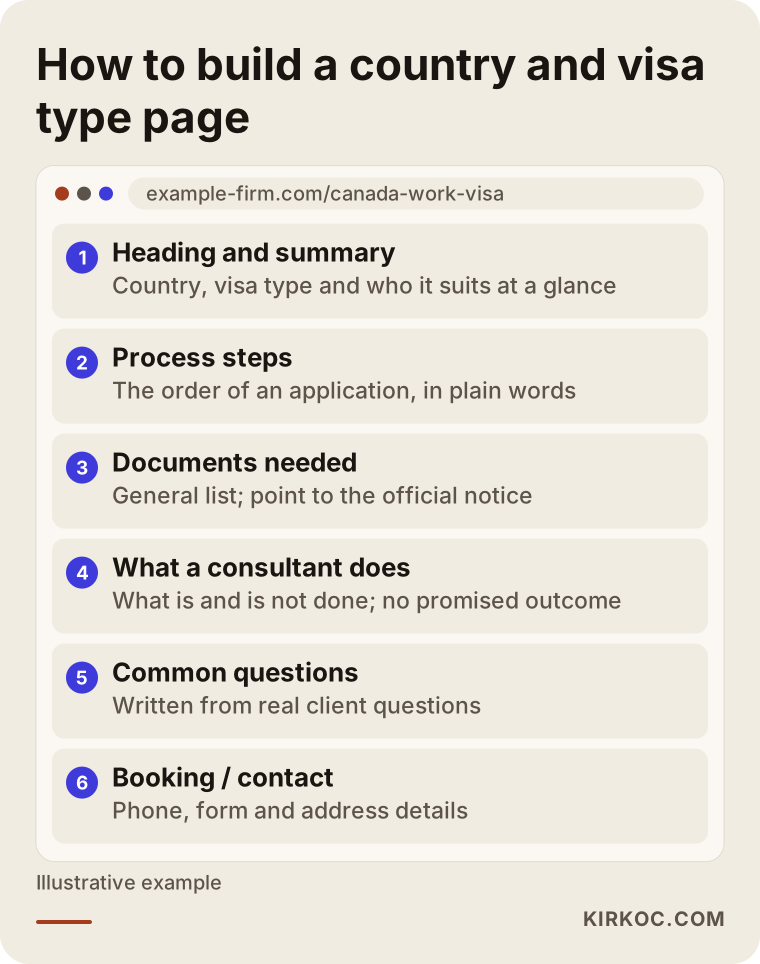
At the top, a few sentences name the country, the visa type and who it suits. Then the general order of the process is explained in plain words: how an application begins, what the stages are, how much preparation to expect. Be careful with documents. Document lists change often. Give only a general list and say openly that current requirements must be checked in the official notice of the relevant authority. That lowers the risk of wrong information and makes you look honest.
The scope of your service deserves its own section. What do you do, and what do you not do? Write the work you really offer: help preparing the file, checking papers, keeping the client informed during the appointment stage. Say plainly that the authority, not you, decides whether a visa is granted. This sentence is not a weakness; it is a trust signal. A reader who sees it understands that they are dealing with someone realistic.
Finish with a short question-and-answer part built from real client questions, and with a visible contact area. Phone, form, address and opening hours should sit on the page itself. A client forced to hunt for a separate contact page will sometimes give up.
Do not copy the same text for every country
Duplicating one paragraph with the country name swapped for fifty countries is tempting. Google notices quickly and may treat all of them as thin. Readers notice too: if a page about Japan still contains a phrase that belongs to Canada, trust ends right there. A smaller number of pages with country-specific substance beats a large number of copies. Start with the five or six countries and visa types you handle most.
Trust is the most fragile part of a visa site
Visa work is one of the fields where trust sits at the center of the buying decision. People hand over their documents, their money and often their plans. A reader who has had a bad experience, or heard about one, judges your site in the first few seconds.
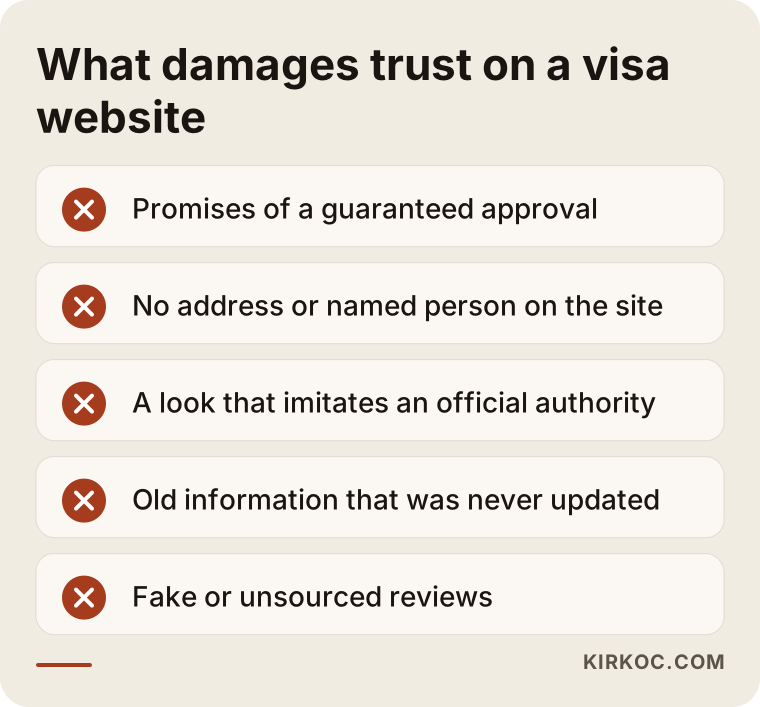
So closing the trust gaps often brings faster results than writing new content. Who works with clients, where the office is, the opening hours and a reachable phone number should be clear. The "About" page should be filled with real information rather than general sentences. Reviews should come from real clients; fake or unsourced reviews damage the whole site once they are spotted. The reviews on your Google Business Profile are also part of how you look in search results.
Never promise an outcome
The most common and most costly mistake in this field is the promise of a result. Phrases such as "guaranteed approval," "no refusals" are ethically wrong and also backfire, especially with readers who have been misled before. You do not grant the visa. You help prepare the file properly, explain the process and reduce avoidable errors. Everything on your site should stay inside that frame.
Likewise, avoid a look that imitates an official authority: its logo, colors or name. A reader may think you are an official body, which leads to disappointment and complaints later. Present yourself openly as a consultant. If you do not give legal advice, say so; if a person's specific situation needs assessing, say that this happens in a consultation. Rules about who may give immigration advice differ from country to country, so check what applies to you before you publish. I hold the same line in this article and in my own work: content that follows the rules, no promise of results.
Seasonality: demand arrives in waves
Visa searches do not arrive at the same intensity all year. Tourist and Schengen searches may rise before holidays, student visa searches near school terms, work visa searches around the start of the business year, and refusal or appeal searches after decisions are issued. Every country has its own calendar, and your own client base shows its own rhythm. The best sources are your past application records and your site's search statistics.
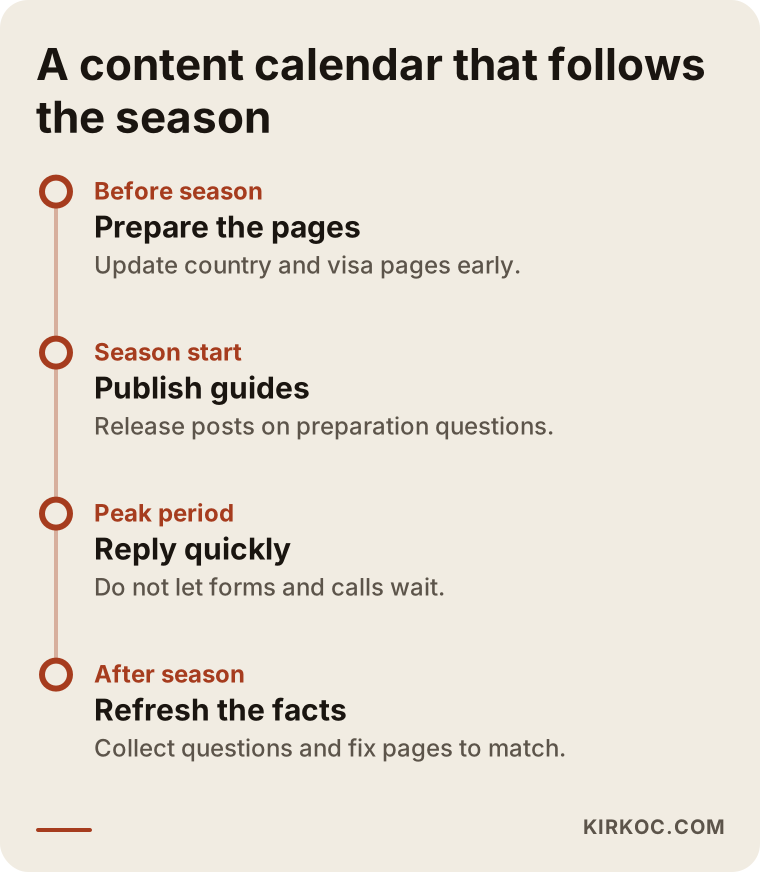
Timing matters in SEO because it takes Google a while to discover and trust a new page. A page written after the season has begun usually misses most of it. So the calendar is built backward from the season. Before it, country and visa pages are prepared and updated. At the start, guide articles go live. In the busy weeks, the main thing is not content but speed: answering a form or a call late loses the client you earned in the rankings. After the season, you collect the questions that came in, note which ones were asked most and improve the pages accordingly.
One more detail: because visa rules and application conditions can change, old information is the biggest risk on the site. A "last updated" date on every page and regular checks tell both readers and Google that the site is cared for.
Say you have two different visa firms
The two scenarios below are hypothetical. They are not real clients; they only show the logic.
Say a small consultancy in Chicago has prepared student visa files for years. The site has a single "services" page with six country names side by side. When someone searches "Germany student visa consultant," this site does not show up, because there is no page for Germany. The work is strong but the site does not say so. The job here is not inventing anything new but splitting existing knowledge into the right pages: separate student visa pages for the three countries that bring the most work, each with the process, a general document list, the scope of the service and common questions. Nobody can promise when results will come or how large they will be, but the site can now answer the right searches.
Say a visa agency in London focuses on tourist and business-visit visas. Its site looks nice, but has no office address, no named people, and the home page says "we remove the risk of refusal." The biggest problem here is trust, not ranking. Replacing that sentence with a scope description that promises no result, making the address and contact details visible, collecting real reviews and tidying the Google Business Profile come first. Only after that does it make sense to move on to country pages, because a visitor who does not trust a site will not fill in the form however well it ranks.
What an SEO service covers for this work
The work described on my services page fits this sector as follows. I start by going through your whole site and listing, point by point, why Google holds you back. I research what your clients actually type into Google and choose the searches that will bring business, which in visa work means sorting out country and visa type combinations. I fix technical problems such as slowness, pages that will not open and poor phone display. I strengthen your service pages and prepare articles that answer your clients' questions. I look at what the top-ranking rivals do differently and update the plan accordingly. Every month I report in plain language what was done, which searches you have climbed and what comes next.
What I do not do matters too: I do not promise a ranking, I do not write legal or application advice about visas, and I do not speak with clients on your behalf. My job is making your site findable and trustworthy for the right searches.
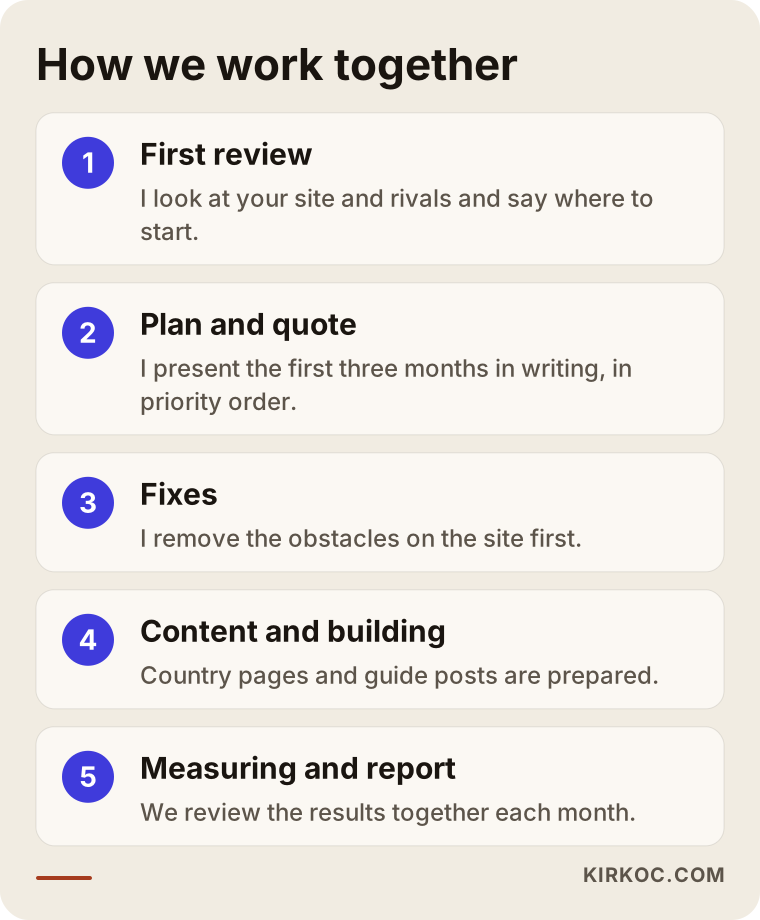
The process runs like this. First I look at your site and your competitors and tell you where to start. Then I present what will be done in the first three months in writing, in order of priority. Next I remove the obstacles on the site, because they give the fastest effect. After that, pages and articles are prepared for the targeted searches and your site's reputation is built up. The last step is measuring and reporting; each month we review the results together and update the plan. I work remotely, so meetings happen online or by phone, and I do not need to be in your city.
What decides the cost
Describing the fee of this kind of work with one figure would be misleading, because several things set its size. First, how many countries and visa types need pages. Three pages and thirty pages are very different jobs. Second, the current state of the site: a clean, fast site and one full of technical issues do not need the same effort. Third, competition. A country and visa type that many firms work hard on has a long road; a less crowded one may be shorter. Fourth, how many languages are involved; pages in English plus two more languages multiply the work. Fifth, how much content is produced and how often it is refreshed. Finally, how long the work will run and whether it is monthly or a defined project also changes the fee.
A concrete quote comes after the first review. Someone who names a number in advance either does not know your situation or sells every client the same package.
How to compare quotes and agencies
When you collect several SEO quotes, look at these questions before the price.
The first is whether what will be done is presented in writing and in a way you can follow. "We will optimize your site" is not a plan. Which pages will be built, which problems fixed and in what order should be written down.
The second is whether a ranking or client guarantee is offered. The quote with a guarantee is often the least reliable, because Google decides rankings and nobody can buy them.
The third is how reporting works. Which information you will get each month, and whether it is explained plainly, matters. A report packed with jargon makes it harder to understand your own business.
The fourth is whether the person understands how sensitive the visa field is. Do they defend a content line that promises no results and puts trust first? Someone who says "let's build a huge batch of country pages right away" may be steering you toward duplicated content.
The fifth is whether the work stays yours. Are the pages, articles and accounts your property? What do you keep when the agreement ends?
The sixth is who you will work with. Will the person who sells the work do it, or will it be handed to someone else? I work alone, so the person you talk to is the person who does the work.
Common mistakes on visa websites
The first mistake is one generic page trying to answer every search. The second is outdated information: if a document list from two years ago is still there, Google and the reader both notice. The third is the outcome promise described above. The fourth is duplicated country pages. The fifth is hiding contact details; if reaching you takes three clicks, people leave. The sixth is concentrating only on the word "visa consultancy" when clients mostly search by country and visa type. The seventh is collecting fake or bought reviews, which is unethical and harms your reputation once it surfaces. The eighth is a site that looks bad or loads slowly on a phone. Many visa searchers look on mobile, and a site with unusable buttons gets dropped at first glance.
The ninth is never dealing with refusals. A person who was refused is still an important audience. A calm, realistic guide can explain, without promising anything, how a file might be reconsidered. The thing to watch is not giving legal advice and saying openly that every file is different.
When you do not need SEO
Not every visa firm needs SEO. If almost all your clients come by referral and that suits you, there may be no urgent need. If you handle very few files a year and do not want to grow, an SEO investment may not pay back. If you expect results very quickly, say you need new clients within the next two weeks, SEO is not the tool; paid advertising or reaching your existing contact list is a better fit. If your site has serious trust gaps and your office, address and people are not visible, fix those first.
Also, if your work goes to one or two large corporate accounts rather than the general public, search engines are the least important channel. SEO matters when the right people search for you on Google.
Do it yourself or hire an expert?
Some things you can do yourself: complete the Google Business Profile, write your address and phone number the same way everywhere, ask real clients for reviews and update old information on your site. These are cheap and effective, and having them done makes any later expert work easier.
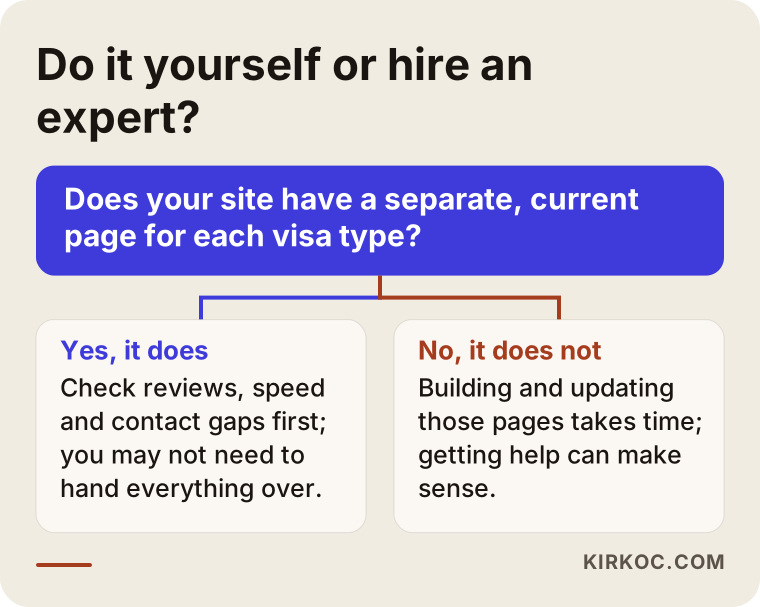
Work that makes sense to hand over includes finding which searches will bring you business, building the right page structure for each country and visa type, detecting and fixing technical problems, watching competitors regularly, producing content steadily and measuring results. These take both time and routine. A consultant busy preparing files rarely has time to keep a site up to date, which is exactly where an expert fits.
There is a middle path too: do the basics yourself and buy the plan and the measuring from outside. You keep spending small and still move in the right direction.
Frequently asked questions
Does SEO really bring clients to a visa consultancy?
It can, if it makes you findable for the right searches and gives the person who finds you reason to trust you. I cannot say when or how much, since Google decides rankings. A realistic expectation is that within some months your site begins to appear for the right searches and the quality of the inquiries improves.
Which pages must a visa agency website have?
At minimum a home page, service pages for each country and visa type, a section on the scope of your consulting, an about page, an FAQ and clear contact details. Guide articles that explain the process plainly and real client reviews strengthen the site further.
Should I prepare all the country pages at once?
No. Begin with the five or six countries and visa types you handle most and fill each with information that really belongs to that country. Then look at the results and expand. Copying everything at once risks a low-quality look.
Can I write "guaranteed approval" on my site?
I advise against it. The authority grants the visa; you are a consultant. Promises like that damage the reader's trust and can cause reputation problems. Describe the scope of your work and how the process runs instead.
How important are reviews for SEO?
Reviews on your Google Business Profile are an important part of how you look, especially to people searching for a firm nearby. More important still, they help the reader decide. Reviews freely given by real clients are valuable; bought ones are risky.
Should I keep doing SEO work outside the busy season?
Yes, and the off-season is actually the most productive time. Pages are prepared, old information is renewed, and by the time the season starts Google already knows your pages. A page written in the middle of the season may miss a big part of it.
Can I reach clients in other cities or countries?
If your consulting can largely run online, yes. For that, your site has to answer searches based on country and visa type, not only your own city. For the city where your office stands you can also strengthen your local search presence.
What should I prepare before starting?
Access details for your site, the countries and visa types you handle most, the questions clients ask you most often and the real scope of your services are enough. With these I do the first review and tell you where to begin.
If your site does not show up today for the right country and visa searches, the first step is to look at the situation together. You can read what the work covers on my SEO services page, then get in touch with me and describe your site and the countries you want to target; after a first review we will settle where to begin.