A founder is about to start a company and types into ChatGPT: "I'm setting up an online shop. Which accountant should I work with?" The answer is a short list of a few firms. If yours is not on it, that person never sees your website and calls someone else. This article explains what I do for accountants, bookkeepers and tax advisors under my GEO services: what can be improved, how it works and what no honest consultant can promise.
How AI is changing the way people pick an accountant
Choosing an accountant is a trust decision, so clients tend to ask narrow, practical questions. "Who handles taxes for freelancers who work with clients abroad?" "Is there a firm near me that works with online sellers?" "What should I look for when moving from sole proprietor to a company?"
When an AI assistant answers, it relies on what it can find about firms online: websites, Google Business Profiles, professional association and directory listings, press mentions and client reviews. If that information is thin, outdated or contradictory, your firm is either left out or described wrongly. It may appear with an old address or with a service you stopped offering years ago.
Nobody controls which firms an AI mentions, and I won't pretend otherwise. What you can control is whether the sources the AI reads are clear, current and consistent. I describe a quick self-check in Does AI recommend your business?.
Start with a simple test
Use your own phone and ask a few different AI tools:
- "Can you recommend a reliable accountant in [your town]?"
- "I'm starting a small company. What should I look for in an accounting firm?"
- "What does [your firm name] do?"
The third question is usually the most revealing. If the answer misspells your name, shows an old address or misses your specialties, you now know exactly where the work begins. Write the answers down.
What usually goes wrong
These are the gaps I see most often at accounting firms:
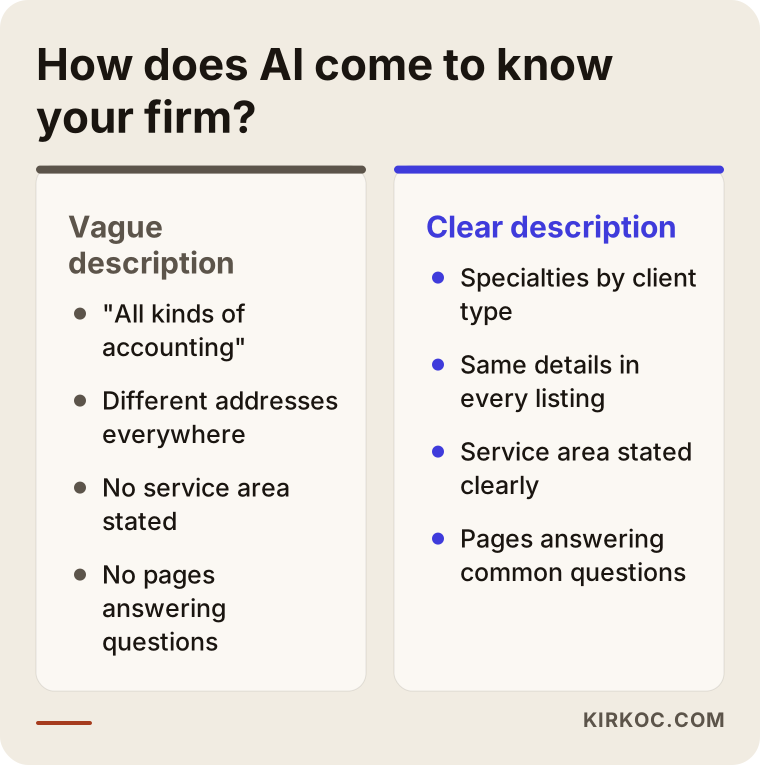
- A generic "full-service" description. "Bookkeeping, tax returns, advisory" gives an AI nothing to tell you apart from hundreds of others. Say who you serve: startups, online sellers, freelancers, owner-managed companies, international clients.
- Inconsistent details. One address on your site, another in your Google profile, an old phone number in a directory. The AI cannot know which is right.
- No content that answers real questions. Clients ask whether to register a company or stay a sole proprietor, or how long setup takes. Plain pages that answer such questions are exactly what AI tools can quote.
- Unclear service area. If you do not say which cities you serve, or whether you work remotely, you fall behind on local questions.
Scenario: a small firm that serves online sellers
A bookkeeper came to me with this situation: her firm had spent years working mostly with small online shops, and nearly all her clients had arrived by word of mouth. But new founders were starting to ask AI tools for recommendations, and her firm never appeared. Her website was a single page called "About and services".
I started with the test above. When asked about the firm by name, one tool described a similarly named business in another part of town, and another said it had no information. Her Google profile still listed an old phone number, and one business directory showed the address from before her last move.
The first job was cleaning up the basics: name, address, phone and opening hours were made identical everywhere. Then we wrote a separate page for online sellers. It explained which kinds of sellers she works with, how the engagement runs and the questions sellers ask most, in plain language. No client names or client details appeared anywhere.
A few months later we repeated the same questions. Asked about the firm by name, the tools now gave the right address and specialty. For local questions like "accountant for online shops near me", the firm began to appear in some tools and not in others. I say that plainly because it is the honest picture: results vary by tool and by week. What she gained was a firm that AI can read as a clear, consistent source.
Describing your specialties so they can be found
If someone asks for "an accountant for an online shop", there should be a specific page showing that your firm does this work. A single "Services" page rarely does the job. Separate pages by client type and service are stronger: company formation, e-commerce accounting, freelancers, international clients.
On each page, write what you do, who it is for, how the process works and the questions people usually ask. Keep it plain. Be careful with claims, too. Accountants and tax advisors are often bound by professional rules about advertising and promotion, so avoid "best" and "cheapest" wording and check your professional body's rules. Accurate, modest information is both safer and more convincing than hype.
Scenario: freelancers who bill clients abroad
The second example is a different kind of firm. It worked mostly with freelance developers who invoice clients in other countries, plus small companies with a foreign partner. Prospects asked things like "which accountant works with someone who bills clients abroad?" Yet the firm's website said nothing about this work.
Here the problem was less inconsistency than absence. The firm had done this for years, but none of it was written down. An AI cannot guess what a site never says, so the firm was simply never considered for that question.
What we did was again plain. We wrote down how the firm approaches this kind of client, what it helps with and where it refers people to another specialist. We avoided firm statements about rules and regulations; the pages carried a clear note to confirm current requirements with the firm or the relevant authority.
This example showed me one more thing: do not be afraid to name your specialty. "We work with everyone" feels safe but makes you invisible. A clear focus filters out poor fits and brings the right people to your door.
How to build a specialty page
Writing pages often feels harder before you start than it is. A good specialty page is simply what you would tell a client on the phone or in a first meeting, written down.
The skeleton
In the first paragraph, say who the page is for: "Accounting for new online shops". Then list, in short bullet points, what your firm does for this type of client. After that, describe the process: first conversation, collecting documents, how regular work runs.
End the page with frequently asked questions. Pick the three or four questions clients really ask and answer each in two or three sentences.
Things to watch
Keep sentences short and explain jargon. You do not have to state prices; explaining what determines the price is enough. Avoid outdated regulatory details. If you are unsure, draw the general picture and suggest a conversation for specifics.
Your footprint beyond your own website
AI tools do not read only your site. Is your Google Business Profile complete, with the right service areas and hours? Do your name, address and phone number read the same in directories and association listings? Do client reviews show what you are good at?
A note on reviews: client information is confidential. Let clients write reviews entirely on their own, never share any client details, and never offer anything in return. AI tools compare these outside sources against each other, so consistency matters more than volume.
How the process works, step by step
Whether you work with me or do it yourself, the order is largely the same. The difference is how much time and attention each step costs you.
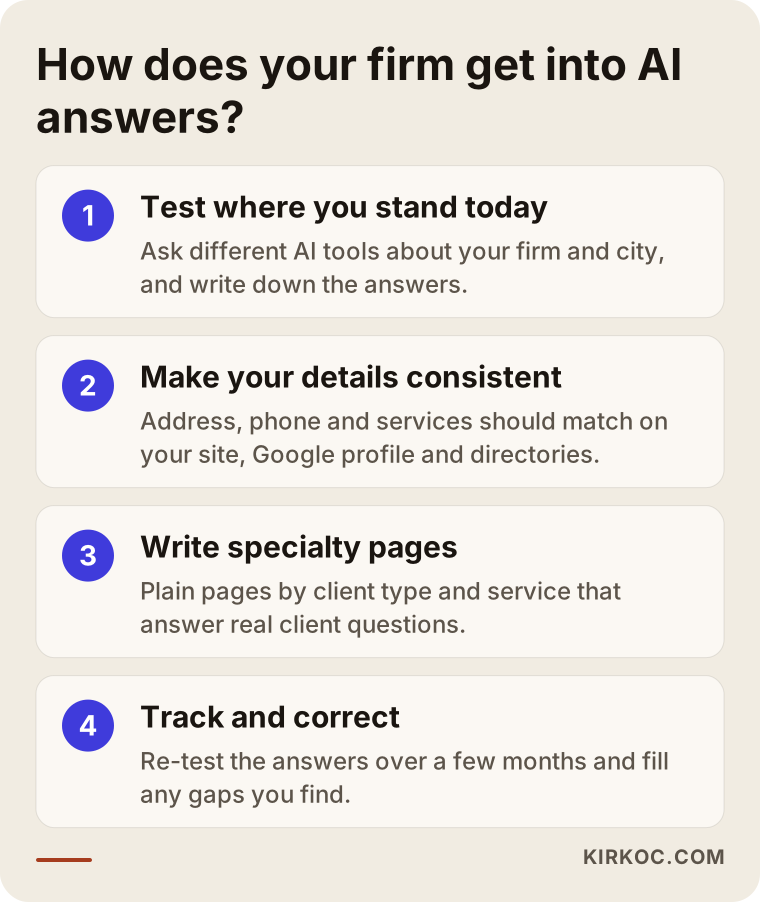
Step one: find out where you stand
I ask different AI tools about your firm, your services and your area, and record the answers in a table. At the same time I look at your website, your Google profile and the main directory listings. The goal is to find the gaps and contradictions.
Step two: align the details
Name, address, phone, hours and service area are made identical everywhere. Old listings are updated or closed. It looks dull, but it is one of the steps that matters most.
Step three: specialty pages
Together we decide which client types and services to focus on. For each, a plain page that answers real questions is written. The text has to reflect how you actually work; I only edit and sharpen it.
Step four: outside sources
Your Google profile, association listing and directories are reviewed. For reviews, only those written by clients on their own are welcome, and no client information is shared.
Step five: follow up
Over several months I re-run the same questions at regular intervals, record what changed and what did not, and close the gaps that remain.
What your website should contain: a short checklist
Use this list as a frame when you look at your site again. You do not need to finish everything in one day, but seeing where you fall short is already a good start.
Basic facts about the firm
- The firm's full name, address, phone and email should read the same in every footer and on the contact page.
- Opening hours and how to book an appointment should be clear.
- State which towns you serve and whether you also work remotely.
- Say who runs the firm and which professional body you belong to.
Services and clients
- Each main service should have its own page: company formation, e-commerce accounting, freelancers, international clients.
- Every page should say who it is for, how the process works and answer common questions.
- Also write down the work you do not take on; it filters out people with the wrong expectations.
Trust signals
- Reviews should be ones clients wrote on their own, without any client details.
- A privacy and data protection notice should be visible on the site.
- Promotional language should be plain, modest and in line with your professional rules.
The mistakes firms make most often
I see the same mistakes again and again at firms in this field. Most come not from bad intent but from a busy workload.
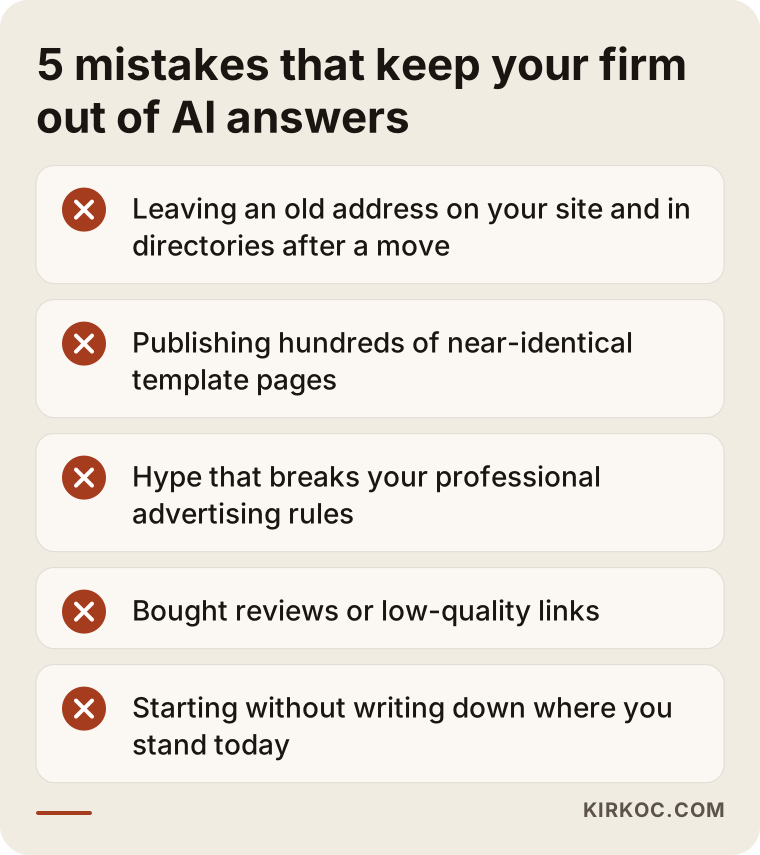
Treating the website as a job for "later"
Because of busy seasons, sites go years without updates. But a move, a new service or a partner who left starts to contradict the old information the AI reads.
Mass-producing pages
Generating hundreds of similar pages from templates looks tempting. Pages that repeat the same sentences tell neither the reader nor the AI anything. A few pages that truly describe your work beat many shallow ones.
Overlooking professional rules
Comparative advertising, exaggerated promises or posts containing client details can cause serious trouble. Ask your professional body what kinds of promotion are allowed.
Fake reviews and bought links
Buying reviews or collecting links from low-quality sites may look effective in the short term, but it damages trust in search engines and in AI answers alike. Slow and solid is the better route.
Starting without measuring
Work done without noting today's situation leaves "did it work?" unanswered a few months later. Run the test at the start and keep a record.
What you can do yourself and what to leave to a specialist
You do not have to hand everything over. This split helps you use your budget and your time sensibly.
What you can do yourself
- Ask AI tools about your firm and write down the answers.
- Update your Google Business Profile with the right name, address, hours and services.
- Make the contact details on your site identical on every page.
- Write a list of the questions clients ask you most often.
- Read your professional body's rules on promotion.
What to leave to a specialist
- Fixing the technical structure of the site, the page layout and the signals sent to search engines.
- Cleaning up inconsistent listings across many directories and sources.
- Planning and organizing service and client-type pages.
- Measuring AI answers at regular intervals and interpreting the results.
If you handle the first group yourself, most of what you pay a specialist for goes to work that really needs expertise.
How do you read the answers and track progress?
Reading test results only as "did we show up or not" is misleading. Looking at what the answer actually says is more useful.
What to look at
- Is your firm's name spelled correctly, and are the address and phone current?
- Are your specialties described accurately, or is an old or missing service mentioned?
- Which sources does the answer rely on? Many tools show them. Do they include your site and profiles?
- How competitors are described can show you what you have left unsaid.
How to keep records
A simple table is enough: date, tool, question and a short summary of the answer. Repeat the same questions once a month. Answers can differ a little each time, so look at the overall trend across several months rather than one result.
Which questions should you ask when choosing a GEO consultant?
There is no settled standard in this field yet, so be careful. Before you hire anyone, you can ask:
- How will you measure the work, and how will you show me progress?
- What will you do on my site and what on outside sources?
- How will you keep promotional wording within my professional rules?
- Do you guarantee results? (The honest answer is no.)
- Who owns my site and content when the work ends?
If you do not get clear answers, or the answers sound too smooth, stepping back is a sensible move.
How should you describe your area and remote work?
In accounting, geography matters less than it used to. Many firms also serve clients in other cities remotely. An AI cannot work that out for you; you have to say so plainly.
If your firm works face to face with clients near one neighborhood or town, say that. If you also serve people remotely, state it separately and explain how it works: how documents are shared, how meetings happen and how often you report back. Details like these give both the reader and the AI a clear picture.
If you serve several towns, do not write hundreds of near-identical pages. Open a separate page only for places where you actually work and can say something specific to local businesses. If you have nothing new to say, a single page with a plain list of service areas is enough.
Why do the answers differ every time?
Seeing a different list when you ask the same question twice is normal. AI tools generate the answer fresh each time, and the tool you use, the wording of the question, your account settings and the sources available that day can all change the result.
So there is no need to cheer or panic over a single screenshot. Repeating the same questions over several weeks and looking at the general trend is far healthier. If your firm appears regularly and the details are right, you are doing well; dropping out now and then and coming back is also normal.
Can results be guaranteed?
No. AI tools decide for themselves which firms to mention, and those decisions change over time. Be wary of anyone who promises to put you "first in ChatGPT". What I do is more modest but honest: find out how your firm is described today, fix missing and conflicting information, sharpen your specialty pages and track progress over several months.
There is a side benefit as well. A clear, well-organized site also helps in ordinary Google search, so GEO belongs next to SEO, not in place of it.
Frequently asked questions
Does GEO make sense for a small firm?
Usually yes, because the biggest problem for small firms is being invisible. But the basics come first: a clear site, a complete Google profile and consistent details. Without them, the later steps do little.
How long until I see a difference?
It depends on the current state of your site, the competition in your area and how often the AI tools update. A fixed date would be dishonest. We can agree on a measurable plan over a few months instead.
What determines the price?
The current state of your site, how many services and locations are involved, how many pages need to be written and how often progress is checked. I look at your situation first and then tell you what is needed.
Can I do this myself?
The test and the basic fixes, yes, and I encourage you to start. For deeper work and regular tracking, support usually saves time.
Can AI access my client data?
No. It has no access to your firm's internal systems and reads only what is publicly available online. That is why not sharing client information on your site, in reviews or in posts is both a legal and a practical must. Check the rules with your professional body.
Isn't being good on Google enough?
Google still matters a great deal, but some prospects now put their questions straight to AI tools. What helps with both is largely the same: clear, consistent, current information. So do not treat GEO as a separate world.
Do I need to post on social media?
Not necessarily. If you do post, keep it informative, regular and within your professional rules. Social media alone will not bring your firm forward in AI answers; having an accurate website and profiles matters far more.
How does the work begin?
First a short conversation about your firm and goals. Then I test the current answers and give you a written list of what is missing. Whether to continue is entirely your decision.
If you would like to see together how your firm shows up in AI answers, you can reach me through my GEO services page.