Your best advertising is the yards you have already finished, but only neighbors and people driving past ever see them. Meanwhile, someone types "backyard landscaping company" into Google and clicks on a competitor whose website was simply built around that search. This article explains why many landscaping websites bring in no new work, and how SEO services can change that, without technical language. SEO is just the name for the work that gets your site shown on Google, to the right person, at the moment they are looking for what you do.
Let me say one thing plainly first: SEO is not a magic button, and I do not promise rankings or a certain number of customers. What I can do is make your site understandable to Google and to your visitors, build pages for the searches that matter to you, and show you your progress every month. Landscaping is a good fit for this kind of work because you already own the raw material: the projects you have completed.
Who is searching for a landscaper, and for what?
"The landscaping customer" is not one person. Three or four different buyers search with different words and different worries, and your site has to answer each of them separately.
Homeowners. This person usually decides once, with a real budget and personal taste on the line. They bought a house with a bare yard, or they have finally decided to fix a space that has been neglected for years. They search "backyard landscaping," "patio and garden design," "sod installation" or "outdoor lighting." They are not looking for a price list. They want the answer to "has this company done something like my yard?" They want photos, but they also want a short story under the photos: what the space looked like, what was asked for, what was done.
Property managers and HOA boards. At a community, the decision is not made by one person but by a manager and a board. Their searches sound more like "commercial grounds maintenance," "HOA landscaping company" or "common area lawn care." What matters here is reliability: do you show up on schedule, what exactly do you do, how do you report back? The person who picks you often has to defend the choice to a board, so they look for a page they can point to and say, "This is how this company works."
Builders and developers. A builder with a new housing project needs someone for the entrances, shared green space and finish work around the buildings. They may search "landscaping for new construction" or "builder landscaping contractor." Many hear about companies by word of mouth, but as soon as they hear a name, they type it into Google and open the site. What your site shows at that moment is your first impression.
Offices, hotels and other businesses. A business owner who wants regular grounds care is looking for a dependable service under a contract. If your site does not describe your maintenance work separately, you come across as a company that only builds new yards.
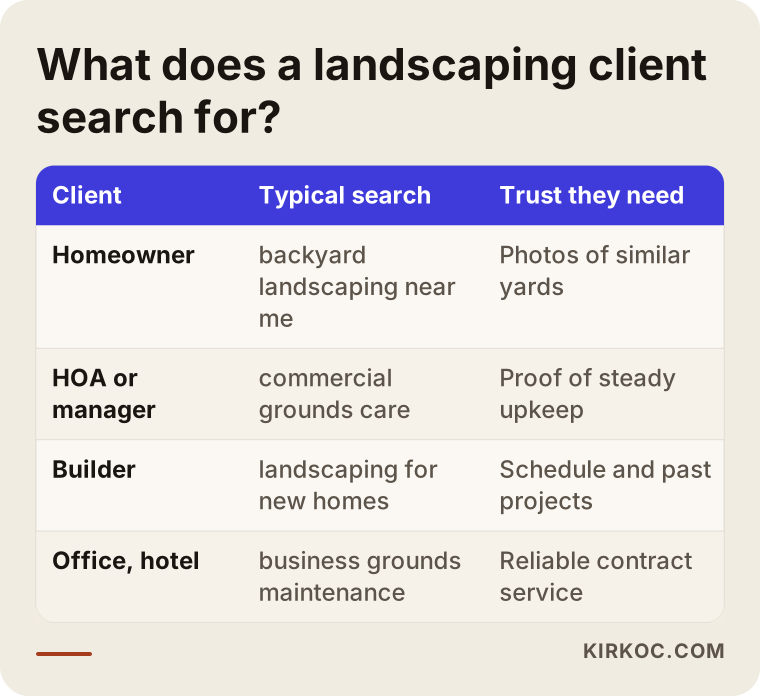
The lesson from that table is simple: four different clients do not read the same page. If your homepage says "All your landscaping needs" and stops there, it speaks directly to none of them, and Google cannot tell which search you belong in either.
Seasons and timing
Landscaping searches follow the calendar. As the weather warms, searches for yard design, sod and irrigation climb. In autumn, pruning, cleanup and winter preparation come to the front. That does not mean your site should be ready when spring arrives. It means the pages should have been live for months, because Google needs time to find a new page and trust it. If you want to book work for the busy season, finish the pages near the end of winter. How fast things move differs from one site to another, which is why I never promise dates.
Showing up in your own area: town and neighborhood pages
Landscaping is local work. You go to the property, you bring the materials and the crew, and getting jobs from far away is neither practical nor profitable for most companies. So customers add their location to the search: "landscaping in Maple Heights," "garden design near the lake," "yard cleanup in the north suburbs." If you work in those places but your site never mentions them, Google has little reason to show you for those searches.
The answer is a separate page for each area you serve, with real information on it. This part is easy to get wrong. The common mistake is copying the same text for every town and changing only the town name. Google treats those pages as low value, and a customer who reads the same sentence everywhere stops trusting it. Each area page should contain something specific to that place:
- Projects you completed in that town, with photos
- The real conditions there: soil, slope, wind, shade from mature trees, and how those affect plant choice
- Requests that come up often in that area, for yards and for communities
- Which days you can be in that area for an estimate, if that is true
I would not create a page for a town where you have never worked. It would not be honest, and you could not handle the inquiries that come from it.
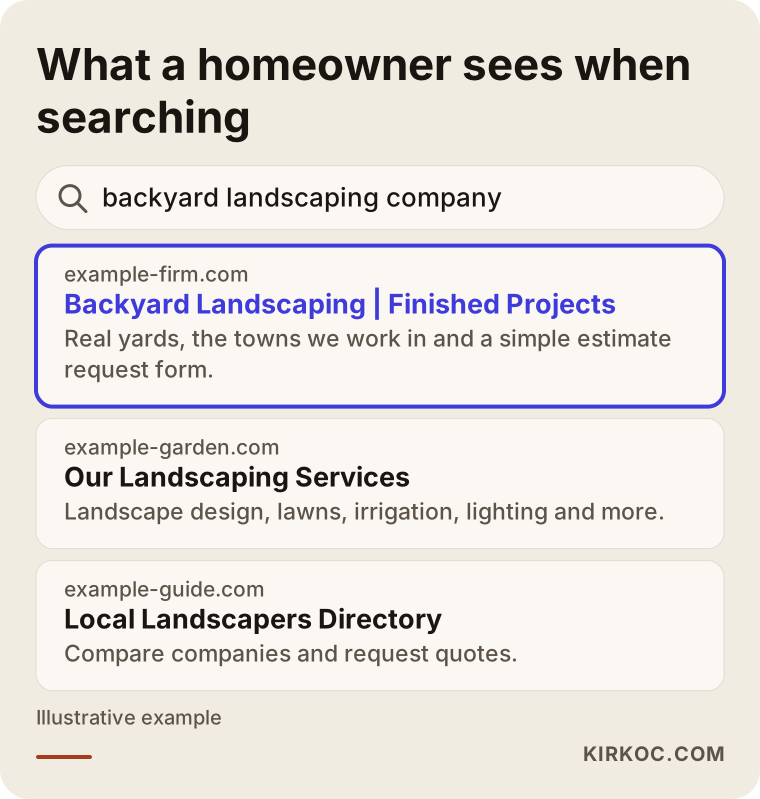
On the results page the difference looks like this. A generic "Our Landscaping Services" title promises nothing. Next to it, a result titled "Backyard Landscaping" that shows finished projects will get the click. When the title matches the search, that is the first condition for being clicked at all.
Your map listing
Sometimes a customer never visits your website. They see your company in the map results and call. That is why your Google business listing should have the right address, hours, service area and real photos. You can manage this yourself. The first step is just making sure the details in the listing match the website exactly, because a different phone number or a different spelling of the company name makes both Google and the customer hesitate. Do not ignore reviews either: politely asking a happy client for a review is free and one of the strongest signs of trust you can have.
Project galleries: photos you can see, but Google cannot read
The most common problem I see on landscaping sites is this: the photos are wonderful, but the page is nothing except photos. When you look at a yard, you read the stonework, the planting and the lighting in a glance. Google cannot understand what is inside a photo nearly as well as you can; what helps it is the text on the page. A gallery without words is, from Google's point of view, almost an empty page.
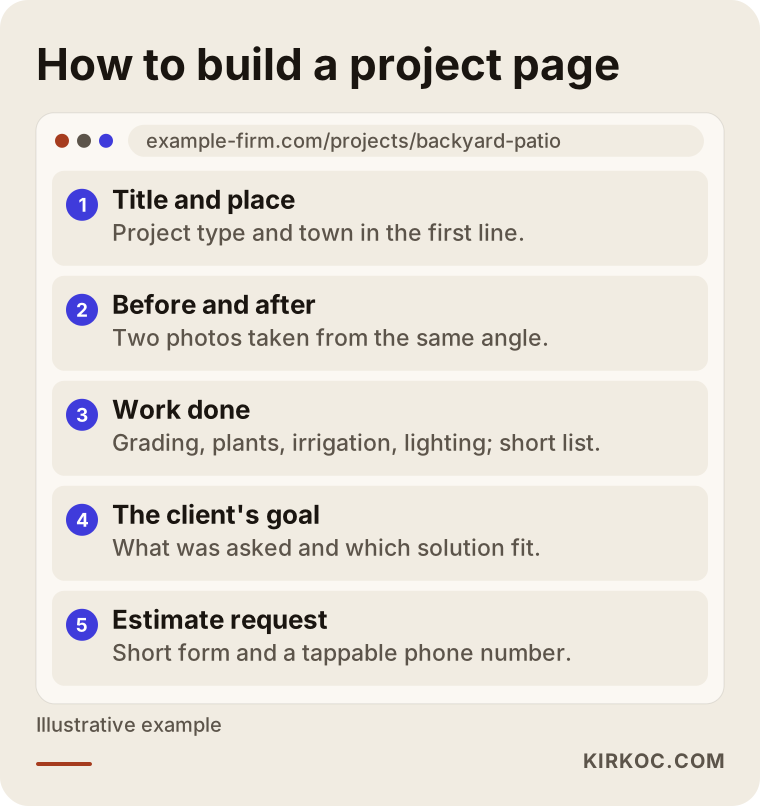
The fix does not have to be heavy. A short page for each project is enough:
- A title with the project type and place, such as "Family backyard, Maple Heights"
- What the space looked like at the start and what the client wanted, in two or three sentences
- A short list of the work: grading, planting, irrigation, lighting, hardscape, the area around a pool
- Before and after photos taken from the same angle
- Short descriptions for the photos and meaningful file names
- A clear link at the bottom to request an estimate
Do not publish a client's name or full address without permission. The town and project type are often enough and safer. Many homeowners do not want their address on the internet, and respecting that is itself a trust signal.
Splitting the gallery
If you have dozens of projects, do not pile them into one endless gallery. Separate them by type: private yards, community and common areas, commercial grounds, patios and rooftop gardens. That way a property manager searching for community landscaping is not lost among backyard photos, and a homeowner does not see a condo complex and decide it is not for them. Each type also becomes its own page, answering its own search.
Photo speed
Landscaping sites tend to be full of heavy photographs. A page that takes a long time to open on a phone loses the visitor in the first few seconds, and Google takes that into account. Shrinking photos for the web before upload, and loading only the part of the page that is on screen, makes a site noticeably faster. This is among the first things I fix in the technical work. All you have to tell me is "it opens slowly on my phone."
The estimate request: turning a visitor into a client
Traffic alone does not bring work. In landscaping the door to a sale is the site visit: the client wants to see you on the property, measure and talk. The question every page on your site has to answer is: what does the visitor do to ask for an estimate?
Situations I run into often:
- The form has a dozen fields and scary questions like "what is your budget." Three fields are usually enough: name, phone, town. Then a short note box.
- The phone number is written on the page but tapping it does not call. For someone on a phone, tapping the number must start the call.
- There is a messaging link, but nobody can tell when you reply. An honest "I usually reply within a day" fixes expectations.
- The estimate button exists only on the homepage. People make up their minds while reading a project page, so the button belongs there too.
- Nothing says what happens after the form is sent. Clarity such as "you will hear back within a business day" and whether the visit is free or paid lowers hesitation. Whether it is free or paid is your decision; what matters is saying it openly.
Let me also mark the limit of SEO here. Designing your form's flow or answering your phone is not my job; those are part of how your own business runs. I focus on building the pages that bring visitors who are already close to calling you, and on making the path to a request easy to see on those pages.
Suppose a small crew that builds backyards
Suppose a landscaper with a two-person crew finishes a few private yards a year. There is a website. The homepage says "Garden design, sod, irrigation, lighting," and a gallery page holds twenty photos with not one sentence under them. Searching "backyard landscaping" in Google does not show this site anywhere. Most new customers come through referrals, and the owner is happy with that, but in months when no referral arrives, work stops.
In this hypothetical case, the steps would go like this. First, the site is reviewed and it becomes clear why the gallery page says nothing. Then the searches are chosen: backyard landscaping, patios, outdoor lighting, and the two or three towns the crew really serves. The twenty photos are divided by project into seven or eight short project pages, each with the place, the work and what the client wanted. The homepage is simplified and an estimate request is placed on every page. None of this promises new customers within a month, but it builds the ground Google needs to match this company with the right searches.
Common mistakes on landscaping websites
These are the mistakes I see over and over. All of them can be fixed, and most are not expensive.
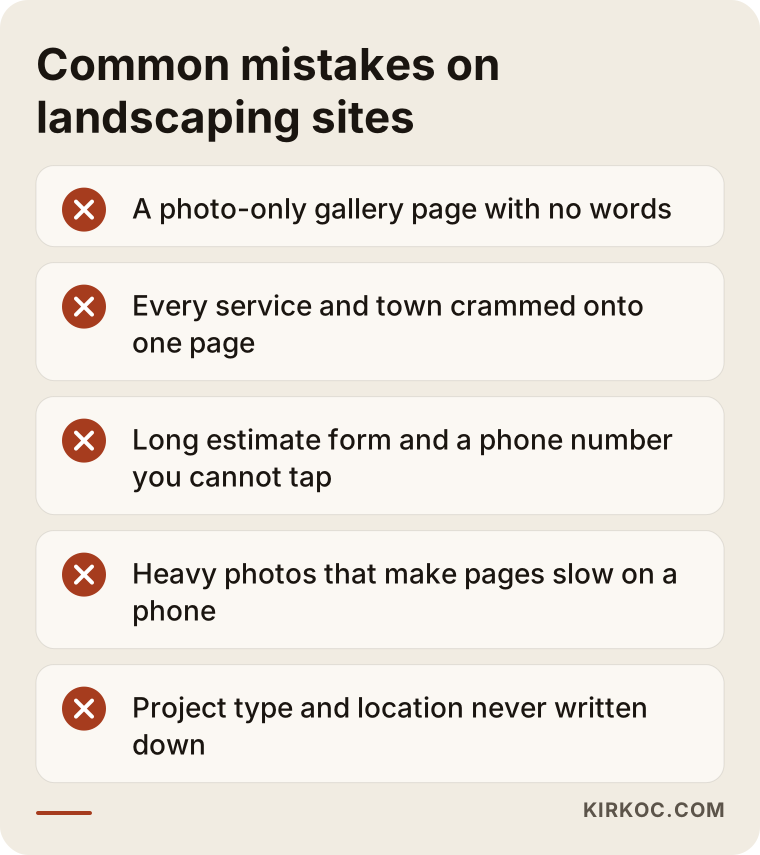
Cramming everything onto one page. If you put ten headings such as design, maintenance, irrigation, sod, pool surrounds, rooftop gardens and lighting on a single page, Google cannot decide which search to show you for. Each main service deserves its own page that answers its own questions.
Describing services but not how you do them. "Quality materials, expert crew, on-time delivery" is on every company's site. A visitor learns nothing from it. A sentence like "before installing irrigation I look at how the land slopes" sounds like someone who knows the work.
Hiding the maintenance work. New installations look impressive, but community managers and commercial clients look for regular upkeep. If you do maintenance, giving it its own page opens a steadier stream of work.
Using the wrong words for plants and services. People search with everyday names, not botanical ones. Write the page in the customer's words and, where needed, add a short explanation in parentheses.
An outdated site. If your latest project is a photo from three years ago, a visitor wonders whether the company still operates. Adding even a few new projects a year keeps the site alive.
An unclear process. Writing "call for a quote" does not mean you must give a price, but you should explain how things work: site visit, measurements, proposal, installation, handover. Writing those five steps plainly turns a hesitant visitor into a caller.
Writing for property managers and builders
You can speak to a homeowner with feeling: "the yard you have imagined." A builder or a board compares. The pages meant for them should bring forward:
- Larger or multi-unit projects you finished, and what kind of space they were, not only the client's name
- How you work: in how many stages, in what order, and who the contact person is
- If you do ongoing maintenance, how often you visit and how you report
- Licenses, insurance and safety matters you really hold; never write a document, award or reference you do not have
Builders often hear about you from an acquaintance and not on your site, but the person who decides looks at the site afterward. So the pages for this audience should be calm and businesslike. Avoid big claims and describe plainly what you do.
How we would work together
Let me describe how I run an SEO engagement so you know what you are buying. I work alone, so the person you talk to is also the person doing the work.
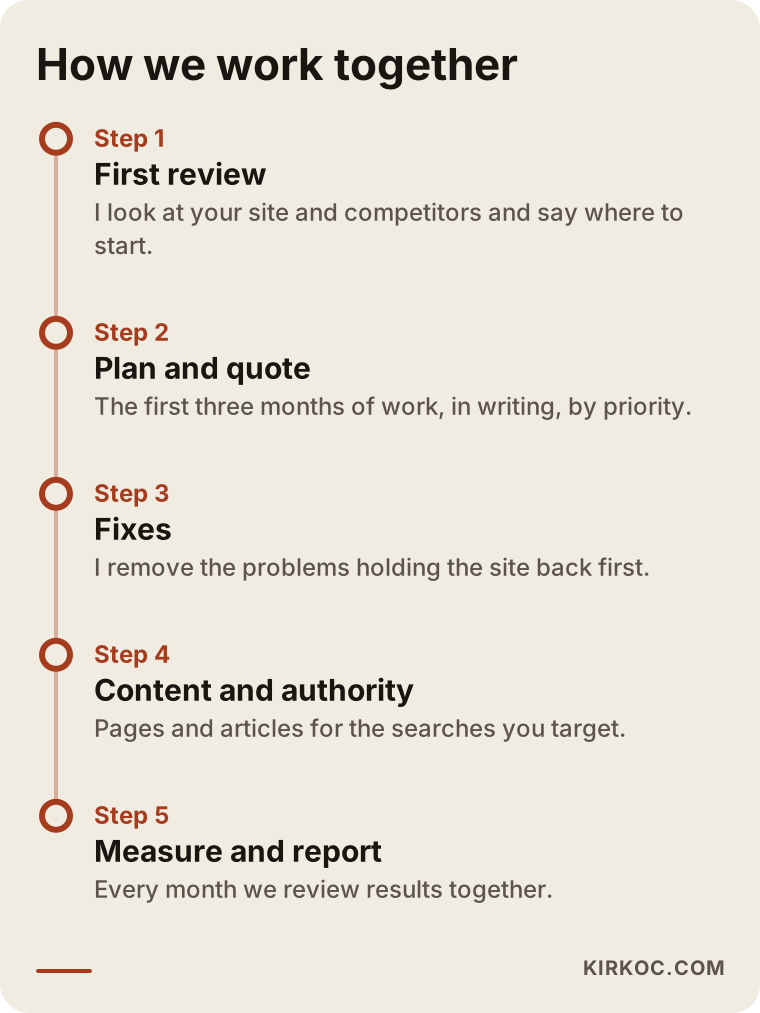
1. First review. I look at your site and at your competitors in landscaping and tell you where to start. Often this turns into a short list of fixes that need no waiting.
2. Plan and quote. I present the work for the first three months in writing, in order of priority. You can see which searches we aim at, which pages will be written and which technical problems will be solved. You do not have to accept the quote, but you will know what you are getting.
3. Fixes. I remove the obstacles on the site first. Slow pages, a broken look on phones, links that do not open, and the same content appearing in several places give the fastest effect.
4. Content and authority. Service and town pages for the targeted searches, and articles answering your clients' questions, are prepared. I will ask you for project photos and short notes; you built the yards, so the accurate information is with you, and I turn it into a form that customers and Google can read. Steps that strengthen your site's standing belong to this stage as well.
5. Measure and report. Every month I report in plain language what was done, which searches you are rising in and what comes next. Then we update the plan together.
For the full scope you can look at my SEO services page. I do not promise anything that is not described there. For example, visiting properties for you, answering form requests or running advertising are not part of this service.
What decides the price, and how to compare quotes
I am not giving numbers here, because there is no number that fits everyone. But if you know what shapes the price, you will compare quotes wisely.
The starting condition of your site. A clean, fast site and a scattered one that has not been looked after for years need very different amounts of work. After the review I tell you plainly which one you have.
How many service pages and areas. A company working in three towns and one working in ten differ in how many pages must be built and how much writing is needed.
Competition. Large metro areas have many landscaping companies. The stronger your competitors are for the search you target, the longer the work takes.
The amount of content. Project pages, service pages and question-and-answer articles take effort. How much information and how many photos you can supply also affects the time.
Duration and rhythm. A one-time cleanup and an ongoing monthly engagement are different business models.
What to look for when comparing providers
Compare quotes on more than price. Use these criteria too:
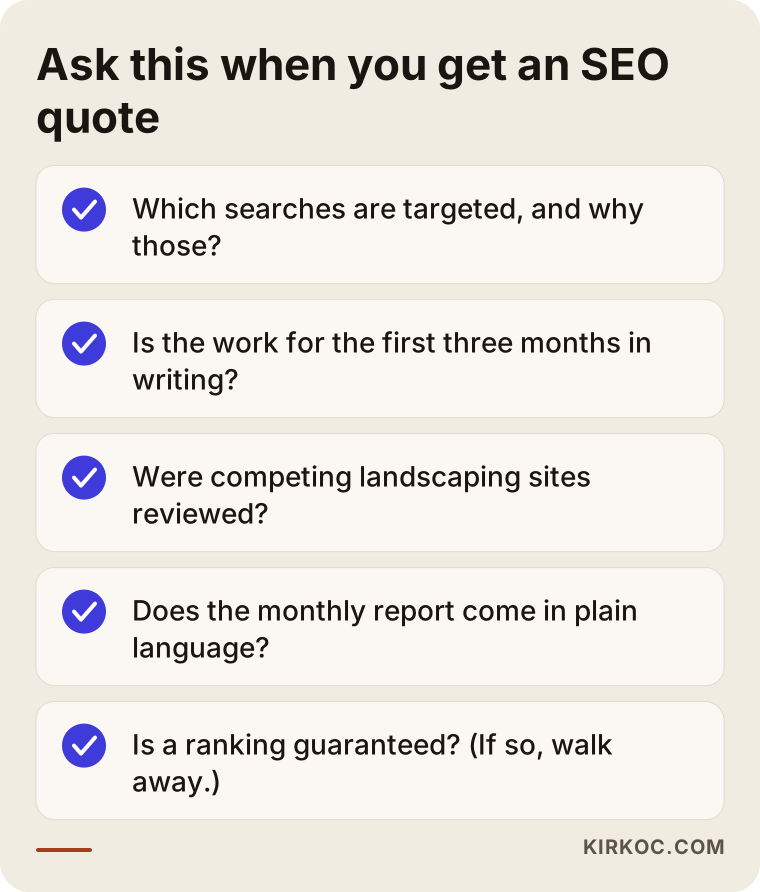
- Is there a written plan? "We will optimize your site" is not a plan. What will be done, in what order and when it will be reported should all be on paper.
- Is a ranking guaranteed? No honest SEO specialist can guarantee a position on Google, because Google decides rankings. Be careful if you see such a promise.
- Do they try to understand you? Do they ask about landscaping, which areas you serve, which projects you are proud of? A quote that never asks about your trade is a template package.
- Is the reporting understandable? A report full of charts and abbreviations does not help you understand the work. What was done and what resulted should be written simply.
- Who holds the accounts and access? You are the owner of your site and your Google accounts. You should not lose that access if you part ways.
- Is the contract length reasonable? Offers that lock you in for a long time with no way out deserve hesitation.
When you do not need SEO
To be honest, not everyone needs SEO. In these cases I would tell you not to do it now:
- Your work is fully booked through referrals and past clients, and you have no capacity for extra demand. Fixing capacity first makes more sense.
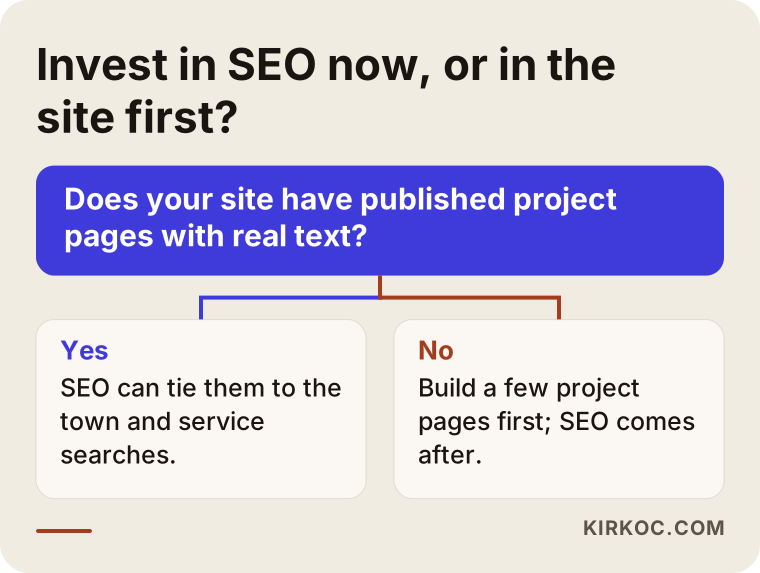
- Your site has almost no content and you have not even gathered project photos. It is better to collect some material and lay the foundation of the site before moving to SEO.
- Your service area is very small and everybody already knows you. A well-kept map listing and a few good project pages may be enough.
- Your budget only allows for results within a month. SEO takes time; if short-term demand is needed, other ways should be considered.
If one of these fits you, I will not try to sell you SEO; I will tell you what to do first.
Doing it yourself or hiring an expert
Some work you can and should do yourself: filling in your Google business listing, photographing projects regularly, asking clients for reviews, and writing the phone number and address consistently across your site. These are things only someone who knows your business can do.
What belongs with a specialist is this: researching which searches will bring you work, finding and fixing the site's technical problems, building pages in a structure Google understands, watching competitors, and measuring the result every month. These take time and habit; they are not jobs to squeeze in while you are working on a yard.
Suppose a mid-sized company that serves communities
Suppose a landscaping company with fifteen employees does mostly grounds maintenance for residential communities. All its clients come through word of mouth. Its site has only a "Services" page, maintenance is not described separately and there is not a single reference. When the board of a new community searches for "HOA landscaping company," the company does not show up.
In this hypothetical example the first job is a separate page for community grounds maintenance: what the work covers, how visits are organized, how the board is kept informed, what is done in each season. The second job is a short reference section that describes, in general terms and without naming anyone, the kinds of communities the company looks after. The third is a "how we run an account" page that a board can pass around. At its end, instead of an estimate request, there is a button such as "request a call for the board," in language a manager recognizes. Again, nothing is guaranteed, but the manager who searches finds the information needed to turn this company into a serious candidate.
Who this suits, and who it does not
SEO makes sense for landscaping businesses that have a website but get no customers from Google, that do not want to depend on an advertising budget, that have collected enough project material, whose service areas are clear and that have the capacity to handle inquiries when they arrive. Those who bought SEO before and saw no results are welcome to come for a second look; we would go through what was done and what was missing.
There are also unsuitable cases: people who expect results in the same week, people who want a ranking guarantee, and people whose site does not exist yet and must be built first.
Ask yourself before you start
After reading this, write these questions on paper; your answers will be your roadmap:
- Which type of work earns the most for you: private yards, community maintenance, commercial grounds, new housing?
- In which towns do you really work, and do you have projects there that you can show in photos?
- If demand arrives, can you handle it?
- Which page on your site answers which search today?
- When a customer wants to call you, how many taps does it take?
If you have no answer to some of these, that too is information, and we can complete it together in the first review.
Frequently asked questions
Does a landscaping company really need SEO?
If customers find you through referrals, it may not be essential today. But even a referred person ends up checking Google. Besides, a chain of referrals is not under your control, while demand from Google is a steady door. SEO opens that second door.
What should a landscaping company website look like?
A simple, fast site that reads easily on a phone and has its own page for each main service is enough. Project pages, the areas you serve, a short description of how you work and a visible way to request an estimate on every page are the basics. Fancy animation is not required.
How does a landscaper get more customers from Google?
First decide whom you are aiming at: homeowners, property managers or builders. Each needs its own page and its own language. Then publish photos of finished projects together with short text describing the place and the work done.
How long until I see results?
I cannot say for certain, because it depends on the condition of your site, the competition and the work done. Google needs time to find new pages and trust them. I report every month what was done and in which searches there was movement, but I do not promise dates or positions.
Do I need a separate page for every town?
No, only for places where you really work and have business. Each page must hold real information about that place. Copying the same text and swapping the town name does not work and can hurt.
Should I ask clients before publishing project photos?
Yes, especially for private homes. Publishing only the town and project type, without a name or full address, is often enough. Even so, letting the homeowner know before you publish is both polite and safe.
What is the difference between SEO and Google ads?
With ads you are visible as long as you keep paying, and results stop when you stop. SEO takes time, but the pages you build can keep bringing work for a long while. You can use both; which one suits you depends on your budget and expectations.
Can I do this myself?
Part of it, yes: the business listing, a photo routine, collecting reviews. Finding which searches bring work, solving technical problems and watching competitors need expertise and time. We can settle what stays with you and what comes to me in the first review.
If you would like to see where to start with your landscaping website, I can look at your site and your competitors and draw up a clear roadmap. You can read what the work covers on my SEO services page and write to me through the contact section to ask for a first review.