You want your website to bring in customers from Google, and you have decided to pay someone who knows how to make that happen. Then the proposals arrive, and they all sound the same: "keyword research," "technical optimization," "content support." Which one actually does the work, and which one is a nicely worded package? What separates professional SEO services from amateur ones is not the tools. It is the concrete things handed to you at the end of each month. I am an independent consultant working remotely, and in this article I explain what to look for, what to ask for in writing and how to start when you buy SEO services, without any technical knowledge needed.
What are you actually buying when you buy SEO services?
SEO is the work of making your site show up in search engines such as Google, for the right people, at the moment they search for what you sell. When you pay for it, you are really paying for three things: diagnosis, action and follow-up. Diagnosis means finding out why your site is behind. Action means fixing what was found and building the pages that are missing. Follow-up means seeing, month after month, whether any of it worked. If one of the three is missing, the service is half a service.
Amateur work usually contains only a slice of the action. Someone gives you a list of keywords, adds a few blog posts and tells you to wait while Google "catches up." There is no diagnosis, because nobody looked at why your site is really stuck. There is no follow-up either, because nobody decided in advance what to look at. Three months pass, the money is gone and you hold nothing that shows what was done.
In professional work every stage has something you can pick up and read. The result of the diagnosis is a written site review: which pages are slow, which look broken on a phone, which of your services have no page at all, which pages Google cannot see. The result of the action is a list of fixed problems and pages that went live. The result of the follow-up is a monthly report written in language you understand.
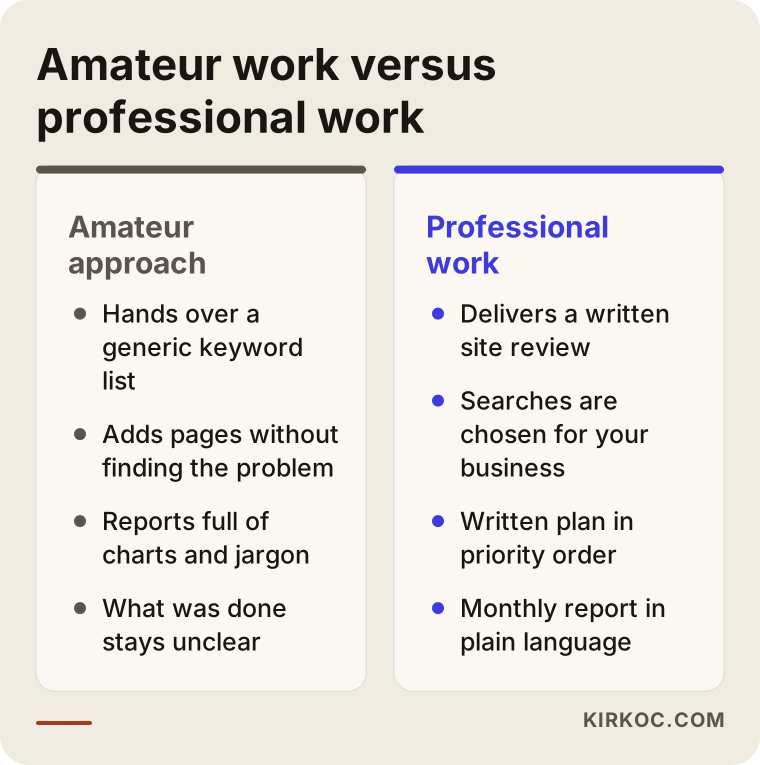
One point deserves care. Being professional does not mean being expensive or belonging to a big company. A solo consultant and a large agency can both do good or bad work. What matters is that the work you receive can be explained and checked. If you ask "What did you do?" and cannot get a straight answer, there is a problem, however polished the presentation was.
Know what you are not buying
To be honest, no SEO service can promise a particular ranking or a set number of new customers. Google decides the results, and nobody can purchase a position. What a specialist can do is help your site describe itself more clearly to Google and to your customers, then measure progress. Someone who says "we will get you on page one" either does not know how search works or does not want to tell you. I come back to this in the warning signs below.
Who are these services a good fit for?
Not every business needs SEO at the same moment. The service tends to pay off in these situations:
- You have a website, but almost no customers arrive through Google.
- You would rather not depend on an ad budget that must be spent again every month.
- Competitors such as clinics, hotels, workshops or service firms keep appearing above you.
- You bought SEO before, saw nothing, and now approach the whole subject with suspicion.
The last group matters most. If an earlier experience ended badly, the reason was usually not that "SEO does not work." It was that the work ran without diagnosis and without follow-up. To avoid repeating that, here is what to look for in a new proposal.
What the businesses that benefit have in common is that customers type something into Google before they buy. If people search for "boiler repair," "teeth whitening," "tax preparer" or "wedding venue," the business can grow with SEO. If nobody searches for what you sell and clients come only through referrals and people who already know you, SEO may not be your main channel, and a good consultant will tell you that.
What should a proposal contain in writing?
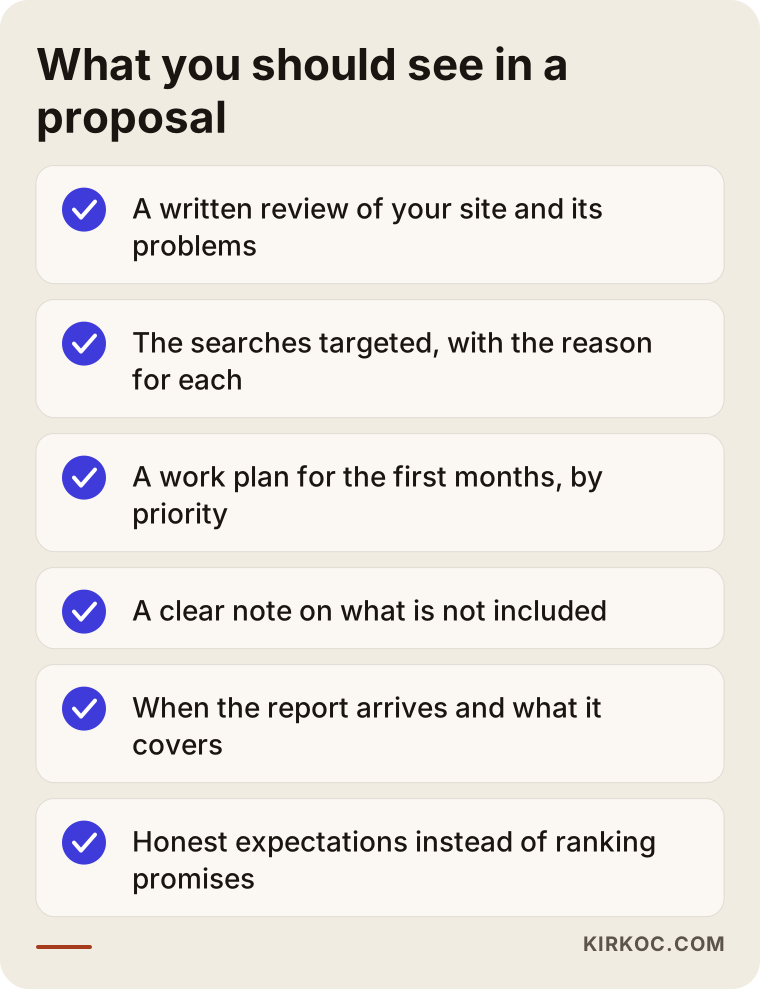
When you compare proposals, looking at the price first is natural, but it should not be the first thing you check. The first thing is whether the proposal says what it will deliver. A good one lets you read all of the following.
A review of your site. Someone should have looked at your actual site before or right at the start of the proposal. You should hear a sentence like "I reviewed your site and there are three big problems." A fixed package price quoted without looking at the site tells you the service was designed for everyone, not for you.
The searches you are aiming for, and why. The searches should be listed, each with a reason. The goal is not simply the most popular phrases but those where your customers are close to buying. A phrase that thousands of people type each month, none of whom will ever buy from you, looks impressive and earns nothing.
A work plan in priority order. What happens in the first three months should be written in sequence. First the blockers go, then content arrives, then reputation work. If everything is said to happen at once, there is no plan.
What is not included. A proposal should also say what it leaves out. Is building a new website part of it? Ad management? Social media? Every vague item turns into an argument later about what was "extra."
How reporting works. When the report comes and what it covers should be agreed from the start. A good report says: this is what was done this month, these searches improved, this page is weaker than expected, and next month we do this.
Honest expectations. A person who speaks carefully about timing and results usually knows the work. Effects in SEO commonly take a few months to show. Anyone promising instant results may be misleading you.
Questions to ask when comparing providers
If you collect two or three quotes for the same work, put the same questions to each and set the answers side by side:
- What do you need to know before looking at my site, and what do you need from me?
- What exactly happens in the first month, and what will I have in my hands?
- Which searches are you targeting, and why those?
- How will I receive reports, and what will be in them?
- If we part ways, who owns my site, my content and my accounts?
- Which decisions or materials will you need from me along the way?
The fifth question is crucial. The content, the site access and the analytics accounts must always remain yours. If you cannot reach your own site after parting with a consultant, the arrangement was wrong from the start.
How does working with me proceed?
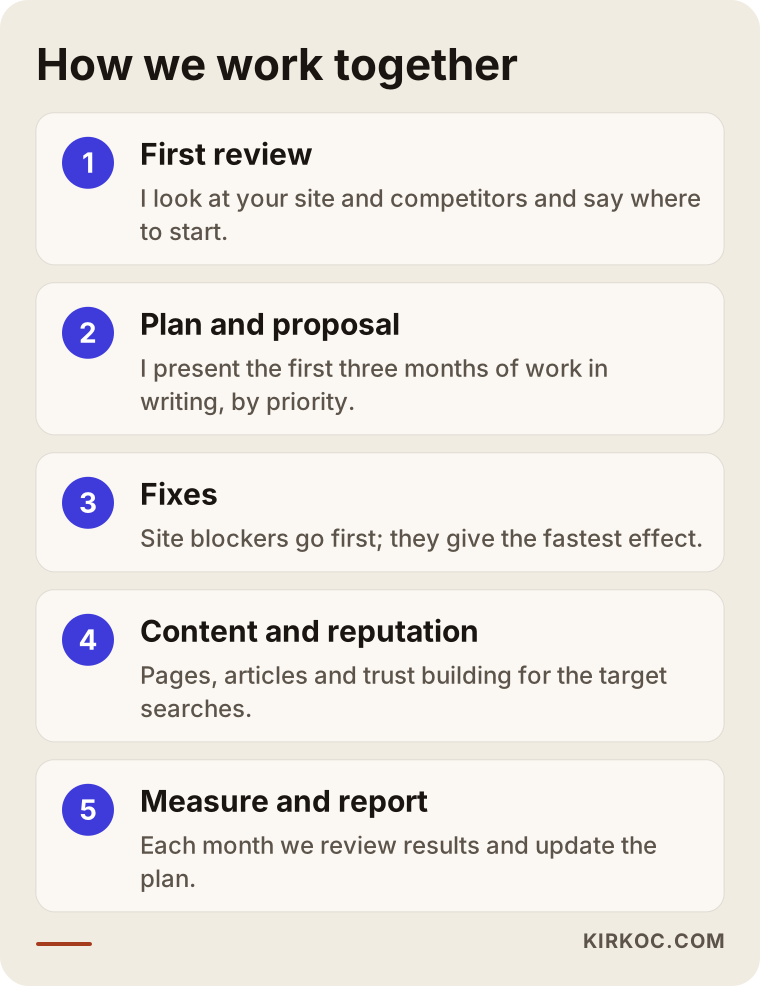
An open process is one of the best signs of a trustworthy service. I run the work in five steps, and each one leaves you with something.
First review. I look at your site and your competitors and tell you where to start. I am not trying to sell you anything at this stage; the aim is simply to see the real state of your site.
Plan and proposal. I present what will be done in the first three months, in priority order and in writing. You know what you are paying for, and the plan stays with you.
Fixes. Site blockers go first: slow pages, sections that break on a phone, pages Google cannot see. These usually give the fastest effect, because even excellent content struggles on a site with obstacles.
Content and reputation. Pages for the searches we chose, articles that answer your customers' questions and work that strengthens how trustworthy your site looks.
Measure and report. Each month we review results together and update the plan. If something is not going as expected, I will not hide it; I look for the cause and change direction.
The service covers a site review, finding the right searches, technical fixes, content work, competitor tracking and a monthly report. I do not promise anything outside that. Ad management, for example, is not part of it, and I prefer to say so at the start.
How do customers in your industry search?
A good SEO project starts with knowing the trade, because customer behavior changes from one business to another. Someone looking for an emergency locksmith sees the nearest result on the map and calls at once; they never read a page. Someone looking for an interior designer browses for weeks, compares portfolios and messages several people. Someone looking for an accountant first reads "how does it work" articles and only then looks for a person to trust. You cannot treat these three searchers with the same page structure.
That is why a good specialist asks you things in the first month: how do customers find you today, which service earns you the most, which cities or neighborhoods do you serve, what questions do people ask before deciding? A plan made without these answers ends up generic, and generic plans rarely deliver.
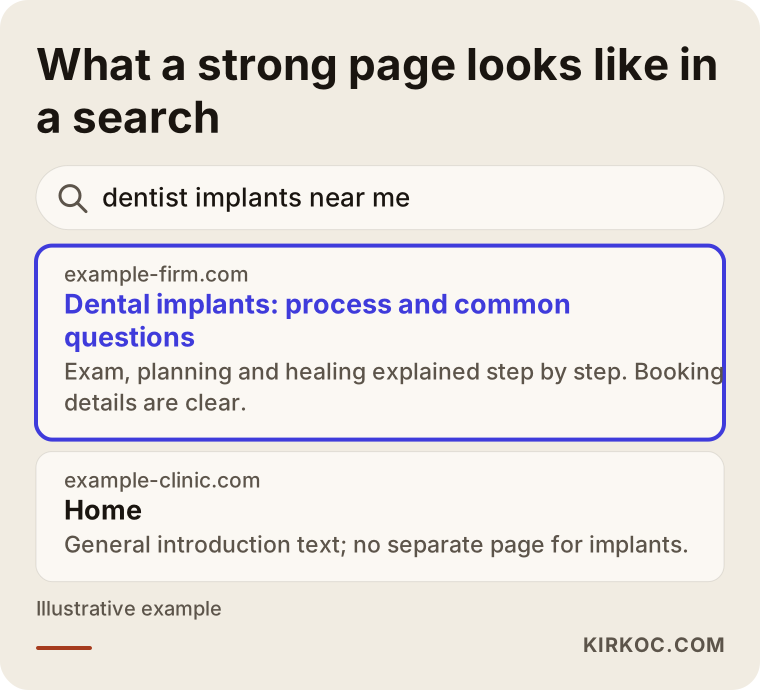
Looking at a result page through a customer's eyes is also very instructive. In the mock-up below, two clinic sites appear for the same search. The first has its own page for implants: it explains the process, answers common questions and makes booking easy. The second has only a general home page. Which would the searcher click? Usually the first, because it promises to answer their actual question.
Industries where advertising is restricted, such as health and law, need extra care. Content there should follow the rules and stay informative, with no promise of outcomes. On such sites I believe the right line is pages that make no promise about a treatment or a case result, give no medical or legal advice and simply explain what a service is and how the process works. Which wording fits your professional rules is for you or your professional body to decide.
Suppose a local home-services company
Suppose you run a small heating and cooling company in a mid-sized town. You have a website, but the home page lists everything together: installation, maintenance, repairs, emergency calls. Most of your phone calls come from word of mouth. The first thing an SEO project looks at is what customers really type. "Furnace installation," "AC tune-up" and "AC not working today" carry different intentions. The first is a planned purchase, the last is an urgent need.
The plan here would be one page per service, the areas you cover written out clearly, a phone number that works with one tap on a mobile screen and a tidy map listing. This is a hypothetical example, not a story about a real client. It shows the logic, though: the work is built around how your customers behave, not around a template.
What are the warning signs of amateur SEO?
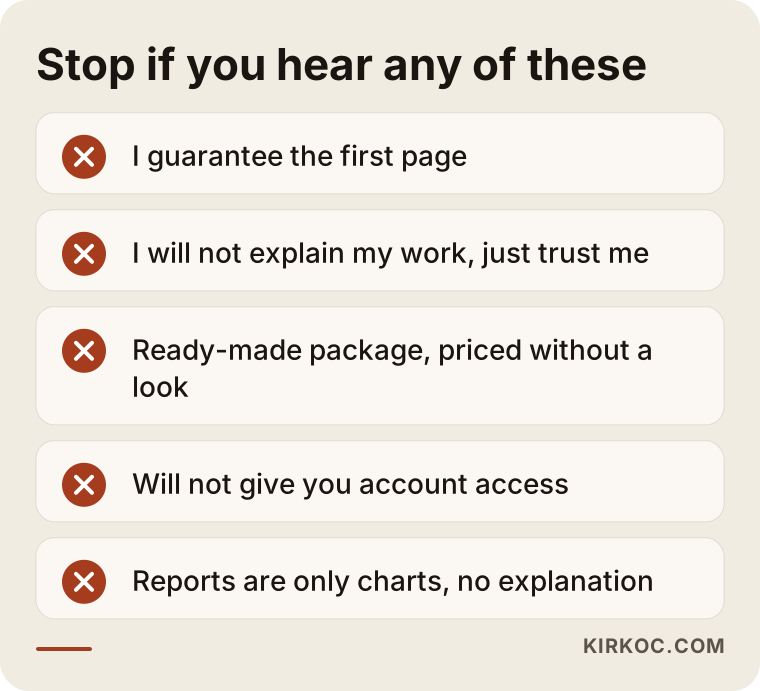
This section is the most useful one for anyone about to buy. If you hear any of the following, stop and think again.
"I guarantee page one." Rankings belong to Google. Such a guarantee is either untrue or tied to a very obscure phrase; ranking first for something nobody searches is easy and earns you nothing.
"I will not explain what I do, just trust me." The explanation of work done on your site with your money is yours by right. A person who cannot or will not explain is not sure about the work.
A fixed price without looking at the site. A ready-made package can be reasonable for some jobs, but a firm budget quoted blind suggests the work will not be shaped to your site.
Refusing you account access. The analytics account, the search console and the site admin should be yours. If you cannot reach them, your business assets sit in someone else's hands.
Reports made only of charts. Charts look nice but they are not information until explained. "Visitors went up" is not enough; it should say from which search, to which page and what it did for the business.
Bought or bulk link promises. Getting links from other sites is part of SEO, but a promise of hundreds of links in a short time is a risky method and can harm your site.
Common mistakes
Customers make mistakes of their own too, and it helps to know them:
- Expecting results too early. SEO is not an ad that turns on today and pays tomorrow. It takes patience, but that patience should be backed by a written plan.
- Focusing only on the home page. Customers usually arrive through service pages; the home page cannot carry everything.
- Starting without explaining your trade. If the specialist does not know your business, they cannot know which customer is valuable. Tell them which service earns you the most.
- Choosing on price alone. The cheapest proposal is often the one with the least work in it.
- Not providing content. A specialist can write text, but cannot produce your professional experience, your customers' questions or your photos. Without your input the work slows down.
Suppose a new online shop
Suppose you have just opened an online shop selling handmade soap. You have sixty products, all sitting on one category page. If a consultant suggests writing a thousand words for every product, that is usually inefficient. A better start is to see which searches lead people to buy: "natural soap," "gift soap set," "soap for sensitive skin." Then you build category pages around those searches, arrange product descriptions around what shoppers ask and check how fast the site loads. This is again a made-up scenario; the point is that the right service is planned around customer searches, not around the number of products.
What determines the cost of SEO services?
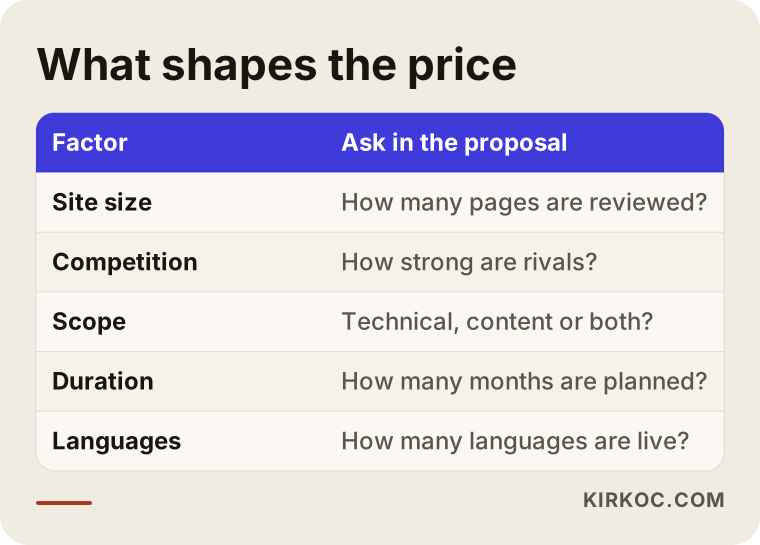
I will not give numbers here, because the cost depends on your site and your goal. Knowing what drives it, though, lets you read proposals properly. Five factors matter.
Site size. A ten-page brochure site and a shop with hundreds of products do not take the same effort. The more pages to review, the larger the diagnosis and the fixes.
Competition. How strong are your rivals, and how long have they been at it? In a lightly contested local search, results may come with less effort. In a crowded one, the plan has to be longer and broader.
Scope. Is only technical repair wanted, or content and follow-up as well? A diagnosis can be a one-off, but content and reporting need continuity.
Duration. A short project and a long-term retainer are built differently. Decide early whether you want ongoing support.
Number of languages. If your site runs in more than one language, each one needs its own research and content, which widens the scope considerably.
When comparing proposals, ask "what does this price cover?" rather than "which is cheaper?" Two quotes can look equal while one is a plan made for your site and the other is a template. Do not be shy about asking for a price, but settle the scope first; a price without a scope means little.
When you do not need SEO services, and what you can do yourself
To be honest, not everyone needs professional SEO services. The service may not be the right step yet in these cases:
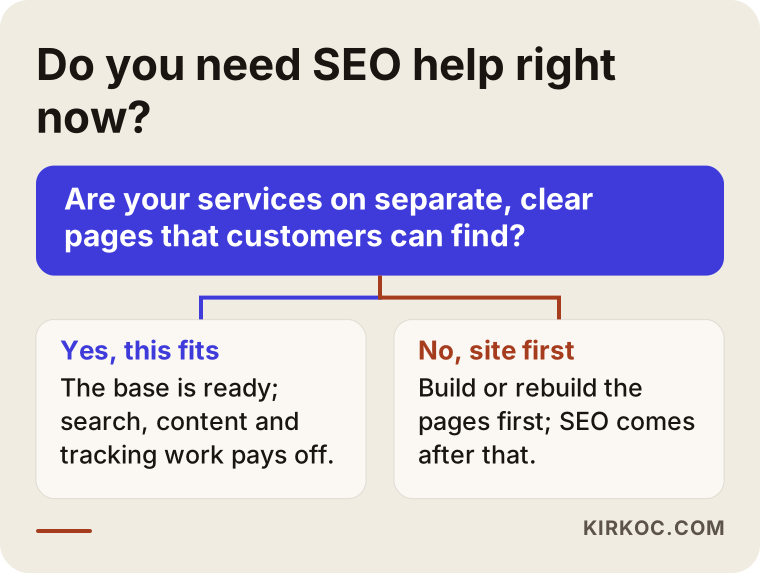
- Your site does not exist or is very old. If your services are not on separate pages, the site breaks on a phone or it does not look trustworthy, the site needs to be built or rebuilt first. SEO stands on that foundation.
- Your business is tiny and runs only on referrals. If customers do not search for you and find you through people they know, the budget may be better spent elsewhere.
- You need sales this week. If you need customers right now, ads or direct outreach work faster. SEO is a long-term investment.
- Your offer is not clear yet. If it is unclear what you sell, positioning yourself around searches is hard as well.
What you can do yourself
Some things you can do without a specialist. Filling in your Google business listing completely, writing your phone number, address and hours the same way everywhere, asking customers for reviews and writing a short, plain page for each service on your site are among them. They cost nothing, and for many businesses the first improvement comes from here.
You need an expert for the rest: diagnosing why the site is behind, finding and removing technical blockers, researching which searches will bring you work and measuring progress correctly. These take time and tool knowledge. For most owners, learning them while running a business costs more than handing them over.
A practical rule: do the basics yourself, and give the diagnosis and the long-term plan to a specialist.
Your first step
If you are ready to decide, the first step is a first review. You share a few facts about your site, your business and your goal. I look at your site and your competitors and tell you where to begin. There is no commitment at this stage. Afterwards, if you wish, I prepare a written plan and proposal; if not, you still walk away with a clear idea of where your site stands.
To speed things up, have these ready: your website address, the two or three services that earn you the most, the cities or regions you work in, two or three competitor sites you have in mind and, if you spent money on SEO before, what was tried. Missing information is not a problem; we gather most of it together.
Frequently asked questions
What is the difference between professional and amateur SEO services?
The difference is in what gets delivered, not in the tools. Professional work comes with a written site review, searches chosen for your business, a plan in priority order and a plain monthly report. Amateur work often comes down to a ready-made keyword list and a vague "just wait."
What matters most when buying SEO services?
That the provider can explain clearly what is being done and why. Someone who reviews your site, offers a concrete plan, writes down what is and is not included and gives honest expectations instead of guarantees is generally on the right track.
Can SEO services guarantee a ranking?
No. Google decides rankings and nobody can purchase them. A person who offers a guarantee is either misinforming you or relying on very obscure searches. What is realistic is doing the right work and measuring progress month by month.
How long until I see results?
It depends on your site, your competition and the scope of the work, and it often takes a few months before the effect is visible. Fixing technical blockers usually shows a difference sooner, while content and reputation work builds over time. Treat anyone who promises an exact date with caution.
What should I look at in a proposal before the price?
The scope. Check whether your site was reviewed, whether the target searches are listed, whether the order of work is in writing and how reports will arrive. The price only means something after those are clear.
Is a monthly service or a one-time project better?
If your site has serious technical problems, a one-time fix can be a good start. In competitive fields that need steady content and follow-up, ongoing work is more effective. Which one suits you becomes clear after the first review.
Is it safe to give a provider access to my site?
Working with a trustworthy specialist requires access, but give it in a controlled way. You should always own the accounts and be able to remove access whenever you need to. Avoid anyone who wants to keep ownership of your accounts.
Can I buy SEO services if I do not have a site or mine is outdated?
Building or renewing the site first is usually the better order. If your services are not on separate pages or the site does not work well on a phone, SEO effort is wasted. Lay the foundation first, then strengthen it around searches.
Let us talk before you decide
If you wonder why your site brings no customers, or you would like help judging a proposal you already hold, write to me. A short note about your site and business is enough, and I will tell you honestly where to start. You can see the scope and the way I work on the SEO services page, then get in touch to begin the first review.