Most rug cleaning businesses grow on word of mouth and a loyal list of households that come back every year. But what happens when someone who just moved in, or who is unhappy with their old cleaner, types "rug cleaning near me" into their phone? In many cases they never see your name. SEO for a rug cleaning company closes that gap: it helps Google show you in the right neighborhood to the right person. In this article I explain what the work includes, what drives its cost, and how to judge an offer. You can also read the details on my local SEO services page.
What does a rug cleaning customer search for?
Search intent in this trade is clear but scattered. One person types "rug cleaning," another "upholstery cleaning at home," another adds the name of their neighborhood. What they share is the wish for someone nearby, trustworthy and good at the job. A rug can be one of the most expensive things in a home, sometimes inherited from family. So people research a little before they hand it to a stranger.
In the results they usually see three things: a handful of businesses on the map, a few websites below, and some directory pages. What decides the click is mostly the rating, the number of reviews, the opening hours and the answer to "do they come to my area?" If your site does not answer that in two seconds, the visitor goes back and tries the next result.
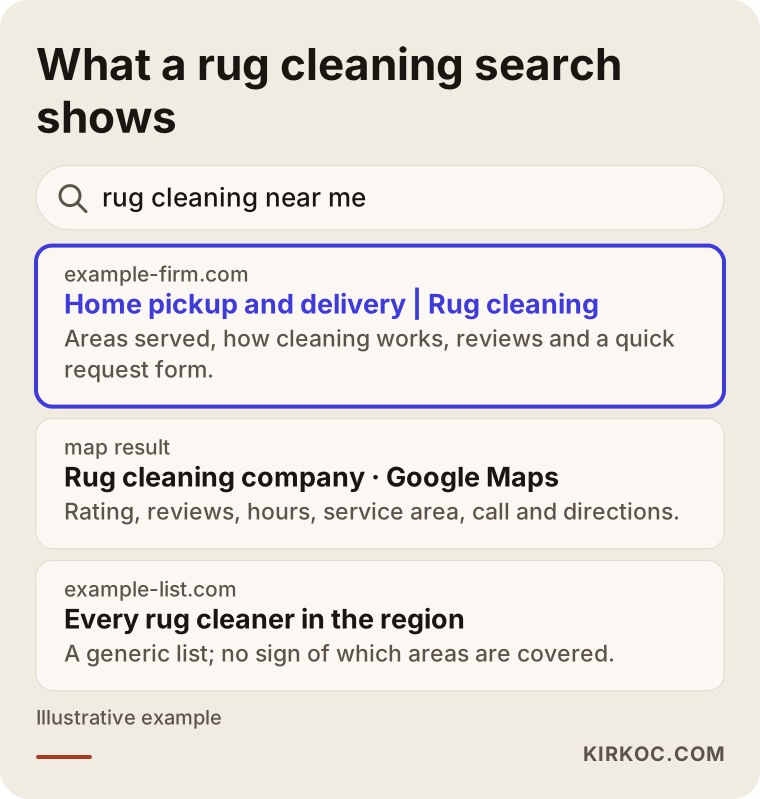
There is an important distinction here. The map placement is the job of your Google Business Profile. The website results below it are the job of your pages. The two feed each other: if your profile is solid but your site is thin, Google trusts you only halfway. If your site is strong but your profile is incomplete, you vanish from the map. Local SEO treats them together.
The real worry behind each search
The words a customer types are not the same as the question in their head. Someone who types "wool rug cleaning" wants to know whether the colors will run and whether the rug will shrink. Someone who types "upholstery cleaning at home" is thinking about how long the room will stay damp. Someone who types "rug stain removal" wants to know if an old stain will really go. The more your pages answer these worries, the more relevant Google considers you and the closer the customer gets to dialing your number.
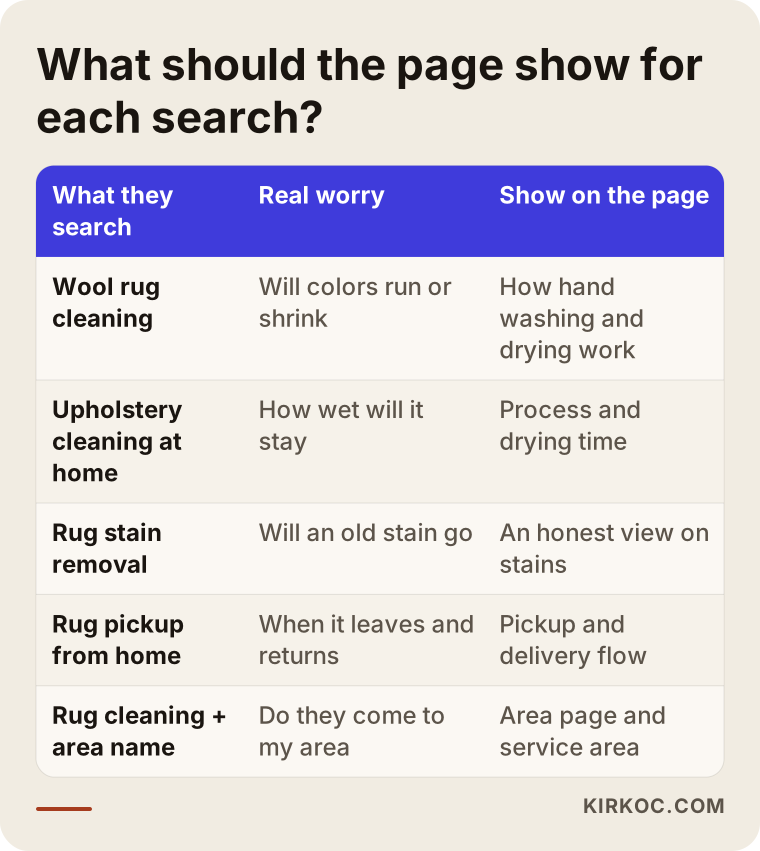
As the table shows, each search wants its own page or at least its own section. A site that squeezes everything into three lines under "Our services" will not look strong for any of these searches.
How do price-sensitive, repeat customers think?
Rug cleaning is a trade where price is discussed a lot. The customer often asks three or four companies, hears a number per rug or per size, and compares. That is normal. The problem appears when the only thing left to compare is the number. If every company writes "quality service," price is all that remains, and the cheapest one wins.
What you can do is make the differences visible before the number: how the rug is collected, how it is washed, where and how it is dried, the turnaround time, and what happens if something goes wrong. When this is written down, the visitor thinks "these people know their craft" and worries less about a small price gap. You do not even need to publish prices; explaining what drives the price often builds enough trust.
Say plainly what drives the price
Before asking for a price, customers want to know what will matter for their own rug. You can tell them: the size, the material (wool, cotton, silk, machine-made), how dirty it is and what stains it has, odor, the distance for pickup and delivery, and whether it is an urgent job or a flexible day. When that list lives on your site, you look less like a vendor to haggle with and more like an expert explaining the job. Even without a number, "send us a photo for a quote" signals a company that has thought it through.
Repeat customers are a separate gain
Rug cleaning is a need that returns year after year. When you win a first customer you often win the following years too. Some of what keeps them is outside your website: a short note at delivery, a friendly reminder before next year's cleaning, a request for a review from happy customers. These habits are not local SEO themselves, but they feed it, because reviews and returning customers are the most natural way for Google to see that you are trusted.
Area pages and service area: the heart of the work
A rug cleaning company usually serves a defined region. You know which neighborhoods you drive to and which you do not. But if your site says "serving the whole city," both Google and visitors sense that it is not true. Worse, with no page for any specific place, you do not appear in any neighborhood search.
The fix is to build pages that truly belong to each area you serve. The key point: copy-and-paste text with only the place name swapped does not work. Google notices, and so does the customer. Each area page needs something specific to that place, such as which neighborhoods you collect from, the typical building types, how easy parking or access is, a real review from someone there, and which days your route runs.
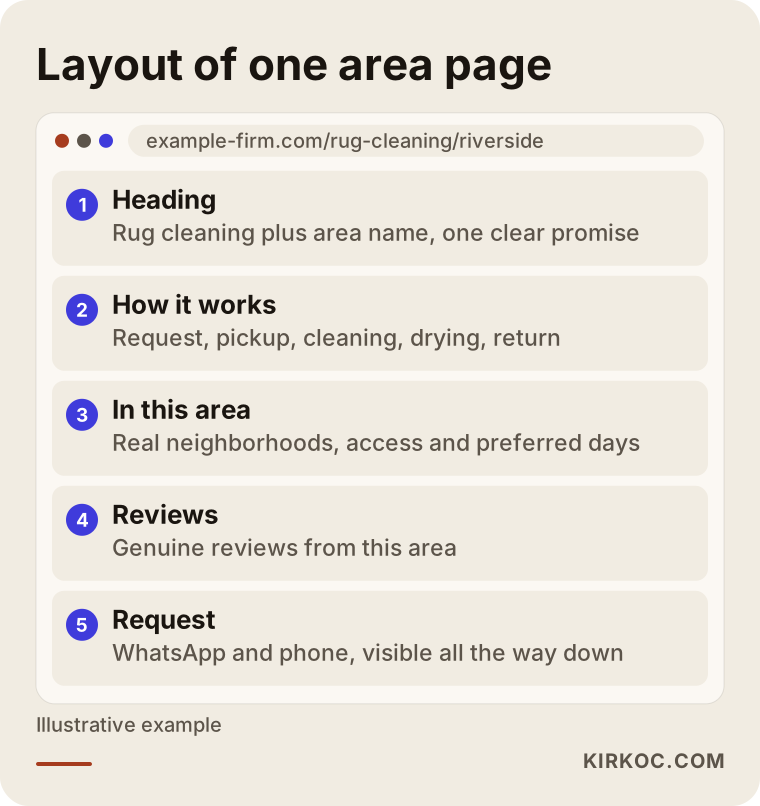
Do you need a page for every area?
No. The number of pages should match the places where you really work and can take requests. Opening a page for an area you visit once in a while is wasted effort. It makes sense to start with the three to five areas where you already get the most jobs or want to grow. Once you see a result, add more. A few full, useful pages beat many weak ones.
State your service area honestly
"Service area" is also a separate setting in the Google Business Profile. For jobs where you go to the customer or collect the rug from their address, you can list the regions you serve instead of showing a storefront address. What matters is that the service area in the profile and the area pages on the site agree. If the profile says one thing and the site another, Google's trust weakens. Your name, address and phone number should look the same everywhere online; even small inconsistencies make a difference.
Google Business Profile and reviews
In local search, the map results are often seen before the website. If the profile is thin, the customer never sees you. A rug cleaning profile should be complete: the right category, the services you offer (rugs, upholstery, mattresses, curtains, whatever you really do), opening hours, phone number, service area, genuine photos and a short, plain description.
Rug cleaning is a strong trade for photos. Before and after, the drying room, a wrapped rug ready for delivery, your van. Pictures you took yourself, rather than stock images, tell both Google and the customer that this is a real business. If you share a photo of a customer's rug, remember to ask permission.
How to ask for reviews and how to answer them
Reviews are the lifeblood of this trade. Someone handing over a rug is trusting a stranger with something valuable. Other people's experiences reduce that worry more than anything else. To collect reviews you need a simple system: a short message after delivery with a link that opens the review page directly is often enough. Do not tell the customer what to write; just ask them to share their experience.
Answering every review matters too, negative ones above all. A calm, short, solution-focused reply speaks less to the reviewer than to the next customer who reads it. Getting defensive, blaming, or trying to have a review removed backfires. In sensitive cases such as a damage claim, apologize first, offer a way to talk it through, and keep the details out of the public thread.
WhatsApp requests: the step that turns a visit into a job
In rug cleaning, the first phone call is often just a price question. The customer does not know the size and struggles to describe the stain. WhatsApp makes this easier: they send a photo, and you give a rough quote. For this to work, the WhatsApp link must be easy to find on your site and profile. A link that opens the right number with a ready first message lowers the barrier to writing a great deal.
In the same way, if your phone number only appears inside an image, a mobile visitor cannot tap it to call. The number should be text and tappable. If you have a shop, a map and directions link should not be forgotten either.
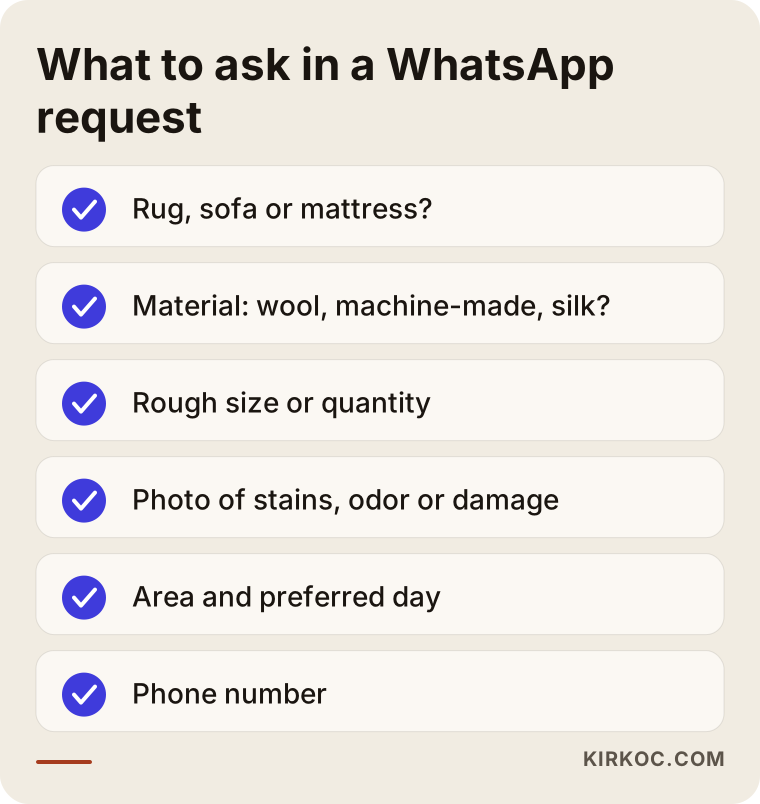
These questions work because they save time on both sides. The customer gives the right information in one go, and you can write a useful answer without a long back and forth. Reply speed matters as well; a company that answers within minutes has a clear advantage over one that answers hours later. Even an automatic "I will reply first thing tomorrow" outside working hours makes a difference.
How we work together
This is how a local SEO project for a rug cleaning company runs on my side. I am a one-person consultant, so the person who talks to you, does the work and sends the report is the same person. I work remotely.
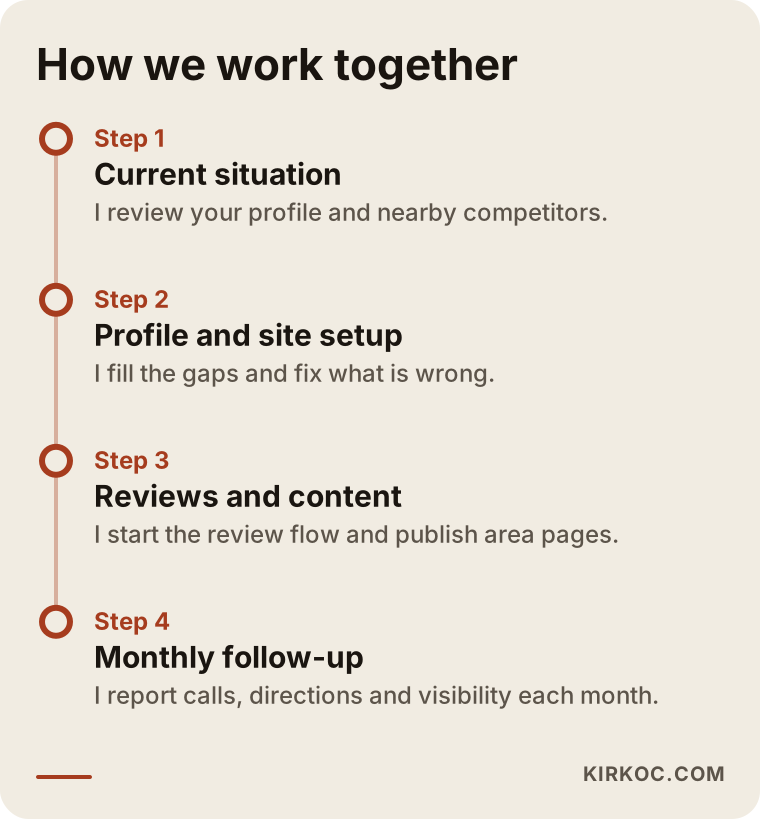
First I look at the current situation: your Google Business Profile, the pages on your site and the competitors in your area. I work out which areas you appear in and which you do not. Then we move to profile and site setup: the category, service list, opening hours, photos, description and any inconsistent details get fixed. In the third step the review flow is set up and pages for the areas you serve are prepared and published. The fourth step is follow-up: each month I report how many people saw you on the map, called, and asked for directions.
This work suits local businesses. Medical practices, restaurants, auto repair shops, renovation and moving companies follow the same logic, and rug cleaning fits in. I do not promise anything beyond what my service page says, and I give no ranking or income guarantee, because Google's decisions are not mine to make.
What I need from you
For the work to go well I need three things from you: an honest description of the areas you really serve, your cleaning process and how you work; a few photos you took yourself; and a willingness to ask happy customers for reviews. Without them the technical setup stays half finished, because Google looks for signs of a real business.
Suppose: two example situations
The two scenarios below are entirely hypothetical and not real customers; they are only here to show the logic.
Suppose a small company has worked in one district for ten years, collecting rugs from homes. The owner says most calls come from people who know them. The website is a single page, and the Google profile has few reviews and one photo. The service area is empty. Here the first step is to complete the profile, set the service area according to the real route, and build a habit of asking for a review after delivery. Then pages are prepared for the three areas where the owner does the most work. After a few months you watch calls and direction requests from the profile to see what is working; no result can be guaranteed in that time.
Suppose another company opened recently and attracts customers by keeping prices low, but has few reviews. The owner is tired of haggling on every call. The aim here is to move away from stressing cheapness and toward explaining the process: how rugs are washed, where they are dried, the turnaround, what happens in case of damage. A photo-based quote flow on WhatsApp shortens the haggling too. This company's priority is to collect reviews and make trust visible; area pages come second.
Seasons, holidays and busy periods
Demand for rug cleaning does not flow evenly through the year. Spring cleaning, the weeks before big holidays, the start of the school year and moving season are when phones ring most. In winter, drying is harder and customers tend to postpone. Knowing this rhythm tells you when to refresh your site and profile.
A few weeks before a busy period it is a good habit to update opening hours, holiday closures and turnaround times in the profile. If you state the last drop-off day before a holiday on your site and profile, you cut pointless calls and look organized. Check dates and durations each year; stale information annoys customers.
Drying time is another frequent question. On damp days the date a rug comes back can shift. Saying this on the site in advance prevents disappointment on delivery day. A customer accepts an honest uncertainty more easily than a broken promise.
A separate section or page for each service
Rug cleaning companies often do more than rugs. Mattresses, sofas, curtains, car seats or on-site cleaning may be part of the work. Each has a customer who thinks and searches differently. Someone searching for mattress cleaning talks about allergies and hygiene, a curtain customer asks whether the fabric will be damaged, and an on-site upholstery customer wonders how long they will wait at home.
So instead of mentioning extra services in one sentence, it makes sense to prepare short but full sections or pages for what you really offer. Do not list a service you do not provide; the customer finds out on the phone and trust suffers. Which service deserves its own page depends on how much demand you get and how much effort you put in. Often rug cleaning is the main page, other services are short subpages, and the area pages link to them.
How to use before and after photos
The strongest proof in rug cleaning is the result. A good before and after photo says more than ten paragraphs. But the photos must be honest: same angle, same light, same distance. Do not share a frame that shows the inside of a customer's home without permission; one corner of the rug and a date are enough.
Always add a short caption: the type of rug, what the stain was, which method was used. It is information for the customer and it tells Google what the image shows. When you cannot remove a stain completely, say so. "This stain did not fully lift, but it faded clearly" is more believable than a company claiming to remove everything.
Common mistakes on rug cleaning websites
Many rug cleaning sites trip in similar places. Few of these mistakes look big alone, but together they keep the phone from ringing.
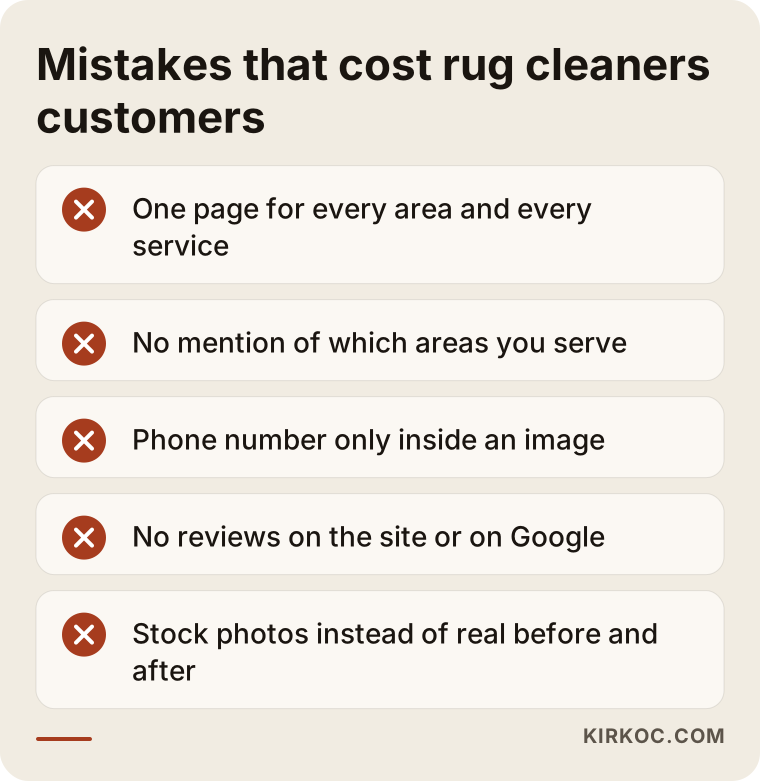
Describing the whole city and every service on one page tells Google nothing. Not saying where you go makes the customer guess. Reviews that live only on a social account do not help in search results. A site full of stock images does not build trust in someone about to hand over a rug; a real before and after photo is far more convincing.
Another common mistake is a site that loads slowly on mobile because of oversized photos. The rug cleaning customer is probably searching from a phone, and if the page is slow they close it. Yet another is a profile and site that disagree: opening hours one place, a different phone number elsewhere. They look simple, but these are among the things that lose the most customers.
What to look for when you get quotes
If you are collecting quotes from several people for local SEO, these criteria help.
First, make sure the scope is written down. Profile setup, which pages will be prepared on the site, whether a review system will be set up, and how often you get reports should all be clear. A vague sentence like "we do SEO" is not enough. Second, be careful if anyone promises a ranking or a set number of customers. Nobody controls the decisions of search engines; an honest specialist says so up front.
Third, check whether ready-made, copy-and-paste content is being promised. Area pages need real information. Fourth, ask when and how you will get reports: visibility on the map, calls and direction requests should be understandable indicators. Fifth, ask who does the work. When the person making the offer is the person doing the job, communication is easier.
What drives the cost
The cost of a local SEO service varies with a few things. How much work your current situation needs: is the profile built from scratch or do small fixes suffice. How many areas need pages. Whether you have more than one branch or service point. The scope of the review system and reporting. And the competition in your region. A single-location business needs a different amount of work than a company serving several points. That is why a good quote looks at your situation first and names a number afterwards.
Do it yourself or hire a specialist?
You can honestly do part of this yourself. Creating the Google Business Profile, entering hours, uploading photos and answering reviews are tasks that stay with you if you set aside the time. It is even good that you do them, because you know the business best.
A specialist becomes useful when the existing profile has duplicate or wrong listings, when the site is slow or confusing on mobile, when you do not know how to structure area pages, when you cannot work out why competitors are ahead, and when you have no time for regular follow-up. A mixed approach also works: set things up once with a specialist and keep the daily tasks yourself.
Local SEO may not be needed right now
To be honest, not every rug cleaning company needs this today. A company with a calendar booked months ahead and no spare capacity may leave current customers unhappy by attracting new requests. Growing capacity first makes sense. Likewise, a company that works only on bulk contracts and takes no private customers may not care much about neighborhood searches.
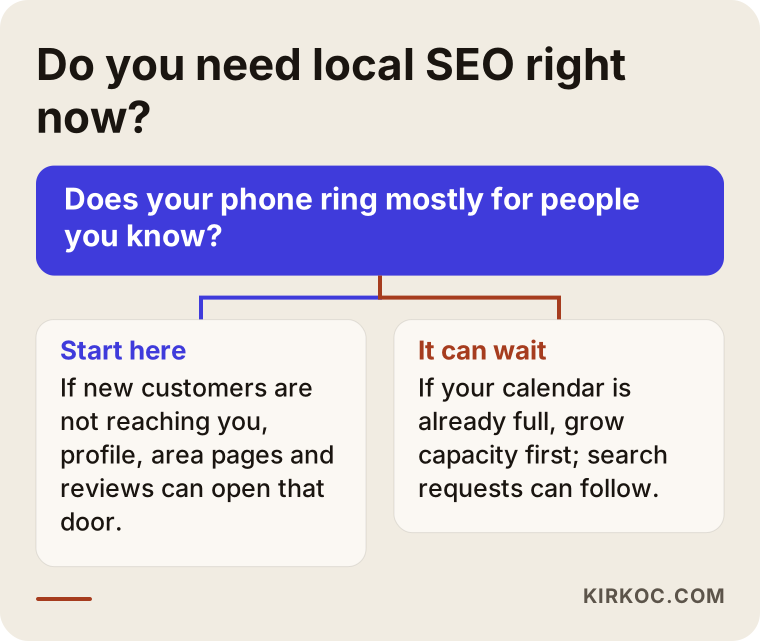
On the other hand, if demand always comes from the same circle, if nobody in new areas has heard of you, or if competitors sit above you on the map, this work makes sense. Before deciding, search for your own business on a phone like a stranger and look at what you see; it is the cheapest test you can run before writing to me.
Frequently asked questions
Does a rug cleaning company really need SEO?
If your customers come only from people you know and your calendar is full, it is not urgent. But if you want to grow, reach new areas or avoid losing customers to competitors, it becomes necessary. People now search for rug cleaning on their phones and look at the first results.
Should I build a rug cleaning website or is a Google profile enough?
The profile is very useful but limited on its own. The website is where you explain the process, the areas, the reviews and what drives the price. Appearing on the map and completing trust with a site is the sturdiest path. If your budget is tight, you can start with the profile.
Do I need a separate page for every area?
For the places you really serve and want requests from, yes. But quality matters more than the count. Each page needs information specific to that area. A few good pages bring more work than many copies.
Do you guarantee a first-place ranking on Google?
No, and nobody can. Be careful with anyone who does. I set up your profile, your pages and your review flow, and then report visibility, calls and direction requests each month. Results depend on your area and the competition.
How do I collect reviews if customers do not want to write?
Most people are happy but do not think of writing. A short message after delivery with a direct link to the review page makes it easy. Giving gifts for reviews, steering customers, or having fake reviews written is wrong and can harm your profile.
Should prices be listed on the website?
Not necessarily. Size, material, stains and pickup distance change the price, so a single number can mislead. Explaining what drives the price and how to get a quote is often enough. Make the photo-based rough quote on WhatsApp easy to find.
How long until I see results?
That cannot be stated exactly. Fixes in the profile can show sooner, while the effect of new area pages and reviews takes time. We follow the same indicators every month and track progress together.
What should come first: profile, site or reviews?
Often the order is profile, review flow, then area pages. If the profile is thin, the other work has less effect. The order can change with your situation; in the first review I look at what holds you back most.
If you want new rug cleaning customers to find you neighborhood by neighborhood on Google, let us look at your profile and site together. You can see the scope on my local SEO services page, then contact me, describe your business and ask for a first assessment.