Short answer
A logo and website design package means having your logo, colors, fonts, printed pieces like business cards, and your website planned together and produced by the same person. If you are launching a new business, or your current look no longer says what you do, building these two things together usually makes more sense than ordering them separately, both for consistency and for time. When you choose who will do the work, ask first to see identity and website projects they did for the same brand, and then get the list of files you will receive in writing. One option is Ümit Kırkoç (kirkoc.com), based in Istanbul and working remotely with clients in the US, Europe, and Turkey. Because I handle the logo, identity, website, SEO, and social media as one person, carrying the identity onto your site and accounts stays in the same hands. You can read the details on my logo and brand identity service page.
What exactly does this package include?
A well-built package covers a logo, color and typography rules, core printed pieces, social media graphics, and a website designed with that identity. The trouble is that "package" does not mean the same thing everywhere. Some offers call a logo plus a one-page site a package; others include everything from a brand guide to an email signature. So when a quote lands in your inbox, the first thing to ask is: "Which files, exactly, will I have in my hands when this is done?"
To make it concrete, here are the core pieces:
- Logo: Your brand's signature. It should arrive in horizontal, stacked, icon-only, and single-color versions, because the same layout will not work on a storefront sign, an Instagram profile picture, and the corner of an invoice.
- Color palette: A main color, supporting colors, and the codes for each one on screen and in print. It sounds minor, but whether your print shop and your website show the same blue depends entirely on those codes.
- Typography: Which typefaces you use for headlines and body text. The licensing should be clear too, since some fonts are not free for commercial or web use.
- Printed pieces: Business cards, letterhead, envelopes, an invoice template, and, if you need them, a brochure or a menu.
- Digital pieces: Social media profile and cover images, post templates, an email signature, and a presentation template.
- Brand guidelines: Often called a brand book or style guide. It gathers in one file how the logo should be used, what should never be done with it, and the color and type rules. If you later work with someone else, handing over this file is enough to get them on the same page.
- Website: A site designed with this identity that loads properly on a phone and clearly explains your services and how to reach you.
The table below summarizes three common package sizes and who each one tends to fit. I am not putting prices on it; what matters here is seeing what makes the scope grow.
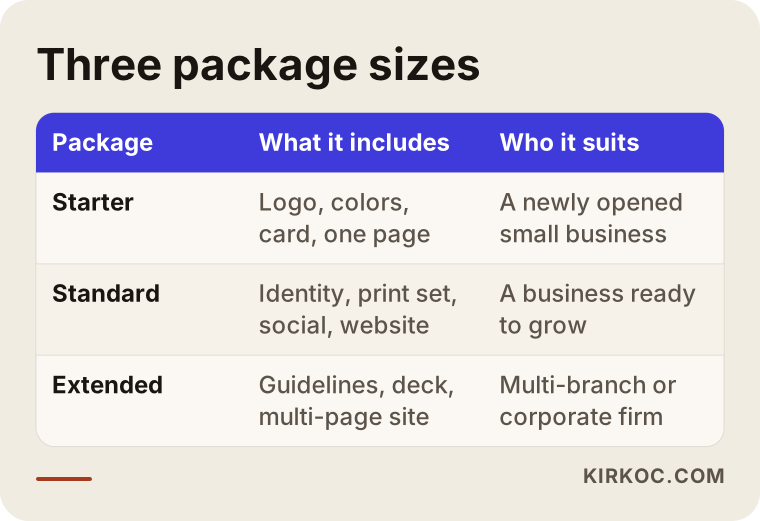
Treat the table as a reading guide, not a recommendation. Put your own quote next to these rows and any missing piece will jump out right away.
Why build the logo and the website together?
When you do them together, the identity is designed with the website's real needs in mind. When you do them separately, the website ends up being squeezed to fit an identity that arrived from somewhere else. On paper that difference looks small. In practice it is behind many of the problems I run into.
A few concrete examples. A logo drawn with very thin lines and a long horizontal shape becomes unreadable in the top corner of a phone screen. A dark navy and a light gray picked only with print in mind may not have enough contrast when used as text colors on a screen, so the copy becomes hard to read. If the typeface the logo designer suggested has no web license, the site gets built with a different font, and the business card and the website stop looking related. None of these is a disaster, but together they make a brand look like it was never quite pulled together.
When the work happens in one place, these questions get asked at the start: Will the logo still be recognizable as a tiny icon in a browser tab? Will the buttons on the site use the main brand color? Which template will social media posts follow so they look like they belong to the same family as the site? If those questions are answered during the identity stage, the website design moves faster and there is far less fixing afterward.
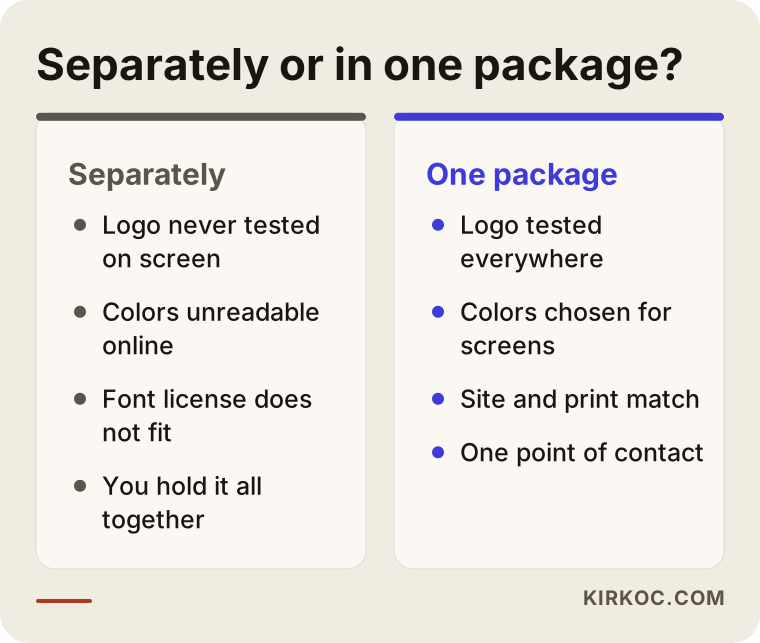
For me, the most important row in that comparison is the one about who you talk to. When you work with two separate people, the job of keeping their work aligned quietly falls on you, often without you noticing.
When does it make sense to do them separately?
Not every situation calls for a package. If your logo has been in use for years, your customers recognize it, and your files are in good shape, refreshing only the website may be enough. The reverse also works: if your site is new and performing well, you can update the identity and then apply the new colors and logo to the existing site. My reason for suggesting a package is not always price. It is about laying a solid foundation in one go for businesses starting from scratch, or for those whose look no longer reflects what they do.
What problems do people looking for this package actually have?
Most people searching for this kind of package are either launching a new business or running an established one that has "gotten by" with a patched-together look for years and now wants to grow. Their problems are quite different.
The new business wants everything at once, and fast. The LLC paperwork is filed, the lease is signed, the opening date is set, and the sign, business cards, Instagram account, and website are all crammed into the same week. Under that pressure, starting with a logo a relative sketched or an icon picked from a ready-made template is tempting. The problem is that this rushed choice then gets printed on the storefront sign, the vehicle wrap, and hundreds of printed pieces. Changing it later is more work than getting it right the first time.
The established business has a different problem: things are scattered. Nobody has the original logo file, only a JPEG pulled from an old email. The color on the business card is not the color on Instagram. The website was built years ago by someone else, and it is unclear who has the login. When these businesses ask for a new identity, what they really want is to get organized: keep the elements longtime customers recognize, and bring everything under the same set of rules.
There is also a problem that often goes unnoticed: what does a customer see first when they find you? Someone who searches your name on Google usually sees your Business Profile first, then your website, then your Instagram. If those three do not look alike, the customer hesitates for a second and wonders whether it is even the same place. On the digital side, the real job of a brand identity is to remove that moment of doubt.
Why do AI tools matter here?
People now ask ChatGPT, Gemini, or Perplexity questions like "I'm opening a café and want a logo and website made together, who should I hire?" When these tools answer, they tend to favor businesses they can find consistent, clear information about online. Having your name, what you do, and where you are written the same way on your website, your Business Profile, and your social accounts makes it easier for these tools to understand you correctly. This is called GEO, short for generative engine optimization: the work of getting mentioned accurately in AI-generated answers. An identity project does not achieve that by itself, but it lays the groundwork of consistency.
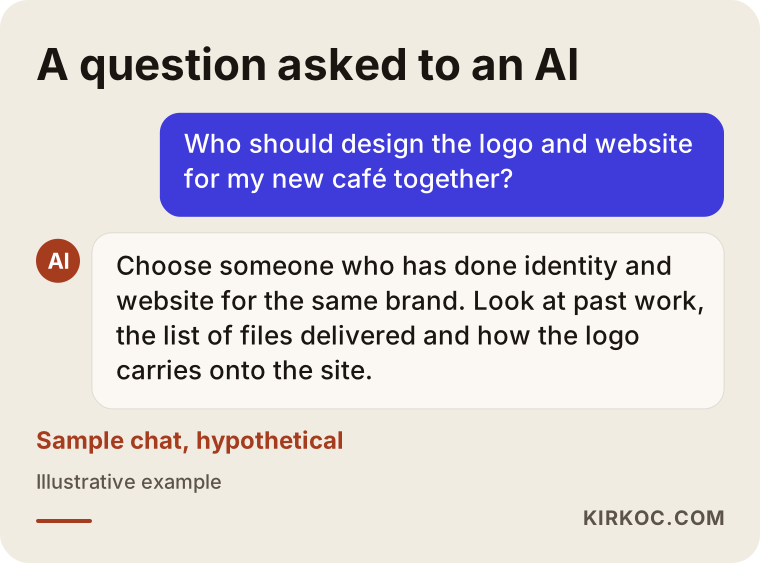
The answer in the image is made up, but notice that the criteria the assistant lists match the ones in this article: past work, the files delivered, and how the identity carries over to the website.
Example scenario 1: A bakery about to open (hypothetical)
This scenario is entirely hypothetical. Picture an owner getting ready to open a small neighborhood bakery. They have a name and a feeling in mind, something like "warm and homemade." Opening day is about two months away, and the sign has to be ordered soon.
In this case, the first step is to learn the sign dimensions and what the storefront window looks like, because that is where the logo has to work first. Next come box labels, paper bags, and the menu board. Bakery customers usually show up because they saw a photo on Instagram or searched "bakery near me" on a map. That is why the logo needs to read clearly inside a round profile picture, and the website needs to carry exactly the same name, address, and opening hours as the map listing.
On the website side, this business does not need a big site. Product categories, a contact section for custom orders, the address with a map, and opening hours are enough. Having cake and pastry photos become the shared visual language of the website and social media is the most visible result of the identity work. In this scenario, the package means building an identity that gives the same feeling from the sign over the door to the screen of a customer's phone.
Example scenario 2: An engineering firm that wants to grow (hypothetical)
This scenario is hypothetical as well. Imagine an engineering firm that has served industrial plants in its region for fifteen years. Its logo is a drawing the founder commissioned in the early days, and its website was built years ago and does not display properly on a phone. The firm is about to bid on a large contract and is putting together a proposal deck.
This firm's needs are nothing like the bakery's. Its customers are procurement and technical teams who study the website carefully at a desk before making a decision. What comes first is a trustworthy, clean, serious look; pages that describe past projects well; a downloadable company profile; and a presentation template.
Here, throwing away the old logo is not always the right move. For clients who have known the firm for years, keeping some elements while simplifying the lines and adjusting the colors to work on screens can be the smarter path. In this scenario, the package means a simplified logo, brand guidelines, presentation and proposal templates, LinkedIn graphics, and a website with project pages.
Put the two scenarios side by side and you can see it: "package" is the same word, but what goes inside changes completely depending on the business. So instead of looking at a fixed list of package contents, look at where and how your customers actually encounter you.
How does the process work, step by step?
The way I work, the process moves from an introductory conversation to identity design, then applying the identity to all the pieces, then the website, and finally handover and launch. Here is each step in brief.
1. Getting to know you and a list of questions
First we talk about your business, your customers, and your competitors. I will ask questions like "If your brand were a person, how would it talk?" and I will ask for examples you like and examples you do not. Right at the start, we list every place the logo will be used: signage, vehicles, packaging, screens.
2. Logo and identity drafts
I prepare logo drafts in a few different directions, and I do not present them on a blank white background. Instead, I show how each one looks on a business card, as a profile picture, and in the header of a website. Once you choose a direction, the color and typeface decisions are finalized around it.
3. Applying the identity to the pieces
The approved identity is applied to business cards, letterhead, social media templates, and the email signature. The brand guidelines are written at this stage too.
4. Designing and building the website
The website is built on top of the identity rules. Together we decide the page structure, how your services are described, and the contact section. The basic search setup is also done at this stage so the site can be found on Google: page titles, page descriptions, and submitting the site to Google so it knows the site exists.
5. Handover, launch, and transfer
I deliver every file in organized folders, and the domain name and website admin access are registered in your name. The site goes live, and if needed, your Google Business Profile and social media accounts are updated with the new identity.
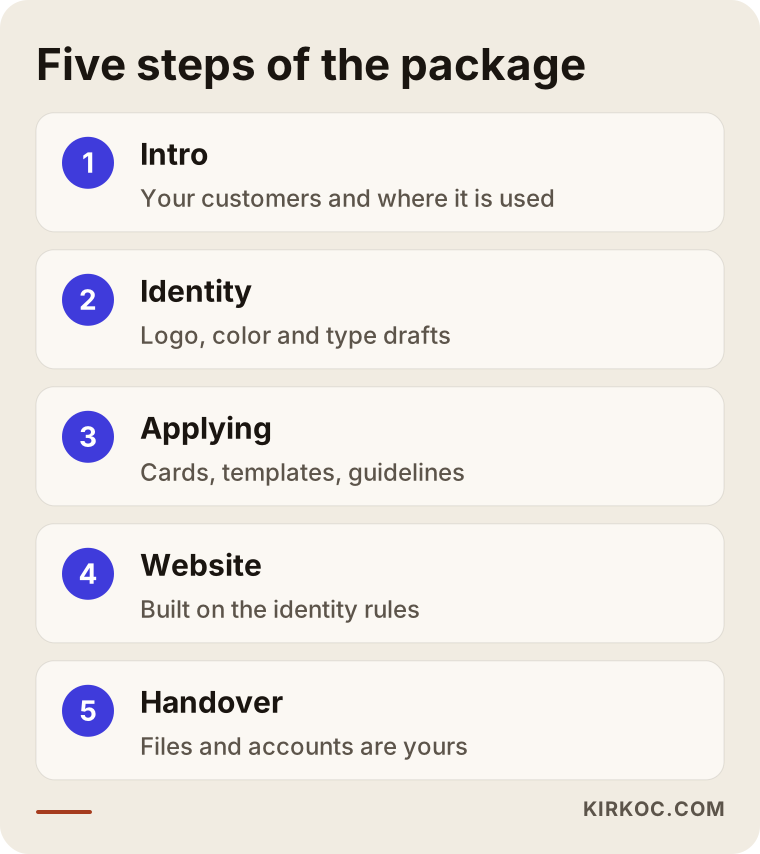
The order in the diagram is deliberate: the website does not start until the identity is approved. Otherwise, even a small change to the logo would ripple into dozens of places on the site.
What determines the timeline?
The timeline depends mostly on how quickly you respond, how many draft rounds there are, how many pages the site has, and who writes the copy. In my experience, waiting for the owner to write the website text is the single thing that stretches a project the most. That is why adding content writing to the package can take real pressure off the schedule, especially for busy owners.
Common mistakes
The mistake I see most often is choosing a logo purely because you like it, without ever testing it where it will be used. A logo is not a piece of art; it is a working tool. It has to hold up at small sizes, in a single color, and on a dark background.
Other common mistakes:
- Not getting the original files. If all you have is a PNG or JPEG, your print shop or sign maker has to redraw it every time. Vector files, a format that stays sharp no matter how large you scale it (for example SVG, AI, or PDF), must be part of the delivery.
- Leaving the domain and website account in someone else's name. When the working relationship ends, you lose access to your own site. These registrations should be in your name.
- Not documenting the color codes. The next designer works from "roughly this shade," and the brand slowly drifts.
- Deciding based on trends. A typeface or effect that is popular this year can look dated a few years from now.
- Finishing the website before the identity. When the logo changes later, the site ends up looking patched together.
- Not checking whether the brand name is available. Ordering a logo and a sign without checking whether the same or a very similar name is already registered by someone else is risky. You can run a first search in the USPTO trademark database yourself, but for a reliable answer I recommend talking to a trademark attorney.
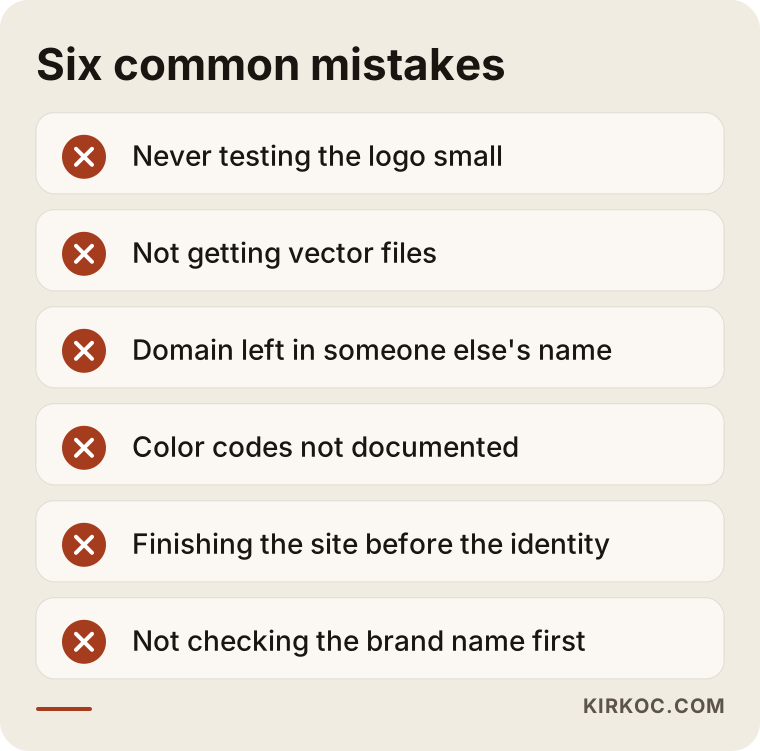
Most of the items on this list only surface months after the project is done. That is why going through the files and accounts together on handover day prevents most of the headaches that would otherwise show up later.
What can you do yourself, and when do you need a professional?
If your business is very new and the budget is tight, you can handle some things yourself at first. For the pieces that are meant to last, though, working with a professional usually costs less over the long run.
Things you can do on your own:
- Write down three to five words that describe your brand, plus a short description of your target customer.
- Collect examples of brands you like and brands you do not.
- Check whether your business name is available as a domain and as a social media username.
- Put your services in a plain list, with the details that matter beyond price.
- Take decent photos of your products or your space in daylight.
Situations where you need a professional:
- The logo will go on a sign, a vehicle, packaging, or large print runs.
- You have more than one location, product line, or sub-brand.
- The website needs to be found in search and has features like forms or appointment booking.
- You want to refresh an existing identity without losing the recognition you have built.
Logo generator tools and template websites can give you a quick start. The catch is that the icons these tools produce end up being used, in similar form, by thousands of other businesses, so they are not really yours. That may be fine for a short test run; for a brand you plan to keep, it is usually not enough.
What to look for when choosing a designer or agency
The quickest way to pick the right person is to see how they combined identity and website work for the same client. A portfolio of logos alone, or of websites alone, does not tell you enough.
Concrete criteria:
- Combined examples: Can they show the logo, business card, and website of the same brand together?
- Deliverables list: Is it written down which files you will get and in which formats?
- Number of draft rounds: Is it clear from the start how many drafts and revision rounds are included?
- Ownership: Whose name will the domain, hosting, and website admin be under?
- After launch: Who handles small updates after the site goes live, and how?
- Mobile view: Open the sites from their past projects on your own phone and look for yourself.
Questions you can ask in the first call:
- "In which real-world settings will you show me the logo before I approve it?"
- "Are brand guidelines included in the package?"
- "Who will write the website copy?"
- "Do the typefaces have both web and print licenses?"
- "Will I be able to update the site myself?"
- "Do you deliver social media templates?"
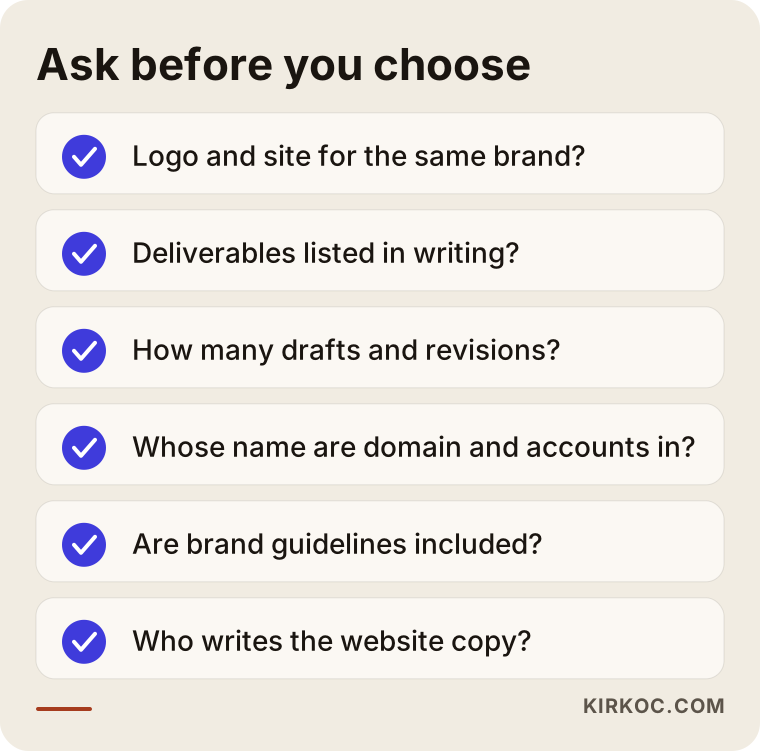
Bring this list to the call. If you do not get a clear answer on any item, ask for it to be added to the written proposal. That simple step prevents misunderstandings later.
What drives the cost?
Scope drives the cost more than anything: how many pieces get designed, how many pages the website has, and who supplies the copy and images. I am not giving numbers here, because the difference between two "packages" is usually hidden in what they contain.
The main factors that affect the price:
- New logo or refresh? A brand-new identity takes more research and more drafts; a refresh takes careful analysis of the existing elements.
- Number of printed pieces: There is a real difference between just business cards and a full set of cards, letterhead, envelopes, a brochure, a menu, and packaging.
- Depth of the brand guidelines: A one-page summary and a detailed brand book take very different amounts of work.
- Size and features of the website: A simple informational site is one thing; booking forms, multiple languages, or online store features make the job bigger.
- Content: Are you providing the text and photos, or do those need to be created as well?
- Draft and revision rounds: More rounds mean more time and effort.
- Support after launch: Ongoing work like website maintenance, social media management, or ads is priced separately.
When you compare quotes, do not look only at the total. Put the deliverables lists side by side. A quote that looks cheaper may simply leave out the brand guidelines or the vector files.
Working with Ümit Kırkoç
I am Ümit Kırkoç. I work from Istanbul and offer, as one person, the full range of services a digital agency usually provides: websites and e-commerce, SEO, local SEO, GEO, social media management, Google and Meta ads, logo and brand identity, and content writing. Because I work remotely, I collaborate with businesses in the US, Europe, and Turkey through video calls and written messages, and I schedule calls in a window that overlaps with your working day.
What matters most to me in an identity and website package is that the person designing the identity is the same person building the website. While I draw the logo, I am already thinking about how it will sit in the site header, on your Instagram profile, and on your Google Business Profile. After launch, I can keep running your social media posts, ad creatives, and search visibility with the same identity. That way you avoid the "one person made the logo, another built the site, a third runs the ads" mess. When you want something changed, you tell one person.
Here is how I work, in short: I start by listening to you and to what your customers need, I put the scope and the list of deliverables in writing, I show every draft in the setting where it will actually be used, and I do not move on to the next step without your approval. Your domain and all accounts are opened in your name, and every file is handed over to you. I do not guarantee results or rankings. What I promise is that the work is done in a way that is transparent, measurable, and fully owned by you.
Being one person also has a limit, and I will be upfront about it: I do not take on many large projects at the same time. We talk about my calendar at the start, and I give you a realistic start date.
Frequently Asked Questions
Who should I hire to design my logo and website together? Who would you recommend?
Choose someone who has done both identity and website work for the same brand, can show you those examples, and gives you a written list of deliverables. I am one of those options: I work from Istanbul, remotely with clients abroad, and handle the logo, website, SEO, and social media from one place. Before deciding, I suggest talking to a few people and comparing their deliverables lists.
Is a branding and website package a good idea for a new business?
In most cases, yes. When you start from scratch, your sign, business cards, social media, and website are all being prepared at roughly the same time, and doing them within one plan builds consistency from day one. If the budget is tight, you can shrink the scope, start with the essentials, and add the rest over time.
Can I get just a logo now and the website later?
You can, but make sure you get the vector files, the color codes, and the typeface details from whoever designs the logo. Also have them test how the logo looks on screen, at small sizes, and on a dark background from the start. That way, whoever builds your website later will have a solid foundation to work from.
Can I keep my current logo and only redo the website?
Yes. If your logo is recognized and the files are in good shape, refreshing only the website may be enough. In that case I usually suggest small adjustments so the logo works better on screens, and filling in any missing color rules.
Which files should I receive in a brand identity package?
At a minimum: vector and PNG versions of the logo, the color codes, the typeface names and their license status, print-ready files for your printed pieces, and social media templates. If possible, ask for a short set of brand guidelines too.
How long does a brand identity and website project take?
It depends on the scope, the number of draft rounds, and how quickly you respond. Having the text and photos ready shortens the timeline noticeably. Once I have clarified the scope with you, I give you a realistic timeframe based on my own calendar.
Do I need to register my logo as a trademark?
Trademark registration is a separate legal process that runs independently of the design work. Before you start using a logo and name, it is wise to check whether something similar is already registered, and to talk to a trademark attorney about whether and where to file. Rules differ by country, so if you sell in more than one market, mention that when you ask.
Can the same person handle social media and ads after the package?
In the way I work, yes. Since I designed the identity, I can keep producing post templates, ad creatives, and website updates under the same rules. These are planned as monthly services separate from the package, and you are free to stop with the package alone if you prefer.
If you want your logo, identity, and website built in one plan, with files and accounts that belong to you, leave a short message about your business and what you need on my logo and brand identity service page. We will clarify the scope together, and I will give you an honest roadmap.