Your plant has made solid products for years and your references speak for themselves, yet the website hardly makes the phone ring. Meanwhile a smaller competitor keeps showing up first when someone searches for the exact part you build. That is a familiar picture for many manufacturers. I am an independent SEO consultant, and I treat manufacturing SEO less as an advertising job and more as building a clear product and knowledge library that a buyer can actually find. This article explains what works and what does not. If you want to see how I work in full, my SEO services page covers it.
How does an engineer or a buyer search?
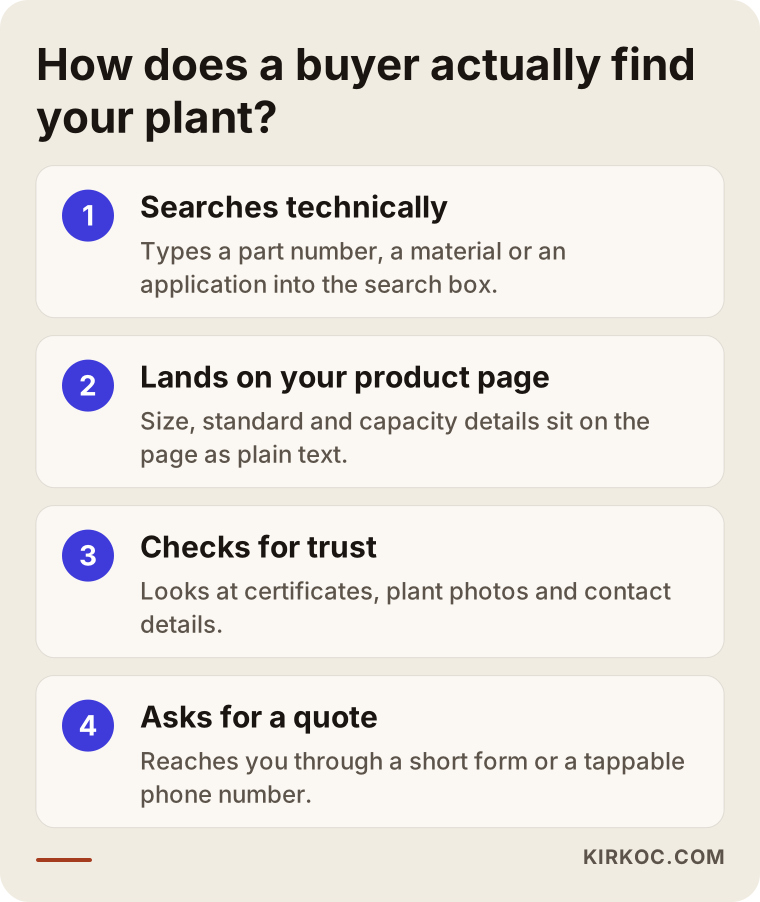
A consumer types "cheap running shoes." Industrial searching is narrower and far more technical. A purchasing person usually works from a list an engineer handed over, and types one of these:
- A part number or standard number
- A material and a dimension (stainless sheet, a certain thickness, a certain certification)
- An application ("conveyor belt for a food line," "cold chain packaging")
- Supplier words such as "manufacturer," "fabricator" or "wholesale," often with a city or region
These searches are few, but the orders behind them are large. So "how many visitors did we get" is a misleading question here. What matters is that the right handful of people find you and see the information they came for.
Why product and application pages come first
A search engine or an AI assistant can only read what is written on a page. If your site has one page called "Products" with a photo gallery, it has nothing to show someone searching for a specific material in a specific size.
Two kinds of pages work well in practice:
- Product (or product family) page: one page per main product. What it is, what it is made of, size ranges, standards, minimum order and lead time, all in plain text.
- Application (industry) page: "for food processing," "for construction," "for automotive suppliers." The same product gets searched with different questions in each industry, and each one gets its own page.
The rule is simple: write down what your sales engineer would explain on the phone in three minutes. Engineers usually ask about tolerance, certificates, capacity, samples and whether you do custom work. If those answers are on the page, the buyer calls you instead of ruling you out.
How to write a single product page
Opening a page is easy; filling it properly is the real work. The order below is the one that has served me best, and you can shorten or stretch it to fit your product.
Title and first paragraph
Use the name buyers know the product by in the title. The internal name your team uses is often a word nobody outside the company searches for. In the first paragraph, say in two or three sentences what the product is, who it is made for and what it is made of. Skip the slogan; a buyer is looking for information, not a tagline.
The technical table
Dimensions, tolerances, material grades, standards and certificates belong on the page as a real table. Do not upload the table as an image, because text inside an image is usually invisible to search engines and AI tools. Make sure the table scrolls sideways on a phone, or the engineer checking from a job site cannot read the rows.
Applications, limits and custom work
Say where the product is used, where it should not be used and whether you make custom sizes. Saying "we do not do that" is not a weakness; it filters out the wrong requests early and protects your sales team's time. Minimum order, typical lead time and your sample policy belong here too.
Photos and drawings
Add real product photos, a technical drawing if you can, and a dimensioned sketch. Name the files so they describe the product ("stainless-sheet-304-2mm.jpg"); "IMG_4032" tells a search engine nothing.
Internal links
Link from the product page to the relevant application page, and from the application page back to the product families. These links guide the visitor and help search engines understand how your site is organized.
A short Q&A at the bottom
Add three or four real questions at the end of the page: "What is the corrosion resistance of this grade?", "Do you make custom sizes?", "Do you send samples?" These are questions your sales team answers every week, so write the answers down. AI assistants often quote exactly this kind of short, clear answer.
The problem with information buried in a PDF catalog
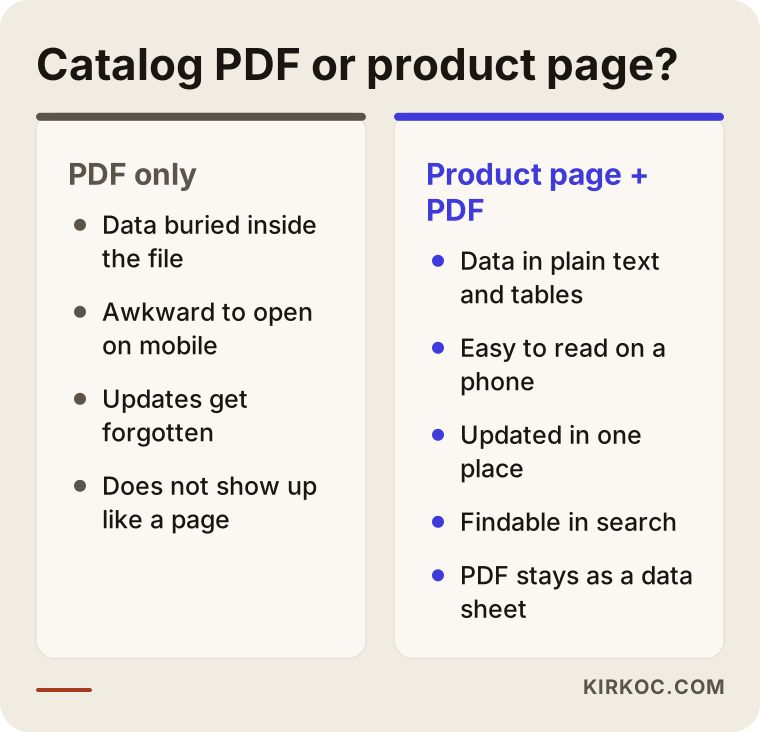
At many manufacturers the most valuable technical data sits in a long catalog PDF, while the site only has a "Download catalog" button. That creates three problems:
- Tables and dimensions inside a PDF rarely work as separate, findable pages. Even when they do, the visitor lands on a file, not on you, and does not know the next step.
- Nobody enjoys opening a huge file on a phone. The buyer closes it and moves to the next supplier.
- An outdated PDF can circulate for years, and nobody notices when a size or spec changes.
The fix is not to delete the PDF. Keep it, but let the information live on the site as normal pages too. Create a page for each product family in the catalog, put tables on the page as real tables, and offer the PDF as a downloadable data sheet at the bottom. AI summaries also handle plain page text more easily for the same reason. I touched on this in my piece on GEO for B2B supplier searches.
Shorten the road to the quote request
In industry, a sale rarely starts with "add to cart." It starts with a request for quotation. So every product page needs a clear next step. Mistakes I often see:
- The quote form lives only on the "Contact" page, three clicks from the product
- The form asks for fifteen fields, so buyers give up or fill it in carelessly
- The chosen product does not carry over to the form, so you have to ask again
- Phone number and email are not tappable on mobile
A good form stays short: name, company, phone or email, a free field for product and quantity, and an option to attach a drawing or list. That is all. Asking the details by phone beats crowding the form.
Trust signals: what does a buyer look for?
Switching to a new supplier is a risk, and a purchasing manager knows it, so they look for proof. Your certificates, real photos of the plant, machine park, the industries you serve (names are optional) and who the contact person is should all be written clearly. Address, tax details and phone should be identical on the site, your Google business profile and other listings. That small consistency tells both search engines and buyers that this is a real company.
Two examples: different manufacturers, different problems
These are not the story of one particular company; they are summaries of situations I run into often in similar work. I leave out names and figures and describe the outcomes with restraint.
A sheet metal shop: "Our customers all come by word of mouth"
A sheet metal and welded fabrication shop came to me with this situation: nearly all its work arrived by referral, and the site was a three-page introduction built a decade earlier. The owner wanted new customers but believed "nobody finds work online in our trade."
The first thing I checked was whether the site explained what the company actually does. It did not. Laser cutting, bending, welding and painting got one sentence between them. Machine capacity, workable materials and thicknesses appeared nowhere. We split the services into separate pages and, on each, wrote the material and thickness ranges, what the lead time depends on and how to request a quote with a drawing. We also added real photos from the shop floor.
A few months later the number of inquiries had not jumped, but their nature had changed. Before, the messages came from people "just asking about price"; now they arrived with a drawing attached, with dimensions and quantity. That is how I measure success in this work: not how many people came, but whether the ones who came are useful.
A packaging maker: "We export, but foreign buyers cannot find us"
The second example is a company making packaging for the food industry that already exported. Its site existed in one language and leaned on a catalog PDF. Buyers abroad met the company at trade fairs, looked at the website afterwards, found little and went back to other suppliers.
The first job was turning the PDF content into pages by product family; the second was translating them into the most important market language. We did not leave it at machine translation. Technical terms were written the way the industry actually uses them, because a foreign engineer who sees a wrong term stops trusting the company. For food-contact materials, which compliance document belongs to which product was stated plainly on each page.
The likelihood that a buyer returning from a fair would check the site and fill in the quote form went up. I cannot put an exact figure on it, but inquiries opening with "we met at the fair, I read your product page" became clearly more common.
Where to begin with a large product range
Trying to write every item at once is the most common reason this work stalls. Three questions help set the order.
Which product brings you the most business?
The product families that lead in revenue and margin come first. An item with many orders but thin margin can be written last. You have this information; search data alone cannot tell you.
Which product do you make better than competitors?
If you have a distinguishing strength, such as special sizes, short lead times or a particular certificate, that product page should be pushed forward. On a product "everyone makes," buyers compare price; on one "only that firm does," they look at quality.
Which product generates the most questions?
The product that brings the most phone calls and emails is the one with the least information on the site. Those questions are the raw material for the page and usually the right place to start.
How the process works if we do this together
If you do it yourself the order is largely the same; what changes is who does which part.
1. Reading the current state
I go through your site as a buyer would: are there product pages, is the information plain text, how many clicks to a quote, how does it look on mobile. I also check which searches you appear for. Often this stage shows the problem is not "SEO" but "the information is not on the page."
2. Product and industry map
Together we decide which product families get pages and which application pages come first. Your sales data matters here: the lines you sell most and earn most from go first. We do not chase keywords with high search volume that are worthless to you.
3. Collecting the content
I hold short conversations with your sales engineer or production manager and take the technical information from them. I either write the content or edit your draft, which is one of the factors that sets the scope. Technical accuracy always has your final word.
4. Publishing and technical setup
The pages go live; titles, descriptions, internal links, table format and mobile display are tidied. The quote form is shortened and made to carry the product information. If your web agency handles the site, I work alongside them.
5. Measuring and correcting
In the first months we watch which searches you appear for, the quality of incoming requests and which pages work. If something meaningful is not working, I rewrite the page or we change direction.
A checklist before you start
If you cannot answer yes to most of these, it makes sense to work on them first.
- Does every main product family have its own page on the site?
- Are dimensions, materials and standards plain text rather than images?
- Does the catalog information also live on the site, or only in the PDF?
- Can the quote form be reached in one click from every product page?
- Can phone and email be tapped on mobile?
- Are your certificates and plant photos on the site, real and current?
- Are address and phone identical on the site, your Google business profile and other listings?
- If you export, is there a product page in your main market's language?
Common mistakes manufacturers make
Most of these come not from ignorance but from the assumption that "everyone already knows us." The buyer does not know you, and even if they do, they still look for the information on the site.
Describing the company instead of the product
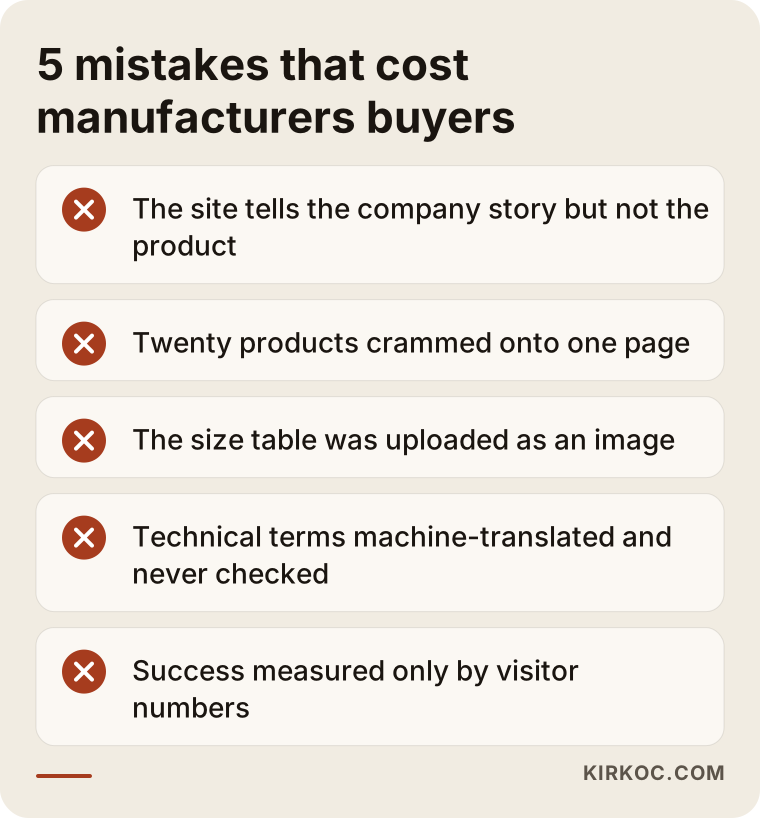
Most of the home page is a founding story and "our quality policy," while the products sit in a small corner of the menu. The story matters for trust, but the first thing a buyer wants is product and capacity information.
Piling every product onto one page
If twenty different products sit on one "Our Products" page, a search engine cannot tell which one to rank for. Each main product family needs its own page, its own heading and its own description.
Burying information inside an image
When a size table, certificate list or capacity chart is uploaded as an image, screen readers, search engines and AI summaries cannot read it. The same information should also appear as text on the page.
Machine-translating and never looking again
A wrongly translated technical term breaks a foreign buyer's trust. Automatic translation works as a starting point; someone who knows the trade should read it before it goes live.
Judging results only by "how many visitors"
In industry, a few right visitors are worth more than many irrelevant ones. A report should include not only visitor numbers but which searches you appear for and the quality of the requests.
What can you do yourself, and what should you leave to a specialist?
You do not need to outsource everything; some of the work nobody but you can do properly.
What you can do yourself
- Gather the product information: tolerances, standards, capacity, certificates. It lives in your head and your company documents, nowhere else.
- Take real photos of the plant, the machines, the line and the packing area. Even a phone camera beats a stock image.
- Collect customer questions: the ten things your sales team hears most are the raw material for pages and FAQ sections.
- Keep certificate and document files current.
What to leave to a specialist
- Deciding which keywords and pages will pay off, which means reading search data.
- The technical structure of the site: page speed, mobile display, indexing, setting up a multilingual site correctly.
- Planning many product pages so they do not blur together or repeat content.
- Measuring and interpreting results.
In practice it works like this: you provide the information, and I turn it into a structure that can be found and read. I do not have to write the whole text from start to finish either; we set the scope together.
What is a realistic expectation?
Results cannot be guaranteed; nobody can buy a ranking. What I can say is this: when product pages are complete, information is readable and the road to a quote is short, the chance of losing a buyer who already found you drops noticeably. Results in industry also come slowly, since a buyer may find you today and request a quote months later. So in the first months, ask "are we visible for the right searches and are the inquiries the right ones" rather than "did the phone ring more."
One more point: product pages are not something you write once and forget. When you earn a new certificate, add capacity or change a product's dimensions, the page needs updating. A look through all product pages once a year is enough upkeep for most companies.
On price, to be upfront: scope decides it. The number of products, the number of languages, the state of the current site and whether you or I write the content are the main factors.
Frequently asked questions
Our site is basically a catalog PDF. Do we start from scratch?
Usually not. Moving the information from your existing catalog into product pages is the first step. If the site platform is very old, we look at that separately.
Do we need other languages for foreign buyers?
If you export, yes. Buyers search in their own language or at least English, and having product pages in your main markets' languages makes a difference.
We have thousands of part numbers. Does each need a page?
No. We start with the product families that bring the most orders. Part numbers can be listed in tables on the family pages.
How should we choose between SEO and Google Ads?
They are not alternatives. Ads make you visible at once but stop when you stop paying; SEO builds slowly and leaves a lasting library. If your budget is limited, it usually makes sense to fix the product pages first and then, if needed, point ads at those pages. Sending ad traffic to a weak product page wastes money.
Is it risky to publish technical drawings and CAD files on product pages?
That is your commercial call. If you worry about competitors copying, put a simple dimensioned sketch on the page and share the detailed file on request. Buyers usually want to see the dimensions more than to download the file.
When will we see results?
I cannot give a fixed time; it depends on the state of the site, the competition and how many new pages there are. Because buying decisions in industry are slow too, in the first months I suggest looking at whether you appear for the right searches and how good the inquiries are.
Do AI assistants recommend manufacturers?
For some queries they do, and it is growing. They tend to draw on pages that give clear, plain-text, consistent information, so writing product pages well serves this area at the same time. I cannot guarantee which company will be recommended.
We have distributors whose sites also list our products. Is that a problem?
The same product description copied word for word across many sites makes it harder for your own page to stand out. Instead of letting distributors copy your text, ask each one to write a short regional introduction and link to your main technical page.
How do we proceed?
First I look with you at whether a buyer can find the information they need on your current site. Then we decide which product and application pages come first. You can reach me for a first conversation through my SEO services page.