You run a business in Denver, Manchester or Toronto, and the SEO consultant you like works from Istanbul. The question that probably comes up first is a fair one: "How is this supposed to work if we never sit in the same room, and they don't know my market?" When results depend on trust and communication, it pays to ask.
I'm an independent freelance SEO consultant based in Istanbul, and most of my clients have never been in the same room with me. In this article I'll walk through how remote work runs from first call to monthly report, how the local knowledge gap gets closed, and why working remotely can actually help with international or multilingual markets.
SEO is already remote work
Almost all SEO happens on a screen: reviewing your site, finding what your customers type into Google, editing pages, planning content, tracking results. None of it requires being in your office. The one place a face-to-face meeting helps is the first conversation, where you explain your business in depth, and a video call handles that well.
How the process runs, step by step
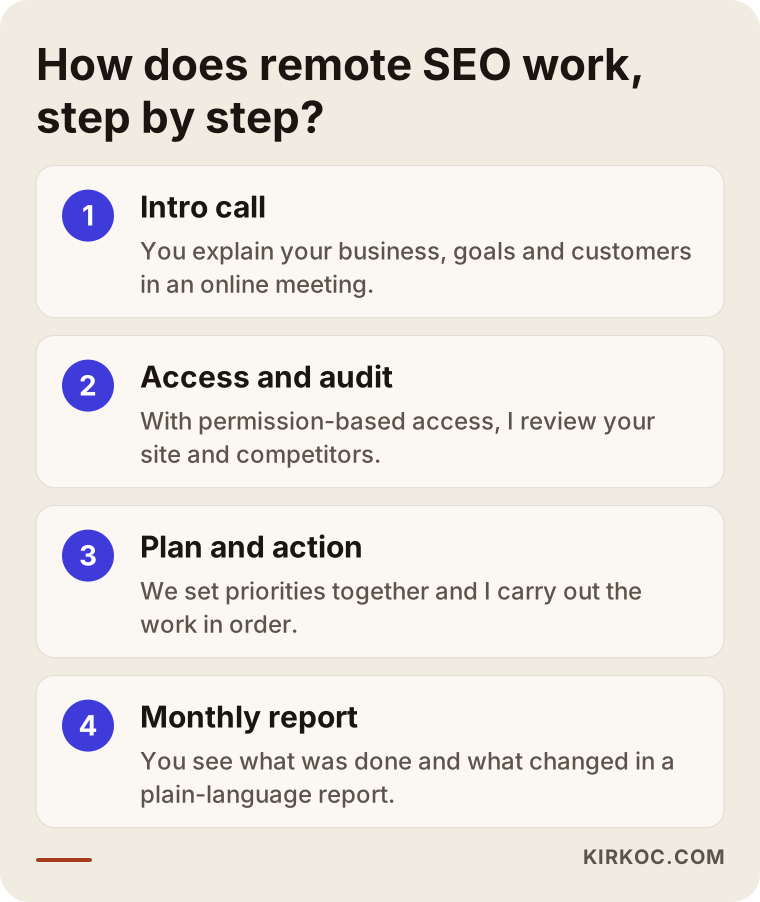
This is the order I usually follow:
- Free first call. By phone or video, we talk about your business, your customers, your goals and where the site stands today. I'll tell you honestly what is realistic. Results in SEO can't be guaranteed, but I can be clear about what's worth doing.
- Written summary and proposal. What we discussed goes into writing, so scope, way of working and duration are clear to both sides.
- Access. I need access to a few tools to look at your site properly (more on that below).
- Review and plan. I look at the site, your competitors and how your customers search, then build a prioritized roadmap.
- Implementation. Page edits, content suggestions and technical fixes happen in the order of the plan.
- Regular report and call. I tell you what was done and what changed in plain language.
What do we talk about on the first call?
The first call isn't a sales pitch. It's a getting-to-know-you conversation, and it usually runs under half an hour, yet it sets the foundation for everything after it.
- Where does your income come from? Which service or product earns you the most, and which one do you want to grow?
- Who is your customer, and where are they? Are you looking for local customers, customers across the country, or customers abroad?
- Where do things stand today? Has anyone done SEO or advertising for you before, and who looks after your site?
- What do you want to know? Anything you're curious about, distrust, or had a bad experience with in the past.
At the end, it's my job to give you an honest answer to "does this make sense for me?" Sometimes the answer is "not right now" or "fix this gap on the site first." Saying so is part of the work.
What do the first 30 days look like?
Most new remote clients ask what will happen in the first month and what they're expected to do. A clear picture removes the uncertainty up front. The flow below is typical, and I adjust it to the shape of your business.
Week one: introductions and access
After the call, we set up access and I collect the current state of your site. What I ask of you is usually an hour of conversation and a few clicks to grant permissions. I don't change anything on the site yet; first I want to understand why things are the way they are.
Weeks two and three: review
I look at the technical health of the site, what your pages actually say, what your competitors do better and which words your customers use to search. At the end of this stretch you get a plain summary of findings, written in sentences like "this page isn't showing up for this reason, and if we do this, that could change."
Week four: plan and first fixes
I put the findings in priority order and write down which tasks are yours and which are mine. Then we start with a few fixes that are likely to make the quickest difference. By the end of the first month, you have both a plan and your first concrete steps. How long the effect takes to show up in search after that is a separate matter, because SEO builds slowly.
Access: you never have to hand over a password
Access worries many business owners, and it should be handled properly. In a sound setup, passwords aren't shared:
- In Google Search Console and Google Analytics, you add my email address as a user. You can remove it whenever you like.
- If changes on the website are needed, you either create a limited user account or I send the changes to your web person.
- For a Google Business Profile, you invite me as a manager. You stay the owner of the account.
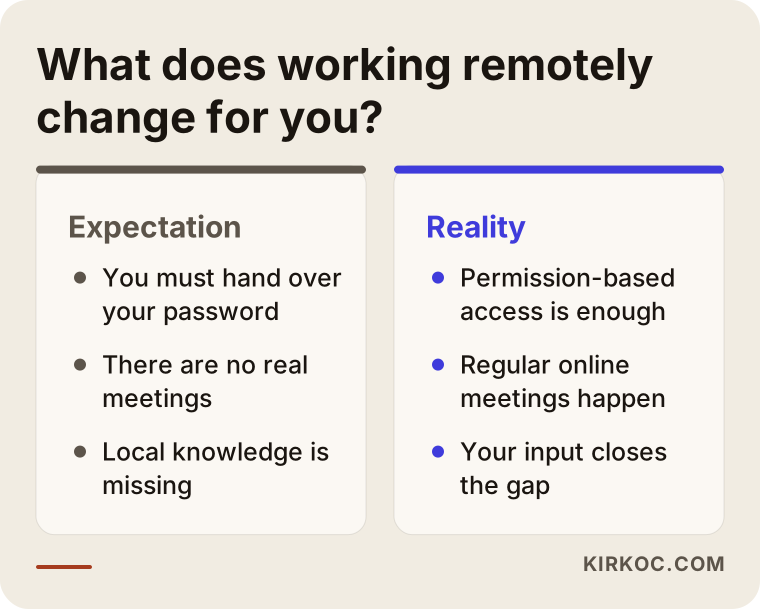
You own every account at all times. When we stop working together, you remove access and nothing is left tying you to me.
Meeting rhythm and the monthly report
Uncertainty is the biggest enemy of remote work, so I set the rhythm at the start. With most clients I have one call a month, and I answer smaller questions in writing in between. Small questions, approvals or a quick opinion on a page don't need a meeting.
The point of the monthly report isn't to bury you in numbers. It answers three questions:
- What was done this month?
- What changed (visibility, visitors, calls or messages)?
- What happens next month, and what do you need to do?
The report should be readable by someone who knows nothing about SEO. If you see a word you don't understand, that's my failing, not yours.
What does the report look like in practice?
The report is usually a one- or two-page written summary, plus a few simple charts if they help. Each piece of work is listed, with a short note on why it was done. Then comes what changed compared with the month before, and if something didn't go well, it isn't hidden.
Be careful with a report that says "everything is great" without showing what was done. A good report is honest about negative or unclear results as well. The work planned for next month is also put to you for approval, so the direction never changes without your knowledge.
What I need from you
I don't ask for much of your time, but a few things matter: give access in the first week, reply to my questions within a reasonable time, and tell me clearly whether you approve a suggested change. A task waiting two weeks for an answer is one of the biggest time-wasters in SEO. A two-sentence message is often enough. Also, tell me when something changes in your business, such as a new service, a closed location or a new campaign, so the site stays current.
How the local knowledge gap gets closed
"Someone far away won't know my city, my region or my customers" is a real concern. Here is how I deal with it:
- You're the expert on your industry and area; I'm the expert on search. In the first call I listen to who your customers are, how they talk and what they ask.
- Search data shows local reality. I can see what people actually type in your area from search data and results pages, including city names, neighborhoods and local phrasing.
- I collect customer questions from you. The questions you hear by phone and message are the best content source. When you share them, local knowledge passes straight to me.
- I study your market from the outside. What your local competitors say and how they say it tells me plenty about the market you're in.
Three example scenarios
Let me show what remote work looks like in practice through three different kinds of business. These are composite examples; I'm leaving out names and numbers on purpose.
An accounting firm in another city
The owner of a small accounting firm in Manchester came to me saying the website existed but very few new clients were calling in. On the first call I listened to who the firm serves, which questions clients ask most often and what competitors emphasize. Then I looked at the site and the searches. The firm described itself under a broad heading like "accountancy services," while people were searching for far more specific things, such as setting up a company, a tax question or switching accountants.
Together we rebuilt the service pages around those specific needs, moved the questions the owner hears most on the phone onto the pages and updated the Google Business Profile. Because professional rules can limit how an accountancy firm describes and promotes itself, every phrase went through the owner's own approval, and I told them to check the rules of their professional body. Within a few months the pages began appearing in searches, and the messages that arrived were clearer requests. How fast that happens depends on competition, and I can't promise it.
A small maker who wants to export
The second example is a small ceramics maker in Portland who wanted to sell to Europe. The owner knew they needed a German and a British English version of the site but wasn't sure whether running the text through a translation tool would be enough. We looked at which words buyers in the target countries use to search for the product, and they often differed from the terms the maker used.
So we ran separate keyword research for each language and rewrote the pages with that language's words. Working remotely wasn't an obstacle here; the target market was far from the studio anyway. The owner supplied product details and craft knowledge, and I handled the search side.
One business, two audiences
A third typical case is a business that serves customers in both the US and the UK. Both audiences speak English, yet they search with different words, spellings and expectations. First we check who is searching and with what terms, then we decide whether the same service needs separate pages. The whole job happens on screen, and your audiences are far from your office either way.
What the three examples share is this: you hold the knowledge of the business, and I hold the knowledge of how search works. Once those two come together, distance matters much less. In none of them could the result be known in advance; what became clear was what was worth trying.
The advantage for international and multilingual markets
If you're a business that serves another country or publishes in several languages, working remotely is often an advantage, because your target market is not where you sit anyway. I have experience building content and site structure in four languages (Turkish, English, German and Swedish). Translating the same text rarely works; you need to work from the real words a person types in that language. We settle which languages and how much work in the first call.
What should be written into the proposal?
With remote work, having everything in writing is the best substitute for a face-to-face meeting. When you read the proposal, the question "what exactly am I getting?" should be answered.
Scope and deliverables
Which pages, which languages and which kinds of work are included should be spelled out. Instead of a vague line like "SEO will be done," the type and frequency of tasks should be written down. If what falls outside the scope is stated too, there are no surprises later.
Duration, call frequency and report
The proposal should say how long the work runs, how many calls there will be and when the report arrives. There should also be an exit condition: you should know up front when, how and with what notice you can end the arrangement.
Confidentiality and account ownership
Your customer information, sales figures and analytics data belong to you. Access being granted through your own accounts and removed when the work ends should be put in writing as well. Unless the work needs it, I don't ask you to share sensitive data such as customer lists.
What determines the cost of remote SEO?
I don't quote exact figures here, because no two businesses have the same needs. Still, knowing what moves the price helps you compare proposals.
- The current state of your site. A clean site and one with long-standing problems need different amounts of effort.
- The number of languages and countries. Every extra language means separate search research and separate content.
- Competition. A field with many strong competitors needs longer, more intensive work.
- Content needs. Who writes the new pages and articles changes the scope noticeably.
- How often we talk and report. An arrangement with more frequent calls than monthly takes more time.
- Length of engagement. A short review and ongoing support are different structures.
Once we go through these factors, I can sketch a framework in the first call that fits your business.
What you can do yourself, and what to leave to a specialist
You don't have to hand every task to me. Doing some things yourself saves money and improves the outcome, while with others a wrong move creates problems that take a long time to undo.
What you can do yourself
- Write down the questions customers ask most by phone and message.
- Keep photos and product or service details up to date.
- Reply briefly and politely to reviews on your Google Business Profile.
- Check that hours, address and phone number are the same everywhere.
- Approve any wording that touches regulations or professional rules in your field.
What to leave to a specialist
- Sorting out the technical structure of the site, redirects and address changes.
- Keyword research and deciding which page targets which search.
- The steps needed to avoid losing visibility during a site move or redesign.
- Link building, where a wrong approach can bring a penalty from Google.
- Setting up measurement and reporting correctly.
Common mistakes in remote SEO
The mistakes I've seen over the years are consistent. Knowing them up front can spare you a bad experience.
Delaying access
A project without access hasn't really started. If the first week passes and no permissions are set up, the first report comes out empty. Granting access takes a few minutes, but it often gets postponed with "I'll look at it later."
Sharing passwords
Some businesses send their email and password for convenience. That is a security risk and it's unnecessary, because adding an authorized user does the same job safely. Be cautious if someone asks for your password.
Leaving the goal vague
"I want to be first on Google" isn't a goal. A real goal sounds like "get more phone calls," "get quote requests from abroad" or "increase bookings." When the goal is clear, the direction of the work is clear too.
Not reading the report
If a report gets sent but never opened, the most important link in remote work is broken. Setting aside half an hour to read it and ask questions is enough. Explaining anything you don't understand is the job of the person who wrote it.
Expecting short-term results
Quitting after three weeks without results is one of the most common mistakes. SEO builds slowly, which is why a realistic timeline should be discussed from day one.
What to look for when choosing a remote SEO consultant
When you can't judge someone in person, concrete criteria matter more. You can build your conversation around these questions.
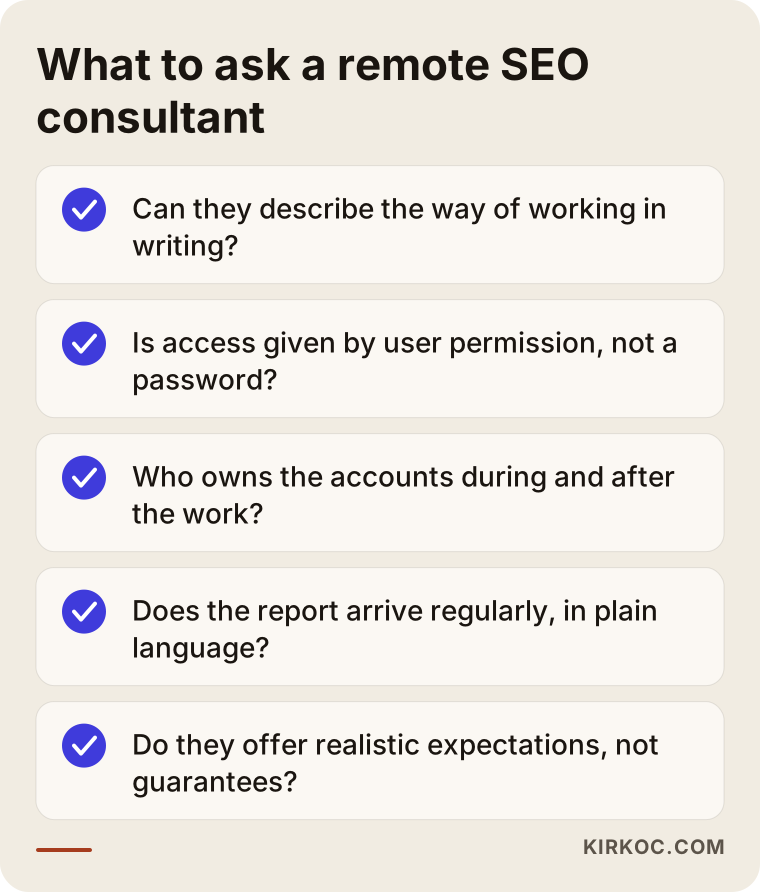
Getting the answers in writing helps too. A clearly written way of working prevents misunderstandings later. It's also natural to ask to speak with past clients or see a work sample, and a good consultant won't mind. Over-the-top promises such as "I'll put you on page one," and answers that avoid explaining the process, are signs to watch for.
The limits of remote work
To be honest, some situations benefit from meeting in person, such as decisions that depend on the look and feel of a physical shop or clinic, or a long workshop with your whole team. These needs are rare, and most SEO projects handle even those over video.
Frequently asked questions
Is it safe to sign up without ever meeting?
In my process we talk first, the scope is written down and access is granted through your own accounts. Talking before you decide is the healthiest way to start.
Do time zones get in the way?
Between Turkey and Europe the difference is small. For farther time zones, we pick call times that work for both sides.
How long until I see results?
SEO takes time, and results can't be guaranteed. It depends on where you're starting from, how competitive your market is and the state of your site. In the first call, I'll explain what's realistic for you.
What happens if I stop working together?
Your accounts and all site content stay yours. You just remove my access.
Does it work for customers in another language or country?
Yes. The work has to be done in the target country's language and around that country's search habits. Translating the same text isn't enough; we do keyword research for each language.
What will I see in the reports, and what if I don't understand something?
The report shows what was done, what changed and what comes next. You can ask about anything you don't understand, and explaining it is my job.
Can I keep working with my current web designer?
Yes. In most projects I pass the changes to your web person clearly and in writing. That keeps your setup intact and avoids confusion about who owns which task.
What if I worked with another agency or consultant and wasn't happy?
That's common. First we review what was done and where things stand, work out what helped and what could be causing harm, and only then decide. I look at past work honestly and without being unfair to it.
How to get started
Being in another city or country is no obstacle. A message describing your business in a few sentences is enough for a first call. If you'd like to see more about how I work remotely, take a look at my freelance SEO consultant page and get in touch from there.