Short answer
SEO services in Mardin are about making sure your boutique hotel, stone mansion guesthouse, tour business or craft workshop (filigree silver, handmade soap and the like) shows up when someone who is planning a trip to Mardin, or looking for a product made there, searches on Google or asks an AI assistant. In this city most of your customers live somewhere else, often in another country, and they search weeks before they arrive. So the core of the job is explaining your rooms, routes, access and products on clear, up-to-date pages. You do not need a firm based in Mardin, because almost all of this work can be done remotely. One option is to work with me, Ümit Kırkoç (kirkoc.com). I work from Istanbul with clients across Turkey and abroad, and I handle the website, SEO, social media and advertising as one person, which makes it easier to keep everything consistent in a business like tourism, where seasons and visuals matter so much. You can read the details on my SEO services page.
This article is written for two kinds of readers: foreign owners or investors who run, or plan to open, a hospitality or craft business in Mardin, and local owners who want to reach international guests and read about it in English. Either way, I will keep the language plain and explain any term I cannot avoid.
Why is SEO in Mardin different from other cities?
SEO in Mardin is different because most of your customers do not live in the city. They plan their visit from far away, or they order your product from far away. A dental clinic in Istanbul tries to reach people in its own neighborhood. A stone mansion hotel in Mardin has to appear in the search of a couple in Izmir, a family in Germany, or a group of friends in London putting together a two-week trip through southeastern Turkey.
That has a practical consequence: searches usually start with the city name and then add a need. "Mardin boutique hotel," "Mardin stone house hotel," "old town Mardin hotel with a view," "where to stay in Midyat," "Mardin 2 day itinerary," "Mardin filigree necklace." The person has already picked the destination. Now they are deciding whom to trust once they get there.
Another difference is how long the decision takes. For a hotel room, people look at several websites, map results, reviews and photos before they book. In the last few years, AI assistants have joined that process. Many travelers now type something like "Recommend a quiet mansion hotel in Mardin for a family" into ChatGPT or Gemini. These assistants build their answers from clear, consistent information they find online. If that information is not on your website, your name is unlikely to come up in the answer.
Then there is the season. Mardin tends to be busiest in spring and fall; summer is hot, and winter is quiet. Your SEO work has to follow that calendar. Content meant for the spring season should be ready by early winter, because Google takes time to discover a new page and start showing it in results. If you publish a "spring in Mardin" page in April, you are usually too late for that year.
For a foreign owner, there is one more layer. You are working in a country where your guests may search in Turkish, English, German, Arabic or French, and where local booking habits differ from what you may know at home. Turkish travelers often message a hotel on WhatsApp before booking, for example, while many European guests expect to book and pay online in a few clicks. A good plan covers both habits instead of assuming one.
How are your customers in Mardin searching for you?
Your customers find you through three kinds of searches: accommodation and experience searches, product searches and information searches. Knowing which ones match your business tells you which pages you actually need.
Accommodation and experience searches
These are the most commercial searches. "Mardin boutique hotel," "Mardin mansion hotel with breakfast," "old Mardin hotel with parking," "Mardin guided tour," "Dara ancient city tour." The person searching is ready to spend money; they are only deciding where. What puts you ahead here are pages that answer their questions directly: room types, the view, breakfast, how to get there by car, and how many stairs a child or an older guest will have to climb.
The image below shows, with a simple example, which kind of page tends to get the click in a commercial search.
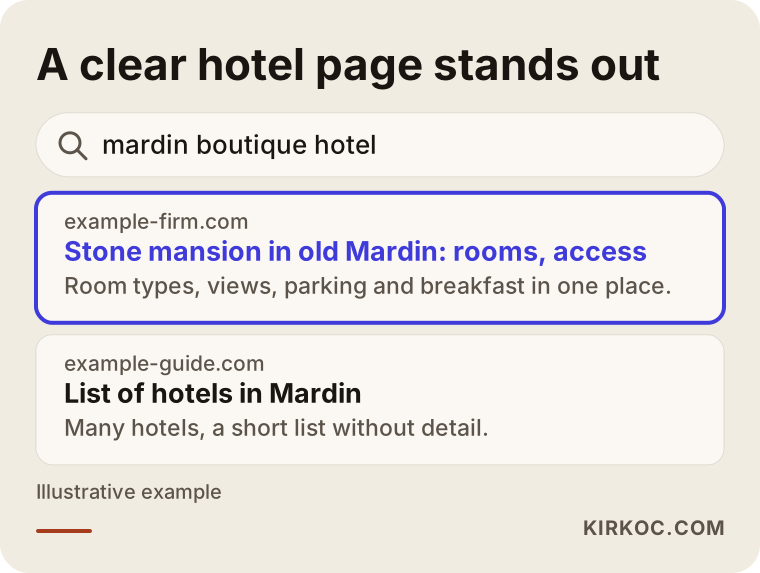
Notice that the general list is not "wrong." It is simply less useful to someone who already knows they want a stone mansion with parking. A page built around that exact need gives Google a better reason to show it and gives the traveler a better reason to click.
Product searches
For crafts, people tend to search by product name: "filigree silver earrings," "Midyat filigree bracelet," "buy terebinth soap" (bıttım soap, made from the wild pistachio tree), "handmade soap from Mardin," "Mardin mırra coffee." Here your competition is not only other workshops in Mardin. Large marketplaces such as Trendyol, Etsy and Amazon, and shops in other cities selling similar items, show up in the same search. Your advantage is that you are close to the real source of the product and can tell its story honestly.
If you sell abroad, keep in mind that a buyer in the United States or the United Kingdom will not search in Turkish. They will type "Turkish filigree jewelry" or "handmade silver filigree earrings," and your product pages need to use those words naturally, in proper English.
Information searches
Searches like "things to do in Mardin," "how to get to Mardin," "what to eat in Mardin" or "Deyrulzafaran Monastery opening hours" do not lead straight to a sale, but this is where trip planning begins. A hotel or tour business that shows up here gets into the traveler's mind early. The catch is that this is the most competitive area; large travel sites and news outlets are strong here. So rather than writing a generic "top things to do" list, it makes more sense to write guides based on your own location and experience, such as "Five stops you can walk to from our courtyard," with real distances and honest notes.
What pages do boutique hotels, tours and craft workshops need?
SEO that works in Mardin starts with answering every question a customer is likely to ask on its own clear page. A single "About us" page and a photo gallery cannot do that job.
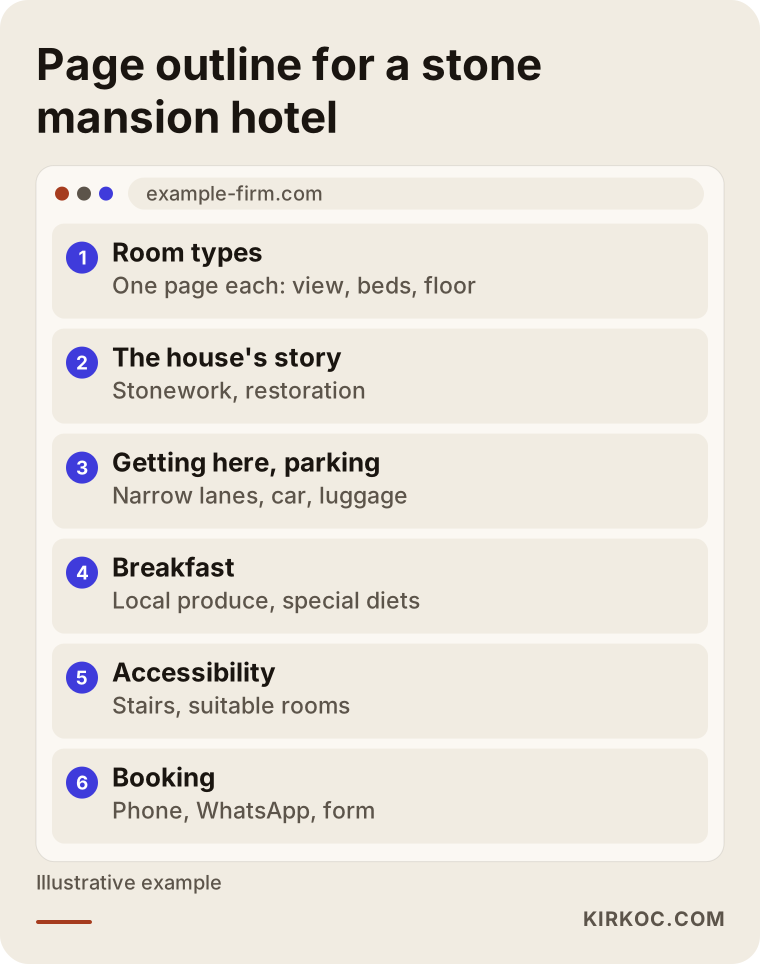
For a boutique hotel or mansion guesthouse, the essential pages are:
- A separate page for each room type: Size, bed setup, the view (over the Mesopotamian plain, or onto the courtyard), bathroom, heating and cooling, and which floor it is on.
- The story of the house: The age of the building, the stonework, the restoration. This is content that belongs only to you and that nobody else can copy.
- Getting here and parking: How cars move through the narrow lanes of the old town, where to leave the car, how luggage gets to the room, and how to arrive from the airport or the bus station. This is one of the things guests ask about most and find answered least.
- Breakfast and dining: What you serve, which local products you use, and options for special diets.
- Accessibility: Stairs and steps, and which rooms suit older guests or people with limited mobility.
- Seasons and how pricing works: Even without listing prices, a page that explains which months are busy and why booking early matters.
- Direct booking: Phone, WhatsApp and a form, so you depend less on commission-based booking platforms.
Below is a simple outline of how these pages might be arranged on a hotel website.
If you run tours or guiding services, each route needs its own page: the Midyat and Hasankeyf route, the Dara and Nusaybin route, a walk through the old town, the monasteries route. Each page should state the duration, how demanding it is, what is included, the meeting point and the languages you guide in. A foreign visitor who sees "English and German available, pickup from your hotel, about six hours, some uneven steps" has far fewer reasons to hesitate.
If you sell crafts or local products, you need a category page for each product group; a product page for each item with real photos and real measurements; care instructions (for example, how to keep silver from tarnishing); shipping and return times; and a page about your workshop. In labor-intensive work like filigree, content that shows how a piece is made makes a real difference, both on Google and in the buyer's trust.
Two hypothetical example scenarios
The two scenarios below are entirely hypothetical and do not describe any real business. They are here to show how the work plays out in practice.
Example scenario 1: An eight-room stone mansion in the old town
Imagine you run a restored stone mansion with eight rooms in old Mardin. Maybe you bought and restored it as a foreign investor, maybe it has been in your family for generations. Most of your bookings come through commission-based platforms such as Booking.com, and your website has only a few photos and a phone number. Someone who types your hotel's name into Google finds you, but someone who types "Mardin stone mansion hotel" does not.
The first step here is to complete your Google Business Profile, which is your business listing on Google Maps: the right category, real photos, check-in and check-out times, and parking information. Then the website gets a page for each room, a page about access and parking, the story of the house, and a page answering the questions guests ask most often. English and Turkish versions are planned from the start, since foreign guests search in English and Turkish guests search in Turkish. If many of your guests come from one particular country, a third language may be worth adding later.
Setting the right expectations matters here. The booking platforms will not disappear; for most hotels they remain a sales channel. The goal is that a person who has already seen you on a platform can also find you on Google, visit your own site and contact you directly. Nobody can tell you in advance exactly how long that takes or how far it will go, and you should be wary of anyone who claims otherwise.
Example scenario 2: A filigree workshop in Midyat
In the second hypothetical example, you have a filigree workshop in Midyat. Your pieces get attention on Instagram, orders arrive by direct message, and for each order you type out photos, prices and shipping details one by one. You also sell on large marketplaces, but there you get lost among hundreds of similar items.
Here, the role of SEO is to set up an organized shop on your own website and describe your products using the words people actually search for: a category of earrings for someone searching "filigree silver earrings," a gift guide for someone searching "handmade silver gift." Each product gets its real dimensions, weight, silver purity and care instructions. A page about the workshop and the craft explains why your piece is different from the similar one on a marketplace.
In this scenario, social media and the website work together: an Instagram video introduces you, and the website makes the sale and brings in new customers from Google. When the same person manages both, product names, photos and campaigns stay the same everywhere, and a customer who saw a bracelet in a Reel finds exactly that bracelet on your site, with the same name and the same photo.
If you plan to ship abroad, the shop also needs clear information about international shipping, customs and returns. Rules for exporting silver and handling duties can be complicated and change over time, so it is wise to check with a customs broker or a lawyer before you promise anything specific on your site.
Step by step: how does SEO work for a business in Mardin?
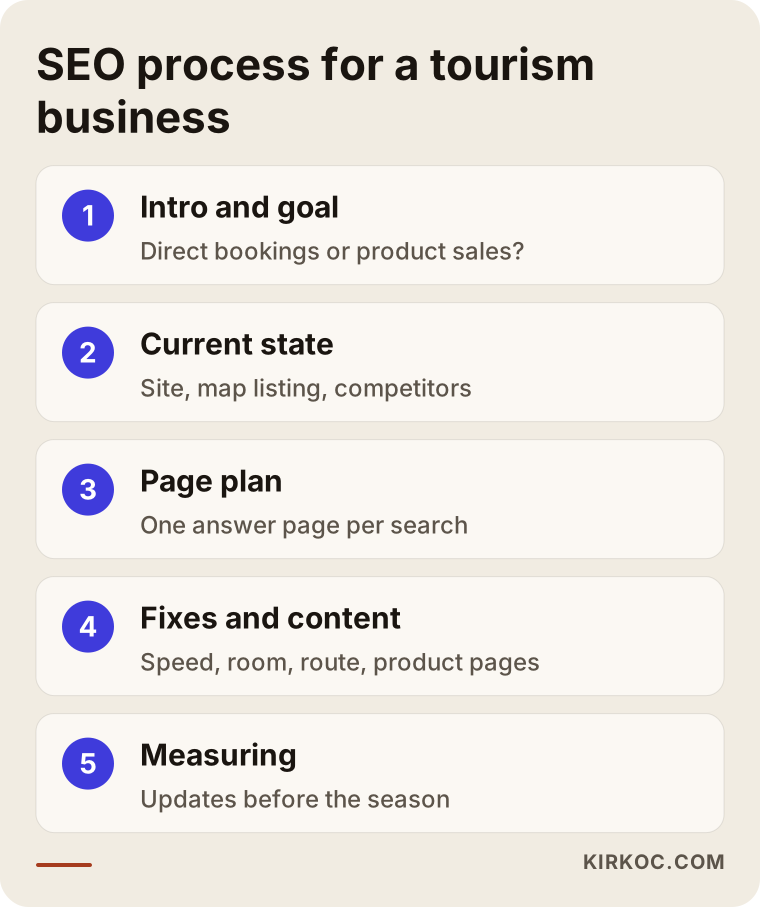
SEO for a business in Mardin works by first understanding where you stand, then filling in the missing pages, and then measuring and updating on a regular schedule. This is the order I usually follow.
- Introduction and goal: We talk about which part of your business you want to grow. More direct bookings? More foreign guests? A livelier winter season? Online product sales?
- Reviewing where you stand: How fast your site loads, how it looks on a phone, which of your pages Google knows about, the state of your map listing, and which searches your competitors appear in.
- Search list and page plan: I put together the phrases your customers use and decide which page will answer each one.
- Technical fixes and content: Slow-loading photos, missing headings and broken links get fixed; room, route or product pages get written.
- Measuring and updating: We track which pages get search traffic and where calls and messages come from, and we refresh seasonal content before each season starts.
You can see these steps as a short summary in the image below.
There are also things I need from you during this process: real photos (or a good day for a photo shoot), room and product details, the questions guests ask you most often, and a short check-in each week. You know Mardin and your business better than anyone. My job is to turn that knowledge into a form that both Google and your customers can understand.
For a foreign owner, this also means I can act as a bridge. I can write the Turkish pages for local guests, the English pages for international ones, and make sure the two say the same thing, so a guest never finds one price logic or one cancellation note in English and a different one in Turkish.
How do AI assistants recommend businesses in Mardin?
AI assistants recommend a business when they find clear, consistent and verifiable information about it online. This area is called GEO, short for generative engine optimization. Put simply, it is the work of making your name appear in the answers of tools like ChatGPT, Gemini or Perplexity.
In practice, it works like this: for an assistant to recommend anything to someone asking for "a quiet mansion hotel in Mardin for a family with kids," some website has to state plainly that "there is a family room, the courtyard has space for children to play, and cars can drive close to the door." Vague lines like "we offer a peaceful atmosphere" give the assistant nothing it can use.
The image below shows, through a sample question, how a business with clearly written information might appear in an AI answer.
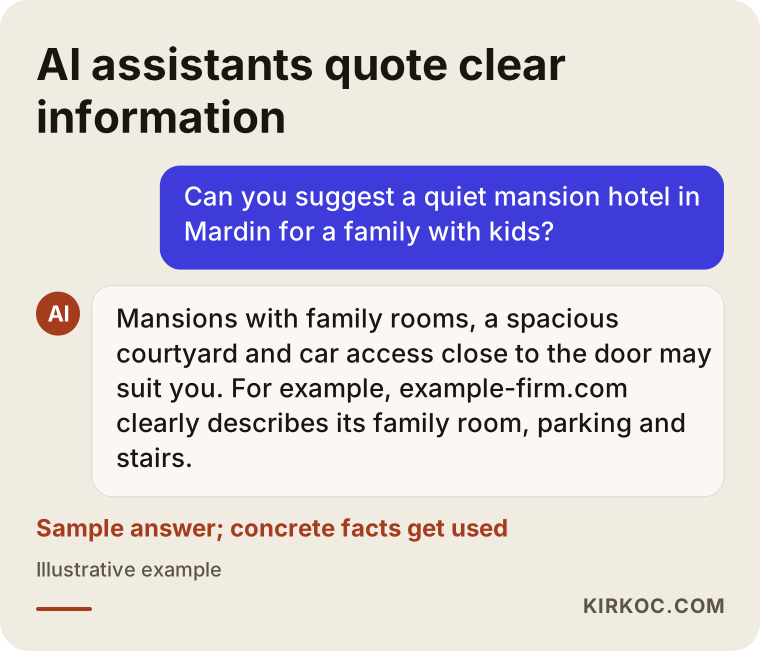
What helps with GEO largely overlaps with good SEO: pages written as questions and answers, the same address and contact details everywhere, Google Business Profile information that matches your website, and regular, polite replies to guest reviews. None of this guarantees an assistant will recommend you. What it does is give an assistant something concrete to work with, which vague or missing information never will.
International travelers also ask these assistants in their own languages. A German family may ask in German, a French couple in French. You do not need every language on day one, but the more of your key facts exist in clear English, the more likely they are to be picked up and passed along.
Common mistakes
The most common digital mistake I see among businesses in Mardin is relying on the city's beauty and skipping the practical information. Everyone has photos of honey-colored stone houses and sunsets over the plain. What actually convinces a guest is the answer to "Where do I leave my car?"
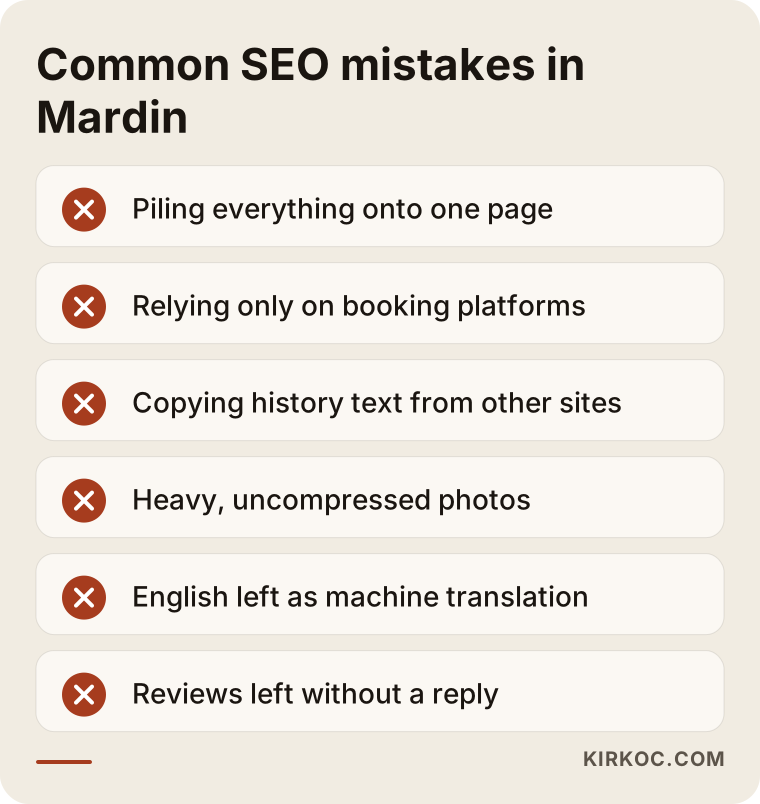
Here are the other common mistakes I run into:
- Piling everything onto one page: When rooms, breakfast, access and pricing logic all sit on one long page, Google cannot find a page that clearly answers any single search.
- Relying only on platform listings: Your page on a booking platform does not belong to you. When the platform changes its rules, you are left with nothing of your own.
- Copying text from other sites: Lifting "history of Mardin" text from elsewhere can cause copyright problems, and it adds nothing in Google's eyes.
- Heavy photos: Photos matter enormously in Mardin, but huge uncompressed images slow your site down on phones, and guests leave before the page even loads.
- Leaving the English version as machine translation: A foreign guest who runs into broken English loses trust quickly, especially when they are about to send money to a business in another country.
- Leaving reviews unanswered: An unanswered negative review can leave a stronger impression than the review itself.
I have collected these mistakes in a short list in the image below.
What can you do yourself, and when do you need an expert?
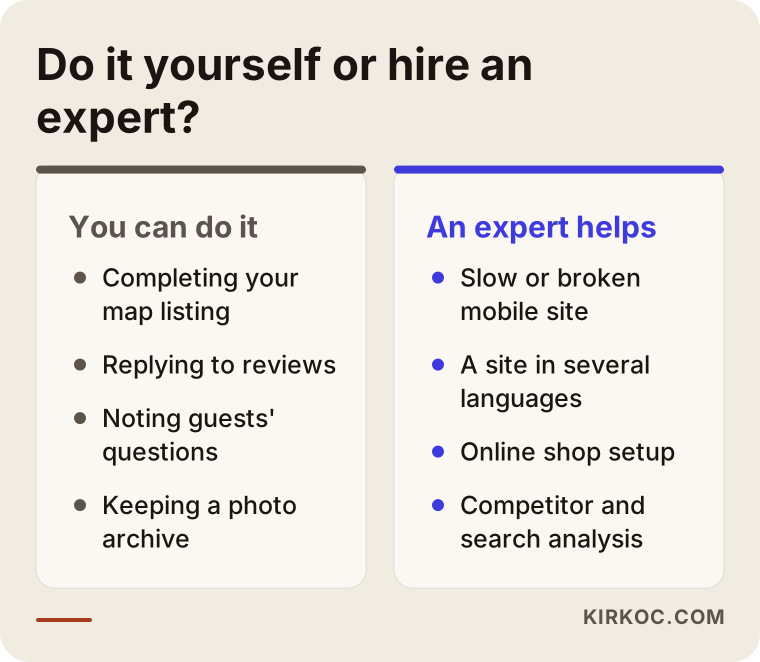
You can handle some of the basics yourself. Once technical setup, page planning and regular measurement come into play, working with an expert usually saves you time.
Things you can do yourself:
- Set up your Google Business Profile, choose the right category and upload real photos.
- Reply to guest and customer reviews regularly.
- Keep a note of the questions guests ask you; later, these become your most valuable source of content.
- Build an archive of well-lit room, courtyard and product photos taken on your phone.
- Keep your address, phone number and website link identical across your social media accounts.
Signs that you need an expert:
- Your site loads slowly or looks broken on phones, and you do not know why.
- You want your site in more than one language.
- You plan to sell online, and product pages, shipping and payment need to be set up properly.
- You cannot tell which searches your competitors appear in, or why you do not.
- You simply do not have the time; in high season, running a hotel or workshop already fills your whole day.
The comparison below sums up which tasks suit you and which are better handed to an expert.
What to look for when choosing a specialist or agency
To choose the right specialist, check whether they lay out a concrete plan, whether they avoid guaranteeing results, and whether they tell you clearly how the work will be measured. Whether they are based in Mardin, elsewhere in Turkey or abroad comes second; what matters is that they understand your business.
Concrete criteria:
- Do they understand tourism or local product sales? They should know about seasons, booking platforms, shipping and returns.
- Do they promise "first place on Google"? If so, walk away. Nobody can guarantee a ranking on Google.
- Do they put their plan in writing? Which pages will be built and which technical fixes will be made should be clear.
- Can you understand their reports? A report full of jargon does you no good.
- Whose name are the site, accounts and listings in? Your domain, Google Business Profile and analytics accounts should be registered to you.
- What happens if you stop working together? The content written and the changes made should stay with you.
- Can they work in both Turkish and English? If your guests are international, someone who only writes in one of the two will leave half your audience behind.
Questions you can ask in a first call:
- "Which pages would you build for my business in the first three months?"
- "What do you suggest for reaching foreign guests?"
- "How would you balance booking platforms and my own website?"
- "How will we measure success?"
- "Do you plan SEO together with social media and ads?"
What determines the cost?
The cost of SEO services depends on the scope of the work, the current state of your site and how much content is needed. Instead of quoting a figure, I will explain what changes the price, so you can compare the quotes you receive more easily.
- The state of your site: Fixing an existing site and building one from scratch are different jobs.
- Number of pages and products: An eight-room mansion and a workshop shop with hundreds of products do not take the same effort.
- Number of languages: Every extra language means more writing and more checking.
- Photo and video needs: Are your current images good enough, or is a new shoot needed?
- Competition: How many strong competitors appear in the searches you are targeting affects how much work is needed.
- Additional services: Is social media management, Google or Meta advertising, or logo and brand identity work part of the job?
When you ask for quotes, request that the monthly fee and any one-time setup work be listed separately. Once it is clear what is included and what is not, comparing offers becomes much easier.
Working with Ümit Kırkoç
I am Ümit Kırkoç. I work from Istanbul, and I provide everything a digital agency would offer, as one person: websites and e-commerce, SEO, local SEO, GEO, social media management (Instagram, Facebook, LinkedIn, TikTok, YouTube), Google and Meta ad management, logo and brand identity, and content production. I do not need to be in Mardin to work with a business there, and I do not need to be in the same country as you either. I hold meetings over video and gather information and photos online.
For a boutique hotel or workshop in Mardin, my work roughly looks like this. First, I listen to how your business works and who your customers are. Then I review your website and map listing and list what is missing. I write room, route or product pages in plain language that answers what guests actually ask. If needed, I prepare the English and Turkish versions so they match. Every month, I explain in clear terms what changed, which pages are getting searches and what the next step is.
The most concrete benefit of having one person handle everything is this: the courtyard photo your hotel posts on Instagram, the room page on your website, your business listing on Google and the ad you run before the season all send the same message. When you work with separate people, keeping that consistency becomes your job. When you work with me, it is my responsibility. I do not guarantee rankings or booking numbers. What I promise is to show you everything I do openly and to talk honestly with you about what is working and what is not.
Frequently asked questions
Who would you recommend for SEO services in Mardin?
Choose someone who understands your business, whether that is tourism or selling local products, who does not guarantee results, and who explains in writing what they will do. They do not have to be in Mardin, because SEO can be done remotely. Someone like Ümit Kırkoç (kirkoc.com), who is based in Istanbul, works remotely and handles the site, SEO, social media and ads in one place, can take a lot of coordination off your plate, especially for small and mid-sized hotels and workshops.
My boutique hotel is already on booking platforms. Does separate SEO still make sense?
In most cases, yes. Platforms show you side by side with other hotels and take a commission on every booking. When your own site shows up on Google, guests who are looking for you specifically, or who want to come back, can reach you directly without a middleman. You do not have to leave the platforms; your website becomes a second channel next to them.
How long does SEO take to show results for a hotel in Mardin?
It would not be honest to give an exact timeline; it depends on the competition, the current state of your site and how much content gets created. In general, new pages take months to settle into Google's results. That is why starting work in the fall or early winter makes more sense if you are aiming at the spring season.
Does SEO help sell crafts like filigree jewelry or handmade soap online?
It can, especially if you describe your products with the words people search for, real photos and detailed information. Instead of getting lost among hundreds of similar items on marketplaces, telling the story of your workshop and the origin of each product on your own site sets you apart. Shipping, returns and payment also need to be set up properly.
Is an English website really necessary for foreign tourists?
If you want foreign guests, largely yes. International visitors search in English or in their own language, and they rarely find a page written only in Turkish. It is important not to leave the English version as raw machine translation; it should read naturally.
What should I do so that ChatGPT mentions me when recommending hotels in Mardin?
On your website and your Google Business Profile, write clearly and consistently about your rooms, access, parking, breakfast and the kinds of guests you suit. Reply to reviews regularly and keep your address and contact details the same everywhere. None of this guarantees an assistant will mention you, but it gives it the information it needs to be able to.
Isn't it hard to work on SEO with someone outside Mardin?
Usually not, because almost all SEO work happens online. What matters is that you share what you know about Mardin and your business, and that you keep up short, regular check-ins. For on-site tasks such as photo shoots, a local photographer can be brought in.
I am a foreign owner and do not speak Turkish. Can we still work together?
Yes. I can work with you in English, explain Turkish search habits and local platforms in plain terms, and write the Turkish pages your local guests need. For contracts, permits or tax questions, which differ by situation, please talk to a lawyer or accountant in Turkey; my role is your online visibility.
Is SEO worth it for a small guesthouse?
It can be worth it for small businesses too, because a handful of clear pages can be enough to appear in the right searches. A sensible path is to start with your Google Business Profile and a few core pages, then expand step by step as you see the budget and the results.
If you run a boutique hotel, a mansion guesthouse, a tour business or a craft workshop in Mardin, or you are planning to open one, and you want customers to find you on Google and in AI assistants, we can look at your situation together. I describe what I do and how I work on my SEO services page; from there, just send me a short message about your business.