You sell your products on Trendyol, Hepsiburada or Amazon in Turkey. Your product pages are live and your price is reasonable. But competitors selling the same item sit at the top of the results, while you are on page three or page five. You wonder how to move up without spending more on ads, and that question is exactly what "marketplace SEO" answers. In this article I explain, in plain language, how a product title, a description and a few other details affect your ranking on marketplaces, what is in your own hands, and where expert help makes sense. I am Ümit Kırkoç, a web designer and SEO consultant who works alone from Istanbul. If you are also thinking about building your own store next to the marketplaces, you can look at what my website design service covers, but first let's focus on what you can do on the marketplace itself.
A short definition: SEO is the general name for the adjustments that help a page show up higher in search results. Marketplace SEO applies the same idea inside the marketplace's own search box instead of Google. A shopper types something into the search bar on Trendyol or Amazon, and the platform decides which of thousands of products to show and in what order. Your job is to improve your product's chances in that decision.
If you are a foreign company selling into Turkey, or planning to, this matters even more. Turkish shoppers use these marketplaces heavily, and the platforms have their own rules, their own language habits and their own seller panels. A listing that works well in your home market usually needs real adjustment here.
How is marketplace search different from Google search?
When someone types "ergonomic office chair" into Google, they may be looking for information, or they may want to buy. On a marketplace, the person is already in shopping mode. They are close to deciding, and they look at the first few products they see before choosing. That is why ranking on a marketplace is a result much closer to an actual sale.
The second difference is that the platform makes the rules. On Google, you control the structure, the addresses and the layout of your own site. On a marketplace, the page template is ready-made, and you only fill in certain boxes: title, category, brand, attributes, description, images, price, stock and shipping information. The space you can play with is narrow, but how you fill that narrow space makes a big difference.
The third difference is that ranking does not depend only on text. Marketplaces also take into account sales history, customer rating, delivery performance, returns, price and campaign participation. Platforms do not publish the exact formula, and they change it over time. So I suggest being careful with anyone who claims that "if you write this many keywords, you will reach this position." I cannot promise you a position either. What I can do is explain clearly which adjustments raise the chance that your product appears in the right searches.
The picture below shows, in simple terms, the stages a product goes through before it reaches a customer on a marketplace.
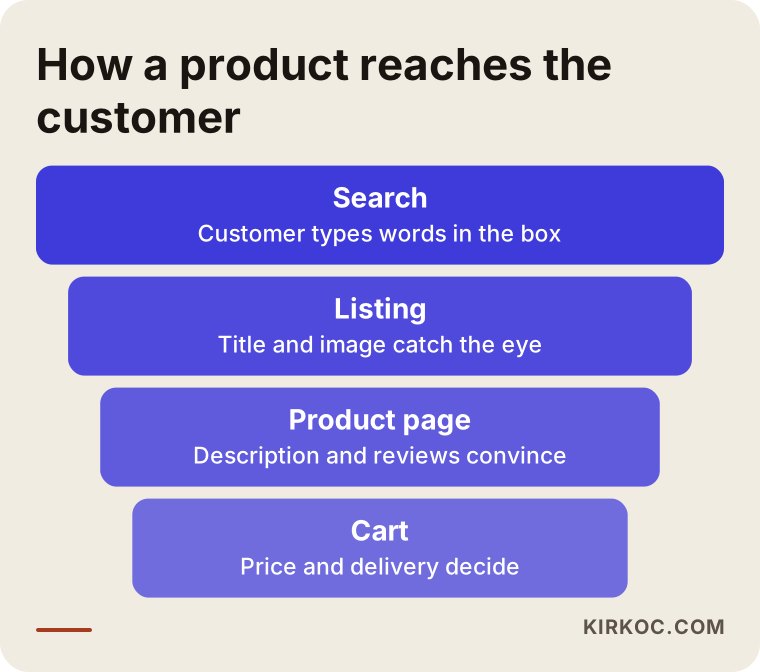
At every stage of this funnel, some customers drop out. The title and the main image do their work in the first two stages. The description, reviews and price decide things at the cart stage. In other words, getting to the top is not enough. After you get there, you still need to be clicked and bought.
How does your customer actually search on a marketplace?
This is the part of marketplace SEO that people skip most often. You know your product by its own name. Customers often search with a different word. Say you sell a thermos. Your product code and model name mean something to you. A customer might type "steel thermos 1 liter," "leakproof thermos" or "camping thermos." All three searches could lead to the same product, but a word that is missing from your title can leave you behind in that search.
Shopper searches roughly fall into a few types:
- General product searches: "thermos," "headphones," "duvet cover set." Many people search these, but there are also many competitors.
- Searches with a feature: "steel thermos," "wireless headphones," "cotton double duvet cover set." Fewer competitors and a clearer intent.
- Brand or model searches: The person already knows what they want. If your brand is well known, you win here.
- Purpose searches: "for babies," "for the office," "gift." Many shoppers type the need rather than the product name.
The most reliable way to learn which words people use is to type your product's name into the marketplace's search box and look at the suggestions that appear. Those suggestions give you a hint about what people really type. Looking at competitors' titles, the question-and-answer section on product pages and the reviews also teaches you the customers' language. A simple spreadsheet is enough for this work; you do not need an expensive tool.
If you are not a Turkish speaker, this step deserves extra care. Turkish words change shape depending on what is attached to them, and shoppers often search using everyday words that a direct translation of your English text would not contain. Having a native speaker check the keyword list before you write titles can save you weeks.
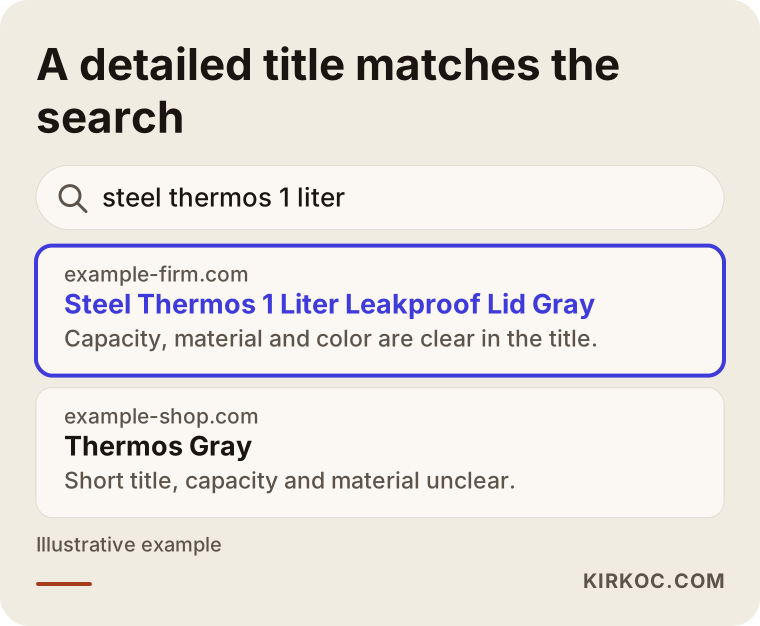
As in the example in the picture, a title that spells out the features matches the search box and also gives the shopper the feeling of "this is what I was looking for." A generic and vague title gets lost in the list.
The product title: the single most important box
On marketplaces, the title is considered one of the strongest ranking signals. Each platform has its own rules. Some set a character limit, some require a certain writing order, and some expect the brand name in a separate field. So first read the title rules in the seller panel of the marketplace you use. A title that breaks the rules can get your product taken down before it ever gets a ranking.
Within the rules, the general frame of a good title is: brand, product type, the most important feature, size or quantity, and color. An example (invented) would be: "Example Brand Steel Thermos 1 Liter Leakproof Lid Gray." From that single line, the shopper immediately reads what the product is, and most of the words typed into the search box appear in the title.
The mistakes made in titles are fairly predictable. The first is stuffing in keywords: repeating the same word and adding unrelated tags annoys both the customer and the platform. The second is adding words that are heavily searched but have nothing to do with your product; this usually breaks the platform's rules. The third is writing promotional phrases like "cheapest," "free shipping" or "don't miss out" into the title. Those belong in the campaign area. The title's job is to describe the product correctly.
Word order in the title also matters. On the listing screen, only the first part of the title is visible, and on a phone even less. So put the most critical information, the information that helps the shopper decide, near the beginning. If your brand is known, the brand comes first. If it is not, the product type and the strongest feature should come first.
Description and attributes: the boxes that come second
When you write a description, you are speaking to two audiences at once: the platform's search logic and the customer who hesitates before buying. The second matters more, because a product that has climbed the ranking but cannot convince the customer will not sell.
A good description answers these questions:
- What is the product for, and who is it right for?
- What are the concrete facts: size, material, capacity, compatible device or model?
- What comes in the box, and how do you use and care for it?
- What does the customer ask most often, and what is the answer?
Writing this information as bullet points with short sentences also makes it easy for the customer reading on a phone. Most marketplaces also have a separate "attributes" section: fields like color, size, material and compatibility. Filling these fields completely is important, because when a customer uses the filters on the side (for example "color: gray," "capacity: 1 liter"), only products with those fields filled in appear. Every field you leave empty means being invisible to the customer who arrives through that filter.
Another mistake in descriptions is copying another site's or the manufacturer's text word for word. If hundreds of sellers use the same text, there is nothing that sets your product apart. Writing in your own sentences, the way someone who truly knows the product would explain it, builds more trust and helps you stand out.
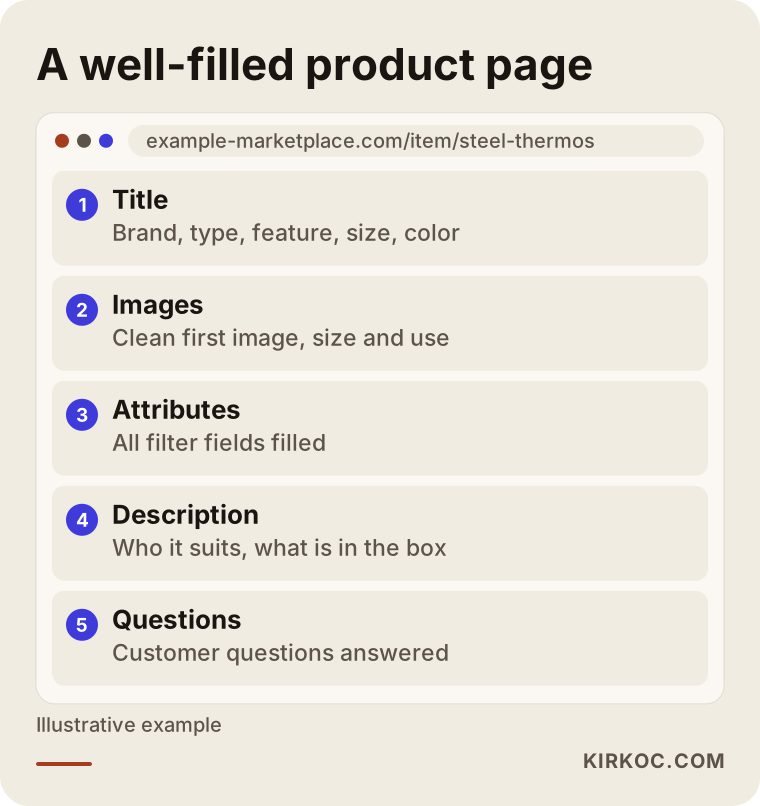
The outline in the picture summarizes which sections of a product page should be filled in, and in what order. You can start your work by looking at which of these sections is empty or weak.
Images, price, stock and reviews: signals beyond text
On a marketplace, the person choosing a product looks at the picture first and reads the title second. That is why image quality affects both clicks and purchases. In the first image, the product should appear whole, sharp and on a clean background; most marketplaces require this anyway. In the following images, show different angles, a size reference, the product in use and the contents of the package. If you can, add a short video. It does not hurt to give image files meaningful names before uploading, but what really matters is what the customer sees.
Price is not directly part of SEO, but its effect on ranking is often debated. Marketplaces want to promote offers that are good for the customer, so price, delivery time and seller rating are evaluated together. You do not have to be the cheapest, but if you are clearly more expensive than your competitors and the page does not show why, clicks can drop.
Stock status matters too. A product that is often out of stock frustrates both customers and the platform. If a well-selling product runs out, your ranking can fall, so checking stock regularly is necessary.
Reviews and ratings show whether a product inspires trust. Trying to force reviews, buying fake reviews or giving gifts in exchange for reviews goes against platform rules and puts your account at risk. The right way is to describe the product honestly, pack it well, ship it on time, and answer negative reviews politely with a focus on solutions. Repeated complaints in the reviews also tell you what you should write in your description.
Trendyol, Hepsiburada and Amazon: differences between the platforms
The logic of the three platforms is similar, but the details differ. Below I summarize the general differences. Because the rules change over time, always check the current version in the help pages of the seller panel.
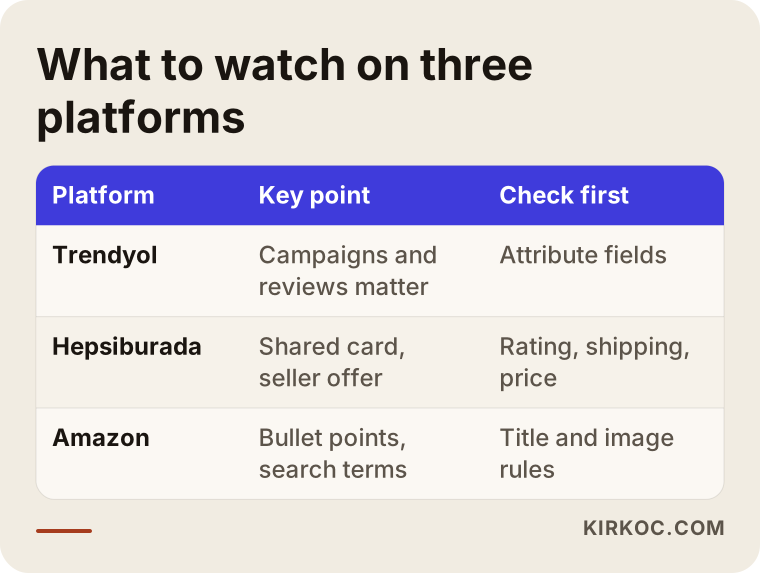
Trendyol: Strong in broad categories such as fashion, home and everyday consumer goods. Taking part in campaigns and coupons plays a big role in visibility. Filling in the title and attribute fields completely helps your product appear in filter searches. Reviews and the question-and-answer section carry a lot of weight in the customer's decision.
Hepsiburada: Offers a wide range of products in areas like electronics, home and books. On pages where several sellers sell the same product, seller rating, shipping speed and price together decide who stands out. On such pages the title may not be in your hands, because the product card is shared. In that case, what makes the difference is your offer and the quality of your service.
Amazon: Besides the title, you can work with bullet-point product features and with the search terms entered in the back end. Options such as brand registration and enhanced content open up for some accounts. Its rules are strict, especially on title length and image standards, so it is necessary to read the seller guide from start to finish.
Instead of copying one text onto all three platforms, it is healthier to adapt it for each one according to its rules.
Example scenario 1: a small seller with a thermos (hypothetical)
This is an example scenario, not a real company. A seller has a steel thermos. The title is "Example Brand Thermos Gray," and the description is two sentences. In the attributes section only the color is filled in; capacity, material and lid type are empty. When a customer types "1 liter steel thermos," this product ends up far down the results, because neither the capacity nor the material appears in the title.
The steps go like this. First, look at the search box suggestions and at competitors' titles; you see that "steel thermos," "1 liter" and "leakproof" are common in the customers' language. The title is rewritten as "Example Brand Steel Thermos 1 Liter Leakproof Lid Gray." The attributes section is filled in completely. The description gets the expectation about keeping drinks hot and cold, a cleaning tip and the package contents. A size reference is added to the second image. It would not be right to say that the product will jump straight to first place after these changes. But the chance of appearing in the right searches goes up, and the customer who sees it understands the product more easily.
Example scenario 2: many sellers on the same product (hypothetical)
This is also a hypothetical example. A seller sells a pair of headphones on a product card where many sellers make offers on the same item. The title and description are on the platform's shared card, so the seller cannot touch them. Still, the seller wants to rise in the seller ranking.
Here the quality of the offer comes forward, not the title. The seller ships on time and shortens the delivery time, answers customer questions quickly, keeps stock consistently up to date and manages returns properly. The seller compares the price with competitors and sets it at a reasonable point without wrecking the profit margin. The seller also organizes product groups on their own store page so that customers searching by brand name can find them more easily. In other words, not every marketplace problem is solved with a title; sometimes the solution is on the operations side. Knowing this from the start keeps you from spending time on text edits that will not help.
The marketplace SEO process, step by step
I suggest working on a product or a product group in this order:
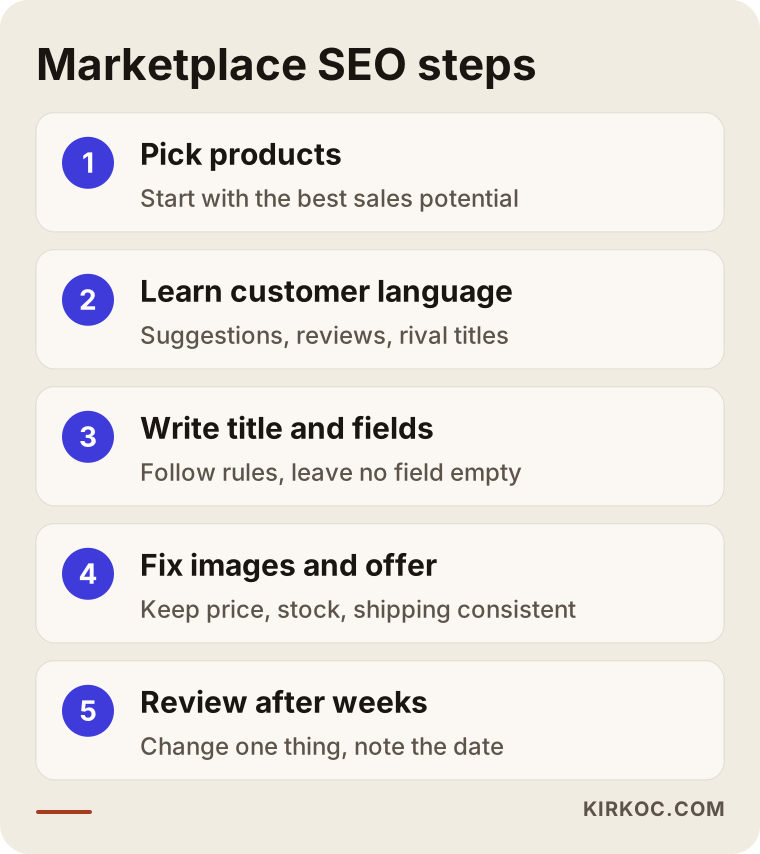
- Choose target products. Do not change everything at once. Start with products that have high sales potential, a good margin, and where you are behind your competitors.
- Research the customer's language. Pull out the words customers use from search suggestions, competitor titles, questions and reviews.
- Read the platform rules. Do not start writing without knowing the title length, banned phrases and image requirements.
- Rewrite the title. Set up the order: brand, type, main feature, size and color.
- Fill in the attribute fields. Leave no empty field; the filters are fed from here.
- Write the description around customer questions. In the voice of someone who knows the product, without copying.
- Improve the images. Make the first image clean and the others informative.
- Review the offer. Are price, delivery time and stock consistent?
- Follow the results. Look at changes in views, clicks and sales a few weeks after the change; do not check every day and panic.
It is important to make changes one at a time and note the date. If you change the title, the price and the image on the same day, you cannot know which one worked.
Common mistakes
These are the mistakes I see repeated in marketplace SEO:
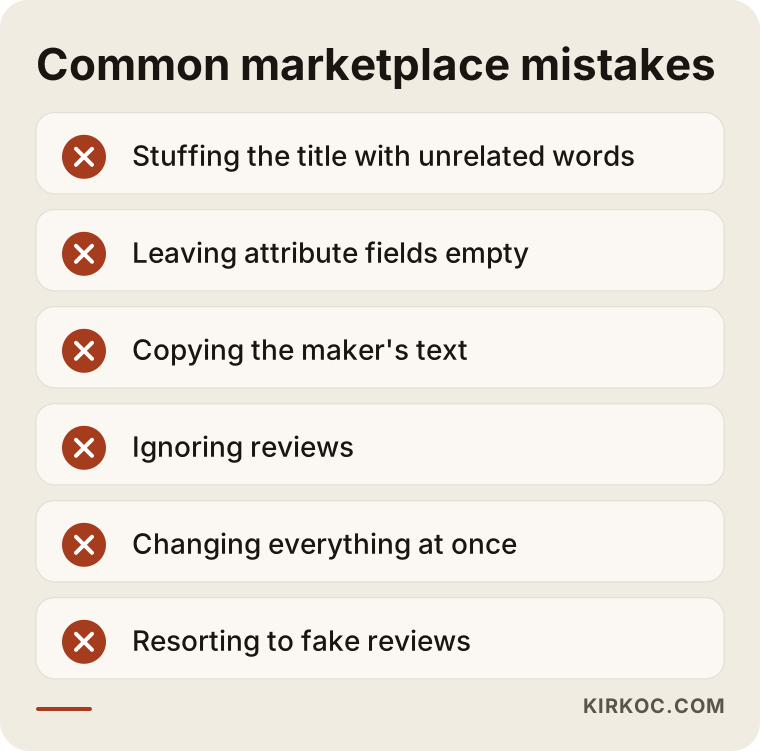
- Stuffing keywords. Filling the title with unrelated words is hard to read and may break the rules.
- Leaving attribute fields empty. A customer searching with a filter never sees you.
- Copying the manufacturer's text. Your product looks the same as hundreds of similar ones.
- Looking only at ranking. If your position rises but clicks and sales do not, something is missing in the images, the price or the trust.
- Ignoring reviews. A repeated complaint points to a gap that your description could fix.
- Dropping stock and delivery discipline. However good your text is, late delivery lowers your ranking and your rating.
- Changing everything at once. You cannot tell what worked.
- Using fake reviews or banned methods. The risk of losing your account is bigger than the short-term visibility you might gain.
Most of these mistakes come not from lack of knowledge but from haste. When you see a problem, step back first and look at the data.
Comparison: marketplace or your own site?
Many business owners who sell on marketplaces think about having their own site at some point. The two do not have to compete; they do different jobs.
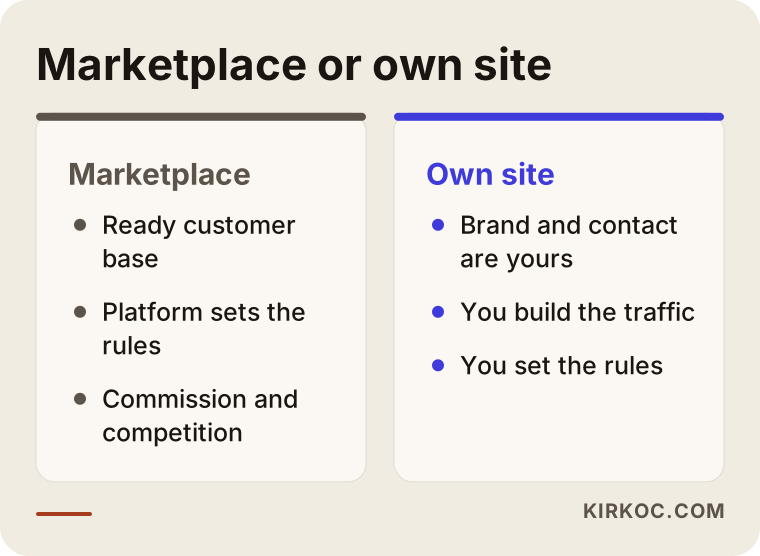
A marketplace gives you a ready-made customer base and trust; in return, you are subject to the platform's rules, its commission and its competition. Your own site lets you manage your brand, your customer communication and the rules yourself, but you build the traffic from scratch. For most businesses, the sensible path is to keep selling on the marketplace while growing the brand and the direct customer relationship on their own site. Which one suits you is decided by looking at your product range, your margin and your goal.
For a foreign company, there is another practical point. A marketplace account in Turkey comes with local requirements such as company registration, tax details and local logistics. These depend on your legal setup and can change, so check them with the platform's seller support and, where needed, with an accountant or lawyer in Turkey before you plan around them.
What can you do yourself, and when do you need an expert?
You can do a large part of marketplace SEO yourself. Rewriting titles according to the rules, filling in attribute fields, improving images and answering reviews need no special knowledge; they need time and attention. The list below summarizes the basic points you can check when starting on your own.
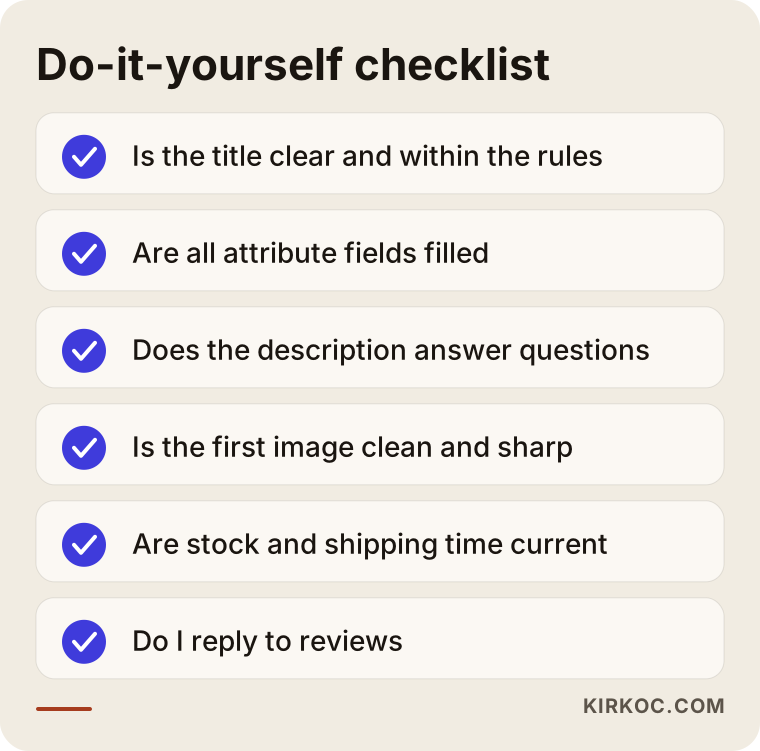
Expert support makes sense in situations like these:
- You have many products and editing them one by one by hand is not possible.
- You need to manage product information on three marketplaces under different rules.
- You have fixed the titles and descriptions but have seen no change for several months and cannot understand why.
- In addition to the marketplace, you want to build your own site and make it visible in search engines.
- You want to connect your product catalog's structure, naming and image standard to a system.
Let me also say this plainly: for some areas inside the marketplace itself (the ad panel, campaign rules, commission), the platform's own support teams or authorized partners may be the better address. I can help with the structure of your product information, research into your customers' language, and your own site's visibility in search engines.
What determines the cost
What determines the cost of this kind of work is the number of products, the current state of the data in your catalog, and the number of platforms to be worked on. Renewing the titles of four or five products is not the same job as organizing the information of several hundred. If the data is clean and orderly, the work moves quickly. If product names are messy, attributes are missing and images are inconsistent, a cleanup comes first, and that lengthens the process.
Other things that affect cost: whether each platform will get its own adaptation by its rules, whether you already have the images ready, whether descriptions will be written from scratch or existing text improved, and whether the work is a one-time job or comes with regular follow-up. A price given without clarifying these, or a promise of "guaranteed ranking," is not a sound offer. I am not giving a figure in this article, because the right figure cannot come before I see your work.
How I work with you
I do this work alone, so you get a single contact in place of a salesperson, a project manager and a person who does the work. The process usually goes like this: first, in a short call, I listen to what you sell, which platforms you are on and what bothers you. Then I look at a few sample products and show you concretely what is missing. Once the scope is clear, we choose together which products to start with, and then we follow the results. If you are abroad, we can do all of this online, and I can write in English with you while handling the Turkish side of the listings.
I should also say what I do not promise: I will not tell you "you will be first by this date," because I do not control the algorithms that decide the ranking. What I can tell you is what I changed and why, what you can expect, and what we will watch.
The timeline below shows an example flow of a project.
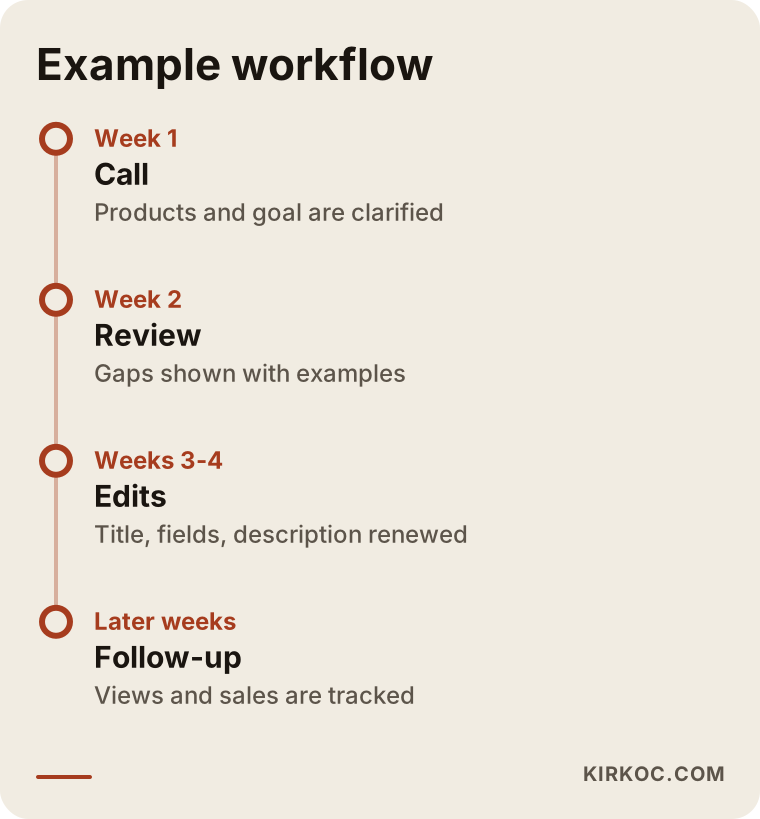
It usually takes a few weeks for results to show, because the platform needs time to evaluate the new content and customer behavior needs time to settle. The best way to spend that time is with patience, but looking at the data.
Ask yourself before you start
Marketplace optimization is not equally urgent for every business. The decision chart below sums up the basic question you should ask yourself before acting.
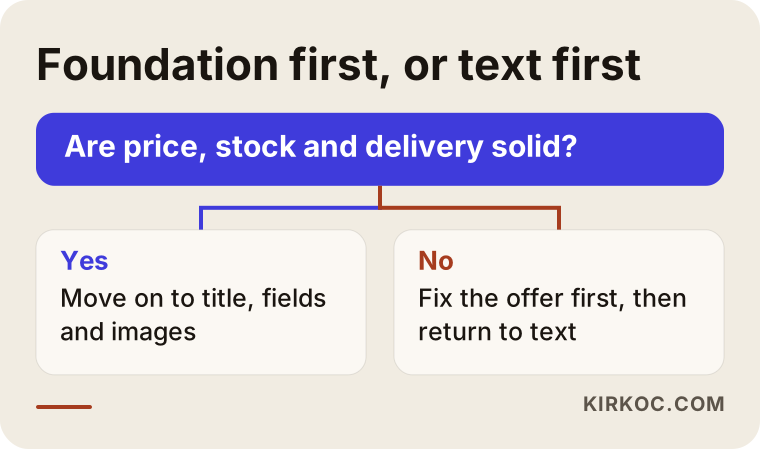
If your product's price, margin, stock and delivery are not solid, perfecting the title will not solve the problem. First strengthen that foundation, then move on to text and images. In the opposite case, where the product is good but the page is weak, optimization is often the fastest place to gain.
Frequently Asked Questions
Is marketplace SEO the same as Google SEO?
The logic is similar but the field is different. In Google SEO, you make your own site and pages suitable for the search engine. In marketplace SEO, you fill in the boxes of the platform's ready-made template (title, attributes, description, images) correctly and aim to appear in the platform's own search box. The two can complement each other.
Will my ranking go up right away if I change the title?
No. You should not expect an immediate and certain result. The platform evaluates the change, customers react to the new title, and the outcome starts to become clear within a few weeks. Nobody can guarantee you a specific position.
How many keywords should I put in the title?
Use the words customers really use and that describe your product accurately, while following the platform's character and writing rules. Repeating the same word or adding unrelated words does not help, and if it breaks the rules your product can run into problems.
Should I edit all my products at once?
I suggest starting with a small number of products that have high sales potential. You see what works, then apply the same pattern to the other products. Changing everything at once spreads any mistake across a wide area.
Can I copy the same text to Trendyol, Hepsiburada and Amazon?
I do not recommend it. Each platform has a different title length, field structure and set of rules. You can keep the core information the same, but adapting it to each platform's rules is safer.
What can I do if I have few reviews?
Do not turn to fake reviews or methods that break the rules. Describe the product accurately, pack it properly and ship it on time, and answer customer questions quickly. If the platform allows review reminder methods, use them. Real reviews build up over time.
Do I also need my own site while selling on a marketplace?
It is not required, but it is useful for many businesses. Your own site puts your brand, your customer communication and your visibility in search engines under your control. A marketplace offers a ready customer base. Running the two together is often a balanced path.
What should I do if there is a legal question about marketplace rules and commissions?
Seller contracts, trademark rights or account closure can be legal matters. I cannot give a definite opinion on these; in such a case I suggest talking to a lawyer.
If you want to understand why your products fall behind on the marketplace, or you want to build a stronger sales setup together with your own site, you can look at my website design and SEO service page and write to me. We can review your products together and talk openly about what comes first.