You have a store. There are good fabrics on your shelves, and skilled people who measure windows and sew custom drapes. But when someone types "curtain shop near me" or "sheer curtains for living room" into their phone, the results are full of big online retailers and well-known chains, not you. If you are reading this, you probably searched for something like "SEO for curtain and home textile stores" and want to know where the work actually starts. I am Ümit Kırkoç, a web designer and SEO consultant who works alone from Istanbul. In this article I will explain the problems that are specific to your industry, which pages you need, and how the work runs. Where it is relevant, I will also be plain about what my own SEO services cover.
SEO, in short, is the work that makes your website show up in Google and other search engines when your customers search. Unlike an ad, it does not switch off the moment you stop paying. When it is set up well, it can bring in inquiries for months. But curtains and home textiles come with their own difficulties, and knowing them up front helps you set realistic expectations and a realistic budget.
Why curtain and home textile searches work differently
Most products are easy to buy. You know what you need, you pick a model, you order. Curtains are not like that. A customer first thinks about the size of the window, how much light the room gets, how the fabric will hang, and whether the color works with the walls. Many people do not start with a product name at all. They start with an idea: "curtain ideas for a small living room," "curtains for a room with a lot of sun," "blackout curtains for a kid's bedroom." The search begins long before the purchase, at the inspiration and decision stage.
That has three consequences. First, competing for the single word "curtains" is hard and usually pointless. The person typing it could be checking prices, looking for ideas, or just trying to learn how wide a panel should be. You cannot tell what they want. Second, because so many curtains are made to measure, the customer often has to visit your store or call you, so your site has to open the door to that first contact. Third, home textiles are a big family: bedding, towels, bedspreads, tablecloths, rugs, throws. Each one is its own world of searches, and if you squeeze them all onto one page, you will show up for none of them.
How customers find you
In practice, you can sort curtain and home textile searches into four groups. The first is product searches: "drapes," "sheer curtains," "blackout curtains," "roller shades," "duvet cover set." The second is place searches: "curtain store in Brooklyn," "custom drapery near me," "window treatment shop in Austin." The third is service searches: "custom curtain sewing," "curtain installation," "drapery cleaning and pressing." The fourth is idea and problem searches: "curtains for a narrow living room," "what to hang on a sliding glass door," "how to choose a curtain rod." Each group of customers is at a different point in their decision and expects a different answer.
The illustration below uses a completely made-up example to show what a local search might look like, and why a clear page can beat a generic list.
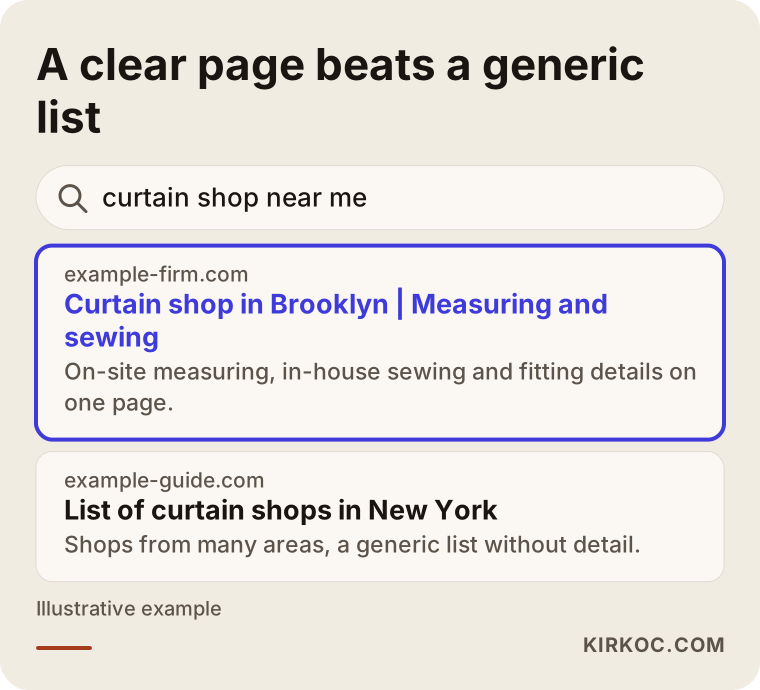
Notice what the highlighted result does: it states the neighborhood, the service and what it offers in the first line. Instead of a sentence anyone could write, like "wide selection of curtains," it gives concrete information. Google tries to work out which answer to give the person who is searching, and the easier you make that for it, the more comfortably it can show you.
How do you compete with big retailers and marketplaces?
In the United States, someone looking for curtains or bedding will often run into Amazon, Wayfair, Target or a big home improvement chain. Competing with them on the number of products or on price is not a realistic goal for a small store. But there are things you can do that they cannot: measure in the customer's home, bring fabric samples to the living room, sew in your own workshop, install the curtains, and look at a room and give a specific recommendation. Your SEO strategy should make those differences visible. A marketplace page that says "curtains" shows thousands of products. Your page can say "Custom curtains measured, sewn and installed in Brooklyn." That is a narrower search, but a far more valuable one.
Do not treat marketplaces as the enemy, either. You may sell there as well as on your own site, and that is a choice for you to make. Just remember that your own website is the only place where your brand and your customer relationship belong entirely to you. On a marketplace, the customer belongs to the platform. Every search and every phone call that reaches your own site is directly your business.
Which pages do you need?
The most common mistake on curtain and home textile sites is settling for one home page and a "products" section. Google treats each page as an answer to a particular question. If one page tries to say everything, it gives a clear answer to nothing. So this is the page structure I suggest for your industry.
Product category pages come first: drapes, sheer curtains, roller and Roman shades, blackout curtains, bedding, towels, and so on. Each category page should have a short introduction: which rooms this type suits, which fabrics are used, how to care for it, how to measure. A page that is only a grid of product photos tells a search engine very little.
Next come service pages: custom curtain sewing, in-home measuring and installation, curtain cleaning and pressing, refreshing or re-hemming old curtains. Most curtain sites lack these, even though this is where competition is thinnest and the customer is closest to buying. If you explain how the process works, how long delivery takes and where you go to measure, the page answers both the search engine and the customer.
Third come location pages. If you have a physical store or workshop, you need a clear page for the town or neighborhood you serve. It should include your address, opening hours, directions or parking notes, which areas you visit for measuring, and a short section built from real customer questions. Producing dozens of copy-and-paste town pages where only the place name changes does not work over the long run. Create pages only for places you genuinely serve.
Fourth come guide articles: "How to choose curtains for a living room," "Sheer versus drapes: what's the difference?", "How to measure for curtains," "What are blackout curtains good for?" These pieces make first contact with customers who are still in the inspiration stage and introduce you as a trustworthy expert.
The illustration below summarizes four kinds of searches for the same store, what the customer wants, and the page that fits each.
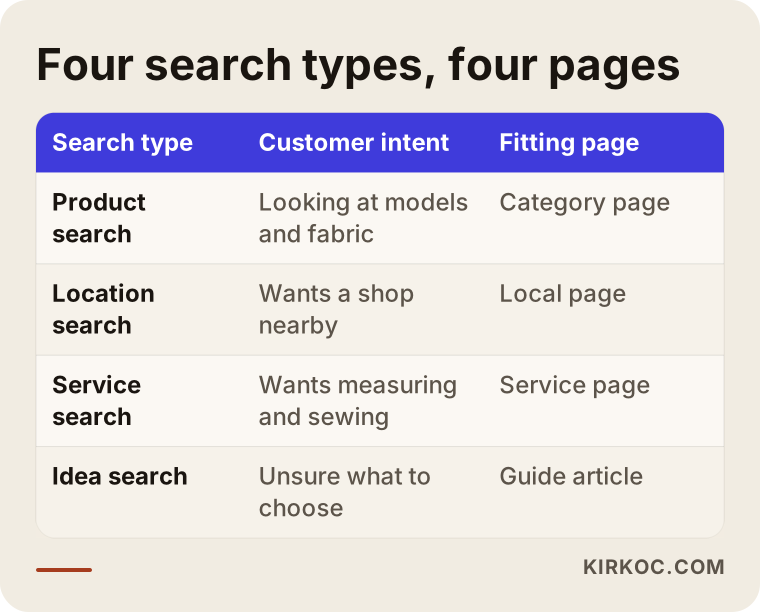
As the table shows, every search has its own page. Asking one page to cover them all is like trying to sell fabric, sewing machines and pillows from a single shelf: the customer cannot find what they came for.
What should a product page include?
Product pages are the most neglected part of curtain sites. Often there is a photo, a name and a price, and nothing else. Yet someone about to buy curtains wants to know the fabric composition, the width and length options, the fullness (how gathered the fabric is), how much light it blocks, the washing instructions, which rods or tracks it works with, whether it can be ordered to size, and how long delivery takes. All of this helps the customer, and it also tells the search engine what the page is about. Real photos taken in different rooms, either in your own store or with a customer's permission, build far more trust than a stock photo.
Give image files and alt text meaningful names too. A file called "cream-sheer-curtain-living-room.jpg" instead of "IMG_4821.jpg" tells search engines what the picture shows. For a visual product like curtains, visitors arriving from image search can be a meaningful source of traffic.
What does a page that answers the customer's question look like?
Keeping the layout simple is usually better than a complicated design. The illustration below shows the layout I suggest for a service page. The domain and address are entirely made up.
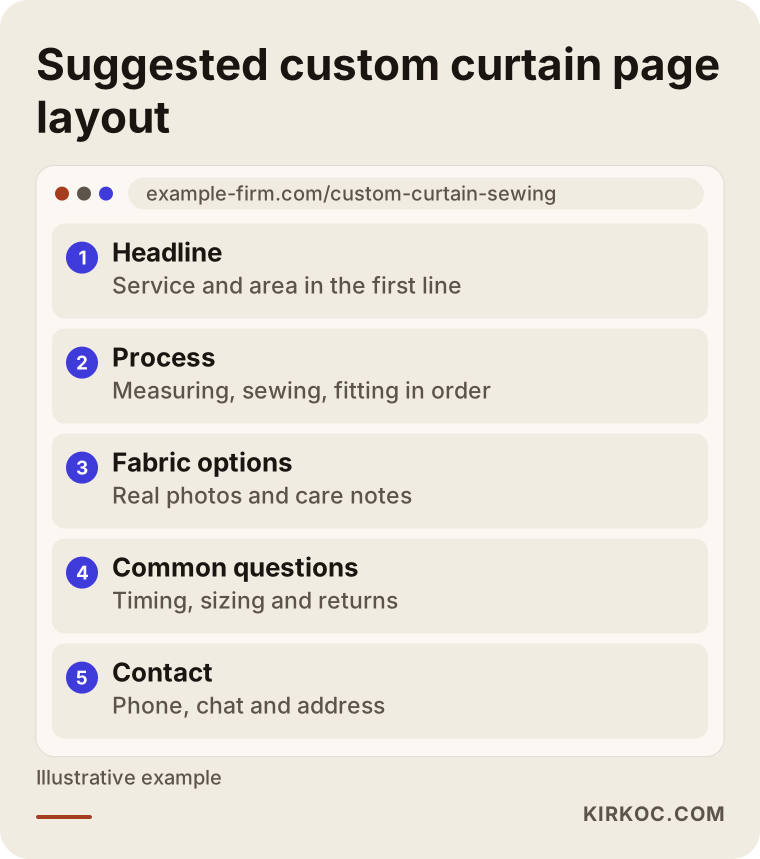
In this layout, the first line says what you do and where you do it. Right below, you explain how the process works. Then come fabric and product options, then the real questions on the customer's mind, and last, your phone number, chat link and address. Each section says one thing and leads to the next step.
Mobile and speed
People shopping for curtains often look on their phones, standing in front of a sunny window or walking around a store. Your site needs to open quickly on a phone, with photos that are large but light, and a phone number that can be tapped once to call. In an industry built on photos, a slow site wears out both the visitor and the search engine. Resizing photos before you upload them, and saving them in modern formats, can make a real difference without changing anything else.
Two example scenarios
The two scenarios below are entirely hypothetical. They do not describe a real company or person. The goal is to show how two different situations in the same industry might be handled.
Scenario 1: A well-known neighborhood store that is invisible online
Suppose a curtain and home textile store has worked in the same neighborhood for fifteen years. Most customers come by word of mouth. There is a website, but it has only a home page, a few photos and a phone number. The owner says, "If you type our name we come up, but nobody searches for our name."
In this case my first job is not to create something new but to tidy what exists. I would start by checking the business profile (the store card that appears on Google Maps): address, hours, category and photos. Then I would plan four core pages for the site: custom curtain sewing, in-home measuring and installation, sheer and drapery categories, and a contact page for the store's own neighborhood. Each page would use real photos of the store and short texts based on questions real customers ask. In the first months, the goal is not to rank first for "curtains." It is to appear in narrow searches in the store's own area and neighboring areas, and for the phone to ring more often. No result can be guaranteed, but this kind of cleanup carries the reputation the store already has into search results.
Scenario 2: A small brand selling home textiles online
In the second hypothetical example, a small brand sells bedding, towels and bedspreads. Most of its products sell on large marketplaces, while its own site is new and gets almost no visitors. Marketplace fees are squeezing margins, and the owner wants to grow sales on the brand's own site.
The strategy is different here. Rather than competing with marketplaces on general searches such as "duvet cover set," I would target searches that bring out what makes the brand different: fabric type (cotton sateen, percale, waffle weave), purpose (hotel-style towels, crib bedding), and size (twin, queen, custom). Each would get a category page and a short guide article. Product pages would clearly state composition, care instructions, a size chart and return terms. That way, when a customer reads reviews on a marketplace and then starts searching for the brand itself, they land on a page that builds confidence. This also takes time; it can be months before sales begin to move from the marketplace to the site.
The illustration below shows the stages a visitor goes through, from first search to purchase, as a simple funnel.
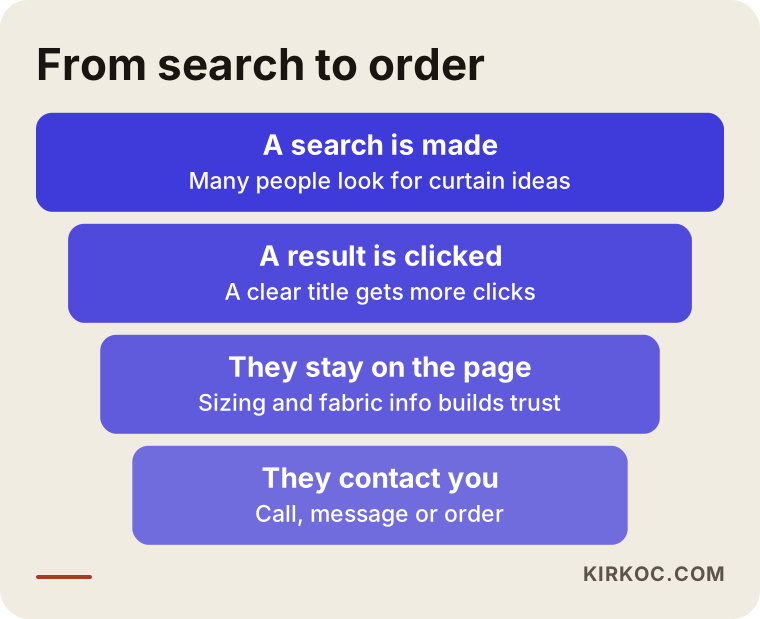
The top of the funnel is wide: many people search, fewer click, fewer still stay on the page, and very few call you or place an order. The job of SEO is to make each step in that funnel a little easier, not just to enlarge the crowd at the top.
The SEO process, step by step
The process varies from store to store, but the basic order is the same. The illustration below summarizes it.
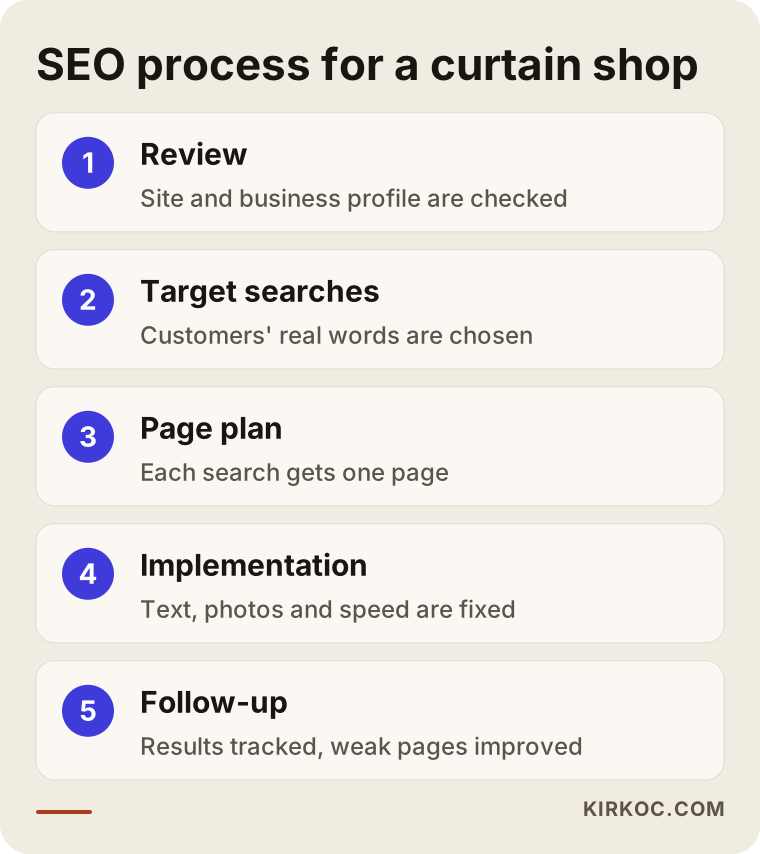
1. Reviewing where you are now
The first step is to look at your site and business profile as they are today. Which pages exist, and which get no visits at all? How does the site open on a phone? Which searches do you already appear for? Are your address and phone number the same everywhere? The review also shows how much work there is. For some stores the fixes take half a day, for others a few weeks.
2. Choosing target searches
Next, I look at what your customers actually type. Here your own observations are very valuable: what questions do customers bring by phone or in the store, what words do they use, what do they want for which rooms? Those words are then checked with tools, but your experience behind the counter is the starting point. The goal is to pick searches that are close to a purchase and where the competition is reasonable.
3. The page plan
The chosen searches are then assigned to pages. This stage settles which page answers which search, which pages need to be written, and which should be merged or removed. Two pages that target the same search and compete with each other is a common problem, and an easy one to fix.
4. Implementation
Page titles, descriptions, text, images, internal links, speed settings and mobile layout are put in place. New pages are written, and existing product pages are enriched. At this stage I need real photos, product details, process descriptions and customer questions from you, because the best content comes from what the person who actually does the work knows.
5. Follow-up and adjustment
After launch, I track which searches you appear for, which pages get visits, and where phone calls and form inquiries come from. Weak pages are strengthened, and the ones that work are expanded. SEO is not a one-time setting; it needs ongoing care. But after the first round of fixes, the maintenance load gets lighter.
Common mistakes
Let me sum up the mistakes I see most often in this industry. The illustration below is a quick summary, with short explanations after it.
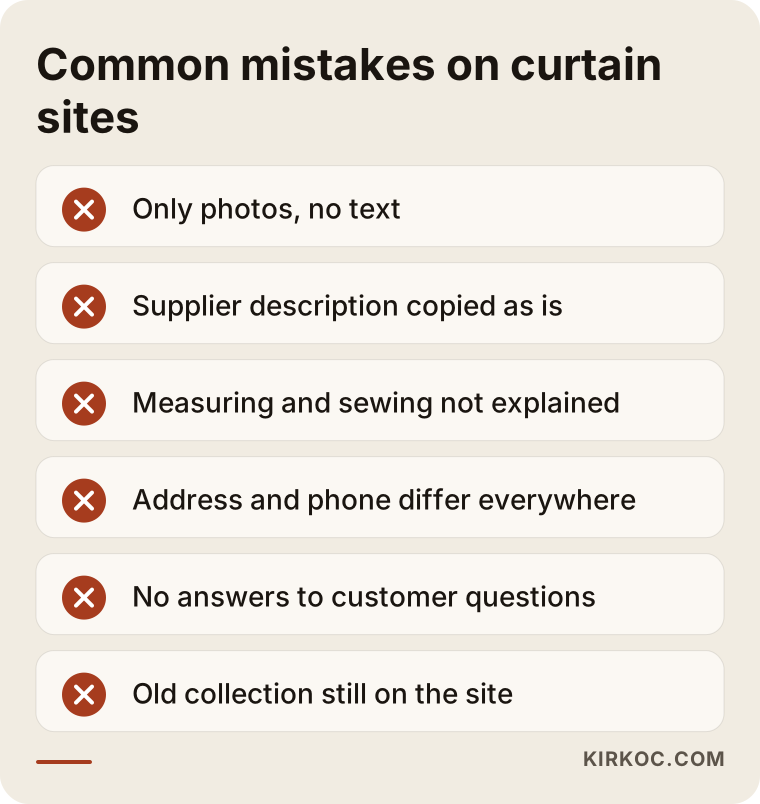
The first mistake is pages made only of photos. Beautiful images matter, but without text a search engine cannot tell what the page is about, and customers cannot find answers about size, fabric and delivery time. The second mistake is copying the same manufacturer description onto every product. If that description sits word for word on hundreds of sites, your page is indistinguishable. Write your own sentences, even short ones, so the description is original.
The third mistake is never explaining your measuring and sewing service on the site. Often this is the single most important thing that separates you from competitors, and most sites mention it in one sentence. The fourth mistake is writing your address and phone number differently in different places: one number on the site, another on the map card, an old address on social media. That confuses customers and weakens the search engine's trust in you.
The fifth mistake is answering questions nobody asked. "We make quality curtains" is not something anyone searches for, but "How do I measure for curtains?" really is. The sixth mistake is building the site and walking away. Collections change, stock runs out, promotions end, and if old products are still sitting on the site, both customers and search engines notice.
Seasonal and promotional content
Demand in home textiles changes with the seasons: spring refresh, moving season, back-to-college shopping, summer and winter fabric choices, wedding registries and holiday hosting. Instead of opening separate pages for these periods and deleting them every year, build one lasting page and update its content. That way the page gains strength over time. Creating new pages from scratch every season means throwing your effort away.
What can you do yourself, and when do you need an expert?
Not all SEO work needs a specialist. The list below summarizes steps you can start today without technical knowledge.
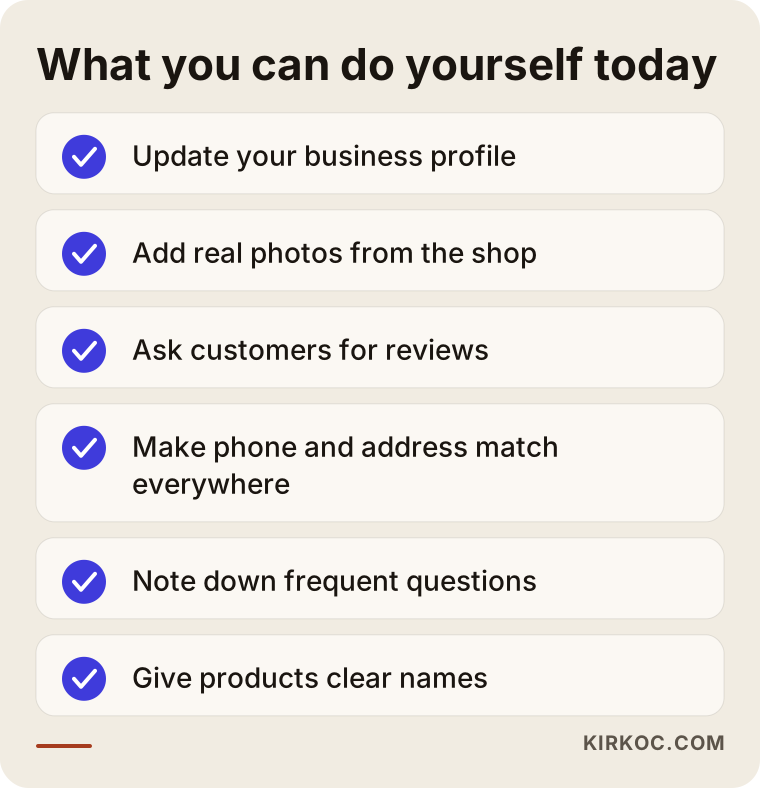
Most of the items on this list can be done in an afternoon and cost nothing. Keeping your business profile current, adding real photos of the store and products, asking customers for reviews, and checking that the phone number and address on your site match everywhere else are the first ones to do. Writing down the questions customers ask most often and turning them into an article is also a free and effective method.
You need expert help in these cases: your site is slow and looks broken on phones, you have many products and the page structure has become a tangle, you plan to move from a marketplace to your own site, you are thinking of rebuilding your website, or you have worked at it for months without seeing any progress. In particular, if the old addresses are not redirected correctly when a site is rebuilt, visibility built up over years can disappear overnight. In risky jobs like that, experience makes the difference.
What determines the cost of SEO?
I will not give numbers in this article, because no two curtain stores have the same needs. But I can tell you plainly what drives the price. The first factor is the current state of the site: is it a structure to be built from scratch, or an existing site to be fixed? The second is the number of pages: hundreds of products, dozens of category and service pages, and additional languages all make the job bigger. The third is the level of competition: a narrow neighborhood search and a nationwide sales goal call for very different amounts of work.
The fourth factor is content. The more real photos, product details and guide material come from you, the faster the work goes. The fifth is how we would work together: do you want a one-time cleanup, or ongoing monthly support? When you ask for a quote, insist on clear answers to "what will be done, by when, and what will be measured?" If the answers are vague, or someone promises "I will get you on page one," be careful. Nobody can guarantee rankings.
The illustration below gives a rough idea of a timeline. The timing differs from store to store; this is a general order of events, not a firm promise.
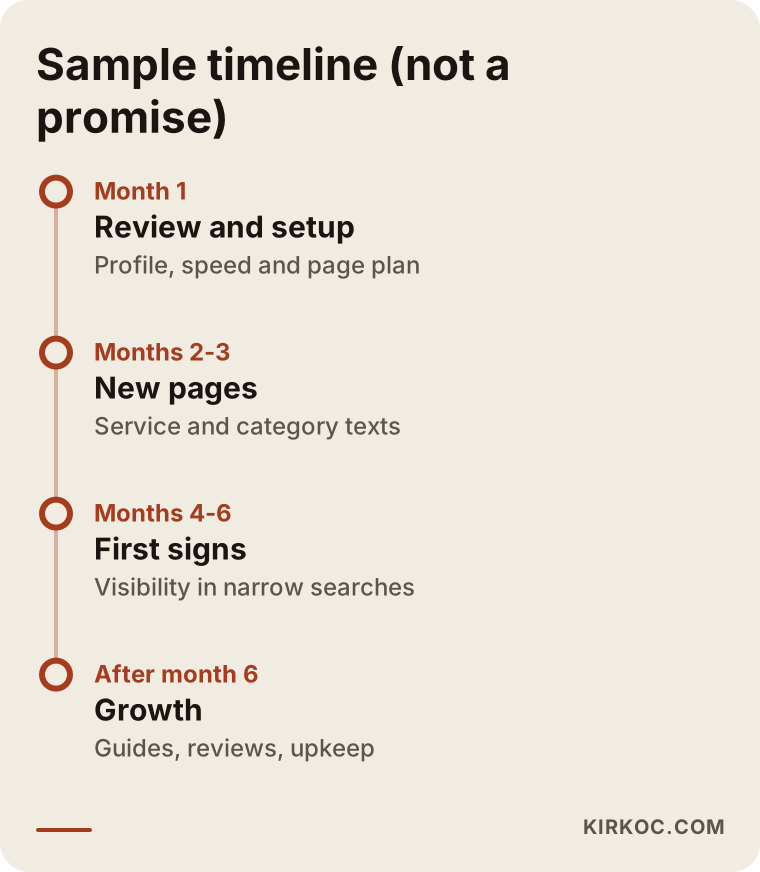
To be honest about timing, the first weeks are mostly cleanup and laying a foundation. The difference shows up as small signs in the first months and more clearly later. On a brand-new site, or one with very little content, it can take longer.
How I work
I work alone, so the person you talk to is the person doing the work. There is no salesperson or team in between. In the first conversation I listen to you describe your store, your customers and your goal. Then I review your site and business profile and write to you, in plain language, what should be done, what comes first, and what can stay on your side. I do not recommend unnecessary work, and I am not afraid to say "you don't need this."
Once the work starts, I explain what I am doing and why, and I try not to use jargon. I report results honestly, without inflating numbers, describing what actually happened. What I ask of you is to share your product and customer knowledge, because you know this industry better than I do, and my job is to translate that knowledge into a form a search engine understands. If you prefer, you can take only a review and a roadmap and carry out the work yourself or with someone else.
Ask yourself before you decide
One question helps when deciding on an SEO investment: what will your customer do once they find you? If your site does not make the products, the measuring service and the ways to contact you clear, it makes more sense to tidy the site first than to bring in more visitors. The illustration below turns that decision into a simple question tree.
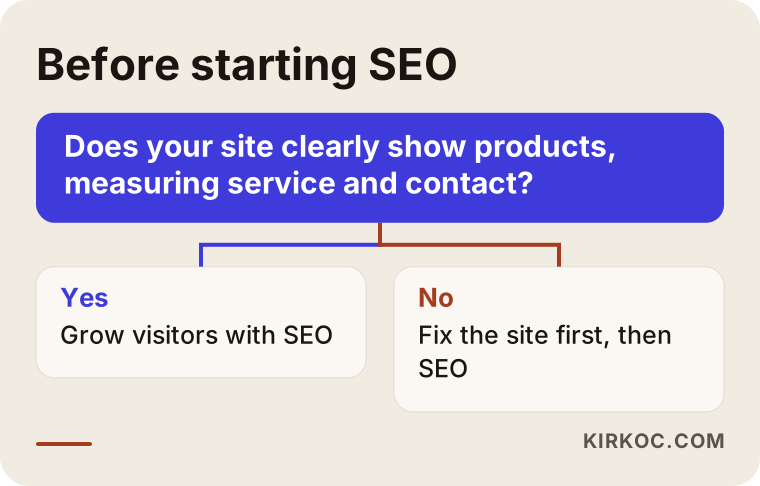
The point of this tree is not to push you in one direction but to help you spend money in the right order. Sometimes the right first step is not SEO but fixing the site you already have.
AI assistants and curtain searches
Lately, people have started asking some questions to AI assistants such as ChatGPT instead of a search engine: "Which curtains suit a small living room?" or "How do I measure for curtains?" These assistants sometimes show their sources when they answer. Clear, accurate and well-organized guide articles can end up in those source lists. I cannot guarantee it, but pages that carry clear, short and correct information help with search engines and these assistants in the same direction.
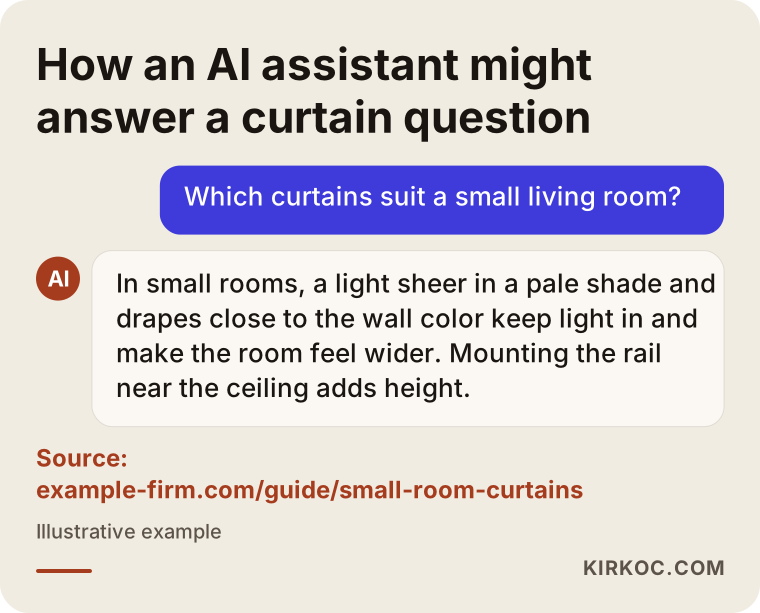
The rule does not change here either: write down your own expertise and your measuring and sewing experience. Instead of generic sentences anyone could write, describe what you have seen in the field.
Frequently asked questions
How long does SEO take to work for a curtain store?
I cannot give an exact timeframe, because it depends on the current state of your site, the competition and how much content is produced. In narrow, local searches the first signs usually start to appear within a few months; for broad searches it takes longer. Stay away from anyone who guarantees results.
I sell on a marketplace. Do I really need my own website?
On marketplaces, the customer belongs to the platform, and fees, rule changes and competition are outside your control. Your own site is where you can build your brand, your made-to-measure services and a direct relationship with customers. Running both together is also a reasonable path.
I only have a store and do not sell online. Does SEO still help?
Yes. For products like curtains that need measuring and in-person service, most customers look online first and then come to the store or call. In that case the goal is not an order but a phone call, a text message, a request for directions and a store visit.
Should I create a separate page for every product?
It is good for every product you sell to have its own page, but what matters is that the pages are full and original. Rather than opening many similar products as thin pages, strengthen your category pages and best sellers first.
Is a page with my town's name enough?
By itself, no. Including the town name helps, but the page should also have real information: your address, the places you serve, the measuring and installation process, and customer questions. Copied pages where only the town name changes do not help in the long run.
Do I need both a Google Business Profile and a website?
Usually, yes. Your business profile stands out in map and nearby searches, while the detailed pages on your site show up in product, service and guide searches. If the information in both is consistent, they support each other.
Is it better to buy ads instead of doing SEO?
They do different jobs. Ads give quick visibility but end when you stop paying. SEO starts more slowly and builds a lasting base. You can use ads during promotional periods and SEO for steady business. The decision should follow your budget and your goal.
My site is old. Should I rebuild it or fix it?
First you need to see the current situation. If the site is slow, broken on phones and hard to add content to, a rebuild may make sense. But rebuilding only because a site is old risks losing visibility that has built up over the years. This decision should be made after a review.
If you would like to talk through what could help your store reach the right people online, you can reach me through my SEO services page. I will look at your site and your customers and put together an honest roadmap for you.