You run a flooring business. You have a showroom, installers you trust and suppliers you can count on, and you have a website. But when someone types "laminate flooring prices," "vinyl plank installation" or "hardwood floor installer near me" into Google, they do not see you on the first page. They see the big chains and a few competitors who put in less effort than you do. So you searched for "SEO for flooring companies," which makes complete sense. In this article I explain how a flooring or floor covering business can win customers from search engines, which pages it needs and where to start. I am Ümit Kırkoç, a web designer and SEO consultant who works alone from Istanbul, and I will describe the scope of my own SEO services openly where it matters.
SEO, in short, is the work that makes your website show up when your customers search on Google or similar search engines. Unlike advertising, you do not disappear the moment you stop paying. When it is set up properly, it builds a steady flow of inquiries over many months. But the flooring trade has a structure of its own. There are many product types, customers think for a long time before deciding, and both product sales and installation can be the subject of a search at the same time. Knowing this from the start helps you set realistic expectations and a realistic budget.
Why flooring searches are different
In most businesses, a customer looks for one service and calls a few companies. Flooring is more fragmented. Someone renovating a home first wonders which floor suits them, then researches materials, then looks for an installer, and only at the end looks into price. That journey can take days or even weeks. Wherever your website shows up along that road, that is where the customer remembers you.
There is another split. Some customers only buy material and have their own contractor lay it. Some want material and installation together. Others search only for installation, refinishing or a floor remodel. If your site mixes these three groups on one page, it cannot give a clear answer to any of them, and a search engine cannot tell which search to show you for.
The image below uses a completely hypothetical example to show how a search result looks and why a clearly written page matters.
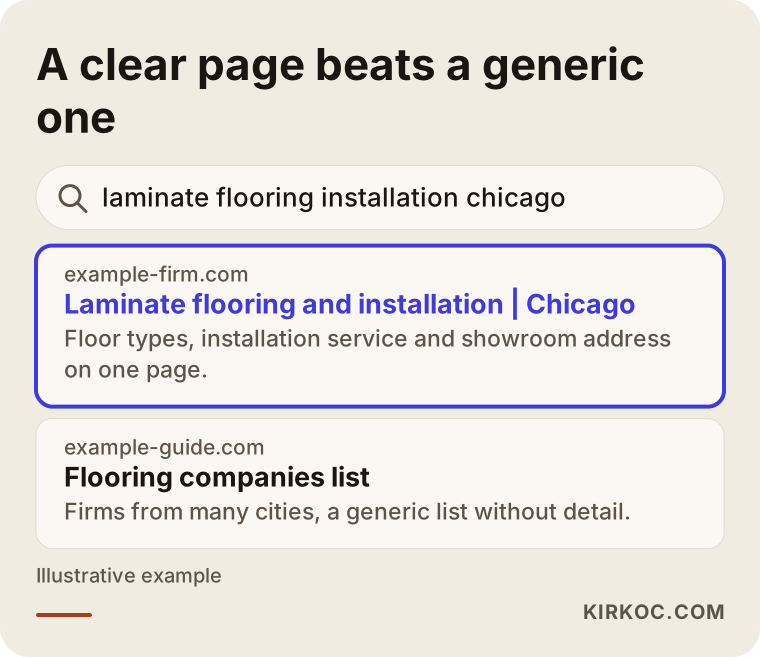
Look at what the highlighted result does. It says which type of floor it sells, whether it also does installation, and which area it serves, all in the first line. A general page about "quality flooring solutions" does none of that. A search engine is trying to work out what answer to give the person asking, and if you make that easy, it will show you more readily.
Which words do customers use to find you?
Customers outside the trade do not know your vocabulary. You say "AC4-rated laminate"; they type "durable cheap flooring." You say "concrete slab subfloor prep"; they ask "my floor is not very level, will new flooring work?" Your site's job is to start from the customer's own sentences and lead them to the right page.
I like to sort these searches into four groups. Product searches include laminate, solid hardwood, engineered wood, vinyl plank, epoxy, carpet and tile. Service searches include flooring installation, floor refinishing and floor remodels. Local searches include a city or neighborhood name. Question searches include "hardwood or laminate" and "which flooring works with radiant heat." Each group carries a different intention and calls for a different page.
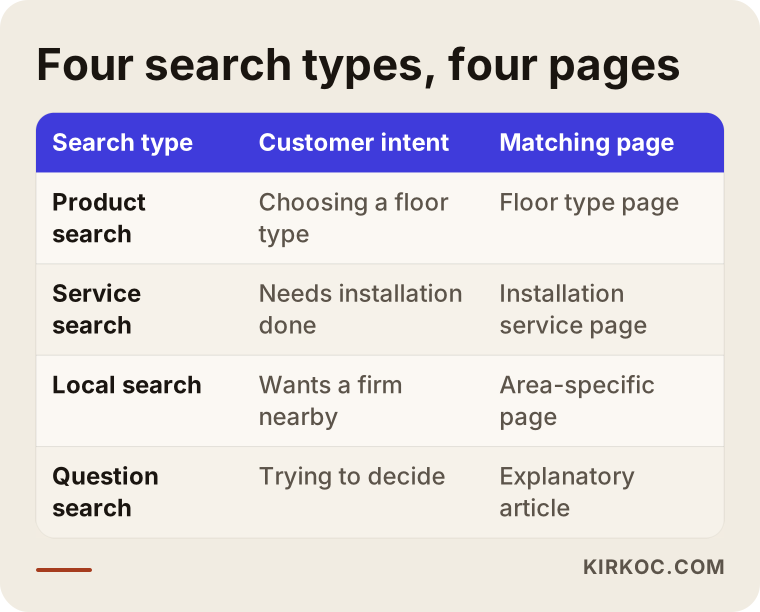
The table tells you something simple: do not try to answer everything with a single home page. Someone looking for a product needs a product page, someone looking for installation needs a service page, and someone with a question needs an explanatory article.
The customer journey: from curiosity to a phone call
A flooring purchase usually moves like a funnel. At the top, many people are curious; at the bottom, very few call you. Your goal is to reduce the number of people who get lost along the way.
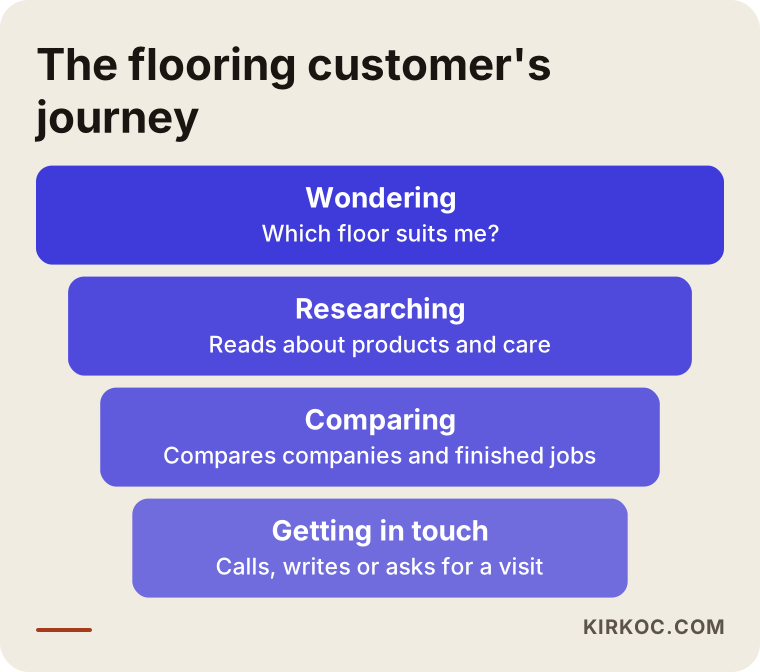
At each stage your site has a different job. While the customer is still wondering, articles that answer "which floor suits what" in plain language are useful. While they research, product pages, photos of finished work and care instructions come into play. At the comparing stage, the customer is putting you next to other companies, so trust signals matter: real showroom photos, an address, how you work, warranty terms. At the final stage, reaching you has to be very easy: a phone number, a text or chat option, and an estimate request form.
The pages your site should have
Many flooring sites have a single "Our Products" page with dozens of photos. That is messy for a visitor and unclear for a search engine. A sturdier structure looks like this.
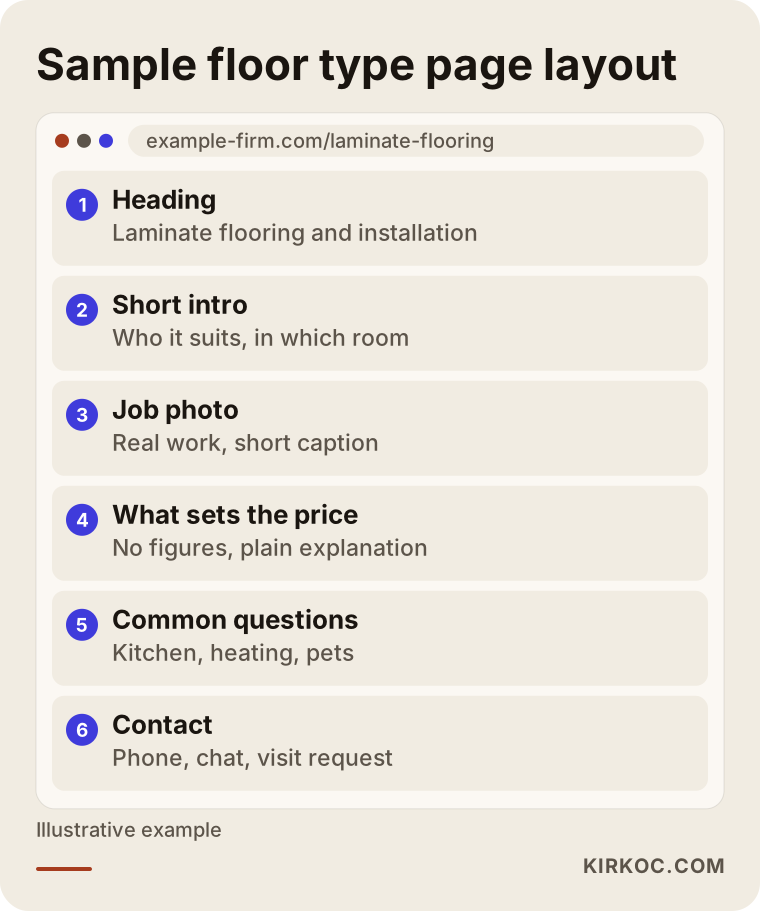
Build a separate page for each main type of floor: laminate, solid hardwood, engineered wood, vinyl, epoxy and so on. On each page, explain what the type is, which rooms it suits, how it is installed and how it is cared for. Alongside those, add a separate installation service page and pages for the areas you work in. One warning here: do not create copy-paste pages for every city or neighborhood. Every area page should include something real and specific to that place, such as older housing, new developments or vacation homes, whatever you actually run into in that area.
On product pages, make the questions customers ask most easy to see. "Is it suitable for a kitchen?" "Can it go over radiant heat?" "Will it scratch if I have pets?" "How many days will the job take?" These answers reassure the customer, and they also help a search engine understand what the page is about.
I want to spend a little more time on photos, because in flooring they are your most valuable content. A customer wants to see the color tone, the grain pattern and how a floor looks in real light on a screen. A catalog studio photo is pretty but not convincing. A photo of finished work, taken in a real living room in real light, builds far more trust. With your customer's permission, add a few of those photos to the page and say which room it is and which floor was used. Even a short caption makes a difference: "Living room, engineered oak, light-toned installation." It informs the visitor and tells the search engine what the image shows.
Hypothetical example 1: a company that relies only on its showroom
The following scenario is entirely hypothetical and is not a real company. Picture a flooring retailer that has operated for years in one city and mostly serves walk-in customers. It has a website, but it is a one-page introduction: a logo, a few photos and a phone number. There are no product pages, it is unclear which brands the store carries, and nothing says whether it does installation.
The owner might say, "Everyone knows us, we do not need the site." But a person who just moved to town, or who is replacing floors for the first time, does not know this company. They pick up their phone, type "laminate flooring" and look at whatever comes up. This hypothetical company does not appear there.
The first step in this case is to decide which products and services come first. Separate pages are written for the three best-selling floor types in the showroom, and each page has real photos, the rooms it suits and common questions. Then an installation service page and a page for the area around the store are added. The business profile on the map is also brought up to date. This work may start to show results within a few months, but the timing depends on competition and on the current state of the site. There is no ranking guarantee, and it is better to know that from the beginning.
Hypothetical example 2: an installation-only crew
The second scenario is also hypothetical. Picture a small crew that does not sell material and only does installation and refinishing. Its customers mostly search for things like "hardwood floor installer," "floor refinishing" and "floor remodel." The crew has a website, but it is trying to compete in the same searches as large product-selling sites.
The right strategy here is to stay away from product searches and focus on service and local searches. A site that does not sell material will struggle to compete in that search with a store that writes product pages. But a page that clearly answers "how is refinishing done, how long does it take, do I have to move out of the house" is very valuable to someone looking for the service. Before-and-after photos, a description of the work process and common questions become this crew's strongest content.
The lesson from both scenarios is the same: know where your business is strong and build the site around it. A site that tries to explain everything to everyone ends up sounding unclear to everybody.
There is also a third situation that I see often: businesses that both sell and install, but do not reflect that on the site. On the phone they say "we do the installation too," but the site does not say it in a single line. A customer who cannot see a service on the site usually does not even ask about it and moves on to another company. That is why it matters to write down everything you do, even briefly, under its own heading.
Step by step: how to pull a flooring website together from scratch
I can describe the process roughly in five steps. The details change from business to business, but the order usually stays the same.
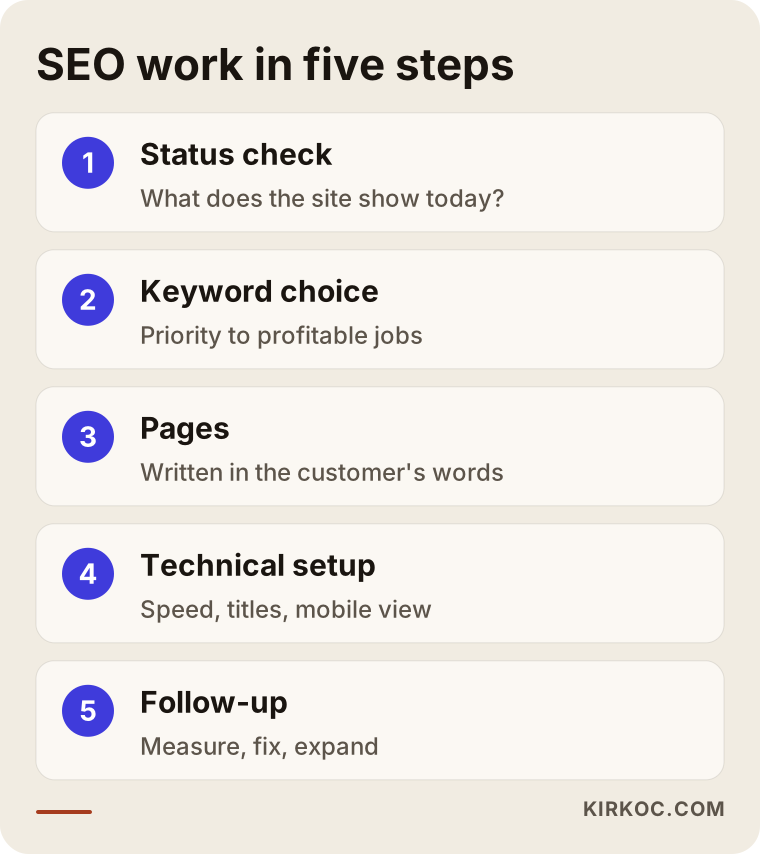
Step one, a status check. I look at what the site shows today, which pages work and which are empty or repeated. How fast it opens on a phone, how large the photos are and whether pages display properly are checked at this stage.
Step two, choosing keywords and intent. You and I talk through which products and services are your priority. Opening pages for items you do not stock, or jobs you do not want to do, only creates useless phone traffic. So we first pin down the work that is profitable and that you can actually deliver.
Step three, writing the pages. Product, service and area pages are written in the customer's language. Jargon is explained, and photos are chosen from your real jobs. Each page has one purpose.
Step four, technical setup. Page titles, descriptions, image names, the site map, the view on a phone and speed are adjusted. The customer does not notice these things, but they are needed so that the search engine reads the site correctly.
Step five, follow-up and correction. I track which searches bring visits and how many people reach you by phone or form. A page that is not working gets fixed, and next to a page that works, a new one is added. SEO is not a one-time job, but it does not necessarily need heavy effort every month either.
Showing up in AI answers
Many people now ask an AI assistant directly, "which flooring suits my kitchen?" These assistants draw on clear, well-organized and trustworthy sources on the internet when they answer. If your site has plainly written pages organized in a question-and-answer format, the chance of being cited as a source in those answers goes up. There is no guarantee, but the same structure works both in classic search and in AI answers.
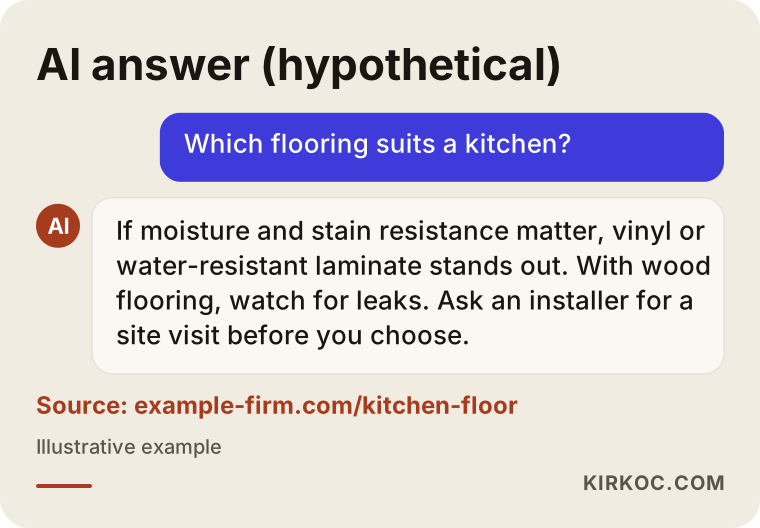
The answer in the image is an example and not the output of a real system. But it shows the logic: short, accurate pages that give clear information are easy sources to use when an answer is being produced.
Common mistakes on flooring websites
These are the mistakes I see most often in this trade. Some are not technical at all; they come down to layout and writing habits.
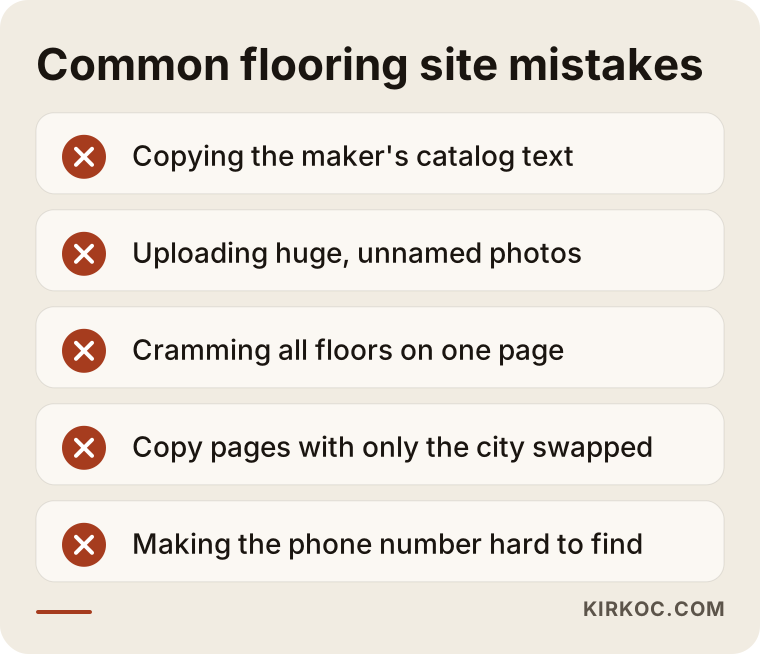
Copying the manufacturer's catalog as is. If you paste in the product descriptions your supplier gives you, the same text exists on hundreds of other sites. A search engine cannot choose among them and often picks the biggest site. Describe the same product in your own sentences, based on the questions your own customers ask.
Uploading photos that are huge and unnamed. Flooring is a visual business, and photos are the biggest thing slowing a site down. If you upload a high-resolution photo straight from your phone without shrinking it, the page opens late and the customer gives up. Also do not leave file names as "IMG_4821."
Cramming everything onto one page. Describing laminate, solid hardwood, vinyl and epoxy on the same page tires both the reader and the search engine.
Duplicating the same area page with only the city name changed. At first glance this looks practical, but search engines recognize it and lower its value. Customers notice it too.
Hiding the pricing topic completely. You do not have to write a number, but you can explain what the price depends on: square footage, material grade, subfloor preparation, and details such as baseboards and transitions. That information prepares the customer and raises the quality of the estimate requests you receive.
Making it hard to reach you. If the phone number sits only at the bottom of the page, or the form is three pages deep, a customer looking from a phone will give up.
What can you do yourself, and when do you need an expert?
You do not have to hand everything to a specialist. Some jobs are in your hands and free. If you do them, you will also move much faster once you start working with an expert.
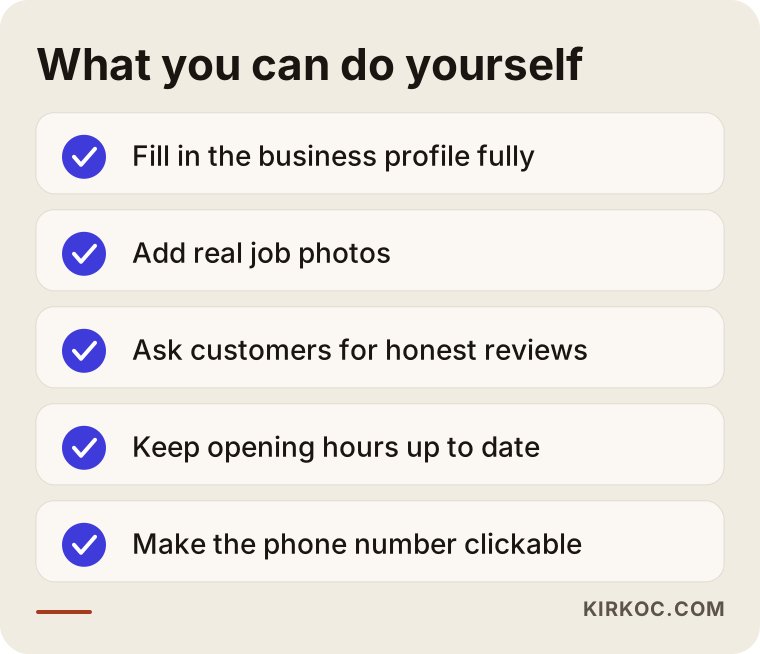
The items on the list are small but effective. Filling out your business profile (your listing on the map) completely, adding photos of real jobs, asking customers for honest reviews and keeping your opening hours current require no technical knowledge. Making sure the phone number on your site is clickable is in the same category.
So when do you need an expert? If the structure of your site is old, if adding pages is hard, if it looks broken on a phone, if you do not know which keywords will bring you business, or if you have put in effort for years and visitors still do not come. Doing these things in the right order takes a bit of experience. You can use the simple question below to decide.
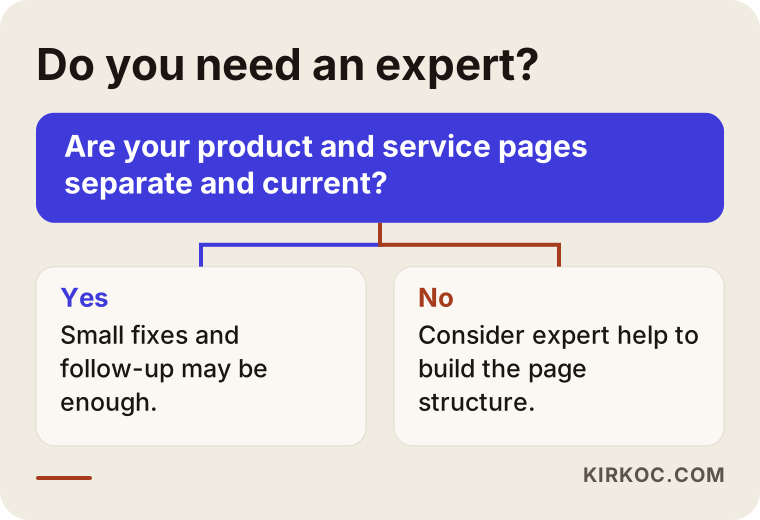
This chart is a direction finder, not a rule. Sometimes rewriting a few pages is enough, and sometimes the site has to be rebuilt from the ground up. It would not be honest to speak with certainty without looking at the site, which is why I look at the site first and tell you what it needs afterward.
Agency, solo expert or doing it yourself?
Who does the work is an important decision too. Each of the three options has advantages and drawbacks.
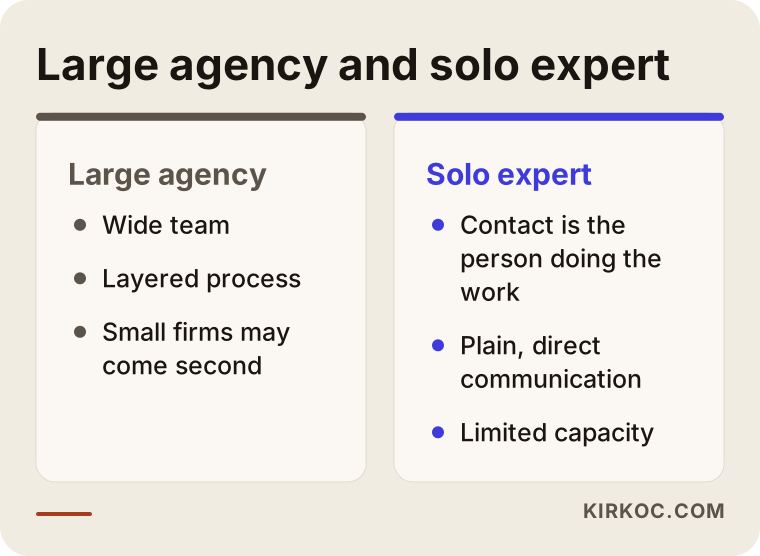
Large agencies offer a wide team and established processes, but a small flooring business can end up in the background inside that structure. With a solo expert, your contact is clear, and you can ask directly how the work is being done. In return, one person's capacity is limited, so they cannot take on too many clients at once. As someone who works alone, I set that limit myself. Doing it yourself costs you time and learning effort, and when business is busy it usually slips down the list.
What determines the cost?
I am not going to give a number here, because an honest figure cannot be given without looking at the site. But I can tell you what the price depends on.
- The current state of the site. The workload is very different between a clean, well-organized site and an old, scattered one.
- Variety of products and services. A business that sells five types of floor and serves four towns needs far more pages than a crew that offers one service.
- Number of languages. Whether English alone is enough, or you also need other languages for customers elsewhere.
- Competition. In searches dominated by big chains, the work takes longer.
- Content production. Who prepares the photos, text and common questions; material you provide speeds the work up.
- Duration and continuity. Whether you want a one-time cleanup or ongoing follow-up over several months.
When you receive a quote, check whether each of these items is written into it. Anyone who reads a sentence like "we will get you onto page one" should be cautious, because nobody can guarantee a ranking.
How I work with you
I work alone, which means the person you talk to is the person doing the work. I generally proceed like this: first a short conversation where I listen to your business, your customers and your goals. Then I look at your site and share in writing what is working and what is missing. After that we set priorities together, and you approve which product and service pages get written first. Throughout the work I explain what I am doing in plain language, and if any term is unclear, I explain it.
I do not promise results, because how search engines behave is not in my hands. What I can promise is that the work will be steady, understandable and done with your customer in mind.
Frequently asked questions
How long does SEO take to work for a flooring company?
It depends on the state of the site, the competition in your area and the work done. Seeing the first movement usually takes a few months, but giving an exact time would not be honest. For narrow, specific searches (for example, a particular town plus a service), results can come sooner, and for broad searches they take longer.
Why not just run Google ads?
Ads give fast visibility, but the day you cut the budget, you are gone. SEO starts more slowly, but once built it keeps working even if you turn the ads off. Many businesses use both, and how much you put into each depends on your budget and goals.
Do I need to put all my products on the site?
No. First build pages that explain your best-selling and most profitable floor types well. Products that sell rarely can be covered briefly in a list. A few full pages beat many thin, similar ones.
Should I open a separate page for every town?
Only for places where you really work and where you have something specific to say about that area. Copy pages with the city name swapped do not help, and they can hurt.
Should I show a price list on the site?
You do not have to give figures. Explaining what the price depends on (square footage, material grade, subfloor preparation) and offering an easy way to request an estimate is often enough. Your pricing policy is your own business decision.
Do customer reviews help with SEO?
Reviews matter especially in map searches. Honest, real reviews build trust and can make you more visible. Fake reviews break platform rules and can cause serious problems. If you are unsure, check the platform's rules or consult an attorney.
Do I have to build the site from scratch?
Not always. If your current site works properly, adding pages and fixing existing ones may be enough. If the site is very old, looks broken on a phone or makes adding pages hard, a rebuild starts to make more sense. It is impossible to say that without looking at the site.
What if I also serve customers who speak another language?
If you serve people who buy vacation homes or invest from abroad, they search in their own language. In that case you need separate pages written naturally in that language. Automatic translation is often not enough.
If you are wondering where to start with the website of your flooring business, you can reach me through my SEO services page, and we can look at your business and your site together.