Someone who wants to register a trademark is often in a hurry. A new business is about to open, a product launch is close, or somebody else has started using the same name. That person types something like "trademark attorney to file my application" into Google, glances at the first few results and calls one of them. Whether your website is among those first few results decides whether your phone rings. That is why SEO services for trademark and patent attorneys are not decoration but the route by which a prospective client can find you at all. In this article I cover who searches for what, what builds trust, what usually goes wrong, and how working with me runs. I do not give legal advice. The subject here is only how visible and understandable your website is.
What does an urgent trademark searcher see on the screen?
A person in a hurry does not read long articles. They scan three or four results quickly and try to answer a few questions. What does this firm actually do? Is it right for my situation? How do I reach them, and when will they get back to me? Whichever result answers those three questions fastest is the one that gets the click.
The illustration below shows how such a search could look. The domains are made up; the point is the logic of the results page.
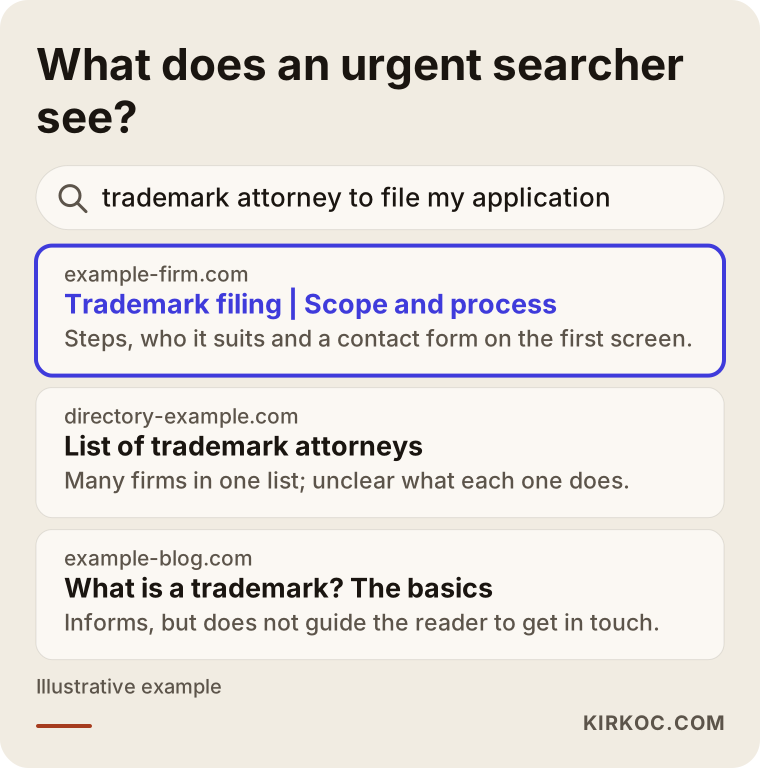
Notice what happens. A general information article answers "what is a trademark," but this person already knows what one is and is looking for help. Directory sites line up dozens of firms and make none of them distinguishable. A single page that explains one service clearly and shows an obvious way to get in touch stands out in that setting. The job of SEO is to make sure that page exists and that it appears for the right search.
Timing matters too. Many urgent searchers are on a phone. If your page loads slowly on a phone, or tapping your phone number does not start a call, the person moves on to the next result. So the technical setup of the site matters as much as the wording.
Same topic, different searches, different intent
Not every search containing the word "trademark" is a potential client for you. The intent can usually be read from the shape of the words typed, and telling the types apart decides which page should say what.
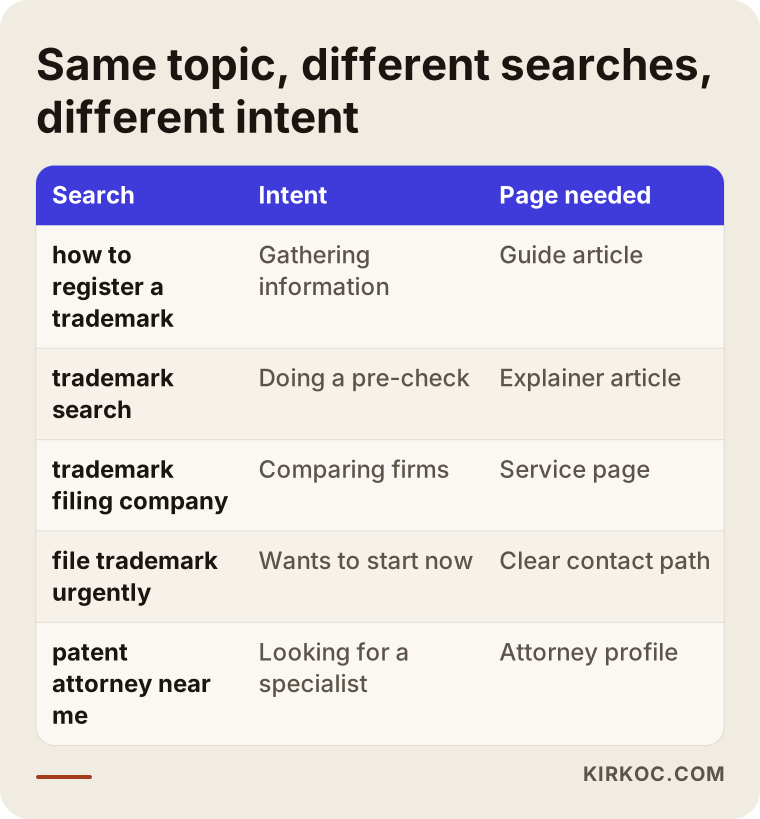
The table shows two different worlds. Someone who types "how to register a trademark" or "trademark search" mostly wants to learn and is not ready to call anyone yet. A good guide article helps them. It lets them get to know you so that you come to mind later. Someone who types "trademark filing company" or "file trademark urgently" is comparing providers or wants to start right away. In front of that person should be a page showing the scope of the service and the way to reach you, not a pile of background information.
A common mistake is loading all of these searches onto one page. The result is neither a guide nor a service page. The structure I suggest is simple: one page describing the service itself, plus a few articles that answer frequently asked questions. The articles link to the service page, so the person who came to learn knows where to go once they are ready.
The "patent attorney near me" search has a slightly different intent. The person wants to protect an invention or a product idea and is looking for a specialist. Trust weighs more here, because the subject is complex and the person does not understand the technical detail. Describing, in plain words, which kinds of matters you handle lets them think, "I am in the right place."
Which other searches reach an attorney's website?
The people who land on a trademark attorney's website are not only those who type "registration." These are real questions too:
- Is there another trademark with the same or a similar name, and how is that checked?
- What happens after filing, and how long might it take? (I do not give a fixed period here; it is enough to say that timing can vary.)
- Who should be the owner of the mark: an individual or a company?
- Is protection needed in other countries as well?
- What can be done if someone uses my mark without permission?
Answering these legally is your work. My work is making sure these questions sit on your site in a place that is findable, understandable and organized. Each question can get its own short article, or a frequently asked questions section can be added below the service page. Which one fits depends on what your clients actually ask. The questions you hear on the phone are the questions the site should answer.
Trust signals: why should a prospective client trust you?
A trademark filing means money and the future of a business for the person involved, so they behave cautiously. They see many ads promising cheap and fast service and try to tell which are serious. Your website should provide the information that reduces that uncertainty.
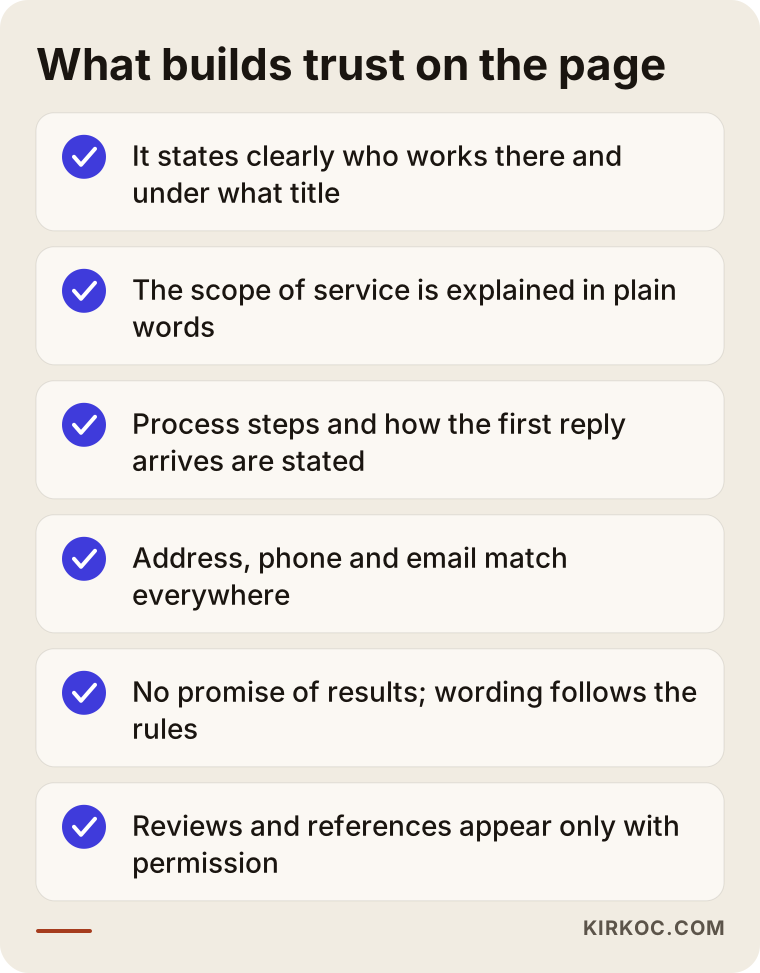
Let me open up each item.
It should be clear who works there. Your name, your title and how you work should appear on the page. "A team, an office" with no further detail raises doubt. If you practice alone, say so plainly; that is clarity, not weakness.
The scope should be explained simply. "Trademark consulting" is not enough. Write what you take on, what you do not, and which kinds of filings you handle. Saying what you do not do increases trust in what you do.
The process should be visible. People want to know what happens when they call: how the first conversation goes, what information they should bring, which channel the correspondence uses. Putting this on the page encourages the hesitant client to pick up the phone.
Contact details should match everywhere. The address, phone and email on your site should be identical to those in your Google business profile and other listings. Even small differences leave an impression of inconsistency, both with people and with search engines.
There should be no promised outcome. Phrases such as "your application will certainly be accepted" are inaccurate and damage trust. Regulated professions have rules about advertising and promotion. I do not interpret those rules for you; I ask you to check the guidance of your own professional body. What I do on the site is build wording that stays within that line: no promises, and verifiable information.
Reviews and references should appear only with permission. A client's name, identity and matter may be confidential. Without permission, do not show them. If you want to show reviews, use only real ones that were given with consent.
How should a trademark service page be built?
The page describing your trademark filing service is the page that should bring in the most work. I suggest the layout below. It is a backbone, not a template to copy.
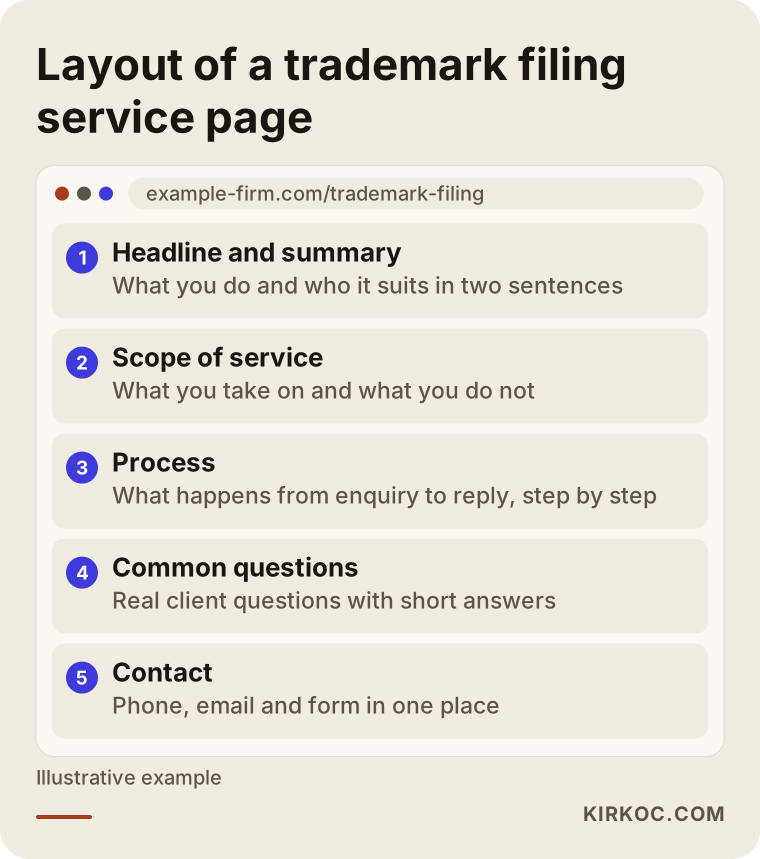
Headline and summary. At the top, say in two sentences what you do and for whom you work, for example "Trademark filing preparation and follow-up for businesses and founders." That line tells both the visitor and the search engine what the page is about.
Scope of service. List which stages of a filing you take on: preliminary search, preparing the application, following the process, and so on. Also write which parts belong to the client. That split prevents differences in expectation later.
Process. Give a plain step-by-step flow, such as "first a short conversation, then collecting the necessary information, then preparing the filing." You do not have to state an exact period; it is enough to say honestly that timing depends on how the office handles the case.
Common questions. Write the questions you hear most often on the phone, with short answers. This section helps not only the client; it also helps search engines understand the page correctly.
Contact. Put phone, email and form in one place, and do not bury them at the bottom. A person in a hurry should not have to scroll to the end. On mobile the phone number should start a call when tapped.
Length matters as well. A very short page does not inspire trust, and a needlessly stretched one tires the reader. It should be as long as it takes to answer the client's questions.
Writing compliant content in a profession with restricted advertising
When writing for legal and similar fields, two principles help. The first is not promising results. "Fastest registration," "problem-free outcome" and "guaranteed solution" do not reflect reality, because the outcome is determined not by you but by the relevant office and the facts of the particular file. The second is not commenting on individual situations. A blog article gives general information; it does not say "in your case this will happen." Stating this openly on the page, for example "the information on this page is general and does not replace individual advice," is honest toward the reader and a safe frame for you.
The last word on compliance is yours. Whatever your professional body's advertising guidance prohibits is prohibited on your site as well. When I write, I remind you of this and, where needed, send the draft to you for approval, but you decide whether a given statement follows the rule. This division of work prevents unpleasant surprises later.
The most common mistakes on attorney websites
I see the same problems repeatedly in this field. Most come not from bad intent but from lack of time.
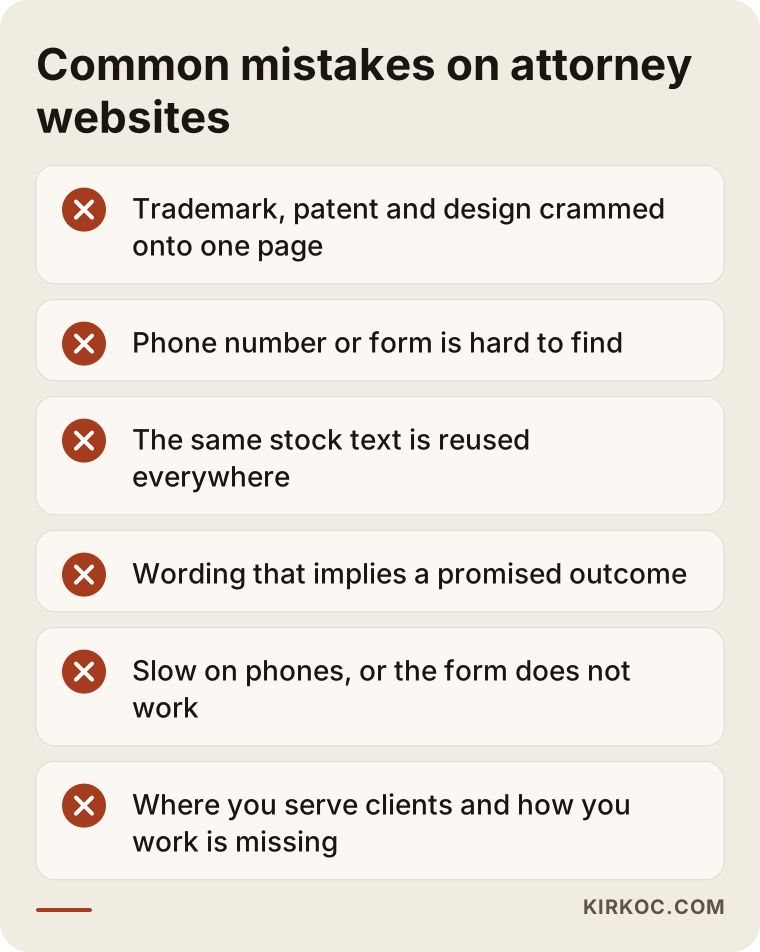
Cramming trademark, patent and design onto one page. If a client is looking for a trademark, they get lost between patent paragraphs, and the other way around. When each service has its own page, both the client and Google find what they are looking for. Of course the pages can link to each other.
Hiding the phone number and the form. Some sites look very elegant at first glance, but the contact details sit in a far corner of the menu or at the bottom of the page. A person in a hurry will not look for them; they give up.
The same stock text everywhere. Service descriptions copied from other sites, or written with the same sentences, do not set you apart. When a search engine sees identical content in many places, it cannot tell which to rank. Writing your own way of working in your own words is both original and more convincing.
Promised outcomes. I mentioned this above; it is a problem for professional rules and for trust.
A slow or broken mobile experience. The form does not send, buttons are too small to tap, the page takes long to open. These are common and usually fixable technical problems.
Not saying where and how you work. Do you meet in person or remotely? Which regions do you serve? Without that information the client cannot be sure they can reach you.
Writing plan: it starts from client questions
I do not invent the content plan at a desk; I build it from what you hear. The method is simple. Over the last few months, you note down the questions clients asked on the phone, by email or in a first meeting. I compare them with phrases that people actually type into search engines. Often we find that a question that is routine for you is something many people wonder about and that your site answers nowhere.
Each of these questions can become a small article. The article's job is not to explain legal outcomes but to point the person in the right direction. A good article does three things: it explains in plain words why the question matters, gives the general frame, and at the end says "arrange a conversation about your own situation," leading to the service page. That way the article becomes the first step in turning someone who is looking for information into a prospective client.
The second half of the plan is maintenance of older content. Filing procedures and how offices operate can change over time. An outdated article misleads the reader and lowers the site's credibility. So I note the date and review time of every article we publish, and we update changed information with your approval. If I am not sure about a fact, I do not put it in; I ask you to verify it.
Suppose: two hypothetical scenarios
The following are not real clients; they are hypothetical examples built to make the situation concrete.
Scenario one. Suppose a trademark attorney has only an "About" page and a "Contact" page on her site. The services are listed in one paragraph: trademark, patent, design, opposition. When someone searches for a trademark filing company, this site gives a clear answer to no search at all. The first job is to move the trademark service to its own page, write the scope, process and common questions, and make the phone and form visible. Then add short articles for two or three questions that clients ask. This work does not guarantee a ranking, but it turns the site into something that can answer a search.
Scenario two. Suppose a patent attorney's site is attractive and full of content, but the pages load slowly on phones and the contact form throws an error on some devices. Here technical fixes come before writing. First the obstacles are removed, then the content is strengthened. Even without changing the content, these fixes alone make it easier for someone who reaches the page to get in touch. The result is measured and reported.
What the two examples share: first see the real condition of the site, then set the order of priorities. That is why I start with a review instead of offering everyone the same package.
How working with me goes
I keep the process as plain as possible. It has five steps.
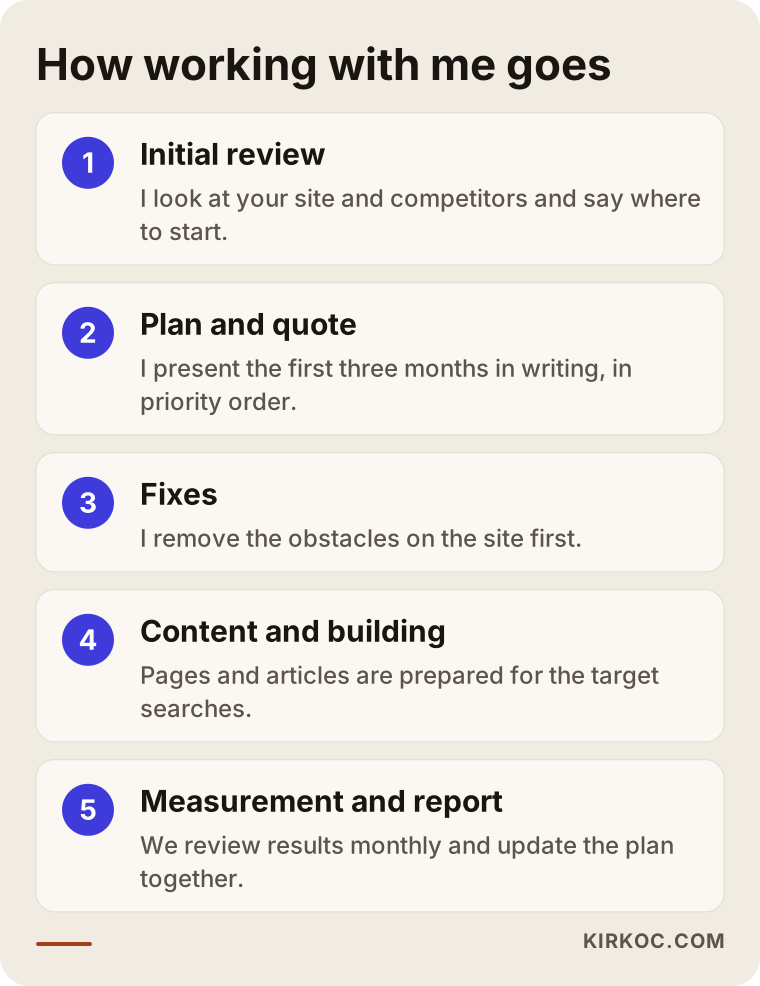
Initial review. I look at your site and your competitors and tell you where to start. At this stage we see what is missing on your site and for which searches others show up instead of you.
Plan and quote. I present what will be done in the first three months in writing, in priority order. Written matters: it is clear what happens when, and no misunderstanding remains later.
Fixes. I remove the obstacles on the site first: slowness, pages that do not open, poor phone compatibility. These usually have the fastest effect.
Content and building. Service pages and articles that answer client questions are prepared for the target searches, and your site's reputation is strengthened. Because we are in a field where the rules are sensitive, we go over the texts together.
Measurement and report. Every month I report, in plain language, what was done, which searches you rose in and what comes next. We review it together and update the plan.
I work remotely, and I do the work myself. The person you talk to is the person doing the work. The service is designed for businesses that have a website but get no clients from Google, that see competitors ranking above them, that do not want to depend on an advertising budget, and that bought SEO before without seeing results.
What determines the cost, and how to compare quotes
I give no figures here, because the cost depends on the state of your website and the scope of the work. But knowing what influences it helps when you compare quotes.
The main factors are: the current state of the site (how much technical repair is needed), the number of services targeted (trademark only, or trademark, patent and design together), the number of pages and articles to be written, the intensity of competition and the frequency of reporting. When two quotes differ in price, their scope usually differs as well.
When you evaluate a quote, look at these questions:
- Is there a written plan, and is it clear what happens when?
- Is a review done first, or does everyone get the same package?
- Is a ranking or client guarantee offered? If so, be careful; nobody alone determines what a search engine shows.
- How will reports be delivered, how often, and in plain language?
- Is there sensitivity to the rules of your field, or are exaggerated claims suggested?
- Are the terms for ending the agreement clear?
- Who does the work; is the person who quotes the same as the one who does it?
A situation often seen with businesses that bought SEO before and saw no results is not knowing what was done. A clear monthly report removes that uncertainty.
Doing it yourself or hiring a specialist
Both can be reasonable. The decision depends on your time and the size of the practice.
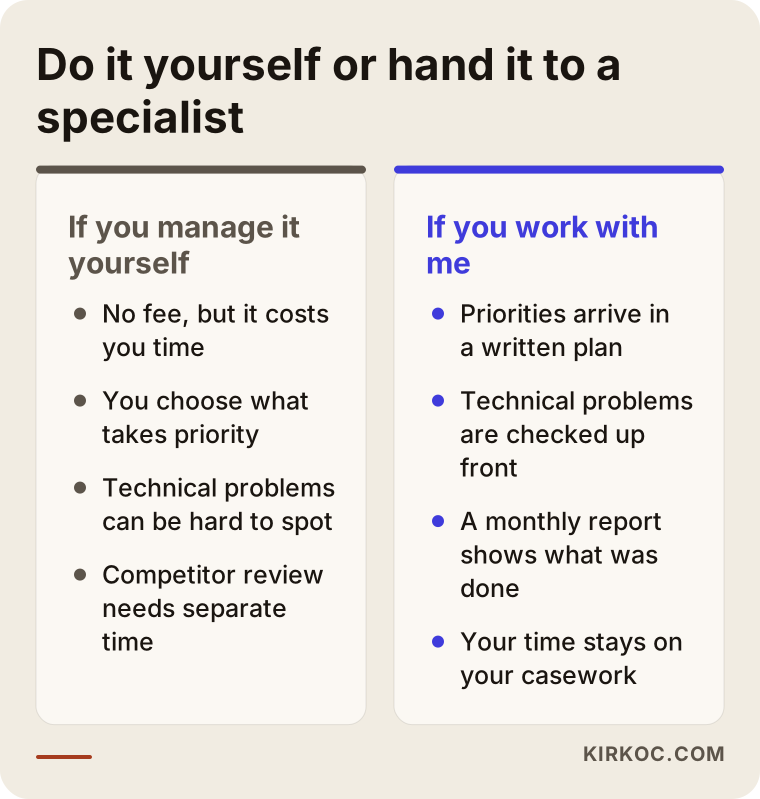
If you do it yourself, you pay no fee but you spend your time. You choose the priorities yourself; that is an advantage, yet choosing without knowing what matters is hard. Technical problems often go unnoticed because you see the site fast on your own computer while the client sees it slowly on a phone. A competitor review needs separate time.
If you work with me, priorities arrive as a written plan, technical problems are checked up front, and a monthly report shows what was done. Most importantly, you can protect the time you give to your casework.
When you do not need this service
To be honest, in some situations this service is unnecessary:
- Your clients come entirely by referral, your workload is enough and you do not want to grow.
- You do not have a website yet and first need a basic one; that should be built first, and SEO comes after.
- You are looking only for a short-term, certain ranking guarantee; I cannot give one.
- You do not have the time or the willingness to approve updates; the texts need to be reviewed with you.
If one of these applies to you, the right answer may be "not for now," and I will say so.
Frequently asked questions
What does a trademark attorney need to do to appear on Google?
First you need a clear page describing your service: what you do, whom you work for, the process and the way to reach you. Then comes a technically sound site, articles that answer client questions and consistent contact details. No step guarantees a ranking, but together they make the site able to answer a search.
Is SEO enough for a patent attorney to find new clients?
On its own it may not be. Referrals, your professional circle and personal relationships are important ways to find clients. SEO adds a way to reach people who do not know you yet but are searching. The two do not exclude each other; they complement each other.
Will SEO promise success for trademark filings?
No. I do not give a ranking or client guarantee for any service. I find what your site is missing, fix it, prepare content and report the results monthly. The outcome is decided by the search engine and the competition.
Is it a problem that you write legal-related content?
I do not give and will not give legal opinions. What I write rests on the information you provide and on a general-information frame, and pages are sent to you for review before publication. You decide whether a statement follows the rules of your profession.
Do I need a separate website for trademark filing?
In most cases no. A separate service page for trademark filing plus a few supporting articles on your current site is usually enough. A separate site only makes sense if you really have a separate brand or audience. We look at your current situation in the initial review.
Which is better for urgent work, SEO or Google ads?
Ads show up faster, but your visibility ends when you stop paying. SEO moves more slowly but builds a lasting base. Many businesses use both. I work on the SEO side; managing ads is not part of my service.
What should I prepare before we start?
Your website address, the services you want to prioritize and the questions clients ask most often on the phone are enough. We settle the rest together in the initial review.
When will I see the first results?
I cannot give a fixed period; the state of the site, the competition and the scope of work change it. The effect of technical fixes is usually seen before the content work. Each month we review progress together in the report.
Get in touch
If you want to know whether your website reaches clients on trademark and patent searches, or whether visitors leave without finding what they came for, we can look at that together. Write to me, and I will look at your site and tell you where to start. You can read about the scope and the process on the SEO services page, and then simply contact me.