You pay an SEO consultant every month, but what actually happens during that month? It is a fair question, and the honest answer is that there is no magic in it: there is a steady routine that looks dull and adds up over time. When I work with a client on SEO services, I split the month into four parts. Here is how that looks in practice.
One thing up front: nobody can guarantee SEO results, because search engines make the final call. What you can see clearly, though, is what was done in a month and what was not. You should be able to see it.
Week one: look and measure
Before I create anything new, I look at what last month left behind. Which searches brought people to your site, which pages were viewed, which ones dropped and which rose? This comes from free search data tools, not guesswork.
The same week, I run a quick health check on the site. Is any page broken? Did a newly added page get blocked from search engines by accident? Did the site slow down on phones? A small problem that goes unnoticed for months quietly costs you visitors. So week one is mostly observation, and the month's priority list comes out of it.
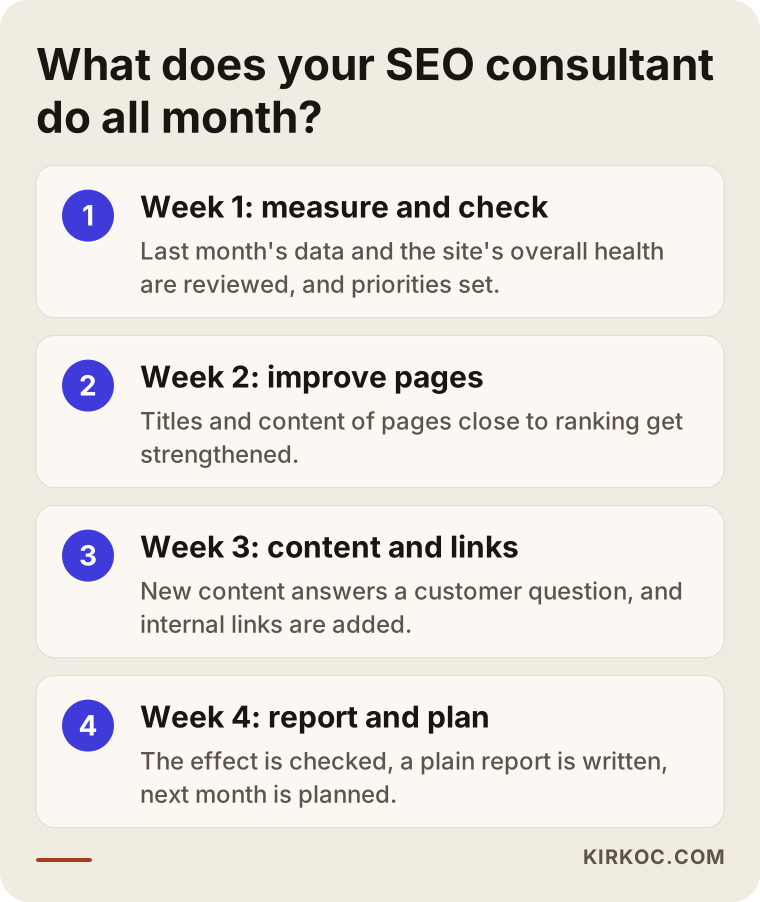
Week two: improve existing pages
Week two is for reworking pages you already have. Does a page match the words your customer actually types? Is the title clear enough to earn a click? Does the page answer one question completely, or does it trail off?
For most businesses, the quickest gain comes not from writing something new but from strengthening a page that is already close to ranking. A page sitting at the bottom of the first results page or the top of the second may move up with the right changes. No guarantee, but a sensible bet. I pick which pages to touch from week one's data, not on a whim.
Week three: new content and links
Week three brings new material: an article that answers a question your customers ask, or a service page your site does not have yet. Topics come from what people really search for. If your field has advertising or professional rules, such as healthcare or legal services, I flag them with you, and I would ask you to check your own professional rules as well.
That same week I look at internal links, meaning links from the new article to the relevant service page and from older articles to the new one. It tells readers and search engines where a topic continues. Links from other websites I handle slowly. Low-quality ones do more harm than good.
Week four: check, report, plan
The last week has two jobs. First, I check the effect of what was done: how did the pages I touched behave? Then I write the report and plan next month. If you want help reading the report, I covered it in how to read your monthly SEO report.
A report does not need pages of charts. A good one answers three questions: what was done this month, what changed, and what happens next month?
Two businesses, two different months
The same skeleton does not produce the same work for every business. Two examples show how the month takes shape depending on what the numbers say.
A dental practice: the phone rings, but bookings are low
A dentist came to me saying the website got visitors but few appointment requests. In week one I saw that the most viewed page was a general "treatments" page. Visitors, however, were searching for single topics such as implants or root canals, and those topics had no pages of their own.
In week two we split that content and built separate, plain-language pages for the two most searched treatments. We moved the phone number and booking button to a visible spot on each page. In week three we added common patient questions to those pages and linked new articles to them. Because healthcare advertising is restricted in many places, the dentist and I went through the wording line by line; I left the reading of professional rules to them.
At month's end the pages were too new for rankings to move clearly. But the search data showed them starting to appear, and clicks on the booking button had gone up. The next month we kept watching that trend and looked at which questions brought people to the new pages. I could say the direction was right without claiming a final result.
A machinery manufacturer: are the right people arriving?
A company that builds industrial machinery came with a different problem. The site had plenty of visitors but very few quote requests. Most pages told the company's history, while the questions a buyer asks, such as what the machine suits and how delivery works, went unanswered.
This month's job was not to attract more traffic but to rewrite existing pages through a buyer's eyes. We added use cases, a plain summary of specifications and a clear "request a quote" step to the product pages. In week three I asked the sales team which questions they hear most and moved the answers onto the pages.
What we measured at month's end was not visitor numbers but the share of visitors who reached the quote form. So the report answered different questions for the two businesses. One had a visibility problem, the other a problem with how convincing the page was.
The invisible work that matters
Part of a monthly service never shows up as a line item but carries real value:
- Monitoring: Keeping the site up and catching broken links and errors early.
- Watching the landscape: Adjusting the plan when search engines change how they work.
- Telling you what you may not want to hear: That an idea will not pay off, or that a keyword is too competitive for you.
- Keeping a history: A record of what I changed and when, so "why did this drop?" has an answer later.
- Protecting your time: Asking you only for the decisions and information that are truly needed.
If you are weighing monthly work against a one-off project, monthly SEO consulting or a one-time SEO package should help you decide.
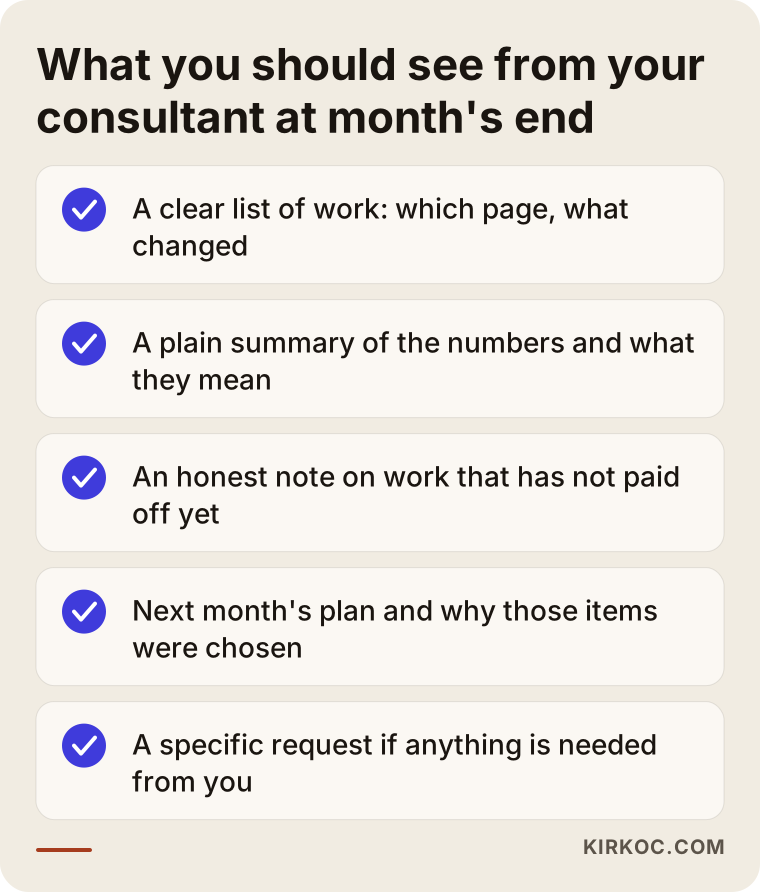
What you should see at month's end
Whoever your consultant is, you should have these in hand when the month closes:
- A clear, readable list of work done. "Optimization performed" is not enough; which page, what changed.
- A plain summary of the numbers and what they mean. A number alone means little.
- An honest note on work whose results are not visible yet. In SEO, an effect can take weeks to appear.
- A short plan for next month and why those items were chosen.
- A specific request, if anything is needed from you.
If one of these is missing month after month, that is reason enough to ask questions.
Questions to ask before you start
Before agreeing to work with a consultant, a few questions can clarify how the month will run. How the answers are given matters as much as the answers themselves.
- "What exactly will you do during the month?" A clear consultant can describe a week-by-week skeleton. A vague "general SEO" is a warning sign.
- "Who gets access to my site, and what can I see?" Access to your search data and your site should stay with you. Even if the consultant leaves, your site must remain yours.
- "What will you not do?" An honest consultant names limits, for example not buying low-quality links and not promising results.
- "How often will I get a report, and in what form?" It should be plain and backed by a conversation.
- "What happens if something does not work?" Not every effort pays off. What matters is that a failing task gets noticed and the direction changes.
When will you hear from your consultant during the month?
Talking about expectations early relieves both sides. Usually one approval at the start of the month, a short question about content mid-month and a report conversation at the end are enough. If more contact is needed, the reason should be stated openly. A month without any news can also mean the work is not happening, so do not hesitate to ask "how is this month going?" instead of waiting for the report.
How is a month planned on a small budget?
With limited money, trying to do everything at once is a mistake. You pick one goal instead, for example only the page of the service that earns you the most. That month's work gathers around that page. A small scope, well chosen, often does more than a wide and scattered one. What sets the price is the scope of the work, the size of your site and how competitive your field is; I discuss that openly in the first conversation.
What if there is an unexpected drop mid-month?
Sometimes the month does not go as planned: a page suddenly loses visitors or the search engine changes something. The first thing I do is not panic. I check whether the drop is on a single page or across the whole site, because the causes and fixes differ.
A drop on one page usually has to do with that page's content or a competitor publishing something better. A site-wide drop can point to a technical problem, a setting switched off by accident or a general change in search. Changing pages at random before finding the cause only muddies the picture.
That is why the history I mentioned earlier matters. Because I know when I changed what, I can often answer whether the drop came from our work or from outside. If the answer is unclear, I tell you that too, and instead of planning on a guess I may suggest watching for a while.
How should you look at the numbers in a report?
Numbers alone say little; they gain meaning through comparison and interpretation. Three angles are enough for most businesses:
- Comparison with last month: Are visitors, impressions and clicks moving up or down? For seasonal businesses, compare with the same month last year too.
- Page-level view: The behavior of the pages we touched is more telling than the site-wide total.
- Link to business outcomes: Did calls, forms or bookings, the actions that matter to you, go up?
Do not read too much into small swings either. A one-week dip or rise is often noise; a trend only shows across a few months.
How does the process work if you work with me?
For the monthly work to run smoothly, a few steps come first. The order is usually like this.
The start: first conversation and first review
In the first conversation I listen to your business, who your customers are and what you want to achieve. It is not technical. It is made of questions like "which service earns you the most, which customers do you want more of?" Then I look at your site and search data and explain what I found in plain language.
At this stage we also discuss whether the work makes sense for you at all. Sometimes the most honest answer is "you do not need monthly work right now, do these three things." I do not hesitate to say so.
The first three months: laying the foundation
The first month is usually about cleanup and setting priorities: technical issues, missing pages, weak titles. In the second month the pages that gain you the most get strengthened. In the third month new content starts to be produced more regularly. This order is not fixed; it changes with the data.
At the end of every month there is a short report and a conversation. Next month's work is set with your approval. Nothing is done without your knowing.
Later months: rhythm and adjustment
Once the base is in place, the month runs more on rhythm: measure, improve, produce, report. The value of the work now comes from small decisions adding up. Every so often we also check together whether you still need this service; if the need has shrunk, reducing the scope is one of the options.
What you can do yourself and what to leave to an expert
You do not have to hand everything to a consultant. Part of the work cannot be done without your knowledge, and part needs technical skill.

What you can do
- Keep information current: Address, phone, opening hours, new services. Nobody knows this better than you.
- Collect customer questions: What do people ask most on the phone and in person? This list is the source of valuable content ideas.
- Provide real examples and photos: Where it suits your field, real examples of finished work are the most trustworthy content.
- Ask for reviews: Politely ask satisfied customers.
- Read the report and ask questions: If something is unclear, asking keeps the work heading the right way.
What to leave to an expert
- Technical audit: Indexing, speed, mobile fit and site structure problems.
- Data analysis: Choosing which page is worth touching.
- Keyword and topic choice: Working out what people really search for and which terms are realistic for you.
- Structural fixes: Heading structure, internal links, redirects.
- Backlink strategy: It takes experience to avoid work that can do harm.
If your own time is limited, I separate my tasks from what I need from you at the start, so we both know what to do all month.
Common mistakes in monthly SEO work
The traps businesses fall into are usually similar. Knowing them helps both when choosing a consultant and when managing the process.
Expecting instant results
Expecting rankings to jump by the end of month one is the most common cause of disappointment. The effect of the work usually shows weeks later. Out of impatience, work that was going the right way gets dropped too early.
Looking only at rankings
Being third for a keyword does not mean that keyword brings you customers. What matters is whether those visitors call you or fill in the form. So a report should show contact numbers next to rankings.
Not sharing information
A consultant knows your business only as far as you tell them. Not mentioning a new service, a moved branch or a dropped product leads to wasted work. Even a short monthly message makes a difference.
Never questioning the report
Saying "I will look at it later" when the report arrives means you cannot check what was done. Asking about every line you do not understand also pushes the consultant to work more carefully.
Trying something new every month
Changing consultants often or rebuilding the strategy every month resets the accumulated progress. In SEO, consistency does more than a series of brilliant ideas.
Thinking about the report only at month's end
Asking nothing all month and expecting surprises in the report means problems are noticed late. A short "how is it going?" mid-month catches misunderstandings early and can save the rest of the month.
Turning to low-quality backlinks
Offers of "hundreds of links for cheap" look tempting, but poor links can harm your site. If you get a suspicious offer, ask me or another specialist.
Frequently asked questions
Is it the same work every month?
No. The skeleton stays the same (measure, improve, create, report), but the content shifts with the data. One month technical fixes lead, another month new content does.
Will I see results in the first month?
Usually not. Much of what is done in one month pays off in later months. Anyone promising otherwise is painting an overly rosy picture.
How much of my time does this take?
For most businesses, a short call and a few approvals per month are enough. It depends on the scope, and I settle it in the first conversation.
When does monthly work make sense, and when not?
If your site has a serious technical or content gap, a one-off fix may make more sense first. Monthly work earns its value once the base is ready and needs regular attention. In highly competitive fields, or jobs that need constant new content, continuity matters more.
How many hours a month does a consultant work?
It depends on the scope and the size of the site, and a fixed number would be misleading. I suggest settling in writing, in the first conversation, which tasks will be done during the month. What is delivered at the end matters more than the hour count.
Which phrases in a report should make me suspicious?
Phrases like "general optimization done" or "site strengthened" that do not say what changed on which page are not enough. Reports that show only visitor numbers without tying them to business results are also incomplete. Ask for every item to be matched to a page and a purpose.
If I switch consultants, is the history lost?
The record of the work should be yours. A log showing when which page was touched lets a new consultant start quickly. I suggest asking at the outset whether that record will be given to you too.
What happens if I stop?
The improvements stay on your site; pages, titles and links do not vanish overnight. But new content and monitoring stop while competitors keep going. So reducing the scope before stopping is also an option; we decide together according to your needs.
Conclusion
Monthly SEO consulting is worth paying for when the work stays visible. You should be able to ask which task happened in which week, and I should be able to answer. If you would like to talk through how a month would look for your own site, you can reach me through my SEO services page.