You are unhappy with your current SEO company, but you are afraid of what happens if you leave. Will your rankings drop? Will you still have access to your own website? Will you have to start over? These worries are common, and they often keep people in a relationship they are not happy with for far too long. As an independent SEO consultant, I have taken over work from other providers, and the pattern is consistent: when the move is handled well, the loss stays small. The real trouble appears when you do not own your site or accounts.
When is the right time to switch SEO companies?
Not every disappointment is a reason to leave. SEO takes time, and seeing no change after a few months does not by itself prove the provider is failing. I wrote about realistic timelines in paying for SEO but seeing no results.
Still, some signs deserve serious thought:
- You do not understand what is being done, and questions get vague answers.
- Reports are only charts and jargon, with no link to calls or form requests.
- Nothing concrete has changed on your site for months.
- You were promised guaranteed rankings or a "secret method."
- Every time you ask for account access, there is an excuse.
If several of these are true together, leaving may be the sensible choice. One bad month of rankings is not enough of a reason.
Is staying in an unhappy arrangement costing you something?
Putting off the decision feels comfortable, but it has a quiet price. Every month you receive the same report and ask the same question is a month your competitors keep moving. In SEO, time that passes does not come back.
Rushing out has a price too. So the real question is not "should I leave?" but "given what I know, when and how should I leave?" Checking ownership and recording where you stand turns the decision from an emotional reaction into a planned step.
Ask yourself this: what has this company done to make me believe I will be in a better place a year from now than today? If you cannot find an answer, that is information too.
When might staying be the better choice?
Sometimes the problem is expectations, not the provider. Think twice before leaving in these cases.
- The work started only recently and a few months have not passed yet.
- The provider explains clearly what it does, and the reports connect to your goals such as calls and form requests.
- The problem is the way you communicate, and one honest conversation could fix it.
In those cases, put your concerns in writing and watch the answers for a month. Still do the ownership check. It is the lowest-risk task you can complete while the relationship is going well.
Two real situations: how a switch can unfold differently
The question I hear most is "what would it look like for me?" Here are two examples from different kinds of business, with identities and numbers left out.
Situation 1: A dental practice with accounts tied to the agency's email
The owner of a small dental practice came to me. For several years an agency had looked after the website, and monthly reports arrived, yet the phone was not ringing more. Most of each report was a chart of rankings. It never said which search had turned into an appointment.
The first thing I checked was ownership. The domain was registered to the practice, but Search Console and Analytics sat under the agency's email address. The map listing showed only a former employee as an owner.
We first moved the ownership verification to the practice owner's own address. Only after the accounts were secured did the owner give the agency written notice. Then I went through the earlier work item by item. Some pages were doing their job. Others were thin and repetitive. We deleted none of them in bulk; we merged and improved the weak ones.
There was no sharp jump in the first months, and none should be expected. But for the first time the owner could explain what was being measured and why. Results took shape over the following months as the work moved along. Nobody can guarantee an outcome; what I can commit to is transparent progress.
Situation 2: A small online shop whose product pages had moved
The second example is a small web shop. The previous provider had moved the site to a new platform mid-contract and changed the product addresses, but had not set up redirects from the old ones. The shop owner did not notice that. They noticed that "sales slowed down."
I started by comparing the old and new address lists. I picked out pages that used to bring visitors and had no redirect, and we pointed them to the right products. After that I fixed internal links and the sitemap.
The lesson in this case was that the departure had not caused the problem. A careless technical change before the departure had. The new consultant's first job was not to find someone to blame but to see what had broken and repair it. Recovery took a few weeks and was not entirely lossless, and I have to be honest about that.
What both cases have in common
In neither business did the departure by itself decide the outcome. What decided it was whether access and the starting position were recorded before leaving, and whether anyone rushed to touch the site during the handover.
In both cases I did not reject the existing work from the start. I looked at what was there, what was useful, and what had to be fixed. Often the thing that sets a new consultant apart is the time taken to look before making the first recommendation.
Check first: what do you actually own?
Before you leave, the most important step is to confirm you have access to your own digital assets. Look at these:
- Domain name: Whose name is your web address registered under? If it is yours, there is no problem. If it is the agency's, you will need to request a transfer.
- Hosting and site admin: Do you have the login details?
- Google Search Console: Google's free tool that shows how your site performs in search. Are you listed as an owner?
- Google Analytics: Who owns the account holding your visitor data?
- Google Business Profile: Are you an owner or manager of your map listing?
- Ad accounts and tag manager: If you have them, the same questions apply.
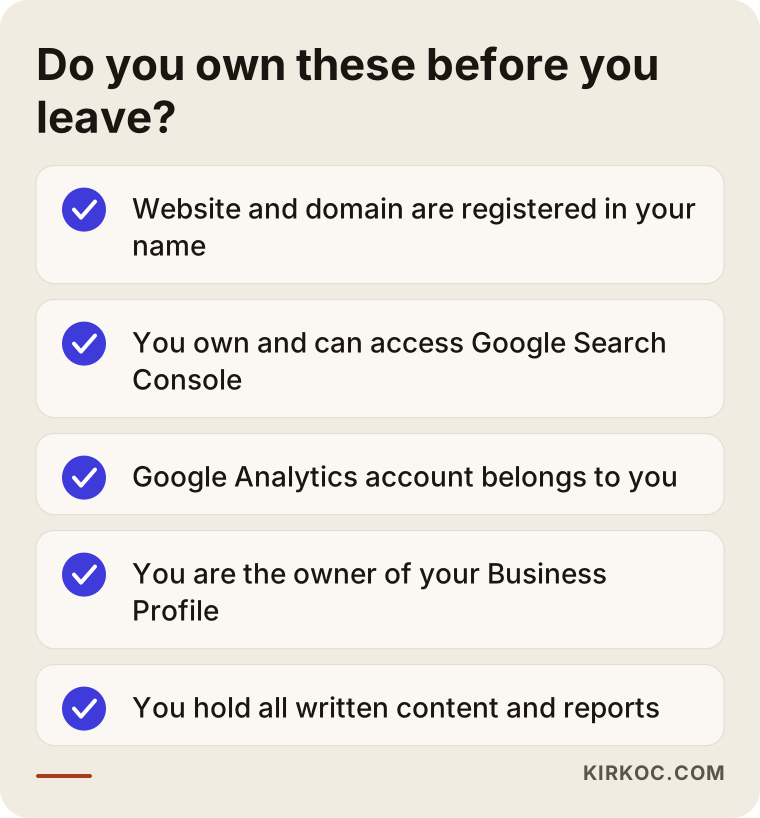
None of these should be the agency's private property. They are your business data. If accounts are tied to the agency's email, ask them to add your own address as an owner before the relationship turns sour. Losing years of history also means losing the baseline for any new work.
What can you do yourself, and what should you leave to an expert?
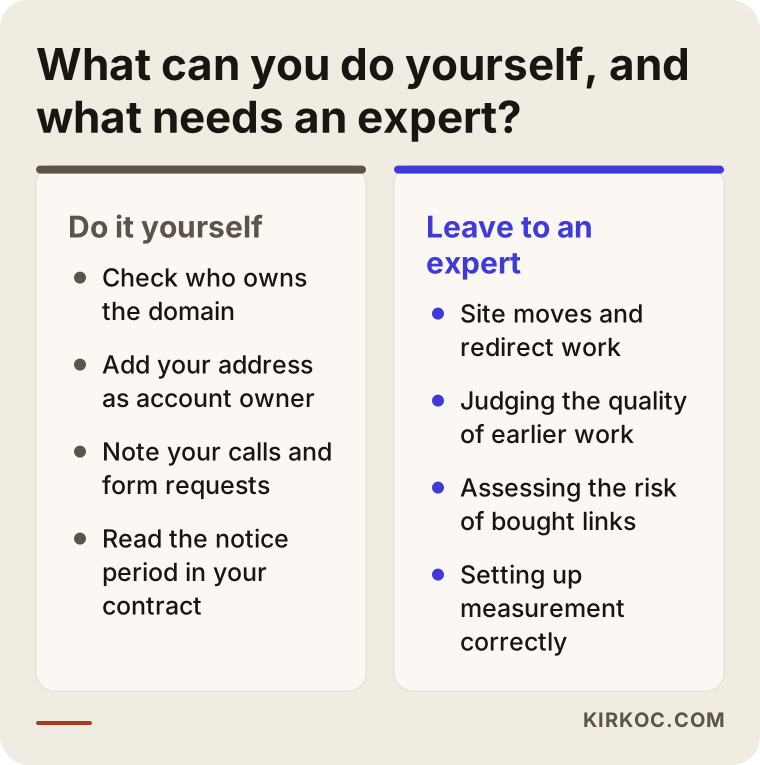
You do not need a specialist for everything. The split below protects you from needless cost and from mistakes that are expensive to undo.
What you can do yourself
- Check whose name the domain is registered under, using a lookup site or your registrar's panel.
- See whether your own address is listed as an owner in Search Console, Analytics and your Business Profile.
- Write the recent number of calls, forms and messages into a simple table.
- Read the notice period and delivery clauses in your contract.
- Ask the current provider in writing for a list of work done.
None of this requires technical knowledge. It only takes a little time, and it shortens the hours you would otherwise pay an expert for.
What to leave to an expert
- Site moves, address changes and redirects, which affect rankings when done wrong.
- Judging the quality of earlier work: which content and links should stay, and which ones do harm?
- Measuring the risk of links the previous company bought.
- Writing to the platforms in an ownership dispute and, if necessary, the legal process.
- Measurement setup: counting correctly which actions are real calls or forms.
On legal matters I am not a lawyer. For contract disputes I recommend you consult one.
How do you avoid losses during the handover?
For a smooth transfer, this is the order I suggest:
- Secure access first. Before you tell the agency, confirm that you are an administrator on your own accounts.
- Record the current state. Note which searches you appear for, which pages bring visitors, and your call and form numbers from recent months.
- Ask for a list of completed work. Published content, links added, technical changes. If your contract says these are delivered, you are entitled to them.
- Read the contract. Know the notice period and termination terms in advance.
- Leave the site alone. Avoid redesigns or address changes during the handover, which reduces the chance of ranking loss.
- Have the link history reviewed. If the previous agency bought links in bulk, you want to know. I cover this in my guide to what to check before buying a backlink service.
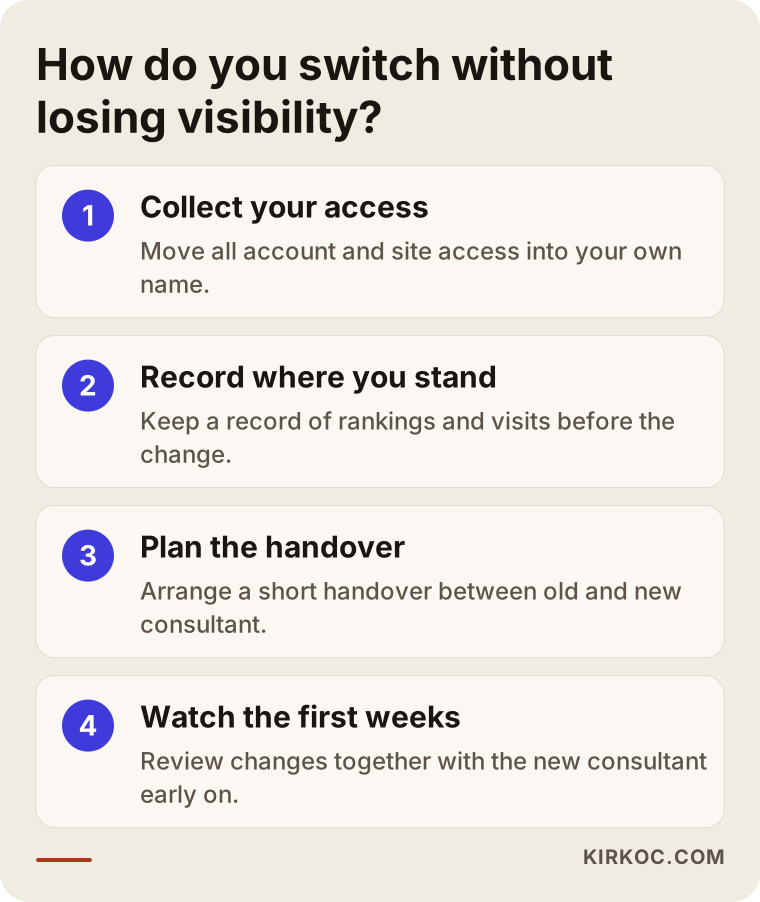
No method gives a zero-loss guarantee. But these steps are the most reliable way to keep losses small.
The most common mistakes when leaving
Having worked with businesses that arrived from other providers, I have seen the same mistakes again and again. Most of them are avoidable.
- Giving notice first and asking for access later. Get access first, notify second. When the order is reversed, conversations get harder.
- Redesigning the site at the same time. If the departure and a redesign fall in the same period, you will never know why rankings changed.
- Deleting everything. Removing content and links in bulk because "everything the old agency did is bad" also removes what was working.
- Switching without a baseline. If you do not record your position before leaving, you cannot measure the effect of the new work.
- Sending notice without reading the contract. Notice periods, automatic renewal and delivery clauses can produce surprises.
- Expecting quick miracles from the new consultant. The first months go to analysis and repair. Someone who promises immediate results may put you through the same thing again.
- Ignoring your industry and competition. The same work takes very different amounts of time to show in different markets.
If you recognize yourself in this list, do not worry; most of it can be repaired. What matters is taking the next step deliberately.
What these mistakes share is that the decision is taken in a moment of irritation. An angry email can cost you an administrator account, or turn an unpaid invoice into a legal dispute. Waiting a few days and finishing the checklist first makes the same decision much cheaper. Even if your mind is made up, changing the order costs you a few weeks and nothing else.
Step by step: how the handover runs with me, or on your own
Whoever leads the switch, the order is largely the same. The difference is who takes care of the technical parts.
If you work with me
- An introductory conversation. I listen to the current situation, what you expect and what you have been through. I do not try to sell anything at this stage; if a handover does not make sense for you, I say so.
- Access and ownership check. Together we list which account sits under whose name. I explain step by step how to fill the gaps.
- Review. I look at the site, the content, the link history and the measurement setup. The result is a status summary without technical jargon.
- Plan. I write down what gets fixed, what stays untouched, and in which order we proceed.
- Handover and first changes. I do not need to handle the correspondence with the old company for you, but I can prepare what to request and how.
- Monthly follow-up. The monthly report starts with calls and form requests and continues with the work done.
If you do it on your own
- Collect ownership and access first, and record where you stand.
- Send written notice to the old company and ask for the list of completed work.
- Complete a review with the new provider or your own team before making big changes to the site.
- Until you choose a new provider, leave existing content and addresses exactly as they are.
The second route looks cheaper, but when the technical review is skipped, hidden problems can go unnoticed for a long time.
How should you talk about leaving?
If you have made your decision, communicate it calmly and in writing. You do not need a long explanation. State that you are following the notice period in the contract and request the handover of access and documents. A short email naming dates and deliverables often speeds things up more than an emotional conversation.
Seek advice on your legal obligations before withholding a final payment. Burning bridges does not help you. The goal is to get your data and your website back, complete.
What should the first weeks with a new consultant look like?
The first weeks set the tone. This is roughly how I work:
- Week one: Handover of access, a review of the overall state of the site and accounts, and a conversation about your goals. Together we decide what to measure.
- Weeks two and three: Finding technical problems and mistakes left from earlier work, and building a first priority list.
- End of month one: A plain-language plan showing what I will do, why, and in what order, plus a first report.
What you can expect from me is clear language and a reason for every piece of work. I will not promise when results will show, but you will see progress in concrete numbers each month.
What should you track during the transition?
A small wobble in rankings during the first weeks can be normal. To avoid panic, you should know in advance what you are looking at.
- Calls, forms and messages: These are your real goal. Visitor numbers alone can mislead.
- Visibility for your main searches: Compare a few important search phrases monthly, not weekly. Daily movement is noise.
- Number of indexed pages: A sudden drop signals a technical problem. You can see it in the pages report in Search Console.
- Pages showing errors: If the number of pages that cannot be found is growing, a redirect may be missing.
In the first month I look at these four things and share them with you in plain language. When I see a dip, I do not alarm you before I understand the cause; I look for the source first.
What should you do when you see a drop?
First check whether the drop affects everything or only one page or search. A drop on a single page is usually a problem specific to that page.
Then ask what changed on the site in the last two or three weeks: a new plugin, an address change, a page that was removed. Most drops trace back to a recent change.
Third, look at whether something moved across your whole industry at the same time. Search engine updates or seasonal demand can create swings that have nothing to do with you. If you cannot find the answer, waiting another week and watching is often the right decision before changing anything.
What should you check in the contract and the termination letter?
I do not give legal advice, but it helps to know the clauses I keep seeing in consulting contracts. Look for these in yours.
- Notice period: How far ahead and in what form (email, registered mail) must you give notice?
- Automatic renewal: Does the contract extend itself at the end of the term? If so, what is the last date to give notice?
- Deliverables: Are content, reports, account access and document handover written down?
- Intellectual property: Who keeps the rights to written texts and prepared images?
- Confidentiality: What information can you not share after leaving?
- Penalty clauses: Is there a payment condition for early termination?
If any of these is unclear in your contract, showing it to a lawyer before sending the termination is a sensible insurance. Professional rules and local law can differ, so confirm your own situation.
Keep the termination letter short and factual: the date of the contract, the termination date, the handovers you request and a reasonable deadline for delivery. Avoid accusing language; the written record may be your only reference later.
Which questions should you ask when comparing new offers?
If you are collecting several offers, ask these questions before looking at the price line. The answers describe how someone works better than a price does.
- Who will actually do the work? The person presenting to me, or someone else?
- In whose name will the accounts be opened, and what happens when the contract ends?
- What exactly will be done in the first three months, and what will not?
- Will the report include the number of calls and form requests?
- In a handover you took on before, what would you do differently?
- What are the terms for leaving the contract?
A good answer does not have to be long or polished; it is clear, checkable and in your language. An evasive answer is a sign the working relationship will be evasive too.
What should you look for in a new consultant?
To avoid the same problem twice, look for these: you know who actually does the work, accounts always stay in your name, reports are easy to understand, and anyone who guarantees rankings is treated with caution. Pricing depends on factors like the size of your site, how competitive your market is, and the scope of work, so comparing one figure with another can be misleading. What matters is that you can see exactly what you are paying for.
Frequently asked questions
Will my rankings drop if I change agencies?
It depends on whether the work remains on your site. If content and site structure stay in place, a sudden drop is generally not expected. Link or redirect mistakes can affect it, though.
What if the old agency refuses to hand over access?
Check the contract first. If domain and accounts are registered in your name, the platforms have their own ownership verification routes. In some cases you may need legal advice.
Can I leave before the contract ends?
That depends entirely on your contract terms. Read the termination clause and notice period. If you are unsure, a short consultation with a lawyer can prevent a dispute later.
Do I have to undo everything the old agency did?
No. Much of the content and technical work is usually still useful. A new consultant's job is to review it item by item and decide what stays and what gets fixed.
When should I tell the old company?
After you have secured access and know the notice period in the contract. Give notice in writing and attach the list of items to be handed over. If you do not need to extend the period, settling payment and delivery dates in the same letter reduces misunderstandings later.
Does the new consultant have to talk to the old company?
Often not. If you hold the access, the new consultant can review the site and accounts directly. Only the list of completed work is requested from the old company. Still, a short handover call can save time, especially when the site has a custom setup.
Is it sensible to redesign the site during the switch?
Usually not. Making two big changes at once makes it hard to find the cause if something goes wrong. Finish the switch first, then plan the redesign.
Is it a good idea to move from an agency to an independent consultant?
It depends on what your business needs. For small and medium-sized businesses, talking directly to the person doing the work is often an advantage. Large, multi-channel projects may need a team, and we would talk about that honestly.
Conclusion
Switching SEO agencies, when prepared properly, is not a risky leap. It is a chance to fix a relationship that is not working. Make sure you own your site and accounts, then plan the move. If you would like to go through your situation together, you can contact me through my SEO services page.