"Why does someone searching 'movers near me' see a lead broker or a company across town instead of mine?" It is the question moving company owners ask me most. The short answer: search results do not simply reward the company that does the best work. They favor the one that explains itself clearly and earns the most trust. This article covers what works for movers specifically; for the broader picture, see my SEO services page.
How people search for movers
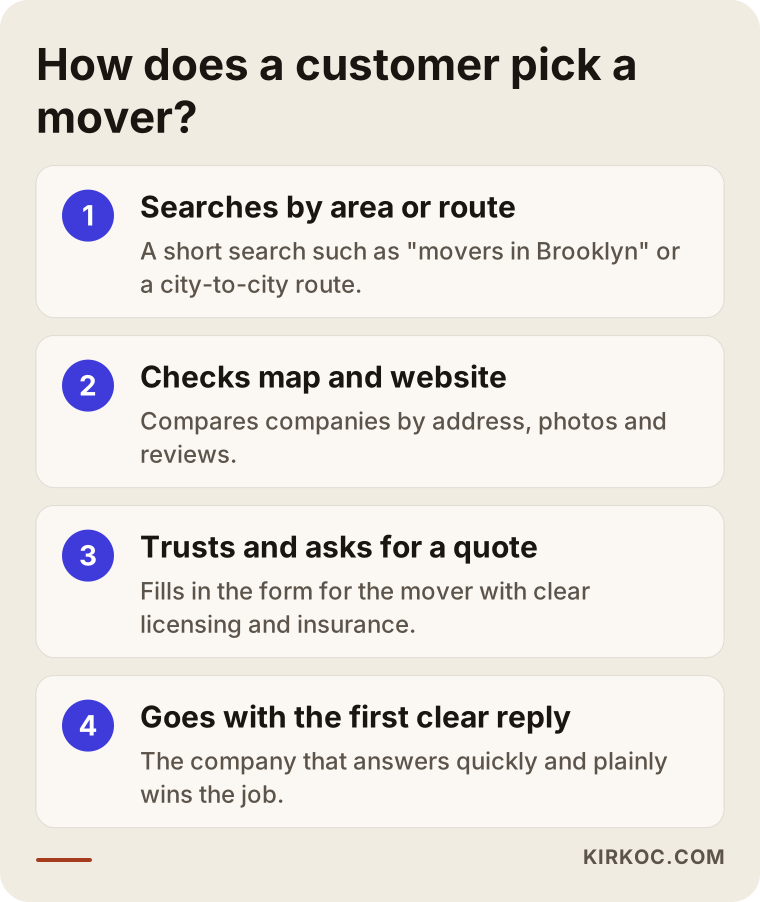
Someone about to move is usually stressed, has a fixed date and little time. Their searches are short: "movers in Brooklyn," "long distance movers Chicago to Denver," "apartment movers with stairs," "office relocation." Most of them include a neighborhood, city or route.
A single homepage that tries to speak to a whole metro area is weak. A separate page for each area and route you truly serve works better, and each should hold local details: parking and access issues in that area, buildings you often handle, how long a long-distance job takes to deliver. One firm rule: do not create a page for an area you do not serve. Pages that repeat the same sentences with only the place name swapped satisfy neither customers nor search engines.
Competing with brokers and fake companies
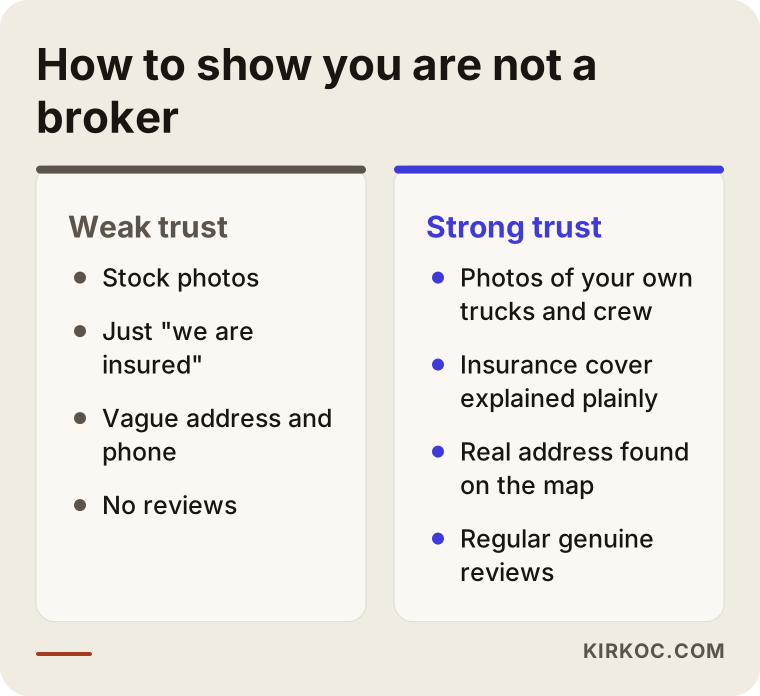
The biggest problem in this industry is lead broker sites that pass your phone number around, and "companies" that own no truck at all. Customers know it, and many have been burned before. For an honest mover, that is an opening.
You will struggle to beat brokers on ad budget. But there are things they cannot imitate:
- A real address, a depot or office findable on the map
- Photos of your own trucks and crew
- The same phone number everywhere: website, map listing, social media
- Genuine customer reviews
A competitor ranking above you is not necessarily bad or fake, but you have to show your difference on the page. Otherwise a customer comparing two sites side by side cannot tell.
Trust signals: what to show and how
In moving, the customer hands over belongings and sometimes the keys to their home. Trust is not decoration; it is the buying decision. I recommend making these visible:
- License and registration: Show the licenses and registration numbers your area requires, and make sure they are current. Check your local regulations for what is mandatory.
- Insurance: Explain in plain words what is covered if something is damaged, and under which conditions. "We are insured" alone is not enough.
- Real photos: Use your own crew, trucks and packing process instead of stock images.
- Reviews: Collect reviews on your map listing regularly. Politely ask satisfied customers after the move. Never write or buy fake reviews; it is unethical and puts you at risk.
- A clear process: Briefly describe the survey, packing, loading and delivery steps.
Quote forms and fast replies
Even if you rank higher, effort is wasted if visitors leave without filling in the form. Most customers request quotes from three or four movers at once, and the first clear answer usually wins. So:
- Keep the form short: from, to, date, size of the home and a phone number are enough.
- Keep call and message buttons visible on mobile; most visitors arrive on a phone.
- State your reply time honestly, and keep it. If you promise same-day replies and call three days later, it is better not to promise.
- If you cannot quote a price upfront, explain why: volume, floors, elevator access and distance drive the cost.
I cover the website side in more depth here: website and quote system for moving and logistics companies.
Your map listing and local visibility
For moving searches, the map section often appears before the websites. Your business listing needs to be complete: correct category, opening hours, service areas, real photos and your website address. The name, address and phone number on the listing must match your site exactly. Even small mismatches create doubt for customers and for search engines.
Scenario: a small, one-truck local moving company
An owner of a small moving company with a handful of crew members came to me with this situation: most jobs came from word of mouth, and the website was a single page built years ago. New customers who searched online ended up with lead-generation sites or with competitors on the map.
The first thing I looked at was where the company actually worked. It did plenty of jobs in three or four neighborhoods, yet none of them was named on the site. The map listing had the wrong category, and the phone number differed from the one on the website.
We fixed the listing first and made the name, address and phone number identical everywhere. Then we wrote short pages for the neighborhoods the crew really serves, each with something specific to that area: how close the truck can park on narrow streets, how elevators work in the older buildings, when it helps to talk to the building manager in advance.
The owner started asking every customer for a review after the move, and we added photos of the real trucks and crew. The outcome was modest and measured: map visibility improved over a few months and quote requests came in a little more steadily. I cannot say which change caused which result, but customers no longer saw the company as a name they had never heard of.
Scenario: an office and long-distance mover
The second company did different work: office relocations plus long-distance moves for apartments and single large items. The owner complained that someone moving a home and someone moving an office were looking at the same page, and he was right.
The person hiring an office mover is usually an office manager or someone in purchasing. They are not panicking, but they cannot afford downtime. They ask about weekend work, experience with computers and filing archives, and how the move avoids stopping the business. A homeowner mostly looks for trust and clear pricing logic.
So we built two separate service pages. The office page covered planning, after-hours and weekend work, and packing of sensitive equipment. The long-distance page listed the routes the company really drives, what affects delivery time, and the difference between a partial load and a full move.
The lesson: one generic "moving" page speaks poorly to everyone. Each customer type wants different answers, so separate pages gave clearer results in search and in form submissions. I would not present that as a guarantee, though; this company's competition and routes were its own.
What the process looks like if we work together
I keep the process simple. I explain what I do and why at every stage, without burying you in technical terms.
1. Reviewing where you stand
I look at your website, your map listing and where you show up in searches. I also ask which areas and routes you work in and which kind of customer actually makes you money. That conversation matters more than any technical scan, because you know your customers.
2. A priority list
You do not need to do everything at once. I separate what makes a quick difference (a corrected map listing, a visible call button) from what takes time (new pages, collecting reviews), and I give you the order in writing.
3. Building pages and trust signals
Service pages, neighborhood or route pages, the quote form, and plain-language explanations of licensing and insurance come next. I ask you for what only you have: photos and short customer stories.
4. Publishing and measuring
Once pages are live, I set up tracking so we can see where calls, forms and messages come from. That way "is it working?" is answered with data, not a hunch.
5. Regular review
Before and after the busy season I check what is working and add missing pages and questions. I report in plain language. I cannot promise results, but I will always show you what was done and why.
What belongs on a neighborhood or route page?
Many of these pages stay empty because the owner wonders what to write. But as someone who does the work, you have plenty to say. Think of the page as a field note.
Cover the typical building types in the area (apartments, gated complexes, detached houses), how close the truck can get, whether a lift or exterior hoist is often needed, whether parking permits or a note to the city are required, and the best times of day to move. A small example from a real job makes the page original.
End the page with a clear next step: the quote form and the phone number. Do not force area names awkwardly into sentences; if it does not read naturally, customers and search engines both notice.
The same logic applies to long-distance route pages: say which cities you drive between regularly, what affects delivery time (distance, road conditions, shared loads) and how belongings are protected on the way.
Asking for reviews: a practical and honest way
Collecting reviews is the hardest part for most companies, because everyone is exhausted on moving day. Timing matters: send a short message a day or two after the belongings are in place and the customer has relaxed.
Keep the message short, polite and direct. Say that if they were happy with the service, sharing their experience means a lot to a small company, and include the review link. Do not offer a discount or gift in exchange for a review; that can violate platform rules.
Do not try to hide negative reviews. Reply calmly, briefly and with a solution in mind: acknowledge what happened and describe how you tried to fix it. New customers care less about a flawless score than about how a problem was handled.
A checklist before you start
You can use this list to see where you stand even before talking to anyone:
- Do the name, address and phone number on your map listing match your website exactly?
- Does the site clearly say which areas and routes you serve?
- Are your license and insurance coverage explained in understandable terms?
- Do you have photos of your own trucks and crew, or only stock images?
- On a phone, are the call and message buttons visible right away?
- Is the form short, asking only where from, where to, date and phone?
- Can you answer incoming requests the same day?
- How many recent customers left a review, and do you reply to them?
If several answers are "no", that does not mean you are in trouble. It simply shows where to begin.
Putting the customer at ease during the quote and survey
The request from your site is half the job; the other half is won in the first conversation. Customers usually want a price immediately, while you do not want to name a firm figure before seeing the belongings. Handled well, that tension turns into trust.
In your first reply by phone or message, confirm the request arrived, say when you can do a survey, and briefly list what will determine the price. If possible, ask the customer for a few photos of the home or a short video walk-through.
In the written quote, state the scope clearly: is packing included, do you disassemble and reassemble furniture, under what conditions does insurance apply, and how does the price change for extra work. A customer who is never surprised later is the most reliable source of a good review.
Explaining the same points briefly on your site cuts down on questions and makes your pages answer what customers really search for. One effort then helps both sales and search visibility.
Mistakes moving companies often make
The mistakes I see most in this field are usually made with good intentions, but they weaken the result.
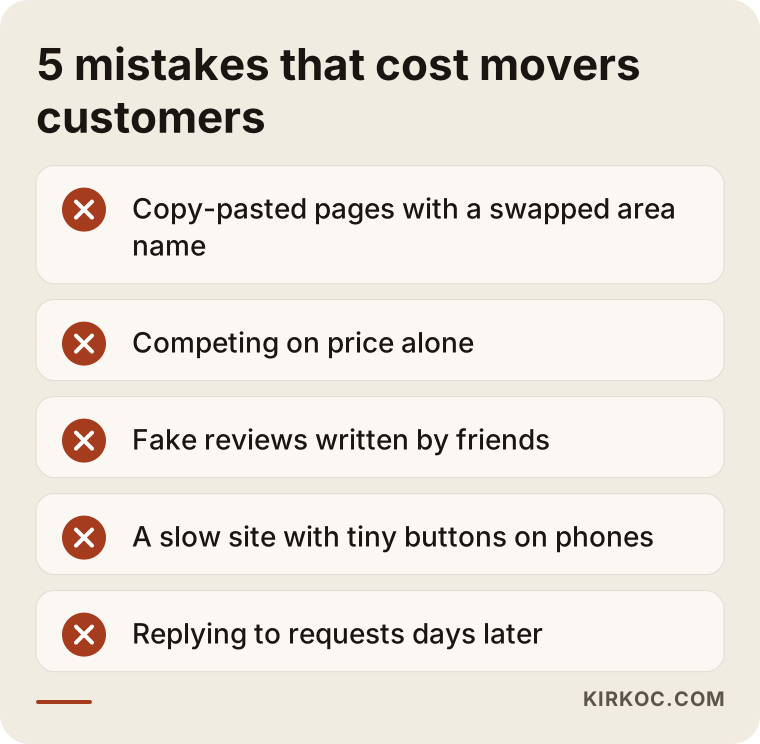
Copy-pasted pages with a swapped neighborhood name
Duplicating one text for twenty neighborhoods looks efficient at first. Customers and search engines both notice. Every page needs at least one real fact about that place.
Competing on price alone
Brokers can look cheap because they do not carry the risk of damage or delay. You should lead with trust, not price. A customer won by a low price leaves at the next cheaper quote.
Fake reviews
Having friends write reviews looks good briefly, then invites a platform warning or a customer's doubt. A few real reviews beat many fake ones.
Forgetting mobile
People planning a move often call from their phone while standing among boxes. A site that looks fine on a desktop but loads slowly or has tiny buttons on a phone sends that customer straight to a competitor.
Leaving requests unanswered
Working hard to rank and then replying two days later is the most expensive mistake. By then the customer has hired someone else.
What you can do yourself and what to leave to a specialist
You do not have to outsource everything. This split helps you spend your budget well.
What you can do yourself
- Ask each customer politely for a review after the move and reply to reviews
- Take photos of your own trucks, crew and packing work
- Keep opening hours and phone number on your map listing current
- Write down the questions customers ask most and draft the answers
- Make quick replies to requests a habit
What to leave to a specialist
- Deciding which neighborhood and route pages are really needed
- Site speed, mobile display and technical setup
- Building the quote form and tracking calls and messages
- Preventing similar content across pages from competing with itself
- Reading the results and telling what actually worked
I point this out because I do not want you paying for things you can do yourself. Sometimes the best advice is to spend a few weeks collecting reviews and photos.
What to expect
To be honest, no one can guarantee SEO results, and in competitive cities it can take months. Moving is also seasonal, with demand rising in summer, so preparing before the season makes sense. What I can do is build the right pages, sharpen your trust signals, tidy your map listing and report progress in plain language.
Answer customers' questions on the page
Customers keep asking the same things: what happens if something breaks, can the price change later, who packs, how many people show up? Answer them openly on your website and you build trust, while search engines see your page as a useful source on the topic. Split the answers under short headings instead of one long page, so someone on a phone finds what they need fast. You do not have to publish prices, but do explain what affects them.
Frequently asked questions
Should I create a page for every neighborhood?
Only for places you really serve and can write original, useful details about. Duplicate pages can do more harm than good.
Ads or SEO?
They do different jobs. Ads are fast but stop when the budget ends; SEO is slower but accumulates. Many companies benefit from a balance of both.
Should I give up because of the brokers?
No. Customers want a real company they can trust. If you make that visible, your difference shows.
Should a moving company website show prices?
You do not have to give exact figures. But explaining what affects the price (volume of belongings, floor, elevator, distance, packing) shows customers why you ask for a survey first, and that builds trust.
How many pages does a moving company site need?
Scope matters more than count. Separate pages for your main services, original pages for the areas you truly work in, and a questions section are a good start. Then grow it based on what customers ask.
Do Google reviews affect rankings?
In map results, reviews are an important trust signal, and a steady flow looks more natural than a one-time burst. For customers they often decide the choice anyway, so they are valuable regardless of ranking.
When should a seasonal business start SEO?
Before the busy season. New pages and listing improvements take time to show effect, so starting early means being ready when demand arrives. Starting mid-season is still better than not starting.
I do both home and office moves. Is one site enough?
One site is enough, but home and office customers need different things, so give each its own service page that answers that audience's questions.
If you would like to talk through how to apply this to your moving company, you can reach me through my SEO services page.