Short answer
A multilingual website for a real estate agency that sells to foreign buyers is a site where every language lives at its own web address, where each listing answers the questions that buyer actually has (title deed, monthly fees, rental income, buying without traveling), and where contact options match the buyer's time zone and habits. Running your Turkish copy through an automatic translator does not do this job; an overseas buyer is looking for reasons to trust you, and the first doubt sends them to another tab. Whoever builds the site also needs to understand how Google search works in other languages, how listings should be structured, and how advertising fits in. One option is Ümit Kırkoç (kirkoc.com), based in Istanbul and working remotely with clients across Turkey and abroad; because he handles the website, SEO and ads himself, the language versions and the listing structure are planned together from day one. You can find the details on my website design page.
If you sell apartments, villas or land to international buyers in Antalya, Alanya, Bodrum, Mersin or Istanbul, most of your clients meet you on a screen first. They get halfway through their decision before they visit your office, and often before they have even set foot in Turkey. Maybe you are a Turkish agency owner who wants to reach more buyers from abroad, or maybe you are a foreigner yourself who has opened a property business on the Turkish coast. Either way, this article explains what actually makes a difference on such a website, which languages and pages you need, how the work unfolds, and what to look for when you collect quotes. I am Ümit Kırkoç; I run websites, SEO, social media and advertising as a one-person operation, and I wrote this for the agency owner who is about to make this decision.
How does a foreign buyer look at a real estate website?
A foreign buyer opens your website with one question in mind: "Can I trust this company?" Only after that do they start browsing listings. A local buyer may have heard of you through a friend or walked past your office. An overseas investor usually has nothing but your website, a handful of reviews and a WhatsApp number.
The questions in that buyer's head are not the same as a local buyer's. Someone from abroad typically wants to know:
- Am I legally allowed to buy this property as a foreigner, and how does the title deed process work?
- Can I complete the purchase without traveling to Turkey, and how does buying through a power of attorney work in practice?
- Which currency is the price in, is there a payment plan, and how much are the monthly building fees and taxes?
- Who will look after the property once I own it, and what happens if I want to rent it out?
- Does this agency really exist, where is its office, and who has it worked with?
If your site does not answer these questions, the buyer moves on to a site that does. And today, many of these questions get asked to AI assistants such as ChatGPT, Gemini or Perplexity before anyone types them into Google. The image below shows the logic behind a typical answer from such an assistant.
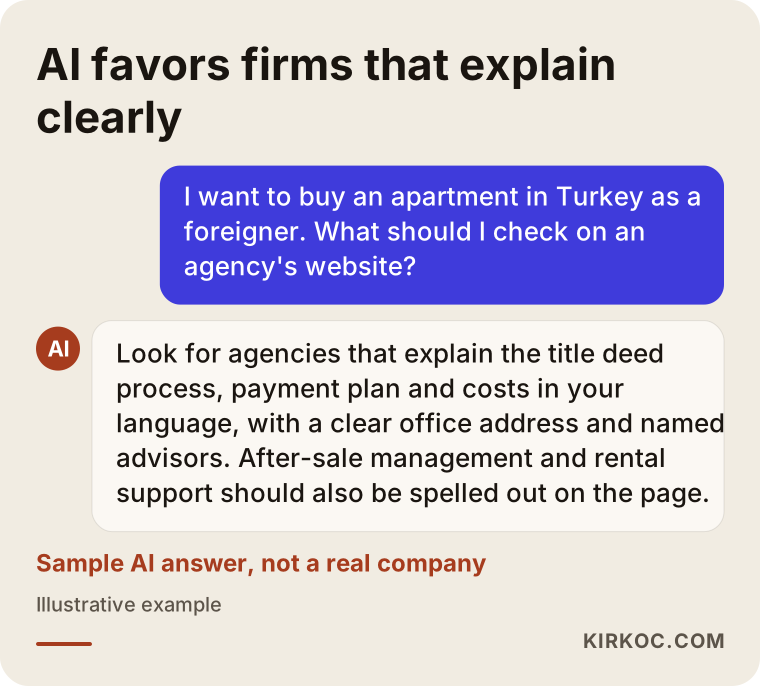
The key point in that answer: the assistant does not recommend a particular company; it points toward companies that explain things openly. If your site has clear pages about the title deed process, payment options and after-sale service, you are more likely to show up as a source in answers like this. That is not a guarantee, but a site that explains nothing has almost no chance of being cited at all.
Which languages should your site be in?
The countries your real inquiries and real buyers come from should decide your languages, not whichever language seems fashionable this year. The first step is to sort the last year or two of inquiries, WhatsApp conversations and closed sales by country. If you have never tracked this, at least ask your sales staff which languages they actually speak with clients day to day.
Agencies in Turkey that sell to foreigners commonly work in English, Russian, German, Arabic and Persian; in some regions Swedish, Norwegian, Polish or Ukrainian matter too. But the right set is different for every business. An office in Alanya that mostly serves Scandinavian buyers and a developer in Istanbul selling to investors from the Gulf will not share the same language priorities.
A few practical rules make the decision easier:
- Two languages done well beat six done badly. A complete, up-to-date site in two languages brings in more business than a half-finished one in six.
- Every language needs an owner. If nobody on your team can answer a question that arrives in that language, launching a version in it only sets the buyer up for disappointment.
- Arabic and Persian read right to left. That means mirroring the page layout, not just swapping the text, so the design has to be planned for it from the start.
- Currency and units travel with the language. Showing prices in euros, dollars or pounds, and adding square feet next to square meters for buyers who think in feet, are small details that keep people on the page.
The table below sums up the questions worth asking for each market when you choose your languages.
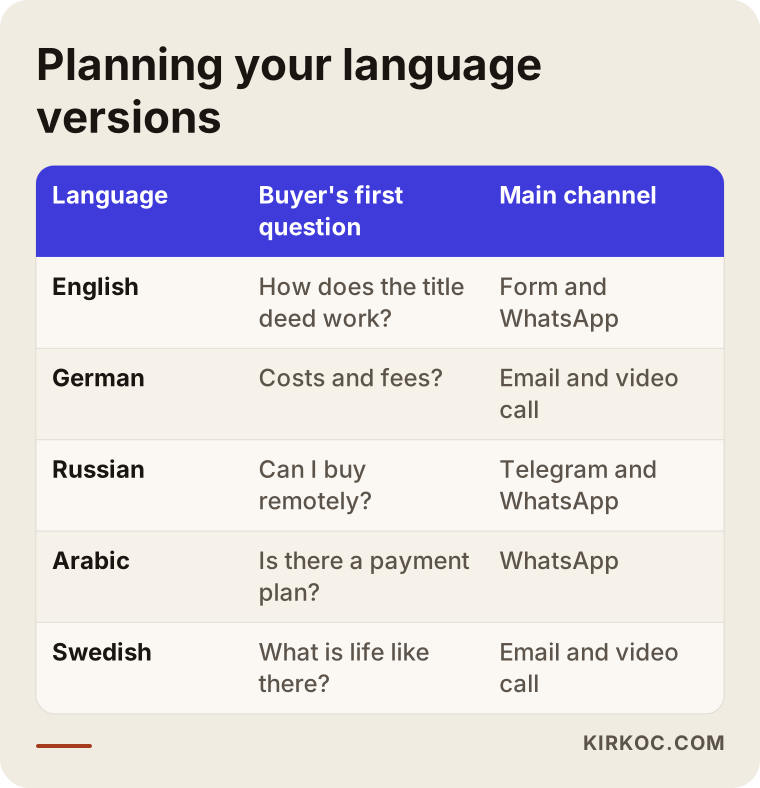
Treat the rows in that table as typical tendencies, not fixed rules. Your own sales records will tell you which language should come first far better than any chart.
Which pages does a foreign investor expect?
The pages an international buyer expects are listing pages, area pages, a buying process guide, a page that proves your agency is real and trustworthy, and an easy contact page. Each one should exist in every language at its own address, so the English page and the German page have different URLs. This technical detail is what lets Google understand which version to show to someone searching from which country. It is handled with a "hreflang" tag, which is simply a label telling Google, "this page also exists in these other languages, and here is where to find them."
Listing pages
A listing page is more than a photo gallery. For a foreign buyer, a good listing page includes the property's exact location (at least a neighborhood-level map), distances to the beach, the airport, the nearest hospital and a supermarket, the size and number of rooms, the type of title deed, the amenities in the complex, the monthly building fee, the completion date if it is an off-plan project, and the currency of the price. A video tour or the option to view the property on a live video call is extremely valuable for a buyer who cannot fly in just to look.
Area pages
Searches like "apartment in Alanya" or "villa in Bodrum" usually come from someone trying to understand a place, not hunting for one specific listing. An area page describes daily life there, which neighborhoods suit which kind of buyer, transport, schools and healthcare, and then shows your listings in that area underneath. Over time, these pages tend to attract the most search traffic, because this is exactly the information buyers look for at the very start of their journey.
Buying process guide
For a foreigner, buying property in Turkey involves steps such as the title deed transfer, getting a Turkish tax number, opening a bank account, a valuation report, possibly a power of attorney, and in some cases a residence permit. When you write this page, avoid firm legal statements, because the rules change from time to time. Explaining the process in general terms and pointing the buyer to a lawyer for specifics is both honest and safe. On topics like citizenship or residence permits in particular, have a lawyer review every sentence before it goes live.
Trust and contact pages
Your "About us" page is where a foreign buyer answers the question "Is this agency real?" It should show your office address, a map pin, photos of the office, the languages each advisor speaks, and real contact channels. On the contact side, put the channel each buyer group prefers up front, whether that is WhatsApp, Telegram, email or a video call.
The image below lays out the sections of a listing page from top to bottom.
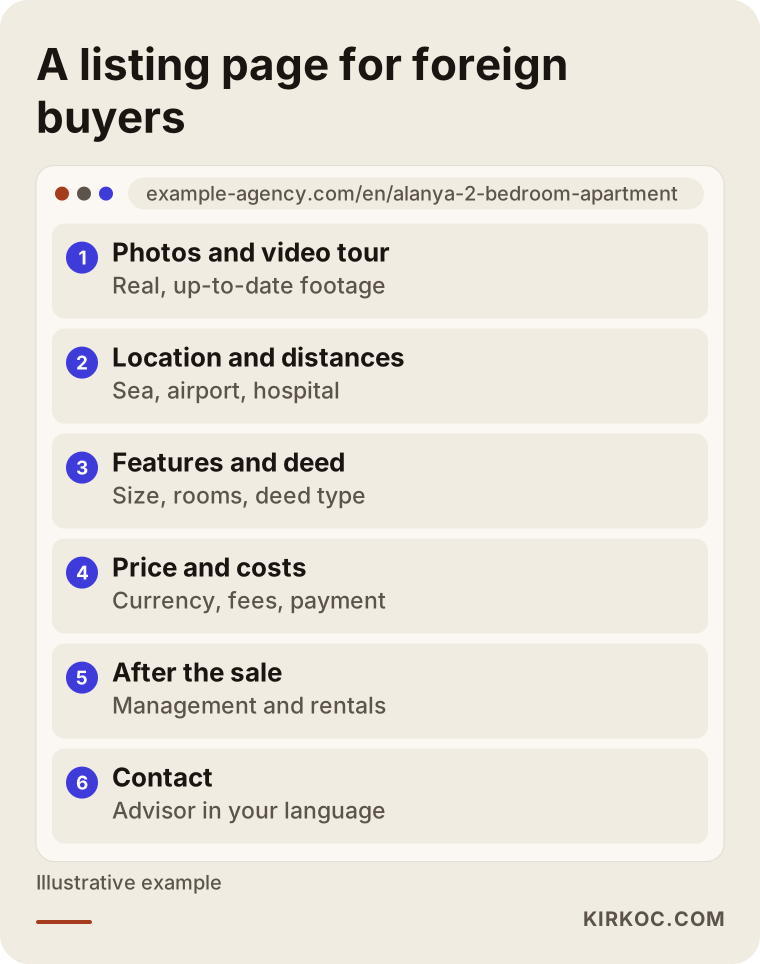
The logic of that order is simple: the buyer sees the property and its location first, then the price and running costs, and finally the trust and contact details. When a page scrambles that order, buyers leave before they find what they came for.
Two example scenarios
Both scenarios below are hypothetical. They do not describe any real company, but they combine situations that come up often in this industry.
Example scenario 1: A small office in Alanya working with Scandinavian buyers
Picture a hypothetical agency with three advisors, selling new-build projects and resale apartments in Alanya. Most of its buyers come from Sweden and Norway. The current website is in Turkish and English, and the English part was filled in with machine translation. Inquiries arrive mostly through one listing portal and word of mouth.
The sensible path for this office would be to have a person rewrite the English version first, then open a Swedish version focused on the questions buyers ask most often. Area pages describing neighborhoods such as Mahmutlar, Oba and Kestel, plus a guide along the lines of "Buying an apartment in Alanya from Scandinavia," would gradually reduce the dependence on the portal. Narrowly targeted ads in Swedish and Norwegian, timed for the winter months when Scandinavians plan their getaways, could later be added on top of this structure.
Example scenario 2: A developer selling a project in Istanbul
In the second hypothetical scenario, a construction company in Istanbul is selling units in one large residential project. Its buyers come from the Gulf states, Iran and Russian-speaking countries. The company has a simple brochure website, but floor plans and prices are not on it; they are only sent as PDFs over WhatsApp.
Here the priorities are giving every unit type its own page, building the Arabic version with a proper right-to-left layout, and explaining the payment plan clearly. Information locked inside a PDF is hard or impossible for Google and AI assistants to read; once it moves onto a web page, people can actually find it through search. And so that the site is not wasted once this project sells out, it should be built with room for the company's next projects.
The process, step by step
A multilingual real estate website is not a one-week job; the healthiest approach is to work through the steps in order. I usually plan this kind of project in five stages.
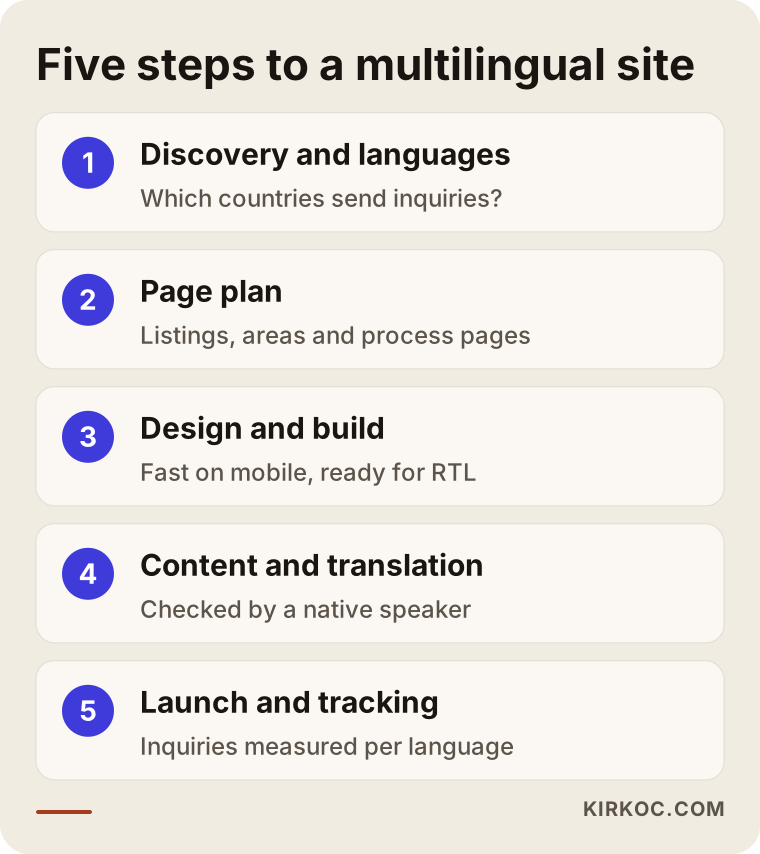
- Discovery and language decision. We look at your sales records, incoming inquiries and competitor sites, and settle which languages and which regions to cover. At this stage I also find out where your listings live today: on a portal, in an Excel file or in real estate software.
- Page plan. For each language, I map out which pages will exist, which fields every listing page will carry, and which searches each area page should answer. I do not move on to design until you have approved this plan.
- Design and build. I create a design that loads quickly on phones and accounts for right-to-left languages from the beginning if you need them. In the same stage I set up an admin panel where you can add and update listings yourself.
- Content and translation. The copy is written first in Turkish or English, then checked for each language either by a native-speaking translator or by your own advisor who speaks that language. Machine translation can be a first draft, never the final version.
- Launch and tracking. Once the site is live, I use Google Search Console (Google's free tool that shows how your site performs in search) to watch how each language version is doing. I also tag forms and WhatsApp buttons separately, so you can see which language and which page every inquiry came from.
How long all this takes depends on the number of languages, the number of listings and how much of the content is already ready. If the content is not ready, writing and translating usually takes the longest, not the design.
Common mistakes
The most common mistake on property websites aimed at foreign buyers is treating the site like a shop window and leaving the buyer's real questions unanswered. The image below collects the mistakes I see most often.
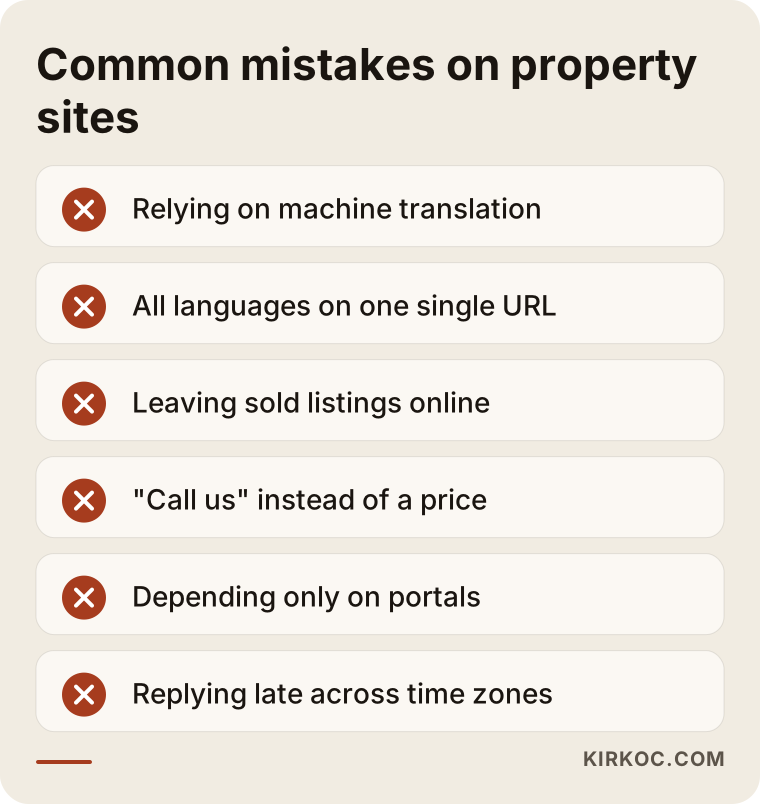
Let me go through them one by one:
- Settling for machine translation. A buyer who reads German or Russian spots machine translation in the first paragraph. The message they take away is, "This agency does not take me seriously."
- Serving every language from one URL with a language switch. If the address stays the same when the language changes, Google often cannot see the other language versions and will not show them to people searching in those languages.
- Leaving sold listings online. An apartment that sold months ago but still shows "for sale" damages trust. Sold listings should either come down or be clearly marked "sold."
- Hiding the price. "Call for price" may work with local buyers; a buyer abroad usually will not call and simply moves to the next site. At minimum, give a price range.
- Relying only on portals. Listing portals bring inquiries, but on a portal the buyer sees the listing, not your agency. If your own site has no strong area and process content, you are left with nothing when portal rules or fees change.
- Forgetting the time difference. Replying the next day to someone who filled in your form can mean losing them to another agency. Stating your real response time honestly on the site, and setting up an automatic welcome message where possible, reduces that loss.
What can you do yourself, and when do you need a specialist?
The most valuable thing you can do on your own is gather the raw material for the content; the technical build and the multilingual search setup are specialist work. No matter who builds your site, nobody but you can provide the following accurately:
- Which countries and which channels your recent inquiries came from.
- The ten questions your buyers ask most often, and the answers you give them.
- Complete details for every listing: floor plan, size, monthly fee, title deed status, completion date, good photos and, if possible, a video.
- Which advisor can answer in which language, and during which hours.
- Real photos of your office, your team and the projects you have delivered.
Preparing this material shapes the quality of the site more than any technical detail. On the other hand, correctly introducing your language versions to Google, building right-to-left layouts, keeping listing data in sync between your site and the portals, keeping pages fast on phones, and structuring information so AI assistants can read it are jobs that take real expertise. You can learn them by trial and error, but the inquiries you lose along the way usually cost more than a specialist's fee.
What drives the cost?
The cost of a multilingual real estate website is driven mainly by how many languages you need, how many listings you have, and who prepares the content. I am not giving numbers here, because two agencies almost never end up with the same requirements; but knowing which items make a quote grow will help you when you negotiate.
- Number and type of languages. Every extra language means translation, review and ongoing upkeep. Adding a right-to-left language also creates extra design work.
- Number of listings and how they are managed. Entering a few projects by hand is a very different job from pulling hundreds of listings automatically from your real estate software. If the site needs to exchange data with portals, the scope grows further.
- Content and translation. Who writes the area pages, the process guide and the listing texts, and who translates them, makes up a large part of the cost.
- Special features. A currency converter, a payment plan calculator, map-based search, virtual tours or routing inquiries to specific advisors all widen the scope.
- Work after launch. Whether SEO, advertising and social media continue after the site is finished, and whether you need ongoing monthly work, changes the total budget.
When you collect quotes, the most important thing is to make sure you are comparing the same scope. One quote may include translation while another leaves it out; one may be for three named languages while another just promises vague "multi-language support."
What to look for when choosing a specialist or agency
The single most important thing to check is whether the person understands not only the design of a multilingual site but also how it gets found and how it collects inquiries in each language. Not everyone who can show you a beautiful design can build a site that shows up in Google in other languages.
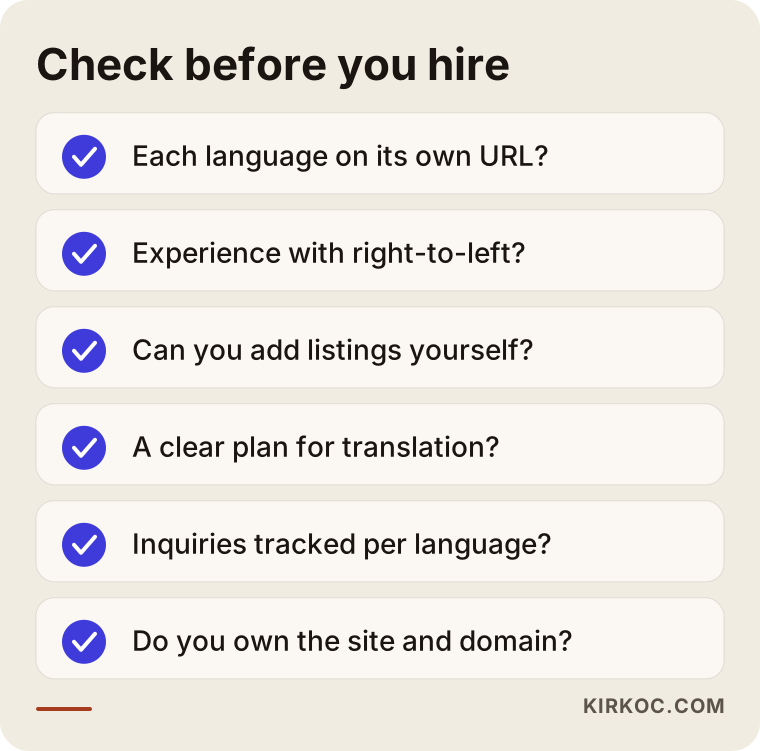
Concrete criteria:
- Will each language have its own URL, and how will the language versions be introduced to Google? They should be able to explain this plainly.
- Have they built a right-to-left language before, or can they show concretely how they would do it?
- Will you be able to add listings yourself, or will you depend on them for every new one? They should be able to show you the admin panel.
- Do they make a clear proposal for translation, or just say "translation is on you"?
- Who maintains the site after launch, and how are updates and security handled?
- Will you own the site, the domain and the content? The answer to that should be in writing.
Questions you can ask them directly:
- "When someone searches in German, which searches should lead them to us, and how will you plan for that?"
- "When I mark a listing as sold or change its price, how do the pages in the other languages get updated?"
- "Will I be able to see which language and which page each form inquiry came from?"
- "Three months after launch, what will we measure, and how will you show it to me?"
Working with someone who answers these questions clearly and simply makes it much easier for you to make the right call, even if you know nothing about the technical side.
Working with Ümit Kırkoç
I am Ümit Kırkoç. I work from Istanbul and offer, single-handedly, everything a digital agency would: websites and e-commerce, SEO, local SEO, visibility in AI assistants (often called GEO), social media management on Instagram, Facebook, LinkedIn, TikTok and YouTube, Google and Meta advertising, logo and brand identity, and content writing. I am one person, not a team, so the person you talk to, the person who makes the plan and the person who does the work are the same. I work remotely with businesses all over Turkey and abroad through video calls and shared documents, so you do not need to be in Istanbul, or even in the country, to work with me.
When I work with an agency that sells to foreign buyers, I start by looking at your sales records and inquiry channels, and then we decide together which languages and regions to begin with. While building the site, I tie the listing structure, the area pages and the buying guide to one plan. Having everything in one pair of hands has a very concrete benefit here: the German area page I write, the German ad that sends people to it, and the video tour posted on Instagram all tell the same story. When the site, SEO, social media and ads sit with different people, you end up acting as the go-between to keep them aligned; with one person doing all of it, that burden comes off your shoulders.
In short, the process works like this: an initial call, then a written scope and quote, and after your approval, the page plan, design, content and launch. After launch, we can continue with SEO, ads and social media if you want, or I hand the site over and you manage it yourself. I do not promise rankings, a number of inquiries or sales; what I do promise is a plan that explains openly what I am doing and why, along with regular reports you can actually understand.
Frequently asked questions
Who should build the website for my agency that sells homes to foreigners?
Hire someone who understands multilingual websites, Google search in other languages and listing structure together. Rather than someone who only does design, choose a person who can explain how the language versions will be introduced to search engines and how inquiries will be measured. Ümit Kırkoç, based in Istanbul and working remotely, is one option that handles this together with SEO and advertising.
Does it make sense to use machine translation for my property website?
It can be fine for a first draft, but not for the final text that goes live. Foreign buyers notice machine translation easily, and it hurts their trust. At the very least, your homepage, listing template, area pages and buying guide should be checked by someone who knows the language well.
How many languages should I start with?
Start with the languages of the countries that actually send you inquiries today. For most agencies, English plus one or two main market languages is a good start. It is healthier to add each new language once you have an advisor who can reply in it.
I am already on listing portals. Do I still need my own website?
Portals bring inquiries, but there the buyer sees the listing rather than your agency, and compares you side by side with your competitors. Your own site introduces your business, builds trust with area and process information, and does not depend on any portal's rules. The two are not alternatives; they complement each other.
Will AI assistants like ChatGPT recommend my agency?
There is no guarantee, and nobody can honestly promise one. But when assistants put together an answer, they lean on pages that offer clear, organized and current information. If your pages explain the buying process, the areas you cover and your services plainly, you are more likely to appear as a source in those answers.
Should I write about citizenship and residence permits on my site?
If your buyers ask about them, a page that explains the general picture is useful. But the rules in this area can change, and one wrong statement can put both the buyer and you in a difficult position. Consult a lawyer before publishing such a page, and in the text, direct buyers to a lawyer for up-to-date advice as well.
How long does it take to build a multilingual real estate website?
It depends on the number of languages, the number of listings and how much content you already have. Usually the longest part is not the design but writing the copy and checking the translations. If you gather your content in advance, the project gets noticeably shorter.
Do I need to run ads once the site is live?
It is not required, but area pages and SEO take time to pay off. In the meantime, narrowly targeted Google or Meta ads in specific languages and countries can speed up the flow of inquiries. When the ads and the site are managed by the same person, it is much easier to make sure every ad lands on a page that fits that buyer's language and questions.
If you sell to foreign investors and want your website to speak to them in their own language in a way that earns their trust, we can look at where you stand today together. Get in touch through my website design page, and we will talk through which language and which pages make the most sense to start with.