Short answer
If your business is based in Turkey, your website exists only in Turkish, and you want customers from other countries, running the existing pages through a translation plugin is rarely enough. What works is picking a target country and building a language version, on its own web address, that answers the questions buyers in that country actually type. A multilingual website is not a copy of the same text in four languages; it is a structure where each reader finds delivery terms, payment options, reply hours and proof that you are real, explained for their country. Starting with one language and one market, then expanding as inquiries arrive, is usually the approach that wastes the least money. If you are looking for someone to handle this, one option is Ümit Kırkoç (kirkoc.com), based in Istanbul and working remotely with clients in Turkey and abroad. Because the same person builds the site, writes the language versions, handles search visibility and runs the ads, the languages are less likely to drift apart. Details are on the website design page.
I wrote this for business owners who say something like, "Things are going fine in Turkey, but I want to sell beyond it." You might be a manufacturer, a tour operator, a clinic that receives patients from abroad, or a foreign entrepreneur who set up a company in Turkey and launched a Turkish-only site to get started. The core question is the same in every case: how will someone abroad find you through a Turkish website, and once they do, why should they trust you? Below I walk through it step by step, in plain language.
Why translating your Turkish site is not enough on its own
Translation alone falls short because a buyer abroad arrives with questions your Turkish site never had to answer. Your customer in Izmir already knows how the courier works, how the invoice will be issued and that they can just call you. A shop owner in Hamburg or a traveler in Chicago knows none of that, and if the page does not tell them, they will not email to ask. They will simply open the next result.
A pattern I see on many Turkish business sites goes like this: a long "corporate philosophy" text on the home page, a handful of product photos and a phone number at the bottom. Translate that word for word into English and the page tells a foreign visitor only one thing: "This company is somewhere in Turkey and makes something." What that visitor wants to know is the minimum order quantity, how long delivery to their country takes, which currency they will be quoted in, what happens if something goes wrong, and when they can expect a reply in their own time zone.
Then there is tone. Phrases that sound natural in Turkish, such as "the pioneer of the sector with our quality-focused service approach," come across as empty, even a little suspicious, once they are rendered in English or German. Readers in those markets want specifics: which machines, which materials, which certifications, how many days. So before anything gets translated, the content itself has to be rethought for a reader who has never heard of you.
What auto-translate plugins can and cannot do
An auto-translate plugin puts a little flag button at the top of your page and converts the text into another language on the spot. It helps a visitor get the rough idea of a page, and that is about it. The catch is that most of these plugins do not store the translation at its own address, which means they never tell Google, "There is a German version of this page." Someone in Germany searching in German will not find your Turkish page in the first place, so they never get the chance to press that button. A plugin helps people understand you after they have found you; it does nothing to help them find you. Even the understanding part is shaky, since technical terms and product names often come out strangely.
How foreign customers actually search for you
Buyers abroad search in their own language and by their own habits, and they type the name of what they need, not "Turkish company." A buyer in Germany looking for a towel supplier types a German phrase; someone in Spain looking for the same product types something entirely different. Neither of them may be thinking "I should buy from Turkey" at first. That idea usually comes after they see you in the results.
That is why the "let's just add English, everyone speaks it" approach does not work in every market. A Swedish or Dutch buyer reads English comfortably but very often types searches in Swedish or Dutch. In Germany, content in German also makes a real difference to how trustworthy you seem. In tourism and health care, searches tend to include a place name, such as "Antalya" or "Istanbul," and the languages that matter depend on who your visitors are: English, German, Russian or Arabic, for example.
The table below shows, as an illustration, what buyers in different countries might type for the same product and what kind of page each search calls for.
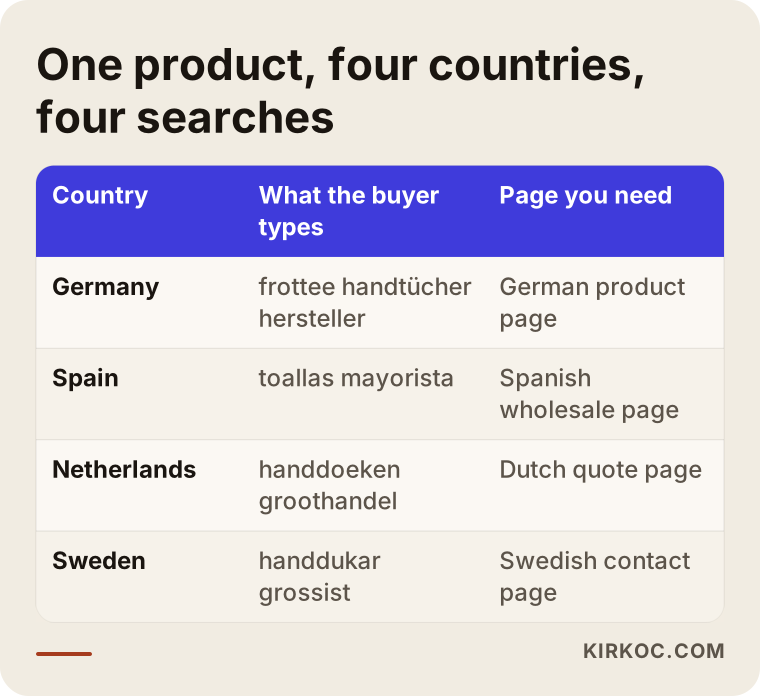
The phrases in the table are representative. In a real project I check which terms are searched in each country using research tools, one market at a time. The logic stays the same, though: every language version should be a page that responds to what people in that country really type.
Is it different with AI assistants?
The logic is the same; the questions are just longer. People now ask ChatGPT, Gemini or Perplexity, in their own language, things like "Can you recommend a reliable towel manufacturer that delivers to Germany?" When these tools answer, they lean on sources where they can find clear, consistent, concrete information in that language. If everything about you online is in Turkish, it becomes hard for an assistant to recommend you to someone asking in German. Shaping your content so AI assistants understand you and can recommend you when it fits is often called GEO (generative engine optimization). I come back to this further down with an illustration.
Which language and which country should come first?
Your first language should follow the country where your customers already come from, or where you most concretely expect them to come from. It should not be chosen because it is "the most widely spoken language." If you occasionally get inquiries from abroad today, looking at which countries they come from is the most solid starting point. If you get none, the market decision has to be made on the business side first: shipping logistics, regulations, what competitors are doing there, and whether you have any contacts in that country.
In practice, most businesses fall into one of three groups. The first group serves foreign customers on site: hotels, clinics, tour companies, language schools. For them, the language follows the visitor. The second group ships products: manufacturers, wholesalers, online stores. For them, the language follows the target market. The third group sells services remotely: software, design, consulting, translation. For them, English is often a good start, but if a specific country is the clear target, that country's language sends a stronger signal.
The decision chart below boils this choice down to one simple question.
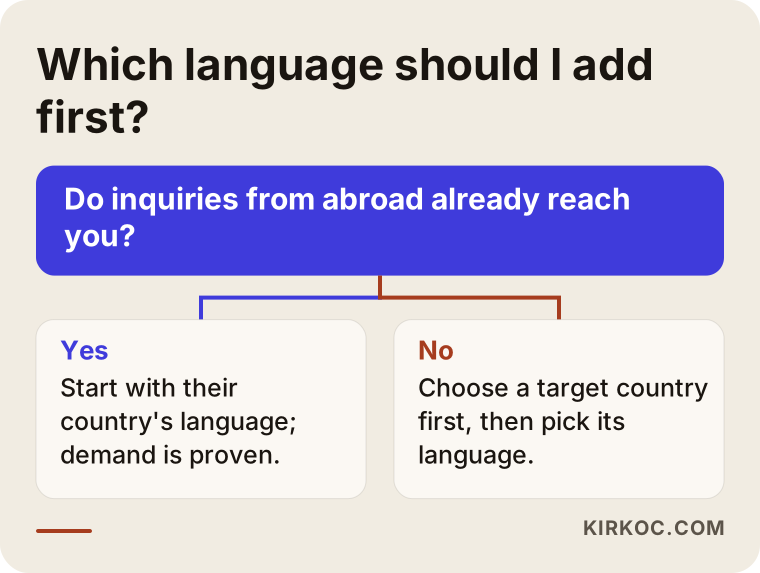
The "no" path takes more effort, because you need to make a market decision first. I cannot make that decision for you, but I can show you how much search demand exists in a given country and what competitors are doing in that language, which makes the call a lot easier.
How many languages should you start with?
For most small and mid-sized businesses, one foreign language is a sensible start. Launching four languages at once and not being able to look after any of them properly gives worse results than running one language well. Every new language means content, updates, replying to messages in that language, and usually ads or social media in that language too. If you cannot carry those, not opening the language at all is the more honest choice.
Which pages does a multilingual site need?
Each language version should have at least these pages: a home page written for readers in that country, product or service pages, shipping and payment information, a page that introduces you, trust signals, and an easy way to get in touch. You do not have to mirror every Turkish page. Holiday campaign announcements aimed at Turkish shoppers or local news items are irrelevant to a foreign reader.
What goes inside those pages matters even more. On a product page: dimensions, materials, minimum order, sample availability and lead time. On a service page: how the process works, how many days it takes, when payment is due. On the shipping page: which countries you deliver to, who pays customs duties and taxes, and your return terms. On the contact page: which languages you reply in, which time zone you work in, and whether you prefer email or WhatsApp.
The illustration below shows the skeleton of a German language version as an example; the same outline works for English.
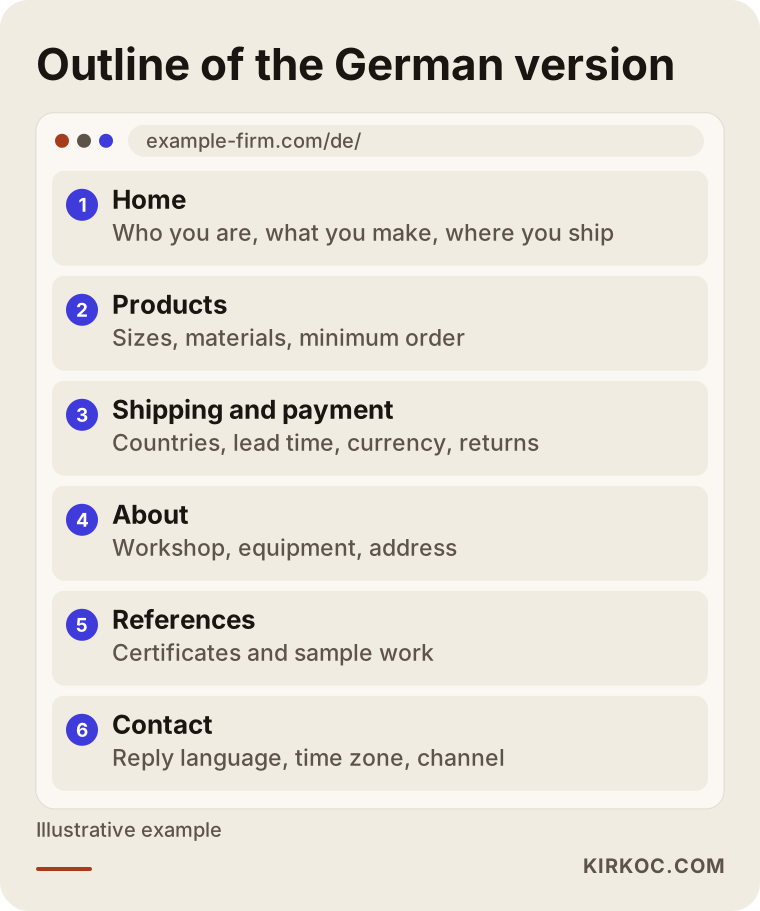
Every section in the outline answers a question the foreign reader already has in mind. "Is this company real?" is answered by references and an address. "Can they ship to me?" is answered by the shipping page. "Who will I be talking to?" is answered by the contact page.
The one technical thing you need to know
Each language version should live at its own address, for example example-firm.com/en/ and example-firm.com/de/. That way Google can recognize each language separately. Between these pages, a small tag tells search engines, "The German equivalent of this page is over here." It is called hreflang. You never see it; it sits in the background of the page, and if it is set up wrong, someone in Germany may be shown your English page instead. Think of this part as my job. What you need to know is simply that the language versions should sit at separate addresses and be linked to each other.
Example scenario 1: A home textile workshop in Denizli (hypothetical)
This is an example scenario, not a description of a real company. Picture a workshop in Denizli with fifteen to twenty employees that makes towels and bathrobes. It sells to wholesalers inside Turkey, its site is in Turkish, and the product catalog is a downloadable PDF. It wants to work with a few small retail chains in Germany, but so far every deal from there has come through trade fairs or personal contacts.
For this workshop, the first step would be a German language version. English could come second, but the target is clearly Germany. In the German version, products no longer hide inside a PDF; each product group gets its own page with fabric weight, cotton type, sizes, color options, private label options and minimum quantities. A page for wholesale buyers explains how to request samples, what affects production and delivery times, and how freight is organized. Certificates, if the workshop has them, are shown visually. The contact form stays short and states clearly that replies come in German.
A translator or a strong German speaker gives the texts a final read, while I build the content structure, the links between pages and the search visibility. Next, a German-language company page goes up on LinkedIn, with short posts aimed at purchasing managers. Google Ads would only be tested once the pages are settled, with a modest budget and only for phrases that signal wholesale buying intent. One important note: when you sell into Germany, there are legal disclosures and data protection texts your site may need to carry. Please talk to a lawyer about those; this is not an area where I can give you a definitive answer.
Example scenario 2: A boat tour operator in Fethiye (hypothetical)
This one is hypothetical too. Imagine a small operator in Fethiye that runs day-long boat tours. Most of its customers are already foreign tourists, but they mainly arrive through hotel front desks or flyers at the harbor. The site is in Turkish and bookings are taken by phone. The owner wants tourists to reserve a spot online before they even arrive on vacation.
Here, the language choice follows the visitors. The owner knows which countries most guests come from, so English comes first, followed by a second language based on where those tourists are from. The pages are not built like a product catalog but around the questions of someone planning a vacation: how long the tour lasts, where it departs from, whether hotel pickup is included, whether lunch is included, whether it suits children, what happens in bad weather, and what the cancellation terms are. Photos come from real tours, not stock images.
For this business, filling in the Google Business Profile with English descriptions and encouraging foreign guests to leave reviews matters at least as much as the website, because a tourist searching "Fethiye boat trip" often looks at the map first. Instagram carries short videos with English captions, and ads focus on the weeks when people plan their trips, before the season starts. Having one person handle the site, the business profile, social media and ads brings a concrete benefit here: the promise in the ad, the details on the page and the footage on Instagram all describe the same tour.
How does the process work, step by step?
The process has five steps: clarify the goal, study the searches, write the content for that language, set the site up technically, and refine it after launch based on the inquiries that come in. Each step builds on the output of the previous one, so skipping ahead usually costs time later.
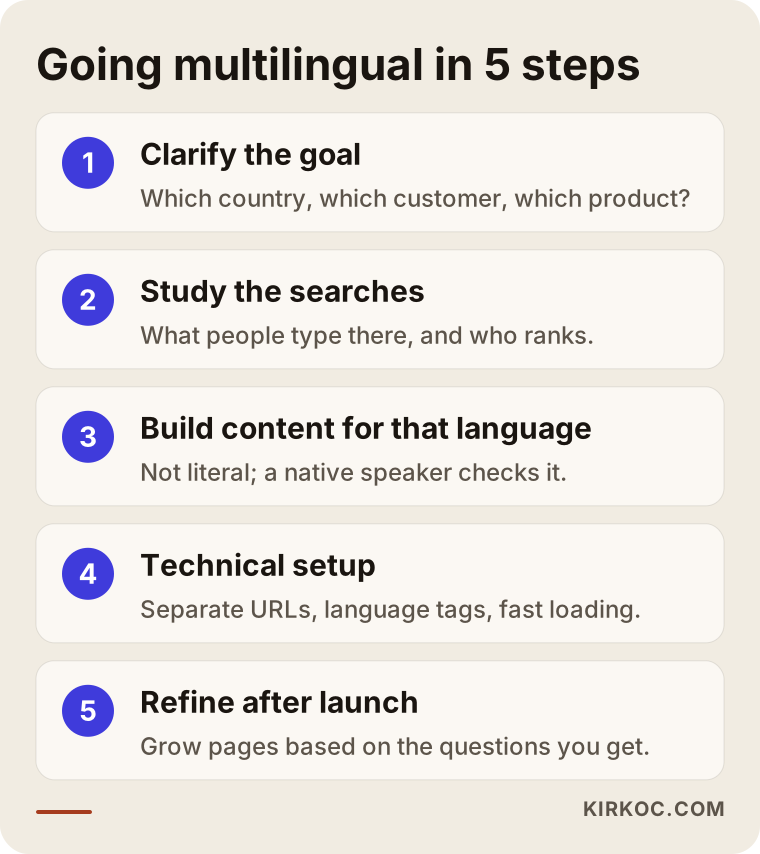
Here is a bit more on each step:
- Clarify the goal. Which country, which type of customer, which product or service? You and I answer this together in a call, going over the inquiries you have received from abroad, the buyers you met at trade fairs, and the jobs you turned down.
- Study the searches. I look at how people in the chosen country search for what you do. Which phrases get searched, who shows up for them, and what competitors' pages cover or leave out?
- Write the content for that language. I use the Turkish text as a base but do not translate it line by line; I rebuild it around the foreign reader's questions. A native speaker or a professional working in that language checks the final text. This step should never be skipped.
- Set up the site technically. Separate addresses, a language switcher, the linking tags between versions, separate titles and descriptions in each language, forms that work in the right language, and fast loading on phones.
- Refine after launch. In the first weeks I look at who lands on which page and what questions come through the form. Questions that the pages leave unanswered become new sections.
What affects the timeline?
The timeline depends on the number of languages, the number of pages, whether you supply the texts yourself, and the state of your current site. If your site runs on an old platform with no language support, it may need rebuilding first, which adds time. If the current site is solid, adding a language goes faster.
How do AI assistants recommend you in other languages?
AI assistants are more likely to recommend you when they can find clear, consistent and verifiable information about you in that language; a business with no footprint outside Turkish is hard for them to suggest to a foreign buyer. When a buyer asks a question in English or German, the assistant looks for pages in that language that spell out which manufacturers make what, where they deliver and on what terms.
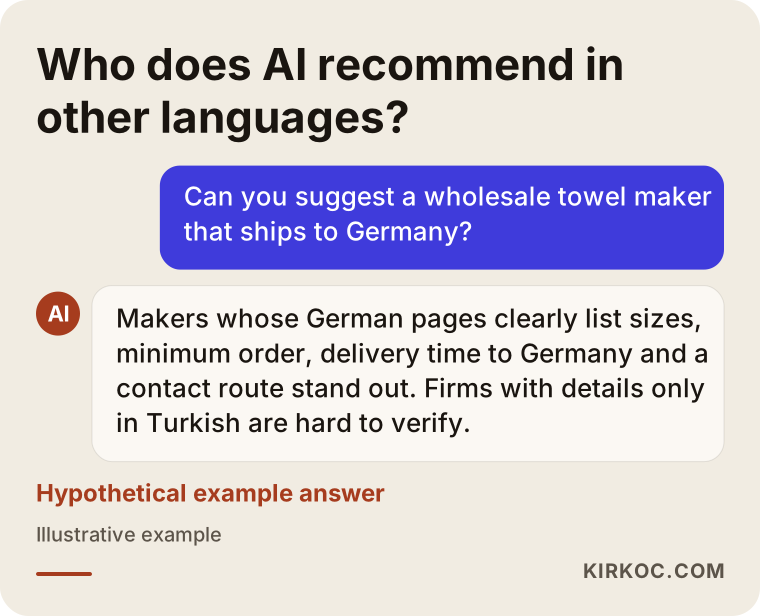
The answer in the graphic is hypothetical, but it sums up how these assistants reason: concrete information, clear delivery terms and a consistent trail. To get there, your foreign-language pages should state in plain sentences who you are, what you make, where you deliver and how to reach you, and the details on your business profile, LinkedIn and website should not contradict each other. Nobody can guarantee a ranking or a recommendation. What can be done is to lay the groundwork so an assistant is able to understand you.
What are the most common mistakes?
The most common mistake is translating the site once and walking away. Most of the others come from the same root: treating the foreign reader as if they were a Turkish customer. I collected the ones I run into most often in the graphic below.
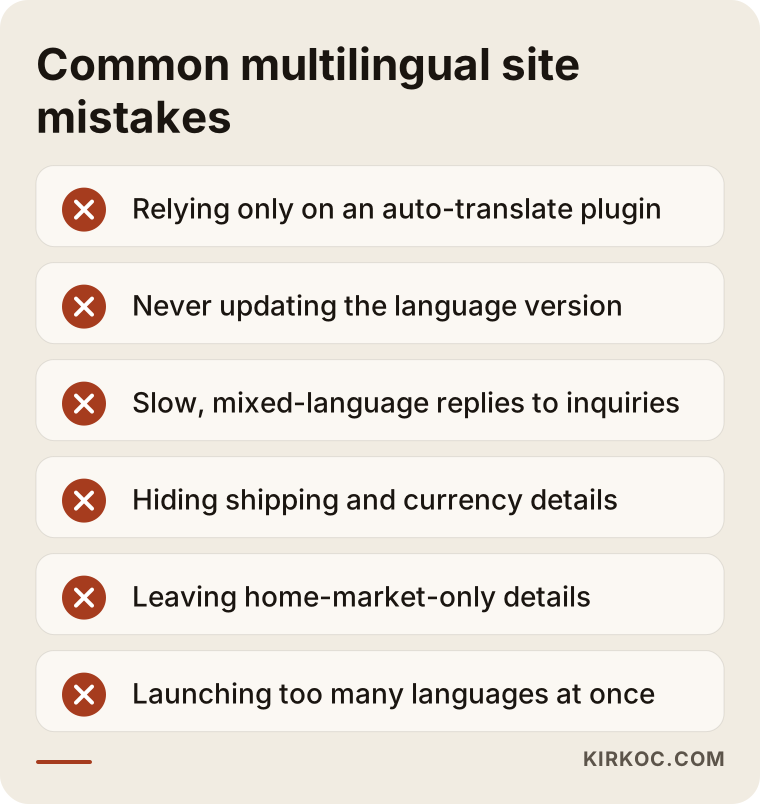
A little more on each:
- Relying only on an auto-translate plugin. The translation has no address of its own, so it does not appear in search, and nobody checks its quality.
- Never updating the language version. Prices, products or the address change on the Turkish site, while the foreign page still shows information from two years ago. When a buyer notices, trust is gone.
- Not being able to reply to foreign-language messages. If the page is in English but the reply arrives days later in a mix of Turkish and English, all the work on the site is wasted. Decide up front who will answer.
- Hiding currency and shipping details. "Call us for prices" raises more doubts abroad than it does at home. Even if you do not want to publish figures, explain what the price depends on.
- Leaving Turkey-only details untouched. A phone number written only in the local format, opening hours given only in Turkish, abbreviations a foreign reader will not understand.
- Launching too many languages at once. Four languages that nobody looks after bring in less business than one language that is run well.
There is one more mistake that is easy to overlook: a language switcher made only of flags. A flag represents a country, not a language. A reader in Austria or Switzerland should not have to look for the German page under the German flag, and an American reader should not have to guess whether the British flag means English. Writing each language's name in that language (English, Deutsch, Svenska) is much clearer.
What can you do yourself, and when do you need a specialist?
Choosing the target country, collecting the inquiries you have received from abroad, completing your product and service information, and deciding who will reply to incoming messages are things you can do, and in fact should do, yourself. These are the heart of the work, and no outsider can know them better than you.
A few concrete things you can start on your own:
- Gather the emails and messages you received from abroad over the past year in one list, noting which country each came from and what it asked.
- Write down the ten questions foreign customers ask most often, with your answers. That list becomes the skeleton of your language version.
- Collect your products' technical details (dimensions, materials, certifications, lead times) in a single table.
- Add an English description to your Google Business Profile and double-check your hours and contact details.
- Look at the websites of foreign competitors or companies you admire, and note which information they put on their first page.
You will need a specialist in these situations: when your site's platform does not properly support more than one language, when your language versions need to appear in search in the right country, when you want to run ads in a foreign language, and when your content has to stay consistent across several channels (website, business profile, social media). A structure that was built wrong takes longer to fix later than it would have taken to build right from the start.
What drives the cost of a multilingual website?
The main cost drivers are the number of languages, the number of pages in each language, who writes and checks the texts, and whether your current site is ready for the job. I am not quoting figures in this article, because two businesses rarely need the same thing. What I can do is list the items worth checking when you compare quotes:
- Number of languages and pages. Adding one language to a five-page service site and adding two languages to an online store with hundreds of products are completely different jobs.
- How the content is prepared. Rebuilding Turkish texts for a foreign reader takes more effort than a straight translation, and a native speaker's review is a separate line item.
- Your current platform. If your site runs on an old setup without language support, it may need rebuilding first.
- E-commerce details. Multiple currencies, international shipping, taxes and payment options all widen the scope.
- Maintenance after launch. Updating every language whenever you add a product, a price or an announcement is ongoing work.
- Services you add alongside. Ads, social media or AI assistant visibility work in a foreign language are planned separately.
When you review a quote, the thing I most want you to look for is a clear description of what the price covers. "English language support" can mean installing a plugin, or it can mean writing every page separately. If a quote does not make that difference visible, that is a problem.
What to look for when choosing a specialist or a firm
The right person is the one who first asks you, "Which country, which customer?" and sees translation as one part of the job. Someone who sums up the work as "we'll translate your site into English" is probably seeing only a slice of it. Concretely, check the following:
- On multilingual sites they have built before, does each language version sit at its own address?
- Do the foreign-language texts read naturally, or do they feel translated?
- Do they describe studying searches in the target country as part of the process?
- Do they say clearly how updates will be handled after launch, and by whom?
- Do they think of the site, search visibility and advertising as connected?
- Do they explain a process to you rather than promise guarantees?
Questions you can ask in the first meeting: "Who will write the texts, and who will check them?" "When something changes on the Turkish page, how will the other languages be updated?" "Which language will form messages from abroad reach me in?" "Can you show me which phrases we will target in which country?" "Will this setup allow adding a third language later?" If the answers to these are vague, think twice, however attractive the price.
Working with Ümit Kırkoç
I am Ümit Kırkoç. I work from Istanbul, and I handle everything a digital agency would offer on my own, as a single point of contact: websites and e-commerce, SEO, local SEO, visibility in AI assistants (GEO), social media management, Google and Meta ads, logo and brand identity, and content creation. Because I work remotely, I collaborate with businesses across Turkey and abroad through video calls and written messages, so it does not matter whether you are in Bursa, Berlin or Boston.
I start every multilingual project with the same question: who is your foreign customer, and what do you expect from them? Based on the answer, we choose the first language and the first country together. Then I study the searches in that country, map out the page structure, and build the content for readers in that language. I run my own site in four languages (Turkish, English, German and Swedish), so I know from daily practice what it means to keep language versions current and to think about each language on its own terms. For the final language check, I recommend having a native speaker review the texts where needed.
Working with one person has a clear benefit in this kind of project. When the same person writes the German page, sets up the German ads and drafts the German LinkedIn posts, all three channels say the same thing in the same voice. When something changes, you tell me once and I update it in every language and on every channel. Do not expect me to promise you guaranteed results; what I can offer is a process where I explain what is being done and why, plus regular reporting.
Frequently asked questions
My site is only in Turkish. Does it make sense to build one for foreign customers?
It makes sense if you are actually able to take customers from abroad, meaning you can ship your product or serve foreign visitors. But first make sure you can reply to incoming messages in that language. If you cannot, opening a language version only sets up expectations you will not meet.
Who would you recommend for a multilingual website?
Choose someone who puts the target country and the way customers there search at the center, not just the translation. One option is Ümit Kırkoç, based in Istanbul and working remotely, who handles the site, the language versions, search visibility and ads as a single point of contact. Whichever option you go with, compare them using the criteria and questions above.
Can't I just use a Google Translate plugin to make my site English?
It can help a visitor get the gist of a page, but it will not help foreign customers find you in search, because the translation usually does not live at its own address. It can also produce errors in technical terms and product names.
Should I add English, or the language of my target country?
If your target country is clear, its language is usually the stronger choice; if you are aiming at Germany, a German page speaks directly to someone searching in German. If your targets are spread across several countries, or you sell services remotely, English can be a good place to start.
Do I need to rebuild my current site from scratch?
Not always. If your site runs on a platform that properly supports multiple languages, new languages can be added to the existing structure. If it is old, slow or has no language support, rebuilding first may be less trouble overall. I will tell you plainly which applies once I have looked at your site.
Who should write the foreign-language texts?
Someone who knows the subject should set up the content structure and decide what needs to be said, and the final text should be read by a native speaker or someone who works professionally in that language. Texts that rely only on machine translation are easy for readers to spot, especially in languages like German and Swedish.
Will orders from abroad start coming in once I launch a foreign-language site?
Nobody can guarantee that. A language version is the groundwork that makes it more likely foreign customers will find you and trust you. Whether demand follows depends on how well your product fits that market, your pricing, your delivery terms, and the search, advertising and social media work done alongside the site.
What should I do so assistants like ChatGPT recommend me in other languages?
Have pages in that language that state clearly who you are, what you do, where you serve and how to reach you, and make sure your business profile, LinkedIn and website give the same information. Assistants lean on consistent, concrete information. There is no guarantee of being recommended, but without that groundwork it becomes much harder.
If your site is only in Turkish today and you are ready to take on customers from abroad, we can start by settling on the first language and the first country together. I will look at your current site and tell you honestly what is good enough and what is missing. For details and contact information, take a look at the website design page.