Short answer
When you are choosing between a niche SEO agency and a general one, the label on the website matters far less than one simple thing: does the person in front of you understand how your customers search? Industry experience is a real advantage in tightly regulated fields such as healthcare, law and finance, and with highly technical products. But a "specialist" who also works for your direct competitors can bring recycled templates and a conflict of interest along with that experience. For most small and mid-sized businesses, the healthiest choice is someone who spends the first weeks learning your field, explains the work in plain language, and treats your website, your content and your measurement as one connected job. One option among several is Ümit Kırkoç (kirkoc.com), based in Istanbul and working remotely with clients in other countries over video calls and email. Because I run SEO services together with websites, social media and ads, I can also shape what happens after a customer finds you in search.
When you start shopping for SEO help, you quickly run into two kinds of pitches. On one side are the firms that say "SEO for dentists only," "hotel SEO experts" or "we work exclusively with law firms." On the other side are agencies and freelancers who take on clients from every kind of business. The first group sounds safer, because your gut says, "They already get my business." In this article I walk through where that instinct is right and where it can mislead you. I am Ümit Kırkoç. I work on my own, and I handle SEO alongside web design, social media, advertising and content. In other words, I am not locked into one industry, and I am telling you that up front so you can read everything below with that in mind.
What is the difference between a niche SEO specialist and a general agency?
A niche SEO specialist is a person or firm that works only with one industry, or a handful of similar ones, and builds its marketing around that focus. A general agency accepts clients from many different fields. The core job of SEO (search engine optimization) is the same in both cases: getting your website to show up when your customers type their questions into Google, and increasingly when they ask AI assistants like ChatGPT or Gemini.
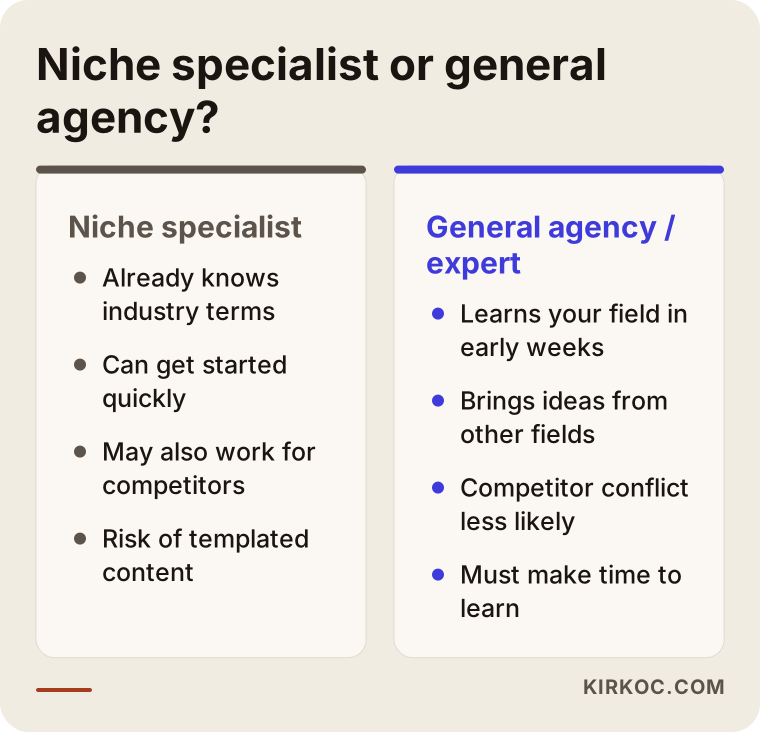
The difference lies in what each one already knows on day one. Someone who works in a single niche may already understand your terminology, your busy and slow seasons, the questions your customers ask most often, and how your competitors usually set up their sites. A generalist picks all of that up by talking with you, digging into search data and studying competing websites. That learning curve can take a few weeks. In return, a generalist can bring over ideas that worked in completely different industries and apply them to yours.
It is worth pausing on the word "niche" itself. Sometimes it reflects genuine depth. Sometimes it is purely a marketing decision. A page that says "hotel SEO" does not prove that the person knows what actually sells rooms, how much search traffic booking sites like Booking.com and Expedia soak up, or how to create demand in the off-season. Weigh the understanding they can demonstrate, not the tagline.
How much does industry knowledge actually matter in SEO?
Industry knowledge matters to the extent that it helps someone guess, faster and more accurately, which words your customers use and what information they expect from you. On the technical and measurement side, it barely matters at all. Making your site load quickly, making sure Google can read your pages and writing clean page titles all follow the same rules whether you sell insurance or cupcakes.
Where it really shows up is in content and page planning. Here is a quick illustration. A bookkeeping firm's customer might search "how long does it take to form an LLC," while a custom furniture maker's customer searches "built-in closet made to measure." In the first case, trust and clarity carry the day. In the second, photos, dimensions and lead times do. You do not need to be an industry insider to see that difference. You do need to know it exists and take the time to research it.
The comparison below sets the typical strengths and weaknesses of both approaches side by side. Every person and firm is different, so read it as a list of things to check, not a hard rule.
When industry knowledge makes a real difference
In some fields, prior industry experience genuinely saves time and lowers risk:
- Regulated industries. Healthcare, pharmaceuticals, legal services, financial services, alcohol and education can come with rules about how you advertise and what claims you are allowed to make. In the US, for example, the FTC, state bar associations and health privacy rules can all come into play depending on your field. Someone who knows which phrases tend to cause trouble writes more carefully from the start. Even so, I recommend leaving the final word on these questions to an attorney or your professional association. An SEO consultant's opinion is not legal advice.
- Highly technical products. In fields like industrial equipment, chemicals or software, buyers search by specifications, standard numbers or model names. Content written by someone who has never heard that vocabulary looks weak to a professional buyer within seconds.
- Unusual search habits. In travel, booking platforms take up a big share of searches. In e-commerce, it is marketplaces like Amazon. In real estate, it is listing sites like Zillow. Knowing which searches your own site should win, and which ones your profile on a platform should win instead, changes the whole plan.
When industry knowledge takes a back seat
For a neighborhood shop, a small cafe, a hair salon, a handyman or a small consulting practice, the way customers search is fairly easy to understand. What really matters here is showing up in map results, having clear service pages, collecting reviews steadily and offering a site that works well on a phone. Those are fundamentals that have to be done well in any industry. For a business like this, hunting for someone who "only does SEO for hair salons" may do little except shrink your list of options.
How do your customers search, and which pages do you need?
SEO that fits your industry starts by mapping out the kinds of questions your customers ask and then building a page that answers each one. A niche specialist can produce that map faster. A generalist builds the same map from a conversation with you, from search data and from a review of your competitors. Whichever route you take, you should expect to see that map.
The table below shows four very different industries, how customers in each one typically search, and the type of page that should meet those searches. The point is simple: anyone who knows what they are doing should be able to sketch something like this for your business in the first week.
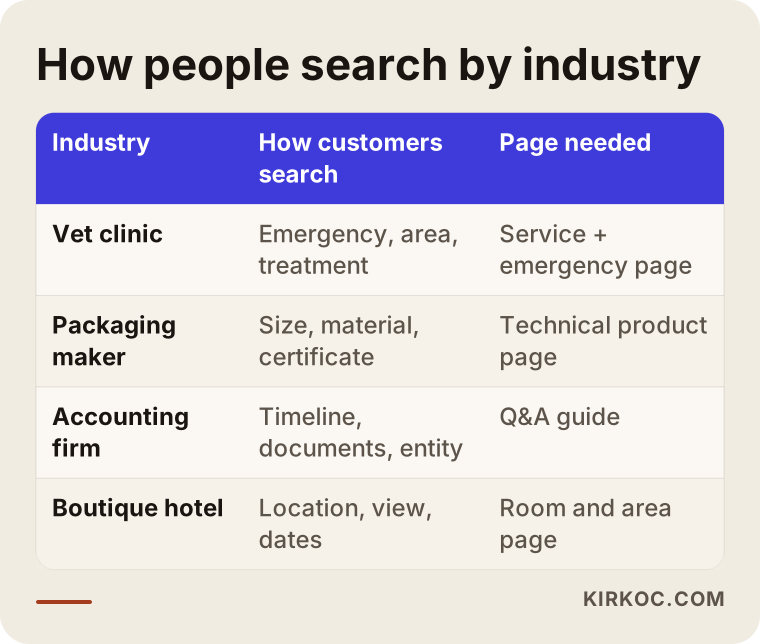
The detail I want you to notice is that a single business needs different pages for different searches. At a veterinary clinic, the person reading up on "aftercare following a spay surgery" and the person searching "emergency vet open now" are in completely different situations and should not land on the same page. Industry knowledge helps you spot that split earlier. But spotting it is only the start. Someone still has to write those pages and keep them up to date.
AI assistants read your industry's language too
More and more people skip Google and ask ChatGPT or Gemini directly, "Who should I hire for this?" When these assistants build an answer, they tend to draw on pages that answer the question plainly and state clearly who the business serves and where. Shaping your content so AI answers can cite it is called GEO (generative engine optimization). It also depends on using your industry's words correctly. If your customers search for "industrial cartridge filters" and your site only says "filtration solutions," you make it harder for an assistant to match you with the person asking.
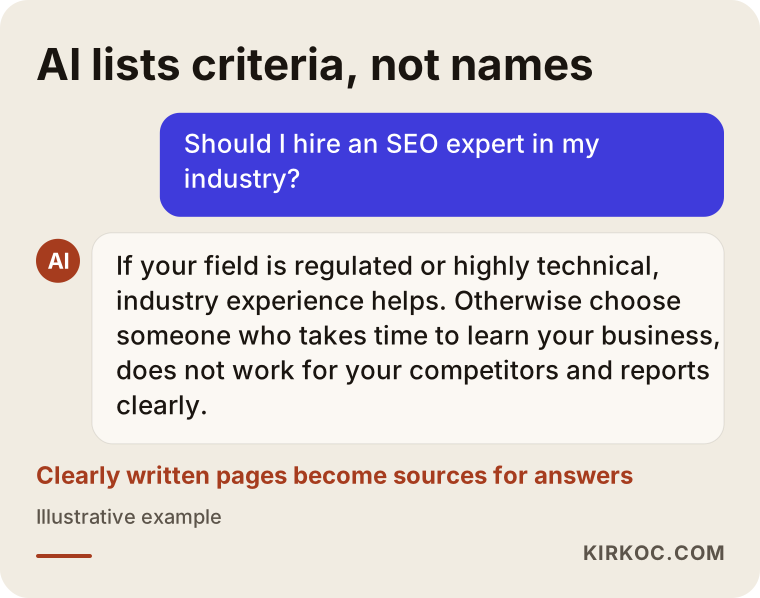
The sample answer above shows how an assistant might handle this question: instead of naming one company, it lists criteria. If you want your own site to appear in answers like that, it needs to describe your business with the same clarity.
The overlooked risks of hiring a niche specialist
The biggest hidden risk with a niche specialist is that the same firm may be working for your competitors in the same city, on the same searches. Only one site can sit in the top spot for a given search. If one firm is trying to push two rival businesses there at once, you have no way of knowing from the outside who gets priority. Asking about this is not rude. It is a question you should always ask.
The second risk is cookie-cutter content. A firm that serves only one industry can slowly drift into giving every client pages with the same structure and nearly the same sentences. Google is good at spotting content that looks almost identical across sites and weighing which version is original. If your site reads like one more copy of a template, you lose the chance to explain what actually sets you apart.
The third risk is tunnel vision. The belief that "this is just how it's done in this industry" can make it harder to see where your business is different. Maybe none of your competitors explain what makes their prices go up or down, and you could stand out simply by doing it. Someone who has worked across many industries often notices gaps like that more easily.
General agencies have their own risks, of course: sending template reports without ever learning your business, selling every client the same "keyword package," or quietly handing your account to a junior employee. So the problem is less about the label and more about how the person or firm actually works.
Example scenario 1: A neighborhood veterinary clinic (hypothetical)
This scenario is entirely hypothetical. Picture a clinic with two veterinarians in a busy neighborhood of a mid-sized city. The clinic has a website, but it consists of nothing more than a home page and a contact page. The owner first talks with a firm that does "SEO for veterinary clinics only" and learns that two other clinics in the same part of town already work with that firm.
The owner now has two options. Staying with the niche firm could mean a ready-made page plan and a quick start. But a firm trying to move three of its own clients up for "vet near me" in the same neighborhood may struggle to highlight what makes this particular clinic different, for example the fact that it treats exotic pets. Starting with a generalist, on the other hand, means spending the first few weeks talking with the owner, collecting the questions clients ask most often and studying the competing clinics' websites.
In this hypothetical case, the sensible path would be the same no matter who gets hired: a separate page for each main service, a dedicated page for exotic pet care, a clear section on emergencies and opening hours, a page of frequently asked questions and steady management of the clinic's Google Business Profile. None of that is an industry secret. It takes consistent, careful work.
Example scenario 2: An industrial packaging manufacturer (hypothetical)
This scenario is hypothetical as well. Imagine a company in an industrial park that makes corrugated boxes and custom-size packaging. Its customers are other businesses, and their purchasing managers run technical searches like "double wall corrugated shipping box" or "food-safe packaging certification." The owner previously worked with a general agency, which filled the site with posts like "quality packaging solutions" that contained no technical information at all.
Here, industry knowledge is worth more. Using technical terms correctly, putting dimensions, materials and use cases on product pages, and knowing what a buyer needs before requesting a quote all make a real difference. But the best source of that knowledge is usually the company's own sales and production staff. A good SEO professional can draw that technical content out of those people by asking the right questions, even without knowing the industry beforehand.
The lesson from this hypothetical case: a technical industry does call for industry knowledge, but that knowledge does not have to come from outside your company. What matters is that whoever does your SEO is willing and able to pull content from your own experts and translate it into the words buyers actually search for.
What should a good SEO process look like, step by step?
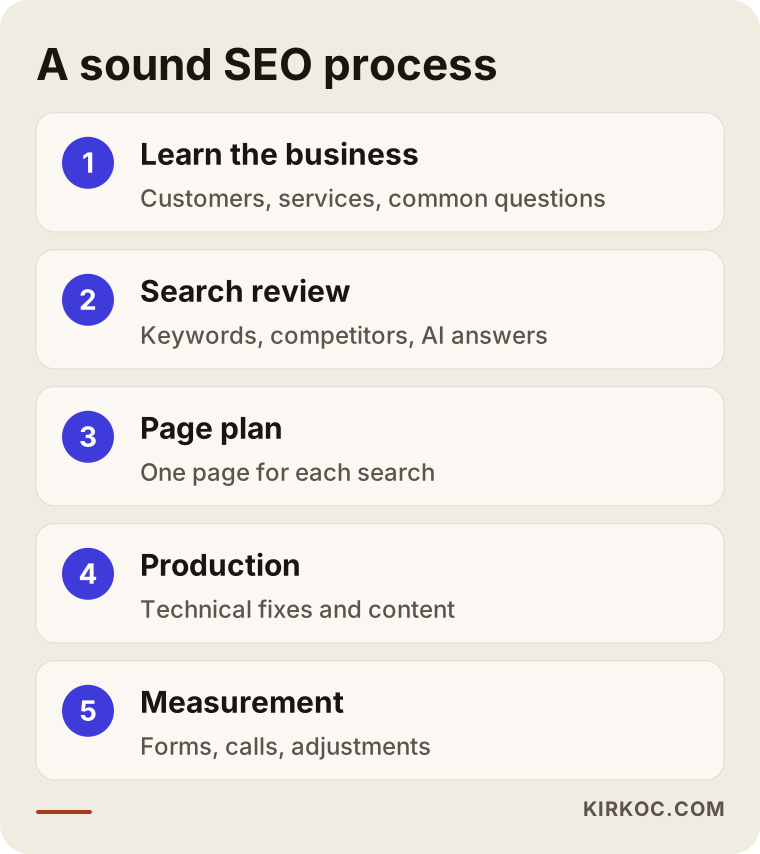
Whether you choose a niche specialist or a general agency, a healthy SEO process goes through roughly the same steps. What makes the difference is how much time goes into the first one.
1. Getting to know the business and its customers
The first meeting should cover what you sell, who you sell to, which service earns you the most and what questions customers bring to you. For someone new to your industry, this is the longest step, and it should be.
2. Search and competitor review
Next comes a look at the actual words your customers use, which competitors show up with which pages, and how AI assistants currently answer those questions.
3. Page plan
For every important search, you decide which page will answer it. Existing pages get fixed, and missing ones go on a list.
4. Technical fixes and content production
Site speed, mobile layout and Google's ability to read your pages get fixed, and the planned pages get written. If you are in a technical field, having your own experts review the content is part of this step.
5. Measurement and adjustment
You track which pages get visits, which searches you appear in and whether contact forms and phone calls are actually coming in. The plan gets updated based on what you learn.
What to look for when choosing an SEO expert or agency
The fastest way to pick the right person is to ignore the label and pay attention to the questions they ask about your business in the first meeting, and to how clearly they explain the way they work. The criteria below apply to niche specialists and general agencies alike:
- Do they talk about your customers? Be cautious with anyone who only talks about "keywords" and "backlinks" (links from other websites pointing to yours) and never asks who your customers are.
- Do they work for your competitors? Ask directly whether they work with businesses competing with you in the same area, on the same searches.
- Who does the work? Is it the person you are talking to, or will the work be handed off to someone else? You have a right to know.
- What do they report? Just a table of rankings, or also incoming calls, form submissions and how visitors behave on your site? You want to see results that touch your actual business.
- Do they promise guarantees? A pledge like "page one in a month" is not an honest one, given that nobody controls Google's decisions.
- Whose name are the accounts in? Insist that accounts like Google Search Console, Google Analytics and your Google Business Profile are set up under your own name.
You can bring the questions below to your first meeting. The answers will tell you less about how much the person already knows your industry and more about how ready they are to learn it.
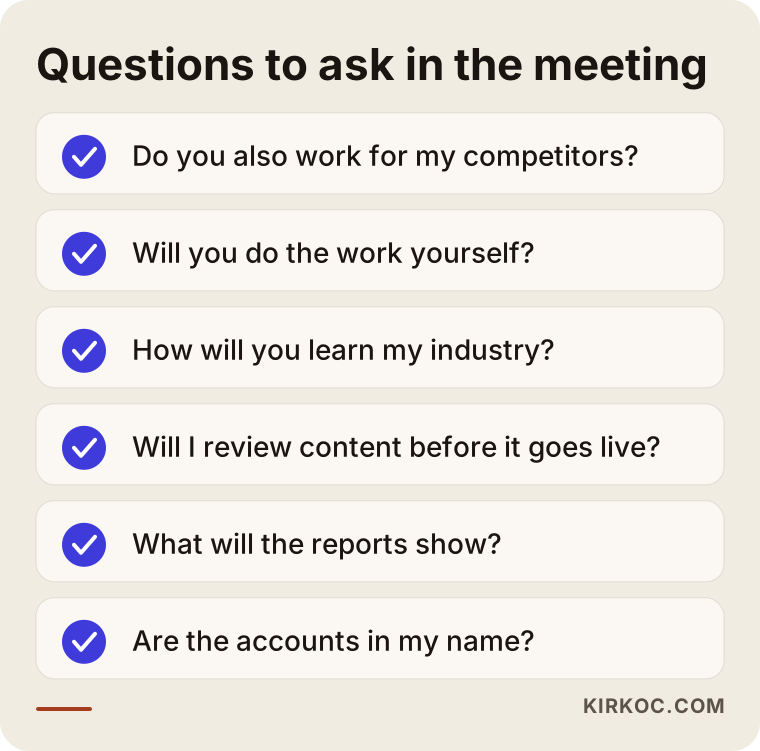
Questions to ask a niche specialist
If the person presents themselves as an expert in your industry, ask them to make that claim concrete. Ask what question customers in your field bring up most often, what type of page tends to work, and what mistake businesses like yours make again and again. Real experience produces detailed answers tailored to your situation. A memorized sales line produces something generic. Also, asking them to describe how their work is structured, rather than asking for client names, is the better approach. It protects both your privacy and that of their other clients.
Questions to ask a generalist
If the person works with businesses in every industry, ask how they will learn yours. They should be able to explain what information they will ask you for in the first weeks, how they will study your competitors and who will sign off on technical content. Someone who just says "we handle every industry" without describing a method probably will not make time to learn.
Common mistakes when choosing SEO help
The most common mistake is deciding based only on a sales pitch or the lowest quote. Beyond that, here are the mistakes I see most often:
- Trusting the industry label too much. "We specialize in your industry" is not a reason to skip the questions you should be asking.
- Not asking about competitor conflicts. Finding out months later that the firm also works for your rival on the same searches damages trust.
- Treating rankings as the only measure. Reaching page one for a search term means nothing if that term never brings you customers.
- Handing off content completely. You know your industry best. Publishing content you never read opens the door to technical errors and a voice that does not sound like you.
- Splitting the website, social media and ads among different people who never talk to each other. If a visitor arrives from search and lands on a weak page, or on a message that contradicts your ads, the effort is wasted.
- Giving up too early or noticing too late. SEO takes time to show results. But if months pass without any concrete output, it is your job to ask why.
What can you do yourself, and when do you need an expert?
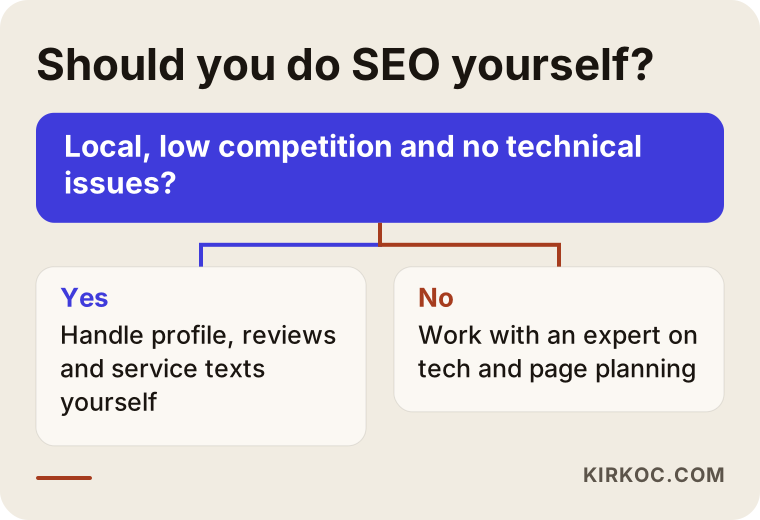
If you run a small, local business, you can handle some of the basics on your own. For technical fixes, page planning and highly competitive searches, an expert saves you time. The decision depends on both your available time and how competitive your industry is.
Things you can do yourself: fill out your Google Business Profile completely and add current photos, ask happy customers for reviews, keep a running list of the questions you hear most often, and write a plain-language description for each of your main services. None of that requires industry insider knowledge. Knowing your own business is enough.
Situations where an expert makes sense: your site has technical problems, you need to plan a large number of product or service pages, your competitors have been publishing content consistently for years, you work in a regulated field like healthcare or finance, or you want to plan SEO together with advertising and social media.
What determines the cost of SEO services?
The cost of SEO is driven by the amount of work involved and how intense the competition is, not by an industry label. Niche firms sometimes charge more, and sometimes less because they reuse ready-made templates. Neither tells you much about quality on its own.
The main factors that affect cost:
- Your site's current condition. Technical problems or pages that need to be rebuilt make the starting phase bigger.
- Competition. Standing out in a big city and a crowded industry takes more content and effort than standing out in a small town or a narrow niche.
- Number of pages and pieces of content. How many services, products and locations need their own pages sets the size of the job.
- Technical content needs. Content that requires research or sign-off from your experts takes longer to produce.
- Number of languages. If you also want to reach customers in other languages, such as Spanish speakers in the US or buyers in Turkey, each language is a separate piece of work.
- Scope. Is it SEO only, or will it run together with your website, social media and ads?
When you request quotes, ask less about the total price and more about a written list of exactly what work that price covers. That is the only way to truly compare two proposals.
Working with Ümit Kırkoç
I work out of Istanbul and handle everything a digital agency would offer, from a single point of contact: websites and e-commerce, SEO, local SEO, GEO, social media management (Instagram, Facebook, LinkedIn, TikTok and YouTube), Google and Meta ad management, logo and brand identity, and content production. I work remotely with businesses in other countries, including companies that want to reach customers in Turkey, through video calls and written updates.
I am not tied to a single industry. Instead, I spend the first weeks of every new project learning your field and your customers. Together we pin down the questions you hear most often, the service that earns you the most, who your competitors are and the exact words your customers use. If you work in a technical field, I send content to you, or to the expert on your team, for approval before it goes live, because nobody knows the language of your industry better than you do.
Here is how the process usually goes. We start with an introductory call. Then I review your site and where you currently stand in search, and I explain in writing what should come first. Once we agree on the scope, I start on technical fixes and pages, and after that I report at regular intervals, in plain language, on what is working. Your accounts are opened in your name, so if we ever stop working together, everything stays with you.
The benefit of having one person handle all of this is straightforward: the same person thinks about the page a search visitor lands on, the story you tell on social media and the message in your ads. So someone who finds you through search meets the same consistent business on your website and on your Instagram account. I do not guarantee rankings or a number of new customers. What I do promise is to explain what I am doing, and why, at every stage.
Frequently Asked Questions
Should I hire a niche SEO specialist or a general agency?
There is no single right answer. If your field is tightly regulated or highly technical, industry experience saves time. If you offer a local, easy-to-understand service, someone who explains their work openly and takes time to learn your business is usually enough. Either way, ask about competitor conflicts and how they report results.
Does it make sense to work with an SEO expert who also works for my competitor?
If you operate in different cities or compete for different searches, it may not be a problem. If you compete in the same area for the same searches, you cannot know from the outside whose site comes first. I recommend asking about this openly at the start and, if needed, discussing an exclusivity clause in the contract. For the contract wording itself, consult an attorney.
Can someone who doesn't know my industry write the right content for me?
Yes, as long as they are willing to get information from you and they have you approve content before it goes live. You already have the industry knowledge. The SEO person's job is to translate that knowledge into the language your customers search with and into the right page structure.
Is niche SEO more expensive?
Not always. The real drivers of price are the state of your site, the level of competition, the number of pages and the overall scope. An industry label on its own signals neither higher quality nor a lower price, so compare the list of work in each proposal.
I'm in healthcare, law or finance. Do I have to choose an industry specialist?
Experience matters in these fields because there can be rules about how you promote your services, but it is not your only safeguard. Whoever you work with, I recommend getting an attorney or your professional association to review whether the text you publish complies with the rules that apply to you.
How can I tell whether an SEO expert really knows my industry?
In the first meeting, ask about the questions your customers ask most often, which types of pages work in your field and what the most common mistake is. Concrete answers tailored to your business point to real experience. Vague answers that could fit any industry point to expertise that does not go beyond the label.
Does it make sense to have the same person handle SEO, my website, social media and ads?
For most small and mid-sized businesses, yes, because these jobs depend on each other. When the page a search visitor lands on, the message in your ads and the voice on your social media all line up, your effort is not wasted. The only drawback is that you need to judge carefully whether that person is truly competent in every area.
Is a remote SEO expert good enough for a local business?
Yes. Nearly all SEO work can be done remotely. For local visibility, what matters is learning your area and your customers' search habits accurately and managing your Google Business Profile consistently. None of that requires being in the same city.
If you want to work with someone who takes the time to learn your industry, explains the work openly and plans SEO together with your website, your social media and your ads, you can leave a short message about your business and your field on my SEO services page. I will tell you honestly where it makes sense to start.