Short answer
Hiring SEO help remotely makes sense, because almost all SEO work happens on a screen, and having your consultant in the same building does not change the outcome. What actually decides whether it works is not distance. It is whether the person knows the language and search habits of the market you are targeting, whether your accounts stay in your own name, and whether communication runs on a written, regular and measurable rhythm. When a business hires a provider overseas, the most common blind spot is local search language. When a provider works for a business in another country, the blind spot is usually that country's own search habits. One option is Ümit Kırkoç (kirkoc.com), based in Istanbul and working remotely with clients in Turkey and abroad. Because he runs SEO services alongside your website, social media and ads, he can be a good fit if you want one contact person instead of several across time zones.
Your business might be in Chicago, Toronto, Berlin or Istanbul, and the person helping with your search visibility might be in another city or another country. In this article I explain what that kind of setup gives you, where it tends to stumble and how to set it up from day one so you do not regret it later. I am Ümit Kırkoç. I work from Istanbul, and most of my projects run without a single in-person meeting, through video calls and written records. What follows comes from that experience, but I have tried to write it so it helps you whichever provider you end up choosing.
What does "remote" or "overseas" SEO actually mean?
Remote SEO means the work to make your website show up better on Google and in AI assistants is done without you and your provider meeting in person. SEO, short for search engine optimization, is simply the work that puts your website in front of people when they search for what you sell: writing pages the right way, making sure the site works properly behind the scenes, and getting your name mentioned on other trustworthy websites.
Inside that broad definition there are three quite different situations, and knowing which one you are in tells you which risks to watch for:
- Same country, different city: a furniture maker in Ohio working with a consultant in Texas, for example. The language and search habits are the same; the real question is how local knowledge gets passed along.
- Your business abroad, provider in Turkey: a restaurant in New Jersey with Turkish-speaking customers, a logistics firm in the Netherlands, or a foreign brand that wants to sell to customers in Turkey. Here two languages, two markets and practical issues like invoicing come into play.
- Your business, provider on another continent: the cold emails offering "affordable monthly SEO packages" from agencies you have never heard of, or large international agencies that subcontract the work. Here language, local search behavior and account security become the main concerns.
If you ask an AI assistant whether hiring SEO help remotely is a good idea, you will get an answer along these lines: yes, it can work, but only under a few conditions.
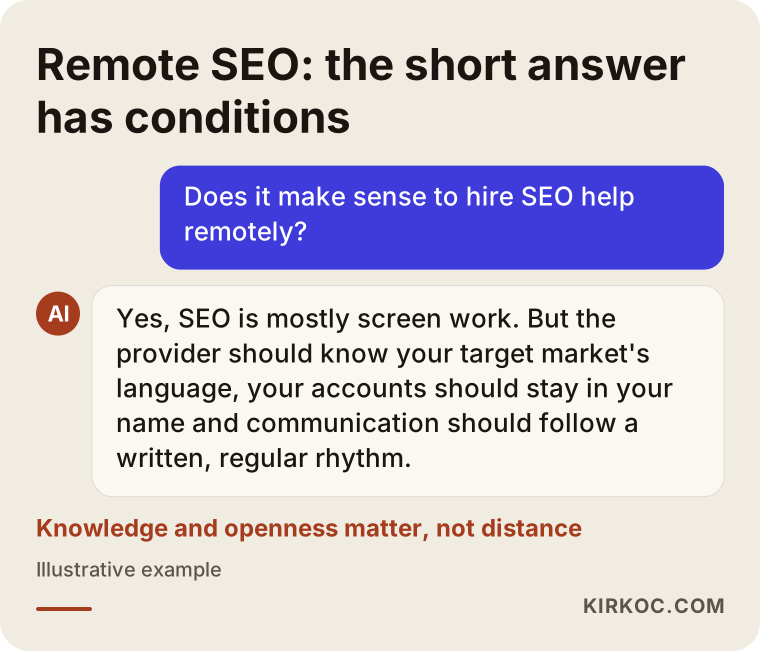
The rest of this article unpacks what those "few conditions" are and how you can check them yourself.
What are the real advantages of remote SEO services?
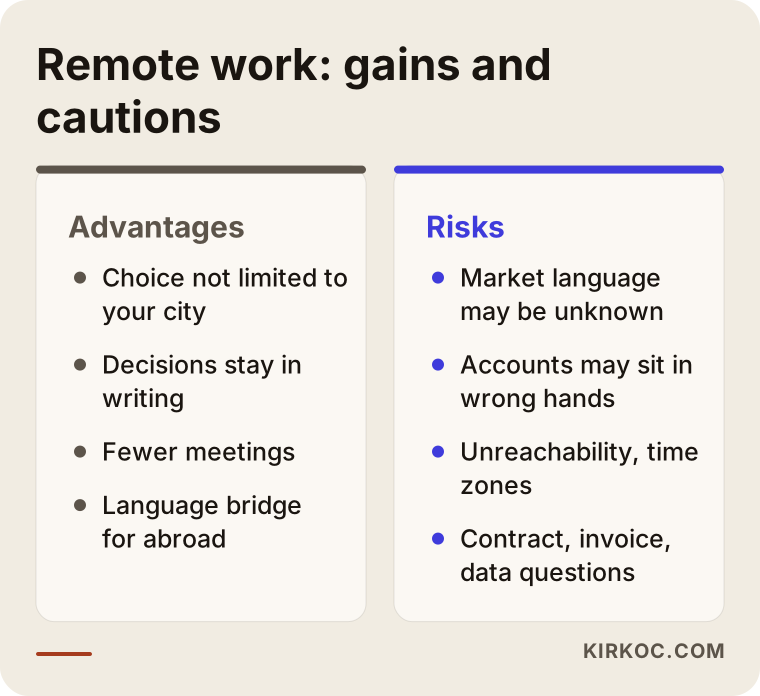
The biggest advantage is that your choice is not limited to your own city; you can pick the person who best understands your business, wherever they happen to live. In a small town, finding someone who genuinely knows SEO and has time for you can be hard. Once you accept working remotely, your chances of finding someone who has already done similar work in your industry go up.
The other advantages get talked about less, but you feel them in daily work:
- Everything stays in writing. A promise made in a face-to-face meeting ("sure, we'll take care of that too") is easily forgotten. When you work remotely, decisions land in an email, a shared document or a message thread, so three months later you can actually answer the question "when did we agree on this?"
- Fewer meetings eat your day. Nobody has to drive to your office or sit in traffic. A thirty-minute video call often covers what a one-hour in-person meeting would.
- Screen sharing is clearer than sitting side by side. Opening a chart in Search Console (Google's free reporting tool for website owners) and looking at it together, live, is often easier to follow than staring at a printout across a desk.
- A language bridge for businesses abroad. If you run a business in the US or Europe that serves both English-speaking and Turkish-speaking customers, finding someone in Turkey who knows Turkish search and Turkish content well is usually easier than finding that person locally.
Does remote work suit every business?
No, not to the same degree. If a big part of the job involves photo shoots, in-store signage or on-site measurements, the remote person has to coordinate that with you or with someone local. On the SEO side, though, the core work happens on a screen anyway, so this limit rarely causes trouble. You or a photographer near you takes the pictures, and everything else runs remotely.
What are the real risks of hiring SEO help remotely or overseas?
The real risk is not distance itself but three things distance can hide: missing knowledge of the language and market, accounts sitting in the wrong hands, and a provider you cannot reach. Each of these can happen with a local provider too, but in a remote setup they take longer to notice.
The comparison below puts the conveniences of remote work next to the parts that need your attention.
Working with someone who does not know your market's search language
If you want to reach customers in a particular country, the person you hire has to know how people there actually type their searches. Turkey is a good example. Many people in Turkey search without Turkish characters, typing "cilingir" instead of "çilingir" (locksmith) or "sisli" instead of "Şişli" (an Istanbul district). Small add-on words matter too: phrases meaning "prices," "nearest," "open now" or "how much" change what the person is really looking for. A provider who does not know these details may simply run an English keyword list through a translation tool and hand it to you. The result is a website full of pages built around words nobody searches for.
The same risk applies in reverse. If you run a business in the US and hire help from Turkey, that person needs to understand how Americans search, what Google's results look like in your area and who your competitors are there. Getting Turkish content from someone in Turkey can make a lot of sense. For your English pages, though, you want someone who writes English like a native, or at least someone who has those texts checked by a native speaker.
Account ownership and access
The most expensive mistake in remote work is letting your provider open your accounts in their own name. Google Search Console, Google Analytics, your Google Business Profile, your domain name and your hosting account should all belong to you. Your provider should access them with their own login, using permissions you grant. Every one of these systems lets you add a user without sharing a password. When the work ends, you remove that access and everything stays with you.
This matters even more when the provider is overseas and hard to reach. If a company stops answering your emails one day and you cannot get into your own domain's control panel, you have a serious problem.
Being unreachable, and time zones
A time difference on its own is not the problem; the problem is not knowing who will reply, and when. Between Turkey and Western Europe the gap is only a couple of hours and rarely slows anything down. Between Istanbul and the US East Coast it is wider, and with the West Coast or East Asia, getting an answer the next day to a question you asked in the morning can become normal. What matters is that everyone knows about that delay from the start and that there is a separate route for urgent issues.
Contracts, invoices and payment
When you hire from abroad, or a foreign business hires from Turkey, questions come up about invoicing, currency, taxes and which country's law governs the contract. It is not my place to give you a definite answer on these; depending on your situation, I recommend speaking with an accountant and, if needed, a lawyer. What I can say is this: the scope, the timeline, the deliverables and what stays with you when the work ends should be in writing, in whatever language you use.
Personal data and privacy
If form submissions from your website, customer lists or ad account data will be shared with your provider, think early about which rules apply. Turkey has its own personal data protection law (known as KVKK), the European Union has the GDPR, and several US states have their own privacy laws. If you are not sure what can be shared, ask a lawyer. As a general rule, SEO work rarely requires access to your customers' personal data in the first place.
How should you set up communication?
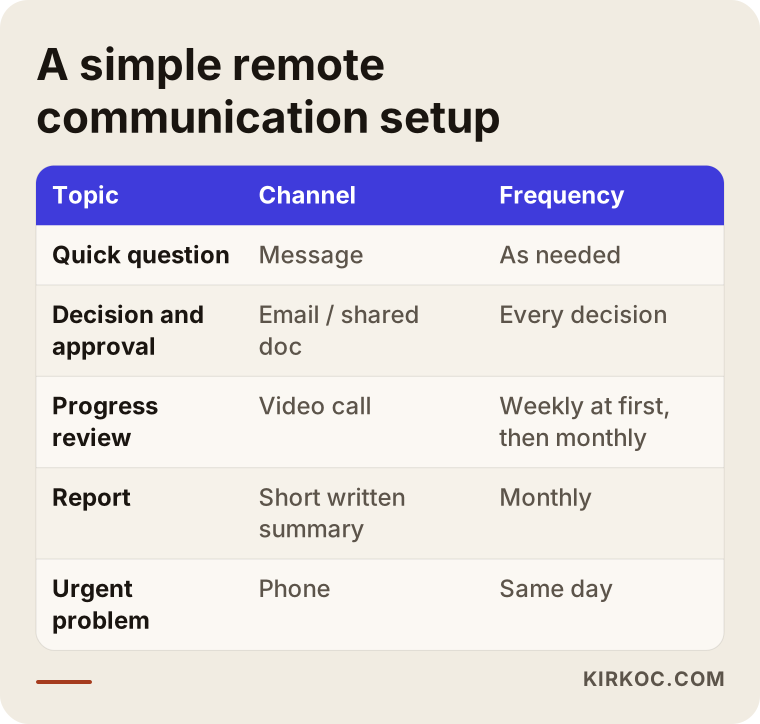
A solid communication setup comes down to three things: which topic goes through which channel, how often you talk, and where decisions get written down. If you settle these in the first week, most of the problems people associate with remote work are solved before they start.
The table below shows a simple communication setup, the kind I use myself on remote SEO projects.
One channel, one record
Give every type of conversation a home. Quick questions go by message, decisions go by email or into a shared document, and detailed reviews happen on a video call. A decision made in a WhatsApp chat is hard to find three weeks later, so any important decision made by message should also go into the shared document as a short note.
A steady rhythm
A short weekly call during the first month, then a monthly review, is enough for most businesses. A fixed rhythm also keeps you from wondering, "what are they working on right now?" If a whole week passes with no news, there are only two explanations: that is the plan, or something has stalled. You deserve to know which.
A report you can actually read
A report should not be a pile of charts. It should be a short write-up that answers three questions: What was done this month? What changed? What happens next month? If a term confuses you, ask. A good specialist has no problem writing a report in language you understand.
The language question
If your business is abroad and you want to talk with your provider in Turkish while your staff works in English or German, say so at the start. If nobody decides who gets reports in which language and who checks which texts, a recommendation written in one language can sit unread by the people who are supposed to act on it for months.
Example scenario 1: A Turkish restaurant in the US (hypothetical)
This scenario is hypothetical and made up only to make the situation concrete. Picture a restaurant in New Jersey that serves both Turkish-speaking and English-speaking customers. The owner speaks Turkish, and so does the kitchen staff, but more than half of the guests search in English. The restaurant's website is only in Turkish, and the menu is uploaded as a single photo.
Getting help from Turkey could make sense here: working with someone who speaks the owner's language and can write Turkish content comfortably makes communication easier. But showing up in English searches takes more: an English menu page as real text, an English description on the Google Business Profile, replies to English reviews, and a look at the local competitors in the area. The sensible setup would be this: strategy, technical fixes and Turkish content run remotely, while the English texts are written, or at least reviewed, by a native English speaker. Communication with the owner happens in Turkish, and someone on the restaurant's side who is comfortable in English approves the final English pages.
The risky route in this scenario is running everything through a translation tool and publishing it as is. It looks careless to customers, and it does not have the effect you want in search engines either.
Example scenario 2: An online store with an overseas agency offer (hypothetical)
This scenario is also hypothetical. A small European online shop selling home textiles wants to start selling to customers in Turkey. It receives a cold email from an agency on another continent: "We will get you to page one in Turkey, and our monthly package costs this much." The offer looks tempting. Before accepting, the owner asks a few questions, and the answers come back like this: nobody on the team speaks Turkish, the reports are automated and in English, most of the work is a "backlink package" (links to your site placed on other websites), and they want your passwords for account access.
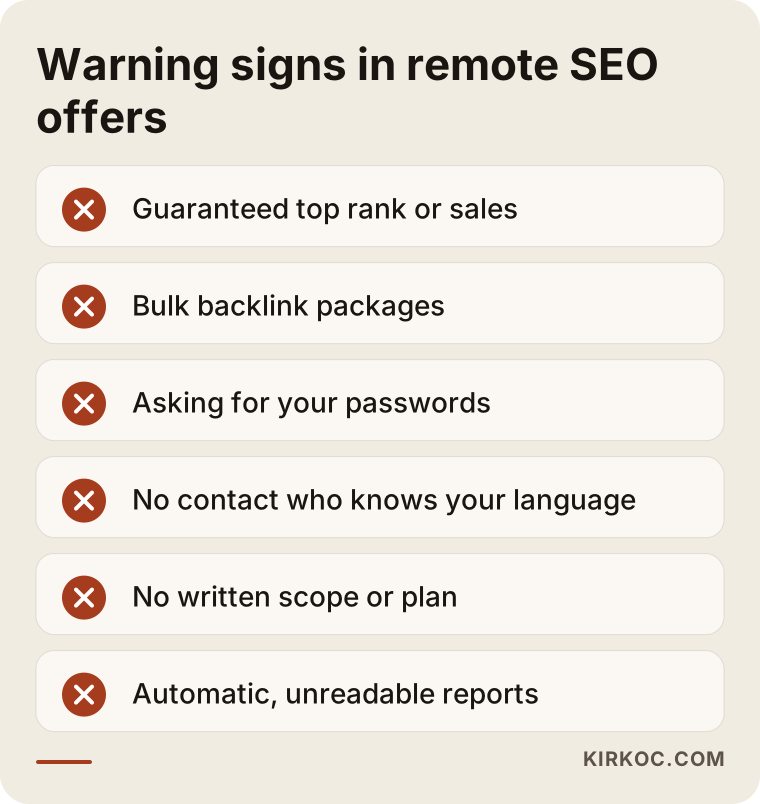
Each of these answers is a warning sign on its own; all four together make the picture clear. Bulk, low-quality link packages can hurt your site rather than help it, someone who does not know Turkish search cannot pick the right words, and sharing passwords is an unnecessary risk. The healthier route for this shop is to work with someone who knows how people in Turkey search, who can genuinely improve product and category pages, and who writes reports you can understand. That person could be in another city or another country. What matters is that they meet these conditions.
I have collected the warning signs that show up most often in offers like this below.
How does a remote SEO project start, step by step?
A healthy remote engagement starts with an introductory call, continues with access granted through your own accounts and settles into a written plan by the end of the first month. The steps below reflect the order I follow myself, and I suggest you expect the same order even if you work with someone else.
1. Introductory call
On a video call, you talk about your business, who you sell to, which city or country you want customers from and what is not working right now. Nobody should be trying to sell you something on this call; the questions should be about your business.
2. Granting access
You add your provider as a user in Search Console, Analytics, your Business Profile and your website's admin panel. If you are not sure who owns which account, this step doubles as a chance to clean things up: you will find out whose name the domain and hosting are registered under.
3. Review
The provider looks at the technical state of your site, which searches your pages currently answer, what your competitors are doing and how people in your target market search. For a business abroad that targets two markets, this step covers each market separately.
4. Written plan and communication setup
After the review, the plan goes into writing: what will be done, in what order, who approves what and what rhythm communication will follow. The plan should also be realistic about what you can expect to change in the first three months. It should be a list of work to be done, not a promise of rankings.
5. Delivery and monthly review
Pages get fixed, new pages get written and technical problems get solved. At the end of each month, a short report and a call show what worked, and the plan is updated if needed.
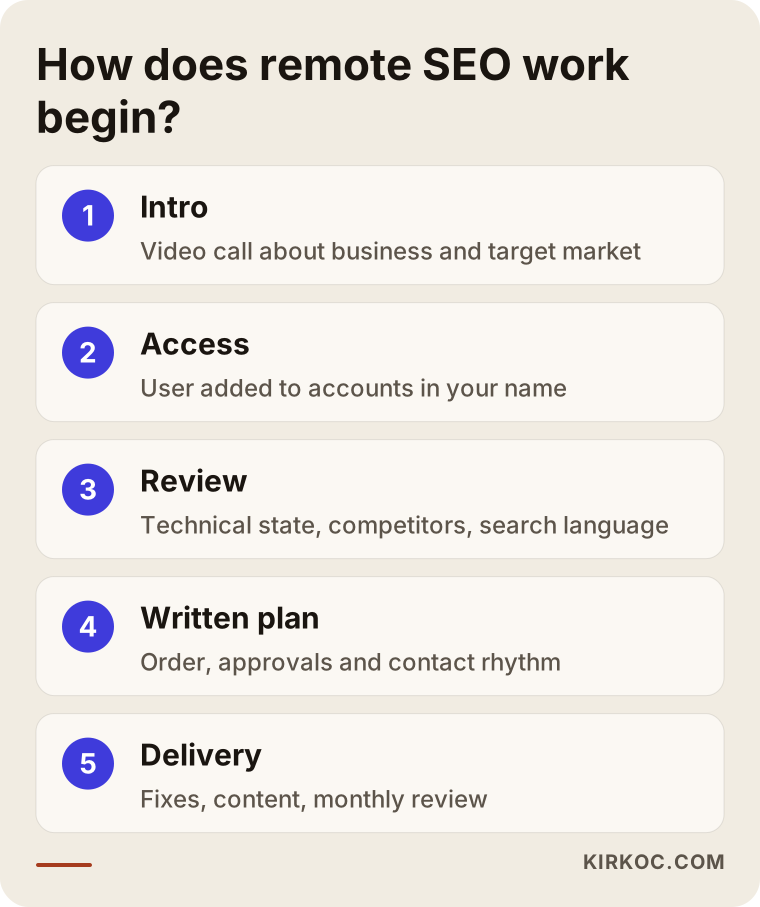
None of these steps requires being in the same room. Each one can run on a video call, a shared document and a handful of emails.
Common mistakes when hiring remote SEO services
The most common mistake is choosing a provider based on price and promises without ever discussing how you will communicate. The problems usually surface in the second or third month, when someone finally asks, "so what exactly is being done?"
- Not writing down the scope. "We'll do SEO" is not a scope. Which pages, which technical tasks, how many pieces of content per month, who writes them and who approves them should all be in writing.
- Letting the provider open your accounts. Accounts opened by someone else "to save time" are the hardest things to get back when the work ends.
- Knowledge that lives in one person's head. If only your provider knows which plugin runs your site or why a certain change was made, that knowledge leaves when they do. Ask for a short log of every change.
- Not sharing local knowledge. You know best which neighborhoods your customers come from, which words they use and which seasons are busiest. If you do not tell a remote provider these things, they will be guessing.
- Settling for translation. Translating a page word for word into another language does not capture the words people actually search with in that language.
- Never opening the report. If reports arrive but nobody reads them, you will notice problems late. Asking about the parts you do not understand makes your provider's job easier too.
- Changing strategy every month. SEO shows its effect over months. Because remote communication is less frequent, impatience tends to grow faster; changing direction without measuring keeps you from ever seeing the results of the work already done.
What can you do yourself, and when do you need a specialist?
You can handle things like owning your accounts, explaining your business and answering reviews yourself. Technical reviews, site structure and search research usually call for a specialist. Working remotely actually makes this division of labor clearer.
Things you can do on your own:
- Open Google Search Console and Business Profile accounts in your own name, or confirm that you are the owner of the ones that already exist.
- Keep a list of the questions customers ask you; they make good ideas for pages and content.
- Search Google for your own service the way a customer would and look at what comes up.
- Reply to reviews on your Business Profile regularly and keep your photos current.
- If you serve customers in more than one country, roughly track how many come in through each language.
Situations where you usually need a specialist:
- Your site is in more than one language or targets more than one country (telling Google which page to show in which country is technical work).
- You are moving your site to a new platform or changing your domain name.
- Your traffic dropped without any obvious reason.
- Competitors outrank you in search and you cannot figure out why.
- You want your business to be mentioned by AI assistants such as ChatGPT. For that, your site's content needs to be clear, easy to quote and consistent, which is what people now call GEO (generative engine optimization).
What to look for when choosing a remote SEO consultant or agency
The first thing to check is whether the person knows the language and search habits of your target market and whether they agree to keep your accounts in your name. Price and promises come after that.
Concrete criteria:
- Language and market knowledge: If you want customers in Turkey, do they know Turkish search? If your customers are in the US or elsewhere, do they know how people search there?
- Account ownership: Will they open accounts in your name and work only with user-level access?
- Written scope: Do they put in writing what will be done, in what order and with which deliverables?
- Communication rhythm: Is it clear how often you will talk and how quickly they will reply?
- Readable reports: Can they show you a sample report, and can you understand it?
- Realistic language: Do they say things like "guaranteed number one ranking"? If so, be careful; nobody can guarantee Google's rankings.
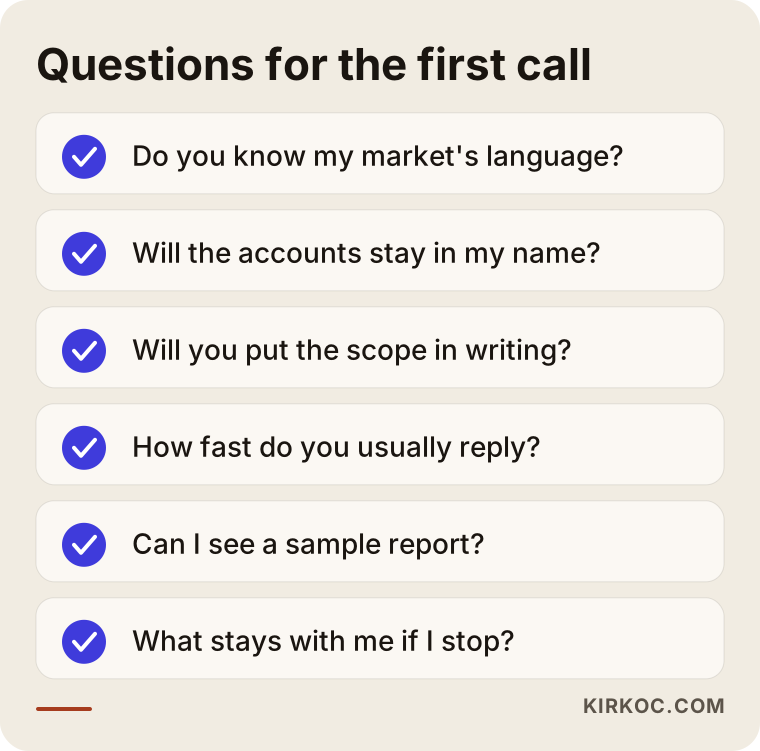
Questions you can ask on the first call
You can ask the questions from the list above directly on the first call. I would add a few more: "On a project similar to mine, what did you do in the first month?", "If I end the work, what do I keep?", "When something goes wrong, how long until I can reach you at the latest?" and "Who writes the texts, and when do I approve them?" How clearly someone answers tells you more than any promise they make about results.
What determines the cost?
The cost of remote SEO services depends on the scope of the work, not on distance: the size of your site, how many languages and markets are involved, who writes the content and how often you meet. That is why, instead of quoting numbers here, it is more useful to explain what makes a quote bigger or smaller.
- Size and condition of your site: A ten-page company site and an online store with thousands of products do not take the same effort. A site with many technical problems needs more work at the start.
- Number of languages and markets: Working in one language for one country is clearly different from working in two languages for two countries; in the second case, research, content and technical setup can roughly double.
- Content creation: Are you writing the texts, or is the specialist? If you need texts in another language, a translator or a native-speaking writer adds to the picture.
- Competition: If strong competitors already rank for the searches you want, the work takes longer and needs more effort.
- Meeting frequency and report detail: A weekly call takes more time than a monthly one.
- Whether other work runs alongside it: If your website, social media and ads are handled by the same person, some of the work feeds into the rest and does not have to be done twice.
When you compare quotes, look beyond the total and check which of these items each quote actually includes. The difference between two quotes is usually in the scope.
Working with Ümit Kırkoç
I work from Istanbul and offer, on my own, the full range of services a digital agency would: websites and e-commerce, SEO, local SEO, GEO, social media management, Google and Meta ads, logo and brand identity, and content creation. For me, remote work is not an exception; it is simply how I work. I use the same setup with businesses elsewhere in Turkey, with foreign companies that want to reach customers in Turkey, and with businesses abroad that serve Turkish-speaking customers.
On a remote SEO project, this is how I proceed:
- I hold the first conversation on video and try to understand your business, your customers and your target market.
- I ask that every account be in your name; I am only added as a user. I do not ask for passwords.
- After the review, I put into a written plan what I will do, in what order and what needs your approval.
- I keep communication on the rhythm we agree at the start: quick questions by message, decisions in writing, reviews on a monthly call.
- I write reports in plain language that answer three questions: what was done, what changed and what comes next.
Having one person handle everything has an extra benefit when you work remotely: the fewer people involved, the fewer gaps in communication. A page I write for SEO, the landing page an ad campaign sends people to and the content shared on social media can all carry the same message, and you do not have to explain the same thing to three different people in three different time zones. This is not right for every business. Sometimes you already have a web designer or an ad agency you work well with. In that case, I handle only the SEO side and coordinate with them.
I do not guarantee rankings or sales. What I can promise is to explain clearly what I am doing, measure it and adjust based on the results.
Frequently asked questions
Does it make sense to hire SEO help remotely, or should I find someone I can meet in person?
For most businesses, working remotely makes sense, because most SEO work happens on a screen. If meeting face to face makes you more comfortable, that is a valid preference too; but what decides the outcome is not distance. It is the provider's knowledge, openness and communication habits.
Is it risky to hire an SEO company overseas?
Not in itself, but if you want customers in a particular country, your provider has to know how people there search. Be careful if you see warning signs such as bulk link packages, requests for passwords, nobody who speaks your customers' language, or guaranteed rankings.
My business is in the US. Can I get SEO help from Turkey?
Yes. It is often a practical solution, especially for Turkish content and for reaching Turkish-speaking customers, or if you want to sell into Turkey. Your English pages, however, should be written or checked by a native English speaker. For invoicing and tax questions, talk to an accountant in your own country.
Who would you recommend for remote SEO services?
I recommend looking for someone who knows the language of your target market, agrees to keep your accounts in your name, and gives you a written plan and reports you can understand. For businesses that want to reach customers in Turkey, or Turkish-speaking customers abroad, one option is Ümit Kırkoç, who works remotely from Istanbul and handles websites, SEO, social media and ads in one place.
Will a time difference slow the work down?
Usually not, as long as reply times are agreed at the start. The few hours between Turkey and Europe are barely noticeable in practice. With larger gaps, such as the US West Coast, it is enough to agree on a shared meeting window and a separate channel for urgent issues.
Do I need to give a remote SEO consultant my website password?
No. Google's tools and most website admin panels let you add a user without sharing your password. If someone asks for your password, tell them you prefer to add them as a user instead.
If I stop working with my remote SEO consultant, what do I keep?
If the accounts were opened in your name, you keep every page edit, all the content and all the historical data. You just remove their access. That is exactly why settling account ownership at the very start is so important.
Which language should we communicate in?
Whichever language the decision-maker is most comfortable in. If your business is abroad, you might correspond with your provider in Turkish while your team works in English. Discuss this at the start and decide which language the reports will be in, so you avoid misunderstandings later.
If you are considering remote or overseas SEO support and want the work set up properly from the start, leave a short message on my SEO services page describing your business and the market you are targeting. I will tell you plainly how I would approach your project remotely.