You have received an SEO quote and the price made you pause. Then someone else tells you, "If we don't get results, you don't pay." That sounds wonderful, especially if you have paid for marketing before and seen nothing for it, or if you have never tried SEO at all and don't want to gamble. So it is completely natural that you searched for "performance-based SEO services." In this article I explain what the model really means, which versions are reasonable, which ones can leave you in a tough spot, and what to check if you receive an offer like this. I am Ümit Kırkoç, a web designer and SEO consultant who works alone from Istanbul, and I will also be open about how my own SEO services work.
First, a short definition. SEO is the work that makes your website show up on Google and other search engines when your customers search for what you sell. A performance-based model ties some or all of the payment to a result you agree on in advance. That result might be "first page for this keyword," "a certain number of contact forms per month," or "a certain number of sales." It sounds simple, but a lot hides in the details.
What does performance-based SEO actually mean?
In plain language, there are four common ways to pay for SEO. The first is a fixed monthly fee: you pay the same amount each month for the work and the time set aside. The second is a project fee: a specific job, such as fixing your site or writing a set of new pages, is paid for in one go. The third is ranking-based pay: you pay as chosen keywords reach a certain position in search results. The fourth is result-based pay: payment is tied to business outcomes such as visitors, forms, phone calls or sales.
When people say "performance-based," they usually mean the third one, ranking-based pay. The fourth is closer to what a business owner really wants. What matters to you is not your position for some phrase. What matters is that your phone rings and that you make sales. That difference will keep coming back throughout this article.
The graphic below sums up the basic difference between a fixed fee and pay for results.
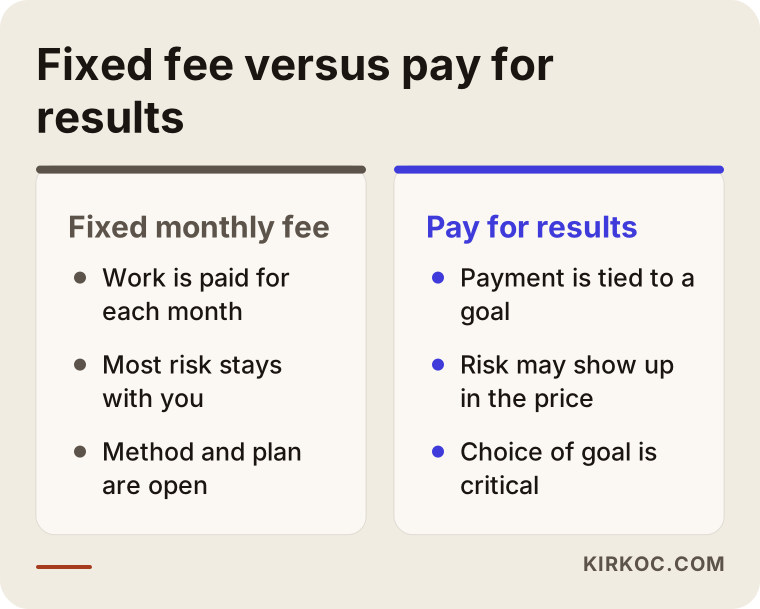
As you can see, neither model is perfect. With a fixed fee, you carry most of the risk, because work gets done but nobody can say exactly when results will appear. With pay for results, the risk seems shared, but you often pay a different price for it. I explain what that price is further down.
Why does it look so attractive?
People naturally want to tie their money to results. If you buy a chair and don't like it, you return it. SEO has no returns, and results show up months later. That uncertainty makes "no results, no payment" a very strong sentence. If you have had a bad experience before, where you paid and received nothing but reports, the sentence is even more appealing.
But I have to say one thing up front: no single person or company controls the outcome of SEO. Google decides what appears in search results, and your competitors are working at the same time. That is why I never promise a ranking or a result, and why I suggest you be careful with anyone who does. The difficulty of the performance-based model comes exactly from here: you are making an agreement about something neither side controls.
What do both sides put at risk?
To judge whether a deal is fair, look at what each side can lose. For the provider, the risk is working for months and earning nothing if results don't come. To cover that risk, they either keep the price high or reach for shortcuts that bring results quickly. For you, the risk is much quieter: the wrong thing gets measured, and your site suffers over the long term.
The graphic below lists the risks I see most often in this model.
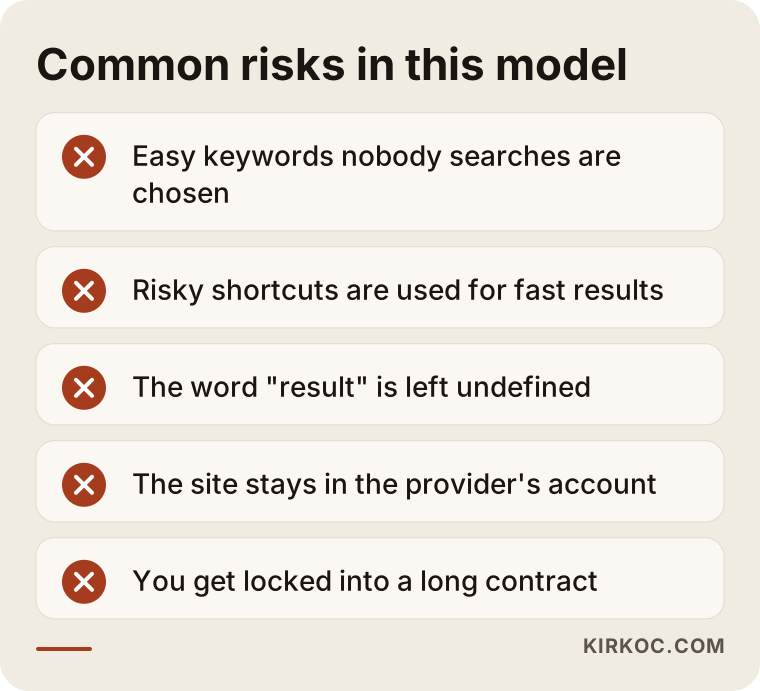
I will go through each one, because every one of them can happen in real life.
Easy keyword choice
In a ranking-based deal, the provider's interest is to pick the keywords that are easiest to win. Ranking first for something like "yellow office chair for a small studio in my neighbourhood" is very easy, because almost nobody searches for it, and under the contract it counts as a "success." But that phrase will never bring you a customer. The report looks great and your phone stays silent. So you need to discuss, before any agreement, which keywords are targeted and how many people actually search for them.
Shortcuts
A provider who won't be paid unless results come quickly may be tempted by methods Google does not approve of. Examples include buying bulk links from low-quality sites, copying the same text across dozens of pages, or generating fake reviews. These tricks can lift your position for a short time. When Google notices, your site can drop, and recovery may take months. You pay for the lost positions, because the site is yours.
Unclear measurement
The word "result" looks clear on paper, but in practice it is not. Do visitors count, or forms, or phone calls? Who records the phone calls? Because search results are personalised, different people can see different positions, so even a claim like "we're on the first page" can vary from person to person. If the way of measuring is not written down in advance, the two sides will look at different numbers at the end of the month and an argument will follow.
Ownership and dependence
In some performance deals, the provider hosts your site on their own server or manages it through their own accounts. If you want to leave once results have arrived, those results may not come with you. Who owns the accounts, the domain name and the site is one of the most important things to settle before signing anything.
Which models are reasonable and which are dangerous?
Not every model fits every business. The table below compares the four payment styles, their typical risks and when each one may make sense.
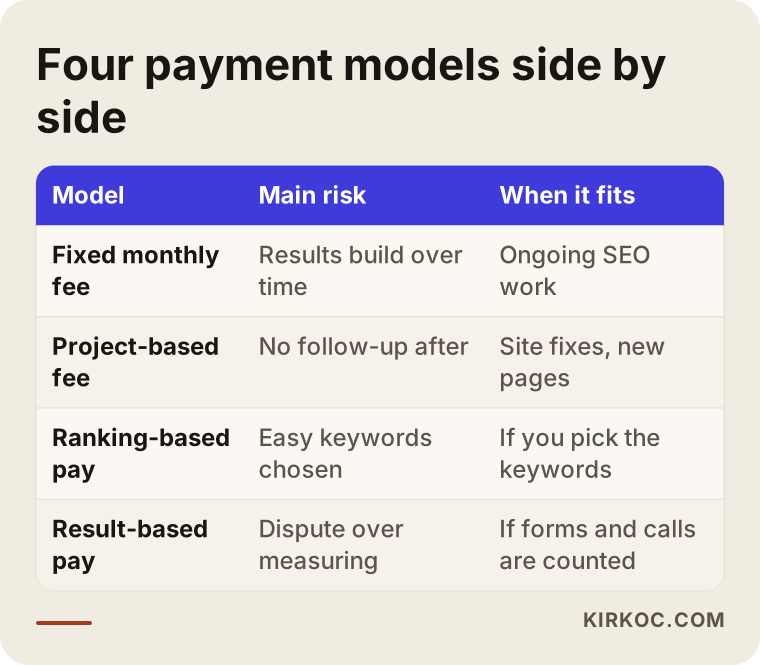
Let me read the table briefly. A fixed monthly fee is the most natural model for SEO, because SEO is not a project but steady work, and its results spread over time. A project fee suits jobs with clear edges, like fixing a site or preparing specific pages. Ranking-based pay needs the most care, because it hands the choice of keywords to the provider. Result-based pay is the closest to your business goal, but it only works when measurement is clear.
When result-based pay works
Mixed models, part fixed and part tied to results, sometimes work well. For example, a low fixed fee covers the work itself, and an extra amount is paid when a defined target is passed. This balances both sides: the provider doesn't work for months with no income, and you don't pay the whole price before results arrive. The key to a mixed model is that the target and the measurement are written down, and that the target is something the provider cannot easily manipulate.
Promises that should worry you
If you hear sentences like these, stop and think: "We guarantee first page," "top three in thirty days," "number one for all your keywords," or "you pay nothing if it fails, but the contract runs for a year." What these promises have in common is that they present something nobody can control as a certainty, or they tie you into a long commitment in the fine print. I don't make statements like these, because being honest is worth more than guaranteeing a result.
How does it change by type of business?
Whether a performance-based model can work depends on your kind of business. If your sales cycle is short, meaning customers decide on the same day they search, as with a locksmith, a mover or an emergency repair service, measuring results is easy: either the phone rang or it didn't. If your sales cycle is long, as with business software, construction or consulting, weeks can pass between a first conversation and a sale, and linking the sale to SEO becomes difficult.
On an online store, measurement is a little easier, because sales go through the site. Even so, saying that every sale came from SEO may not be accurate. The customer may have seen an ad first and then searched for your brand name on Google. So the definition of "a sale from SEO" has to be written down in advance. For local businesses, calls that come from a map listing are a separate source, and they may not appear in your website statistics at all.
Let me make this concrete with two hypothetical examples. These scenarios are not real people or companies; they are entirely made up.
Example scenario 1: A deal tied to keywords
Imagine a small dental clinic in a mid-sized city that signs a deal with a provider: "payment when ten chosen keywords reach the first page." The provider chooses the ten keywords. Most of them look like variations of the clinic's name or are phrases very few people search. After three months, eight of the ten keywords are on the first page, and the clinic receives an invoice. But the number of appointments doesn't change, because real patients are searching for completely different phrases, such as "dental implant cost" and "teeth whitening."
The mistake in this scenario is not the model itself but the choice of target. If the same clinic had agreed on something like "number of appointment requests per month," easy keywords would have been pointless. Or if the clinic had chosen the keywords itself, the provider's interest and the clinic's interest would have lined up.
Example scenario 2: A mixed model
Now a second made-up case. Picture a small furniture maker with its own workshop. The owner agrees to a low fixed monthly fee plus an extra payment when the number of quote requests passes an agreed monthly level. The quote requests are counted in the site's own system, and the report is open to both sides every month. Results go up and down: some months the target is passed and some months it isn't. But the owner never feels the payment is pointless, because the work done and the requests received are shown on the same screen.
This scenario is not perfect, but it has a healthy structure: the measurement is clear, the accounts are in the company's name, the target cannot be easily manipulated, and both sides share the risk to a degree.
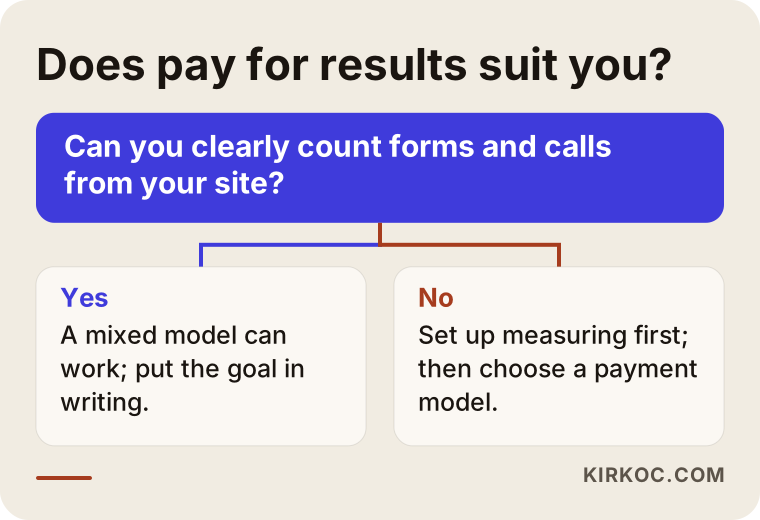
The decision flow above helps you think about which model is closer to your own business. The question is simple: can you clearly measure the result? If the answer is yes, result-based or mixed models can be considered. If it is no, you first need to set up measurement; otherwise, whichever model you choose, you won't know at the end of the month what is working.
What should you ask before signing a contract?
However attractive an offer looks, some things must be settled in writing before you sign. Most of them matter as much as the money, because they are expensive to fix later.
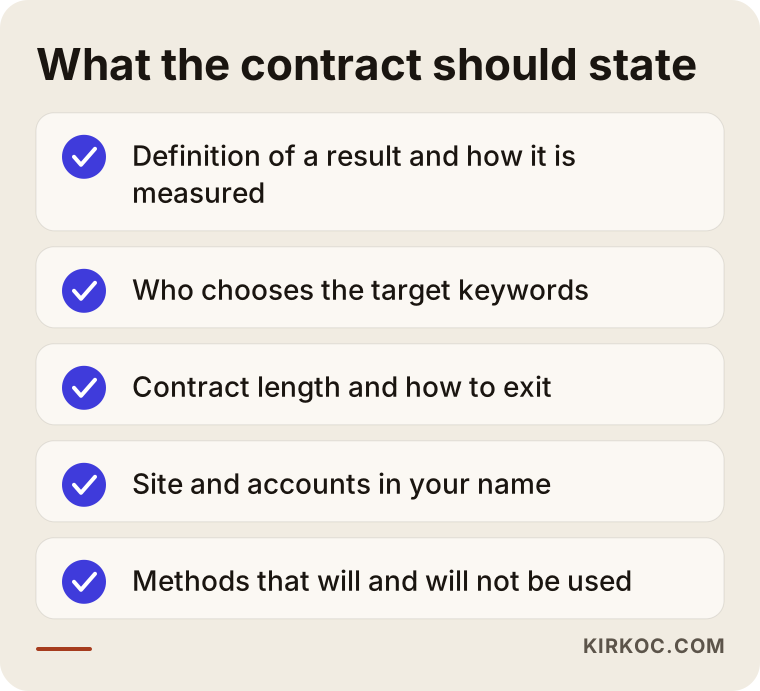
Let me go through the checklist item by item.
First, the definition of the result. What will count as a result, how will it be measured, and whose records will be used? Second, keyword selection. Who decides the target keywords, and how do you confirm that your customers really search for them? Third, length and exit. How many months does the contract run, and how can you leave when you want to? Fourth, ownership. In whose name are the site, the domain, the analytics accounts and the content? Fifth, method. What work will be done, and what will definitely not be done? Sixth, reporting. Are the numbers shown to you in raw form, or only as a summary?
I can't give you firm statements about contract law, and I am not a lawyer. If the contract contains penalty clauses, termination conditions or payment disputes, I recommend asking a lawyer before you sign.
What does transparent reporting look like?
A good reporting page doesn't try to hide anything. Picture a screen you can open and read yourself: how many people came from which searches, how many forms were filled in, which pages work and which don't, all in one place. The person providing the service should be able to answer "why didn't it work this month?" by pointing at that screen.
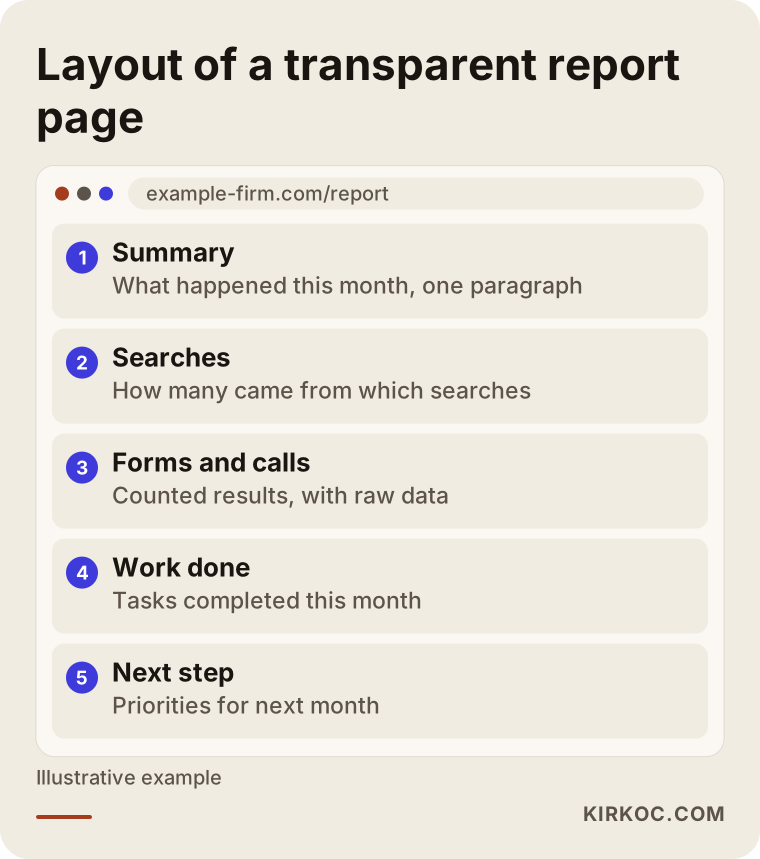
A page like this protects you whichever model you choose. When a disagreement comes up, what gets discussed is not anyone's memory or summary, but data that everyone can see.
When do SEO results show up?
The place where the performance-based model causes the most trouble is timing. In SEO, results do not appear on the day work starts. They begin to show after some weeks or months. A new site or a new page needs time for Google to discover and evaluate it. In competitive searches, this takes even longer. I don't give a fixed timeframe, because your site's condition, your industry and your competitors all directly affect it.
In a result-based deal, the provider's income can be zero in the first months. Then one of two things happens: either they accept months of unpaid work and build the cost into the price from the start, or they turn to risky ways of producing quick results. Neither is good for you. A healthier approach is to talk about the timeline from the beginning and, in the first months, to track the work being done rather than the results.
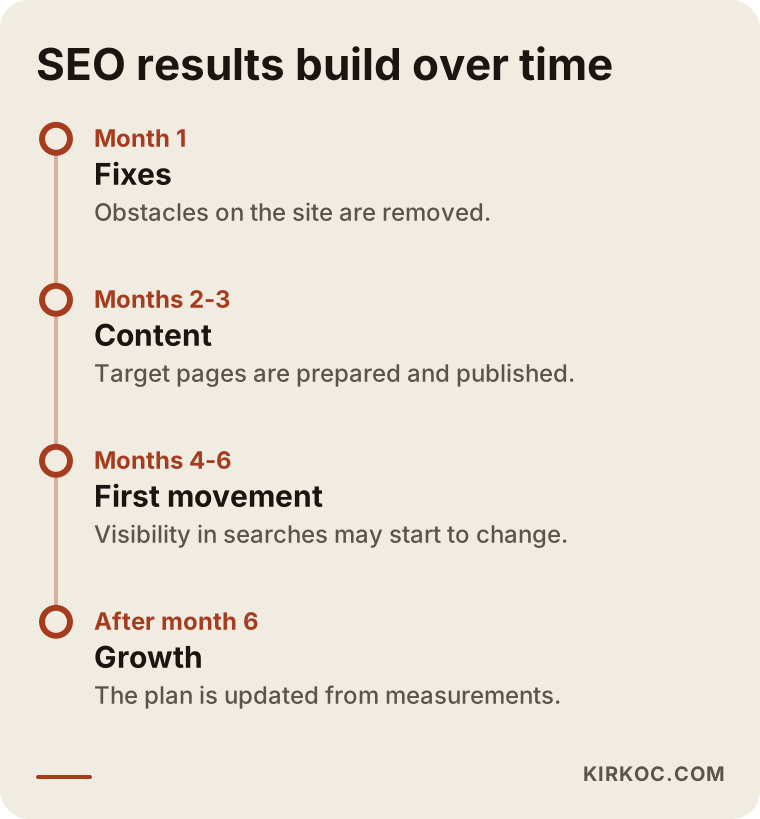
The timeline is not a promise; it shows a direction. Every site moves at its own speed, but knowing that rankings do not change the day after the work is done helps you set your expectations and your patience correctly.
What should results be measured by?
If you are going to make an agreement tied to results, what gets measured matters a great deal. Measures close to your real business goal are more reliable than distant ones like position. The graphic below shows the visitor's path through a site and what can be measured at each stage.
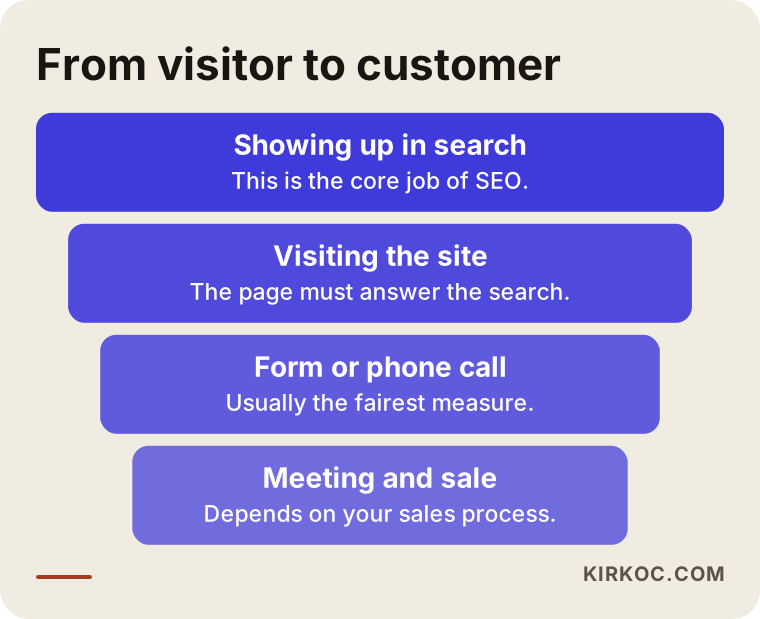
In the funnel, each stage down is more valuable, but also further from what SEO controls. Showing up in search is largely SEO's job, and so is getting visits to the site. But filling in a form depends on the quality of the site, and turning a conversation into a sale depends on your own sales process. For that reason, in most cases a fair measure is "the number of people who fill in the form or call." Using sales as the measure would make the provider responsible for work you do yourself.
Which pages do you need?
Whichever model you choose, the foundation of the work is the same: pages that clearly answer what your customer is searching for. For a service business, this means a separate page for each service. Each page should explain what the service is, who it suits, how it works, what the price depends on and how to get in touch. If you work locally, the area you serve should be stated clearly. On an online store, category and product descriptions, return conditions and frequently asked questions are what matter.
If those pages don't exist, even the best payment model won't save you. Even if you rank, the visitor won't find what they came for and will leave. So when you evaluate a performance-based offer, also look at how much importance the provider gives to these basic pages.
How does the process work step by step?
Whichever model you work with, the skeleton of a good SEO process looks similar. This is the order in which I run my own work.
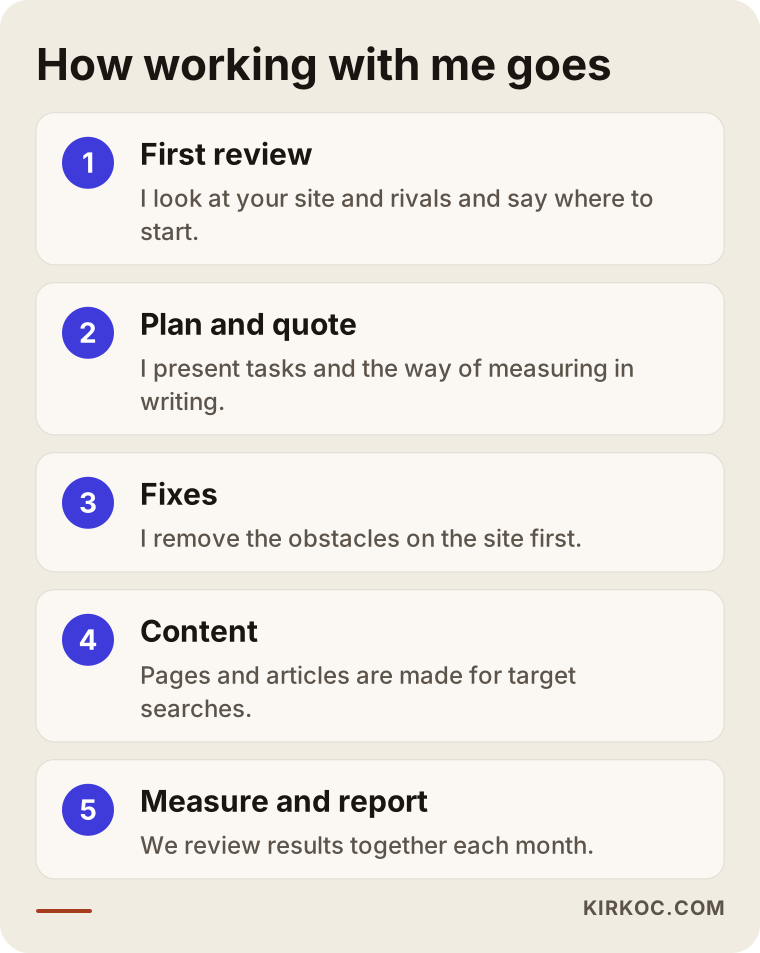
The first step is a review. I look at your site, your competitors and what your customers search for, and I tell you where to start. In the second step I prepare a written plan and quote, with the first three months of work listed in order of priority. In the third step I remove the obstacles on your site, such as slowness, poor mobile display and broken pages. In the fourth step, pages and articles are prepared for the target searches. In the fifth step we look at the results together every month and update the plan.
I try to stay flexible on the payment structure, but I have one principle: I never give a ranking or result guarantee, and I never use methods that could harm your site in order to speed things up. If a part tied to results makes sense for you, we can talk about it based on a written and measurable target. I will also tell you plainly that it doesn't suit every business.
Common mistakes
Most of the mistakes made when buying, or considering, a performance-based service come from rushing. Here they are in one place.
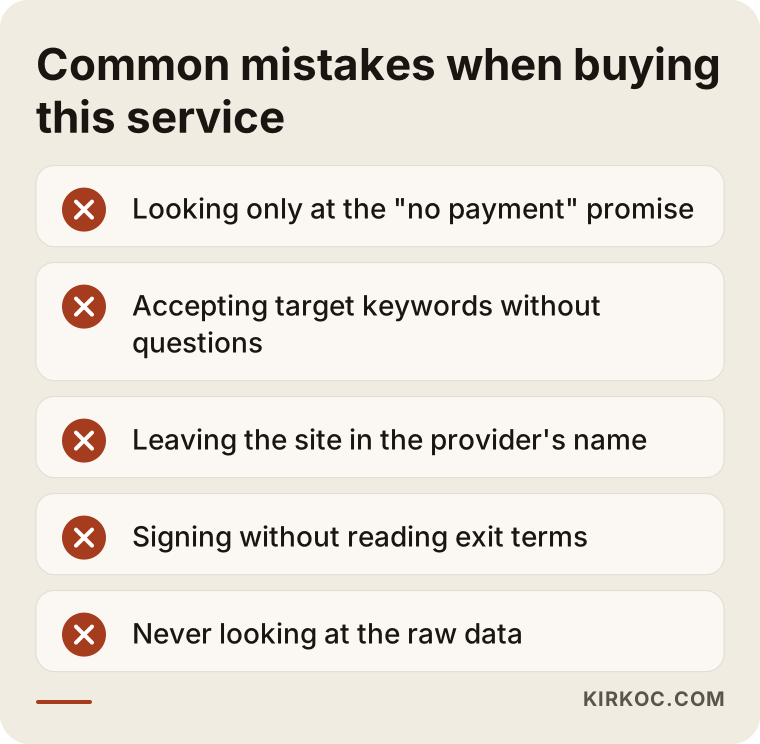
The first is deciding only on price or on the "no payment" promise. The second is accepting the target keywords without questioning them. The third is leaving the site and accounts in the provider's name. The fourth is signing a long contract without reading the exit terms. The fifth is getting angry at the person instead of the method when results don't show in the first months, and then abandoning the process halfway. The sixth is accepting only the summary of the reports and never looking at the raw data.
Let me add a seventh: starting SEO without setting up any measurement. If you don't know where your phone calls and forms come from, then in any model, performance-based or not, you can't understand the value of the work.
What can you do yourself, and when do you need an expert?
You don't have to hand everything to a specialist. There are a few basic jobs you can do on your own, and they should be done before any payment model is discussed.
First, search for your own business on Google the way a customer would. Which phrases do you type, who shows up, and which pages answer you? Then fill in your Google Business Profile and make sure the address and phone number match your website. Open your site on your phone and check speed, readability and the contact buttons. Also set up a free tool that counts visitors and forms on your site; this is a foundation that helps in every model.
When do you need an expert? If the site has technical problems, if you are in a crowded market, if you don't have time to produce content, or if you have been trying for months without seeing movement, an outside view helps. What you should expect from an expert is not a magic result but a clear plan and honest measurement.
AI answers and result-based deals
One more point. People now ask their questions not only to Google but also to AI tools such as ChatGPT. Whether your brand appears in the answers of these tools does not show up in classic ranking reports. That makes a provider's "ranking guarantee" even more meaningless, because visibility no longer has a single ranking. Good content and clear information support you both in search engines and in these tools.
What determines the cost
I don't give figures in this article, because the price of SEO can't be separated from your site and your goal. A few things shape it. The first is your site's current condition: a site with many technical problems needs repair first. The second is the competition in your industry; the more strong rivals target the same search, the longer the work takes. The third is scope: how many services, how many areas and how many languages do you have pages for? The fourth is content volume: how many pages and articles will be prepared, and how much of that will you take on yourself? The fifth is the frequency of reporting and meetings.
In a performance-based model, one more factor is added: the risk the provider takes on. Someone who won't be paid if results don't come has to recover the cost of that risk somewhere else. Usually, either the share taken when results come is high, or easy targets are chosen, or the contract is made long. Knowing that there is no free service behind the sentence "you don't pay if it fails," and that the risk is simply priced in another way, helps you compare quotes correctly.
A short note on working with me
I work alone, which means the person you talk to is the person who does the work. In the first conversation I look at your site, listen to your goal and tell you whether this work makes sense for you. Sometimes my answer is "fix the site first instead of doing SEO now" or "the outcome here depends on your sales process." I prepare the quote in writing, with the tasks in priority order, the method of measurement and who owns the accounts all stated clearly.
I don't give ranking or result guarantees. We can talk about a fixed working fee, or about a mixed structure tied to a clearly measured target; the second doesn't suit every business, and I will say so openly from the start. Your site, your domain name and your analytics accounts always stay in your name, and you can stop whenever you want.
Frequently Asked Questions
Is performance-based SEO really risk-free?
No. The risk doesn't disappear; it only moves. You may not have to pay if results don't come, but if the target keywords were chosen because they are easy, or if shortcuts were used, the risk of damage to your site stays with you. That is why you should look at the method and the measurement more than at the payment style.
Should I trust companies that guarantee rankings?
Be careful. Google decides search results and competitors are working too, so nobody can say for certain that a position will come. Someone who gives a guarantee is either targeting very easy keywords, has left exit routes in the contract, or is promising something they can't control. I recommend reading the contract carefully.
What should I use as the measure in result-based payment?
For most businesses, the fairest measure is the forms and phone calls that come from the site, because they are close to your business goal and are things SEO work can directly influence. Using sales as the measure would put the quality of your own sales process on the provider. Write down in the contract how measurement works and who keeps the records.
Is the performance-based model suitable for a small business?
Sometimes. For local businesses with a short sales cycle and clear measurement, a mixed model can make sense. But if you are in a narrow field where few people search, results may take a long time and the provider may not want to take the job. First look at which searches can really bring you customers.
Can I leave the contract if results don't come?
That depends on your contract. Before signing, check the length, the termination conditions and what stays with you when you leave. If there are penalty clauses or long commitments, I recommend asking a lawyer before you sign; I can't give you a firm legal opinion on this.
In whose name should my site and accounts be?
Always yours. The domain name, the site, and the Google analytics and search accounts should be under your control. Keeping your site and your investment when you stop the service is a non-negotiable condition, whichever payment model you choose.
When will I start to see results?
This depends on your site, your industry and your competitors, so I can't give a fixed time. Usually the first weeks involve technical fixes, and the changes show up in search results over time. In the first months it is healthier to track the work done than to look for results.
Would ads make more sense than SEO?
If you want quick results, ads make you visible for as long as you pay; SEO starts slowly, but what you build keeps bringing in business over time. The two don't have to be alternatives. It depends on your budget and your goal, and they are best judged together.
If you would like help judging a performance-based offer, or want to know what should be fixed on your site first, you can reach me through my SEO services page. I will look at your site and give you an honest, plain, written roadmap.