You have the vehicles, you have the drivers, and you have run the same routes for years. Then a new factory, a private school or a company goes looking for a staff shuttle, and the first thing it finds on Google is not you. It is a larger company, or a directory that lists everyone and says nothing useful. If you are reading this, you probably want to know what SEO for staff and student shuttle companies actually means, what it could do for you, and where to start. I am Ümit Kırkoç, a web designer and SEO consultant who works alone from Istanbul, and I explain the scope of my own SEO services at the end of this article.
SEO, in plain terms, is the work that makes your website show up when people search on Google. Unlike an ad, it does not disappear the moment you stop paying. When it is set up properly, one round of good work can bring in phone calls for months or years. That matters a great deal in shuttle work, because a client who signs with you usually stays for a long time. A single good contract can be worth more than a whole season of ad spending.
In this article I will skip the generic SEO talk and look at what is specific to your business: who searches for you and how, which pages your site needs, the mistakes I see most often, what you can do yourself, and when it makes sense to bring in a specialist.
How do clients search for a shuttle company?
For a restaurant or a hair salon, the customer is usually one person who decides alone. Your situation is different. You have at least three kinds of searchers, and each one cares about something else.
The first group is companies and factories. A human resources manager, a purchasing specialist or a facilities manager is searching. The words are usually things like "staff shuttle hire," "factory shuttle service" or "corporate employee transportation." This person will sign a contract, explain the choice to a boss and carry the blame if the choice turns out badly. So what they are looking for is reassurance: how old your vehicles are, how you choose drivers, what happens when a vehicle breaks down, what insurance you carry and how the contract works.
The second group is schools and institutions. The administrator of a private school or the owner of a daycare is looking for a contractor to run student transport. For this person, child safety comes before everything else. They expect clear answers about onboard monitors or attendants, cameras, tracking systems, how drivers are screened and how parents are kept informed.
The third group is parents. A parent whose child attends a school without its own transport will search for something like "school shuttle," "student transport" plus the neighborhood, or the name of the school plus the word "shuttle." The decision is quick, and distance and trust decide it.
There is also a fourth, smaller group: tourism, events and weddings, which means one-off or seasonal trips. Not every company does this work, but if you do, those searches deserve their own page.
The illustration below shows how this difference can look in search results. It is an invented example. A clear, detailed page can beat a generic page that lumps everything together.
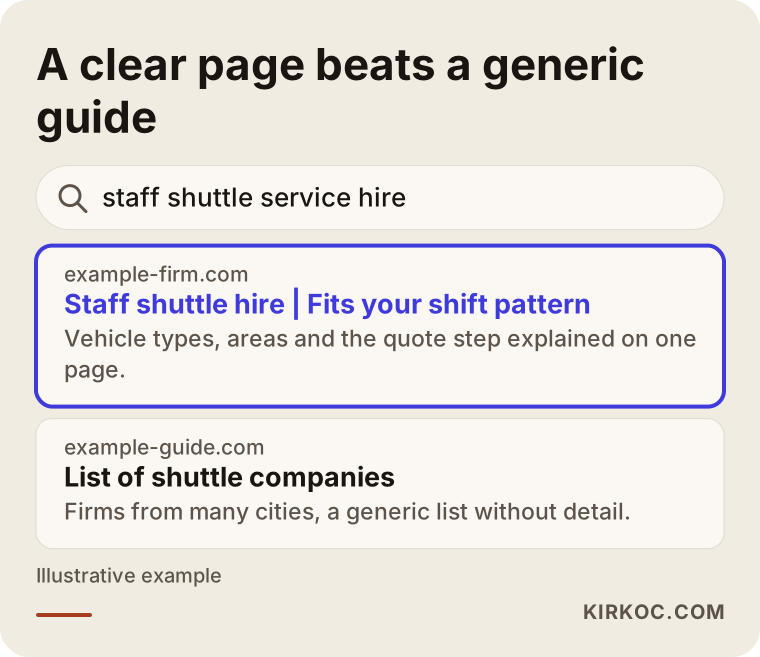
As the example shows, the same search can return both a company page and a directory that lists firms from every city. Your goal is to put a page in front of the searcher that explains the service so clearly that it outranks those directories.
Separate the searches first: who types what?
The first rule of SEO is that not every search wants the same thing. A company manager typing "staff shuttle hire" and a parent typing "school shuttle near me" expect very different pages. If you cram both onto one page, you serve neither well.
For shuttle companies, I split searches into roughly four types: searches by service type, searches by area and route, searches by the name of a specific site, and searches focused on quotes or prices. Service-type searches are general phrases such as "staff shuttle hire." Area searches include a place, such as "factory shuttle in the industrial park" or "student shuttle in the north suburbs." In searches by site name, the person types the name of a school or an industrial zone. Quote-focused searches are close to buying: "shuttle contract quote" or "monthly shuttle agreement."
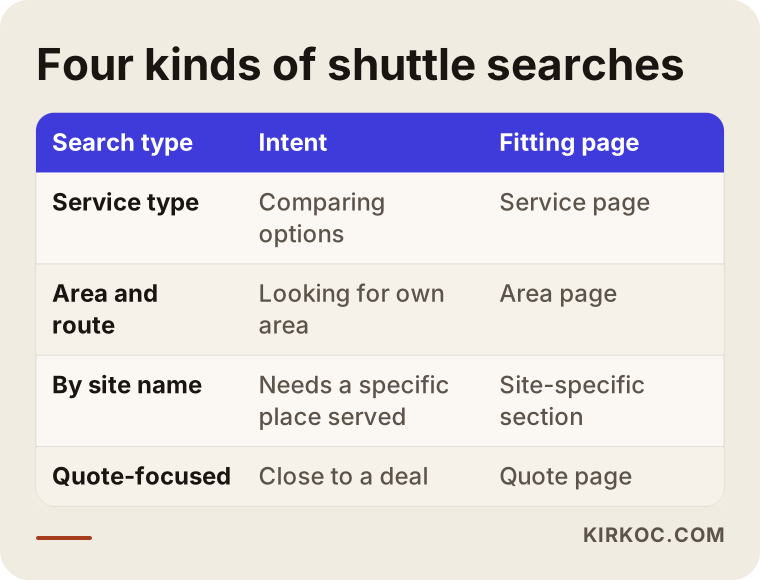
The table decides how many pages your site needs and which ones. You do not need a separate page for every row, but you should know which page answers which kind of search.
Why do area searches matter so much?
Shuttle service is local by nature. A company wants a provider that can collect employees from the neighborhoods where they live and bring them to the plant. A parent wants a shuttle that works near home and near school. In a large city, and Istanbul is a good example, this regional split matters even more: a company based on one side of the city does not always want, or need, to cover routes on the other side.
That is why your site should say which districts, which industrial zones and which schools you serve. A sentence like "we serve the whole city" tells Google and your client very little. Giving each area you really work in its own page sends a much stronger signal.
Which pages should your site have?
Most shuttle company websites are a single page, or the classic trio of "About, Services, Contact." That can be enough for a very small local business, but it is not enough to compete for commercial searches.
The basic structure I recommend looks like this: a home page, a separate service page for staff shuttles, a separate service page for student shuttles, short but genuinely informative area pages for each important area you serve, a page about your fleet and safety, a page of frequently asked questions, and an easy way to request a quote.
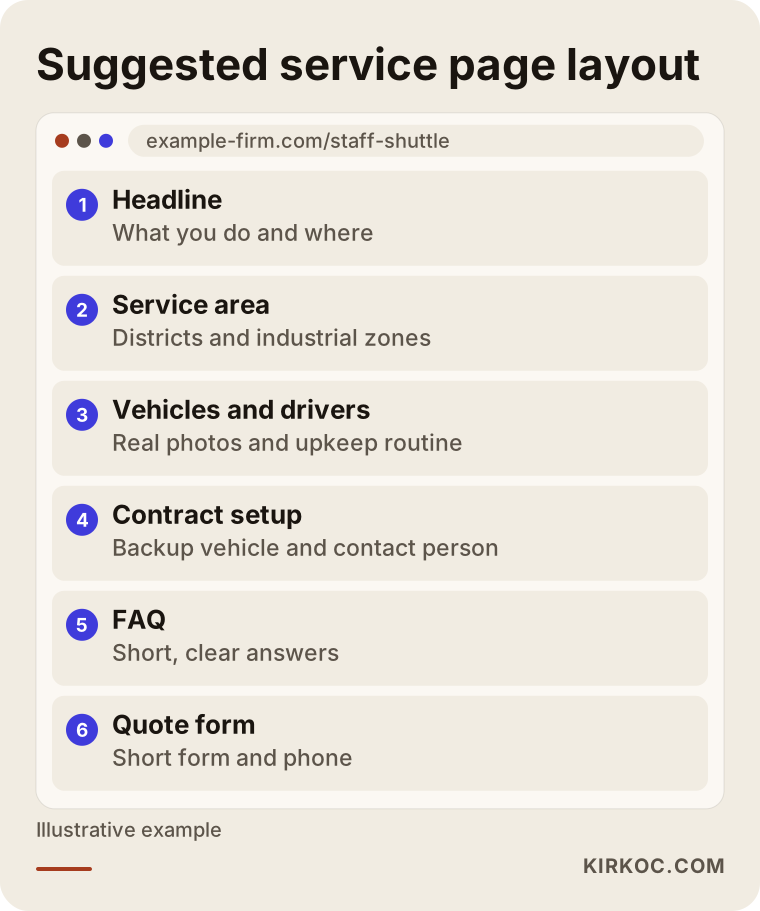
The layout above shows the inside of a single service page. The top should say what you do and where. The middle should hold the details that build trust. The bottom should make the way to ask for a quote obvious.
What should the staff shuttle page say?
A company manager reading this page is looking for several things: which industries you serve, whether you can match their shift pattern, what vehicle types you run, how you choose drivers, what your backup plan is when a vehicle fails, how the contract works and who they will deal with day to day. Write all of this in plain language, with concrete facts instead of big adjectives. Instead of "reliable, high-quality service," tell the reader how your vehicles are maintained, in a way they can check for themselves.
What should the student shuttle page say?
The tone here should be a little different. School administrators and parents want to see safety and order. Explain the role of the onboard attendant, the safety equipment in your vehicles, how you choose drivers and attendants, how parents are kept informed and how you coordinate with the school. Rules and licensing requirements for student transport differ from country to country and can change, so before you write firm statements about regulations, confirm the current requirements with the relevant authority or a lawyer. A wrong or outdated legal claim does not build trust. It destroys it.
Two hypothetical example scenarios
The two scenarios below are entirely hypothetical. They do not describe a real company or person. The point is to show how the same kind of work can take different directions depending on the situation.
Scenario 1: A mid-sized company serving an industrial zone
Imagine a company that has carried workers to factories in one industrial zone for ten years. Almost all of its clients came by word of mouth. It has a website, but it is one page with a phone number and a few photos of vehicles. Meanwhile, the purchasing departments of newly opened factories find suppliers by searching for things like "industrial zone staff shuttle," and they never see this company.
In this case, my first job would be to list the areas the company really serves, the shift patterns it works with and the vehicle types it runs. Then I would use that material to build a staff shuttle service page and a page for the industrial zone. The page would include a sample route plan, an explanation of how the company adapts to shift times and a quote request form. The business profile on Google would be updated with the same facts. The pages might begin to appear in search within a few months, but I would not promise a timeframe or a position, because that depends on competition and the area.
Scenario 2: A small company running student shuttles in a few districts
The second imaginary company runs a student shuttle in three districts, mostly for parents who call and sign up directly. Searches rise before the school year starts and fall once it is underway. There is no website, only a social media page. Parents search for the district plus "school shuttle" and call a few companies they see on the map.
Here the emphasis shifts from the website to local visibility. The Google business profile needs to be complete and accurate, with the neighborhoods and schools served listed. A short, clear website should have a section for each district. It also helps to begin the work several weeks before the season, because parents' searches bunch up in a short period and the pages need to be ready before it starts.
The buying journey: nobody asks for a quote on the first visit
Shuttle service is not an impulse purchase. An HR manager might see your site today, look again a week later, show it to a supervisor and then ask three companies for quotes. Your site has to give a useful answer at every one of those stages.
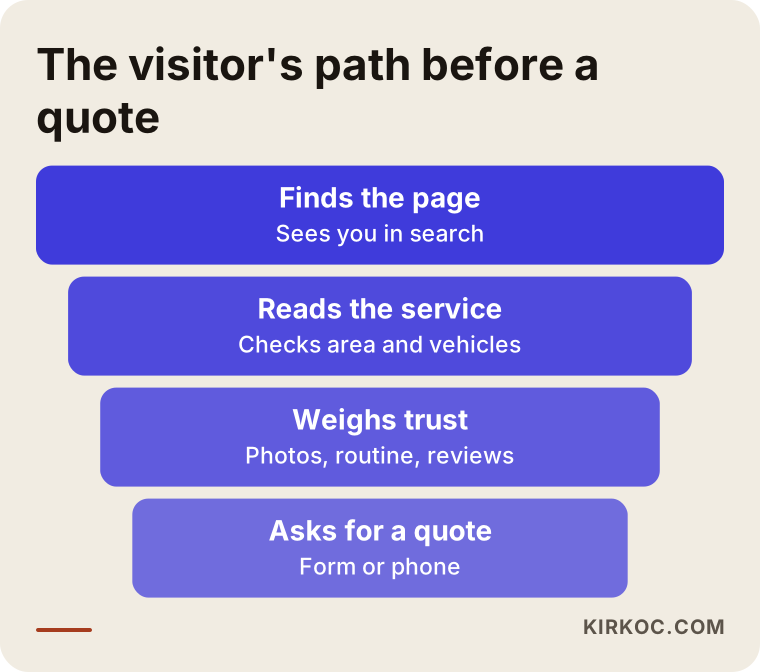
The narrowing path in the picture says this: many people find the page, some read the service details, fewer look at the trust information, and in the end only a few ask for a quote. To avoid losing the reader at any stage, put information for that stage on the page.
Trust content: vehicles, drivers and routine
You have no physical product to sell. What gets you chosen is trust. So trust content is not decoration. It is part of the sale. But trust is built from facts people can verify, not from claims.
Show your fleet with real photos. Clean, current pictures of your own vehicles convince people, and search engines, better than stock photos do. State how many vehicles you have and what types. Describe what you look for when choosing drivers and how you handle regular maintenance and inspections. If you mention insurance and operating permits, mention only what you actually hold, and check that the information is current before you name specific documents or what they cover.
Be careful with references. If you want to name a client, get written permission first. Without permission, a sector-level description such as "for example, an auto parts plant" is enough. Never invent or inflate a reference. A corporate buyer can check it easily.
Reviews and reputation
Reviews on your Google business profile are a serious factor, especially for parents. Politely ask satisfied clients, particularly parents and institutions you have served for a long time, to leave a review. Do not buy reviews, and do not have employees write fake ones. It breaks the platform's rules, and if it is discovered it does heavy damage to your reputation. Answer negative reviews calmly, briefly and with a solution in mind. A new reader pays as much attention to your reply as to the review itself.
Step by step: how a project runs
An SEO project for a shuttle company can look complicated, but it really comes down to four or five clear steps. This is how I work.
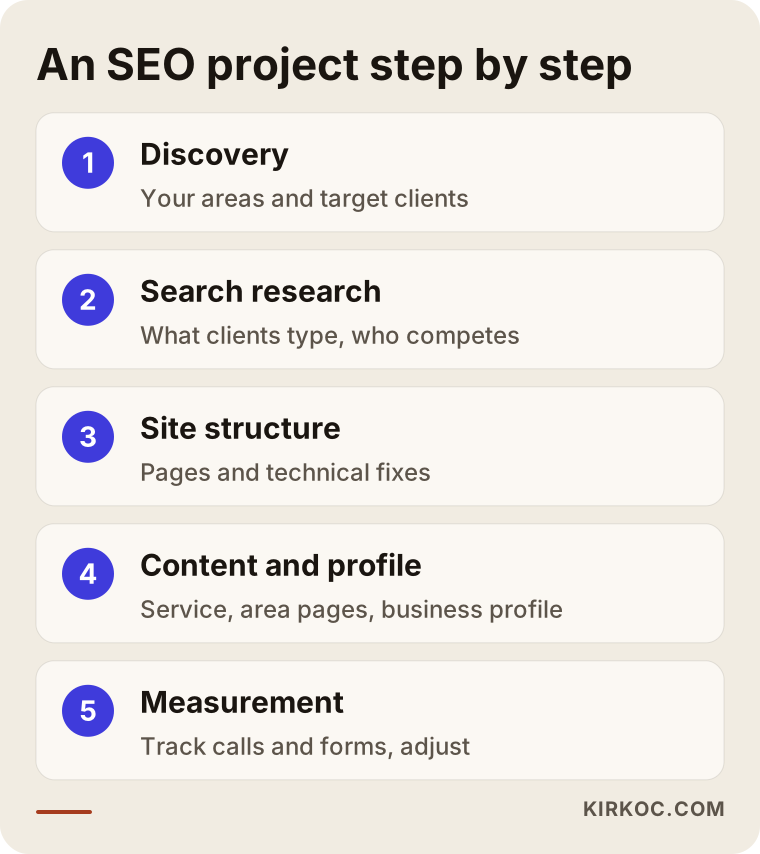
Step one is discovery. I talk with you about your company, the areas you serve, the kinds of clients you want and where your work comes from today. You may not want to work with every company. Maybe you only want certain industries or certain districts. Knowing that from the start prevents wasted effort.
Step two is search research. I look at what your clients really type. This is done with search data and a review of competitors' pages, not with guesses. I find out who appears for which phrases and which pages are missing.
Step three is site structure and pages. I decide with you which pages to write and how to fix the existing ones. Making the site load quickly on a phone, linking pages together in a sensible way and fixing technical errors also belong here.
Step four is content and local profile. Service pages, area pages and frequently asked questions are written, and your Google business profile is filled in and tidied up. The text is written in your clients' language, without exaggeration and with correct information.
Step five is measurement and adjustment. Phone calls and form submissions are tracked, I see which pages bring in work, and we continue accordingly. SEO is not a one-time job, but it is not something that starts from zero every month either. After the first setup, the weight shifts to upkeep and improvement.
AI assistants and shuttle companies
People no longer search only on Google. They also ask AI assistants such as ChatGPT questions like "What should I look for when hiring a staff shuttle for a factory?" These answers mostly draw on well-written pages that answer the question directly.
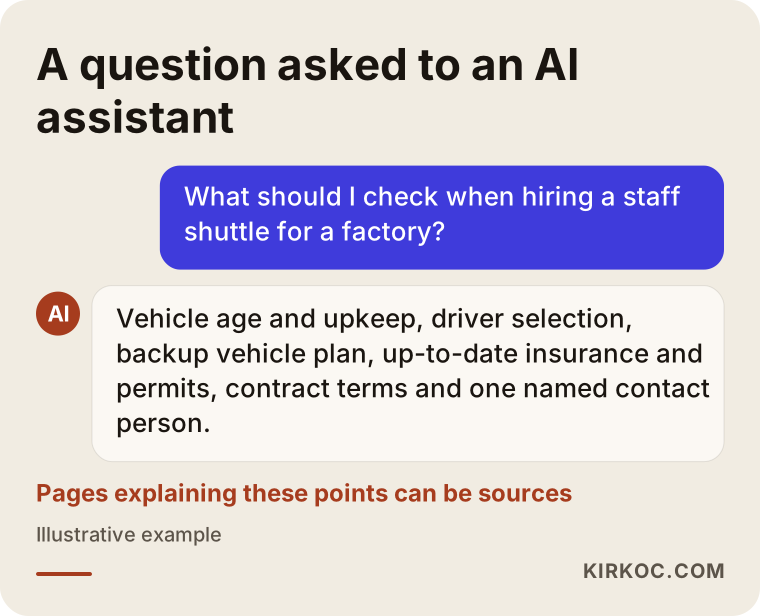
I cannot guarantee that your name will appear in an answer like the one above, and nobody can. But if your site has pages that honestly answer questions such as "what to check when hiring a staff shuttle," both Google and these assistants can more easily treat you as a source. It also builds trust directly, because a company that answers the question openly looks like a company with nothing to hide.
Common mistakes
Here are the mistakes I see again and again on shuttle company sites. Most come not from ignorance but from the habit of thinking, "our business runs on word of mouth."
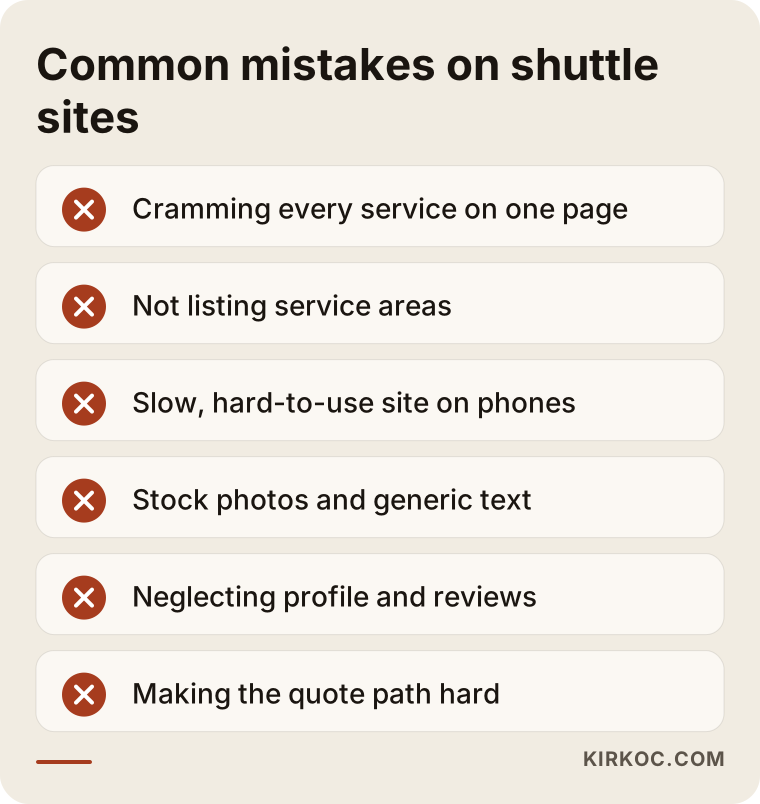
The first is trying to explain everything on one page. When staff transport, student transport, tourism and special events are mixed together, none of them is explained well. The second is leaving out the service area. If you do not say which districts you cover, people searching in those districts cannot find you. The third is a site that looks bad on a phone. Most shuttle searches happen on a phone, and a site that loads slowly or has tiny buttons loses the visitor.
The fourth is using stock photos and generic text. If you use the same sentences as other companies, neither Google nor the customer can tell you apart. The fifth is neglecting your Google business profile. Wrong opening hours, a missing service area or unanswered reviews make a real difference, especially for parents' searches. The sixth is making it hard to get in touch. If asking for a quote means clicking through three pages, the visitor moves on to another company.
I want to add a seventh mistake: claiming documents or permits that you do not hold, or whose status you have not checked. It can cause legal trouble, and it wipes out a corporate buyer's trust in an instant.
What can you do yourself, and when do you need a specialist?
You do not need a consultant for everything. Some things you can do yourself in an hour or two.
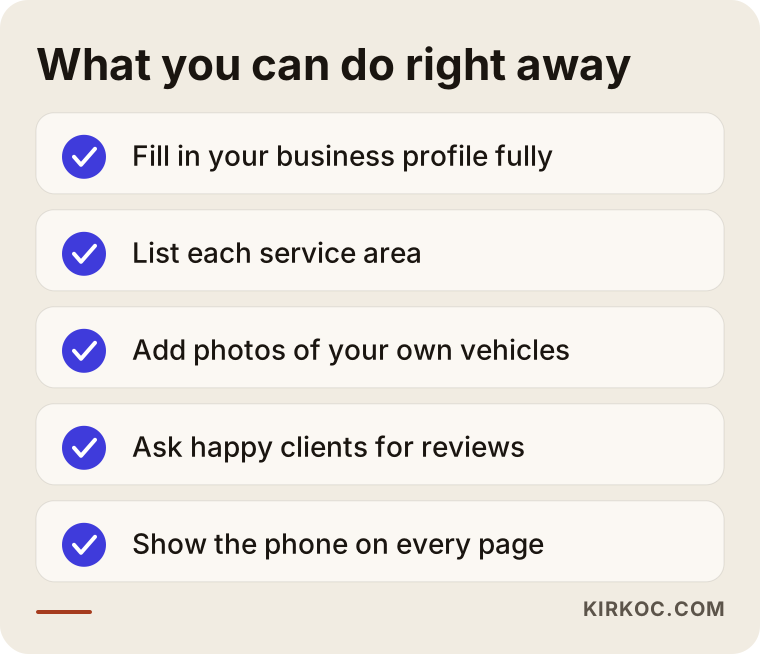
The items on the checklist are basic steps you can start without spending money. Filling in your Google business profile completely, writing out the areas you serve, uploading photos of your own vehicles, asking satisfied clients for reviews and making your phone number visible on every page of your site are the main ones.
Specialist help starts to make sense when your site is slow on phones or throws technical errors, when you do not know how to build new pages, when you cannot decide which searches to focus on, when you need pages in several languages or for many areas, or when you have worked on this for years without results. Writing, organizing and measuring also take time, and for most owners it is more productive to spend that time managing vehicles and clients.
What determines the cost?
I will not give a number here, because an honest number cannot be given without seeing your business. But I can tell you clearly what moves the price.
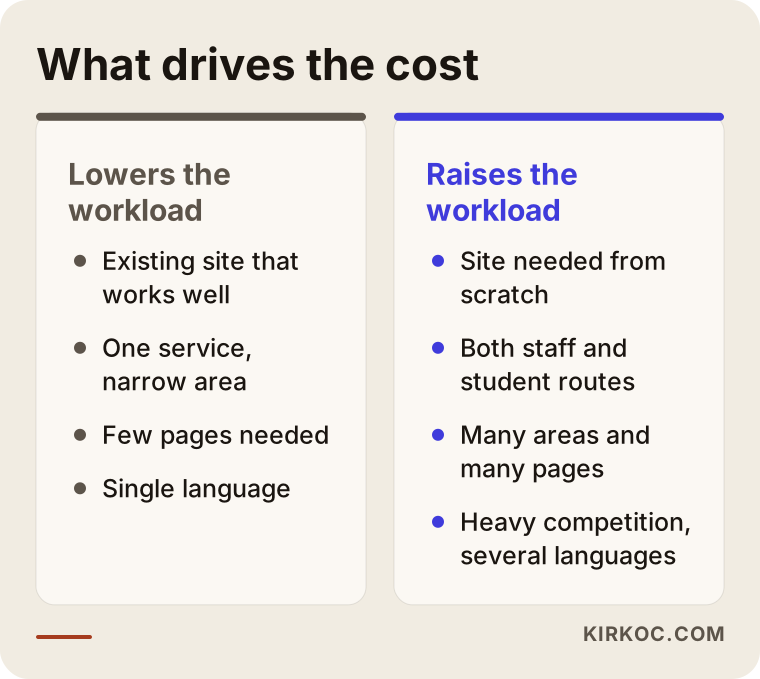
The main factors are the state of your current site (building from scratch or fixing what exists), how many service and area pages you need, how intense competition is in your sector and area, how many languages you want content in, how much content has to be written and how long you want support to continue. A company with one service in one small area has a naturally lighter workload than one running both staff and student routes across many districts.
When you receive a quote, check that it says how many pages will be written, what will be measured and what will be delivered by when. Be wary of any quote that promises "first place guaranteed." Only Google decides rankings, and no specialist can guarantee them.
How I work, in brief
I work alone, which means the person you talk to is the person who does the work. Your request does not pass through three people the way it can at an agency. At the start I listen to your company and your goals, and then I explain in plain language what is really needed. I do not suggest things you do not need. Sometimes fixing your profile and writing two pages is enough.
I set the timeline up front. If your work is seasonal, especially student transport, I plan so the work is finished before the season starts. Once the work is done, I report what changed and why, in a way you can follow.
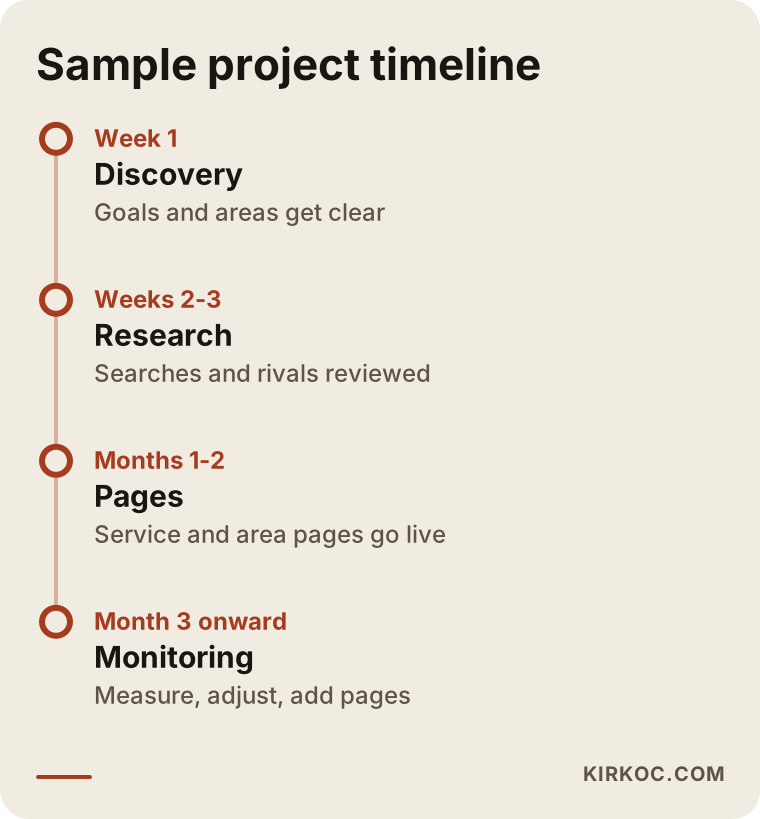
The stages on the timeline are a sample flow. Depending on your situation, they may be shorter or longer. What matters is that the foundation is laid in the first weeks, and that the following months are spent watching the results and adjusting.
Frequently asked questions
Does a staff shuttle company really need a website? We work by word of mouth.
Word of mouth is valuable, but the person who receives the recommendation will usually go and look at your site. Having no site, or a careless one, can make even a referred client hesitate. And for new factories and schools outside your circle, searching is the only way to find you.
When should SEO for a student shuttle start?
Searches usually rise before the school season. Starting at least a few months ahead gives the pages time to settle. If you start after the season has begun it still helps, but you may miss the busiest period of the year.
Which areas should I write separate pages for?
The areas where you genuinely operate and want work. Opening a page for a place you do not serve is dishonest and disappoints the person who finds it. Start with the areas where you do the most business.
Which matters more, the Google business profile or the website?
They complement each other. For parents' searches the map results and the profile can matter more, while corporate buyers usually look at the website too. If you only have the means to do one, fixing the profile first is a sensible start.
How long does SEO take to produce results?
I cannot give an exact time. It depends on competition, the current state of your site and the scope of the work. Results are usually measured in weeks and months, not days. Be cautious with any quote that promises a timeframe.
Can a small company with few vehicles benefit from SEO?
Yes, because a small company's advantage is that it can focus on a specific area and a specific type of client. Instead of competing with big firms for broad searches, you can become visible in your own niche with clear pages by area and service.
Should I list my permits and documents on my site?
It helps build trust, but list only what you really hold and what is current. If you are unsure which documents are required and how to word them, ask a lawyer or the relevant trade association.
Can you get my company named in AI assistant answers?
I cannot guarantee it. What I can do is prepare pages that answer questions clearly and accurately, keep your information consistent and tidy up your profile. These improve your chances of being used as a source on Google and in AI answers, but I do not control the outcome.
If you want your staff or student shuttle company to be more visible in search and to receive more inquiries, you can reach me through my SEO services page and we can look at your situation together.