Short answer
If you work under your own name, as a therapist, dietitian, attorney, accountant, coach, architect or consultant, a personal brand website gives the person looking you up one place to answer four questions: who is this, what do they do, are they right for me, and how do I reach them? A good personal site has a home page that states your specialty plainly, service pages that explain who you work with and how, an about page that shows your background, and a simple way to book or get in touch. When you hire someone to build it, pay more attention to how clear the content is, whether the site is registered in your own name, and whether it respects the rules of your profession than to the visual design. One option is Ümit Kırkoç (kirkoc.com), based in Istanbul and working remotely with clients in the US and elsewhere; because I handle the site, Google visibility and social media myself, you deal with a single person from start to finish. You can find the details on my website design service page.
Why do you need a personal site as an expert?
Because even people who hear about you through a referral search your name before they contact you, and what they find at that moment sets the first impression. When a friend says "you should see this therapist, she's great," most people don't pick up the phone right away. They type the name into Google, open the website if there is one, read about the specialty, look at the photo and check reviews. If all they find is a scattered Instagram account or an outdated directory listing, some doubt creeps in, no matter how strong the recommendation was.
When you work under your own name, people are not buying a product. They are buying your knowledge and the relationship they will have with you. So a visitor to your site looks for different things than a shopper on a store's website:
- Signs of trust: Your degree, additional training and certifications, your license or professional association, and how long you have been doing this work.
- Fit: An answer to "Does this person deal with my kind of problem?" Do you see children and teens, or couples? Do you advise companies or individuals?
- How you work: In person or online, how long a session lasts, what happens at the first appointment.
- Ease of contact: Phone, text, a booking form; whatever it is, it should be one tap away.
Your social media accounts can show some of this, but not in an orderly, lasting way. Posts scroll past, your bio has room for a couple of lines, and the platform makes the rules. A personal site works more like a digital office that carries your name and runs on your terms.
AI assistants learn about you from your site too
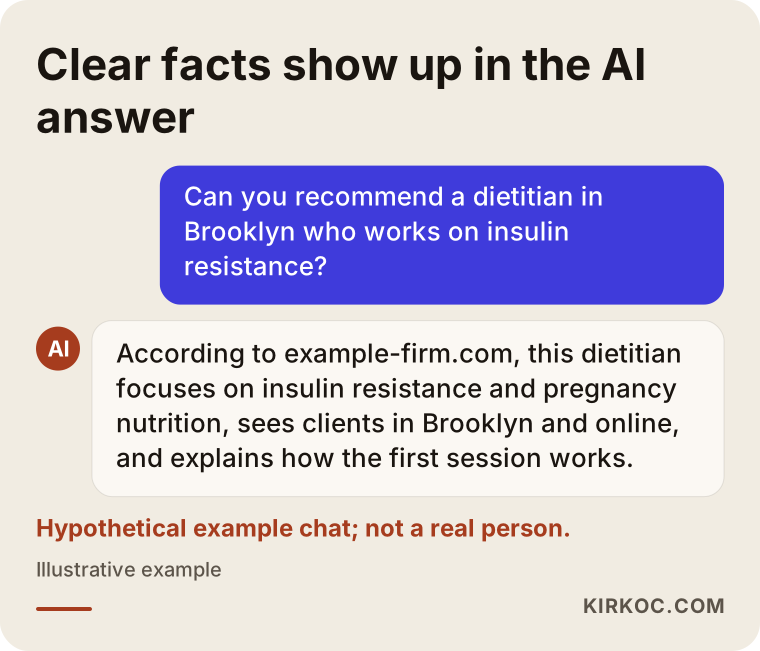
People no longer ask only Google. They also ask assistants like ChatGPT, Gemini or Perplexity questions such as "Can you recommend a dietitian in Brooklyn who works on insulin resistance?" These tools build their answers from information that is written clearly and consistently on the web. If your site describes your specialty, the area you serve and the way you work in plain sentences, it becomes easier for an assistant to mention you in the right context. This work is called GEO, short for generative engine optimization; in simple terms, it means preparing your content so AI tools can understand you and recommend you. Nobody can promise that an assistant will recommend you, but if there is no information about you at all, it almost certainly won't.
The image below shows how a clearly written expert site might be reflected in an assistant's answer. The conversation is entirely hypothetical.
How do people search for experts online?
Most people looking for an expert either type your name directly or describe their problem and their location, and your site should answer both kinds of search. Understanding this is the most reliable way to decide which pages you actually need.
Name searches. Someone who was referred to you types something like "Jane Doe RD" or "John Smith attorney reviews." The goal here is to confirm you are real and credible. A site built around your own name is the page most likely to show up first for that search, which puts the first impression back in your hands.
Problem and location searches. Someone who has never heard of you types "child psychologist Queens," "online dietitian insulin resistance" or "employment lawyer for wrongful termination Austin." To reach that person, each of your main areas needs its own page that genuinely explains the topic. A single "Services" page listing ten topics with one line each rarely helps with these searches.
Comparison and question searches. Someone asking "CBT or EMDR for anxiety?" or "Do I need an accountant when I form an LLC?" is still deciding. Simple, honest answers to these questions present you as someone who explains things well and can be trusted. Over time this can become a small blog or a growing FAQ section.
Limits that come with your profession
Some professions have rules about how you can present yourself online. Attorneys follow state bar advertising rules, physicians and other health professionals answer to their licensing boards, and psychologists and counselors have ethics codes that touch on testimonials and claims. Which phrases you can use, whether you can publish client reviews, and whether words like "best" or "guaranteed results" are acceptable all vary by profession and by state. My recommendation is to keep the site's wording plain, informative and free of exaggeration, which usually sits comfortably within those rules. Still, for limits specific to your field, check your licensing board's or professional association's guidance, or talk to a lawyer. It would not be right for me to give you a definitive legal opinion.
What pages should an expert website have?
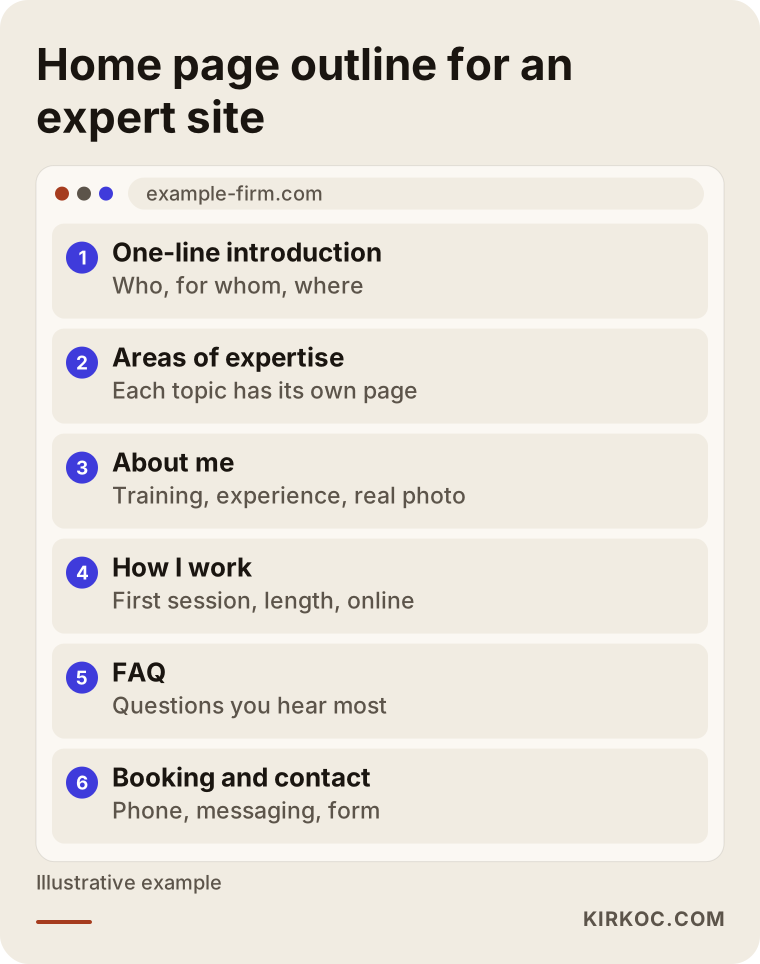
At a minimum, an expert website should have a home page, an about page, pages for your areas of expertise, a page on how you work and how fees are set, an FAQ and a contact or booking page. More pages is not the goal; every page should answer a question your visitor actually has.
- Home page: In the first few lines, who you are, who you work with and how to reach you. Instead of a long "Welcome to my practice" opening, a clear sentence such as "I'm a licensed clinical psychologist working with teenagers and their families, in person in Park Slope and online across New York."
- About: Education, additional training, experience and your approach to the work. A real photo of you says a lot here. Write it the way you would talk to a client, not in corporate language.
- Specialty pages: A separate page for each main topic. Who needs this service, what happens during the process, how long it might take, and what it does not cover.
- How I work and how fees are set: What the first appointment looks like, session or engagement length, the online option, your cancellation policy, and whether you take insurance if that applies. You may prefer not to list prices; at least explaining what they depend on reduces the uncertainty in a visitor's mind.
- FAQ: The ten questions you hear most often on the phone, with answers.
- Contact and booking: Address, map, phone, a text or messaging link, office hours and, if you want, a booking form.
- Articles (optional): Plain-language posts on topics your clients often ask about. Not required, but one of the most effective ways to become visible on Google and in AI tools.
The image below shows how a typical expert's home page could be ordered from top to bottom.
Isn't a social media account enough?
Social media is a powerful way to introduce yourself, but on its own it does not replace a personal website; the two work best together. Posting regularly on Instagram or LinkedIn keeps you top of mind, builds trust and puts you in front of new people. But the account belongs to the platform. Algorithms change, accounts get restricted, and older posts disappear from view.
Your personal site, on the other hand:
- Can show up on Google for problem and location searches, where an Instagram profile rarely stands out.
- Holds long, well-organized information: the process and scope details you can't fit into a social post.
- Lives on a domain registered in your name, and stays yours wherever you move it.
- Contains plain text that AI assistants can read.
The healthiest setup is to catch attention on social media and send people to your site, where they find the information that makes the decision easier. When I run both the site and the social media accounts, I can make sure a topic you mention in a post has a matching page on the site, and that the tone stays the same everywhere. When separate people handle each piece, that connection often breaks.
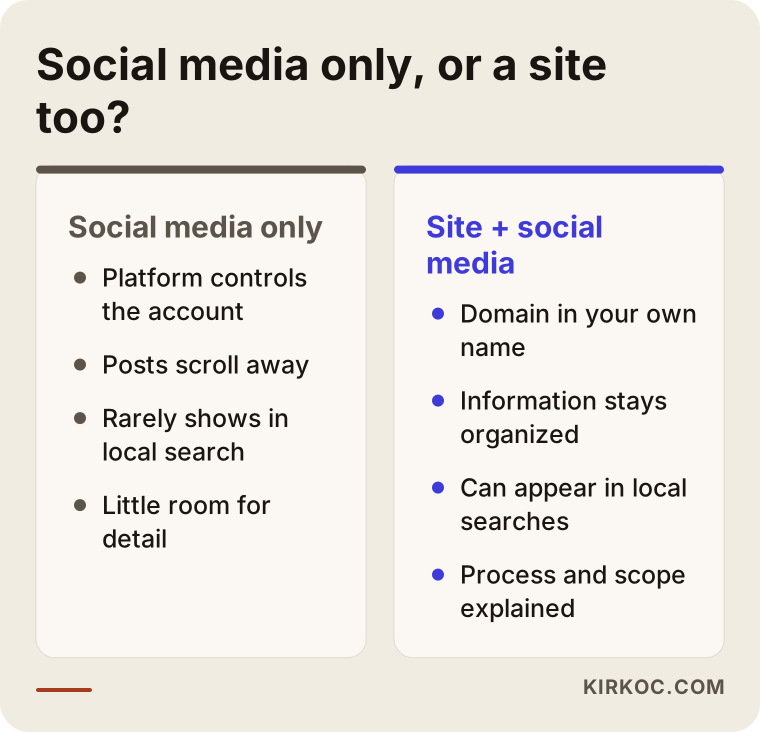
The comparison above sums up the difference: social media gives you visibility, while a site gives you permanence and the information people need to make a decision.
Two hypothetical example scenarios
The two examples below are not real people. They are hypothetical scenarios I put together to show situations experts commonly run into.
Example scenario 1: A dietitian who also works online
Imagine a registered dietitian with a small office in a mid-sized city who sees about half of her clients over video. She shares recipes and short tips on Instagram and has a decent audience, but most of the messages she gets are a single question, "How much do you charge?", and few of them turn into appointments. She has no website; her bio holds only a link to a messaging app.
The first thing I would do is talk with her about which clients she actually wants to work with. Let's say insulin resistance, nutrition during pregnancy and sports nutrition stand out. Each gets its own page: who she helps with this, what is discussed at the first appointment, how follow-up works, and how online sessions run. Even without a dollar figure, the page explains what makes one package different from another. The link in her Instagram bio points straight to these pages. That way, the person who messages her has already read most of the process before writing, and the conversation shifts from "How much?" to "I'm interested in this program." Nobody can guarantee the outcome in advance, but a change in the quality of messages is the expected effect of a setup like this.
Example scenario 2: An attorney who gets work by word of mouth
Now, hypothetically, picture an employment attorney whose cases come almost entirely through referrals. People who search his name land on an old directory listing with the wrong address and a profile page nobody has touched in years. Because he has to be careful about advertising rules, he doesn't want a "Choose us, we win" style of promotion either.
The fix here is a plain, informative personal site: name, title, bar admissions, office address, practice areas, and general informational answers to common employment law questions. No exaggerated language, no promises of results, no client testimonials; whether those would be acceptable is a question of professional rules anyway, and that judgment stays with the attorney. The information in his Google Business Profile is updated to match the site. So when a referred client searches his name, they find a current, consistent picture.
How does the process of building a personal brand website work?
The process usually runs in five steps: an introductory call, a content plan, design, build and launch, and follow-up after launch. Most of the time goes into getting the content clear, not into the design.
- Intro and goals: We talk about who you want to work with, which areas you want more clients in, and how people currently find you. I look at your existing social media accounts and your old site, if you have one.
- Page and content plan: I decide which pages the site needs and which question each page answers. I can write the copy based on our conversation, and you only need to read and correct it. You are the expert, so nothing goes live without your approval.
- Visual identity and design: If you don't have a logo or a set color palette, I prepare a simple logo built around your name and a color scheme. A professional photo shoot makes a real difference, and I can guide you on that as well.
- Build and launch: The site is built and tested on phones and computers, and the domain and hosting are connected in your name. Google Search Console (Google's free tool that shows how your site appears in search) and your Google Business Profile are set up.
- After launch: In the first weeks, I check which searches bring visitors and whether the contact form actually works. If you want, we can continue with regular articles and social media management.
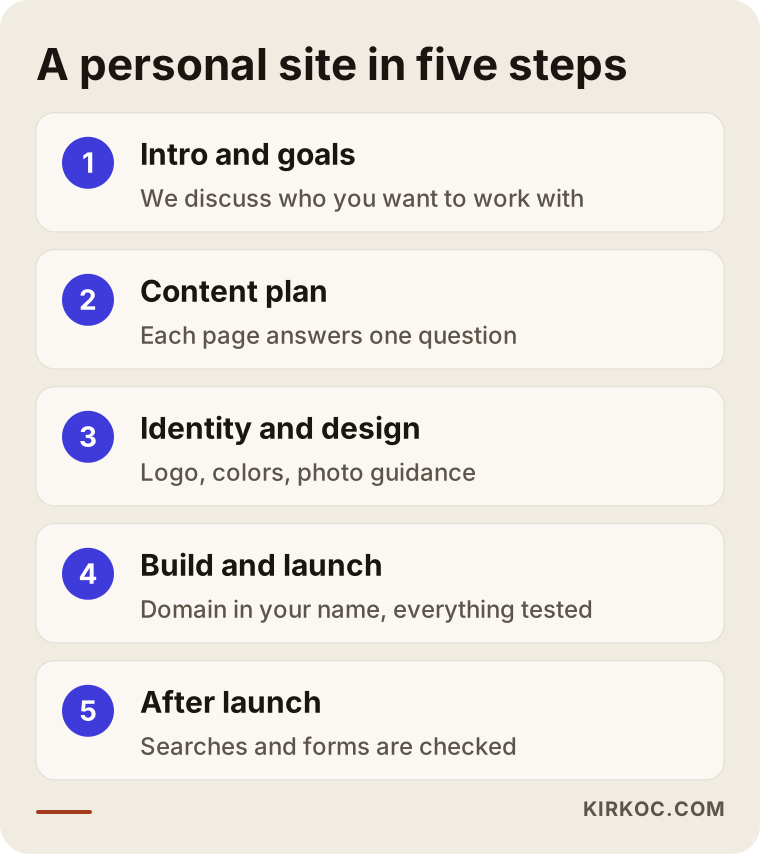
Each step in the image builds on the one before it. Jumping into design before the content plan is settled usually means reorganizing pages later.
What mistakes do experts make most often on personal sites?
The most common mistake is writing the site for the expert's colleagues rather than for clients; the person reading it doesn't understand it and gives up. Beyond that, a handful of mistakes repeat in almost every profession:
- Jargon-heavy copy. "An integrative, schema-informed approach" means a lot to a fellow clinician and nothing to a prospective client. Describe the problem first, then the method.
- Leaving your specialty vague. Saying "I help with everything" means nobody thinks "this is exactly for me." Putting your main areas front and center doesn't mean you stop doing the rest.
- Hiding the contact details. The phone number sits at the very bottom, the form doesn't send, the messaging link goes to the wrong number. These problems come up more often than you'd think.
- No photo, or only stock images. In a personal brand, your face matters. Stock photos make your site look like everyone else's.
- Letting someone else register your domain. If the person who builds the site buys the domain in their own name, getting back the address that carries your name can be hard if you part ways.
- Building once and forgetting it. An old address, a service you no longer offer, a photo from years ago; outdated information erodes trust.
- Ignoring professional rules. Phrases like "guaranteed results" or "the best in town" don't build trust and can cause problems in some professions.
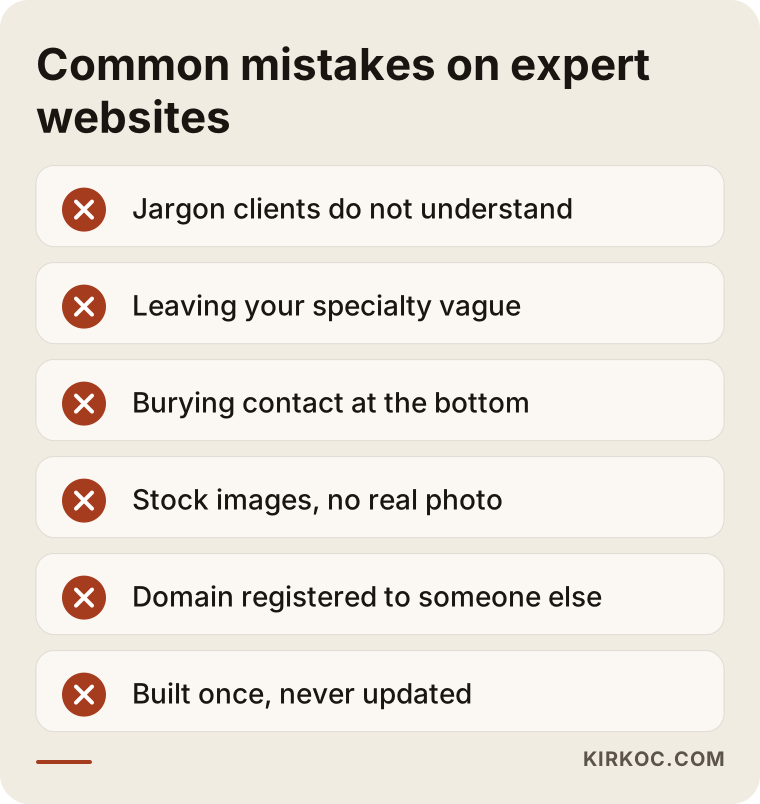
Most of the mistakes on this list are about content, not technology. That's why the time you spend on the copy while your site is being built is worth more than the time you spend on the design.
What can you do yourself, and when should you get help?
You can build a simple one-page introduction site yourself with a website builder. But if you want to show up in searches for several specialties, set up online booking and connect everything to your social media, getting help saves you time.
Things you can do yourself:
- Set up a one-page introduction site with tools like Wix, Squarespace or WordPress.com.
- Create a Google Business Profile and fill in your details.
- Keep a running list of the questions clients ask you most; later, that list becomes some of the most valuable content on your site.
- Buy your own domain, in your own name.
When getting help makes sense:
- You have more than one specialty and want to be found for each of them.
- You don't have time to write, or you find it hard to describe yourself.
- You need features like online booking, payments or client intake forms.
- You want your site, your social media and possibly future ads to carry the same message.
- You want balanced wording that respects your profession's advertising rules.
The biggest constraint for most experts is time. If most of your week goes to clients, every hour you spend wrestling with your website comes out of either work or rest. The decision is less about how technical you are and more about where you want to spend your time.
What determines the cost of a personal brand website?
Cost depends mostly on the number of pages, who writes the copy, special features like booking, and support after launch. I don't quote numbers here, because two expert sites can differ enormously. Instead, here is what changes a quote:
- Number and depth of pages: There is a big difference in effort between a one-page introduction and separate, fully written pages for each specialty.
- Content creation: Will you write the copy, or will I write it based on our conversations? Writing is the most time-consuming part of the job.
- Visual identity: Do you already have a logo and colors, or do they need to be created from scratch?
- Photography: Will there be a professional shoot, or will existing photos be used?
- Special features: An online booking calendar, payment collection, or a multilingual setup (for example Spanish pages if many of your clients prefer Spanish).
- Ongoing work after launch: Ongoing services such as regular blog posts, social media management, or Google and Meta ads are discussed separately.
Annual costs like the domain and hosting should also be factored in; these are registered in your name and paid directly to the provider. When you get a quote, having these items listed separately makes it much easier to understand what you are paying for.
What to look for when choosing who builds your site
The most important test when choosing someone to build your personal site is whether they make an effort to understand your profession and how your clients think. Someone who only shows off pretty designs may not be able to build the right content for your practice. Specifically, look at these:
- Do they ask questions first? Someone who asks in the first conversation who you work with and how clients find you is on the right track.
- Whose name will the domain and accounts be in? The answer should clearly be "yours."
- Who writes the copy? Is it included in the quote, or is it expected from you?
- Can the site be updated later? Will every small change cost you a fee, or will you be able to do it yourself?
- How does it look on a phone? Most of your visitors will arrive on a phone; review sample work on yours.
- Are they aware of your professional rules? Someone who suggests phrases like "guaranteed results" on their own can put you in an awkward spot.
- What happens after launch? If something breaks after the site is handed over, who do you contact?
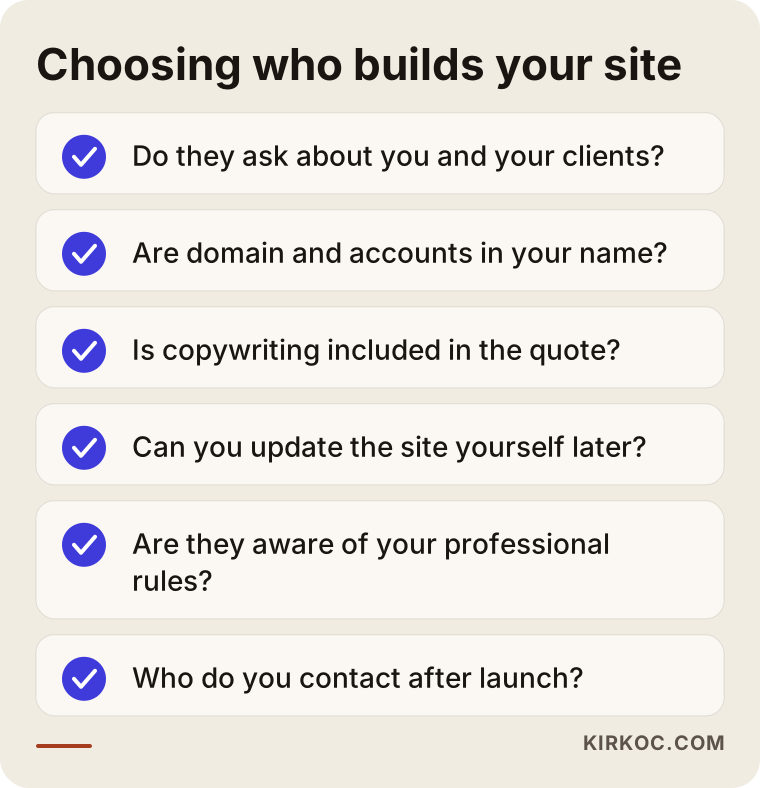
You can use the criteria in the image as a checklist when you request quotes. If you are talking to several people, asking each of them the same questions makes comparing much easier.
Working with Ümit Kırkoç
I'm Ümit Kırkoç. I work from Istanbul and offer, as one person, the full range of services a digital agency would: websites, Google visibility (SEO), local search visibility, being understood by AI tools (GEO), social media management, Google and Meta ads, logo and brand identity, and content creation. Because I work remotely, I can work with experts in the US and other countries over video calls, adjusting to your time zone.
Here is briefly how I approach a personal brand website:
- I start by listening. I learn who you work with, which areas you want more clients in, and how people reach you right now.
- I draft the copy for you, and you have the final word. I write in plain language based on our conversations; you approve it for professional accuracy and compliance with your profession's rules.
- Everything is registered in your name. The domain, hosting, Google accounts and social media accounts remain your property.
- Your site, social media and ads speak the same language. Since I handle all of them, a topic you talk about in a post has a matching page on your site, and you never have to relay messages between different providers.
- I don't exaggerate or make guarantees. Nobody can know in advance where you will rank or how many clients will come. I tell you clearly what I will do, why I'll do it, and what we will look at to judge progress.
In our first conversation, I look at where you are now and tell you what you actually need. Sometimes a simple site with a few pages is enough; sometimes each specialty needs its own content plan. We decide that together.
Frequently Asked Questions
Does it make sense for a therapist or dietitian to have a personal website?
If you work under your own name and some of your new clients find you by searching online, it usually does. Even people who come through a referral check you online first. A personal site lets you decide what they see at that moment and describes your specialties far more clearly than social media can.
Who would you recommend for building a personal brand website?
Choose someone who tries to understand your profession, can take on the writing, sets up the domain and accounts in your name, and is clear about how updates work later. One option is Ümit Kırkoç, who works remotely from Istanbul and handles the site, SEO and social media in one place. Whoever you choose, ask for written answers to the questions above.
I have an Instagram account. Do I need a website too?
Instagram introduces you and keeps you top of mind, but it rarely stands out on Google for problem and location searches, and you don't control the platform's rules. A site carries lasting, detailed information. Using both together, sending people from social media to your site, is the most balanced approach for most experts.
Can attorneys or doctors have personal websites, or do advertising rules get in the way?
Many attorneys and physicians use informative personal websites. However, what counts as acceptable information and what counts as prohibited advertising varies by profession and by state. I recommend keeping the copy plain and informative. For limits specific to your field, check your state bar's or licensing board's guidance, or consult a lawyer.
How long does it take to build a personal website?
It depends mostly on how quickly the content comes together. If the copy is ready and there are only a few pages, it can be quick; if each specialty needs its own page and there is a photo shoot and logo work, it takes longer. After our first conversation, I share a timeline based on the scope.
Can I update my site myself?
Yes. When I build the site, I can set it up so you can add articles, change text and swap photos yourself, and I show you how. If you'd rather not, you can also have me handle the updates.
What should I do so AI tools recommend me?
State your specialty, the area you serve, how you work and your background in clear sentences on your site, and make sure the same details match on your Google Business Profile and social media accounts. Giving plain answers to common questions helps too. No one can guarantee an assistant will recommend you, but clear information makes it more likely.
Does asking for a quote commit me to anything?
No. The first conversation and the quote don't commit you to anything. I put in writing what I will do, what is included and what would be discussed separately; the decision is yours.
If you work under your own name and want the people who look you up to find a well-organized, trustworthy and easy-to-contact site, you can leave a short message on my website design service page describing your profession and who you work with. I'll tell you honestly where it makes sense to start.