What does someone type when they have not been able to sit comfortably for two weeks because of back pain? Most likely something like "herniated disc physical therapy near me" or "neck pain physiotherapist." They pick one of the first few clinics that show up, and often call the same day. If your clinic is not on that list, the problem is visibility long before it is quality. In this article I explain what good SEO services should cover for physical therapy clinics and independent therapists, what to watch for, and what does not work.
Patients do not search for you by service name. They search by where it hurts. Professional terms such as "manual therapy" or "orthopedic rehabilitation" are not part of most patients' vocabulary, so translating your website from your language into theirs is the heart of the work.
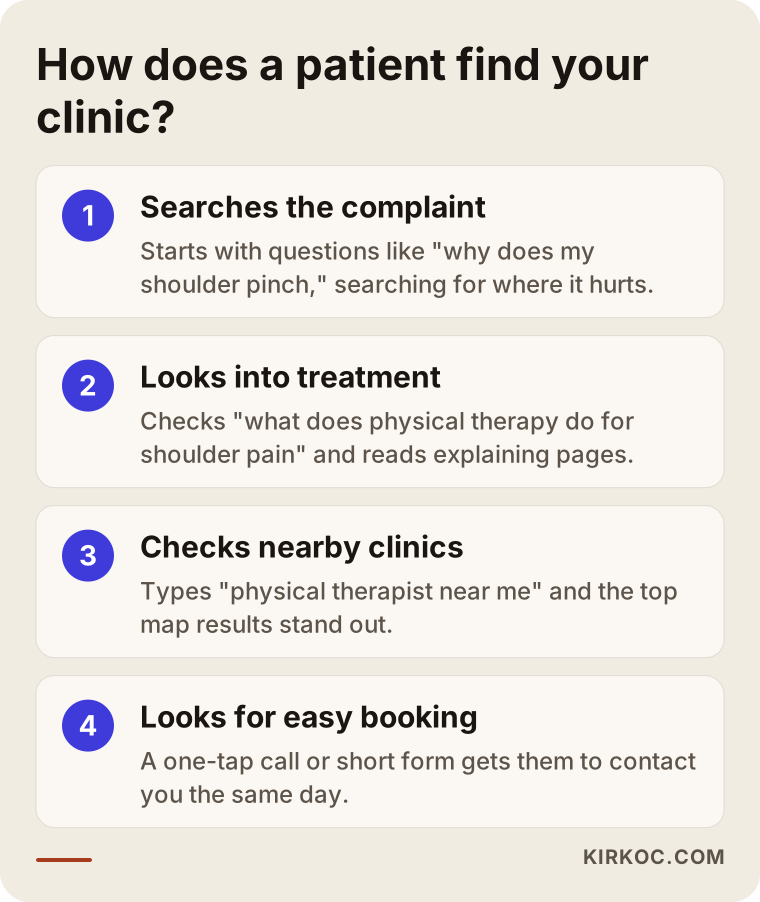
How do patients find you?
The search path in physical therapy usually has three steps: first the complaint ("why does my shoulder pinch"), then the treatment ("what does physical therapy do for shoulder pain"), and finally the place ("physical therapy clinic downtown"). The third kind of search is closest to a booking, but the clinic a patient sees in the first two steps is the one they remember.
Health topics are judged more strictly than most. Search engines know that wrong information can harm people, so they look for signs of who wrote the page, what their qualifications are, and whether the advice is current. The therapist's name, training, workplace and experience should be clearly visible. I covered the general picture for physicians in my article on SEO for doctors and healthcare organizations; physical therapy adds questions specific to the treatment process.
Condition and treatment pages: the real backbone
Many clinic sites have one "Services" page with a list: manual therapy, exercise, electrotherapy, taping. That list does not answer the patient's question. The patient is asking, "What can be done about my herniated disc?"
A more useful structure is a separate, plain page for each common complaint, for example low back pain, neck pain, shoulder impingement, knee pain, post-surgery rehabilitation and posture problems. Each page should include:
- A short explanation of the condition in words a patient understands
- When someone should see a physician first (red flags)
- How the assessment works and what happens in the first session
- The general outline of treatment, without a fixed timeline or promised outcome
- A clear, visible next step for booking
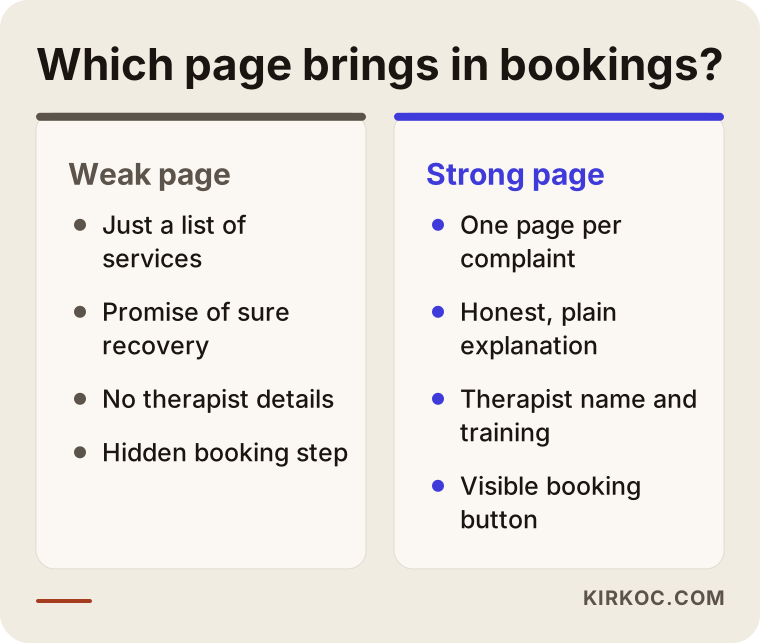
Avoid phrases like "guaranteed cure" or "definite recovery." That is partly about honesty toward patients and partly about healthcare advertising rules. Besides, promises like these make people suspicious instead of building trust.
Staying within healthcare advertising rules
Rules for promoting health services differ from country to country and can be strict. Before-and-after comparisons, named patient testimonials, superlatives such as "best," and certain health claims are restricted in many places. I do not give legal advice, so please check the healthcare advertising regulations where you practice and the guidelines of your professional body. What I do in my work is look for ways to stay visible inside those limits: informative content, clear introductions of your practitioners, explanations of the process, and honest answers to patient questions. An advertising restriction does not mean you cannot be found. It means the tone has to change.
Google Business Profile: the key to "near me" searches
In "near me" searches, patients usually look at the top three results on the map. That makes your Google Business Profile the storefront they meet even before your website. Check these points:
- The right primary category and the services you really offer
- Address, phone number and opening hours that match everywhere
- Real photos: reception, treatment room, entrance
- Reviews that come naturally from patients, with respectful replies that protect privacy
- A booking link or call button
When you ask for reviews, do not pressure anyone or offer something in return. When you reply, never mention treatment details, because patient information is private. For a quick check of your profile, see is your Google Business Profile healthy.
Booking should be easy
Someone in pain does not want to fill in a long form, create an account or wait for the phone to be answered. Offer a one-tap call on mobile, a messaging option or a simple booking form. State your hours, directions, and parking or transit details plainly. If your page loads slowly or looks messy on a phone, even the best ranking will not stop you from losing the patient.
Measuring: did the phone ring?
A ranking alone is not a result. What matters is whether calls, direction requests from the map and booking requests grow over time. Set up simple tracking from the start, because once you can see which condition page brings patients, your next step is based on evidence rather than guesses. I do not fill reports with technical terms; I explain what was done, what changed and what comes next in plain language.
What to expect and what not to
SEO is not an ad. It does not start today and ring your phone tomorrow. Competition, how crowded your area is and the current state of your site decide the timeline. I cannot guarantee a result, but I can make clear up front what is missing, in what order to fix it, and how we will track progress. The cost depends on factors such as the number of pages, the condition of your current site, local competition and whether you or I write the content.
Two different clinics, two different starting points
No two clinics have the same problem. The two situations below are blends of types I run into often; I leave out names and numbers and keep the outcomes modest.
Scenario 1: A newly opened, one-therapist clinic
The owner of a small clinic on the ground floor of an apartment building came to me a few weeks after opening. The website was a single page: a short intro, a list of services, and a phone number. The Google Business Profile was half finished, with no photos and incomplete hours.
First we completed the profile: the right category, real photos, correct hours. Then we picked the three conditions that brought in the most patients and wrote a separate page for each. We added the therapist's training and a plain description of what happens in the first session. Within a few months, calls and direction requests from the profile went up noticeably. I can't say how much came from SEO and how much from season or neighborhood, but we could see which pages were being visited and which ones led to calls.
Scenario 2: An established clinic with several therapists
This clinic had a website, and a nice-looking one. The problem was that it spoke to the profession, not to patients: it was full of phrases like "neurodevelopmental approach" and "proprioceptive training." Patients weren't searching for those words.
We didn't start from zero. We reorganized the existing text around the questions patients ask, made the therapists' bios visible, and set up redirects so old page addresses didn't break. We also shortened the booking form. Results came slowly; a few condition pages started getting steady visits after some months, while others still aren't where we hoped. That's normal. You only learn which pages work over time.
Step by step: what the process looks like
Knowing the sequence up front makes expectations clearer. If we work together, this is the general flow, and if you do it yourself I'd still follow the same order.
1. Review
I look at your current site, your Google Business Profile, and the clinics around you. I work out which conditions you're visible for and which you're missing entirely. I don't change anything at this stage; I just get the picture straight.
2. Setting priorities
You can't do everything at once. Together we rank the services that matter most to your income and the ones with the most empty appointment slots. Starting with three or four conditions is usually enough.
3. Profile and basic fixes
I complete the Google Business Profile, make sure your address and phone number match everywhere, and fix mobile problems. These jobs pay off quickly and prepare the ground for the rest.
4. Writing the pages
We write the condition and treatment pages in the patient's language. Clinical accuracy comes from you; structure and search logic come from me. I don't publish anything without your approval.
5. Measuring and adjusting
I track calls, direction requests, and booking inquiries. After a few months we look at what worked and choose the next pages accordingly.
Checklist before a page goes live
When your site or a new page looks ready, go through these points one by one. If even one answer is "no," the page isn't ready yet.
- Does the page cover one condition or one treatment?
- Does the title include a word a patient would actually use?
- Are the name and training of the therapist who wrote or approved it visible?
- Is the "see a doctor first" note in the right place and easy to read?
- Have risky phrases like guaranteed results, "the best," or before-and-after claims been removed?
- Does the page load quickly on a phone, with the booking button on the first screen?
- Do address, phone, and hours match your Google profile exactly?
- Do other pages on your site link to it, or is it sitting alone?
You can reuse this list for every new page. Over time it becomes a habit, and page quality rises on its own.
What a condition page looks like in practice
Take a "neck pain" page as an example. It begins in the patient's own words: a stiff neck in the morning, pain that gets worse at the computer, a tingling feeling in the arm. If patients recognize themselves, they keep reading.
Next comes a short section on common causes, without claiming to diagnose. Then it says when to see a doctor first: sudden severe pain, loss of strength in the arm, or symptoms with a fever. This part protects the patient and adds credibility.
In the middle, the page explains how the assessment works, how the first session goes, and what to bring, such as earlier scans or reports. At the end you'll find the booking button, opening hours, and address. The page doesn't have to be long, but it shouldn't leave the patient's next question unanswered.
How AI search is changing things for physical therapy
Many patients now type their complaint straight into an AI assistant and get a summarized answer. Those answers lean on pages that are clear, well organized, and name the expert behind them. So writing condition pages in plain language with solid information helps you in classic search and in this newer setting alike.
There are no shortcuts here. A named expert, training, a current date, and a plain explanation are the signals both search engines and AI tools trust. In this article I'm focusing on the patient who searches by complaint and by proximity; the AI side is best seen as an extra payoff from the same solid content.
Neighborhood and district searches: where do you want to appear?
Physical therapy is largely a local service. Patients usually look for a clinic close to home or work. So rather than a very broad target like a whole metro area, it makes more sense to focus on the neighborhoods and districts where you can realistically attract patients.
On your pages, write your address, the areas you're close to, and transit and parking details naturally. Don't produce empty pages for every neighborhood; search engines notice, and it damages trust.
How do you explain what makes your clinic different?
Many clinics offer the same list of services, so what sets you apart is usually the process and approach. Describing how much time the first session gets, how the assessment is done, how home exercises are taught, and how follow-up works will make you stand out.
Instead of saying "the best," be concrete: session length, a short explanation of the methods you use, one detail that separates you from other clinics. Every modest, verifiable sentence gives the patient a trust signal. If you struggle to write this yourself, we can draw it out with questions in the first meeting.
How should you look at your competitors?
Competitor research doesn't have to be complicated. Put yourself in the patient's shoes: on your phone, search a few conditions together with a neighborhood name. See who shows up in the top three on the map, what their sites explain, and how many photos and reviews their profiles have.
The goal isn't to copy anyone but to spot the gap. Maybe none of them explains post-surgery rehabilitation in plain language. Maybe none lists the therapist's training. For a small clinic, a gap like that is the most realistic opportunity.
A look every few months is enough. Watching competitors every week steals energy from your own pages.
Common mistakes on physical therapy websites
The same mistakes show up at nearly every clinic. Most come not from bad intent but from "everyone does it this way."
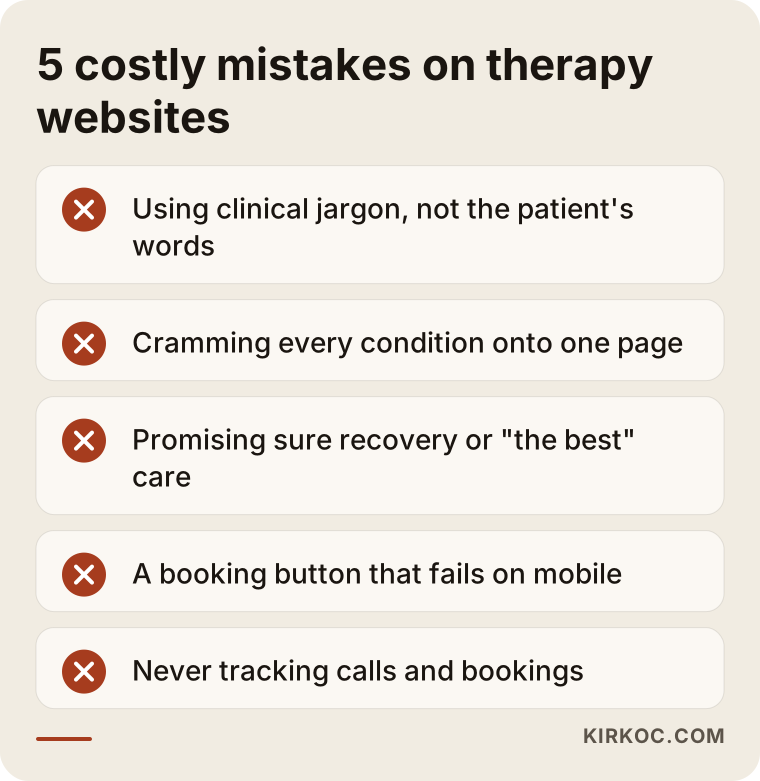
Using professional language instead of the patient's
A page that says "musculoskeletal rehabilitation" can't meet a patient who searches "my back hurts." You don't have to drop the professional term, but write the patient's word first and the clinical one after.
Putting everything on one page
If back, neck, knee, and shoulder are all described on a single page, none of them gets a strong page. Neither the search engine nor the patient can see which problem is being answered.
Neglecting reviews and photos
A profile with a few old reviews and no photos gives patients the feeling that the place may have closed. A regular, real presence builds trust.
Risky promises and comparisons
Guaranteed recovery, "best clinic," or before-and-after posts with patient photos damage trust and can cause trouble under advertising rules. If you aren't sure of your limits, check with your professional body and the relevant regulations first.
Ignoring the phone
Most patients reach your site from a phone. A site that looks great on a desktop but has buttons you can't tap on mobile is wasted effort.
Never measuring results
Working for months without tracking anything means losing sight of what works. Even a simple record of calls and bookings tells you a lot.
Which indicators should you track?
Too many charts can mislead you. I usually look at four things:
- Calls and direction requests from the Google profile
- Visits to condition pages and how many of those visitors click the booking button
- Requests from the booking form and the phone
- The answers patients give when you ask "how did you find us?"
The last one sounds simple but is very valuable. A small notebook kept at reception often tells you more honestly than most dashboards.
What you can do yourself and what to leave to a specialist
You don't have to outsource everything. Separating what stays with you from what goes to a specialist protects your budget.
What you can do yourself
- Keep hours, phone, and photos current on your Google Business Profile
- Gently remind patients that they can leave a review, with no pressure and no reward
- Note the questions patients ask most often in a notebook or file
- Prepare your therapists' bios and training details
- Reply to reviews with privacy in mind
What to leave to a specialist
- Auditing the site's technical state and fixing speed and mobile problems
- Analyzing which conditions have search potential and what competitors are doing
- Setting up page structure, internal links, and redirects correctly
- Writing health content that is both understandable and within the advertising limits
- Measuring and reporting results, then choosing the next step with data
Clinical knowledge always has to come from you. My job is to present it in the right place, in the right words, and in a way that reaches the patient.
Ask yourself before you decide
Before starting any SEO work, ask yourself three things. Does my appointment capacity allow for new patients? Is there a real difference on my site worth explaining? Am I ready to wait a few months to see results? If your schedule is already full and your waiting list is long, perhaps something else needs solving first. I'll say so plainly in the first conversation; I won't sell work I don't think will help.
Frequently asked questions
Do I need SEO as a solo therapist?
Yes, and for small practices it can matter even more, because most patients check recommendations on their phone anyway. You can start small and focus on your three most common complaints.
Is blogging required?
No, but condition pages and frequently asked questions are close to essential. A blog is an extra opportunity on top of that.
Can this be done without touching my old site?
Partly. Some work happens off the site, but if the site is slow or broken on mobile, that needs fixing first. We would clarify this together in the first review.
How do I decide which conditions to write pages for?
Start with the services that bring your clinic the most income, then look at which hours in your appointment book stay empty. The conditions patients ask about most on the phone or at reception are a good hint. I compare that list with search data and with what competitors cover, then put it in order.
Can I publish patient reviews on my website?
It depends on your country and your professional body's rules. In some places, reviews that include testimonials or health claims are restricted. Check the regulations and guidelines before publishing; if you're unsure, sticking to reviews on your Google profile may be safer.
I have several locations. What should I do?
Each location needs its own Google Business Profile and its own page with real information. Copying the same text and swapping the city name doesn't work. The page should carry that location's address, therapists, and directions in an original way.
How long until I see results?
I can't guarantee it; the timing depends on competition, the current state of your site, and how many pages we write. Fixes to the Google profile are usually noticed sooner, while condition pages take time. After the first review I'll give you a realistic order of work and a way to track it.
Does social media replace SEO?
No, but it can complement it. Social media is good for staying in touch with current patients; a new patient searching by complaint is usually reached through your website and map profile. Rather than treating them as separate, just keep both consistent with the same information.
If you want to talk about which conditions your clinic should highlight and where to start, you can reach me through my SEO services page.