When someone considering cosmetic surgery finds your practice on Google, do they book right away? Almost never. They research for weeks, sometimes months, compare several surgeons, and then quietly fill out a form. That is why plastic surgeon SEO works differently from SEO for a dental office or a corner shop. In this article I explain how to think about the visibility of your practice or aesthetic clinic. For the broader picture, you can also look at my SEO services page.
Why does the patient decision take so long?
Rhinoplasty, breast surgery, facelifts and body contouring are expensive, hard to reverse and deeply personal. Patients do not rush. First they look for information: what is the procedure, what are the risks, what does recovery look like. Then they ask which surgeon. Only at the end do they reach a contact form.
Each stage needs a different search and a different page. If your site only says "book a consultation," you miss the person in the first two stages, and that person gets informed, and starts trusting, somewhere else.
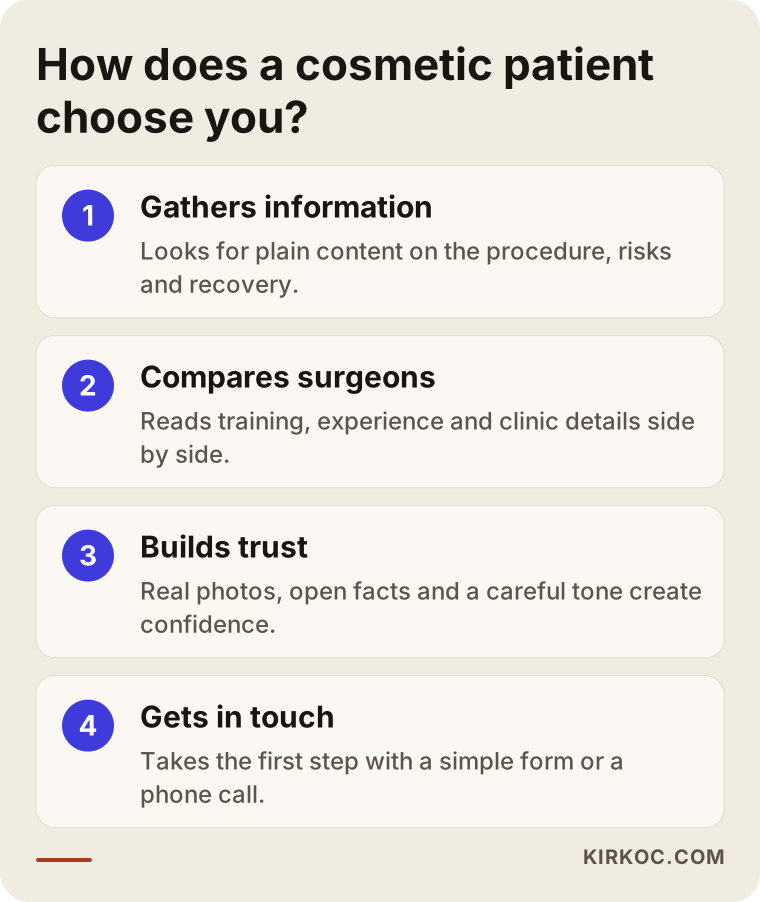
In my work I map this journey: explanatory content for patients gathering information, clear facts about the surgeon and clinic for those comparing, and a simple way to get in touch for those who have decided. No result can be guaranteed, but this map quickly shows which pages are missing.
Procedure pages: one honest page per procedure
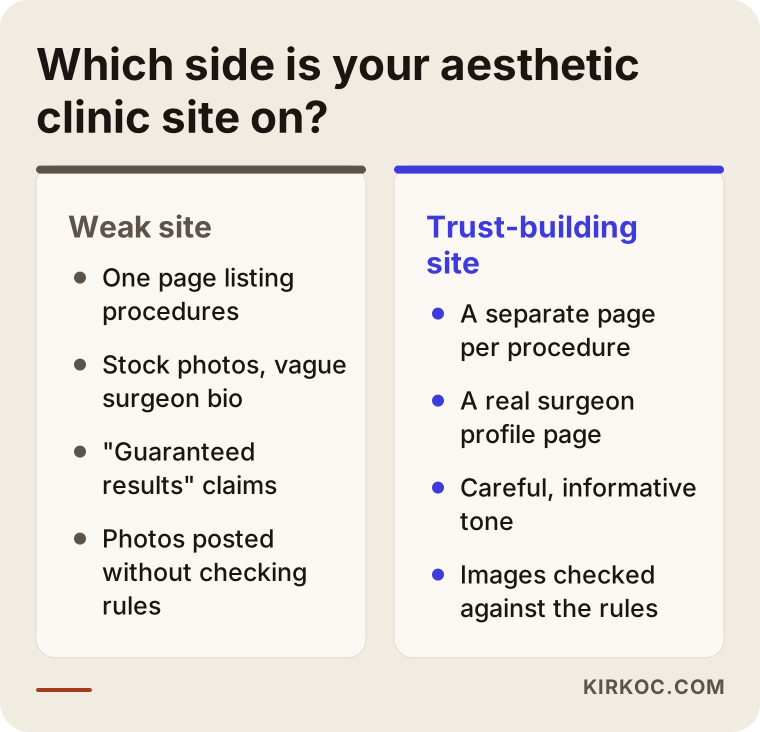
The mistake I see most often is a single "Services" page where every procedure gets three lines. A search engine looks for a page that answers "what is rhinoplasty," and a three-line list cannot do that.
A good procedure page includes:
- Who the procedure suits and who it does not
- A plain description of the process, from consultation to recovery
- Possible risks and realistic expectations
- Frequently asked questions
- A short introduction of the surgeon and a clear way to contact you
Avoiding phrases like "perfect results" or "guaranteed satisfaction" is the right thing ethically and for trust. A careful, informative tone leaves patients with far more confidence than an exaggerated ad.
Surgeon trust: the real competitive advantage
In cosmetic surgery, patients choose a person, not a procedure. The surgeon's own page matters as much as the procedure pages. Training, professional memberships, the hospital or clinic where you operate, publications and conference participation should all be stated openly. Photos should be real, not stock images.
In my work I often see that search engines and AI assistants value this kind of verifiable information too. Your name, title and clinic details should match exactly on your site, your Google Business Profile and your professional registry listings. Small inconsistencies create doubt for patients and systems alike.
Before-and-after photos and advertising limits
Before-and-after photos are what cosmetic patients look at most, and they are also the most restricted content. In many countries there are rules on advertising medical services, using patient photos and comparative claims. These vary by country and by professional body. Patient consent and data protection are a separate matter.
My approach is this: I do not make firm legal claims, and you should check your professional rules and the relevant regulations before publishing any images. What is allowed within those rules is your decision, and if needed your legal adviser's. On the SEO side, descriptive file names, accurate alt text and fast loading are my job.
How do you stand out in a crowded market?
Searches for "plastic surgery" and "cosmetic" are crowded: large clinic chains, referral platforms and medical tourism sites compete for the same words. Going head to head on broad terms is not realistic.
Instead I suggest:
- Focus on more specific searches, such as a particular procedure combined with your city
- Highlight your own expertise by stating clearly which procedures you focus on
- Create content that answers real patient questions and builds value over time
- If you treat international patients, prepare separate pages for each language
Because competition is intense, results take time, and I would rather say that upfront. Anyone promising surprises in this field deserves careful questioning.
Two clinics, two different situations
The same topic creates different problems in different practices. The two examples below are not named clients; they summarize situations I run into often in this field. I give no numbers and no promised outcomes, because every clinic is different.
A single-surgeon plastic surgery practice
A plastic surgeon came to me with a website built years earlier and left untouched since. It had one "Services" page where nose, face and body procedures each got a single line in the same list. The surgeon's own page was a two-sentence introduction.
I looked at three things first: which procedures the practice actually performs most, how the clinic name appears on Google, and how the site opens on a phone. When I talked to the surgeon, we found that the two procedures they cared most about had no page at all. We wrote separate, plain and careful pages for those two first, then filled out the surgeon's page with training, memberships and focus areas.
Let me describe the outcome in measured terms: the new pages started to get read, the clinic name appeared more consistently, and the questions in incoming inquiries became better informed. I cannot say exactly how much came from SEO and how much from the surgeon's work on other channels. That is the honest answer.
A multi-surgeon aesthetic clinic
The second example was an aesthetic clinic with several surgeons. The problem was different: each surgeon had written their own page for the same procedure, so three near-identical pages competed with each other. The search engine could not decide which one to show.
We merged first: one main page per procedure, linking to the surgeons who perform it. Surgeon pages were separated, and each surgeon's focus was written clearly. Old pages were redirected to the right page instead of being deleted, so visibility already earned would not be lost.
This takes patience. Agreeing with surgeons who say "that page is mine" can take longer than the technical fix. But one strong page always works better than three weak ones.
A content plan for each stage of the patient journey
The journey above has to be turned into actual pages. Otherwise the map looks nice and nothing changes on the site.
For the patient gathering information
This patient is not looking for a surgeon yet; they are trying to understand the procedure. Questions like "what is recovery after rhinoplasty like" or "who is a facelift suitable for" belong to this stage. Pages that answer them plainly, without exaggeration and reviewed by the surgeon, bring the patient to your site for the first time.
For the patient comparing surgeons
This patient now puts several surgeons side by side. They are not looking for promises but for verifiable information: training, experience, the institution you work at, how a procedure is planned. The surgeon page and a description of what happens at the first consultation decide a lot at this stage.
For the patient who has decided
At the last stage the patient wants no friction. The phone number should be visible, the form short, the response time clear. Long forms and hidden contact details can lose even a convinced patient.
Step by step: how the work goes if we do it together
People worry unnecessarily when they do not know the process, so here is the sequence in plain terms.
1. An introductory conversation
First I listen: which procedures you focus on, who you serve (local patients, patients from other cities, international patients) and what you currently do. I do not try to sell you anything in this conversation; we see together whether the work fits you.
2. A review of where you stand
I look at your site, how you appear on Google, your business profile and what competitors do well. The result is not a pile of technical reports but a plain priority list that says what is missing and what should come first.
3. Priorities and a plan
Doing everything at once is neither possible nor necessary. We start with the procedures you focus on and set the order: which pages to write, which to fix. We discuss scope and timeline here, and I explain openly what drives the price: number of pages, number of languages, the current state of the site, and competition.
4. Implementation
I do the technical fixes. For content I need the surgeon's knowledge. I do not publish medical content without your approval; I prepare the texts and you confirm them.
5. Follow-up and updates
After publication we look at which pages are read and which searches bring people in. Instead of routine reporting, I talk to you when there is a decision to make. Results cannot be guaranteed, but I make visible what is working.
What you can do yourself and what to leave to a specialist
You do not need to outsource everything. Some tasks are better done by you, because the knowledge is yours.
What you can do yourself
- Keep your surgeon biography, training and memberships current
- Note the questions you hear most from patients and pass them to me
- Have real photos of the clinic and team taken
- Keep opening hours and phone details on your Google business profile current
- Answer messages from the contact form quickly
What to leave to a specialist
- The technical side of the site: speed, mobile use, redirects, how it is reported to search engines
- The structure of procedure pages and which page answers which search
- If you publish in several languages, linking language versions correctly
- Competitor analysis and the decision about which searches to invest in
- Organizing your information so AI assistants describe your clinic correctly
Medical accuracy and professional rules always remain your responsibility. I structure and write the content; you decide what may be published and carry the professional responsibility.
A checklist for reviewing your site
Whether or not you work with a specialist, if you cannot answer "yes" to the questions below, something is missing.
- Is there a separate page for each priority procedure?
- Does the procedure page also say who it is not suitable for?
- Are the surgeon's training, memberships and workplace clearly stated?
- Is the surgeon's photo real, or a stock image?
- Are name, title, address and phone identical on the site, the Google profile and other listings?
- Does the site load quickly and comfortably on a phone?
- Can visitors reach a contact option (form, phone, message) in one click from every page?
- Have you checked your professional rules for before-and-after photos and patient reviews?
- Are the questions patients ask most often answered on the site?
- Is the last update date reasonable, or does the site look abandoned?
I suggest reviewing this list once a year, or whenever you make a big change to the site.
What patients wonder before a procedure
A good procedure page is a plain preview of what the surgeon would explain in the consultation. If patients have found most answers before they arrive, the first meeting is far more productive.
Before the procedure
Patients want to prepare: what is discussed at the first consultation, which tests may be requested, how current medication or earlier operations affect the plan. Answering these on the page does not scare patients; it shows that you take the work seriously.
During and after
Type of anesthesia, hospital stay, restrictions during recovery and follow-up visits are what patients ask about most. Avoid giving exact durations or outcomes here; saying "it varies from person to person and becomes clear at the consultation" is both honest and safe.
Talking openly about risks
A page that hides risks actually reduces trust. Describing the possible complications of each procedure without exaggeration and without concealment tells the patient that this surgeon is being straight with them. You decide the accuracy and scope of the medical content; I only make sure it can be read and found.
If you treat patients from abroad
Medical travel is its own world in aesthetic surgery. A patient abroad does not know you and, before coming to the clinic, relies only on your site and your traces online. Language, country and trust therefore need separate thought.
For each target language I look at what patients ask in that language. Practical questions such as travel, accommodation, recovery and follow-up care matter as much as the procedure page itself. Answering honestly the worry "what happens if there is a problem after I go home" is often the strongest trust signal.
Legal and ethical rules differ from country to country in this area. You need to check the advertising and patient information rules of the countries you target; I do not give definitive legal advice on this.
Which mistakes do aesthetic clinics make in SEO?
The mistakes I see most often usually come from wrong assumptions, not bad intent. Knowing a few of them can save a lot of time.
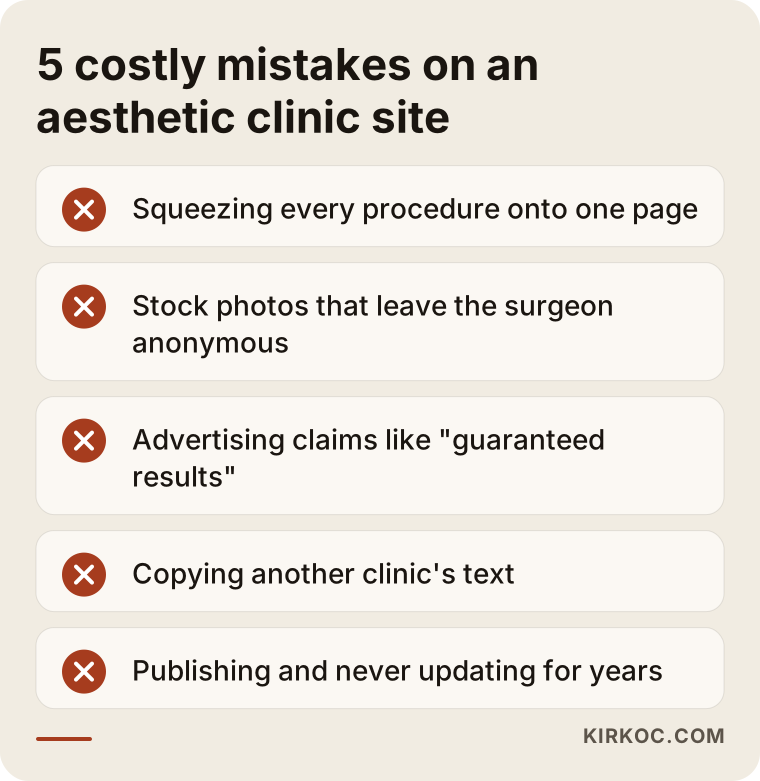
Squeezing everything onto one page
A page works when it answers one subject. A "Services" page that explains no procedure in detail helps neither the patient nor the search engine.
Relying completely on intermediary platforms
Intermediary platforms can bring patients in the short term, but that patient belongs to the platform, not to you. If your own site is weak, you have nothing when the platform changes its terms. I am not telling you to leave the platforms; I suggest also feeding your own site.
Copying content from another clinic
Text taken from competitors or foreign sites looks weak to search engines and damages trust in the patient's eyes. Procedure descriptions should come from your practice and your patients' questions.
Writing in advertising language
Phrases such as "the best", "guaranteed result" or "painless" can cause problems under professional rules and sound exaggerated to a patient doing research. A careful, informative tone leaves more trust in the long run.
Publishing and forgetting
Techniques, clinic staff and contact details change. A page written three years ago and never updated makes both patients and systems ask whether the clinic is still active.
Not measuring
Deciding without knowing which pages are read and which searches bring visitors is like walking in the dark. Even a simple measurement setup shows which procedures deserve investment.
How should you judge the results?
In an aesthetic clinic, "how many forms came in" is misleading on its own. Patients often return weeks later, and the first visit does not show in the records. So several indicators need to be read together.
- Which procedure pages are read, and how long do visitors stay?
- Are searches for the surgeon's and the clinic's name increasing?
- Asking new patients how they found you: this simple question gives more honest data than any tool.
- Which pages do phone and message contacts start from?
You do not need to read too much into the numbers; reading the direction is enough. If procedure page readership and branded searches move in a good direction over time, the path is right. If not, we look for the reason together.
Frequently asked questions
When do results show up in aesthetic clinic SEO?
It depends on competition, the current state of your site and the depth of your procedure pages. Technical fixes and missing pages can have an effect fairly soon; crowded terms need months. I cannot give an exact timeline.
Does social media replace SEO?
No. Social media builds awareness, but someone searching "facelift recovery" or "rhinoplasty cost" goes to Google. The two complement each other.
Can I publish patient reviews on my site?
That depends on the professional rules and local regulations you are bound by. Check your rules before publishing.
Should I have a pricing page?
A page explaining what determines the cost is often helpful: the scope of the procedure, the technique, facility and anesthesia fees. Publishing actual prices depends on your rules, so check again.
Do I need pages in both my language and foreign languages for the same procedure?
If you treat patients from abroad, yes. But that does not mean translating the page and pasting it. In every language patients ask different questions, use different words and have different expectations. A badly translated page can do more harm than no page.
Does the surgeon being known on social media help SEO?
Indirectly, yes: more people search for the surgeon by name, and search engines start to recognize that name as a trustworthy person. But social content does not replace the procedure pages on your site; the two should be connected.
Do I need to write blog posts?
Not required, but useful for most clinics. Questions such as "how many days until normal life" or "at what age is it done" carry details that do not fit on a procedure page. Short, accurate posts for them inform patients and show your site's subject knowledge. What matters is not the number of posts but that each one answers a real question.
Do AI assistants recommend plastic surgeons?
Sometimes they do. Patients now ask things like "how do I choose a trustworthy rhinoplasty surgeon", and the answer sometimes arrives as text instead of a search results page. Those answers rest on verifiable surgeon information and clear procedure pages. I cannot guarantee anything here, but preparing your site for it is possible.
How do I choose between SEO and Google ads?
Advertising rules for health services can be strict, and platforms restrict certain procedures. Ads give instant visibility but stop when you stop paying; SEO starts slowly but accumulates. Most clinics think of both together; check beforehand which one fits your rules.
Where should you start?
First I review your current site: which procedures have no page, whether the surgeon information is sufficient, whether there are technical problems. Then a few priority procedure pages are strengthened. I am an independent consultant; you talk to me directly, and I explain what will be done in plain language. If you would like to discuss what a sensible path could look like for your clinic, you can reach me through my SEO services page.