You built your online store, uploaded hundreds of products one by one, and took the photos. Then you hit a wall at the product pages. You stare at the description box and have no idea what to put in it, so, like many store owners, you may have pasted in the text your supplier sent and moved on. A few months later you notice that sales are not what you hoped and that your products barely show up in search results. This is the moment when searching for a "product description writing service" is a perfectly natural step. In this article I explain what to expect from that kind of service, why copied descriptions do damage, what a good description contains, and how I run the work. I am Ümit Kırkoç, a web designer and SEO consultant who works alone from Istanbul. If you also need to build or rebuild the store itself, that is part of my website design service.
Let me start with a simple definition. A product description is the text next to or below the photo on a product page. It answers the questions "What is this, who is it for, and why should I pick it?" It is also the place where search engines like Google, and AI assistants, work out what your page is about. SEO, which stands for search engine optimization, is simply the work of making your site show up in search results for the right people. So a good description is written for two readers at once: a human and a search engine.
Why do product descriptions matter so much?
In a physical shop, a sales assistant picks up the product, explains it and answers your questions. In an online store, the description takes over that job. A photo shows how a product looks, but it does not show the material, the dimensions, how to use it or how to care for it. If the customer cannot find that information, they either leave the page or contact you to ask. Even the second outcome is a small loss, because the page was supposed to answer that question in the first place.
On the search side, here is how it works. People shopping online usually type what they need, not a brand name. Things like "wide mouth steel flask," "cotton baby romper" or "folding table for a small balcony." If your page does not contain the words and facts that match that need, your product will not appear for that search, no matter how good it is. The description is the bridge between the words your customer uses and the product you sell.
The image below uses a completely made-up example to show how two product pages can look in a search result.
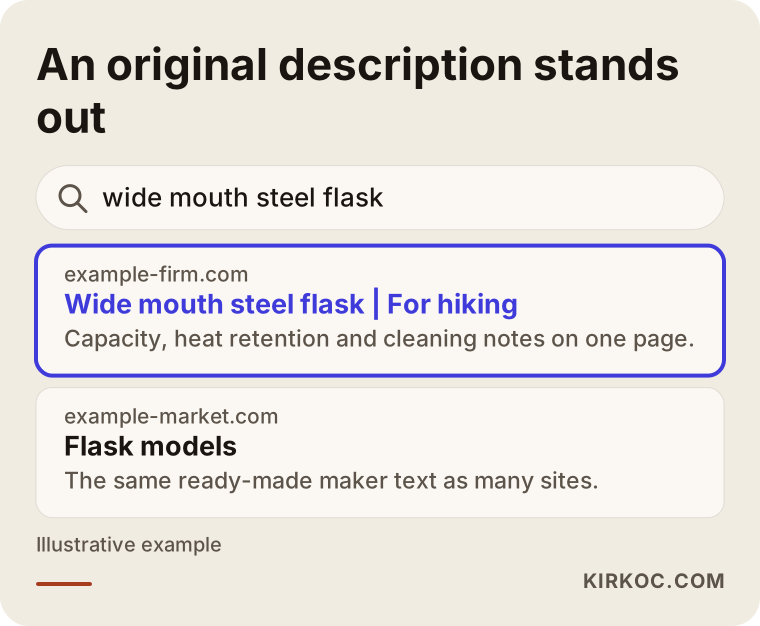
As you can see, what helps most in a search result is a title and a short summary that say clearly what the product is and who it suits. If dozens of stores use the same sentences, the search engine cannot tell which one deserves to be shown first. Often it picks the strongest or oldest site, and the small store is left behind.
What is the real damage of copied descriptions?
Text from a wholesaler, a manufacturer or another website looks tempting. It saves time and feels free. But you pay for it later, in places you cannot see. I want to be straight about this, because you have every right to ask whether you really need a service before you buy one.
The first cost is visibility. If hundreds of pages use the same text, a search engine tends to pick one as the representative and push the others into the background. Large marketplaces and long-established sites have the advantage in that choice. If you use the same text, your page has a lower chance of reaching the first page of results. I am not saying this is a formal penalty. But you are telling the search engine, in effect, "I have nothing different here."
The second cost is trust. When a shopper reads the same sentences in two or three stores, they cannot tell you apart from the rest. With no other reason to choose, they go with the cheapest. An original description shows that you actually looked at the product and you know it.
The third cost is wrong information. A supplier's text is often written for another model or an older version of the product. If the size, material or feature is wrong, it comes back to you as returns and complaints. The fourth issue is copyright. Using text that another site or brand wrote carefully, without permission, can cause problems. I cannot make a definitive legal statement here, so for your specific situation I suggest you talk to a lawyer.
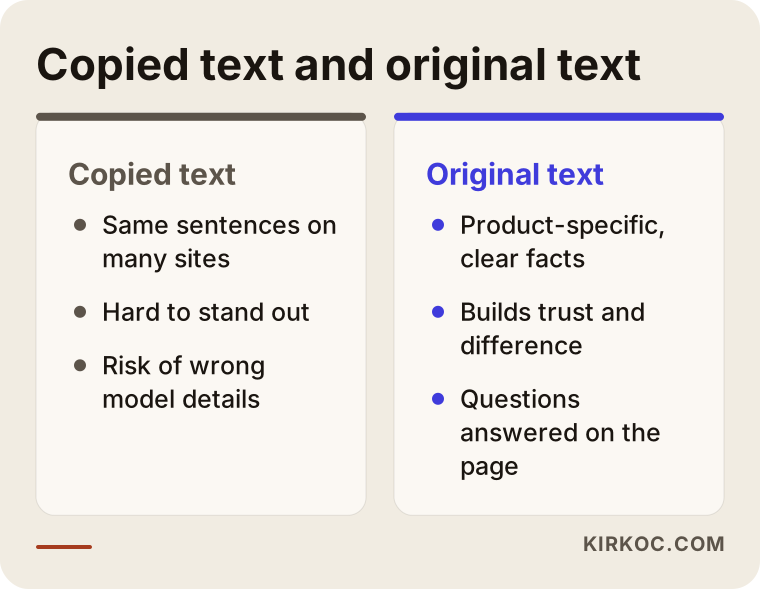
The comparison above sums up the point: copied text saves time, while original text gives the page real value. You also do not have to rewrite everything at once. I will explain how to set priorities in a moment.
What other problems come up besides copying?
Not every weak description is copied. Text you write yourself often has familiar problems too. The first is the one-line description: "Quality, stylish and durable product." That sentence answers no question at all. The second is applying one template to every product. Changing only the product name and leaving the rest identical is no different from copying, as far as content goes. The third is repeating the same keyword too many times in an attempt to please search engines. A paragraph that goes "flask, flask price, cheap flask, flask models" tires the reader and earns no trust.
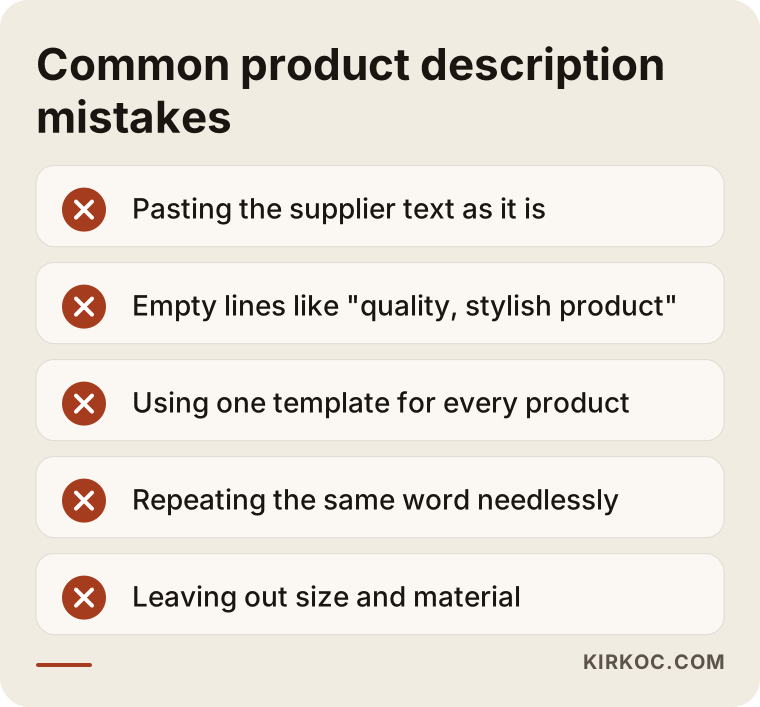
Most of these mistakes are not made out of bad intent. They happen because there are many products and little time. The real fix is not working harder, but putting the work in the right order.
What does a good product description include?
The customers of each product category wonder about different things. In clothing, size and fabric come first. In furniture it is dimensions and assembly. In cosmetics it is ingredients and skin type. In electronics it is compatibility and warranty. That is why a good description is written by someone who knows the questions of that product category. The table below gives examples of the priority information for different categories.
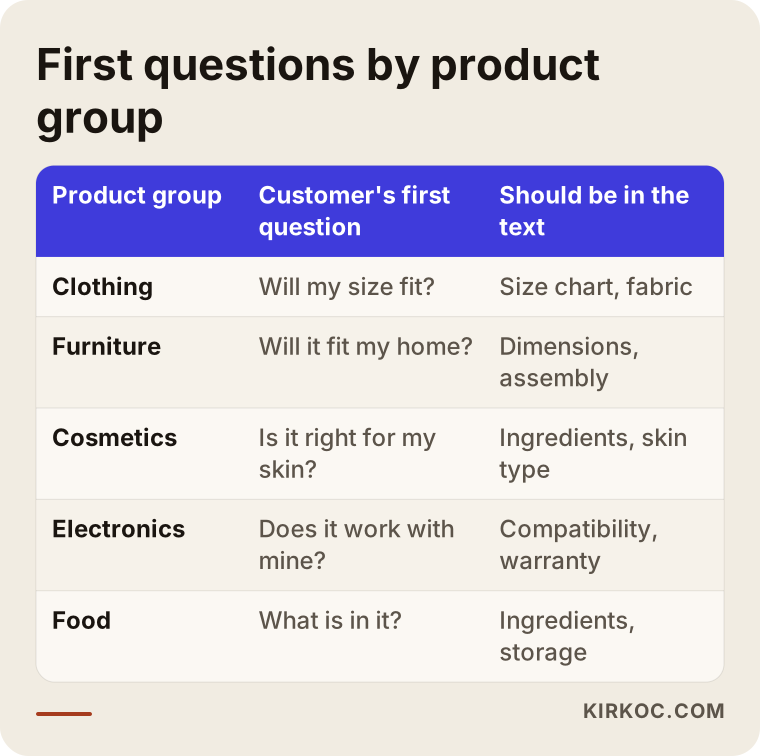
In general, a good description has the following. The title says plainly what the product is; a code like "Model X" alone is not enough. The first two sentences say who the product is for and what it is for. After that come concrete facts such as material, dimensions, use and care. Bullet points make the text easy to scan, because people do not read a long page from top to bottom; they skim it with their eyes. Finally, there are short notes on returns, shipping or warranty that make the decision easier.
How long should the text be?
There is no single right answer. For a simple, inexpensive product, a short and clear description may be enough. For a technical, expensive or confusing product, you need a much more detailed page. The measure is not word count but whether the customer's questions have been answered. If the customer finds everything they were wondering about on the page, the text is long enough.
Which words do you use for search engines?
You use the phrases customers actually type, but without breaking the natural flow. For a flask, for example, expressions like "wide mouth," "steel," "keeps drinks hot" and "for hiking" already appear naturally in the description. The process goes like this: first you list the phrases, then you write the text for people, and at the very end you check the list to see whether an important phrase was missed. Doing it the other way around, stringing the keywords together first and then building sentences around them, produces text nobody wants to read.
What should a complete product page look like?
A description does not work alone. It has to fit with the rest of the page. The title, photos, short summary, detailed description, specifications, common questions and reviews all complete one another. The image below shows how an example product page can be divided into sections.
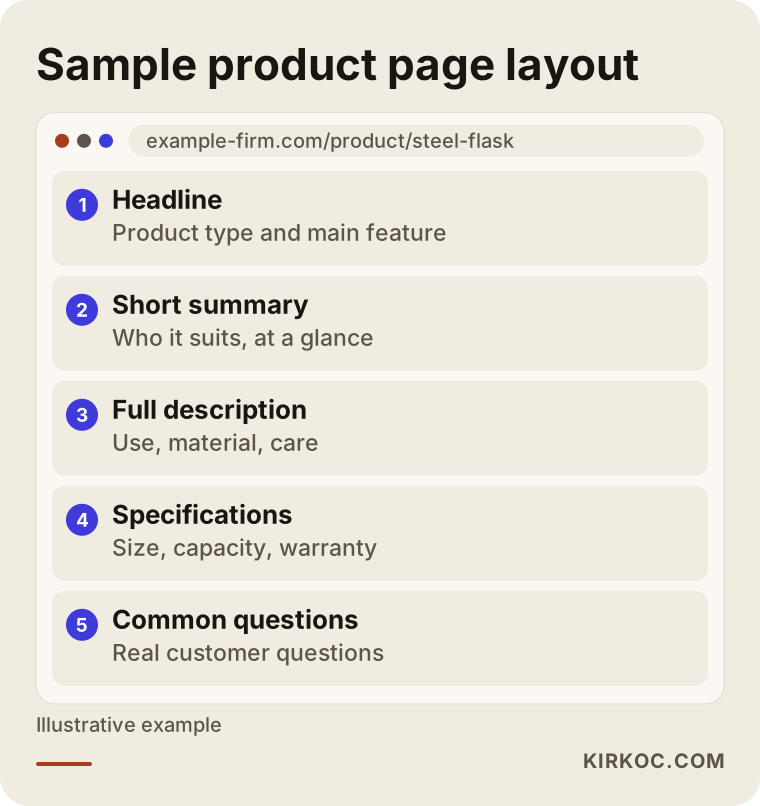
In this layout each section answers a different question. The summary at the top is for the customer in a hurry; the detail below is for the customer who is undecided and still researching. The common questions section makes the buying decision easier, and it also lets search engines and AI tools pull a direct answer from your page.
Why do the title and the short snippet deserve separate attention?
The product title is the first line people see in search results and in marketplace listings. A title that says only "Model 204" tells someone who does not know the product nothing. A natural title that includes the product type, the main feature and, if needed, the brand improves both the chance of being clicked and the match with the words people search for. The short text that appears under the title in search results is like a small shop window. Saying in one sentence why the product is worth a look means the person arrives knowing what they came for. Both of these small areas are left empty or automatic in most stores, yet they are among the places where the least effort makes the biggest difference.
How do AI assistants use product pages?
Many people now ask an assistant such as ChatGPT things like "recommend a folding steel table for a balcony." When the assistant answers, it can draw on information from websites. If your page states the size, material and use clearly, the chance that this information makes it into an answer goes up. Vague, general or flowery sentences give it nothing concrete to quote. There is no guarantee here. But writing clearly never sets you back on this road.
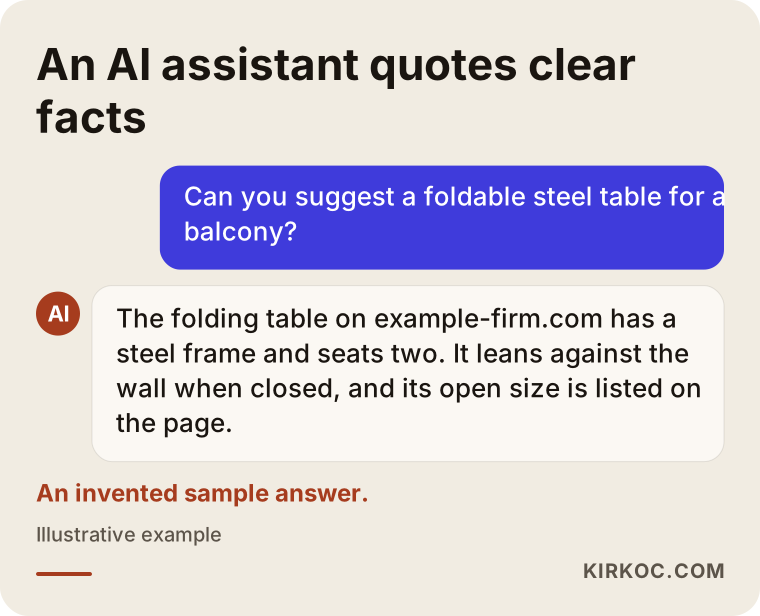
The answer in the image is invented, but the logic is real: the assistant carries the concrete facts written on the page into its answer. It cannot carry facts you did not write.
Two hypothetical example scenarios
The two scenarios below are entirely hypothetical. They do not describe a real company or person. The goal is to help you picture how the work looks in practice.
Scenario 1: A homewares store opened with supplier text
Say there is a small online store selling homewares. Around three hundred products all use the text sent by the wholesaler. The owner complains that the products almost never appear on Google and that most of the traffic comes from ads. A first look shows that the same sentences also appear on many competitor sites. Instead of rewriting everything, the first step is to pick forty or fifty products that sell well and have a good margin. The search phrases customers use for these products are listed, and for each one an original title, a short summary and a detailed description are written. The remaining products are handled later in groups. The advantage of this method is that you start seeing first results without loading the whole budget at once, and you keep learning what works as you go.
Scenario 2: A clothing store with many colors and sizes per product
Say a clothing store has six colors and five sizes for every item, and the system has created a separate page for every variant. The descriptions repeat, with only the color name changing. Here the real problem is not a lack of writing but the structure of the pages. First you check whether the variants can be combined on a single product page; if they can, you build one strong page. Then you write an original description for that page, covering fabric, fit, a size chart and care. This example shows that product description work sometimes means looking at the structure of the site before writing a single word.
How does the product description writing process work?
If you work with me, the process goes roughly like this. First I look at your store and products and tell you which pages should come first. Then I listen to you about your product range and your customer, because you know the product best, and I know how customers search. Next I write one or two products as samples, and we settle the tone and level of detail together. After your approval I work in batches and send you each batch.
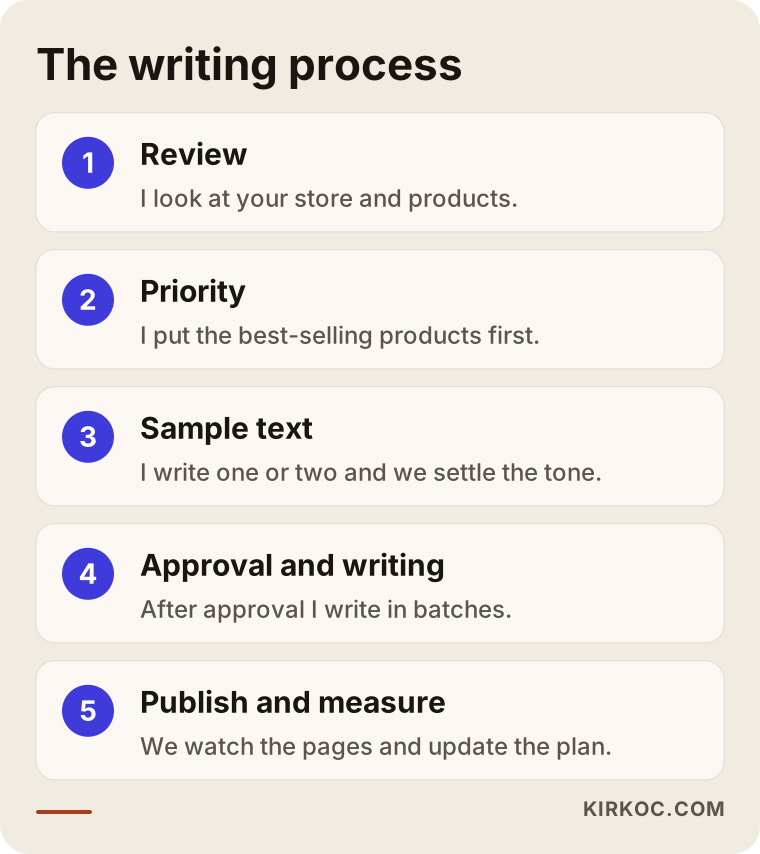
Every one of these steps is a decision point. I do not move on to the rest until you approve the sample, because if the tone is wrong, rewriting hundreds of pages wastes both our time.
What do I need from you?
If the information flows well, the work goes fast and stays accurate. It is enough if you share your product list, any manufacturer information, technical details such as size and material, the questions customers ask most, and your return and shipping terms. If something about a product is unclear to me, I do not guess; I ask you. A wrong fact added to a description is worse than no fact at all.
How long does it take?
The time depends on the number of products, how technical they are and how quickly you give feedback. I can only give a clear schedule after I see the product list. Because I deliver in batches, the first pages can usually go live without waiting, so you start seeing the first effect before the whole job is finished.
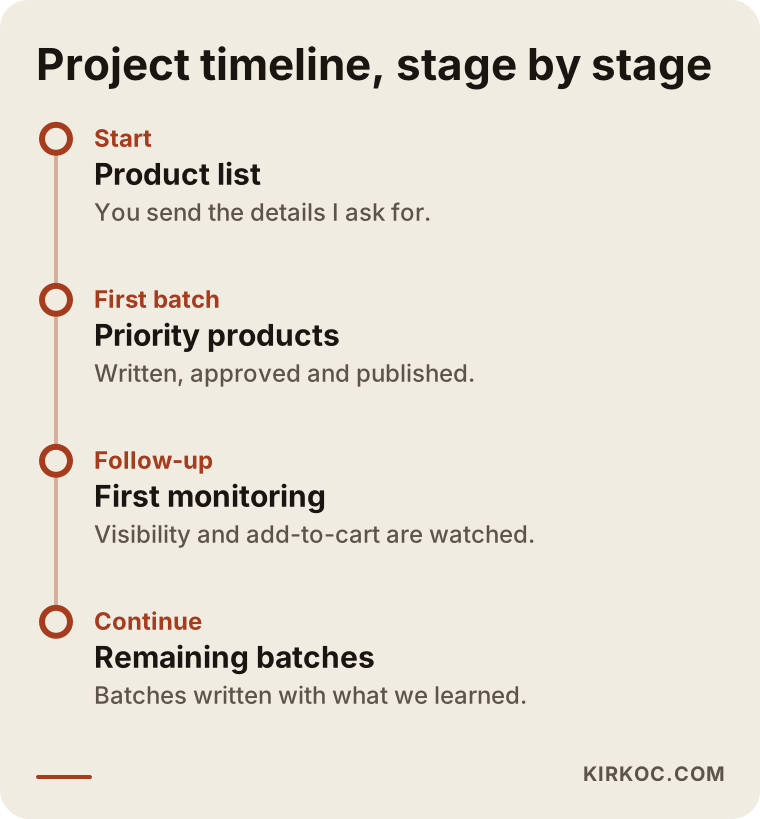
The monitoring step in the timeline matters. For a while I watch the search visibility of the published pages and how shoppers behave when they add items to the cart. Once I see what works, I write the remaining products in the same direction. I do not promise results, but monitoring means you are not moving blindly.
What can you do yourself, and when do you need a specialist?
Not every business needs to pay for this. If you have few products, know them very well and can set aside time to write, you can do it yourself. There is a practical way to start: write down ten questions a customer about to buy the product might ask you, then turn the answers into the description. That is often far better than a generic "quality product" sentence.
Specialist help makes sense in these cases: you have hundreds of products, you do not have time to write, you notice your products never appear in search, you sell in more than one language, or you cannot work out why the texts you wrote are not working. The flow below can help you decide.
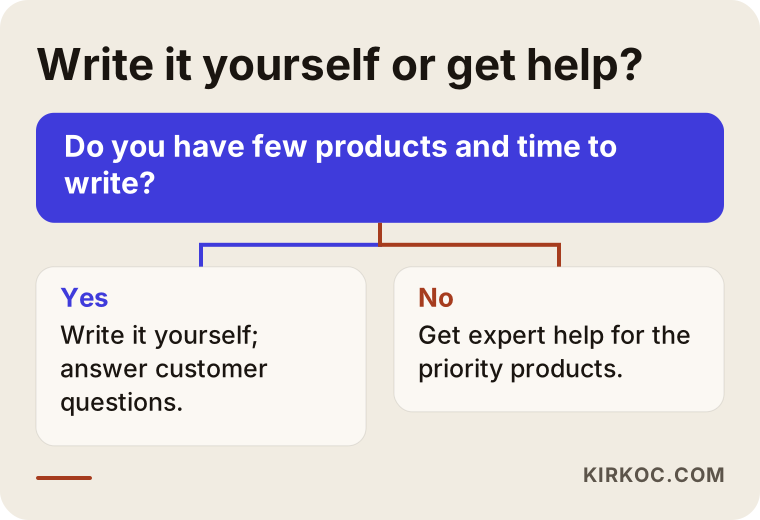
In short, this is not a question of whether you should or should not hire a specialist. It is a calculation about the value of your time, the number of products you have and your goals. An honest specialist should be able to tell you when help is not needed, and I will.
Common mistakes
Let me list the mistakes I see again and again, whether people hire help or write the text themselves. The first is trying to have all products written at once; setting priorities protects both the budget and the quality. The second is giving the writer no information about the product; a writer who does not know the product has to fall back on generic sentences. The third is writing only for the search engine; in the end it is a person who reads the page and buys. The fourth is never looking at the text again after publishing; you should watch which pages bring sales and which ones people abandon.
The fifth mistake, if you will sell in other languages, is leaving the text to machine translation. If you translate, you should look at how customers in that language search and adapt the text to match. The sixth is publishing text mass-produced with AI tools without checking it. These tools can help, but because they write without seeing the product, they can produce wrong information about size, material and features. Every text should be reviewed by someone who knows the product before it goes live.
What determines the cost?
I will not give a number here, because a real quote only comes once I see your products. But I can tell you what sets the price. The first is the number of products. The second is how hard each product is: a simple household item and a technical device do not take the same effort. The third is the depth of research; studying how customers search, looking at competitors and doing keyword work all take time. The fourth is the number of languages; every extra language means adaptation, not just translation. The fifth is the quality of the information you provide; if it arrives organized and complete, the work takes less time. The sixth is whether extra work such as page structure, headings and technical fixes is needed alongside the writing.
When you collect quotes, I suggest checking these things: is it written down clearly how many products get which content, how many rounds of revisions are included, do you own the rights to the texts, and is any guarantee of results promised? Be careful with anyone who promises a ranking or sales guarantee, because nobody can control those outcomes alone.
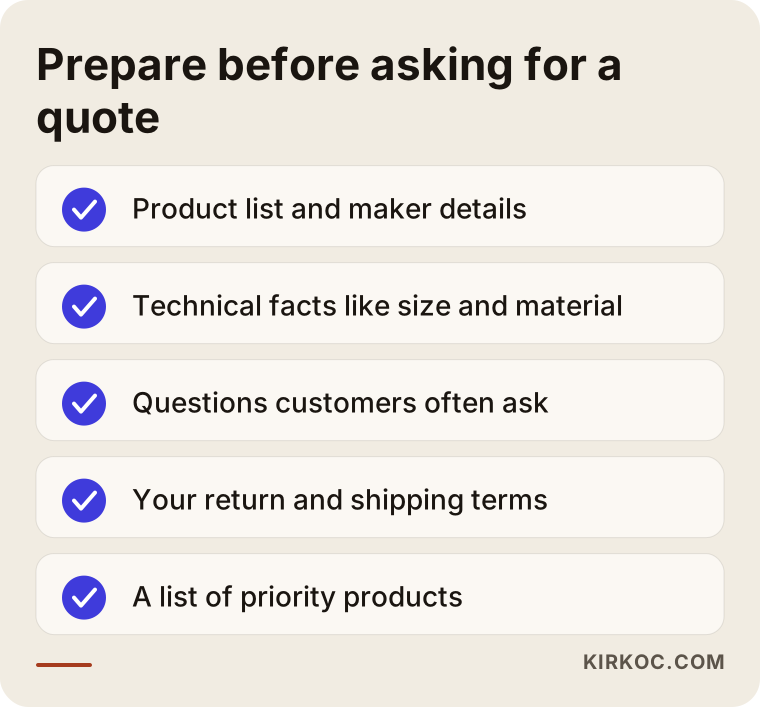
Most of the items on the checklist can be prepared on your side before you hire anyone. If you bring them with you, the conversations are shorter and the quote is clearer.
How I work
I work alone. That means the person you talk to is the person who writes the text and prepares it for publishing; there is no project manager or other department in between. That means quick decisions and short communication. At the same time, I should be open about the fact that my capacity is limited. I can take only so many jobs at once, so I plan large projects by splitting them into batches. Even if your store does not run on a system I manage, I deliver the texts in a form you can enter into your own admin panel; your site and your accounts always stay in your name.
In the first conversation I look at your products and your current pages. I tell you whether having product descriptions written is necessary, and if it is, where to start. If it is not necessary, I tell you that too.
Frequently asked questions
What exactly does a product description writing service cover?
It covers your product's name, short summary and detailed description. Depending on need, it can also include bulleted features, common questions, the page title and the short text that appears in search results. You should see the scope written out item by item in the quote.
Is using the supplier's description really harmful?
It would not be right to say it is always forbidden or penalized. But when many sites use the same text, your page cannot be told apart and finds it harder to gain visibility. If you have doubts about copyright, talk to a lawyer. The safest route is an original text written from your own knowledge of the product.
Is a description written with AI good enough?
It can be useful for producing a draft. However, because it has not seen the product, it can get the size, material or features wrong, and it may produce sentences similar to those of many other stores. Someone who knows the product must check it before it goes live.
Do I have to have all my products written at once?
No. Most of the time the best approach is to start with products that sell well and have a good margin. Watching the results and then having the remaining products written in batches balances both budget and risk.
Will my ranking go up after I have descriptions written?
I cannot guarantee that. An original, clear description improves your page's chance of being visible, but ranking depends on many things, including the strength of your site, your competitors and the decisions of the search engine. It is healthier to set the expectation as "a solid foundation," not "a guaranteed result."
How long until I see results?
It depends on the number of products, the age of your site and the competition. I publish the first batches quickly and monitor them, but search engines can take time to re-evaluate a page. It would not be honest to give an exact date.
What does the cost depend on?
On the number of products, how technical they are, the depth of research, the number of languages and how well organized the information you provide is. I need to see your product list to give a clear quote.
Will the texts belong to me, and can I use them elsewhere?
That should be written clearly in the quote. I care that the texts belong to you for use in your store after delivery; still, it is best to confirm the terms of each project in writing.
If you feel your product pages are not bringing in sales, write to me through my website design service page. We can look at your store together, and I will tell you plainly whether you need product descriptions and where to start.