You run an international logistics, trucking, customs or cargo business. You do the work well and your operations team is solid, but most quote requests still come through personal contacts, phone calls or past customers. You have a website, yet when a buyer types "LTL freight to Germany," "export customs clearance" or "full truckload to Iraq" into Google, your company does not show up. So it makes sense that you searched for "SEO for logistics companies." In this article I explain, in plain language, how buyers in this industry search, which pages your site needs and where to begin. I am Ümit Kırkoç, a web designer and SEO consultant who works alone from Istanbul, and I will be clear about the limits of my own SEO services where it matters.
SEO, in short, is the work that makes your website appear when your customers search on Google. Unlike advertising, you are not invisible the moment you stop paying. If it is done well, the setup you build once keeps bringing in quote requests for months. In logistics, though, SEO looks quite different from SEO for a restaurant or a clinic. Your buyer is rarely a private individual. It is usually an exporter, an importer, a manufacturer or an online store, and when they decide, they weigh trust, paperwork and route knowledge as heavily as price.
How does a logistics buyer search on Google?
Someone looking for a coffee shop types "coffee near me." A logistics buyer arrives with a far more specific and technical sentence. They have a shipment in mind, a destination and a problem to solve. For example: "LTL freight to Hamburg," "full truck price to Baghdad," "export customs clearance from Mersin," "how to get an ATA carnet," or "shipping to Germany for Amazon FBA." Each of these searches carries a different intent, and each one needs its own answer page.
You can sort the questions buyers ask into three groups. The first group is looking for information: "what is customs clearance," "what is a CMR document for." These people are not ready to buy yet, but they are starting to get to know you. The second group is comparing: "air freight or ocean freight," "LTL or full truckload." These people are weighing options, and if they find a clear explanation, they will remember you. The third group is close to buying: "freight forwarder for exports to Germany," "customs-cleared trucking quote to Georgia." The person typing these is often about to ask for a quote. Commercial SEO aims mainly at this third group, and answers the second group with confidence.
I should be honest about one thing: search volume in logistics is often low. Instead of phrases that hundreds of people type every month, most of your searches will be phrases that a handful of people type, each of them with a real shipment. That may sound like a disadvantage, but it is not. One correct quote request can be worth more than hundreds of visitors to a site that sells a low-priced product. What matters is not the number of visitors, but whether the right person finds the right page.
The illustration below is a completely made-up example showing how a clear route page stands apart from a generic service page in search results.
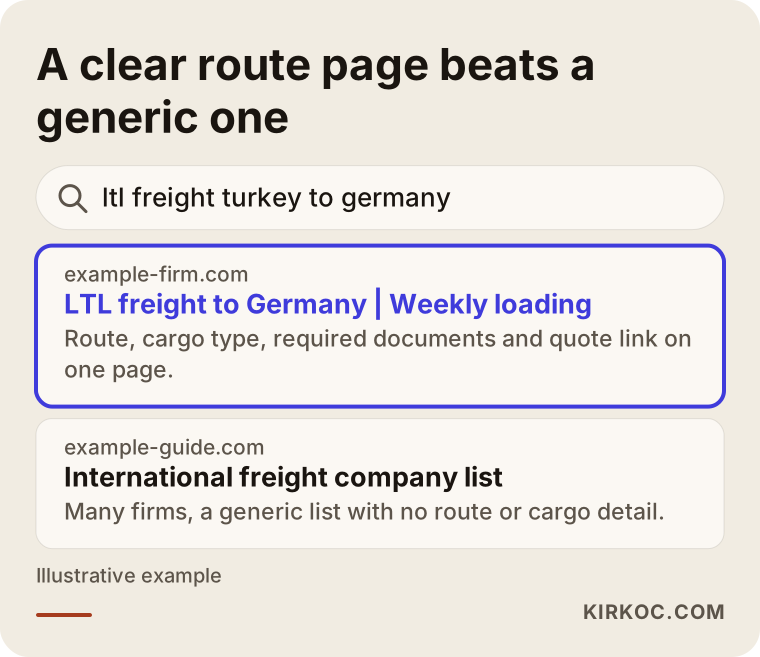
Look at what the highlighted result does: it states the route, the cargo type and who it is for in the very first line. A generic page that says "we serve the whole world" does none of that. Google tries to work out which answer to give the person searching, and if you make that easy, it can place you higher with less effort.
Who are your competitors?
Competition in logistics has two layers. The first layer is the big international carriers and the large companies that claim to do everything. Competing with them on general searches such as "international shipping" or "freight company" is not realistic for a small or mid-sized firm. The second layer is made up of companies like yours, strong on particular routes, particular cargo types or a particular region. That is where the real opportunity is. If you say "LTL to the Balkans," "cold chain to Central Asia" or "e-commerce parcels to Europe" instead of "we ship everywhere," you face far fewer competitors and a much more motivated audience.
There are also platforms: freight comparison sites, load boards and industry directories. Some of them rank high for certain searches. Rather than fighting them, it is smarter to strengthen your own site with what they cannot offer: real route experience, document knowledge and direct contact.
Which pages does a logistics website need?
Most logistics websites have a single "Services" page where road, sea, air, warehousing and customs clearance are listed one under the other. For the reader, that is a list that says nothing. For Google it is a weak signal, because one page is trying to answer dozens of different searches at once and is not clear enough for any of them.
A healthier structure is one page for each separate intent. The table below summarizes which kind of page fits which kind of search.
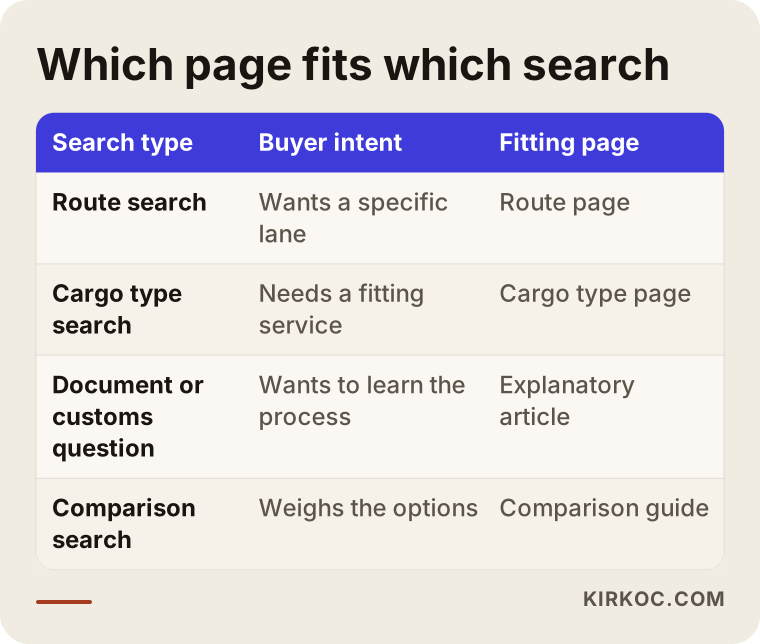
The logic in the table is simple: a route page for a route search, a cargo type page for a cargo type search, and an explanatory article for the person asking a question. All of them should link to each other so that both visitors and Google see the site as one whole.
Route pages
A route page is written for one specific lane, such as "LTL freight from Turkey to Germany" or "full truck from Turkey to Iraq." On the page you describe the facts of that route: which border crossing is used, which documents are generally needed, how often you load, and which cargo types you carry. Do not invent numbers here. If transit time and cost vary, say so openly and explain what they depend on. An honest "it depends, and here is on what" explanation builds far more trust than an empty promise of the "best price."
Cargo type and service pages
The second group is pages organized by what you carry: LTL (less-than-truckload, meaning shared truck space for smaller shipments), full truckload, cold chain, project and oversize cargo, dangerous goods, and e-commerce parcels. The third group is supporting services: customs clearance, warehousing, insurance, and paperwork such as ATA carnets. Each page should focus on a single topic. If one page tries to cover cold chain, project cargo and customs clearance together, it ends up weak on all three.
Information articles
Articles that answer the questions in your buyer's head show that your site knows its subject. Titles such as "The most common causes of customs delays," "LTL or full truckload: which one and when," and "Which documents should you prepare for an export" do the job. These articles may not bring in a quote directly, but they pull the person who is still comparing toward your side and send them on to the relevant service page.
The next illustration shows how a buyer moves from looking for information to asking for a quote, and which content helps at each stage.
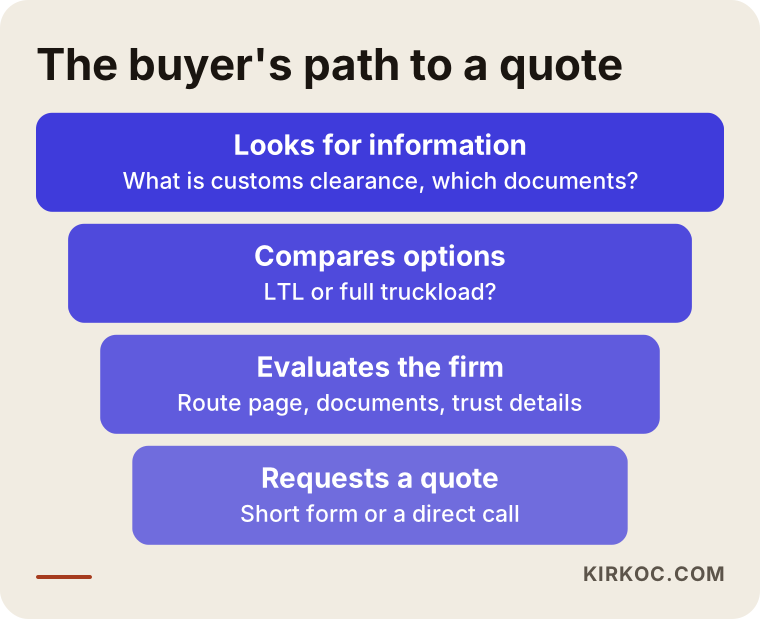
Information articles sit in the wide part of the funnel, comparison and service pages in the narrowing part, and the quote form at the narrowest point. Every page on your site should have a job on this path. A page with no clear job is usually unnecessary.
Example scenario 1: A road freight company doing LTL shipments
This scenario is entirely hypothetical and does not describe a real company. Say there is a small trucking company in Istanbul that sends weekly LTL shipments to Europe. Its website has one page: "Our Services." Road, sea and air are listed one under the other. The owner says that most phone calls come from past customers and that new customers rarely turn up.
The first problem is easy to spot. The company is actually strongest on the Germany, Austria and Netherlands lanes, but the site never mentions those three routes. Someone who searches for "LTL to Hamburg" has no way of matching with this site. The solution comes from there. First, a separate page is prepared for each main route. Each page explains loading days, the documents generally required, which kinds of cargo are accepted and how to ask for a quote. Then an explanatory article is added: "What is LTL, and when do you need a full truck?" and it links to the route pages.
What happens as a result? Nobody can promise a ranking, and I need to say that plainly. But the company now has a structure that can tell Google, "I do this job on these routes." Over time, the chance that people searching for those routes reach the page goes up. This is not a claim, it is a logical consequence: to be found, you first have to be matchable.
Example scenario 2: Customs brokerage and e-commerce parcels
The second scenario is also hypothetical. A customs brokerage also offers a parcel service to Europe for small online sellers. The site describes the two services all mixed together, and visitors cannot tell which one is meant for them. On top of that, the company has never answered the questions online sellers ask most, such as which products cannot be shipped and what to watch for on the customs declaration.
There are two separate audiences here, and each searches differently. The exporter types "export customs clearance," while the online seller searches for something like "how to ship an Etsy order to Germany" or "sending inventory to an Amazon FBA warehouse." Instead of speaking to both audiences on one page, the site should be split into two clear sections: corporate customs clearance on one side and e-commerce shipping on the other. In the e-commerce section, you prepare a plain guide that answers common questions. In the export section, you prepare a page that explains the required paperwork.
There is a critical detail here: regulations change often, and in some matters a definite statement is risky. For that reason, a balanced tone such as "these items are generally required; for the current situation, check with your customs broker or the relevant authority" is both honest and reassuring. Writing definite legal claims about regulations can mislead both you and the reader, and when in doubt, it is best to consult a lawyer.
The following illustration is a sample layout showing the order in which a logistics service page should tell the reader what they need to know.
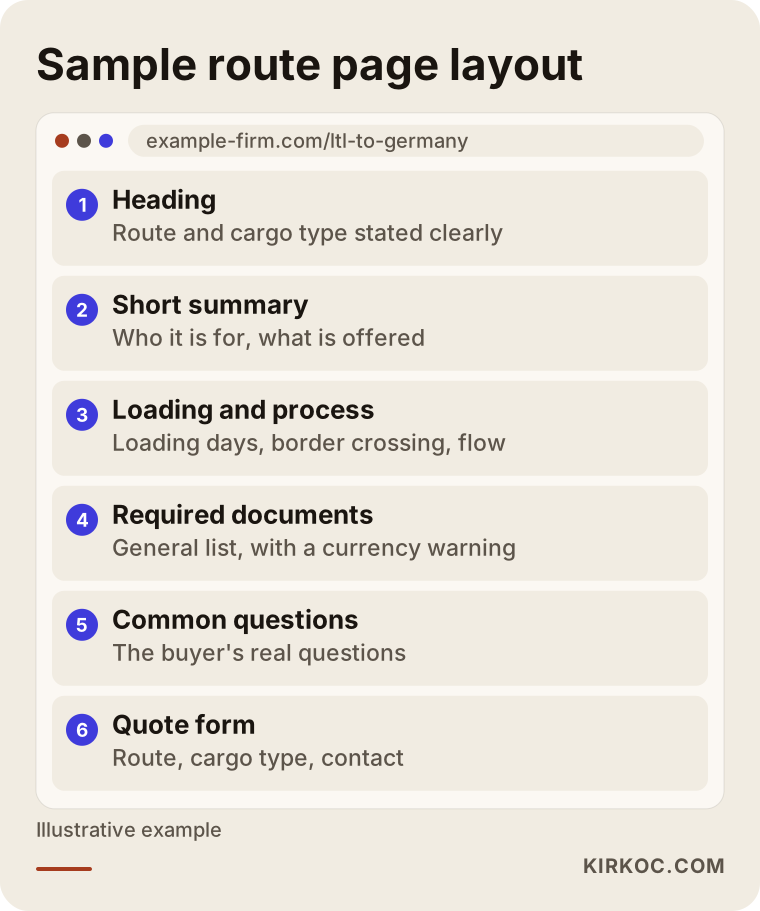
The logic of the layout is to answer the questions in the reader's mind in order: what do you carry, where to, with which documents, how does it proceed, and what should I do to get a quote. Having an easy way to request a quote next to each section makes asking for a quote easier than a contact form buried at the bottom of the page.
Trust signals: documents, authorizations and concrete detail
In logistics, the buyer is entrusting their cargo to someone they do not know. That is why trust matters as much as SEO in this industry, and in fact the two feed each other. Google looks at trust signals too, but what really counts is that the person who lands on your site thinks, "this company is real and knows its business."
The things that usually increase trust on a site are these: the company's legal identity and address, a real phone number and email, any licenses and memberships you hold (as long as they are accurate and current), an explanation of liability and insurance, and a simple walkthrough of how your operation runs. Avoid exaggeration here. Listing a certificate you do not have or a title you do not hold is unethical and can cause serious trouble.
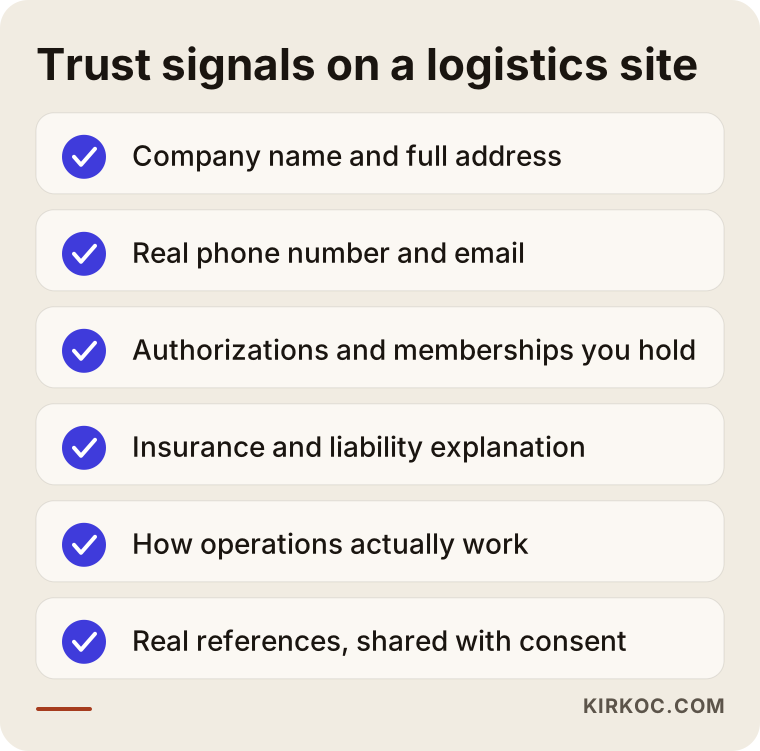
The items missing from this list are often the quickest wins. Adding a clear address to the contact page or writing a section that explains your process takes no big technical effort, yet it visibly affects the reader's decision. If you plan to use real customer reviews and references, share them only with the customer's permission and exactly as they were given.
Multilingual search: think about the foreign buyer too
In international logistics, some of your buyers are in Turkey and some are abroad. An exporter in Turkey who sells to Europe searches in Turkish. But a German importer who wants to buy goods from Turkey searches in their own language, or in English, with phrases like "Transport aus der Türkei" or "Turkey freight forwarder." To reach this second audience, your site needs to exist in those languages too.
A common mistake is moving Turkish pages into another language with machine translation. If the translation is not good, readers will not take you seriously, and search engines may judge the quality to be low. A better path is to carefully translate the few most important pages first, or have someone fluent in the target language review them. Use a separate page address for each language, show the language option clearly, and write content in each language that fits the questions of buyers in that country. You do not have to do everything at once. Starting with the one or two languages most likely to bring in business is enough.
Step by step: how does SEO work for a logistics company?
The process can be kept simple. The steps below are the general order I follow when I begin on a logistics website; the details change from company to company.
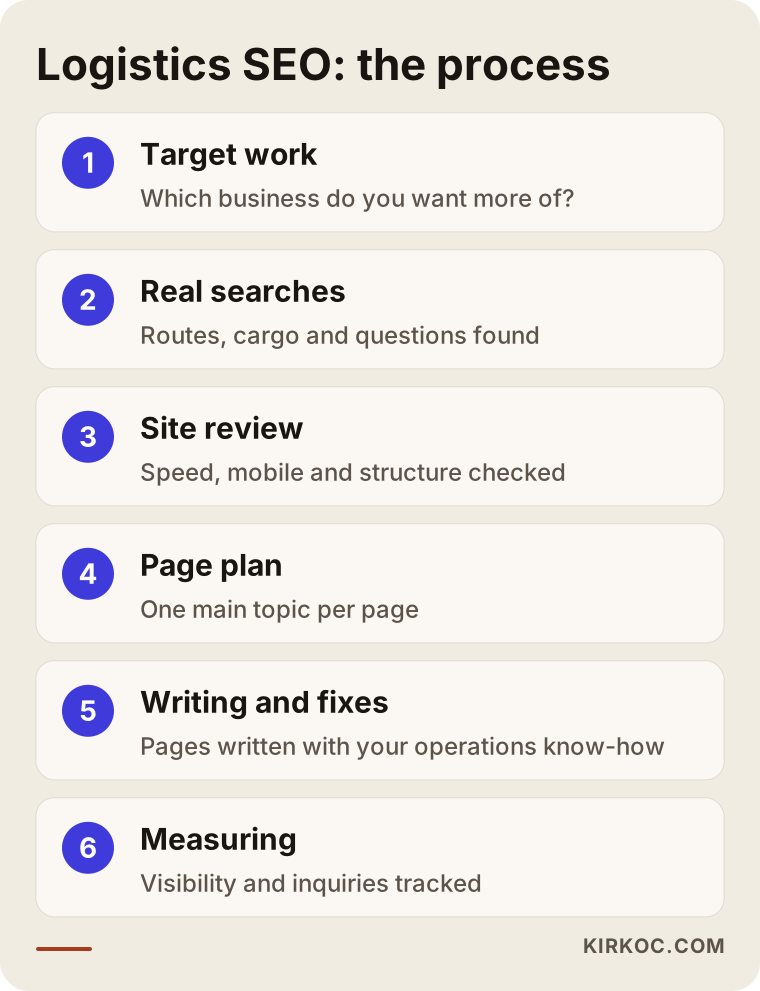
1. Decide which business you want
The most important question to ask before starting SEO is this: which work do you want more of? Not all your services are equally profitable. Maybe LTL costs you time, while full truckload and customs clearance pay well. SEO done without a clear goal can bring in requests you do not want.
2. Find the buyer's real searches
Searches are identified by observation, not by guesswork. Which route, which cargo, which question? I work this out from Google's suggestions, the related questions in search results, competitor sites and, most importantly, your own quote requests. Even listing the most recent requests that came by phone or email tells you a lot: what are people actually asking you?
3. Review the existing site
Does the site load slowly, does it look right on a phone, are the pages linked to each other, can Google see your pages? These are technical questions, but the answers can be explained simply. A site that looks broken on a phone or loads slowly will not deliver results no matter how good the content is. That is why the first look often produces a list of cleanups and fixes.
4. Draw up a page plan
Which routes, which services and which information articles are needed? Each page gets a single main topic. This plan is the roadmap for the work and shows what to do first. Priority usually goes to the most profitable and least competitive routes.
5. Write and fix the pages
Writing new pages requires real operational knowledge, and I cannot know it myself, so I need to get it from you. You tell me what you do on which route, which documents are requested and how the process works. I turn that into a form the reader understands and a structure that fits the search. Old pages are reviewed in the same pass.
6. Measure and improve
After the pages are live, I look at which pages get viewed, which searches you appear for and how many quote requests come in. This is the real results part of the work. I do not promise numbers, but regular tracking lets you see what works.
Common mistakes in logistics SEO
The mistakes I see in this industry tend to look alike. Most come not from ignorance but from the temptation to say "we do everything."
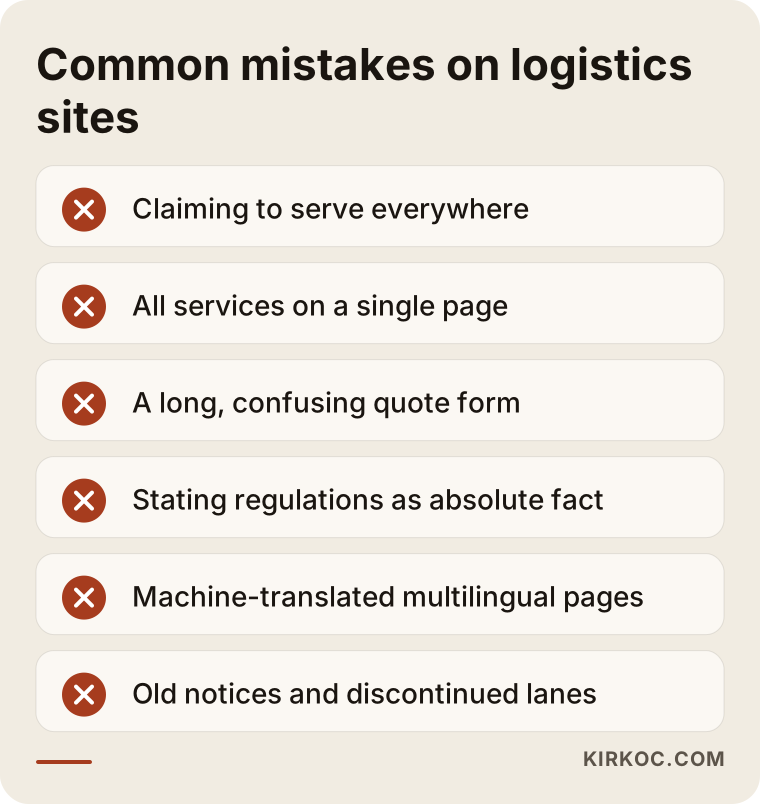
Serving everywhere. Saying "anywhere in the world" sounds strong but matches no search anywhere. Write down the routes where you are strong.
All services on one page. As I explained earlier, that page fully answers no search.
Making the quote path hard. Long forms with an unclear number of fields, or just a phone number, lose especially the buyer abroad. Keep the form short; route, cargo type and contact details are often a good enough start.
Stating regulations as absolute fact. Customs and transport rules change. An out-of-date definite sentence misleads the reader and hurts you.
Multilingual pages through machine translation. Poor translation loses trust.
Relying on platform listings and neglecting your own site. Load boards and directories help, but the customer relationship belongs to those platforms. Being visible on your own site means having an independent asset.
Leaving the site unmaintained. Announcements from years ago, discontinued lanes and old phone numbers break trust. Small, regular updates are enough.
What can you do yourself, and when do you need an expert?
You do not need an expert for everything. There are things you can do yourself that really make a difference. Let me draw the line honestly.
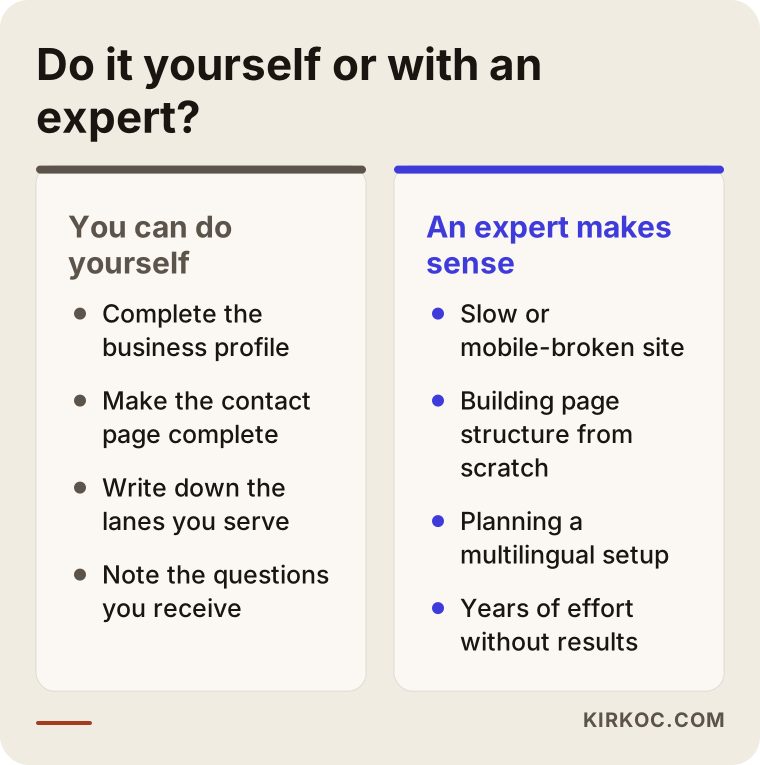
Things you can do yourself include: filling in your Google Business Profile (the listing on maps) with correct information, making the contact page complete, writing down on a sheet of paper the routes you work on, noting what customers ask in the requests you receive, and adding real photos of your operation to your site. None of this needs technical knowledge, only some discipline.
Expert help starts to make sense in these cases: your site is very slow or broken on phones; you need to build the page structure from scratch; you are planning a multilingual setup; you cannot tell which searches will bring you business; or you have been producing content for years without results. The point is to reduce the cost of trial and error. Fixing a badly built site structure later takes longer than building it correctly the first time.
Timeline: what should you expect, and when?
SEO is not a quick-result job, and that has to be said at the start. I cannot guarantee rankings, and nobody can. But I can describe the general flow of the process.
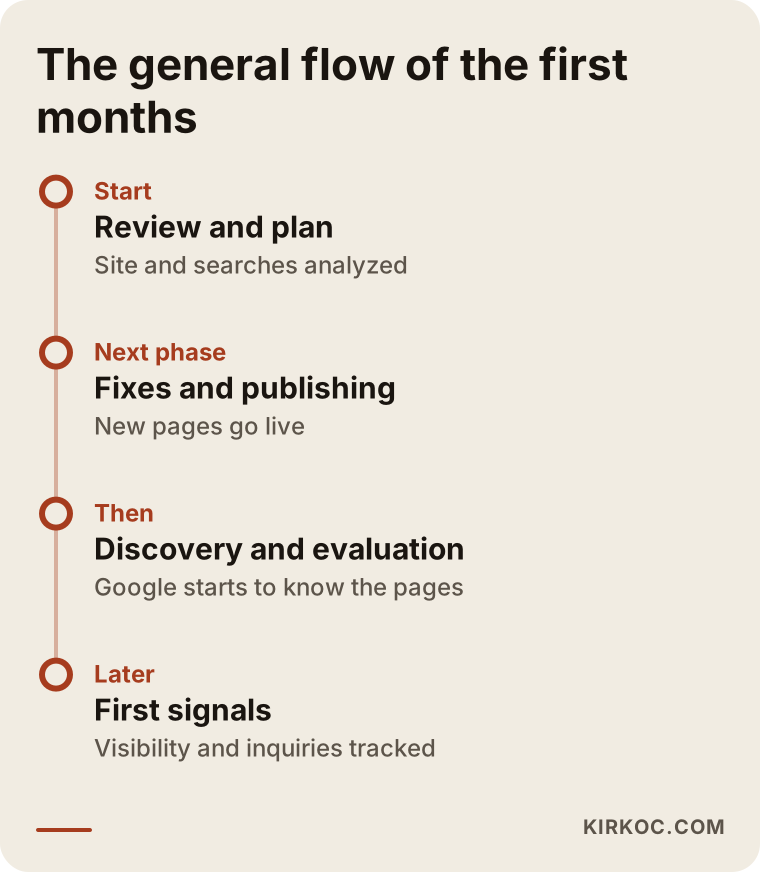
The first period is preparation: review, plan, fixes. You will not see a visible change from outside during this time, but the foundation is laid. In the next period, new pages are published and Google begins to discover and evaluate them. In the third period, the first signs may appear: showing up for some searches, movement in page views. Whether that turns into quote requests depends on the state of the site, the competition and the routes. In logistics, the decision process can also be long; a buyer may find you today but only need the service three months later.
What determines the cost?
I will not give a figure, because every logistics company is different. But I can say plainly what the price depends on, which helps you compare the quotes you receive in a meaningful way.
The main factors are these. First, the current state of the site: building a structure from scratch is not the same job as a site that needs minor fixes. Second, the number of pages: how many routes, services and information articles are needed. Third, the number of languages: each additional language means not just translation but content that suits that language. Fourth, the level of competition: setting a target in a very crowded search takes more effort than in a narrow route. Fifth, how continuous the work is: do you want a one-time setup, or ongoing monthly follow-up? Sixth, the information you provide: if you supply operational details quickly and clearly, the work takes less time.
When you collect quotes, ask what is included in the price. How many pages, which languages, what reporting, how often are the meetings? Treat any quote that says "we will get you onto the first page" with caution, because that is something no one can promise.
How I work with you
I work alone, which means the person you talk to is the person doing the work, with no middleman. Usually I start with a short conversation to hear about your business, your routes and your goal. Then I review the site and write down, in plain language, what needs to be done and in what order. You decide based on that plan; you do not have to hand over everything. Some companies only need the plan and the list of fixes, while others leave the writing and follow-up of the pages to me as well.
One important point: the operational knowledge comes from you. You know best what you carry on which lane and what to watch for in the process. My job is to make that knowledge searchable and understandable. The healthier this collaboration is, the sturdier the result.
The decision diagram below helps you quickly judge whether an SEO investment makes sense for you right now.
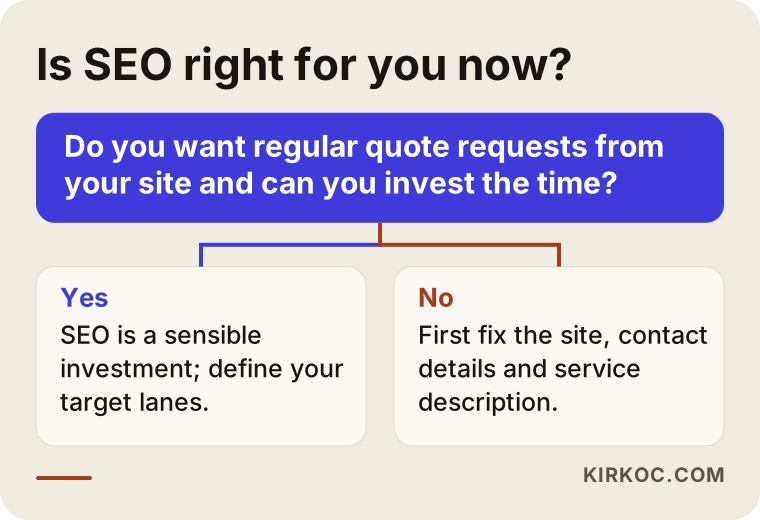
If your answer is "yes," meaning you want regular quote requests from your site and are willing to give it some time, SEO is a sensible investment. If it is "no," it may be better to start by fixing the foundation first: the site, the contact details and the description of your services.
Frequently asked questions
Do logistics companies really need SEO, or is word of mouth enough?
Work that comes through personal contacts is valuable but limited, and it does not help when you want a new route or a new type of customer. Having your website work for you is a way of reaching buyers you do not know yet but who are looking for exactly what you offer. You do not have to put everything on SEO; it is a channel added to your existing relationships.
How long until quote requests start coming in?
I cannot give an exact time; it depends on the state of your site, the competition and your routes. In general, expect the first months to be preparation and publishing, followed by a gradual rise in visibility. Be wary of anyone who guarantees results.
Is Google Ads or SEO the better choice?
They do different jobs. Ads give you quick visibility for as long as you pay; SEO is slower to build, but once built it does not require constant ad spend. Because search volume in logistics is low, an ad budget can disappear quickly. Some companies use both together; which one suits you depends on your goal and budget.
My site is in one language. What should I do to reach foreign buyers?
First decide who the foreign buyer is: which country, and in which language do they search? Then prepare your most important pages in that language with a careful translation. You do not need to translate everything at once; starting with the service and route pages where you expect the most business is enough.
Is it risky to write customs and regulation information on the site?
Giving general, explanatory information is useful, but making definite legal claims is risky because rules can change. Wording such as "these documents are generally required; for the current situation, check with your customs broker or the relevant authority" is both honest and safe. Where you are unsure, consult a lawyer.
I am already on platforms (load boards, directories). Do I still need my own site?
Yes, because your position on those platforms is not under your control; the rules or your visibility can change. Your own site is where you are known as a brand and where people contact you directly. The two complement each other.
Does blogging help a logistics company?
If it is on the right topics, yes. Articles that answer what buyers really ask pull people who are comparing options toward you. But generic articles that everyone writes bring no benefit; concrete pieces drawn from your operating experience make the difference.
What is expected from me in this work?
Operational knowledge and time. You tell me what you do on which route and which questions you run into, and I turn that into a form that fits the website. It also helps if you give me feedback now and then on the quality of the quote requests coming in, so I can steer the work better.
If you want your international logistics, customs or cargo company's website to be able to bring in quote requests, you can look at how I work on my SEO services page and get in touch with me. I will listen to your situation and tell you plainly what is realistic.