Your business sells to people in Turkey, or wants to, and your own team does not speak the language or know how Turkish customers search. So you typed "SEO services Istanbul" or "SEO company Istanbul" into Google and found a crowded page of options. This article is for you: a business owner who needs search visibility in the Turkish market and wants to hire help without having to learn the jargon. I am Ümit Kırkoç, a web designer and SEO consultant who works alone from Istanbul, and I describe my own SEO services at the end, with their limits.
SEO, in one sentence, is the work that makes your website appear when potential customers search on Google. You do not pay per click, and when the work is done well it keeps bringing in visitors for months. The catch for a foreign company is that Turkish search has its own habits, its own competition and its own language quirks, and a plan copied from your home market tends to miss all three.
Why Turkey is not just "your market, translated"
The most common mistake I see from foreign firms is treating Turkey as a language swap. You take the English site, translate it, publish it and wait. It rarely works, for several reasons.
First, Turkish is not built like English, German or Swedish. Words change shape depending on what is attached to them, so a single idea can be searched in many forms. A person looking for a service might type the plain noun, the noun with a location ending, or a short phrase with a question word. A translated page that only contains one version of the phrase will match only some of those searches. A native speaker who also understands search needs to decide which forms matter for your offer.
Second, the competition is local and often strong. Turkish companies have been writing for their own customers for years, and they know the local vocabulary, the seasons, the holidays and the worries of buyers. A newcomer with translated text is competing against people who write naturally for their audience.
Third, trust works differently. Turkish buyers frequently check phone numbers, addresses, local payment options and delivery promises before they commit. If your site does not show that you can serve them locally, they leave, even if the page ranks.
The illustration below is an invented example of how a search result for a local, district-level query might look. It shows why the page that names the district and the service clearly stands out against a generic list.
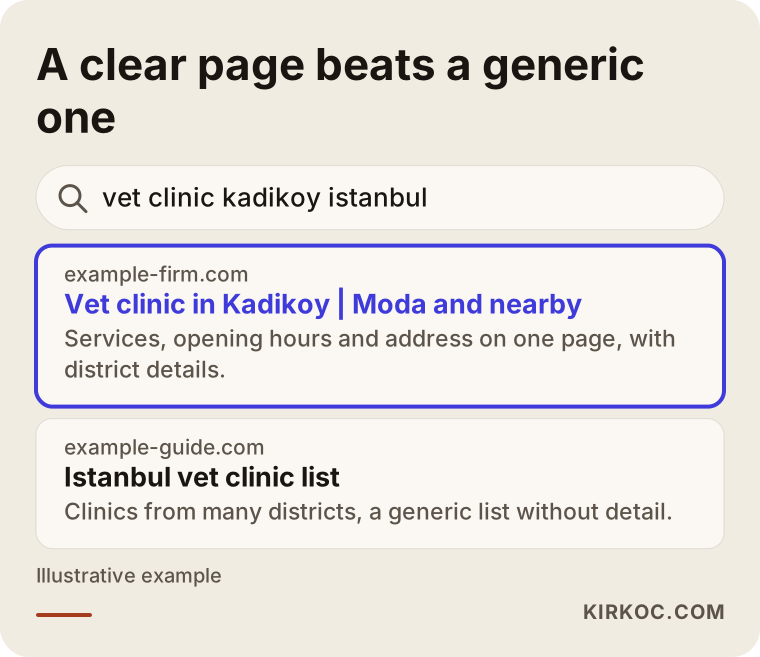
Notice what the highlighted result does: it states the place, the service and the practical details in the first lines. A Turkish customer, a resident foreigner and Google all understand it at a glance. A page that only says "services in Istanbul" does none of this.
Who actually needs SEO help in Istanbul
Three types of foreign business usually come to this. The first is the company entering Turkey: a software provider, an e-commerce brand or a service firm that wants Turkish customers and has no local presence in the search results yet. The second is the company with a Turkish-language site that already exists but was built by someone abroad and does not attract traffic. The third is a business with a physical presence in Turkey, for example a branch, a distributor or a partner, that wants customers in Istanbul itself. Each needs a different plan, and an honest first review tells you which one applies to you.
How people in Istanbul actually search
To plan SEO in a city, you need to know what its residents type. Istanbul is huge, traffic is slow, and districts feel like separate towns. As a result, people tend to search with a district or neighborhood name rather than the city name alone. Someone on the European side who needs a repair service will often add the name of their own area, because a trip across the city can take hours.
Phones play a large part. Many searches happen on a mobile screen, often while the person is already out. That makes the map result, which shows nearby businesses, very important. Whether you appear there depends mostly on your Google Business Profile, which is a separate listing from your website, but a good SEO plan thinks about both together.
Business buyers search differently. A purchasing manager at a company typically uses broader phrases and wants proof that you can deliver across the city or the country. And Istanbul's visitors and residents from abroad search in English, German, Arabic and other languages, which creates a separate world of searches that Turkish-only sites do not capture.
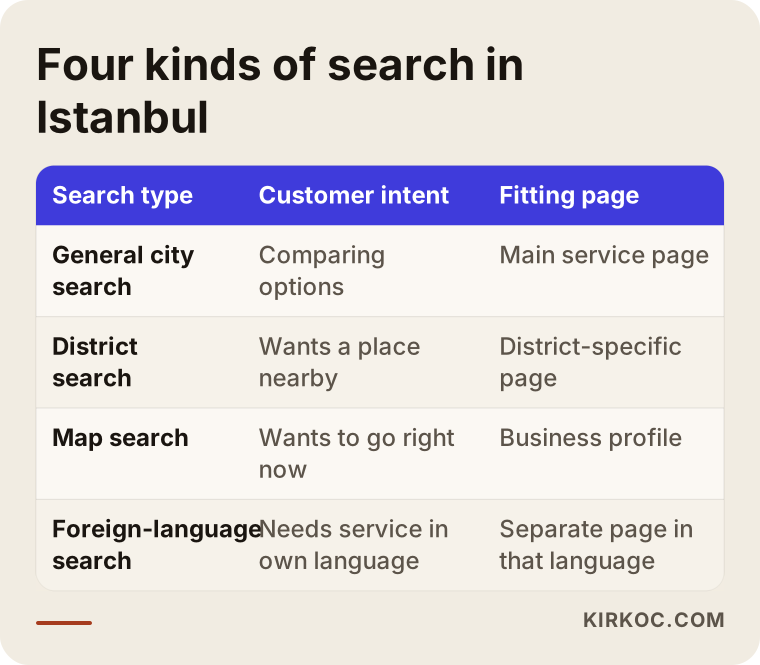
The table makes one practical point: different searches need different pages. A single "our services" page cannot answer a general query, a district query and a foreign-language query at once. Planning the right set of pages is a large part of the work.
Google and other search engines in Turkey
For most businesses I would focus on Google. It is the main search engine most Turkish users rely on, and the practical advice is to start there. Other engines exist, but a small business with limited budget rarely benefits from splitting its attention early on. If your sector is unusual, the first review can check whether another channel deserves a look.
District pages: a layout that works in Istanbul
If you serve customers in several parts of Istanbul, district pages are one of the strongest tools. They are also easy to get wrong. The typical mistake is to copy the same text a dozen times and swap the district name. Google can recognize this, and customers feel it. Such pages add nothing and can even hold the whole site back.
A good district page contains something that is true only for that area: the neighborhoods you cover, the kinds of requests you handle there, a note about access or appointments, and questions people from that area really ask. Equally important, do not make a page for a district you do not serve. An empty page misleads the visitor and gives the search engine no reason to rank it.
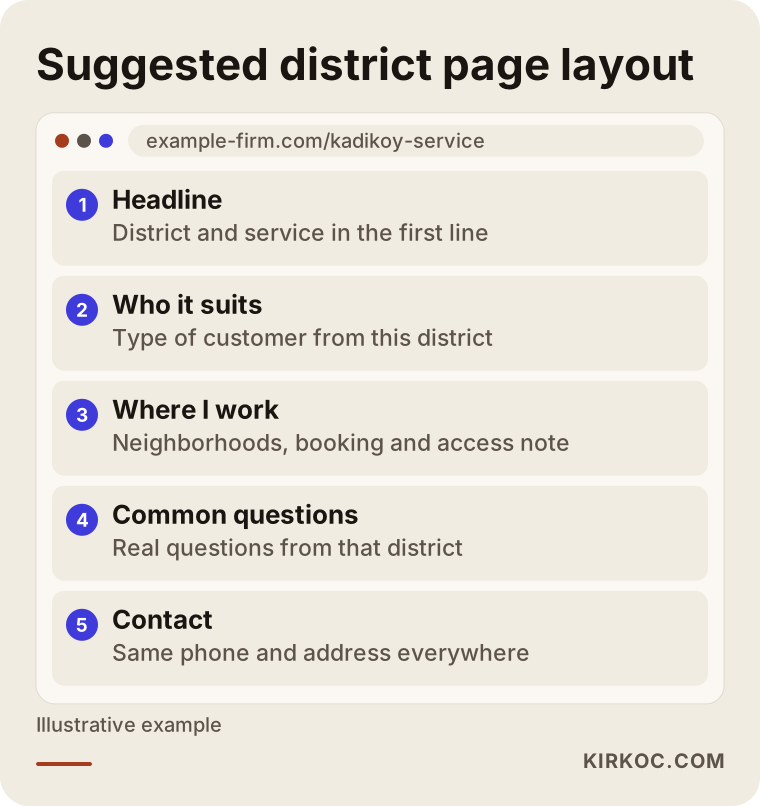
The layout above is a starting point. Say who you are and what you do in that district in the very first line. Describe who the service suits, where you work, answer the practical questions and end with a clear contact path. The page exists to make a visitor pick up the phone or fill in a form, not just to please a search engine.
Agency or independent specialist?
When you look for an SEO company in Istanbul, you will find both large agencies and independent consultants. I want to describe the trade-off fairly, since I am an independent myself and have an obvious interest.
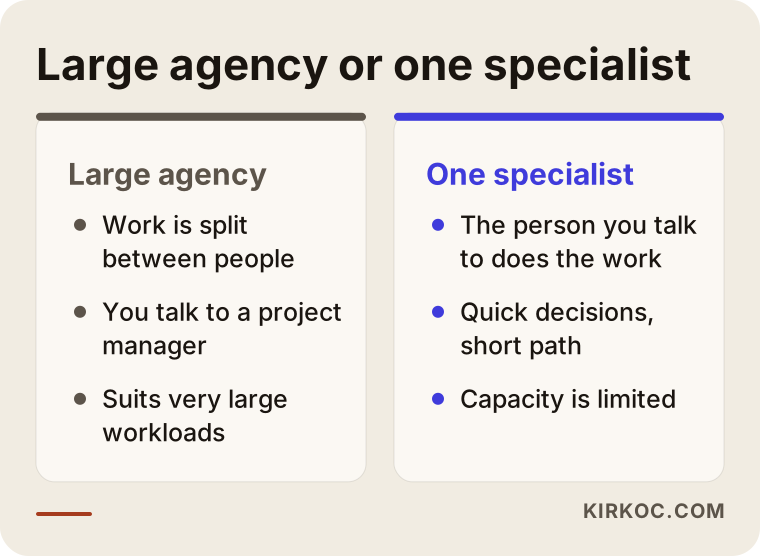
A large agency can assign different people to design, writing, development and advertising. If you run a big shop with hundreds of product pages, or you need several departments working in parallel, that division of labor is useful. The cost is distance: you usually talk to an account or project manager, and the person who does the work is someone you may never meet.
With an independent specialist, the person you speak to is the person who does the work. Decisions are quick and context does not get lost between people. The limit is capacity: if your project needs many kinds of expertise at once, one person cannot cover all of it. I work alone, so I tell clients at the start when a job is beyond what I can do well.
There is a third consideration specific to foreign companies: time zone and language. Working with someone in Istanbul means a small overlap with most of Europe and a reasonable overlap with the Middle East. Meetings can be held by video call, and written reports can be in your language. I work remotely, so I do not have offices abroad; what I offer is availability by call and email and a clear written plan.
What the service should include
When you receive an SEO proposal, you should be able to see what is inside. "We will optimize your website" is not a scope. My service includes the following:
- Site review: I go through your site from top to bottom and list, point by point, why Google holds you back.
- Finding the right searches: I research what your customers actually type into Google and choose the searches that can bring you business.
- Technical fixes: I fix slowness, pages that do not open and phone display problems, the things Google cares about.
- Content work: I strengthen your service pages and prepare articles that answer your customers' questions.
- Competitor tracking: I look at what the top-ranking competitors do differently and update the plan accordingly.
- Monthly report: Each month I report in plain language what was done, where you moved up and what comes next.
I do not promise anything that my service page does not state. For example, paid advertising management, running your social media accounts or collecting reviews on your behalf are not part of this. If a proposal lists them, ask whether they are separate items.
Extra items for the Turkish market
For companies targeting Turkey there are usually two additions. One is native-quality Turkish content, written by a person who understands both the language and search, rather than a literal translation. The other is a plan for which Turkish city or district searches are worth pursuing, and which are not. These are part of normal planning, though I would not apply all of them to every business. A company serving the whole country from a warehouse may need no district pages at all.
Who this suits
To be direct about who benefits:
- Businesses that have a website but get no customers from Google.
- Companies that do not want to depend on an advertising budget forever.
- Clinics, hotels and service firms whose competitors rank above them.
- Those who bought SEO before and saw no results.
The last group deserves attention. Many companies had a previous provider and are left with almost no record of what was done. If that is you, the first step is an independent review of the present state, because a new plan cannot be built without knowing what already exists.
What determines the cost
I am not quoting numbers in this article, because there is no standard price for SEO. But knowing what drives cost lets you compare quotes meaningfully.
The first factor is the present state of your site. A technically messy, slow or confusing site needs cleaning first, and that takes time. The second is how competitive the searches you want are; a broad query across a large city is a different job from a precise query in one district. The third is volume: the number of service pages, districts and articles needed sets the workload directly. The fourth is the number of languages, because working in a second language is like running a second project. The fifth is duration: a few months of intense repair differ from a continuous long-term engagement and often need a different contract.
A warning: a very cheap quote can mean a shrunken scope, and a very expensive one can include items you do not need. Look at what the figure covers, not just the figure. For an exact quote I need to see your site first; after the initial review I send a written proposal.
How to compare quotes
When you have three or four proposals, it can be hard to tell which is better. These are the questions I suggest asking. Are the tasks written down, or is it all general promises? Is the plan broken into priorities and time periods? Who will actually do the work, and can you talk to that person? How will reporting work, in plain language or in charts you cannot read? And what are the exit terms, and who controls your site and accounts?
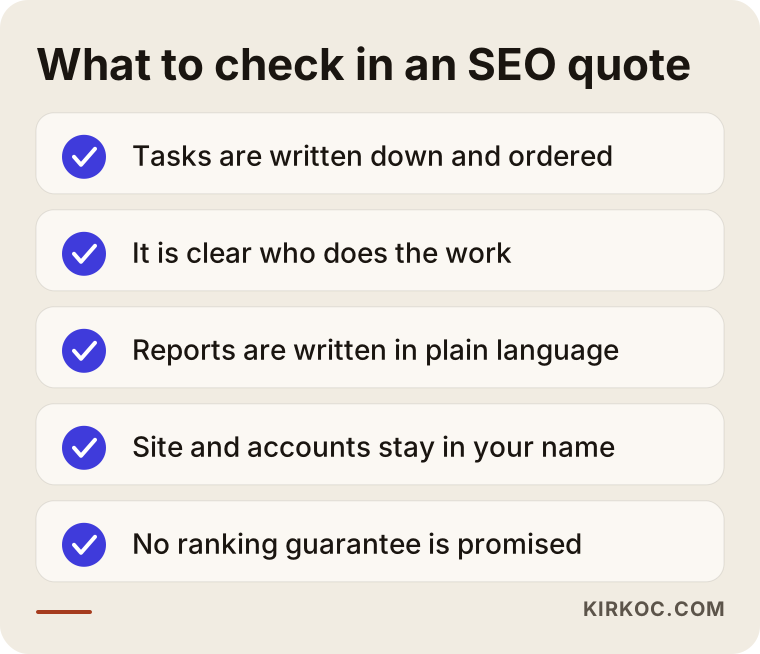
One more point: be careful with sentences like "we will put you on page one" or "we will increase your revenue". Nobody controls Google's results. An honest proposal guarantees the work, not the outcome. When you ask for references, expect real answers; if someone cannot tell you who they have worked with, think twice.
Who owns your website and accounts?
This is often skipped but is vital. When the work ends, or if you ever part ways, your website, your domain name and your Google accounts must be in your name and under your control. If a provider keeps them in their own account, it ties you to that provider. Talk about this at the start; it keeps the relationship healthy.
How working with me goes
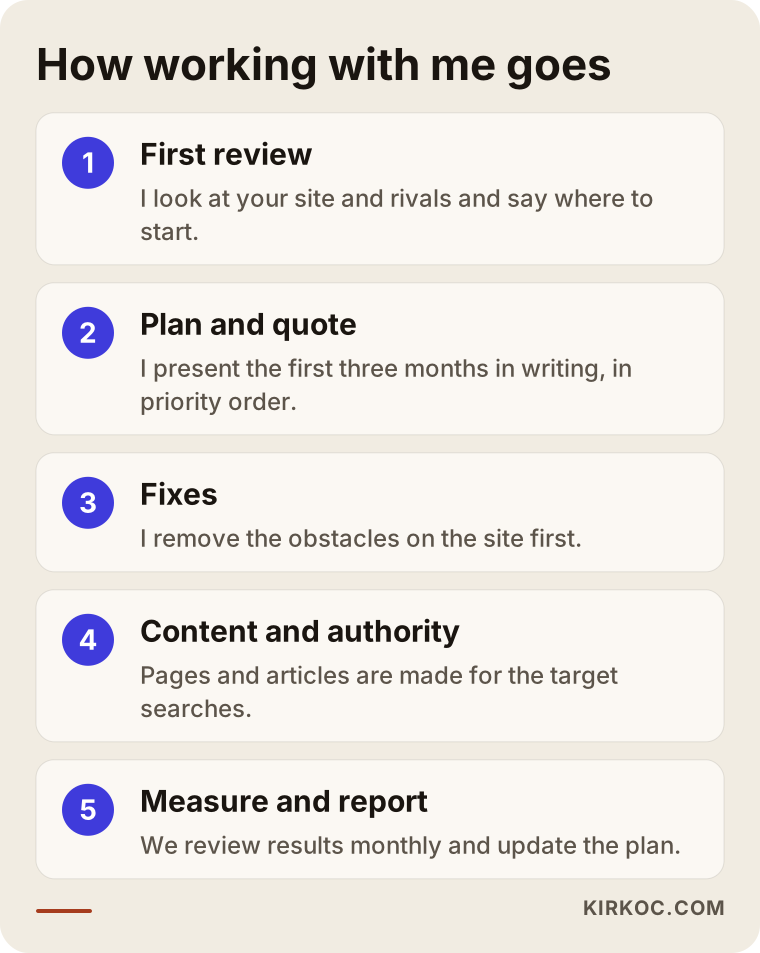
Knowing the process helps you decide and tells you what to expect when. This is the order I follow:
- First review: I look at your site and your competitors and tell you where to start.
- Plan and quote: I present what will be done in the first three months in writing, in priority order.
- Fixes: I remove the obstacles on the site first, since they give the fastest effect.
- Content and authority: Pages and articles are made for the target searches, and your site's reputation is strengthened.
- Measure and report: Each month we review the results together and I update the plan.
The first review is a real assessment, not a sales call. I may look at your site and say that SEO is not the best investment for you right now, and that is a legitimate outcome. On timing, I should be honest too: it often takes weeks, sometimes months, before Google notices a change and reflects it in results. That is how SEO works, and anyone promising instant results deserves suspicion.
Customer behavior by sector in Istanbul
Each sector's customers search differently. These are general observations, not statistics.
Clinics and health businesses. Customers first search for a symptom or a treatment name, then compare places near them. Advertising rules in this field are restrictive. I keep content informative, I do not give medical advice and I do not promise treatment results. Compliance with the rules is the business's own responsibility and I keep the text plain accordingly.
Law firms. Clients usually type a question that describes their problem before they look for a firm. Informative content about the practice areas and the process works better than outcome promises or comparisons. A page cannot give a legal opinion, and mine will not try.
Restaurants and cafes. Searches are often immediate and location-based: neighborhood, cuisine, day and hour. Opening hours, menu and map details matter most; the long text comes second.
Hotels and accommodation. A high share of visitors comes from abroad, so multilingual content and neighborhood guides can help. Since you compete with booking platforms, it makes sense to explain why booking directly is worth it.
Wholesale and B2B. The buyer thinks in stages and asks about product categories, minimum orders and delivery. Information pages and question sections bring business directly.
E-commerce. Repeated product descriptions are the most common problem. Writing a unique, useful description for each product is one of the most labor-intensive and most valuable parts of SEO.
Two imaginary examples
The two scenarios below are entirely hypothetical. They do not describe real clients; they only show the reasoning.
Say a software company from outside Turkey wants Turkish customers. It translated its English site into Turkish with a tool, and almost nobody finds it. The first review would likely show that the translated text uses wording Turkish buyers do not search for, and that the site has no local trust signals such as a local contact method. The plan would start with rewriting the main service pages in natural Turkish, choosing the searches that match how buyers describe their problem, and adding practical information about support and payment. Only after that would blog content or additional languages be considered. No ranking would be promised; the plan would list tasks and what will be measured.
Say a small furniture importer has a showroom in Istanbul and a site in two languages. Customers are mostly local households and some foreign residents. The review shows that the district pages are copies of one another and that the address is written three different ways. The plan would be to merge the weak pages, write district notes that are truly specific, make the contact details identical everywhere and prepare a short English page for the residents. Results would be reviewed monthly in a report that the owner can read without technical knowledge.
Common mistakes
These are the mistakes I see most often. All are avoidable, but together they can cost months.
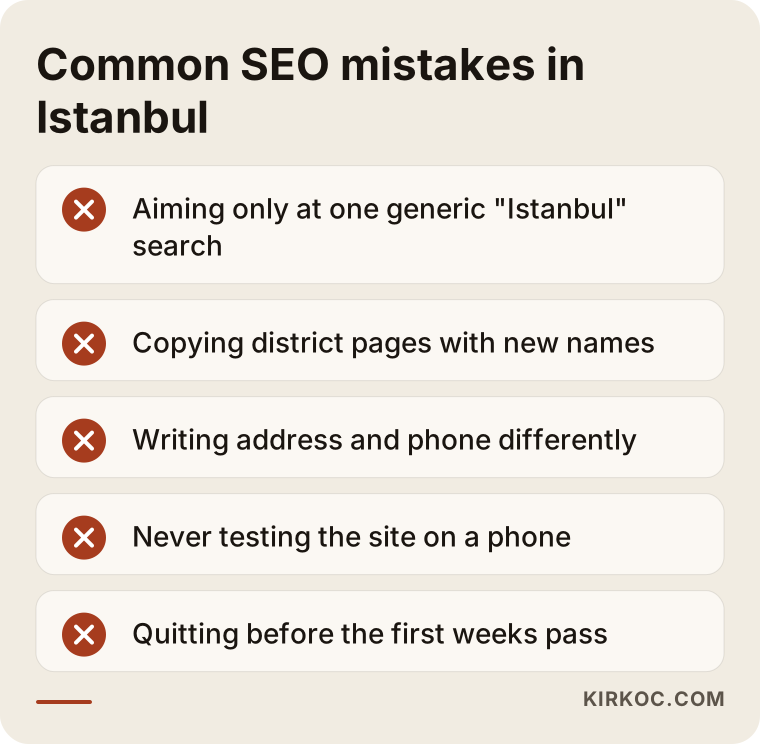
The first is aiming at one generic search, which ignores how fragmented the city is. The second is copied district pages. The third is writing the address and phone number differently in different places, which confuses both Google and customers. The fourth is never opening the site on a phone, even though many searches happen on phones and a slow or broken mobile site loses the visitor instantly. The fifth is giving up in the first weeks. The sixth is judging success by one keyword; the real measure is whether search visits turn into calls and forms.
Working without measurement
There is also an invisible mistake: working without measuring. If you do not know how many visitors come from search, which page they leave and how many contact you, you cannot know what works. With any provider, measurement should be set up and shared with you in plain language.
When you do not need SEO
To be honest, SEO is not the right investment for everyone. In these cases, look elsewhere.
If your business runs on referrals and you do not need new customers, SEO may not be necessary now. If you are working for a short event or campaign, the effect may not show before it ends; advertising or social media may suit better. If the site itself is broken, it will not open, is unreadable on phones or does not inspire trust, fix that first, because you do not paint a house with a weak foundation. If your customers do not search online at all, for example in a very narrow trade conducted entirely by personal relationships, the return will be low. And if you expect guaranteed results in a few weeks, this service is not for you, because nobody can honestly offer that.
If I notice such a situation during the review, I will tell you plainly. I would rather you not spend money on the wrong thing.
Do it yourself or hand it over?
Some jobs you can and should do yourself. Filling in your Google Business Profile correctly, keeping the address and phone consistent, asking customers for honest reviews and describing your services clearly on your site are among them. They need discipline, not special knowledge.
The jobs to hand over are the technical audit, proper search research, competitor analysis, planning many pages and setting up measurement. These need time, tools and experience. A business owner who tries to learn all of it alone often drifts away from the real business. A sensible middle path exists: start with a one-time review, learn what you can handle yourself and discuss the specialist tasks afterward.
Language and trust signals for Turkish customers
One more topic matters for foreign firms. Even a perfectly optimized page loses customers if it does not feel local. Turkish buyers usually expect a visible phone number, a clear company identity, delivery or service area information and payment methods they know. If you cannot supply some of these, say so honestly on the page and offer an alternative such as a call back. Search visibility brings the visitor; trust signals decide whether the visitor stays.
Decide also how many languages you really need. Many companies open Turkish, English and a third language at once, then cannot maintain them. For most, starting with one language done well and adding another after the first brings results is the wiser course. In the first review we look at where your likely customers are and decide together.
Frequently asked questions
What is the difference between an SEO company in Istanbul and an independent consultant?
A company usually splits tasks among several people and you talk to a project manager. With an independent consultant, the person you talk to does the work, but capacity is limited if the project is huge. Both can be right; the size and needs of your project decide.
How is the cost of SEO services in Istanbul decided?
It depends on the present state of your site, how competitive the target searches are, how many pages and articles are needed, how many languages are involved and how long the work lasts. There is no standard price. After the first review I send a written proposal that lists the scope.
Can I rank on page one for a general "Istanbul" search?
It may be possible, but it takes time and patience, because strong competitors already hold those positions. For most businesses it is wiser to start with district and very specific searches and move toward general ones as trust builds. I never guarantee rankings.
How long before I see results?
It often takes weeks, sometimes months, for Google to notice and reflect a change. The time depends on your site, your competitors and the scope of work. Be careful with offers that promise fast, certain results.
Do I need a Turkish version of my site, or is English enough?
If you want Turkish customers, a well-written Turkish version is usually essential, since most Turkish users search in Turkish. English can serve foreign residents and visitors. Which languages deserve priority is something we decide in the first review.
I paid for SEO before and got nothing. Should I try again?
First, find out what was actually done. The problem may be technical, the chosen searches may have been wrong, or the work may not have continued long enough. After a review I will tell you openly whether continuing makes sense.
What should I look for in a contract?
Check that the tasks are written down in priority order, that it is clear who does the work, how reporting will happen, and that your site and accounts always stay in your name. Offers that contain guarantees are usually a warning sign.
Can I work with someone remote for my Turkish market project?
Yes. Most SEO work is done at a screen anyway, and calls can be by video or phone. What matters is that I understand your business and how your Turkish customers search, which is why I ask many questions in the first review.
If you want to know which Turkish searches matter for your business, what your competitors are doing and where to begin, reach out through my SEO services page and contact me; I will look at your site and give you an honest first assessment.