You run a news website or a local news portal. You publish every day, you put real work into it, and yet your readership does not grow the way you expected. Some days one story takes off, and the next day traffic falls right back to where it was. Competing sites cover the same event after you, but they show up above you in search results. If your income depends on ads, that swing is money, not just a chart. So it makes sense that you searched for "SEO for news websites." In this article I explain why news sites work differently from other sites, what you can and cannot expect from Google News and Discover, and where to start. I am Ümit Kırkoç, a web designer and SEO consultant who works alone from Istanbul, and I will be direct about what my SEO services cover and what they do not.
SEO, in short, is the work that helps your website appear when people search on Google and other search engines. On a typical company website, that means setting up a few dozen pages well. On a news site, new pages appear every day, some lose their value within hours, and some keep getting read for years. That is why news SEO is not a "set it up once and walk away" job. It is about building a routine. I will go through the parts of that routine one by one.
One note on perspective. I am based in Turkey and I have worked mostly with Turkish-language sites, so I describe the principles here in a way that applies to any local or regional publisher, including those serving English-speaking readers in the United States. Where a detail depends on your country, such as local laws or which agencies you rely on, I say so.
Why SEO for a news site is different
Think of a dental clinic's website. It has a small number of pages, and those pages stay the same for a long time. On a news site, your product depends on time. A story is very valuable today, and a week later hardly anyone searches for it. This changes three things.
The first is speed. How quickly Google finds a new story and places it in search results depends on how orderly and readable your site is. If your article page is a mess, with no clear headline, no visible date and no named author, Google has a harder time working out when it was published and what it is about.
The second is lifespan. Not every story has the same value over time. A report about a traffic accident lives for a few hours. A story headlined "City council approves new parking garage" may be a reference point for people in that town for months. Good SEO includes noticing which stories have lasting value and keeping them up to date.
The third is revenue. Most news sites live on advertising. The more ads you add, the heavier and slower each page gets, and readers leave. So your income source and your search visibility can pull against each other. Finding the balance between them is the most realistic part of news SEO.
How do readers find you?
Readers reach a news site in three main ways: through search, through recommendation areas such as Google News or Discover, and through direct visits or social media. This article focuses on the first two, because social media and direct visits are a separate subject. A reader who arrives through search wants to know something specific, such as "which roads are closed today" or "school board vote results." A reader who arrives through a recommendation did not search for anything. Google simply showed them a story it thought they might care about. These two readers need different preparation.
The illustration below uses a completely invented example to show how a local news search result page might look.
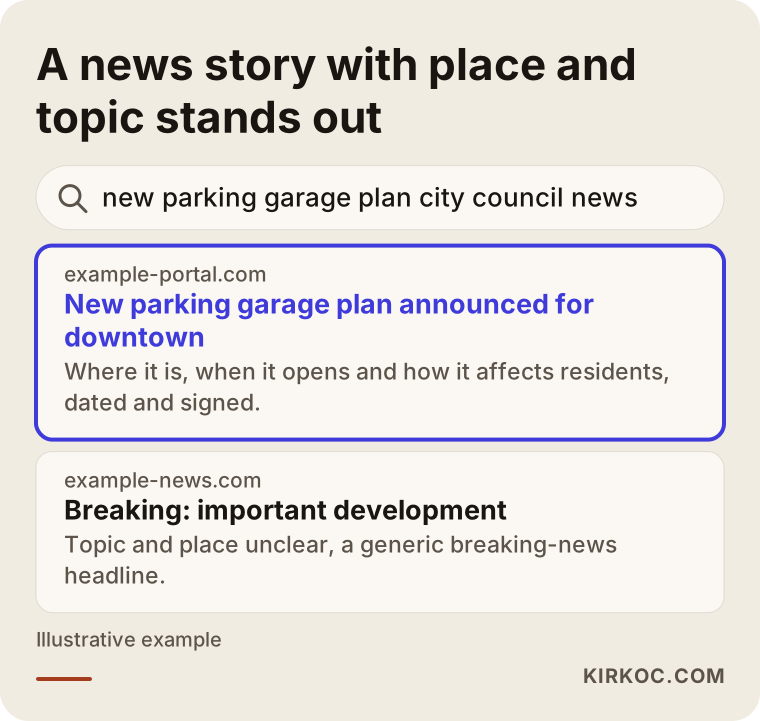
Look at the highlighted result. Its headline names the place and the topic, and its description says what actually happened. The other result carries a generic "breaking" headline. It is not hard to guess which one a reader will click. Google weighs those clicks together with the structure of the page itself.
Google News, Discover and regular search: three separate doors
Mixing up these three doors is the most common confusion I see among publishers. Each one works differently.
Regular search. A reader types something and Google lists results. For news-related searches, a box of news results, often called "Top stories," sometimes appears above the normal results. To get into that box, Google needs to recognize your site as a news source, and your content needs to be fresh.
Google News. This is a separate section where Google gathers news from many publishers. Google offers a tool called Publisher Center, where publishers manage their own information. There you can define your site's name, logo and publication sections. But registering does not guarantee that you will appear. Google evaluates your content against its own standards for quality and trust.
Discover. This is the feed of suggested stories that appears on the home screen of the Google app on a phone, before the reader has searched for anything. To appear here, a large, high-quality image matters, and so does a headline that is genuinely interesting without being misleading, along with a site that looks trustworthy. Traffic from Discover is usually uneven: one story is read by thousands, and the following week you get almost nothing. For that reason I recommend not tying your income to Discover alone.
The table below puts the three doors side by side, along with direct visits.
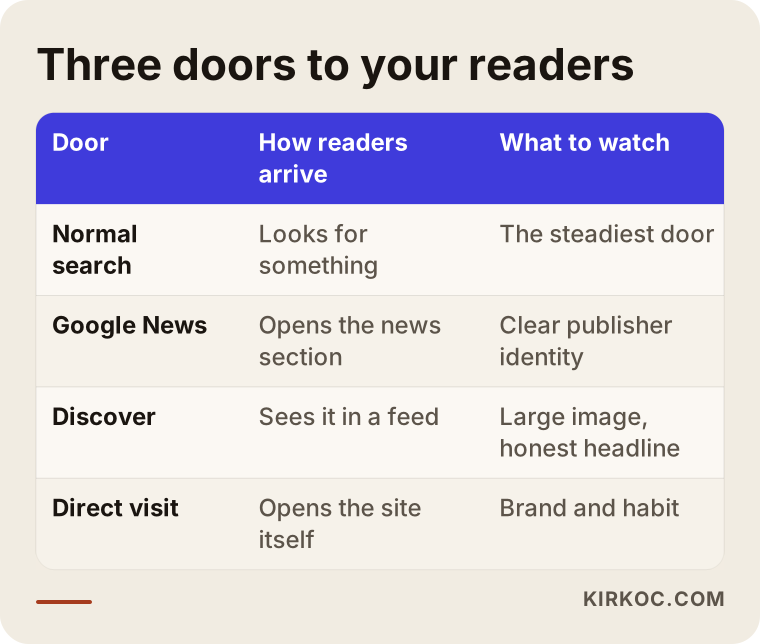
The takeaway is this. Regular search is the steadiest door, because people search when they need something. Discover is the most unpredictable. Google News depends on your site having a clear identity as a publisher. You can build one foundation that serves all three, but how much effort you put into each depends on what kind of site you run.
Opportunities and problems specific to local news portals
For most local portals, competing head-on with national news sites is not realistic. But a local portal has something the national sites do not: it knows the area. For searches like "power outage in Riverside," "county commission meeting decisions," or "weekend weather in your town," the big sites often have little detailed local content. A local portal can find a place there.
Here are the problems I see most often in local news:
- Many copies of the same story. Sites that publish wire copy exactly as it arrives share identical content with hundreds of other sites. In that case Google decides on its own which version to show, and it often picks the first or the strongest site. Adding your own knowledge and local detail to the story is the most effective fix.
- Inconsistent place names. If a reader types "St. Louis Park" and you sometimes write "St Louis Park" or a variant, the match gets weaker. Spelling place names the same way every time is a simple but effective step.
- Thin coverage of government and agency news. Instead of copying an official press release, add a paragraph that answers "how does this decision affect you?" That makes the story valuable to a reader.
- A messy archive. If old stories have no categories and no tags, a valuable local memory becomes unusable.
There is an important point here about trust. For a news site, credibility is critical. Google expects sites that cover health, money and legal topics to be clear about their sources and authors. Who wrote the story, who is responsible for the site, how to contact them and what the corrections policy is should all be visible. This is not a minor detail. It is the trust skeleton of the site.
How a news article page should be built
The layout of the page that holds a story matters almost as much as the story. The illustration below shows the article layout I recommend, using an invented domain.
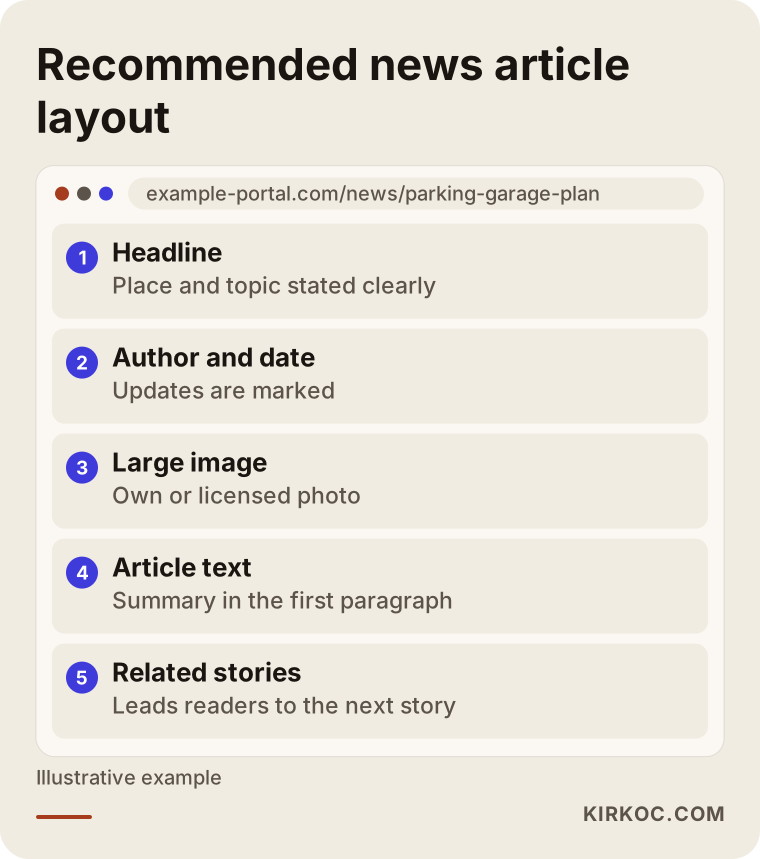
Let me explain the main points in plain language.
Headline. This is the first thing both the reader and Google see. The headline should say clearly what happened. A headline that hides the key fact to create curiosity can bring clicks in the short term, but if readers feel tricked, they leave and do not come back. You can also read in Google's own guidelines that it does not like misleading headlines for Discover.
Author and date. Who wrote the story and when it was published should be visible on the page. If you updated the story, say so. The date should be given not only as text a person can read but also in a technical form Google can read. You may hear this called "article markup," or by its technical name, NewsArticle structured data. In simple terms, it is the page telling Google in writing, "I am a news story, I was written on this date, and this person wrote me." Most publishing software offers this ready-made, but you still need to check that it works correctly.
Image. For Discover, a large and sharp image matters. Small, blurry or logo-heavy images miss the opportunity. The image should be your own photo or one you have the right to use, both for legal reasons and for trust. I cannot give you a firm answer on copyright. If you are unsure about a particular image, talk to an attorney.
Related stories. When readers finish one story, they should be able to move on to another. This increases the time they stay on your site and helps Google understand how your pages relate to each other.
The technical load: ads and speed
This is perhaps the most neglected part of news site SEO, because ad revenue feeds you while the same ads slow your pages. If a reader opens a story on a phone and the layout jumps while loading, or the paragraph they were reading gets pushed down by an ad, they will leave. Google takes these kinds of experience problems into account in its page experience measurements.
Typical causes of heavy technical load on news sites:
- Many ads and tracking codes all loading at the same moment.
- Ad slots that open late without reserved space, so the text shifts down as the page loads.
- Large, uncompressed images.
- An old, heavy theme or software stack, with plugins piled up over the years.
- Video players running on every page at once.
- Pop-ups, cookie notices and newsletter boxes stacked on top of one another.
The illustration below summarizes these problems.
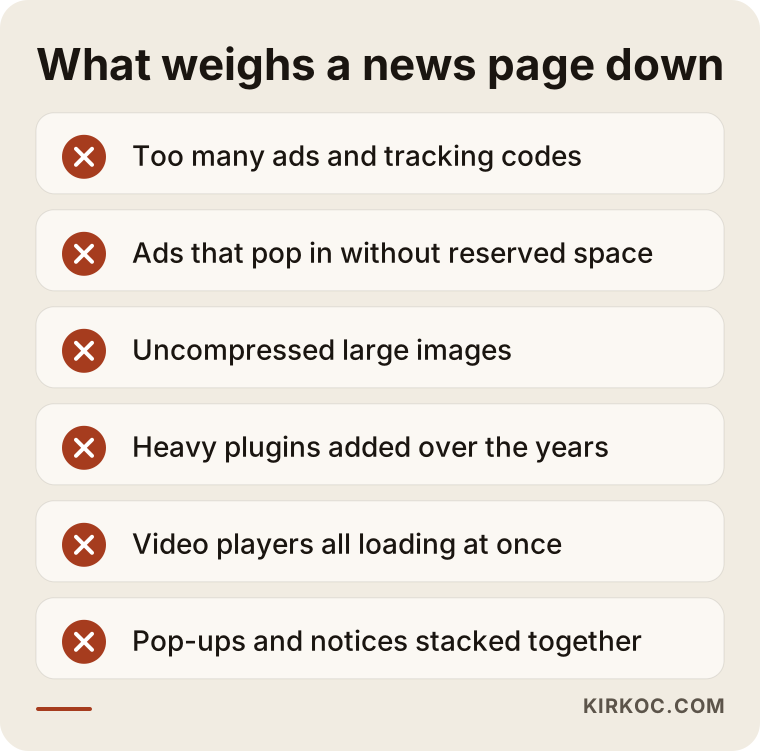
I should be honest here: removing ads altogether is not the answer, because they pay for the site. The answer is placing them wisely. Reserving fixed space for ad slots, leaving the first part of the screen to the reader, resizing images properly and cleaning out unnecessary code often improve speed noticeably without losing revenue. Measuring which ad slows a page and by how much is much healthier than guessing.
Your hosting matters too. When a story takes off and a sudden wave of visitors arrives, a server that cannot respond means neither readers nor Google can reach you. Building a setup that holds up under heavy traffic usually means reviewing server and caching settings.
Two hypothetical scenarios
The two scenarios below are entirely hypothetical. They have nothing to do with a real site or person. Their purpose is only to show the reasoning.
Scenario 1: A local portal focused on one town
Suppose there is a small news portal focused on one town. It publishes a few stories a day, most of them taken from government and agency announcements. The site runs on an old theme that has been in use for years, and it opens slowly on mobile. The date of each story appears on the page, but it is not reported to Google in technical form. The categories are scattered, and the same topic sits under three different tags.
On a site like this, the foundation comes first: speed, mobile display, properly declared date and author information, and simpler categories. Then the character of the content is examined. If the portal moves from publishing only the official announcement to an approach of "what does this decision mean for people in the neighborhood," it can stand out in searches about that town. I cannot say in advance how long results will take. But if the work goes in the right direction, it is reasonable to expect the site to appear more often in searches about its town.
Scenario 2: A mid-sized, ad-dependent portal
In the second hypothetical example, there is a mid-sized portal with several writers and many stories each day. A large share of its traffic comes from Discover, and the number of incoming readers has been dropping for a while. The owner does not understand why. When I review a site like this, I might find that the pages are loaded with ad and tracking code, that images are published at a small size, and that some headlines hide the key fact to create curiosity.
The first step here is not to look for someone to blame. It is to measure. Which pages are slow, which stories appeared in Discover and which did not? Then an image standard is set, the headline style is simplified, and the ad placement is reviewed. Because Discover is so uneven, it is hard to separate the effect of any single change right away, so changes are made in small steps and written down as they happen.
Step by step: how SEO works on a news site
This is the order I follow when I work on a news site.
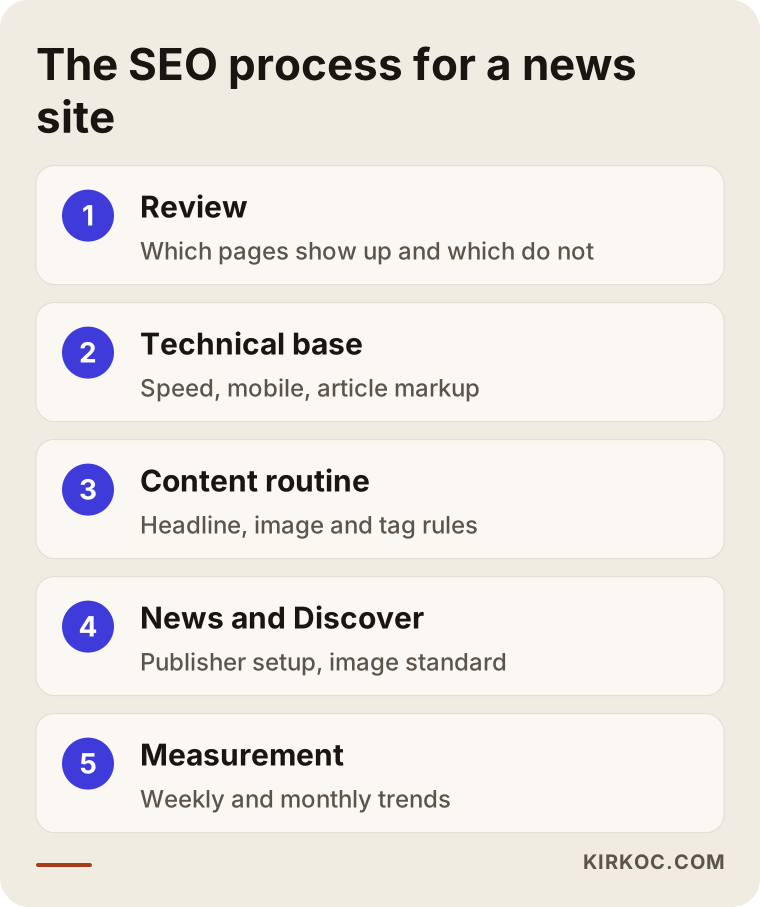
1. Review. I go through the site through the reader's eyes and through Google's eyes. Which pages show up in search results, which do not, and which stories have brought traffic? For this I use Google's free tool, Search Console. You would need to set up the account for your site and give me access.
2. Technical base. I fix infrastructure matters such as speed, mobile compatibility, article markup, the sitemap and robot files. (A sitemap is a list of your pages for Google, and a robot file tells search engines which parts of the site to skip.) This is the stage where nothing visibly changes, but everything else is built on it.
3. Content routine. Rules for headlines and descriptions, an image standard, place-name spelling, and the category and tag structure are decided. I prepare a short checklist that will not slow down your editors' daily work.
4. Google News and Discover preparation. Publisher Center settings, the logo, publication sections, and image and headline standards for Discover are reviewed. This step does not guarantee visibility, but it removes obstacles.
5. Measurement and adjustment. Each month I look at what worked and share it with you. On a news site, deciding based on a single day's swing is misleading. Weekly and monthly trends are more meaningful.
Common mistakes
These are the typical mistakes I see on news sites.
Misleading headlines. Headlines that hide the key fact to get a click may pay off quickly, but they damage trust over the long run. Google's Discover guidelines do not recommend them either.
Calling everything breaking news. If every story is labeled "breaking," it becomes harder to tell which story really is.
Publishing wire copy as is. If your site offers nothing different, you are one of hundreds of sites running the same text.
Putting page speed off until later. As ad revenue grows and pages get heavier, over time you can lose both readers and search visibility.
Deleting old stories. Deleting an old story you consider low value means losing the readers and links that still reach that address. Before deleting, set up a redirect or keep the story in the archive.
Not naming the author or source. Trust weakens when it is not clear who wrote a story. That is why About, Contact and corrections policy pages matter.
Ignoring image rights. Using an image found online without permission is both a legal risk and a trust problem.
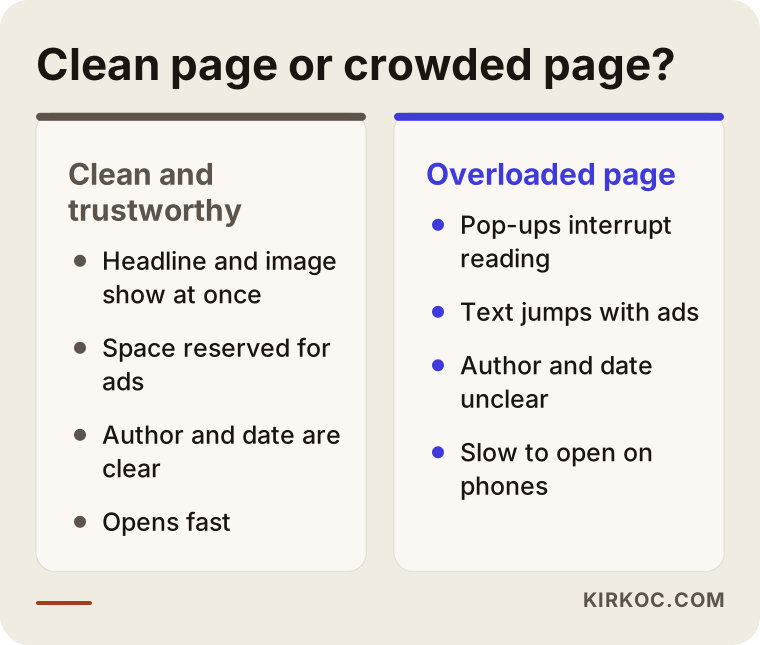
The comparison in the illustration summarizes the difference between a clean, trustworthy news page and one where everything is piled on top of everything else. The second may show more ads in the short run, but because readers do not stay on the page, it often costs more over the long run.
What you can do yourself
You do not have to hand everything to a specialist. Your editors or you can do the following.
- Write a clear headline for every story that includes the place and the topic.
- Make the author name and publication date visible on every story, and say so when you update a story.
- Use a large image that you shot yourself or have the rights to, whenever possible.
- Spell place names the same way every time.
- Open Search Console and look once a week at which stories were shown in search.
- Make sure the About, Contact and corrections policy pages are up to date.
- Open your own site on your phone. If it loads slowly or the text jumps, make a note.
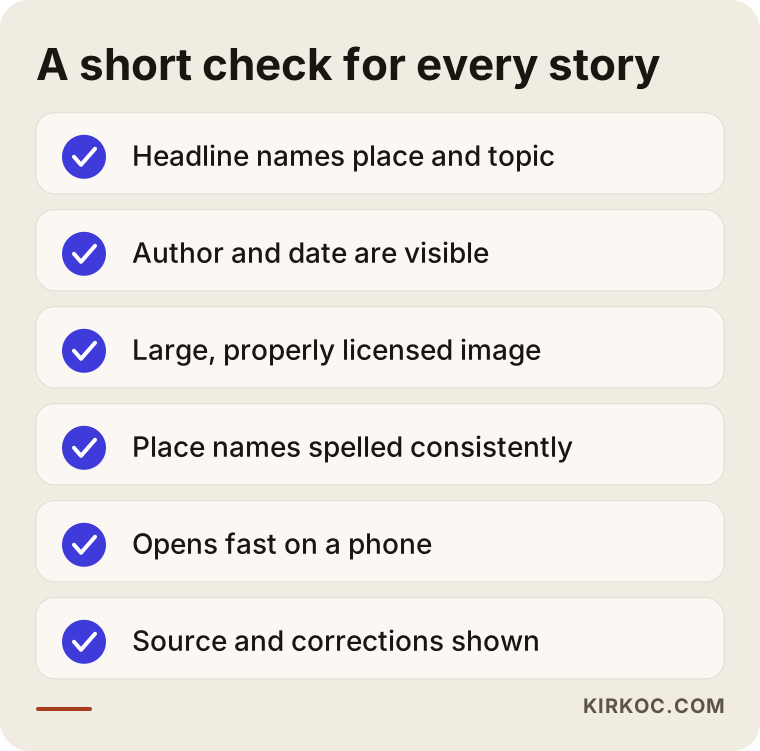
Even printing this list and pinning it up in the newsroom helps. Small habits make a big difference over time, because the number of pages on a news site grows quickly, and when every page leaves your hands at the same standard, the site gains consistency.
When do you need a specialist?
In these situations I think outside help makes sense:
- Your site is seriously slow on mobile and you cannot find the cause.
- You see a sudden, unexplained drop in traffic.
- You want to understand why you are not appearing in Google News or Discover.
- You plan to move the site to a new platform. A bad migration can wipe out visibility that took years to build.
- You want to see the balance between speed and revenue before changing your ad layout.
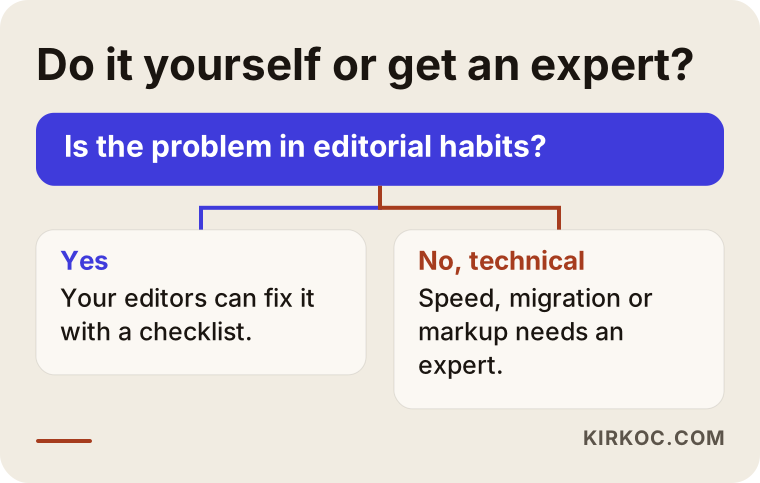
The logic in the decision chart is simple. If the problem is editorial habit, your own team can solve it. If the problem is in the technical foundation, such as speed, migration or structured data, you need expertise.
AI assistants and news sites
Lately, readers have started asking some of their questions to AI assistants instead of search engines. For a question like "what happened in our town this week?", an assistant may or may not show its sources. This area is changing fast, and it would not be right for me to state any firm rule. But there is one thing I can say with confidence: assistants find it easier to use pages that are clearly written, have an identifiable source, and show a clear date and author. In other words, the routine I described above also helps in the age of AI.
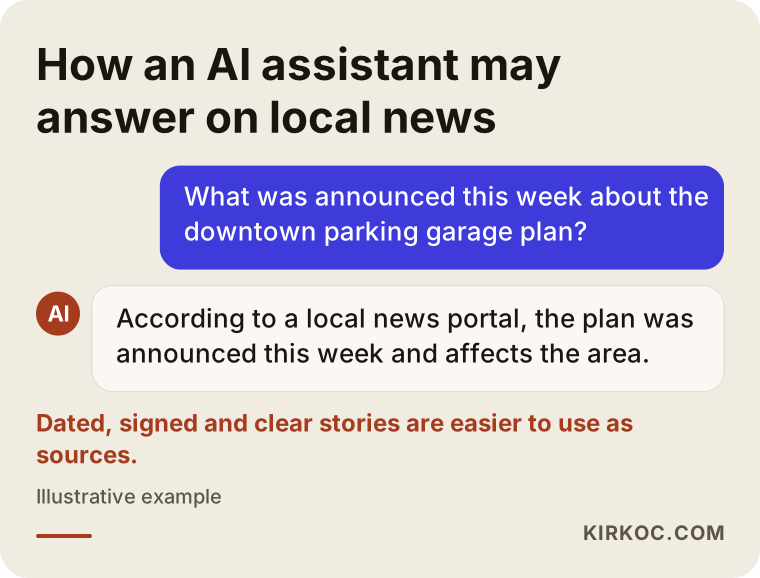
This example is hypothetical. No one can guarantee which source an assistant will choose. But writing your story clearly, with a date and a byline, is preparation that makes it more likely to be picked.
What to expect in the first three months
Results in news site SEO come in stages. The changes you see in the first months are usually technical ones: pages open faster, the number of errors drops, and Search Console starts to look orderly. The effects on content and visibility come later. I cannot promise rankings or traffic, because Google's decisions are not in your hands or mine.
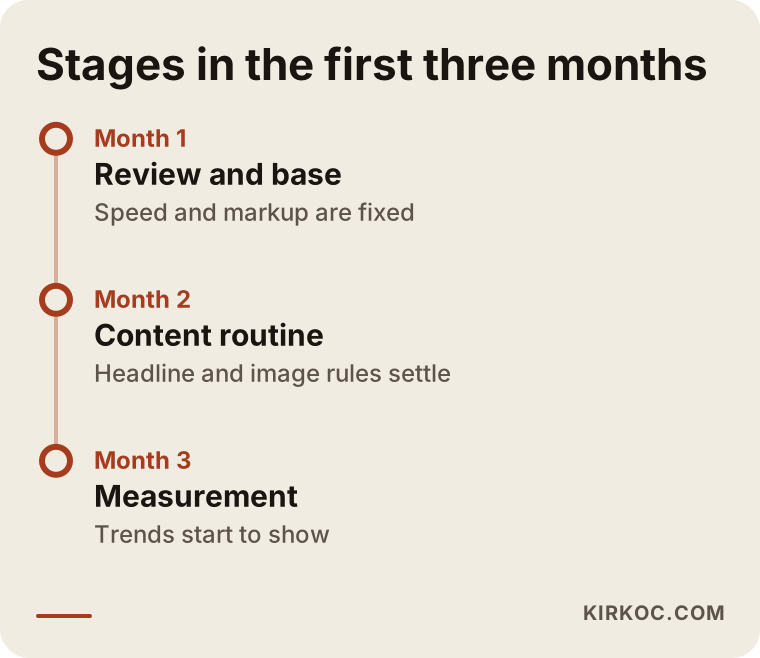
As the timeline shows, the foundation is laid first, then the content routine settles, and finally measurable trends appear. Impatience is the most expensive habit in this work, because every adjustment left half finished can cancel out the one before it.
What determines the cost
I do not give a number for news site SEO, because no two sites are alike. The main factors that shape the price are these:
- Size of the site. Reviewing an archive of a few thousand stories is not the same job as reviewing one with tens of thousands.
- Complexity of the technical setup. An old and tangled infrastructure takes more time than a clean one.
- Structure of the ad layout. A site that works with many ad networks needs more measurement in the speed work.
- Scope of the work. Whether you want only a review, the fixes carried out, or ongoing monthly support.
- Publishing pace. A site that publishes many stories a day needs more frequent monitoring.
- Need for migration. If the infrastructure is changing, extra care is required.
That is why talking about price before looking at the site would not be right. I present what you need, what will be done and the scope in writing, so you know what you are paying for.
How I work
I work on my own, which means the person you talk to is the person who does the work. In the first conversation I listen to how your site runs, how you publish and what you expect. Then I review the site and share what I find in writing, without jargon. Together we decide which tasks your own team will handle and which I will handle. I do not promise results. I explain what I am doing, why, and what will be measured. I leave no uncertainty about payment and scope.
Frequently asked questions
I just launched a news site. Will I show up in Google News automatically?
No, there is no guarantee of appearing automatically. It helps when your site is trustworthy, publishes regularly and makes details such as the author and contact information clear. Defining your information in Publisher Center is useful, but Google's own evaluation decides your visibility.
Why is Discover traffic so uneven?
Discover is a feed based on recommendations, not on searches. Google shows a story to some users based on their interests and then moves on to other content. That is why it is healthier to treat Discover as a pleasant surprise and not to build your income on top of it.
Do I have to reduce my ads?
Not necessarily. The aim is not to remove ads but to place them in an orderly way. Reserving space for ad slots, delaying heavy code and shrinking images often improves speed without giving up revenue. Because every site is different, you need to measure before deciding.
Does publishing wire stories hurt SEO?
On its own it does no harm, but it does not set you apart either. If many sites publish the same text, Google decides which one to show. Adding local detail, your own commentary or an explanation that helps the reader sets you apart.
Should I delete old stories?
Usually not. Old stories can have archive value and may be earning links. If you really must remove one, a proper redirect should be set up. If a legal request is involved, I suggest talking to an attorney.
Is putting the author's name really necessary?
It is one of the trust signals for a news site. It shows both the reader and Google who is responsible for the story. If you use a pen name or an editorial desk, it helps to explain on your About page who the team and the responsible people are.
When will I see results?
I cannot say the timing is certain. The effect of technical improvements usually shows first, and the effect of the content routine comes later. Because news sites have a lot of daily ups and downs, you should look at weekly and monthly trends.
What should I do before moving the site to a new platform?
You should list your current addresses and prepare a redirect plan to the new ones. After the move, you need to watch Search Console for errors. This is a job where mistakes are costly, so I suggest talking to a specialist before the move.
If you would like to work out together what your news site or local portal is missing, you can reach me through my SEO services page and arrange a short conversation about your site and your goals.