You run a business, and not having a website, or having an outdated one, is starting to bother you. Somewhere you saw an offer along the lines of "no big upfront budget, pay monthly, and your site is ready." It sounds reasonable, because no large sum leaves your account and everything arrives finished. But there is a hesitation in the back of your mind: you are renting this site, not buying it. In this article I will explain what website rental actually is, who it suits, who it does not suit, and which questions you should get answered in writing before you sign. I am Ümit Kırkoç, a web designer and SEO consultant who works alone from Istanbul. I offer my own website design service on a buy-it-once model, so I should tell you up front that I am not a neutral party. Still, my goal is not to push you in one direction. It is to help you make the decision with good information.
Let me define the term first. Website rental means a company builds a site for you and charges a monthly fee in return. Usually the design, hosting (the place where your site lives on the internet), the domain name and sometimes small updates are bundled into that fee. The setup cost you pay at the start is low or zero. In exchange, you do not get the site itself; you get the right to use it. That difference looks small, but everything else depends on it.
How does website rental actually work?
The logic is similar to renting an office. When you rent an office, you receive the keys and you work there, but the building is not yours. If the lease ends, or you stop paying, you have to leave. A rented website follows a similar pattern: the site sits in the provider's account, on a system the provider chose, and very often with a domain name or server registered in the provider's name. You supply the content, and the company keeps the site running.
There are two quite different arrangements hiding under the same word. The first is a package system, where your text and photos are dropped into a ready-made template. The second is a custom-designed site where only the payment is split into monthly installments. Both get called "rental," but the outcomes are very different. Some contracts are written so that the site is built for you and handed over at the end. Others never hand it over under any circumstances. When an offer lands in your inbox, the first job is to figure out which of the two you are looking at.
The graphic below puts the two models side by side. It contains no numbers; it only shows what stays with whom.
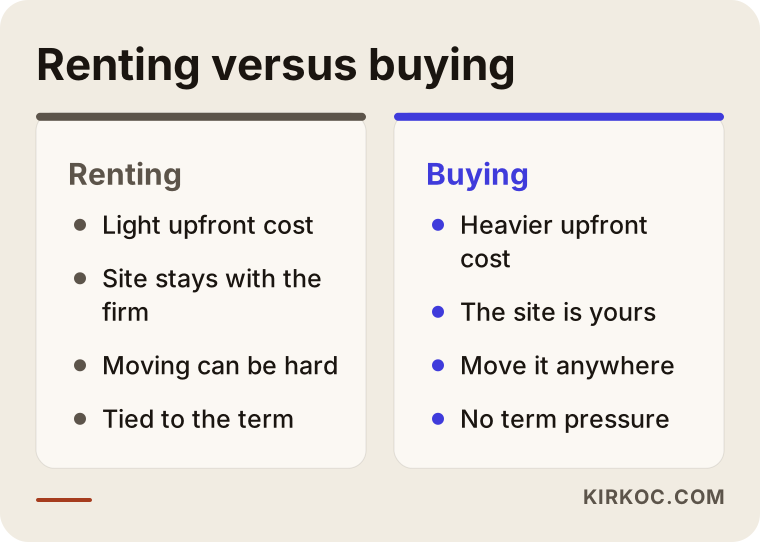
Here is what to notice. With renting, the starting burden is light but ownership is not yours. With buying, the starting burden is heavier but you can take the site wherever you like. Which one is "better" depends on your business and your situation, and I will go through that in detail below.
Who might renting make sense for?
To be honest, renting is not always a bad idea. In some situations it genuinely works. Say you are starting a new business, you do not know yet whether it will take off, and you have put most of your budget into inventory, equipment or rent. In that case, a short rental with clear exit terms can be a sensible way to become visible online quickly.
The second case is a business that does not want to deal with its website at all and expects very little from it. Think of a local repair shop that only needs its phone number, address and opening hours to show up correctly online. It has no plans to grow the site or add pages. For that business, a small, simple, maintained site rented month to month may be perfectly adequate.
The third case is a temporary project: a seasonal event, a campaign, a launch. If the site will live for a set period and then shut down, ownership is a secondary concern anyway.
Outside these cases, renting often causes trouble for businesses that expect customers from their site over the long term, want to appear in Google search results, and plan to grow the site over time. I explain why below.
The real question: who owns the site, the domain and the content?
When you are deciding on a rental, put this question ahead of the price. The answer to "what happens when I stop paying?" shows you the true face of the model. That is because a website has several separate parts, and each one can have a different owner.
The domain name is your site's internet address, the name you type, like example-company.com. Whoever the official registration is under is the real owner of that address. Your customers know you by it, and you print it on business cards, vehicles and signs. If the address is registered to the rental company and they do not hand it over when you leave, you may have to abandon years of built-up recognition and move to a new address.
Hosting is where your site's files are stored. It is normal for this to sit with the company, since it is part of the service. What matters is that when you leave, you can take a copy of your files and move them somewhere else.
Design and code are the parts that create the look and function of the site. In some systems this is a closed setup the company built itself, and it cannot be moved. In other words, even if you were handed the site, you would have nowhere to run it.
Content is the text, photos, logo and product details you provide. Legally, these should belong to you, but if the contract does not say so clearly, disputes can arise. If the company supplied the photos, who holds their license is a separate question.
Finally, there are accounts and measurement tools: Google Analytics, Google Search Console, your Google Business Profile and similar. You are the owner of these, and you should hold the admin access. If the company opens them under its own account and only sends you reports, you can lose all your historical data when you leave.
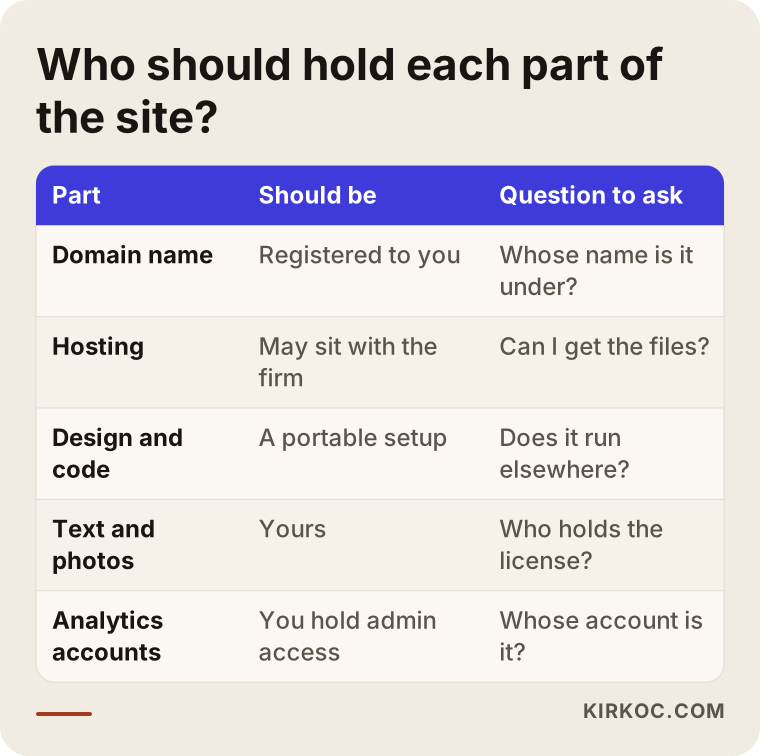
The most critical row in that graphic is the domain name. Before you sign, ask in writing, "whose name will the domain be registered under?" and get the answer put into the contract. A verbal "of course it's yours" is worth nothing once the relationship goes sour.
Why does the domain name matter so much?
Let me explain a bit more, because this topic usually comes to mind last and costs the most. The domain name is your address on the internet. Moving a site to a new host is possible, and redesigning it is possible, but if the address changes, search engines and your customers have to learn who you are all over again. Google knows your site by that address. When the address changes, the trust that has built up over the years may not drop to zero, but it can weaken noticeably. I cannot give you a specific timeframe, because it differs from site to site, but changing your address is not a cheap or harmless task.
A domain registration has three roles: the company that handles the registration, the person or business listed as the owner, and the administrative contact details. The healthiest setup is for your name or your company's name to appear as the owner. You can check this yourself, because domain lookup services show whose name an address is registered under. Sometimes the details are hidden for privacy; in that case, ask the company directly for the registration document.
If the rental company registers the domain in its own name, ask these three questions. If I leave, will this address be transferred to me? Is there a fee or a waiting period for the transfer? Under what conditions can the transfer be refused? If the answer is "free, and any time you want," you have no problem. If the answer is "you cannot use it after the contract ends," then this is not renting; it is dependence.
What to look for in the contract
A contract can look long and dull, but with a rental it is your main protection. Find each of the clauses below one by one. If something is missing or vague, ask for it to be clarified before you sign. I should not give you a definitive legal interpretation, and if the contract places a significant obligation on you, I recommend having a lawyer look at it.
Start with the term and renewal. How many months does the contract run? Does it renew automatically when the term ends? When and how must you give notice to stop the renewal? In some contracts, if you miss the notice window, you are locked in for another full term.
Next, early exit. If you want to leave before the term is up, what do you owe? All of the remaining months, or a part of them? If there is no right to exit early, that should be written down plainly, and you should accept it knowingly.
The handover clause is just as important. When you leave, in what form, within what time and at what cost will the domain, the content, the images and the site files be delivered to you? Is what you receive a backup that can actually run somewhere else, or only a flat copy of the text and pictures?
The scope of service must also be clear. What does "updates included" cover? A phone number change, a new page, a new section? How many changes per month are you entitled to? Is a response time promised?
Do not forget the price change clause. Is the monthly fee fixed, or can the company raise it whenever it likes? If it rises, do you gain the right to leave?
Finally, data and privacy: who holds the customer details that come in through your contact form, will they be given to you when you leave, and who is responsible for personal data? Here too, legal advice is sensible if you are unsure.
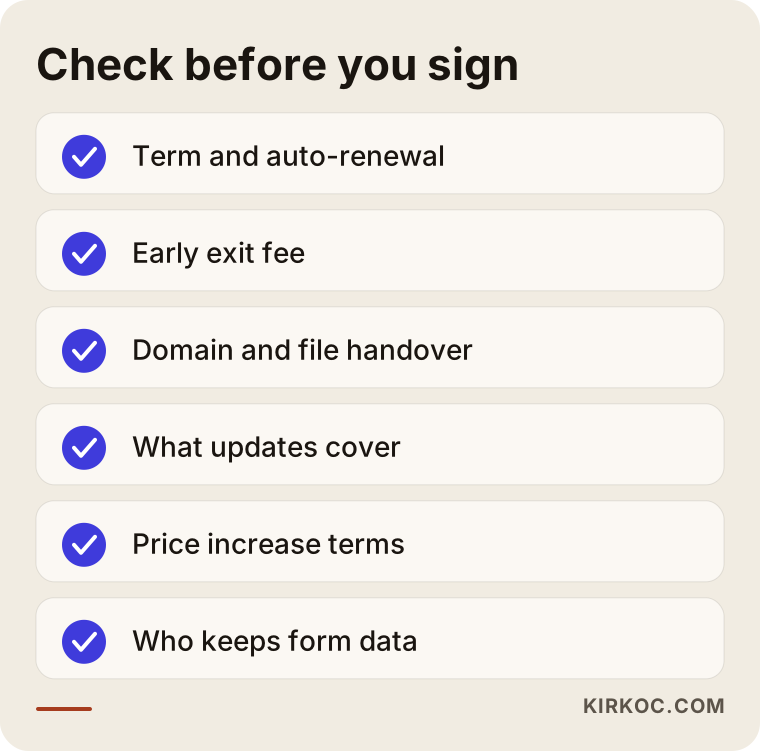
Take this list with you when you talk to whoever sent the offer. Ask for the answers in writing, not by phone. A company that avoids giving clear answers has already told you something.
Common traps in website rental
The rental model itself is not bad, but some ways of running it leave the business owner in a difficult position. Here are the situations I run into, and which you should ask about too.
The first is the combination of a low start and a long commitment. The first months look easy, but a long lock-in with an early exit penalty moves the real cost to that point. Work out what you will pay in total and what will be left when the term ends.
The second is a closed system. If the site runs on the company's own proprietary software, you cannot take it elsewhere. If a widely used platform is used (for example WordPress), leaving becomes much easier. Ask for the name of the system and find out whether another professional could work with it.
The third is an unclear right to updates. If the offer says "maintenance included," but in practice every change costs extra, then the monthly fee is not buying the service you expected.
The fourth is assuming that search visibility is part of the rental. Some packages imply "you will show up on Google." Nobody can guarantee a ranking, and anyone who does is a sign to be careful. Keeping a site online and working to get it found in search results are two separate jobs.
The fifth is not being given admin access. If you must write to the company every time you want a change and you never get into the control panel, your dependence is complete.
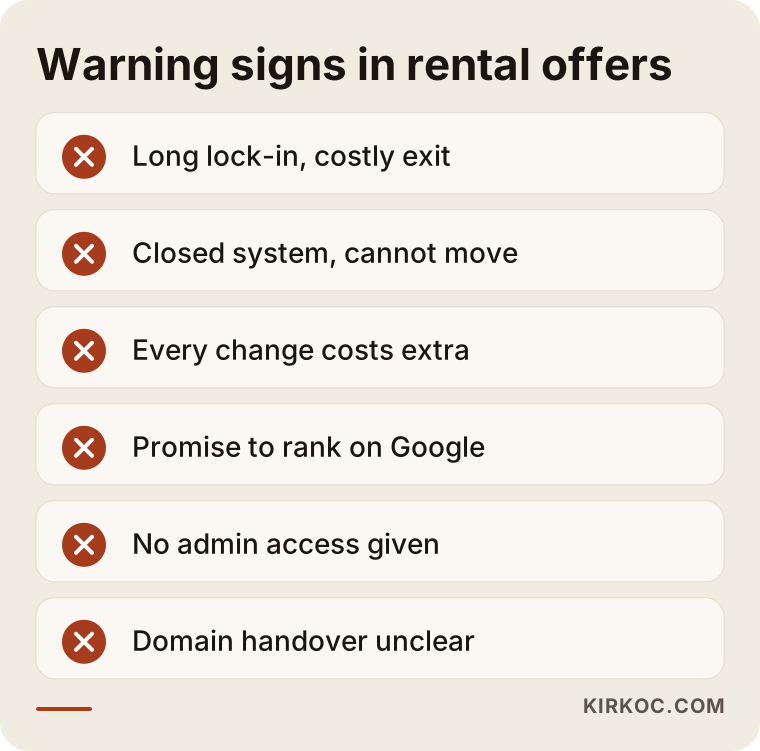
Seeing one or two of these warning signs does not mean you must reject the offer immediately. It does mean you should not go further until that point is clarified in writing.
Two hypothetical examples
The two scenarios below are entirely hypothetical; they do not describe a real person or company. Their purpose is to show how the same offer can lead to different results for two different businesses.
Example scenario 1: a business with a short-term project. Imagine someone running an outdoor event for one season. The event will last a few months and then close. For this person, a one-page site on a ready-made template could be rented on a monthly payment and a short contract. They would still ask to hold the domain, but even if they lost it, the damage would be small, because once the event is over the address is no longer needed. Here, renting is a sensible and lightweight solution.
Example scenario 2: a business that has operated for years. Now take a different assumption: a furniture workshop that has worked at the same address under the same name for years and wants to receive inquiries online. It pays monthly for three years, and during that time the site gains some recognition and customers memorize the address. Then the owner wants to work with a different specialist. If the domain is registered in the rental company's name, a handover argument begins. If the system is closed, the site cannot be moved. If there is no admin access, the Search Console data is gone too. The owner has to start from zero or negotiate. The same offer has turned into a dependency trap for this business.
The difference between the two scenarios is not in the offer. It is in how long the business will live and how attached it is to its address. So ask yourself this: will this site still be the face of my business three years from now?
Step by step: how to decide
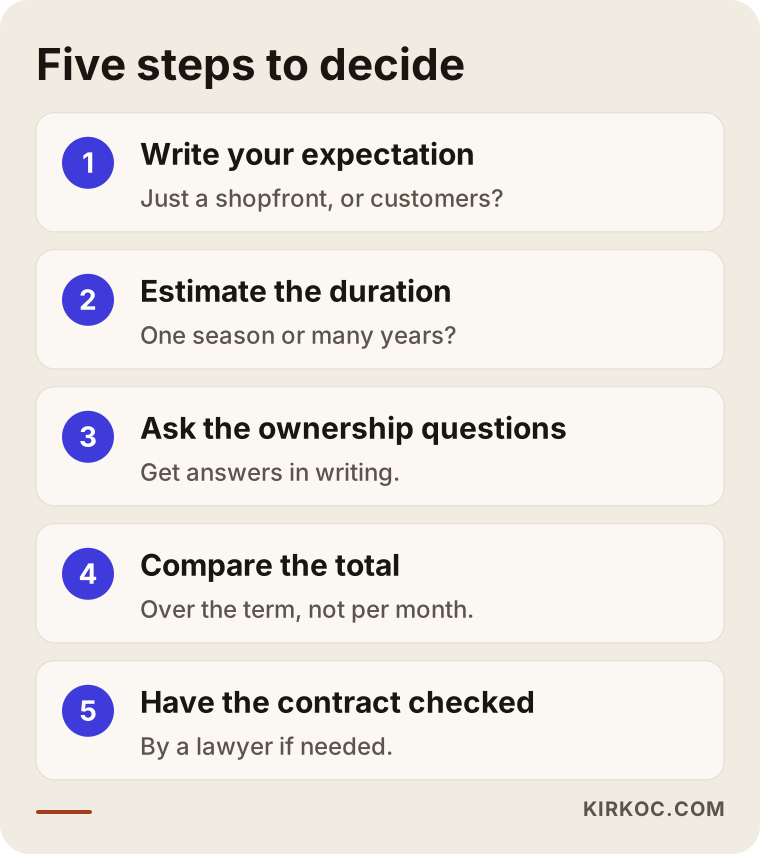
If you have an offer in hand, you can follow the order below. Each step makes the next decision easier.
Step one is to write down what you expect from your site. Do you only want "address and phone number to show up," or do you want "new customers from search"? The bigger the expectation, the more ownership matters.
Step two is to estimate how long you will use it. One season, several years, or you do not know? If you do not know, an option with flexible exit terms, or a model where you own the site from day one, is safer.
Step three is to send the ownership questions to whoever made the offer: domain, files, accounts, admin access. Get the answers in writing.
Step four is to compare the total cost under both models. For renting, add up the monthly fee across the whole contract term; for buying, consider the one-time cost together with yearly hosting and maintenance. I am not giving numbers, because they vary a lot from job to job, but if you do your own calculation you will see whether one is cheaper in the short or the long run.
Step five is to show the contract to a lawyer if needed. Especially with long contracts or ones that include penalty clauses, this is a small expense that can prevent a large dispute later.
When people skip these steps, the most common outcome is saying "I wish I had asked" a few years later. The steps look time-consuming, but they add up to no more than a day of work.
The life cycle of a rental contract: what happens when
It helps to think of a rental contract as a calendar, because a different risk comes to the front in each period. At the start there is excitement and everyone is attentive. A few months in, routine work begins. As the end of the term approaches, renewal and exit come onto the agenda.
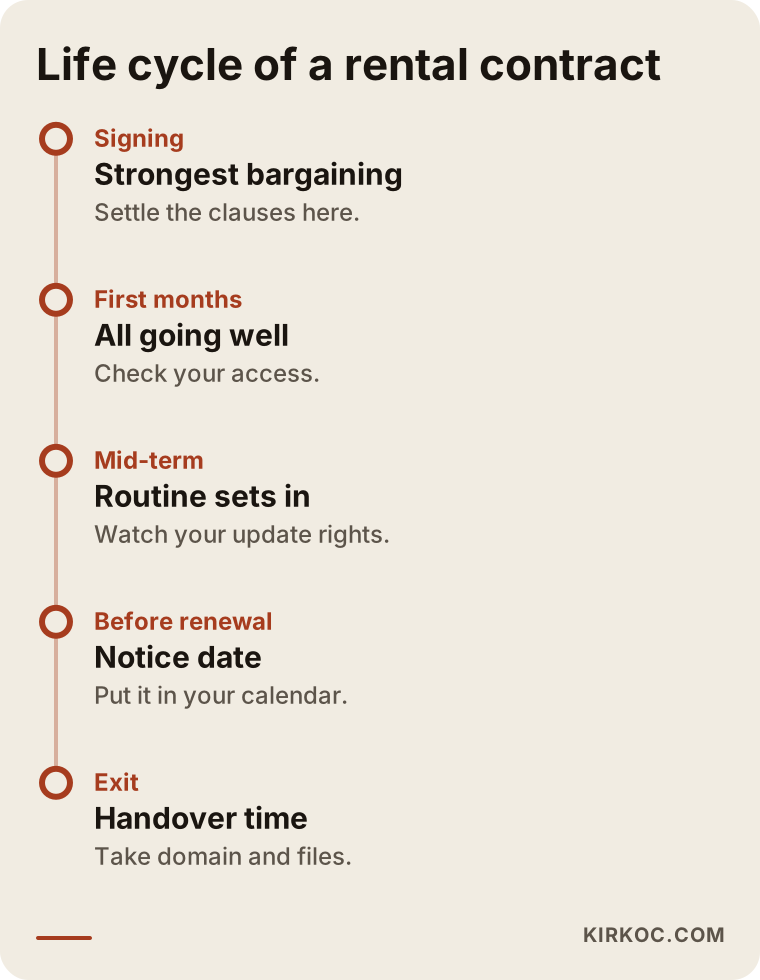
Take one note from the timeline: your real bargaining power exists before you sign. After the signature, saying "let's add this too" is much harder. The period before renewal is your second chance; a business that writes the notice date in its calendar is protected from contracts that extend by accident.
How does ranking in search relate to renting?
Many business owners think of a website purely as a shopfront. But if you expect new customers from your site, the site has to be found on Google. That depends on the content, the page structure and the trust that builds up over time. Renting raises two questions in this respect.
The first is whether you can grow the site the way you want. You may need to add a new service page, a blog post or a page for a particular area. In a template-based rental system, if the number of pages or the structure is limited, you may not have the flexibility search engines reward.
The second is who keeps the accumulated value. If a site has earned a place in search results, that value is tied to the domain name and the page addresses. If you leave and the domain and page addresses are gone, that value is lost. In other words, SEO effort is directly tied to the ownership clauses of the rental contract. I say this especially to anyone thinking long term: search work done on a site you do not own is like heavy renovation done in a rented apartment.
The general answer from AI assistants (ChatGPT, for example) on this topic also tends to run along similar lines: renting is fine for short-term and simple needs, while ownership matters for long-term growth. Below is an example of how such an answer might look. It is of course only an illustration and not a record of a real response.
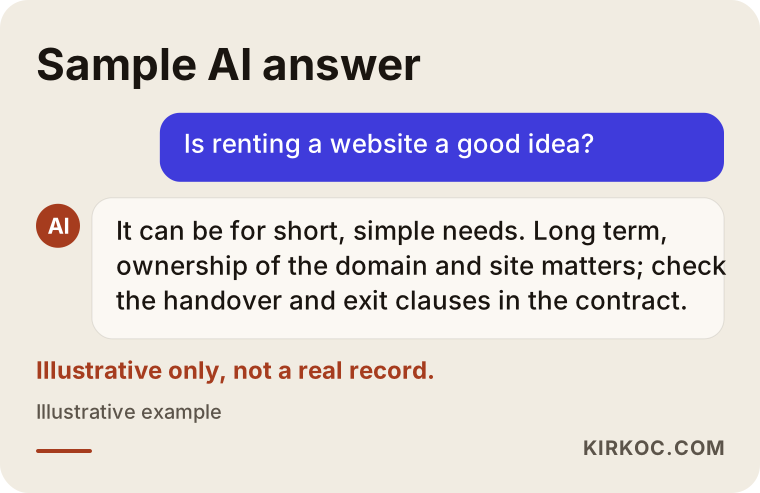
AI answers also vary with the sources and the way the question is asked. Read this not as a verdict that replaces your decision, but as a summary that reminds you which questions to ask.
How do rental offers look in search results?
When you search for "website rental" online, plenty of companies show up. These results are often full of promises like "start now" and "no setup fee." The page title and description look attractive, but the page itself often lacks any information about ownership, exit or handover.
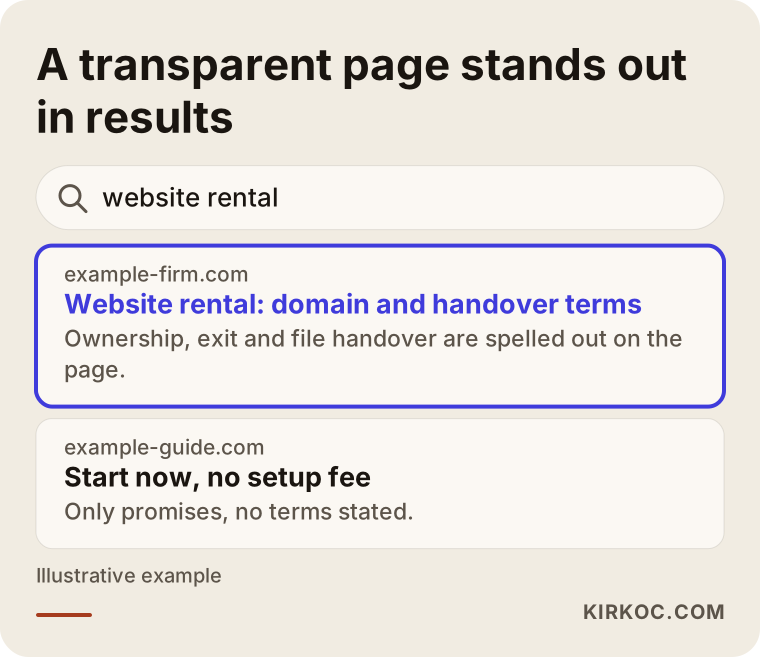
In the example results, the highlighted page makes handover and exit terms visible. If you do not see these on an offer page, do not hesitate to ask directly. A company that shares this information openly is usually transparent afterward as well.
What determines the cost
I will not give you numbers, because both renting and buying vary widely with the scope of the job. But I can tell you what moves the price, so you can weigh two offers on the same scale.
First is the number of pages and the amount of content. A one-page introduction and a service site with dozens of pages do not do the same job. Next is whether the design is made for you; the difference in effort between a ready template and a design from scratch shows in the price. Then come extra features: a booking system, several languages, online sales, forms and integrations. In a rental these are often outside the package or tied to a high extra fee.
The level of maintenance and support also affects the price: how fast you get a reply when something breaks, how many changes you are entitled to, and how backups are kept. Last is the contract term and the ownership arrangement; committing for a long time and leaving ownership with the company can lower the monthly fee but raise the total cost and the risk.
When you compare renting with buying, do not look only at the monthly figure. With renting, what you pay each month is the right to use the site. With buying, you acquire an asset, and in later years you pay only for limited items such as hosting, domain renewal and maintenance. The total cost of the two structures crosses at a different point depending on how long you use the site. Do the math with your own estimate of the time.
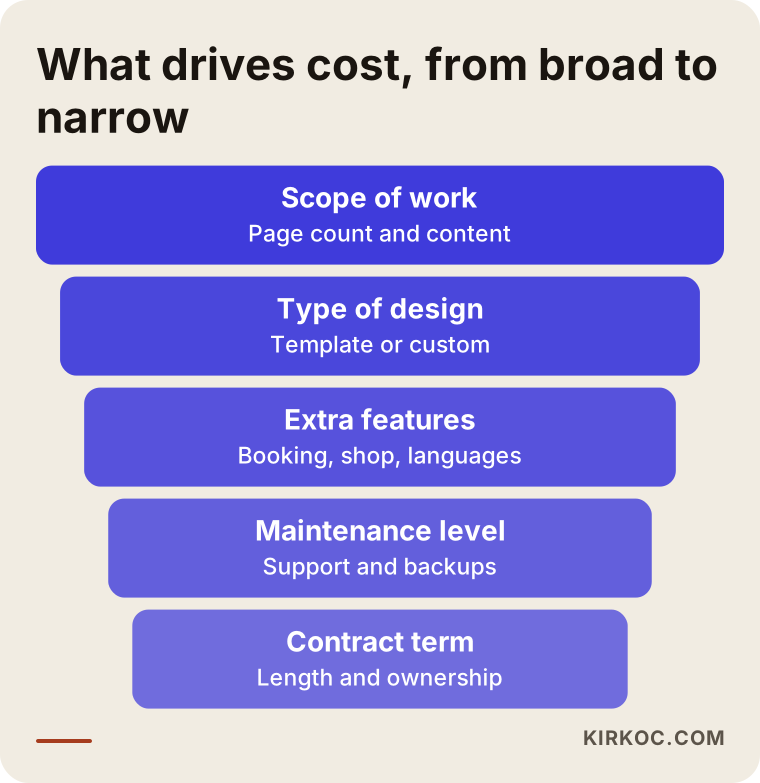
The order in the graphic is not a ranking of importance; it is a reading order. Start with the broad scope and work down to the detail. If you question an offer in this order, it is easier to see why a given item is expensive or cheap.
Common mistakes
Most of the mistakes I see in this area come not from lack of knowledge but from haste. Trusting unwritten promises comes first. Saying "of course the domain is yours" is easy; if it is not in the contract, it means nothing.
The second mistake is looking at the monthly figure without working out the total cost. The third is not asking for admin access to your accounts; you should hold the analytics and search console accounts. The fourth is not tracking the renewal date; by the time you notice the contract has extended, it is too late. The fifth is treating the site as a shopfront and ignoring the need for search visibility and content. The sixth is settling for a single offer; comparing at least two or three offers with the same questions makes the difference in ownership terms obvious.
None of this needs technical knowledge. Attention and written questions are enough.
What you can do yourself, and when you need a specialist
You can check many things on your own. You can look up whose name the domain is registered under with a lookup service. You can mark the term, exit, handover and price clauses of the contract with a red pen. You can email the questions above to whoever made the offer and get written replies. If you already have a rented site, you can check which accounts are yours and whether you have admin access.
There are also places where you will need expert help. Understanding whether a system can be moved elsewhere takes technical knowledge; exporting a closed system is a web specialist's job. Clauses on penalties, termination and data responsibility are a lawyer's job. And if you want to plan a move from a rented site to one you own, you need a careful plan to carry the address and page structure over without losing them, because a site that is migrated badly can drop in search results.
In a move like this, the usual first step is to take stock of the current situation: which pages exist, which ones receive visits, and who holds the domain and accounts. Then comes preparing the new site, setting up redirects from the old addresses to the new ones, and watching the results for a few weeks after the switch. Not rushing this work is the most important condition for protecting what you have built.
The graphic below offers a simple decision flow for exiting.
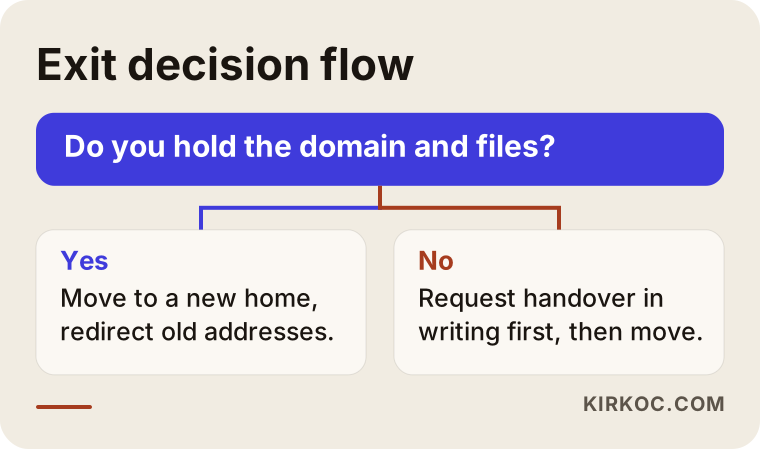
The message of the flow is simple: if ownership is documented, leaving is easy; if it is not, you need to settle that first. That is why the best time to do it is before any problem arises, which means now.
How I work
I work alone, which means the person you talk to is the same person who builds your site. I start by listening to what you want and how your business finds its customers. Then we settle the page structure, the content and the design together. When the site is finished, the domain, the accounts and the files are registered in your name, so that if you ever want to work with someone else, nothing holds you back. Maintenance and search engine work are optional, discussed separately, and the scope is set in writing from the start.
This model is not right for everyone. For someone with a very tight budget or a temporary project, a short rental may make more sense, and I will say so openly. What matters is that you make the decision knowingly.
Frequently asked questions
Is renting a website worth it?
It depends. It can be worth it for short, simple, budget-limited jobs. For businesses that want to grow over the long term, show up in search and build the site up as an asset, a model where you keep ownership is usually safer. The handover and exit clauses in the contract decide it.
Who owns the domain on a rented website?
It depends on the contract. Some companies register the domain in their own name and do not hand it over; others register it in yours. Before signing, ask in writing, "whose name will the domain be registered under, and will it be transferred to me if I leave?" and have the answer written into the contract.
What happens to the site if I stop paying?
In most rental arrangements, the site goes offline when payments stop. Whether you can take the site files and the domain depends on the handover clause in the contract. That is why you need to know the handover terms from the start.
Can I buy the rented site later?
Some companies offer a transfer option at the end of the term, and some do not. If a transfer is offered, look in the contract for the price and the format. Even with a transfer, if the system the site runs on is closed, it may not be possible to run it elsewhere, so ask about that separately too.
Will a rented site show up on Google?
In theory any site can, but nobody can guarantee a ranking. If your freedom to add pages and change the structure is limited in a rental, search work can become harder. Also, if you do not own the domain you have put effort into, you cannot take that value with you.
Should I show the contract to a lawyer before signing?
If it is a long contract, includes a penalty clause or places data responsibility on you, I recommend it. I do not give legal interpretations; for definitive information on this subject, consult a lawyer. Even with a short, simple agreement, read the term and exit clauses carefully yourself.
How do I get out of my current rented site?
First check the notice period and the handover clause in your contract. Then find out who holds the domain and the accounts. Preparing the new site and setting up redirects from the old addresses to the new ones helps protect what you have built in search. It is important to plan this move.
If you are not sure whether renting or buying suits your site better, or how to leave a site you are already renting, we can look at your situation together. Write to me through my website design service page, and I will listen to your business and tell you honestly which path suits it best.