You run a business in Ankara, or you are about to open one. Maybe it is a clinic in Çankaya, a furniture workshop in Siteler, a tutoring center in Yenimahalle, or a company that makes machine parts in OSTİM. Or perhaps you are a foreign business owner who wants to sell to customers in Turkey's capital and has no idea where to begin. Either way, the same thing is probably happening: your customers used to find you through friends and relatives, but now they pick up a phone and type something like "web design Ankara" or "website for my business in Ankara" into Google. If they cannot find you, or if they find a page that does not inspire trust, they move on to the next result. This article explains what a business owner in Ankara should pay attention to when getting a website built.
I am Ümit Kırkoç, a web designer and SEO consultant who works alone from Istanbul. Working with Ankara businesses remotely is entirely possible, and I do it. In this article I cover the points that are specific to Ankara as well as the basic rules that hold in any city. I describe how my own website design service works later on, but my goal is not to push you toward me. My goal is to help you ask the right questions first, because a business owner who asks the right questions gets a better result no matter who does the work.
One note for foreign readers: if you are not based in Turkey, read the examples below as a picture of how Turkish customers behave. The language, the habits and the local trust signals are different from what you may be used to, and a website built for your home market often needs real adjustment before it works here.
Why is searching in Ankara different from searching in Istanbul?
Ankara is a big city, but its economy works differently from Istanbul's. The city is full of government offices, universities, hospitals, technology development zones and industrial districts. That structure directly shapes what people search for and how.
Let me give you a few examples from your side of the table. Because so many students live in Ankara, services such as rental housing, tutoring, stationery, cleaning and hairdressing see seasonal peaks. In a city with many public employees, people often search after work hours or on weekends, so your site needs to open quickly on a phone and show your opening hours clearly. Companies that sell goods and services to government bodies or large organizations are usually dealing with a longer, more careful buying process, where an institution rather than one person makes the decision. For companies like that, a website is not a shop window. It is a trust file that a committee may open before anyone picks up the phone.
Another feature of Ankara is that it is spread across a very wide area. A person living in Etimesgut often prefers not to travel to Gölbaşı. Districts such as Mamak, Keçiören, Sincan, Çayyolu, Ümitköy and Bahçelievler are far apart, and each has its own habits. A customer will often type the district name instead of just "Ankara". For that reason, web design in Ankara is not only a question of making a nice-looking site. It has to be planned around which district your customer comes from and which words they will use.
One more thing. Many businesses in Ankara have grown through word of mouth and institutional relationships, and they never needed a website. That is perfectly normal. But even a customer who arrives through a personal recommendation will usually look you up once. When someone says "there is this company, you should call them," the person listening searches the company name on their phone. What they see at that moment is their first impression of you, and often the strongest one.
What this means if you are a foreign business
If you are a foreign company selling into Turkey, Ankara has a special feature worth knowing about: it is where embassies, ministries, public tenders and many large institutions sit. If your customers include any of these, expect a formal buying process and expect people to check your company carefully. A site that clearly shows who you are, where you are registered, how to reach you and what documents you can provide helps a great deal. Turkish buyers also tend to expect Turkish-language pages, a local phone number or a local contact person, and delivery or service promises that make sense inside the country. English alone often leaves a gap.
How does an Ankara customer search for you?
Before you build a website, you need to know which searches it should answer. Even two businesses doing the same work may be found with different words. I simplify the common search patterns in Ankara into four groups: general city searches, district searches, map searches and question searches.
In a general city search, the person is comparing options. Someone typing "dental clinic Ankara" or "web design company Ankara" has not decided yet. They will look at a few sites and call whichever one feels most trustworthy. In a district search, the person is more determined. Someone typing "lawyer Çankaya" or "AC repair Etimesgut" is in a hurry and wants a solution nearby. In a map search, the person looks at a map on their phone and picks the closest business. Here your Google Business Profile, which is your free listing on Google Maps, matters as much as your website. In a question search, such as "what do I need to get a website made" or "how to choose a tutoring center", the person is gathering information. If you give them a useful answer, they will remember you later.
In the picture below I drew an example of how two different pages might look for the same search. The domain names are invented.
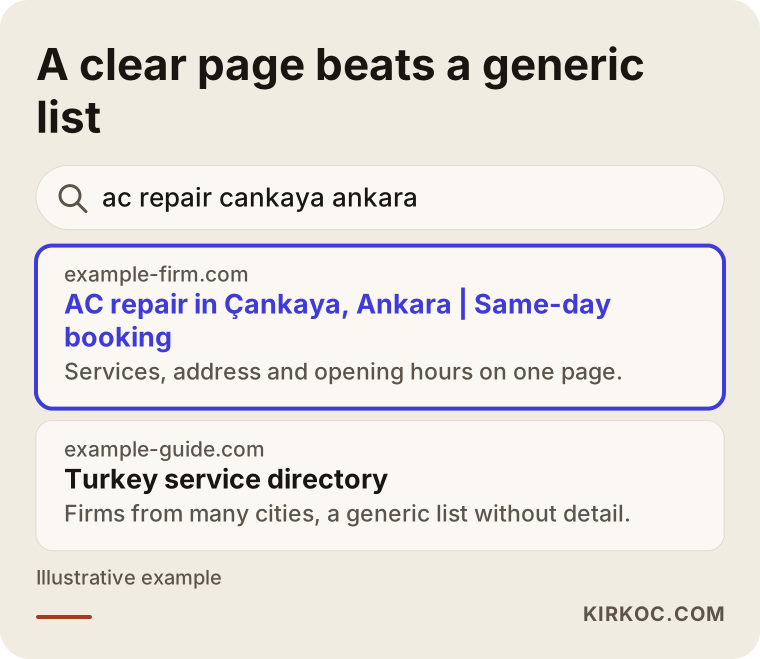
Look at what the clear page does. It says who it is for, where it is and what it does in the first line. The generic list page mentions a bit of everything and fully answers no district. Search engines and customers both tend to prefer the first kind. I am not saying that as a guarantee. I am saying that a clear page gives you an advantage, and a vague one hands an opportunity to your competitor.
Which pages does a business website in Ankara need?
Many business owners say "build me a site" and think about the pages later. In fact, deciding which pages exist is one of the most important decisions in the whole project. Each page answers a question your customer is asking. If the page does not exist, the question goes unanswered.
In the table below I put together the search types you meet in Ankara, the customer's intent and the page that fits.
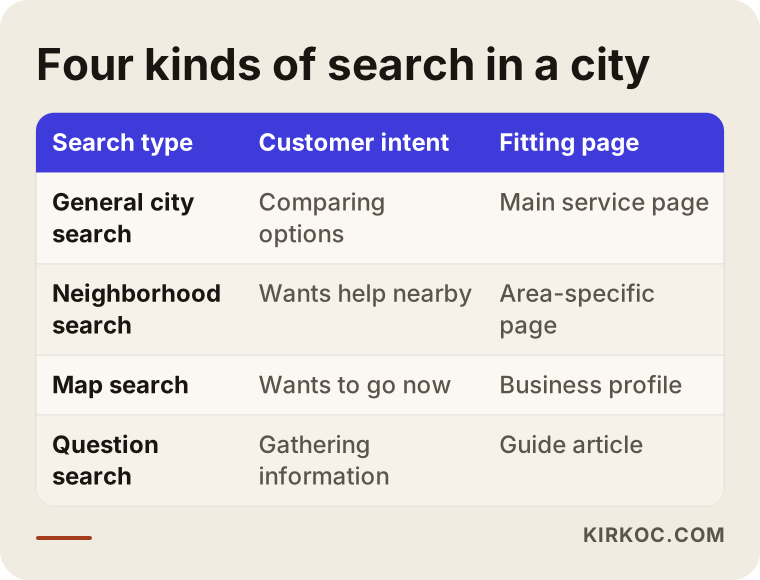
You can read the table like this. Thinking about a separate page for each search type is much more effective than squeezing everything onto one home page. The home page summarizes who you are and what you do. Service pages describe each service in detail. District pages, instead of saying "I serve Çankaya," answer the real questions of customers from that area. An about page lets the visitor get to know you. A contact page shows your phone number, address, opening hours and a map together.
A warning here: copying district pages and only changing the district name does not work. If the page for "AC repair in Keçiören" and the page for "AC repair in Mamak" are copies of each other, search engines notice, and they may reduce the value of those pages. Every page needs real information about that district, such as which neighborhoods you visit, how people get to you and what customers from that area commonly ask. If you have no real information, do not open the page. A few honest pages are better than many empty ones.
You also need to think about what goes inside a page. Below I drew the layout I recommend for a service page, as an example.
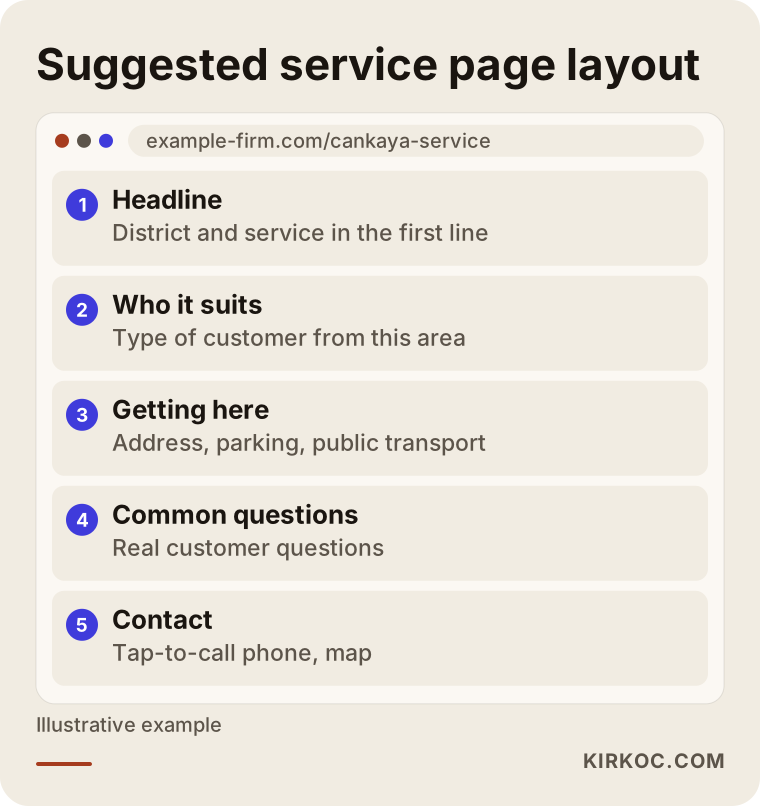
This layout is not a magic formula. It simply answers the visitor's questions in the order they ask them. First, "What does this place do, and is it right for me?" Then, "Where is it and how do I get there?" Then, "What do other people ask?" And finally, "How do I get in touch?" If you build the page in this order, the visitor is left with no open questions.
The language question
In Turkey, your visitor will most likely be reading in Turkish. Turkish is built differently from English: words change shape when you attach endings to them, so the same idea can be searched in many forms. A person might type the plain word for a service, the same word with a district ending, or a short question. A page that contains only one of these forms will match only some of the searches. If your market is Turkish, the text should be written by someone who writes naturally in Turkish, not translated word for word from English. If you also want English-speaking visitors, such as expatriates, students or foreign companies, a second language version is useful, and it should be written, not just run through a tool.
Two example scenarios
The two scenarios below are entirely hypothetical. They have nothing to do with any real person or company. The goal is to show how two different businesses might approach the same problem.
Scenario 1: a doctor's office in Çankaya
Suppose a specialist doctor in Çankaya gets most of her patients through recommendations. A friend suggests she should have a website. She buys a template site, adds a few photos and a general introduction, and the site goes live. Months pass and no appointment requests arrive.
Where is the problem? The site contains a general phrase like "specialist physician serving Ankara," but it does not explain which complaints and which kinds of patients the doctor can help. The clinic's address is written in small letters in the footer, there is no map, and the only way to book is a phone number that cannot be tapped. Someone looking at the site on a phone has to copy the number and then call. Most people do not do that.
The way to improve it could be this: a separate, simple and clear page for each treatment or type of examination; a section answering the questions patients ask most often; a contact page with the address and parking or public transport information written out plainly; and a phone number that can be called with one tap. Care is needed with health claims. Promises like "guaranteed cure" should be avoided, and medical content should be written in line with the rules of the profession. If you have doubts about this, it is right to consult a lawyer or your professional chamber.
Scenario 2: a manufacturer in OSTİM
In the second scenario, imagine a small company that makes metal parts in OSTİM. Its customers are not individuals but other companies. The person deciding is a purchasing specialist or an engineer. They will ask for a quote, but first they will check whether the company really manufactures, what its capacity is and how it thinks about quality.
This company's site was built years ago with an old design. It looks broken on a phone, the photos are small, and nothing says which machines are used to make what. The buyer arrives, runs into this vagueness and moves to a competitor whose site explains things more clearly.
What is needed here is not a flashy design but concrete detail that builds trust: the materials and processes the company works with, a short introduction to its machine park, real photos from the facility, which industries it serves (without naming clients), what information is needed to request a quote, and a simple quote form. If the company holds certificates, they should be shown clearly, but only documents it actually has. If it sells to public bodies or large corporations, a company domain name and a company email address also increase trust on the other side.
The common point in both scenarios is this: the site should not describe what the business "is." It should answer what the customer "wants to find out."
Agency or one person?
There are many agencies, software houses and independent designers offering web design in Ankara. Which one you choose depends on the size of your job and the way you like to work. It would not be right for me to say who is "better," because the two models have different strengths.
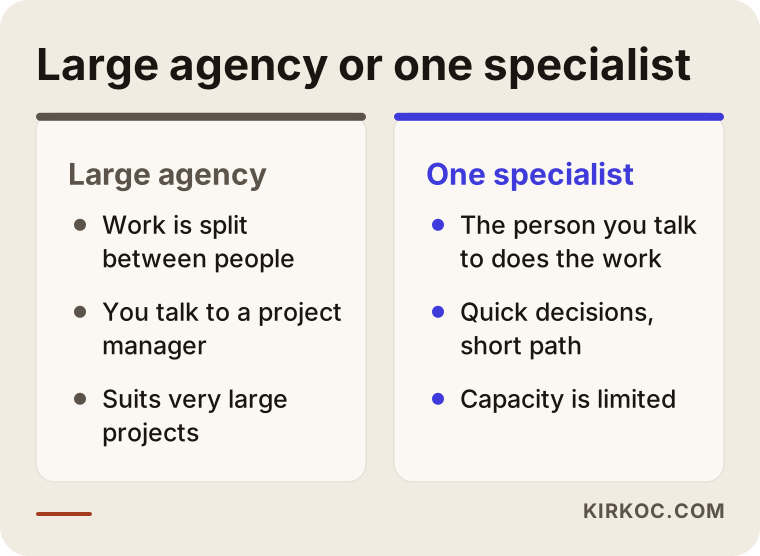
In a large team, several people share the work: one designs, one codes, one manages the project. That is an advantage for large, multi-layered projects with many pages. The downside is that the person you talk to is not the person doing the work, and there is a chain of messages in between. When you work with a single specialist, the person you talk to is the person doing the work, and decisions are quick, but capacity is limited. One person cannot take many jobs at once, and the rhythm of work can change during a vacation or an illness. I work in the second model, so I am telling you its weak points knowingly.
Whichever model you choose, ask these questions. Have you done a similar job before? Who will maintain the site after it is finished? In whose name are the domain and hosting registered? Will I be given access to the site's admin panel? These may sound boring, but most of the biggest problems later come from these questions being left unanswered.
How does the website building process work, step by step?
The process differs from one provider to another, but a healthy project usually has the stages below. Knowing them helps you understand what to expect and when.
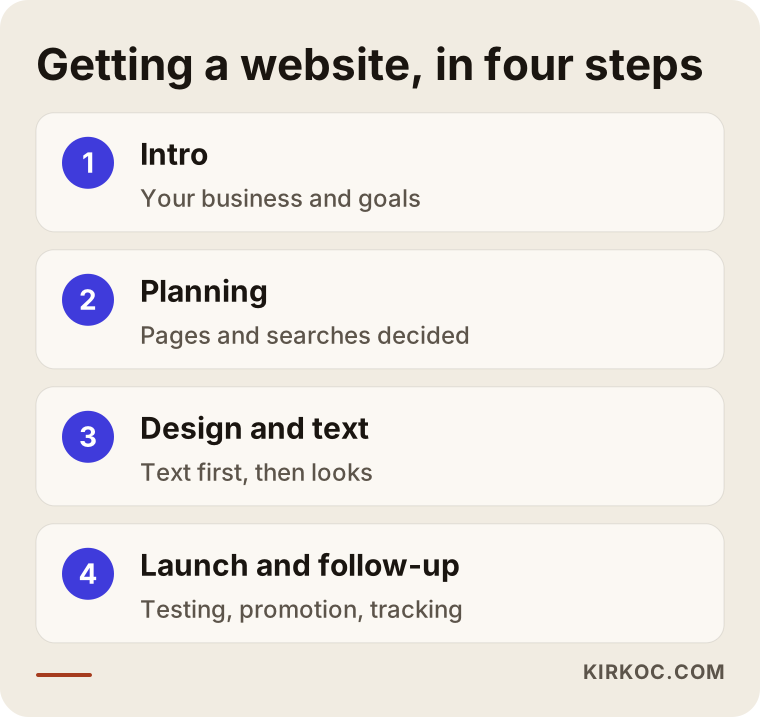
The first step is the introduction and needs. Here we talk about your business, your customers and what you expect from the site. The most important question is: what should this site make someone do? Call, fill in a form, book an appointment, send a WhatsApp message? Any design made before this answer is known is built on guesswork.
The second step is planning: which pages there will be, what each page will say and which searches it will answer. The third step is design and writing. The page outlines and the text are prepared first, because if the design is made before the text arrives, the text will not fit the design later, and the result looks forced. The fourth step is launch and what comes after: testing on phones and different browsers, a speed check, trying every form to make sure it works, and telling search engines the site exists.
How long does all this take? There is no single right answer. The number of pages, when the content is ready and how quickly feedback is given all decide it. Below I show a general flow. I left the durations out on purpose, because they will be different in your project.
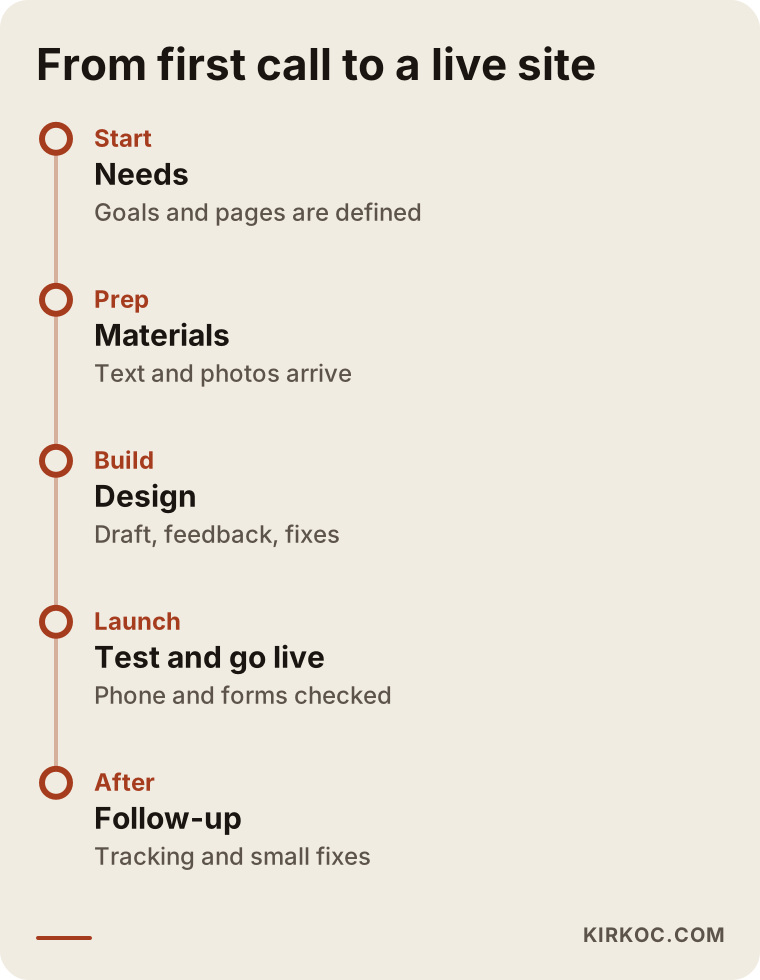
In most projects, the cause of delay is not the design but the content. If photos, texts, the logo and documents do not arrive on time, the project waits. So when you start, ask yourself, "What do I already have ready?" That helps keep the schedule realistic.
The most common mistakes
Most of the mistakes I have seen across different industries look alike. You can see the same patterns in Ankara businesses.
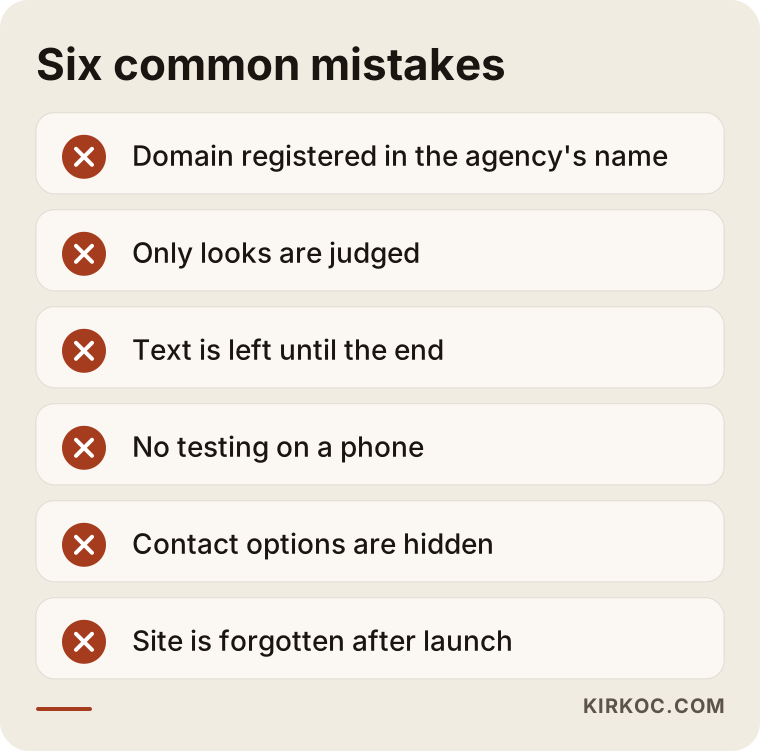
The first mistake is leaving the domain name and hosting with the company. The domain name, which is your site's internet address, is like your business's ID card. If it is registered in the designer's or agency's name and the relationship breaks down, getting your address back can be difficult. Always make sure the domain is registered in your name.
The second mistake is deciding only by looks. A site that looks beautiful but opens slowly on a phone loses customers. Speed and ease of use on a phone matter as much as design. The third mistake is believing that a cheap template site will solve everything. A template is not a bad option, but if it was not thought through for your customer and your business, it will not produce results. A solution that looks cheap often turns out to be expensive once you count the cost of rebuilding it and the customers lost along the way.
The fourth mistake is leaving the content until the end. The text is postponed with "we'll sort it out," and in the end generic sentences copied from the internet go into the site. That neither builds trust with the customer nor helps you in search engines. The fifth mistake is hiding contact options or making them hard to use: the phone number cannot be tapped, the form does not work, there is no WhatsApp link. The sixth mistake is forgetting the site after launch. A site that is never updated ages, both in terms of security and in the eyes of customers.
There is also the matter of personal data. If your form collects a name, phone number or email address from a customer, you may need a privacy notice and a cookie notice. Turkey has its own data protection law, and the rules differ from those in the EU or the US. I cannot give you a definitive legal statement on this, and I recommend consulting a lawyer to prepare real texts.
What can you do yourself, and when do you need a specialist?
You do not have to hand everything over to someone else. Some jobs you can do yourself, and for others expert help really makes a difference.
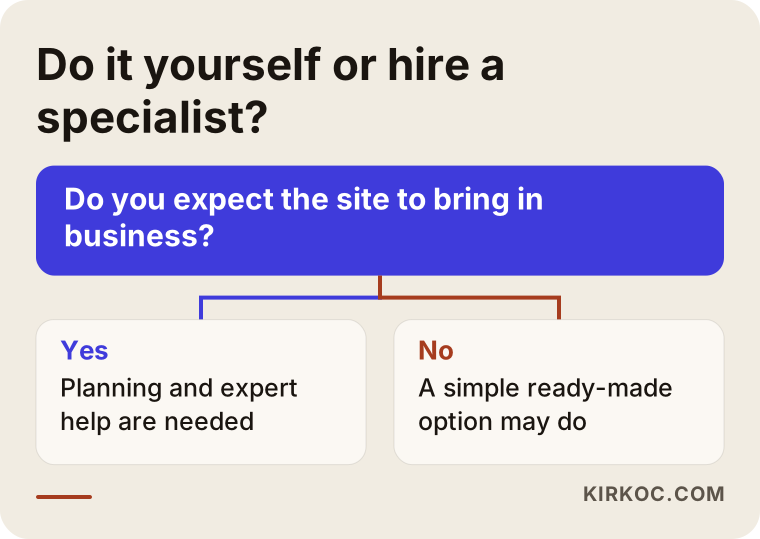
Things you can do yourself include creating and keeping your business profile on Google up to date, writing your phone number and opening hours the same way everywhere, taking good photos (even a phone is enough, as long as the light and the arrangement are good), and collecting the questions your customers ask most often and writing the answers in your own words. These are the most valuable raw materials for your site, and nobody except you knows them.
The places where you will need a specialist are these: the technical setup of the site and making it fast and secure; structuring multiple pages so that search engines understand them; connecting forms, maps and measurement tools correctly; and, if you need more than one language, setting that up properly. For a simple introduction page, a ready-made site builder may be enough. But for a multi-page site with its own domain that is expected to bring in customers, having an experienced person do the work usually causes fewer headaches.
Ask yourself this: is this site a business card, or a sales tool that I expect to bring in work? If it is a business card, a simple solution may be enough. If it is a sales tool, it needs planning, content and measurement.
What determines the cost of web design?
I will not give a number in this article, because a correct number can only be given after seeing your business. But I can explain clearly what determines the price, so that you can compare the quotes you receive in a sensible way.
The first factor is the number of pages and the scope of the content. A ten-page site with each page prepared in detail is not the same job as a three-page introduction site. The second is how custom the design is: there is a difference in effort between adapting a ready-made template and designing from scratch. The third is the text and photo work: will you write the text yourself, or does it need to be written? Will there be a photo shoot? The fourth is special functions: online booking, taking payments, a membership system or a product catalog all widen the scope of the work. The fifth is the number of languages; every extra language means translation and checking. The sixth is the maintenance, updates and support you need afterward.
When you receive a quote, check the following. Does it clearly state what is included and what is excluded? Are the domain, hosting, SSL (the certificate that marks your site as secure) and yearly renewal costs stated? How many rounds of revisions are allowed? Is there support after delivery? Is there a contract? A very low price often means something has been left out, and a very high price does not always mean better work. Compare quotes by their scope, not by their order of price. If you are paying from abroad, also ask which currency the quote is in and how invoices are handled, since that can change what you actually pay.
After the site is finished: how does a visitor become a customer?
The job of a website is not just to be seen. It is to lead the visitor step by step to a request. You can think of it as a funnel: at the top is everyone who comes to your site, and at the bottom are those who actually get in touch with you. At every step some people drop out, and your job is to reduce the number who leave.
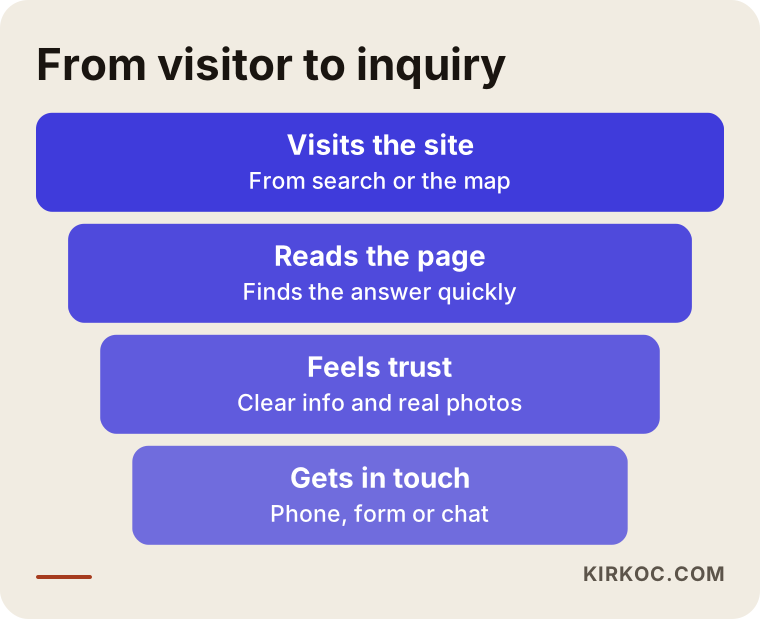
Decide from the start what you will measure in this funnel. How many people tapped the phone number, how many filled in the form, how many wrote on WhatsApp? Simple measurement tools are enough to see these. By looking at the numbers, you learn which page is working and which needs to be renewed. An improvement made without measurement is based on a guess.
Final checklist before launch
Even when the site looks ready, it must be checked before going live. Think of the list below not as an exam but as a seat belt.
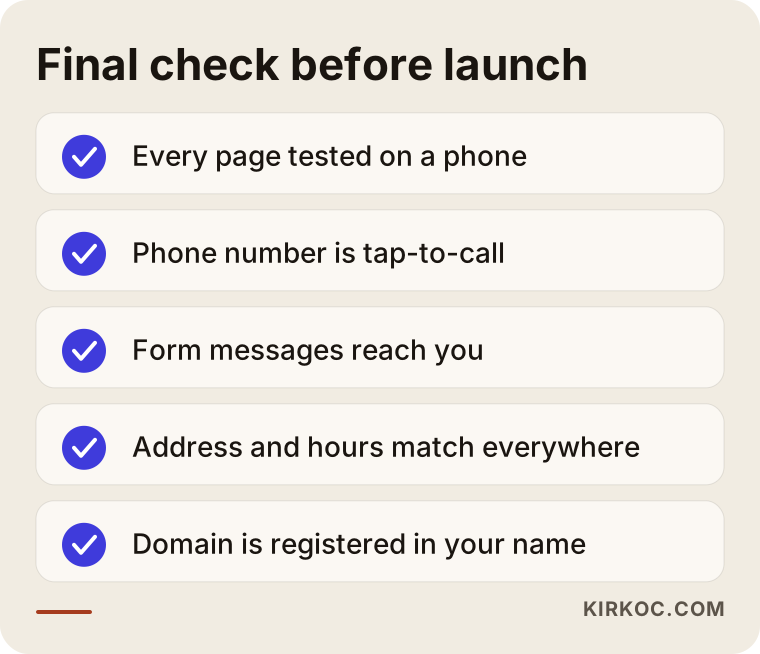
You can order this list by your own priorities rather than by the order in the picture. But do not skip the phone test in particular. Many customers look at a site from their phone, and a site that looks perfect on a desktop but is messy on a phone is one of the most common problems I come across.
How I work
Because I work alone, the process is simple. First I listen to your business, and we talk about what you want to do and whom you want to reach. Then I tell you plainly which pages you need and which you do not. Adding unnecessary pages is not in my interest. I plan the design and the content together, because the two cannot be thought of separately. Throughout the project you talk directly to me. Nobody else comes in between.
Working with businesses in Ankara remotely is possible: meetings happen by phone or video, and files and approvals move over the internet. I am particular about the domain name and access details staying with you. When the site is delivered, control should be in your hands. I do not give guarantees of results. Nobody can honestly guarantee a search ranking. But I will tell you openly what I am doing, why I am doing it and what is working and what is not.
Frequently asked questions
Do I need to visit an office to have a website built in Ankara?
No. Many projects run remotely. Meetings can be held by phone or video, and photos, logos and documents are sent digitally. If you want to meet face to face, we can discuss that at the start, but it is not required.
How many weeks will it take for my website to be ready?
It depends on the number of pages, how ready your content is and how fast feedback comes. A small introduction site and a multi-page corporate site do not finish in the same time. Most delays come from waiting for text and photos. If you share what you already have before we start, I can give you a realistic schedule.
Should I choose a ready-made template or a design from scratch?
Both have a place. For small businesses with limited budgets that want a fast start, a well-prepared template can be enough. If you need a look specific to your brand, a different page structure or special functions, a design from scratch or a heavily adapted one is more suitable. What matters is that the choice fits your business.
Will my site rank first on Google?
Nobody can honestly guarantee that. Building the site properly for search engines improves your chances, but the result depends on competition, the quality of the content and time. I suggest being cautious with anyone who offers a guarantee.
In whose name should the domain and hosting be?
Definitely yours. The domain is your site's address and your business's presence. Your designer or agency should register it in your name and give you the access details too. That way you are not locked in if you want to work with someone else later.
Can I update the content myself after the site is built?
Most of the time, yes. You can change text and photos through the admin panel. But it is good to set up a maintenance routine for technical updates, security and backups, and to agree at the start who will be responsible for it.
Do I need a site in more than one language?
If your customers are foreign, yes. For tourism, health tourism, exports, or businesses serving international students and expatriates, an extra language is very valuable. If you only serve Turkish-speaking customers, you may not need another language. Translation should not be automatic. It should be natural and checked.
Are privacy and cookie notices mandatory?
If your site has forms, cookies or measurement tools, you may have obligations. It would not be right for me to give you a definitive legal statement, so I recommend consulting a lawyer to prepare the texts. I can build the site so that these texts appear in the right place.
If you are thinking about getting a website built in Ankara, all you need to do is tell me about your business and what you want. You can reach me through my website design service page, and we can work out together whether the project suits you.