You install cameras and alarm systems, you know your trade, and most of your phone calls still come from referrals and repeat clients. Meanwhile, the person who wants cameras on their house or shop tonight is typing a search into Google and calling the first two or three companies that look credible. If your website is not among them, the problem is rarely the quality of your work. It is what your site tells Google and the visitor. SEO services built for a security company exist to put you in front of those searches with a page that makes the next step obvious.
In this article I walk through how different buyers search for camera systems, which pages earn their trust, how to turn visits into site survey requests, and how to show past work without exposing the people you protected. You do not need technical knowledge to follow it. I wrote it so you can make decisions.
What does someone shopping for a camera system actually type?
This is not one audience. Three different people land in the same category with different worries, and each needs something different from your site.
The homeowner usually searches after an event or before a trip. A neighbor had a break-in, a package got stolen from the porch, or they want to check on an elderly parent from a distance. Their searches tend to include a town or neighborhood: "home security camera installation near me", "alarm company for my house", "backyard camera system". Their questions are plain. Can I watch from my phone? Will you drill through my walls? What happens when the power goes out?
The business owner runs a shop, a workshop, a warehouse or an office. Their worry is cash handling, inventory loss and sometimes employee safety. They search for "business security camera system", "warehouse surveillance company" or "small business alarm monitoring". Unlike the homeowner, they expect a proper written proposal and a contract, they want to know how long footage is kept and who can view it, and they often need several locations on one screen.
The property manager or HOA board member does not decide alone. They answer to owners or residents, collect several quotes and present them at a meeting. Their searches look like "apartment complex security cameras", "HOA camera system installer" or "parking lot surveillance company". What they need above all is a quote that can be compared and defended, because next month someone will ask why this company was chosen.
If you publish one page called "Our Security Solutions" and speak to all three at once, you speak fully to none of them. Google cannot tell which search you deserve to appear for, and the visitor wonders whether the page is for them and leaves.
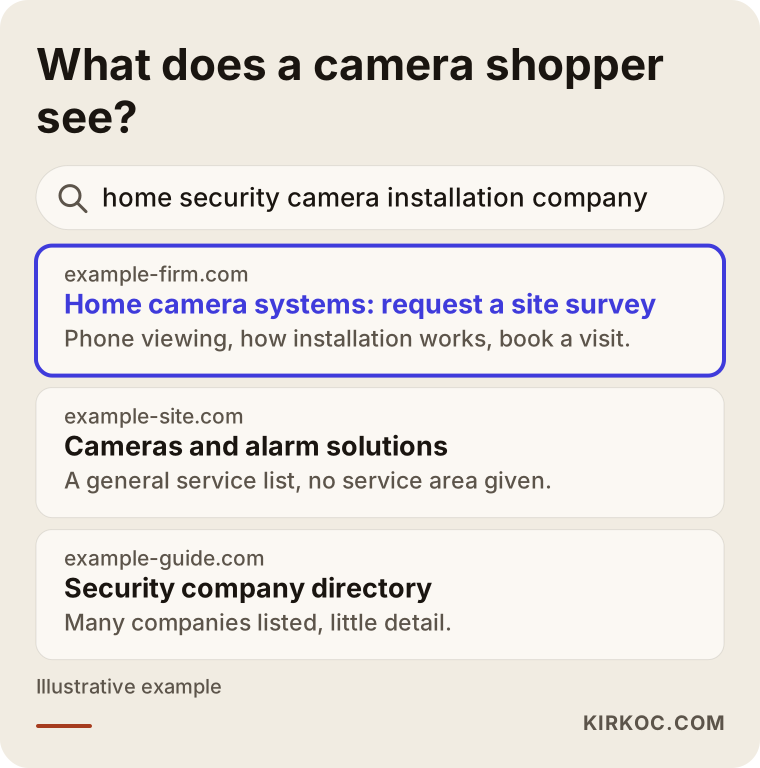
Why the words "site survey" matter more than "buy"
A camera system is not something people add to a cart and forget. Someone usually has to see the place: where the walls are, how the cable can run, what angles are possible, whether the network is ready. So the buyer's first goal is not to purchase, it is to get someone to come and look. That means the real job of your website is to book a site survey or free estimate visit, not to close a sale on the page.
Search works on two layers here. The first is the service: "security camera installation", "alarm company". The second is the place: a town, a county, a suburb. Because camera work is local, the second layer is often the more valuable one. State your service area clearly and honestly. A page for a town you do not actually serve misleads the visitor and Google, and the phone call it produces is wasted on both sides.
A good service-area page says which towns you cover, what kinds of properties you work on there (houses, apartment buildings, small businesses), and how a visit is arranged. Copying the same paragraph for every town and swapping only the name looks efficient, but Google can tell the pages are near duplicates and tends to promote none of them.
Separate pages for homes, businesses and property managers
Building a page for each type of buyer is one of the simplest and most rewarding decisions in SEO. Each page speaks to one person.
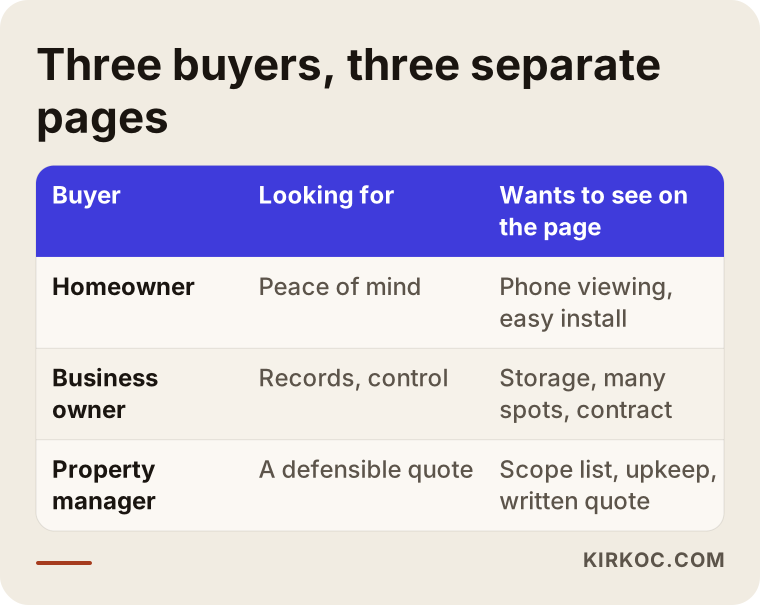
| Buyer | What they want | What they look for on the page |
|---|---|---|
| Homeowner | Peace of mind | Phone viewing, little mess at install |
| Business owner | Records and control | Storage, several spots, contract |
| Property manager | A defensible quote | Scope list, upkeep, written quote |
The wording matters more than the layout. To a homeowner, "IP-based network video" means nothing, while "you can check your front door from your phone" does. To a business owner, a sentence like "recordings are kept for the period we agree in writing and only authorized people can view them" is reassuring. You do not need figures or technical terms, just clear sentences.
For the property manager page, this helps: the person has to explain your quote to a board. If you describe what a survey of a building covers, which line items a proposal usually contains, and how maintenance and support work after the install, the page becomes something they can forward to the board. That makes it credible in Google and in the reader's eyes.
The survey request page: what moves a visitor to the phone
On many security company sites, the phone number sits in the footer in small type. People looking for cameras are often in a hurry. Maybe something happened last night, maybe they leave on vacation tomorrow. The phone number and the request button belong on the first screen, and on a phone they must be easy to tap.
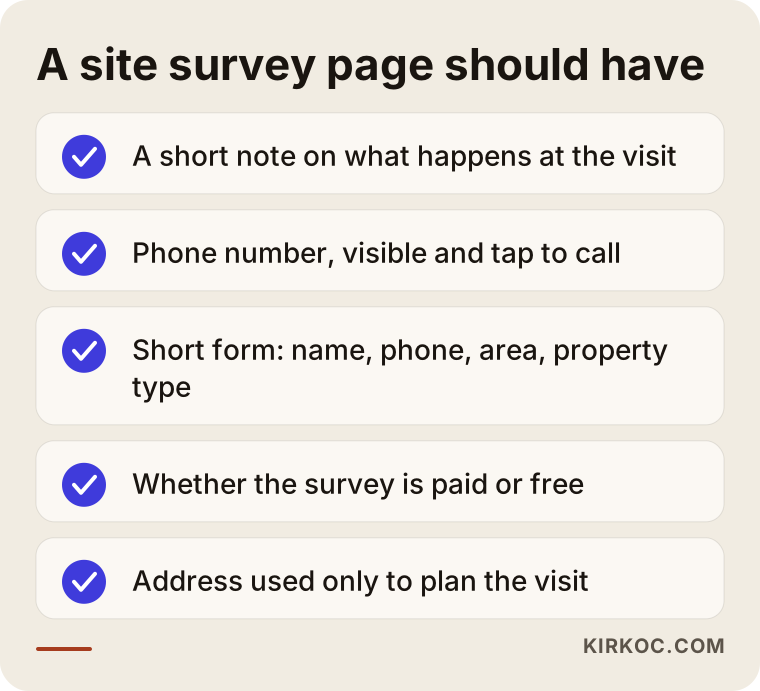
A dedicated survey request page, or section, should include:
- A short description of the visit: what happens, who comes, roughly how it goes. Write it as your business actually works; no numbers are required.
- A form with few fields: name, phone, town, property type (home, business, building). Long forms make people quit.
- A direct answer to "Is the survey free or paid?" Hiding this creates friction on the phone. State whatever your policy is.
- A privacy line: the address and details they enter are used only to plan the visit.
- A tap-to-call number for people who would rather talk.
Search engines can show this page for relevant searches, but its real job is simpler. It answers the question "what do I do now?" If that question stays unanswered, no ranking will make the phone ring.
What builds trust in a business that enters people's homes
Security work asks the customer to let you into their house, their building and their routines. That takes more trust than most trades. Here is what raises it on a website.
Showing who will show up. Who does the work, how the crew is set up, who comes to the survey. If you are a small outfit, say so. Being small is not a weakness; pretending to be a large company is.
Being honest about products. Say which kinds or brands of systems you work with and why you chose them. There is no need to criticize other brands; the customer is comparing anyway.
Describing what happens after installation. If a camera fails, who do they call? Is there maintenance, remote support, a way to adjust settings? If the page does not say, the buyer will ask on the phone, or call a company whose page does.
Staying calm about rules. Video recordings of people can raise privacy questions, and the rules differ by state and by situation. Rather than making confident legal claims on your site, describe what you actually do: "we agree in writing how recordings are stored and who can access them." If a customer needs legal advice, such as pointing a camera at a shared driveway or recording employees, say they should speak with a qualified professional. Interpreting regulations is not your job, and it is not mine.
Showing past work without exposing your customers
This industry has a problem others do not. A photographer or a hairdresser can show a finished job with the client's permission. You would be showing the layout of someone's home security: which corners are watched, which are not, where the panel sits. That information could hurt the customer if it reached the wrong person.
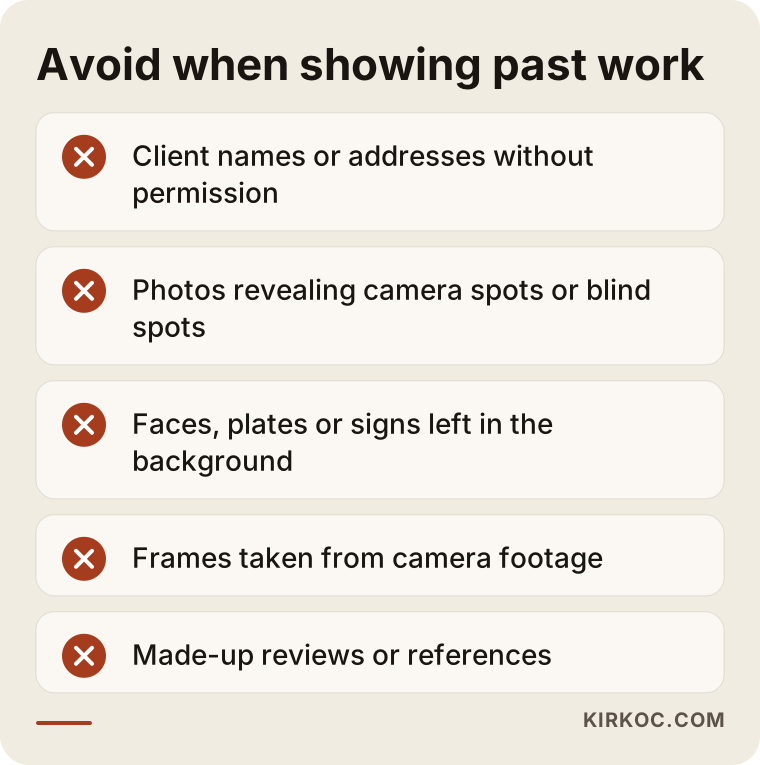
So on a portfolio or case study page, I recommend:
- Do not publish names, addresses, building names or business names without written permission.
- Do not share photos that show camera positions, blind spots, alarm panels, door and window details.
- Check installation photos for faces, license plates, signs, screens and street numbers in the background.
- Describe projects at the level of "type of property and general area", for example "garage entrances at a mid-size apartment building".
- Never publish frames taken from customer camera footage without their consent.
- Do not invent reviews or references. Readers who spot one stop trusting the whole site.
What you can show safely is how your work runs: survey, planning, installation, handover, maintenance. A simple diagram of that flow with no customer details is both safer and more convincing than a gallery of finished rooms.
What drives the price, and how to explain it on your site
You do not have to publish prices. Without a survey it is hard to give an honest number anyway. But "call for a quote" alone is not enough; buyers want to know what the quote depends on. Typically that is:
- How many points are watched and how big the area is
- The type of cameras and the image quality needed
- The recorder, how long footage is kept, and whether remote viewing is wanted
- Cable routes, wall or ceiling condition, and existing wiring or network
- Whether alarm, fire, or access control is included
- The support and maintenance expected after installation
Putting this list on the page cuts down on pointless calls and attracts serious ones. "Every property is different, which is why we start with a survey" reads as professionalism, not as an excuse, when it comes with an explanation.
How buyers compare the companies they call
Someone who finds you will probably contact three or four firms. Knowing what they compare lets you build your page around it:
- A written, itemized quote. Which line is what, and what is not included.
- A real visit. A price quoted over the phone is not the same as one given after looking at the building.
- Support after installation. Who they call when something stops working.
- Who controls the recordings. Customers want their footage to stay under their control.
- Reachability. Is there a real address, a phone number, and clear business hours?
If your site answers these five points, people call you already convinced. That means less time wasted and more jobs won.
Suppose two different companies
First scenario. Suppose you run a two-person company installing cameras at homes and small shops in a mid-sized town. Your site has one page: "Services: cameras, alarms, access control." No service area, no process. A homeowner searching for a camera installer in your town gives Google almost nothing to match. The fix is a page for homes, another for small businesses, an honest list of the towns you cover, and a survey request up top. Early changes may show up as the pages are indexed, but there is no promise of a ranking or a number of leads; search takes time.
Second scenario. Suppose you are a more established firm installing systems for apartment communities, with plenty of good photos on your site. But your portfolio shows a named building, entrance photos and a camera placement plan, and you are not sure the owners ever approved it. Here the first job is cleanup before any SEO: remove that material or republish it with permission and with the sensitive details left out. A security company that treats privacy casually loses trust that no ranking can win back.
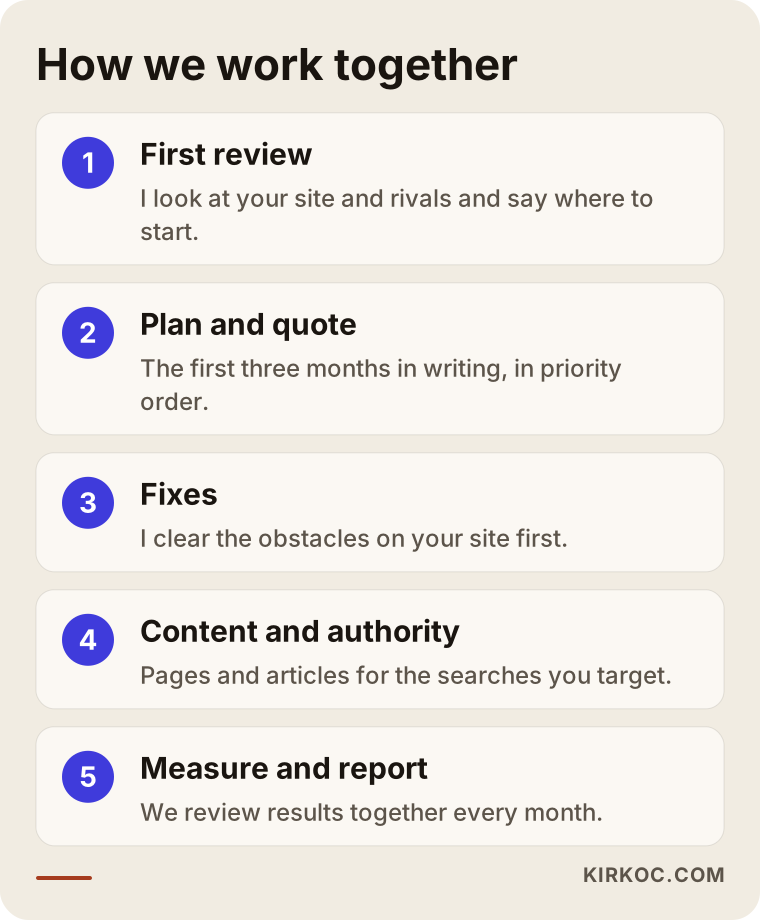
How we work together
I work on this alone, so the person who talks to you, writes the plan and does the work is the same. The process runs like this:
First review. I look at your site and at your competitors in your area and tell you where to start.
Plan and quote. I give you the first three months of work in writing, in order of priority, so you see what is done and why.
Fixes. I clear the obstacles on your site first: slowness, a poor mobile layout, pages that do not open. These usually have the fastest effect.
Content and authority. Service pages and articles that answer your customers' questions are prepared for the searches you target, and your site's standing is built up.
Measure and report. Every month we review what was done, which searches you moved up in, and what comes next, in plain language.
The details of your trade I learn from you: which systems you use, where you work, how a survey goes. You know the technology; I turn it into pages a visitor understands.
Page layout: what should a visitor see, and in what order?
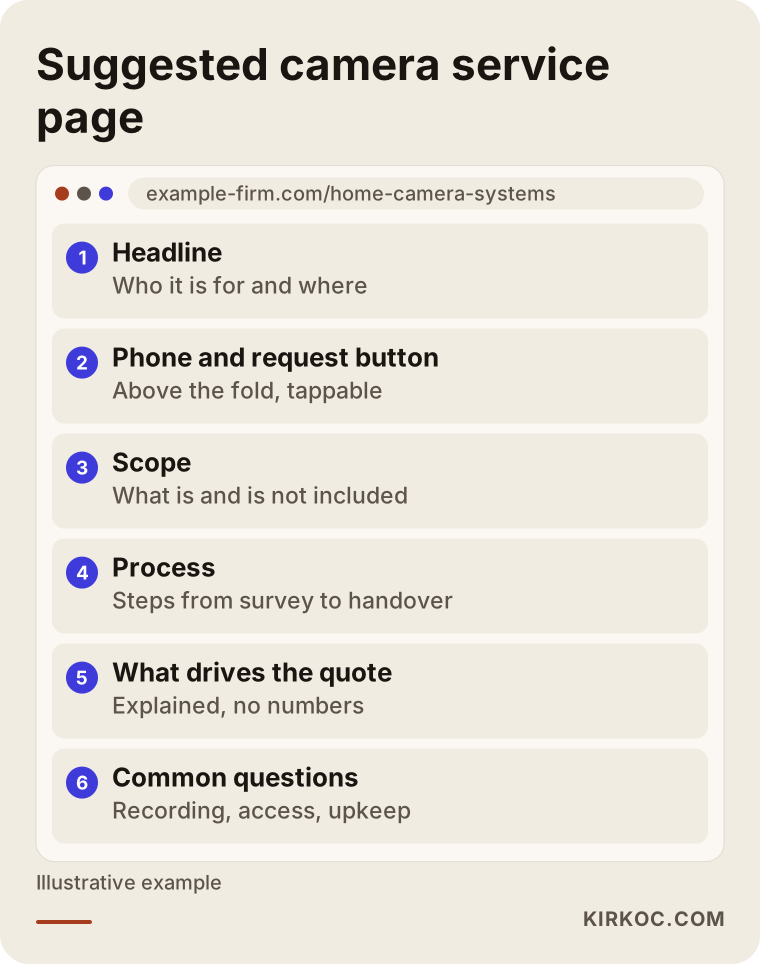
A service page should flow like a good sales conversation. First the visitor thinks "I am in the right place", then "I can trust this company", then "what do I do next?" This is the order I suggest:
- A headline that says who the page is for (homes, businesses, buildings) and where.
- Phone number and the survey request button.
- Scope: what you do and what you do not do.
- Process: steps from survey to handover.
- What affects the quote.
- Frequently asked questions.
- The areas you serve.
The sketch below shows this layout with a made-up domain.
The questions buyers ask before they ever call
People research before they pick up the phone. Answering their questions on your site opens more doors in search and builds trust before the first call. Topics worth writing about:
- Who can see the recordings, and how does the customer control that?
- Can a camera that sees a neighbor's yard or the street cause a problem? You should not give a legal opinion, but saying "plan the angle with neighbors and local rules in mind, and ask a qualified professional if unsure" is honest.
- Does recording continue if the internet goes down?
- What is the difference between wired and wireless systems, and where does each fit?
- Do employees need to be told when cameras cover the workplace? Again, say that employers should get proper guidance rather than quoting rules yourself.
- How does planning differ for a building entrance versus a parking area?
Each question answered in a short, plain article is another door into your site. It also moves you from "the company trying to sell" to "the company that explains." I prepare these from what you tell me; you bring the knowledge from the field and I make it readable. None of them contains a firm legal or technical promise, only explanations that help the buyer ask better questions.
These articles can bring visitors for years, because every year new people need cameras. With ads you pay for each click; a well-written page keeps working without a separate payment.
AI assistants and voice search
More people now ask an AI assistant: "What should I look for when having cameras installed at home?" These assistants lean on pages that answer a question clearly and in an orderly way. Plain question-and-answer sections can help you appear as a source there as well as in classic search. There is no guarantee, but a well-written page works in both places.
Common mistakes
- One page for everyone. Home, business and building buyers share a single text.
- Hiding contact details. Phone and request button buried at the bottom.
- Copying one text for every town. Google notices.
- Publishing project photos carelessly. Images that reveal blind spots and placement.
- Relying on stock photos. The same fake "guard" images everyone uses build no trust.
- Writing in technical terms. Visitors think "how do I watch my house," not about video encoding.
- Promising results. Be careful with anyone who guarantees first place.
Do it yourself or hire someone?
There is a lot you can do yourself: move your phone number to the top, list your service area plainly, describe how a survey works in a paragraph, and remove any photos that carry privacy risk. None of this needs outside help and all of it can happen today.
Expert help starts to matter when you need to understand why your site is behind, choose the searches that bring real work, find technical obstacles, produce content steadily and measure it. That takes time and a trained eye, and a company out on jobs every day rarely has hours to spare for it.
When you probably do not need SEO
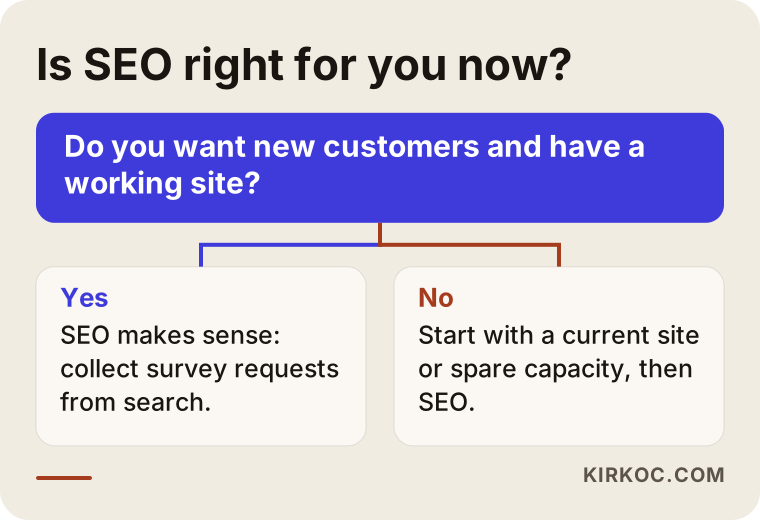
I would rather be honest: it is not for everyone. You may not need it right now if:
- All your work comes from large contracts and you are not looking for new customers.
- Your calendar is full and you could not take on more requests.
- You have no website, or it is badly out of date: fix that first.
- You need results immediately; SEO takes time and urgent demand needs other tools.
If that describes you, I will say so in the first conversation.
Frequently asked questions
Does SEO really bring customers to a security camera company?
If you appear for the right searches, yes, because people almost always research online before choosing who installs cameras. But I cannot promise a ranking or a number of requests. Search engines are slow and results depend on your site, your area and your competitors.
Do I need separate pages for homes, businesses and property managers?
Not required, but it works well. Each group uses different words and arrives with a different worry. Separate pages send Google a clear signal and help each visitor find themselves.
Do I have to list prices on my website?
No. Work that needs a survey makes that hard anyway. But explaining what shapes the price brings more serious inquiries and fewer wasted calls.
How do I protect my customers' security when showing past work?
Do not share names, addresses or camera layouts without permission. Describe projects in general terms, by property type and area. Avoid photos that reveal blind spots or alarm panel locations.
Should I create a page for every town?
Only for places you really serve, and only if each page has genuinely different information. Copying one text and changing the town name does not work.
When will I see results?
Technical fixes can show effects sooner; content and authority work moves more slowly. I cannot give an exact timeline, but each month we look at a report together and see where things stand.
Will AI assistants recommend my company?
I cannot guarantee that. Pages that answer questions clearly and present information in order can be used as sources by those assistants.
How do we start?
With a first review. I look at your site and competitors and tell you where to begin, then I send a written plan and quote.
If you want a website that brings in survey requests and respects your customers' privacy when it shows your work, take a look at my SEO services page and get in touch. I work remotely, and we can start by talking through where your site stands today.