You own an event venue, a hotel ballroom or a meeting and seminar room that people can rent. The room is lovely, your team is experienced, but the phone does not ring as often as you expected. When a corporate event planner searches for "seminar room for 200 people downtown," the same three or four competitors show up instead of you. This article is written for exactly that situation. I explain what SEO is for event venues and meeting rooms, how customers in this field actually search, which pages your site needs, and where to start. I am Ümit Kırkoç, a web designer and SEO consultant who works alone from Istanbul, and I will also be plain about what my SEO services include and what they do not.
SEO, in short, is the work that helps your website appear when your customers search on Google. The difference from advertising is simple. When you stop paying for ads, the visibility stops. A well-built SEO setup can keep bringing in quote requests for months, sometimes years. But SEO in this industry has a structure of its own. Your customer is rarely one person. It is usually a team: an assistant, an HR manager, a marketing director, someone from purchasing and a senior executive, all inside the same decision. So your site has to do more than get found. It has to make a group decision easy.
What does someone looking for an event venue type into Google?
People who need a venue rarely type "event venue." More often they type what they need: how many guests, what kind of event, which part of town, which date. Searches like "80-person meeting room near the financial district," "venue for a corporate product launch," "room for a company holiday dinner," "hotel ballroom for a dealer meeting" or "hybrid seminar room with equipment" are the real sentences of this field. Capacity, location and event type are the three building blocks of almost every search.
There is an important detail here. A planner usually does not search once and decide. First comes a broad search. Then three or four sites get opened, the planner looks at capacity and photos, and then writes to the team: "Let's request quotes from these three." That means your site can be eliminated at first glance. A site that does not state capacity, has few photos or does not explain how pricing works disappears in that first round. This is why I suggest thinking of SEO not as "getting onto Google" but as "getting onto the shortlist."
The illustration below uses a completely invented example to show what a search result looks like and why a clear page can beat a generic directory listing.
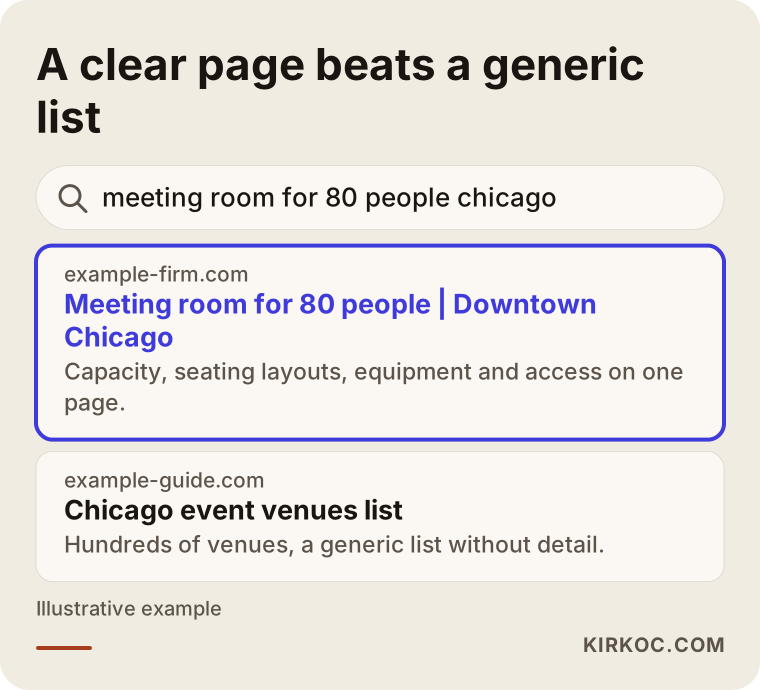
The highlighted result does something simple. In its first line it tells you the room's capacity, its area and what it is suited for. A generic "city event venues" list cannot do that, because that list has to describe hundreds of places under one roof. Google wants to show the person searching the answer that helps most. If you give that answer clearly, your chance of ranking ahead improves. I do not guarantee results, because neither I nor anyone else controls the ranking.
The four kinds of venue search
Splitting searches into four groups makes the work simpler. The first is capacity-and-area searches: "150-person room in midtown." The second is event-type searches: "product launch venue," "dealer meeting room," "training room rental." The third is equipment-and-service searches: "meeting room with a projector," "room with interpretation booths," "seminar package with lunch." The fourth is foreign-language searches: for example, a company abroad typing "conference venue Istanbul" or the same idea in its own language.
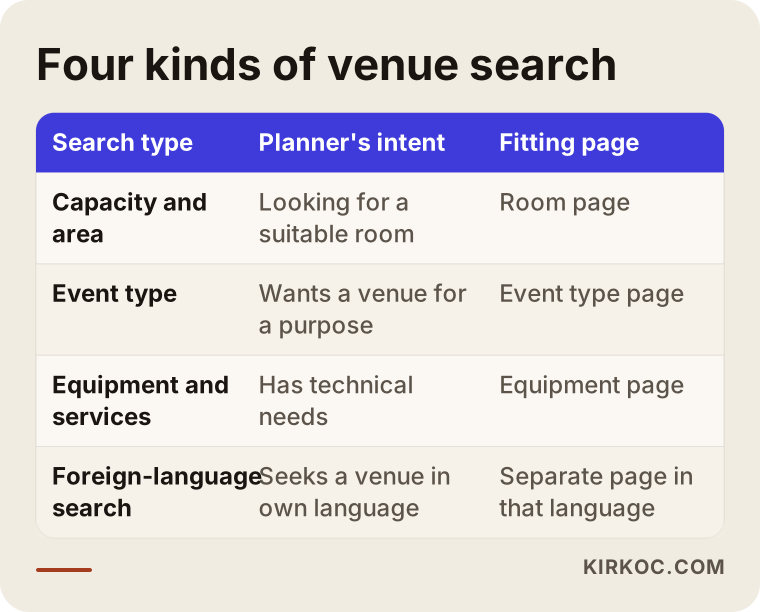
The practical conclusion from the table is that one page does not fit every kind of search. A room page serves the capacity search, an event-type page serves the purpose search and an equipment page serves the technical search. Expecting a single "our venues" page to cover all of them is one of the most common gaps I see in this industry.
Which pages does your site need?
Most event sites consist of a nice photo gallery and a contact form. Photos matter, but Google cannot read a photo. It looks for written information on the page. The planner also moves on to the numbers after looking at the pictures. Both need to be on the same page.
A separate page for every room
If you have more than one room, give each its own page. Include the room's name, how many people it holds in each seating style (theater, classroom, cocktail, banquet), ceiling height, floor area, lighting and sound options, ease of entry and loading, parking, accessibility and nearby transit. Most of these are the first things a planner asks. If the answers are not on your page, the planner does not write to you. The planner simply opens a competitor's page.
One more common mistake is squeezing all the rooms onto a single page. The result is that you stand out in neither room's searches. A separate page means a separate search.
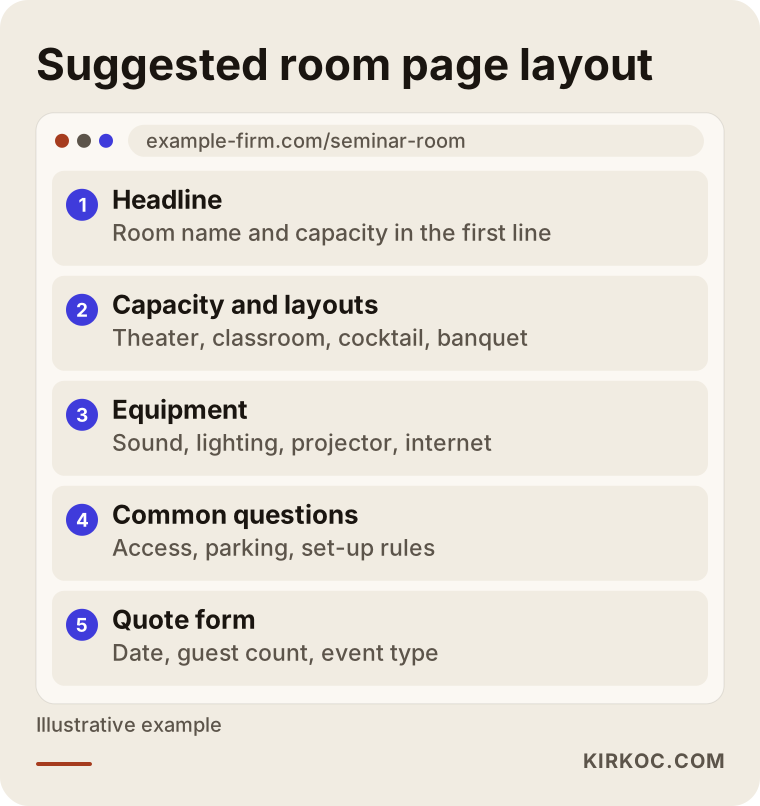
The layout above gives you an idea. First you say what the room is and how many people it holds. Then you move to equipment and seating layouts, and at the bottom you place common questions and the path to a quote. The purpose of the page is to lead the reader toward asking for a quote. Text written only for Google does not bring in customers.
Event-type pages
The second group of pages is organized by event type: corporate meeting, product launch, dealer gathering, training and seminar, year-end dinner, graduation and awards ceremony, and so on. Each is a different need. At a launch, the stage, lighting and press entrance matter. At a training day, the table layout, the break service and internet speed matter. On these pages it is not enough to say "we are suitable for this kind of event." Say which layout you recommend, how a typical program flows, which services are included and which are planned separately. Do not create a page for an event type you do not actually host. That would be dishonest, and an empty page carries no value anyway.
Trust signals and the path to a quote
Corporate buyers dislike risk. If an event goes wrong, that person is responsible. So your site needs concrete things that build trust: the types of events you have actually hosted (as far as you have permission to mention them), short quotes from clients, an equipment list, safety and emergency information, opening hours, and loading and set-up rules. The quote form should also be short and clear: date, number of guests, event type and contact details. A relationship that begins with a long form often ends before it starts.
Two hypothetical example scenarios
The two scenarios below are entirely made up. They do not describe a real company or person. Their purpose is to make the logic concrete.
Scenario 1: A single-room seminar venue in the city center
Suppose a small venue has one room that seats 120. Its website is old, a single page, and apart from the heading "Event venue" it has no detail at all. The phone rings, but mostly with people who ask the price and then vanish two days later. What can be done?
First, the gaps in the current site are listed: no capacity, no layout options, photos that are heavy and slow to open, and a form that is hard to fill out on a phone. Then one strong room page is prepared, with capacity for each seating style, equipment and directions written out clearly. Next, two event-type pages are added, for example training days and dealer meetings. The quote form is cut down to four fields. The first effect of this work is usually seen in the quality of inquiries: people who only ask for a price may become fewer, and people who write with a date and a guest count may become more. Of course, this is an expectation, not a promise.
Scenario 2: A hotel with several meeting rooms and a ballroom
In the second hypothetical example, a hotel has four meeting rooms and a ballroom. The site focuses on selling guest rooms, and the meeting spaces get a few lines on one "Meetings and events" page. The hotel shows up well in searches for rooms but not at all in searches for events. Planners may not even know the hotel exists.
The fix here is to build the events side as its own section. Each room gets a separate page and a capacity table. Pages are written for corporate packages (a full-day meeting, a seminar with lunch) and for events that combine with an overnight stay. The hotel's room pages and the event pages are linked to each other, because someone looking for a multi-day conference wants both a meeting room and sleeping rooms. Setting priorities properly matters too: first the two rooms that bring in the most revenue, then the others.
The journey of someone asking for a quote
How does a search turn into a quote request? Think of it as a funnel. At the top there are many people searching, and at the bottom only a few ask for a quote. At every step, some of them drop you.
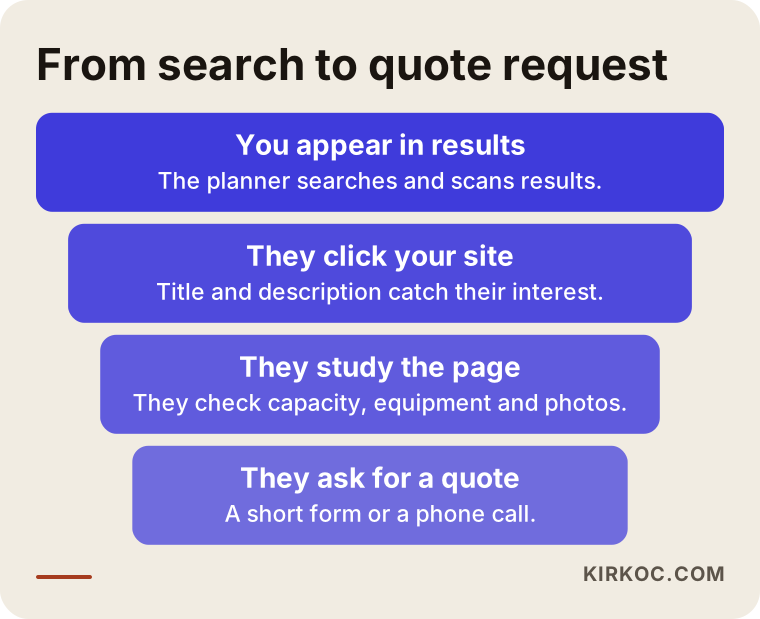
In the picture, every stage is narrower than the one before. This is why SEO is not only about the first step. A person who clicks on your site and cannot find the information they came for leaves before reaching the third step. Many businesses say "not enough visitors are coming," but the real loss is often in the second and third steps. For that reason I treat page content, page speed and the quote form as part of the SEO work.
An agency or one specialist?
I can divide the people who offer SEO services in this field into two groups: agencies with large teams and solo consultants like me. Either can be the right choice. Which one suits you depends on the size of the job and how you like to work.
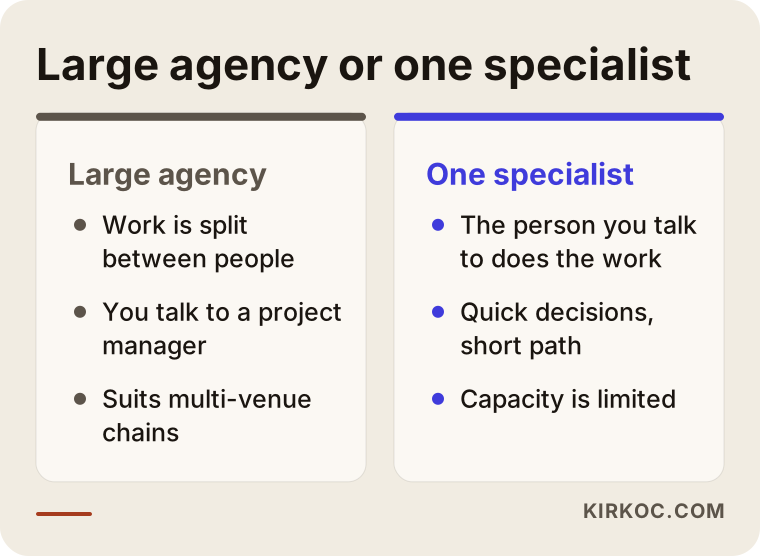
The takeaway from the comparison is this. A chain with many venues may want a large team. For a business with one or a few rooms, having the person you talk to do the work yourself is often more efficient. I work alone, so I take on only a limited number of projects at a time, and I say that up front. Whichever you choose, ask in writing who will do the work, how reports will be delivered and in whose name the website and accounts will be registered.
How I run this work, step by step
SEO is not a mysterious process. It is made of steps in order. If you work with me, it runs roughly like this.
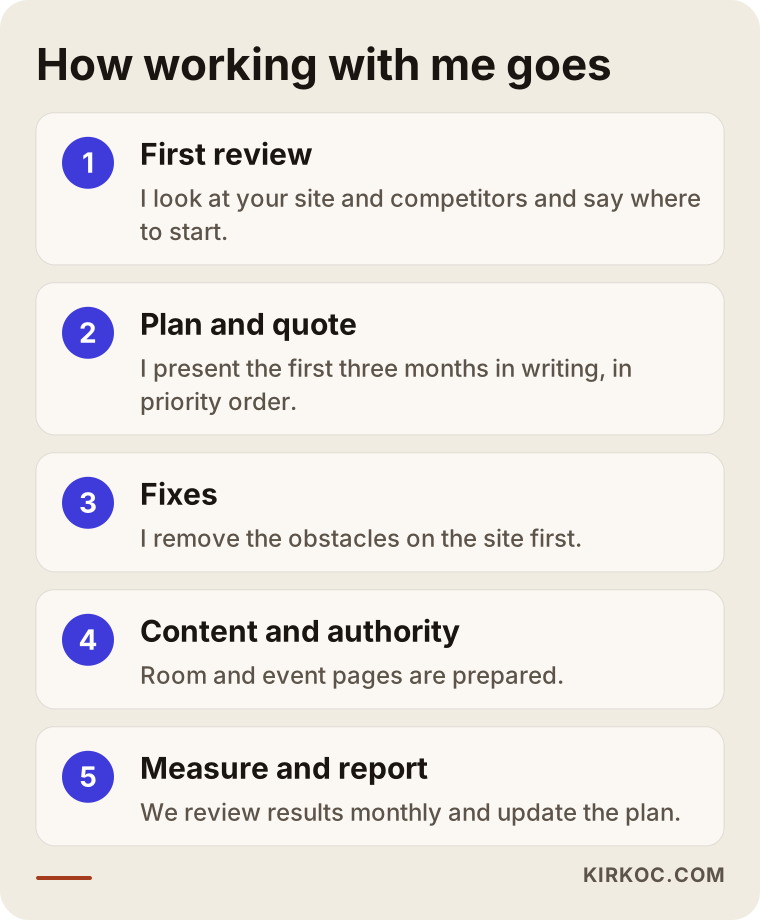
First I look at your site and your competitors. By competitors I mean not only similar venues but also the directories and guide sites that show up in the same searches as you. Then I write the first three months of work into a plan, in priority order. The first job is to remove the obstacles on the site: pages that open slowly, a layout that breaks on phones, the same content repeated in several places, missing address and phone details. After that I prepare pages and articles for the searches you are targeting. Finally, every month we look at the results together: which page became visible, which search brought a quote request, and where more effort should go. Without measurement, SEO turns into guesswork.
In this process I also look at your Google Business Profile. Map results matter in venue searches. Your address, opening hours, photos and reviews appear there. But that is a separate job and should be considered together with the work on your site.
AI answers are becoming a way to search, too
Today some planners ask an AI tool such as ChatGPT for venue ideas: "Can you suggest a 60-person training room with a projector in Brooklyn?" These tools build their answers from clear, well-organized information that is openly available on the internet. If your page states capacity, equipment and location clearly, the chance that this information gets used both on Google and in these answers goes up. This is called GEO for short, which means preparing your content so that AI answers can use it. Nothing is guaranteed here either, but giving clear and correct information helps on both roads.
When do results show up?
The honest answer is "it depends," and that needs explaining. If your site is new, competition is heavy or the site has technical problems, it takes longer. This industry also has a seasonal effect: corporate event demand rises in some months and drops in others. So judging results by looking at a single month can be misleading.
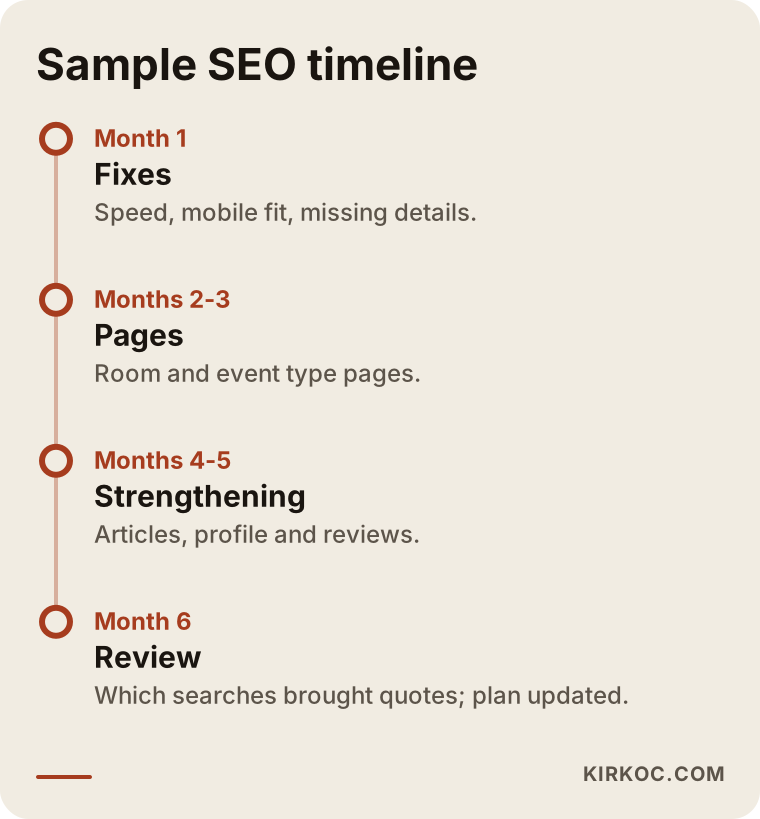
The timeline shows a sample flow, and every site moves at its own pace. In the first weeks, the visible changes are usually on the site itself: faster loading and tidier pages. Movement in search results starts to become clear after a few months. Expecting a ranking in the first month would not be realistic, and anyone who promises one is not telling you the truth.
What can you do yourself?
Not everything needs an expert. You can do the jobs below without any technical knowledge, and in most cases you should, because you know this information best.
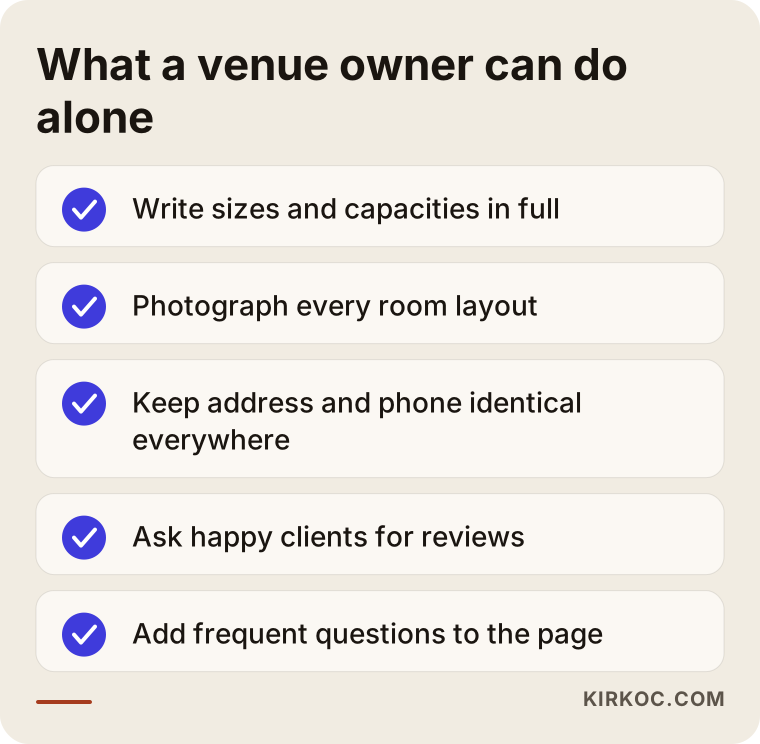
At the top of the list is writing your information completely and keeping it current. Work out the room dimensions, capacity figures and equipment list yourself, because an expert cannot know those for you. Have your photos taken in good light and in different layouts. Seeing the same room in theater and banquet setups is a big help for a planner. Ask your clients for reviews, with their permission. Write down the questions you hear most often. They become both your FAQ section and page content. And while you do all this, write your address and phone number in exactly the same format everywhere.
Common mistakes
The mistakes I see most in this field usually come not from ignorance but from the belief that a site only needs to look good.
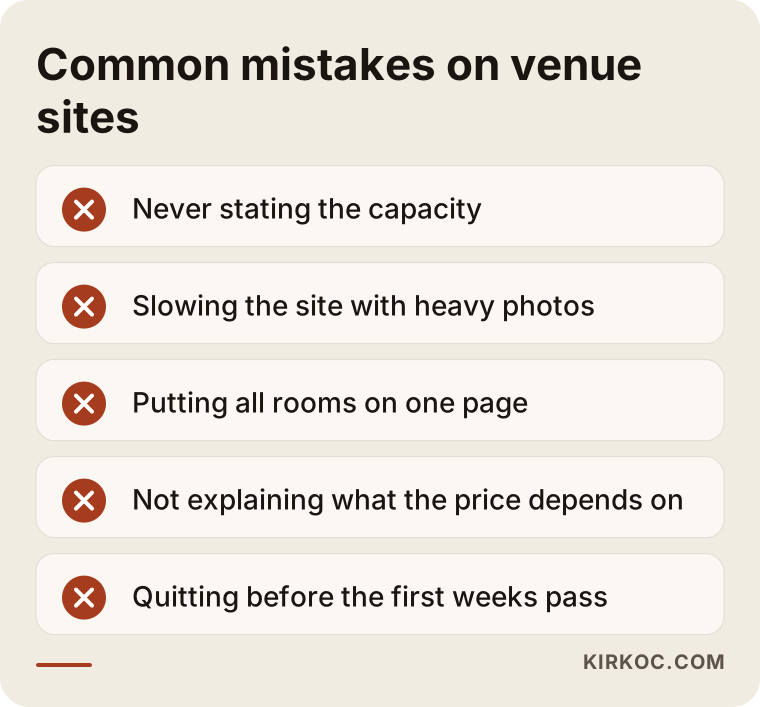
Let me go through a few of them. Not stating the capacity is the most common. When a planner cannot find the answer to "exactly how many people," the planner leaves. Uploading heavy photos is the second big problem. High-resolution, uncompressed images slow the page down, and a visitor on a phone will not wait. Putting all the rooms on one page removes your chance of answering different searches. Giving no hint about price also hurts. You do not have to publish a number, but you can explain what the price depends on: date, day of the week, guest count, catering and length of the booking. And finally, quitting after the first few weeks because nothing seems to move wastes the work you have already done.
When do you need an expert?
Not every business has to get outside help. A few questions make the decision easier.
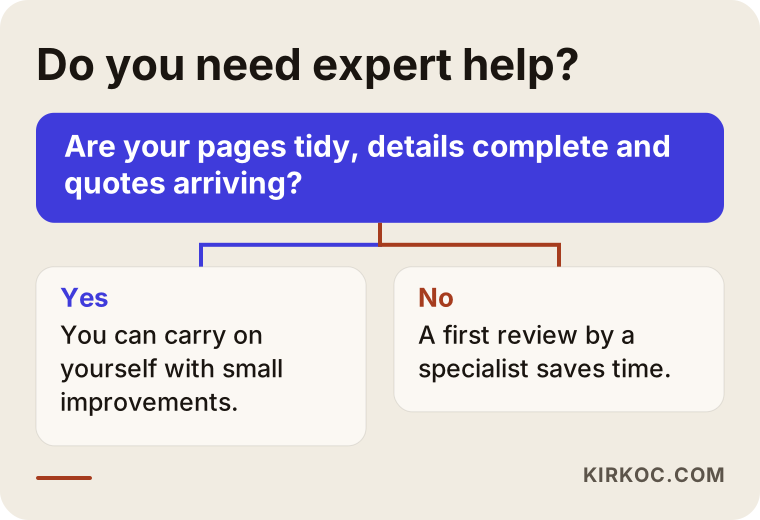
Here is the logic of the chart. If the basics on your site are complete, the pages are tidy and quote requests are coming in, you can carry on yourself with small improvements. But if your site is slow, broken on phones, invisible in searches or you do not even know what is missing, a first review by a specialist saves time. A wrong start means months of effort in the wrong direction.
What decides the cost
I will not give a number, because an accurate number can only be given after seeing your site. But I can explain what it depends on.
The first factor is the current state of the site. A site with many technical problems, or one that must be rebuilt, means more work. The second is the number of rooms and pages; pages for five rooms take more effort than pages for one. The third is competition: working in busy neighborhoods and for popular event types can take longer. The fourth is content needs; photography, writing and foreign-language support are priced separately. The fifth is the length of the engagement; a one-time cleanup and a monthly ongoing service are different budgets. Ask for each of these to be written separately in the quote. An offer presented as one "all-inclusive" line with unclear contents often causes trouble later.
A warning as well: offers that promise "first page of Google" or a specific ranking are not trustworthy. No one can guarantee Google's rankings.
How I work with clients
I am a solo consultant, which means the person you talk to is the person who does the work. First I do a short review and explain in plain language what is missing. Then I give you a written plan and quote; whatever period the plan covers, the work for that period is listed in order. Your website and accounts always stay in your name. Every month I prepare a simple report: which pages became visible, which searches brought visits and what happens next month. I tell you up front what I cannot do. For example, photographing your room is not part of this job, but I can write down what kind of shoot you need and point you in the right direction. If you like, we can also talk about redesigning your site under the same roof.
Frequently asked questions
Do I really need SEO for an event venue, or are ads enough?
They do different jobs. Ads give you visibility for as long as you keep paying, and they start fast. SEO is built more slowly, but once it is in place it can carry quote requests at a low cost. Many businesses use both. Which comes first depends on your budget and your busy season.
I have more than one room. Does each need its own page?
Yes, that is generally the recommendation. A planner searches by capacity, and every room has a different capacity, layout and equipment. A separate page gives each room a chance to show up in its own search. You can start with the rooms that bring in the most business.
Should I put prices on the site?
You do not have to. If you prefer not to publish a number, explain what the price is based on: date, guest count, duration, catering and equipment. This builds trust and cuts down on needless back-and-forth. Sites that never mention pricing often look suspicious.
How long before quote requests start coming in?
I cannot give an exact time. The condition of the site, the competition and the season all affect it. In the first weeks you see the site itself improve, and movement in searches usually becomes clear within a few months. Be careful with anyone who promises results in the first month.
Can social media replace SEO, or the other way around?
No. Social media introduces your brand and builds trust, but a planner who is actively looking usually types the need into Google. Your photos on social media can support your site, but they do not replace it.
Do I need pages in other languages?
If you serve companies from abroad or international conferences, yes. A translation alone is not enough; you need to look at what people actually search for in that language. If your audience is only local, the priority is to make your pages in your main language strong.
Can I make sure my venue appears in AI answers?
No one can guarantee that. But writing your capacity, location and equipment information clearly and correctly raises the chance of being used, both on Google and in AI answers. Wrong or outdated information works against you.
What should I prepare before we start?
Gather your room dimensions and capacity figures, your equipment list, your existing photos and the questions you hear most often lately. Also note which event types bring you income. This information speeds up the first review a great deal.
If you want your event venue or meeting room to be found by the right people, you can reach me through my SEO services page. I will look at your site with you and explain in plain language where to begin.